I wrote reactions to the policy suggestions that will be presented today at the SacRT board meeting: SacRT board 2026-11-09 4.1 customer service. What I did not write about is how the board should approach this.
These rider-facing policies are too important to leave to staff. Though it has never been verbalized, it seems that staff intent is that staff develop and implement the policies without board approval. The implementation of a zero-tolerance policy for all violations, without board knowledge or approval, supports this concern.
SacRT develops extensive documents, with approval by legal counsel, for a huge number of board decisions. Most of these end up on consent agenda, but some are the subject of public hearings. The current topics on strollers, carts, and bicycles are far more important than most of what is addressed by the board.
No policies on strollers, carts, and bicycles should be implemented without approval by the board.
The policies must include:
Clear language about what the policy is.
Clear language about what the potential penalties for violation are.
Clear information about what will be communicated to riders about the policy. This would include signs posted on light rail and buses, verbal announcements at light rail stations and on buses, and public outreach efforts designed to reach all riders.
Clear information about what Transit Ambassadors and other SacRT staff will communicate to riders about the policy, and appropriate responses to perceived or actual violations.
Documentation of actual safety or customer issues that justify the policy.
Documented review by the SacRT Mobility Advisory Council.
Let me be blunt. I do not trust SacRT staff to develop and implement policy on strollers, carts, and bicycles without board approval. Agenda item 4.1 is ‘for information only’, and nothing indicates that board approval will be sought for these suggestions.
Though these policies have been on the SacRT Mobility Advisory Council meeting agendas for several months, it was deferred all but one of those months, and the discussion on the remaining month was very brief. Again, this is on the board agenda when it has not previously been on the MAC agenda in any meaningful way. The next MAC meeting is November 19.
Correction: I misidentified this agenda item as 3.1. It is 4.1.
The Customer Response and Feedback slides continue to use incorrect terminology, including the words ‘modification’ and ‘medication’. The correct disability term is ‘accommodation’. Please see SacRT Board 2026-11-09 for the full agenda.
Strollers – family hostile
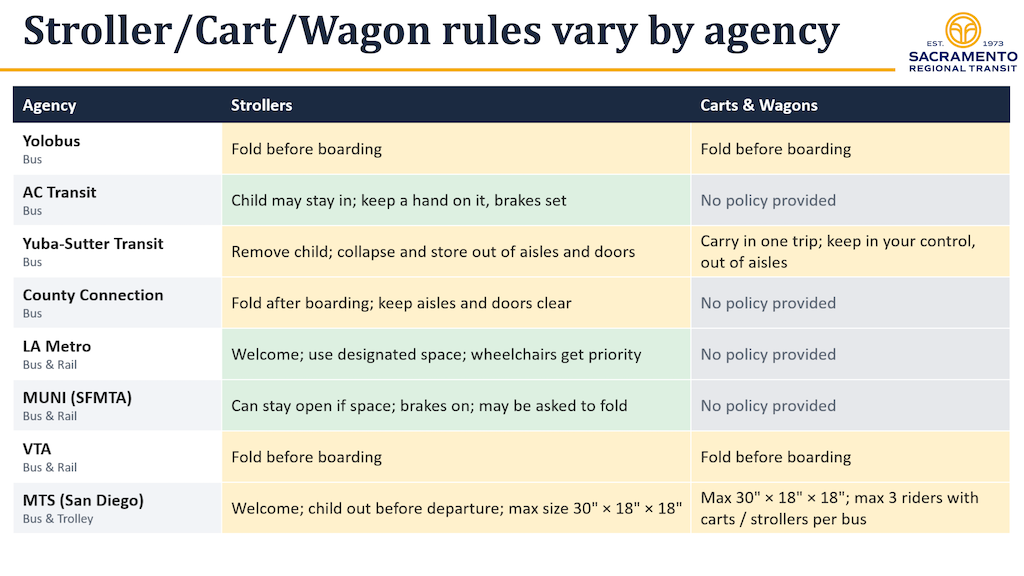
The chart of other transit agency policies on strollers shows three major agencies (SFMTA Muni, LA Metro, and AC Transit) that allow the child to remain in the stroller.
Slide 2 of Customer Response & Feedback presentation
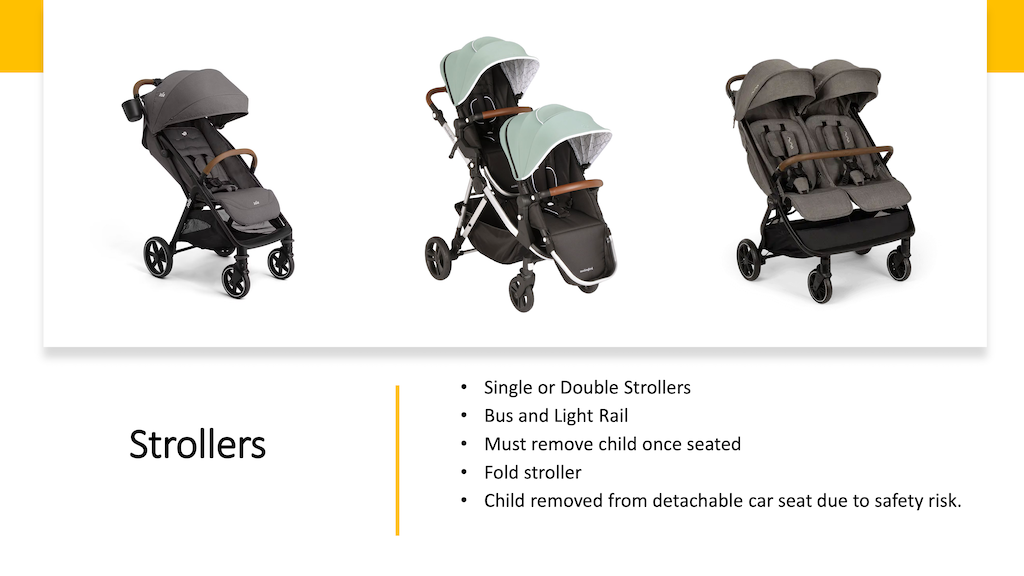
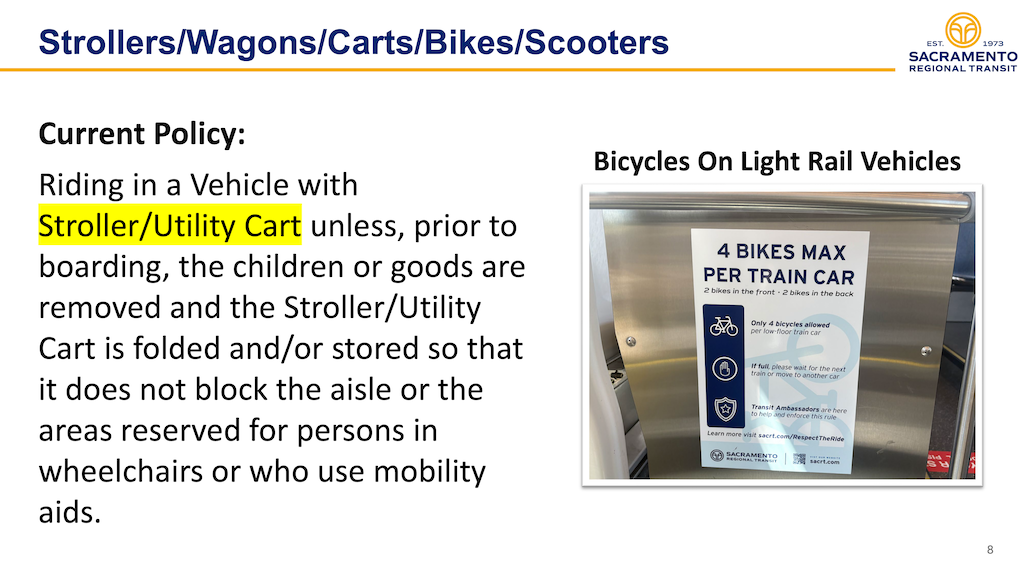
The suggested policy for strollers is an improvement over the apparent existing policy that requires the child be removed and the stroller folded before boarding, allowing be child to be removed and the stroller folded after boarding. However, this is still a family-hostile policy.
Why does SacRT feel that it must be more restrictive than major transit agencies? Does it have any actual safety informations to present? Or is this just a continuation of archaic policies that no one gave any thought of to begin with, and are now being defended?
Slide 3 of Customer Response & Feedback presentation
Added info on LA Metro code of conduct. Buses: Strollers: may be kept in the wheelchair securement area when available. Riders with wheelchairs will be given priority. Rail: Strollers: Look for the decal on the outside of the car denoting the designated space for passengers with strollers.
Added AC Transit stroller policy (for buses, AC Transit does not have rail), since SacRT staff decided to remove the AC Transit element from the slide: When boarding with a stroller, the passenger has the option of leaving the child in the stroller. At the passenger’s request, the driver will operate the lift to allow the passenger with a stroller to board more easily. Drivers are not to assist with baby strollers. While on-board, the child may remain in the stroller provided that the passenger maintains control of the stroller at all times, keeping at least one hand on the stroller while the bus is moving and the stroller doesn’t pose a safety hazard to any passenger. In no case is the stroller to be allowed to remain in a position that blocks aisles, doors, steps or emergency exits. The stroller’s brakes should be set so that the stroller will be secured and prevented from rolling and becoming a safety hazard.
Carts and Wagons
This policy seems reasonable.
Bicycles
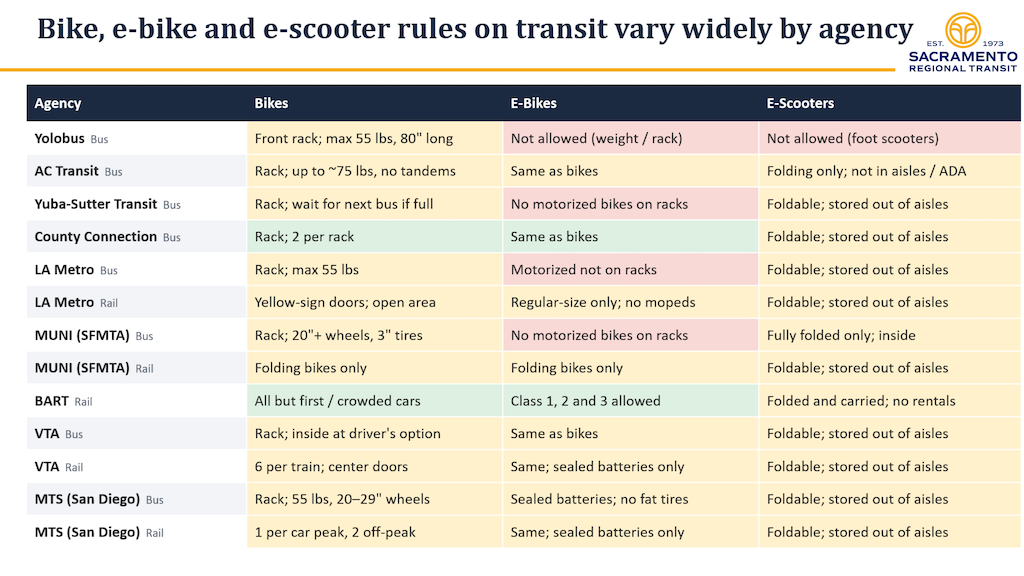
LA Metro, BART, and SFMTA Muni Metro rail cars were designed to accommodate bicycles. SacRT Siemens S700 US (ultra short) rail cars were designed to NOT accommodate bicycles, because San Diego MTS, which SacRT had a joint order, specified rail cars designed to not accommodate bicycles. This is mistake that will last as long at the S700 cars last. SacRT has made no real effort to mitigate this issue.
Slide 7 of Customer Response & Feedback presentation
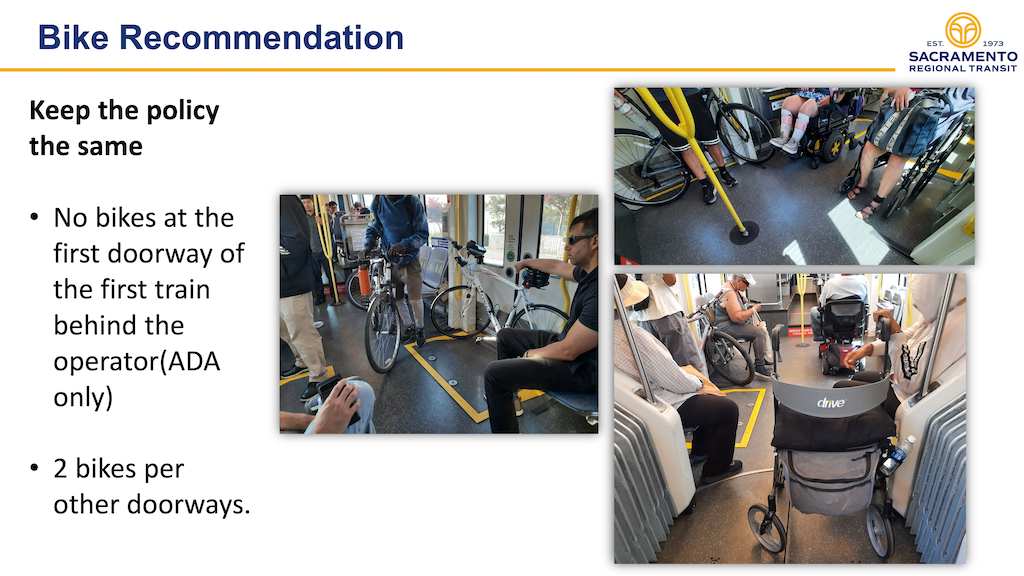
The suggested policy of no bikes at first doorway of first rail car is odd, since the first doorway is not the accessible ramp doorway. The board presentation may explain the rationale.
The ‘2 bikes per other doorways’ suggestion is actually a change from current policy of four bikes per railcar, since there are four sets of doorways on each car, meaning eight bikes. Policies must be clear and understandable by all riders, but this one is not.
The request of transit and bicycle advocates that one seat by each accessible door pair be removed in favor of a bike hook, increasing capacity by two bikes per rail car, has apparently not been considered.
Slide 9 of Customer Response & Feedback presentation
Bicycle Lockers
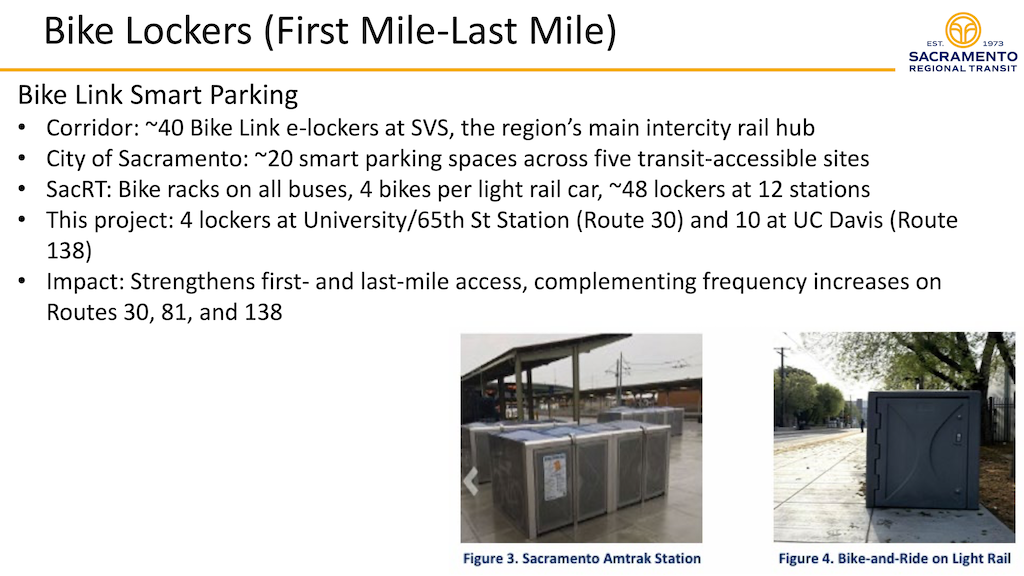
Bike Lockers (slide 11) mentions bike lockers.
Slide 4 of the 2026-09-28 agenda 3.1 presentation mentions ‘bike lockers’ but without any additional information. I have not found any other mention of bike lockers in board agendas. I assume the SacRT count of about 48 lockers at 12 stations is the rental lockers which are very lightly used. It is not clear what ‘This project: 4 lockers at University/65 St Station (Route 30) and 10 at UC Davis (Route 138)’ refers to. I have not found any mention of purchasing and service agreements for bike lockers in board agendas. If there are to be new BikeLink e-lockers at University/65th St and Davis, that is great, but it would be useful to have more information. It isn’t clear why just Route 30 is mentioned, when University/65th St is a transit hub with light rail and multiple buses.
The front bike racks on buses work well. It would be great to have a policy that bikes may be brought on-board if the front bike rack is full, for the last bus of the day only.
Slide 11 of Customer Response & Feedback presentation
Technology
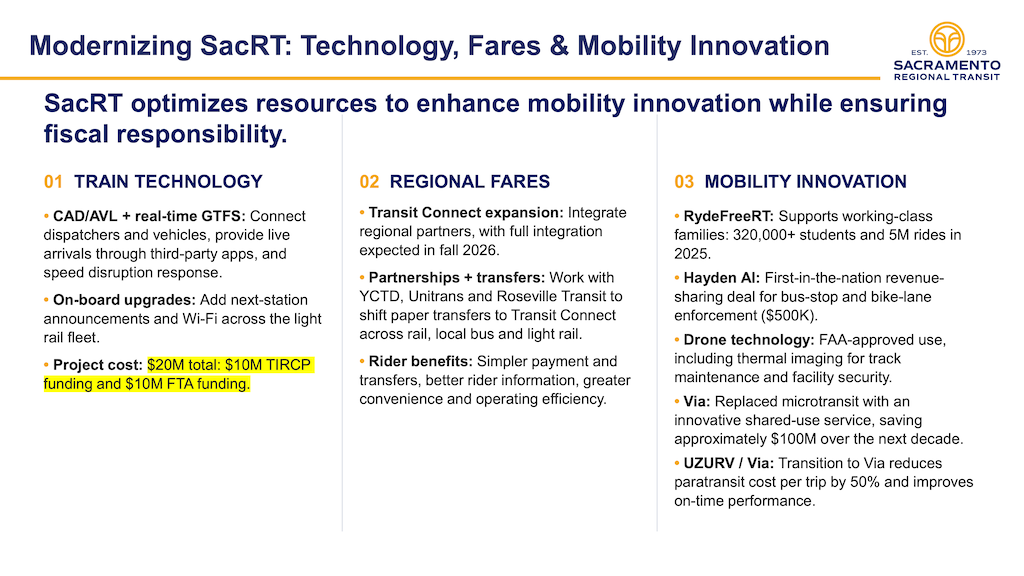
Modernizing SacRT: Technology, Fares & Mobility Innovation (slide 12) mentions several enhancement. Real-time GTFS has been requested for years, and almost every major transit agency has had this capability for years. Yay! Transit app, the most commonly used transit planning app, depends on real-time GTFS. CAD/AVL = Computer-Aided Dispatch/Automatic Vehicle Location. WiFi access on light rail will be great. Acceptance of the Transit Connect app by all regional transit agencies will be great (only SacRT and Yolobus accept at this time). No timeline for any of these enhancement has been provided.
Mobility advocates have expressed concern about the transition from UZURV to Via, but I don’t understand enough to comment.
Slide 12 of Customer Response & Feedback presentation
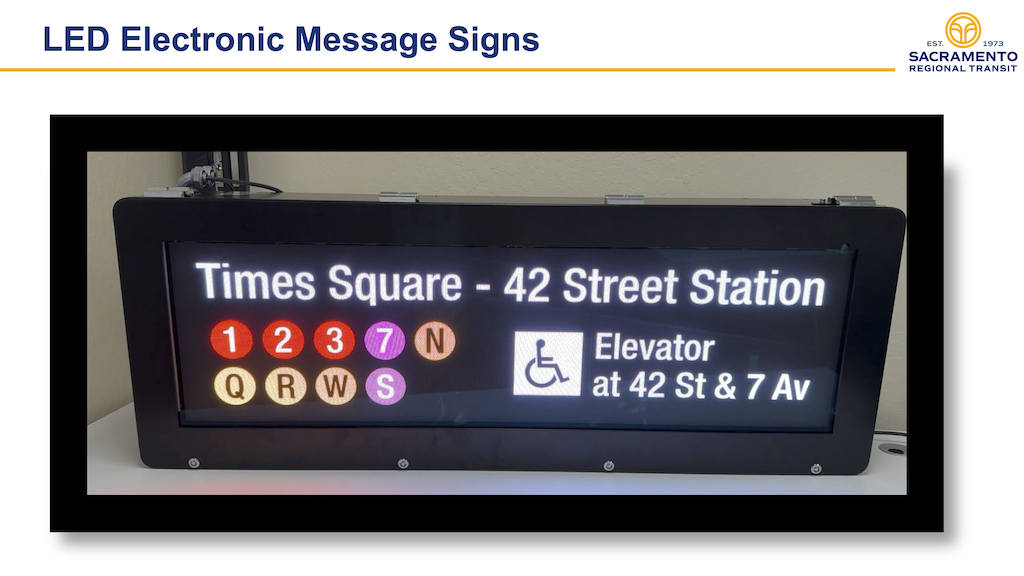
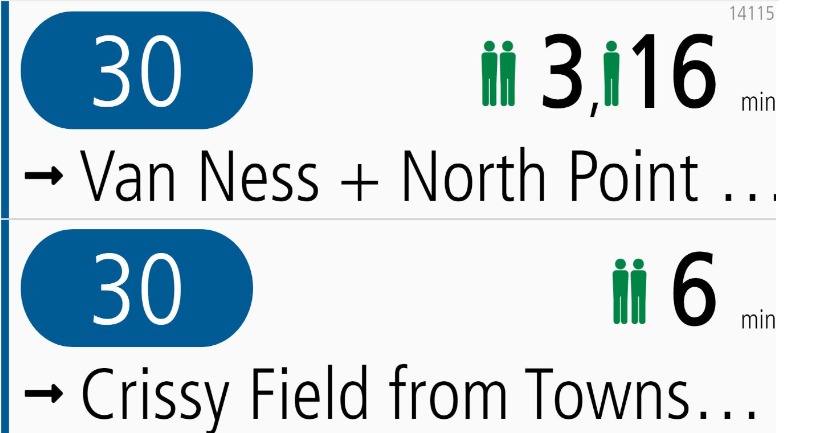
‘LED Electronic Message Signs’ (slide 13) are great. However, the sample shown is only one of many types of information. These signs can also offer next arrival for light rail trains and buses, which is the information most useful to riders. They can show bus connections at light rail stations, for example LA Metro rail cars. They can, less commonly, show maps with current train and bus locations. It is not clear what the vendor, hardware, and software selected by SacRT will offer. A contract has been awarded, for at least some signs, but SacRT has not offered a timeline. The second image below shows a SFMTA Muni real-time bus stop display. These signs also show maps in alternation.
Slide 13 of Customer Response & Feedback presentationSFMTA Muni real-time display at bus stops, with arrival and capacity information
The SacRT Board will meet on Monday, November 9, 2026, starting at 4:00 PM. The simplified agenda is below, with selected documents of interest to me, linked.
SacRT has added a ‘public participation‘ document, which addresses remote participation and comments. Comments in person and via email remain the same, as explained in the document.
I may have comments on agenda items between now and the board meeting.
2.3 Resolution 2026-11-126: Approving the Renewal of All SacRT Health and Welfare Benefits for 2027
2.4 Resolution 2026-11-127: Approval to Enter Into a Purchase and Sale Agreement with Sutter Valley Medical Foundation for Surplus Property Located in Sacramento, CA and Delegation of Authority to the General Manager/CEO to Execute One or More Grant Deeds and Lease Agreement
2.5 Resolution 2026-11-128: Approval of Building and Parking Lease Agreement (2810 O Street) with Christopher Wordlow (APN 007-0274-005)
2.6 Resolution 2026-11-129: Approving Contract for Insurance Broker Services to Alliant Insurance Services, Inc.
2.7 Resolution 2026-11-130: Conditionally Delegating Authority to the General Manager/CEO to Award a Contract for Provide and Commission Frequency Converters with Backup Battery
2.8 Resolution 2026-11-131: Approving A Good-Faith Funding Letter and Authorizing Submission of Exemption Requests from the Innovative Clean Transit Zero-Emission Bus Purchase Requirements
2.9 Approving Contract Change Orders No. 14 and No. 15 to the Contract for Low Floor Vehicle Platform Conversion Phase 2 Project with PNP Construction, Inc.
a) Resolution 2026-11-132: Approving Contract Change Order No. 14 to the Contract for Construction of the Low Floor Vehicle Platform Conversion Phase 2 Project with PNP Construction, Inc.; and
b) Resolution 2026-11-133: Approving Contract Change Order No. 15 to the Contract for Construction of the Low Floor Vehicle Platform Conversion Phase 2 Project with PNP Construction, Inc.
2.10 Resolution 2026-11-136: Delegating Authority to the General Manager/CEO to Award a Contract or Contracts for On-Call Revenue and Non-Revenue Vehicle Towing Services
INTRODUCTION OF SPECIAL GUESTS
3.1 Resolution 2026-11-134: Recognizing RiderShip for the Masses as a Transit Advocacy Champion for its Dedication and Advocacy on Behalf of Public Transportation Riders
UNFINISHED BUSINESS
4.1 Customer Service Response to Feedback and Comments: staff | presentation
PUBLIC ADDRESSES BOARD ON MATTERS NOT ON THE AGENDA*
Consent Calendar: There was extensive discussion of item 2.6: ‘Resolution 2026-10-123: Rescinding Resolution No. 12-04-0050 and Revising SacRT’s Voting Procedures for Property and Business Improvement District Assessments’. Though the issue was a change in voting, board members discussed relationship with PBIDs (Property Business Improvement District) and the assessments on SacRT properties. The item was continued to another board meeting.
Item 3.1: Linda Hinz presented on ‘customer service response’. Her presentation was all about law enforcement and and a defense of a zero tolerance policy on fare evasion. She touted her law enforcement experience and defended the decisions that had been made to increase law enforcement action and personnel (without board discussion or approval). She said there were 2000 citations a month for fare evasion, but did not mention how many involved law enforcement. She said the target for transit ambassador employees was 51, though her slide said there were currently 60. She said a training program for Transit Ambassadors would be established. Apparently the only training is from existing ambassadors on the job. She said that a single incident of a fare evader not being cited could result in loss of all federal funding. This is her questionable reading of SB 5492 (Hagerty), which has been introduced but not passed. SacRT is piloting the use of drones, which is a further militarization of law enforcement.
SacRT has hired one ‘Social Services Practitioner’ to work with unhoused people in the right-of-way. This compares to 161 personnel dedicated to law enforcement. The priorities of Ms. Hinz are clear.
Ms. Hinz’s over-dramatization of everything in a whiny voice is typical. Listen for yourself to the recording.
My comments were:
Policy on zero-tolerance on fare evasion, strollers, shopping carts, and bicycles has still not been brought back to the board. It was on the MAC agenda for four meetings, but there was only brief mention during one of the four, and was not addressed in the other three.
The ‘customer relations’ approach presented by Ms. Hinz is a law enforcement priority approach, with no consideration of riders.
Ms. Hinz mentioned a red line that could not be crossed several times. Apparently this line is not being able to produce proof of fare within five seconds of being asked. This is a very sad policy for an agency which is supposed to be providing transit service to member of the public.
Helen O’Connell spoke about the difficulty that some disable people are having using the ticket vending machines (TVMs) and presenting proof of fare due to difficulties with manual dexterity, and that some of these riders have been ticketed for not being able to produce fare quickly enough.
There was also a presentation on the incident in Folsom when crossing gates were down for an extended period of time. Apparently a lack of prompt communication between SacRT staff and Folsom Police exacerbated the issue. SacRT promised to do better next time.
Item 4: Public Addresses Board on Matters Not on the Agenda
My comments were:
Police vehicles parked illegally for a long period of time in the commercial loading and passenger loading zones in front of the SacRT building at 1102 Q Street caused a UPS delivery truck to have to park in the bus stop (all nearby spaces were occupied), thereby causing a SacRT bus to stop in the street instead of at the curb, thereby causing two riders to have to step off the curb to reach the bus. One of the riders seemed to have disability and had a hard time stepping off the curb. This is unacceptable.
When one of the light rail lines is delayed, the information displays at overlapping stations are changed to indicate that delay, and the schedule for the line that is not delayed is not displayed until the delay is resolved. As a result, riders don’t have any information about the line not delayed. This is ridiculous.
The new Dos Rios station is wonderful, by far the best station on the system.
Advocates were excited that GTFS-RT (realtime) would be implemented on the Gold Line with the new S700 rail cars, since SacRT now had GPS information about railcar locations. For unknown reasons, SacRT chose to now implement GTFS-RT for light rail. It is implemented for buses.
Other commenters:
Evan Siroky: talked about the lack of GTFS-RT (realtime) information, which apps use to present train location and arrival information; he has professional expertise in GTFS
Mattie Parfit: people without phones or printers can’t use free fare; the readers should be turned off for the day and covered up
Margie Donovan: no AC on some buses; passenger names have been used on radio, in violation of rider privacy
Item 6.1 General Managers Report
Henry Li tried to address the real time question by saying that the digital messaging signs at stations would eventually be updated to provide real time information. It is not clear when new signs and a display system with this capability will be implemented. See the 2026-09-28 report, scroll down to 7.1 General Managers Report, for more information on the signs. He said this was intentionally delayed under Light Rail Modernization was completed so that there would not be new signs in old trains. At that time, he said a contract had been awarded to Clever Systems in April, but there is not known timeline.
Though the signs (and announcements?) within the new light rail cars and the station could use the same system to display information, it is not necessary to delay one for the other. Henry then launched into a discussion of vandalism at the light rail stations, apparently blaming the lack of real time information on vandalism. When questioned by a board member about how vandalism was related to the signs, Henry could not answer. The Connected Transit Card readers have been routinely vandalized, but this has nothing to do with information signs, or with GTFS-RT.
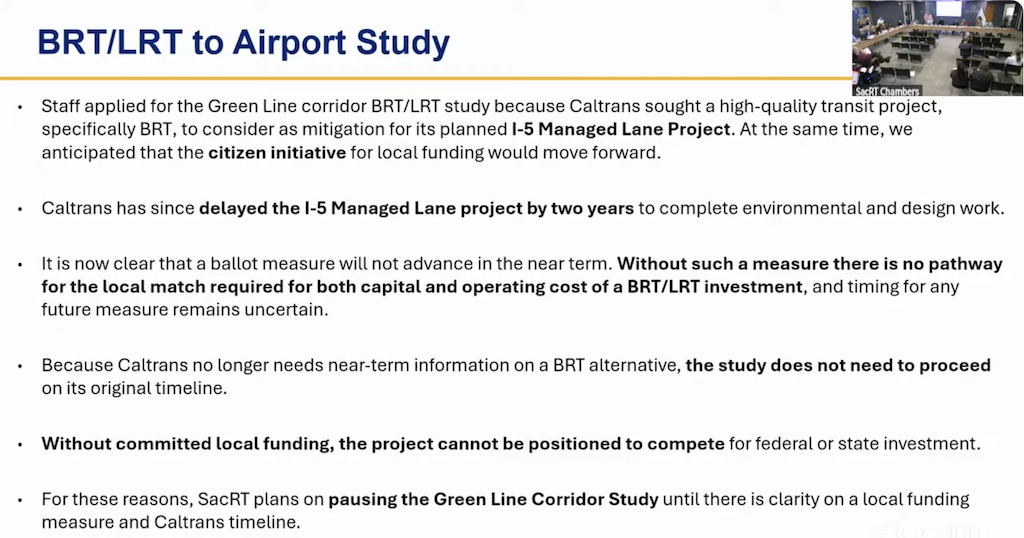
Henry announced that there would be no Green Line BRT/LRT study, due to Caltrans delay and lack of funding. His slide, not in the provided presentation, is below. Henry implied that the grant amount, $700K, might be repurposed.
The SacRT Board will meet on Monday, October 26, 2026, starting at 4:00 PM. The simplified agenda is below, with selected documents of interest to me, linked.
A policy response on zero-tolerance, strollers, carts, and bicycles is not part of this agenda, so far as I can determine.
SacRT has added a ‘public participation‘ document, which addresses remote participation and comments. Comments in person and via email remain the same, as explained in the agenda.
I may have comments on agenda items between now and the board meeting.
2.1 Motion: Approval of the Action Summary of September 28, 2026
2.2 Receive and File: Quarterly Treasurer’s Report
2.3 Conditionally Awarding Contracts for Pre-Employment and DOT/DMV Certification Medical Examinations and Evaluation of Job Description Physical Requirements
a) Resolution 2026-10-119: Conditionally Awarding a Contract for Pre-Employment and DOT/DMV Certification Medical Examinations, and Evaluation of Job Description Physical Requirements to Agile Occupational Medicine PC; and
b) Resolution 2026-10-120: Conditionally Awarding a Contract for Pre-Employment and DOT/DMV Certification Medical Examinations, and Evaluation of Job Description Physical Requirements to Dignity Health Medical Foundation, A California Nonprofit Public Benefit Corporation, dba Mercy Medical Group
2.4 Resolution 2026-10-121: Approving Sole Source Procurements for Supply Purchases and Maintenance and Repair Services for Equipment, Components, and Parts for Light Rail Maintenance and Wayside Contractors and Delegating Authority to the General Manager/CEO to Execute Contracts
2.5 Resolution 2026-10-122: Approve the First Amendment to Fiscal Year 2025-2026 Transportation Development Act Claim
2.6 Resolution 2026-10-123: Rescinding Resolution No. 12-04-0050 and Revising SacRT’s Voting Procedures for Property and Business Improvement District Assessments
2.7 Resolution 2026-10-124: Authorizing the Execution of the Cycle A and Cycle B Low Carbon Transit Operations Program Project(s) and Certifications and Assurances, and Submittal of Project Nominations and Allocation Requests to Caltrans for Fiscal Year 2025-26 Low Carbon Transit Operations Program
Whenever the topic of Green Line light rail to the airport comes up, SacRT board members and staff claim that this is the highest priority of the public. This is false. The last board meeting spent a lot of time on the Green Line, the reserved right-of-way, light rail, and BRT ideas. There is a funded BRT study: Green Line to the Airport: A Vision for the Future. Several board members said that they supported the BRT study, but that the ultimate solution was and remains light rail. Despite one of the parts of the 2026-09-28 board presentation being on the BRT study, the three maps in the presentation were all of the ultimate light rail alignment, not of the BRT project.
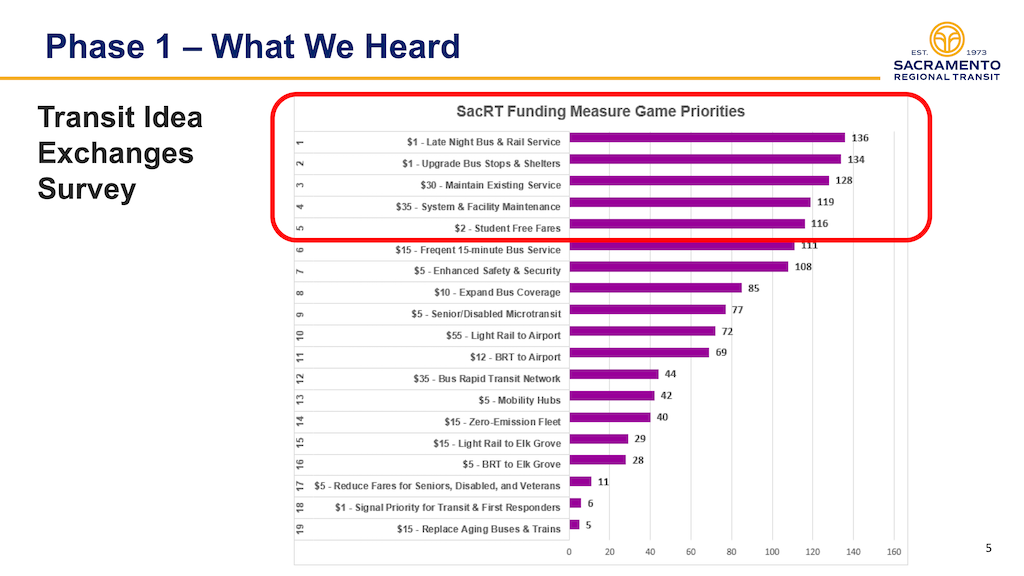
SacRT ran a public outreach process to gather input from the public on what they wanted from SacRT, as part of the Comprehensive Operational Analysis, to determine both short range and long range priorities. The Transit Idea Exchange: What We Heard & What Comes Next page provide information on the process and the outcome. The page lists five public priorities: Improving bus and light rail service frequency and reliability, Increase service hours on bus and light rail, Making stations and stops more welcoming and accessible, Enhancing safety, lighting, and cleanliness, and Keeping fares affordable for seniors, persons with disabilities, veterans and students. Light rail extensions, whether to the airport or Elk Grove, were not in the top five. The page does not contain details on process and results, but there are scattered documents that are relevant.
A presentation to the board on 2025-10-27 (https://startransit.wordpress.com/wp-content/uploads/2025/11/sacrt_2025-10-27_agenda-5-1-funding-presentation.pdf) has a chart from the Transit Ideas Exchange Funding Game (page 5). Green Line light rail to the Airport ranked 10, and light rail to Elk Grove ranked 15. A separate survey by FM3 (starting page 8) conducted to gauge support for a transit sales tax measure, again indicated that the public thought light rail extension less important than maintenance.
I was only able to attend one of the workshops, in Elk Grove (STAR: Transit Ideas Exchange in Elk Grove). Despite being located in Elk Grove, and given the City of Elk Grove’s desire to see light rail extended well into Elk Grove, and SacRT board member and Elk Grove city council member Rod Brewer’s support, the public was not interested. The public wanted better bus service.
So, given these facts, why does the board and staff continue to claim Green Line light rail to the airport is the public’s top priority? Because it is the shiny thing. ‘World class cities’ have light rail to the airport, and Sacramento city and county and region want nothing more than to be considered a world class city. The politicians on the SacRT board (all are elected officials, appointed from the cities and county) also want projects for which they can do ribbon cutting. Better bus service does not involve ribbon cutting.
World class cities also have great transit systems. We do not, far from it. Things like light rail, or subway, to the airport, which indeed many cities do have, are built on a base of high-frequency, affordable, effective bus transit. Without that, light rail to the airport is an isolated and very expensive shiny thing that is not useful because the basics have not been met.
STAR advocated, in How to build successful transit and many other posts, for an incremental approach to building transit service. Yes, light rail is on the list, but it is not the starting point. SacRT is running hourly service to the airport, Route 142 Airport. Ridership is low, in part because the service schedule does not meet the needs of workers at the airport, and in part because hourly service cannot be effective. Yolobus also runs hourly service to the airport, which is more successful because it also serves Davis and Woodland, but it is very slow. SacRT and Yolobus schedules are not coordinated. The next step for the airport is high frequency bus service with a long span of service. Not BRT, not light rail.
To use an expression, service to the airport is ‘sucking all the oxygen out of the room‘, meaning that a focus on the airport is taking up time and energy that could be devoted to improving bus service and starting to address the coming funding crisis that will require SacRT to reduce service.
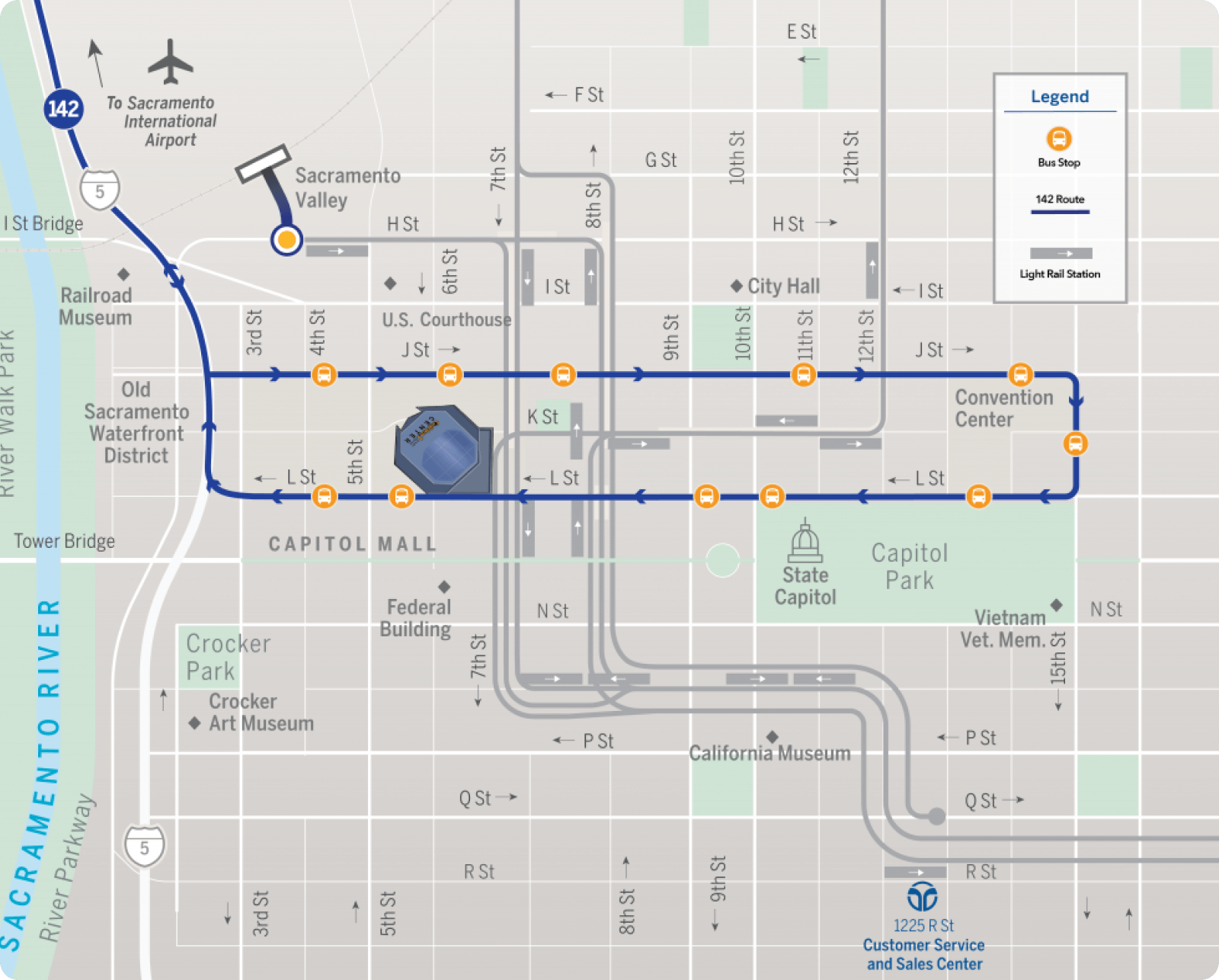
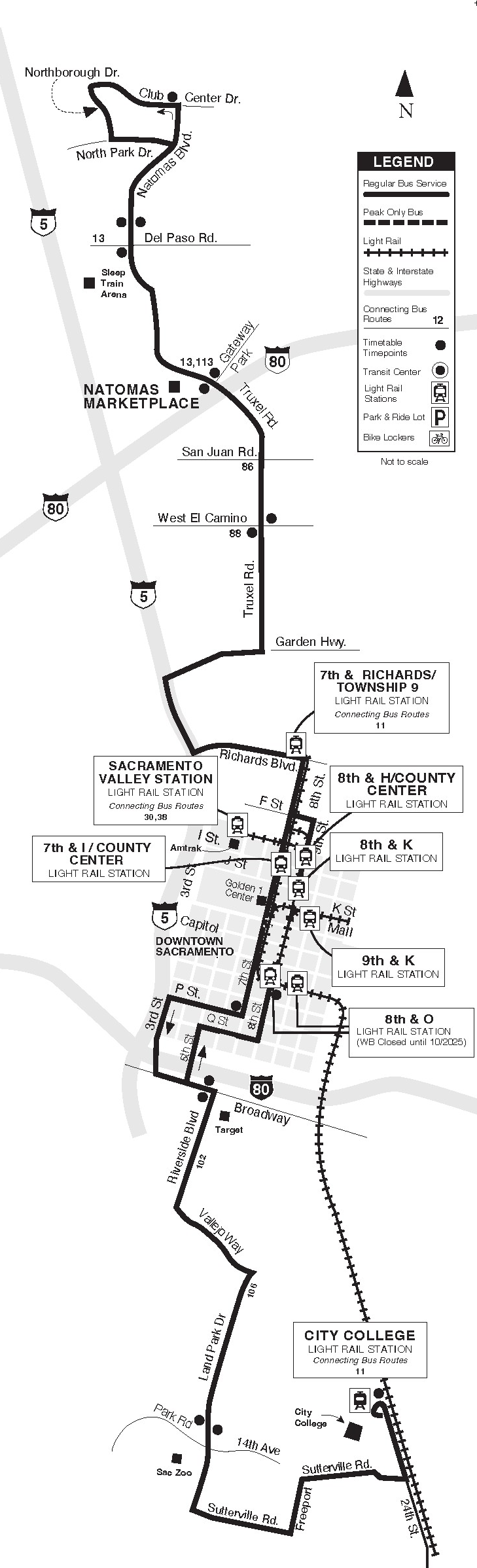
Three maps below show routes that are relevant to the effort to serve North Natomas and the airport. The first two maps show Route 142 Airport Express bus, with a frequency of 60 minutes. This route uses Interstate 5 for much of the distance. The third map shows Route 11 Natomas/Land Park bus, with a frequency of 30 to 45 minutes (one of the two lowest frequency regular bus routes). This route jogs briefly to Interstate 5 to connect Truxel Road and 7th Street.
A rather disappointing board meeting (SacRT Board 2026-09-28). Again, staff is underprepared to answer board member questions, and many board members are asleep at the wheel, not asking any questions, or in some cases, not really paying attention.
I spoke on three issues, and my comments are below, in italic. These were written ahead of time, so my actual testimony may have dropped some points or added others. If you want to hear what I said, or other transit advocates said, or board members said, or staff said, you can listen to/watch the YouTube post of the meeting at https://www.youtube.com/watch?v=-0gEKiVZ_3Q&list=PLAfWRxJkwPon701gc9cUsUqqBDlmiWJnt&index=4.
Yet again, the staff report and presentation have not been made available to the public along with the rest of the agenda. With one exception since July 2025, these documents have always been late, even showing up in several cases during the board meeting. I can no longer see this as an oversight, or unintentional. I believe this is an effort on the part of staff to hide this information for as long as possible so that the public and advocates cannot review the documents and develop a response. This is unacceptable.
This item was presented by Lisa Hinz (VP of safety, security, and customer satisfaction).
Board asked about delay of 3.1 documents, Tabitha Smith (board secretary) said it was a website uploading error. Henry Li (general manager) promised it would not happen again. It is a fact that the customer service documents are almost always finished well after other board documents, often after the agenda has been posted. So this is not just a document posting issue, it is a failure to complete important documents in a timely manner.
No policy was shared on fare enforcement, strollers, shopping carts or bicycles. Existing policy was restated, slide below.
slide from ‘Customer Service Response to Feedback and Comments’ presentation on stroller policy
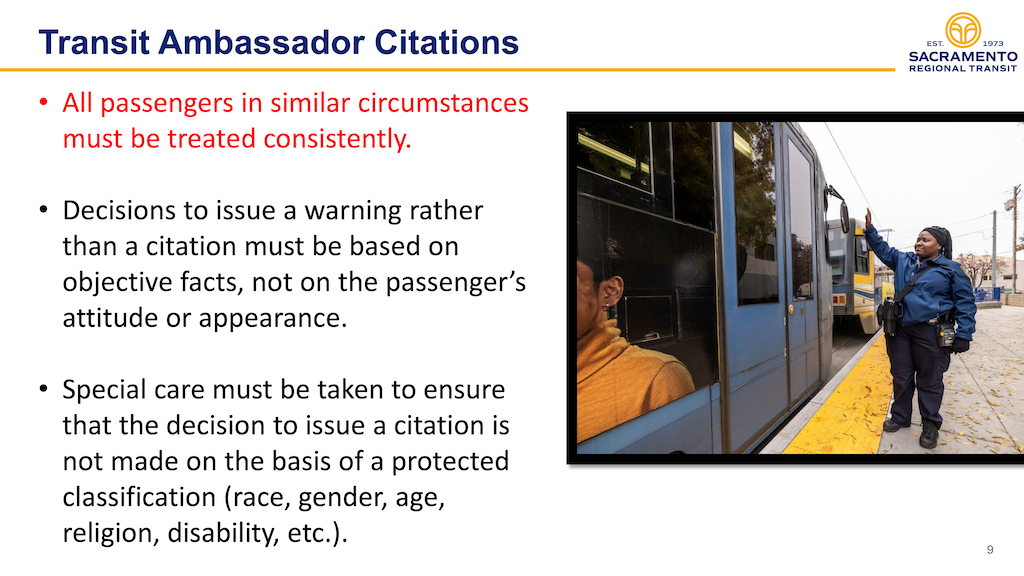
Lisa Hinz gave a vociferous defense of the idea of zero-tolerance, slide below. She said that anything less than zero-tolerance would lead to unequal treatment of passengers, followed by lawsuits against SacRT. It is clear to me that Lisa does not consider riders to be people, then are just names on citations. Her level of empathy for people is zero. Lisa’s attitude is a typical law enforcement one which believes that people are just an inconvenience to the real mission of law enforcement. Guilty until proven innocent. This face that SacRT presents to the public is horrible, and it has resulted in a significant loss of reputation for SacRT, as well, as apparently, a loss of riders.
slide from ‘Customer Service Response to Feedback and Comments’ presentation on zero tolerance
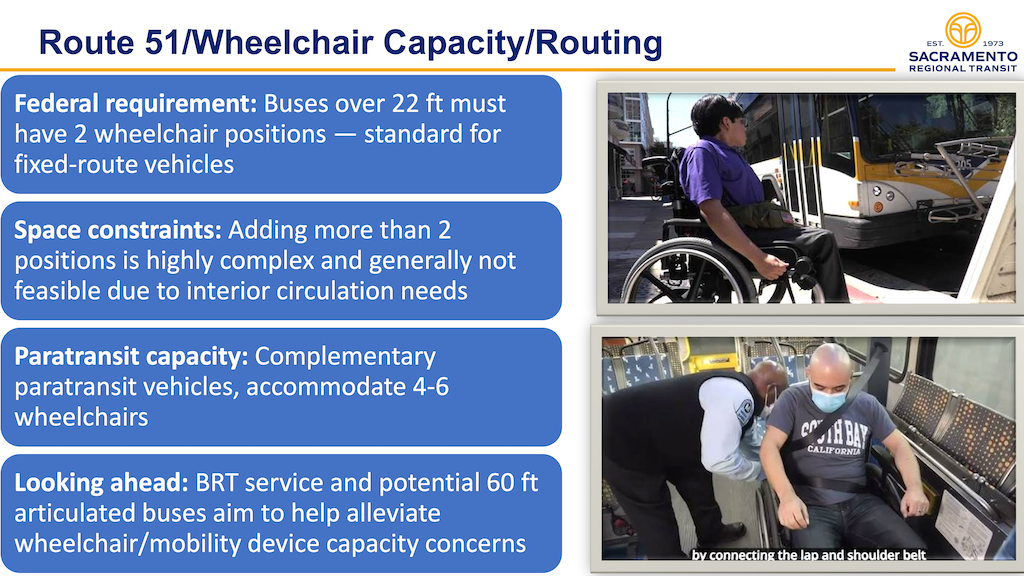
One of the slides indicated that accommodating more than two wheelchairs was impossible for the Stockton BRT, slide below. I added to my comments that AC Transit’s new buses have three to five wheelchair positions. SacRT has chosen to purchase buses that meet the FTA minimums, and not to provide additional capacity. Another advocate reminded that buses not infrequently have to leave wheelchair users behind when the two spaces are already full.
slide from ‘Customer Service Response to Feedback and Comments’ presentation
It appears that policy will go to MAC first, and then back to the board. ‘Proposed Policy for Cart and Wagon use on SacRT vehicles (Priscilla Vargas, ADA Compliance Officer)’ was on the August MAC agenda, but was tabled. It was also on the September agenda, but minutes not available yet, and I have not had time to review the YouTube recording, so I don’t know if it was addressed. (Update: There was some discussion at the September MAC. The policy is that wagons will be banned. Shopping carts will have a size limit, and apparently riders will have to make a ‘reasonable modification’ (The correct term is ‘reasonable accommodation’, but Priscilla Vargas apparently does not know the correct term.) request to the accessibility department (?). Other riders without that permission will have to remove contents and fold their carts. Lisa Hinz contradicted this interpretation. Who’s on first? It was admitted that the public has not been provided information on these policies. Ack! Strollers and bicycles were not addressed.)
This presentation is immensely complicated. It was reviewed by a number of transit advocates, including some who work in transit, and most could not make sense of it. There is too much detail and not enough clarity. The presentation violates the basic writing technique of ‘tell them what you are going to tell them, then tell them, then tell them what you told them’. It may be that some people are interested in all this detail most people want to know ‘what’s the upshot’. That is nowhere to be found.
Though it is hard to parse the information, it appears that the $1.2 billion estimate does not include the $500 American River bridge. So the project is really $1.7 billion. To assume that the city will, under its current and ongoing budget crises, and difficulty winning grants for major projects, be able to come up with a half million is questionable.
I noted several board member nodding their heads on my comment, that they thought the presentation was needlessly complicated.
Serna commented that there must not be sunk costs for conversion to light rail. He asked about a flyover for CA 99 that could be used for both buses and light rail. Hume also commented on sunk costs, and suggested considering alternative modes including autonomous vehicles. He said surface routes may not be good even if dedicated lanes, though I’m unsure what this has to do with the project. Dickinson said the traditional rail is best and questioned why the route (similar to Route 11) goes back to Natomas rather than staying on I-5. Said if people want local service, give them local service; if they want the airport, give them the airport.
It keeps getting claimed by board members and staff that Green Line to the Airport light rail is the top project for the public, but that is not what the ‘Transit Idea Exchange’ listening sessions indicated. The public was uninterested in these very expensive moon-shot projects, and primarily wanted better bus service.
4. Matters not on the agenda
The public relations debacle that resulted from SacRT’s sudden implementation of a zero-tolerance policy on fare collection, strollers, shopping carts, and bicycles, was without any discussion or decision by the board. This indicates to me that ‘customer satisfaction’ must be moved out of the organizational structure of ‘Security, Safety, and Customer Satisfaction’. The law enforcement orientation of this division cannot provide the necessary attitude and attention to the mission-critical function of customer satisfaction.
The placement of the Transit Ambassador program within this division may also be problematic. SacRT has never clearly defined the function of the TAs. If their primary function is law enforcement, leave the program here. If their primary function is customer service, then move them elsewhere in the organization structure. If SacRT does not know what their primary function is, which appears likely, then the program needs to be revisited and revised.
There were several other advocates who spoke on items not on the agenda. Crystal Lee McGee, head of ATU 256 (Amalgamated Transit Union Local 256), introduced Ms. Johnson, who spoke about being harassed by her supervisor as a new mother, and not provided a private lactation area. The SacRT Go supervisor’s name was mentioned but I did not catch it. It is rare for ATU to go to the board with personnel issues, so it is clearly one of critical importance. This may be another instance of SacRT’s anti-family orientation, along with the anti-family stroller policy.
The General Managers Report presentation often includes slides that were not in the posted document. These slides are not made available after the fact.
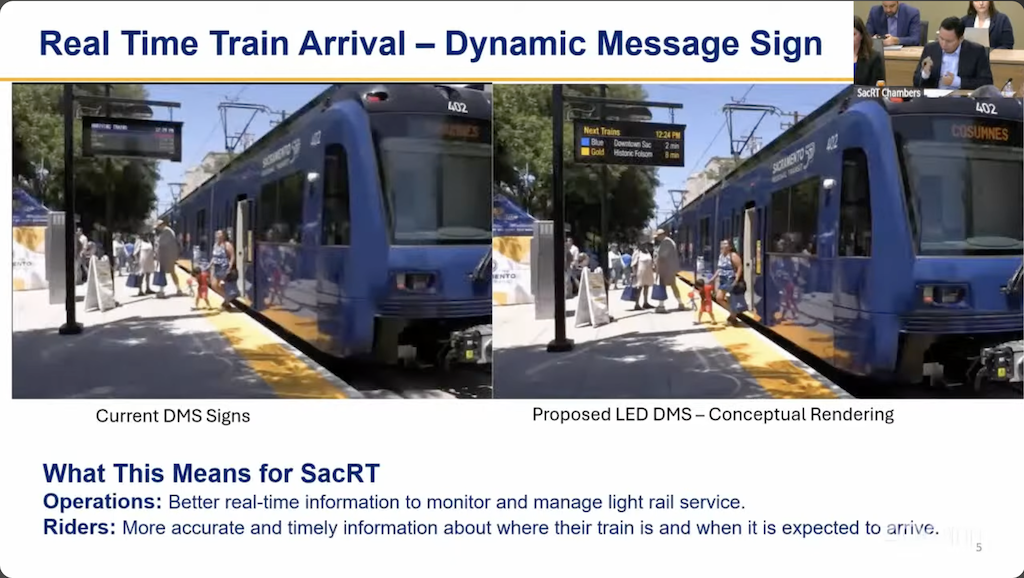
One such slide on was on modern information signs for light rail. Henry said that implementation of new signs is was intentionally delayed so that it could be integrated with the Light Rail Modernization program. This was the first the public had heard about this. Several of the existing signs are non-functional, and have been for some while. Other signs have display issues, making them hard or impossible to read. Even when the signs work, they rarely have useful information for riders. A common message is that light rail trains are running 15 minutes late, which is nonsensical since the frequency during weekday days is 15 minutes. Riders have no way of knowing whether the arriving train is on time or delayed, they just want the train to come. Part of the reason that SacRT can’t provide accurate information about light rail delays is that they did not implement high quality GPS and real-time GTFS for the new light rail cars, so they don’t know where those trains are without asking the operators for location. I did not capture that slide, unfortunately. (Update: I reviewed the YouTube video [1:44:30], and captured the slide below. The new system will be from Clever Devices/Hitachi. Their website shows internal displays but not these external station displays.)
capture from YouTube of 6.1 General Managers Report on real-time signing
In the September MAC meeting, it was announced that 45 new Siemens S700 cars have been or will shortly be on hand, but the next set of cars, 46 to 65, will not start arriving until February of 2029. New cars will gradually replace legacy cars on the Blue Line as they become available. That may mean that the new light rail information signs might not be installed until many years from now. Yow!
The GM report mentioned the following on the Transit Connect program physical cards: “This next phase also includes important updates for Connect Card pass holders. While Connect Card users should continue using their cards for now, the transition to Transit Connect will begin later in 2026. Much like the ZipPass retirement earlier this summer, Connect Card customers will receive a window of time to use any stored value on their cards before switching to the new system. Riders will have the option of moving to the Transit Connect app or obtaining a new Transit Connect smart card if they prefer a physical alternative.” I will re-state that the physical or Smart Card was not part of SacRT initial planning for Transit Connect and Tap2Ride integration. It was added after members of the transit advocacy community including state workers questioned what would replace the Connect Transit Card. It has still not been defined for the public how the physical cards will relate to the app, nor how services will be provided to unbanked people. Critical details of Transit Connect have not been shared with the public. Nothing SacRT does happens on time, so it is likely that Phase 2 will occur sometime next year, not this fall.
To be honest, I have a hard time following the GM report. It is at the end of the meeting, when everyone is tired. Henry spends a lot of time announcing events, which are already on the website and in the Next Stop News, and talking about light rail disruptions, which if reported at all, should be in a separate agenda item.
Update: Staff said that the 3.1 presentation was not available on the board documents page, due to a website upload issue. It still is not there. It was, at some unknown point, available in the agenda combined file, so I extracted it and linked it in the agenda post. Henry Li said that this will not happen again, and that the document will normally be provided at the time of the agenda release along with all other documents. However, this has not happened in the past, and I have doubts about it in the future. There will be more to be said about this agenda item, along with a report on the meeting.
Three hours before the September 28, 2026 board meeting, agenda item 3.1 ‘Customer Service Response to Feedback and Comments’ staff report still has no content, and no presentation has been made available. This is not accidental. Over the period of time since this agenda item was added to the board agenda (July 2025), only once has the staff report and presentation been made available at the same time as the rest of the board agenda. Several times the item has been added during the board meeting.
I have come to believe that this is intentional on the part of SacRT staff, to hide the staff report and the presentation from the public until the last minute, so that the public and advocates do not have the chance to review the documents and formulate a response. Even though the presentations usually gloss over issues, and present ‘solutions’ that are often fabrications, these are still an embarrassment to SacRT. Of all the issues that come before the board, this is the most critical, or perhaps equal with the budget. SacRT exists to meet the needs of riders and the public. When the public, and advocates, are unhappy with the service, SacRT is failing. And it is failing with disturbing frequency. A problem cannot be solved until it is admitted and identified. SacRT does not seem interested.
This issue is related to the location of customer service within the staffing structure of SacRT, and it must be moved elsewhere, out of security and safety (law enforcement): SacRT: move Customer Satisfaction
The SacRT Board will meet on Monday, September 28, 2026, starting at 4:00 PM. The simplified agenda is below, with selected documents of interest to me, linked.
As usual, the staff report for item 3.1, ‘Customer Service Response to Feedback and Comments’ contains no information nor presentation. This delay in making information available to the public is intentional, to make it more difficult for the public to review and comment on this item. Three hours before the board meeting, 1:00 PM on Monday, September 28, item 3.1 ‘Customer Service Response to Feedback and Comments’ is unchanged, still no real staff report or presentation.The presentation was available in the combined agenda at the time of the meeting, but was not and still is not available in the agenda item.It has been extracted and linked below.
It is unknown at this time whether a policy response on zero-tolerance, strollers, carts, and bicycles will be presented, but if so, it will not be for board decision. There are many policies not for board decision, but given the immense controversy that resulted from the staff-implemented zero-tolerance policy, this is an appropriate policy for the board to address and decide upon.
SacRT has added a ‘public participation‘ document, which addresses remote participation and comments. Comments in person and via email remain the same, as explained in the agenda.
I may have comments on agenda items between now and the board meeting.
2.1 Motion: Approval of the Action Summary of August 24, 2026
2.2 Resolution 2026-09-112: Approving the Settlement Agreement and First Amendment to Contract for ADA Paratransit Scheduling, Dispatch and Eligibility Software as a Service with HBSS Connect Corp.
2.3 Resolution 2026-09-113: Conditionally Approving the Contract for On-Call Alternator Rebuild Services (Niehoff) with Kirk’s Automotive Incorporated
2.4 Resolution 2026-09-114: Approving the First Amendment to the Contract for Real-Time Train Information System (Computer-Aided Dispatch/Automatic Vehicle Location) and Dynamic Message Signs with Hitachi Rail CD U.S. LTD. Formerly Known as Clever Devices LTD
2.5 Resolution 2026-09-115: Second Amendment to the FY 2026 Operating Budget
2.6 Resolution 2026-09-116: Formally Consenting to and Supporting the Establishment of the Sacramento Area Council of Governments and the Sacramento Regional Transit District as Dual Designated Recipients for Applicable Federal Transit Administration Formula Funding Apportioned to the Sacramento Urbanized Area
2.7 Resolution 2026-09-117: Approving the Five-Year Agreement for Peace Officer Assignment with the County of Sacramento Sheriff Department
The SacRT Board will meet on Monday, August 24, starting at 4:00 PM. The simplified agenda is below, with selected documents of interest to me, linked. There is no ‘Customer Service Response to Feedback and Comments’ item on the agenda, which means that the ongoing controversy over SacRT’s zero tolerance policy for fare evasion, strollers, shopping carts, and bicycles will not be addressed. This issue is not mentioned in the General Managers Report.
SacRT has added a ‘public participation‘ document, which addresses remote participation and comments. Comments in person and via email remain the same, as explained in the agenda.
I may have comments on agenda items between now and the board meeting.
2.1 Motion: Approval of the Action Summary of July 27, 2026
2.2 Resolution 2026-08-100: Amending Title II (Conflict of Interest and Code of Ethics) of Sacramento Regional Transit District’s Administrative Code to Revise Appendix A
2.3 Approving the Fourth Amendment to the License Agreements for Underground Conduit and Fiber with MCImetro Access Transmission Services LLC at Three Locations
A) Resolution 2026-08-101: Approving the Fourth Amendment to the License Agreement for Underground Conduit and Fiber with MCImetro Access Transmission Services LLC at 39 th Street and R Street; and
B) Resolution 2026-08-102: Approving the Fourth Amendment to the License Agreement for Underground Conduit and Fiber with MCImetro Access Transmission Services LLC at 59 th Street North of S Street; and
C) Resolution 2026-08-103: Approving the Fourth Amendment to the License Agreement for Underground Conduit and Fiber with MCImetro Access Transmission Services LLC at 65 th Street and Q Street
2.4 Resolution 2026-08-104: Approving a Contract for Facilities Pest Control Services with California Professional Pest Control, a California Corporation doing Business as California Pest Control
2.5 Resolution 2026-08-105: Designating the General Manager/CEO as the Accountable Executive for Sacramento Regional Transit District’s Transit Asset Management Plan
2.6 Resolution 2026-08-106: Authorizing Applications for Grant Funding From the Sacramento Area Council of Governments (SACOG) 2026 Federal Funding Programs; Authorizing the General Manager/CEO to submit SACOG 2026 Federal Funding Program Application Priorities; and Authorizing the General Manager/CEO to Execute all Grant Documents and Timely Project Delivery Requirements
2.7 Resolution 2026-08-107: Approving the Transfer of Title of 3701 Dudley Boulevard, McClellan, CA from MP-655 LLC to Sacramento Regional Transit District
2.8 Resolution 2026-08-108: Awarding a Contract for Purchase of Transit Buses to Gillig LLC Under the Basin Transit Contract No. 23-01 and Delegating Authority to the General Manager/CEO to Execute Amendments to the Contract
2.9 Resolution 2026-08-109: Conditionally Delegating Authority to the General Manager/CEO to Approve Contracts for Verizon Connect Fleet Equipment and Subscription Service
INTRODUCTION -OF SPECIAL GUESTS
3.1 Employee and Retiree Recognitions – First and Second Quarters 2026
UNFINISHED BUSINESS
4.1 Resolution 2026-08-110: Adopting the Sacramento Regional Transit District Strategic Plan 2026-2030 (staff report | plan | presentation)
PUBLIC ADDRESSES BOARD ON MATTERS NOT ON THE AGENDA*
NEW BUSINESS
6.1 Bus Rapid Transit Efforts – Adoption of the Locally Preferred Alternative for Stockton Boulevard & Retention Strategy for Green Line Irrevocable Offers of Dedication (staff report | Stockton presentation)
a) Resolution 2026-08-111: Adopting the Locally Preferred Alternative for the Stockton Boulevard Safety and Transit Enhancement Project; and
b) Information: Green Line Irrevocable Offers of Dedication