I attended the SacRT board meeting yesterday. My report highlights things I am interested in, or grabbed my attention, and is not intended to be comprehensive. You can view the meeting video online at https://www.youtube.com/live/rtB9B2fXBck?si=p3M2Gf5JWfHK8AJg. An action summary will be available in the agenda of the next board meeting, scheduled for August 24.
One step forward, one step back. SacRT is again offering the public to make comments via Zoom, either in the Zoom app or by phone managed by Zoom. Good. Comments on the consent agenda (agenda items starting with 2) are now limited to two minutes total, rather than two minutes per item. It isn’t clear what will happen if a board member pulls an item from consent, for discussion. That did not happen in this meeting. Will that item be an exception to the two minutes total? And how would a member of the public know ahead of time that an item will be pulled, and submit a comment card?
Rosario Rodriguez was an alternate for Patrick Kennedy, as a County of Sacramento representative. She made a point in comments that she regularly uses light rail to commute. This resulted in applause from the audience, because it is unusual. Kennedy and Maple as sometimes users of transit, but not as often as Rodriguez. Yah!
Though it was not pulled from consent for separate discussion, there were several board questions and comments related to item 2.11 authorizing the Green Line BRT study. Serna was concerned by the lack of information about right-of-way easements along Truxel that will expire at some point. Dickinson, Budge, and Maple were concerned that a focus on BRT would handicap consideration of light rail in the future. As I have said many times, I don’t think light rail to the airport will ever be financially feasible. Every time there is an estimate of the cost, it goes up, is currently $2 billion, and would be billions more by that time it might come to planning and construction. There simply is no justification for such an expensive infrastructure project for such a low ridership and network benefit. I’m not opposed to the BRT planning effort, though I also believe that SacRT (and/or Yolobus) must demonstrate that there is a demand for better service by first implementing 30 minute bus service to the airport, which does not exist because SacRT did not align its schedule with the Yolobus 42A/42B schedule.
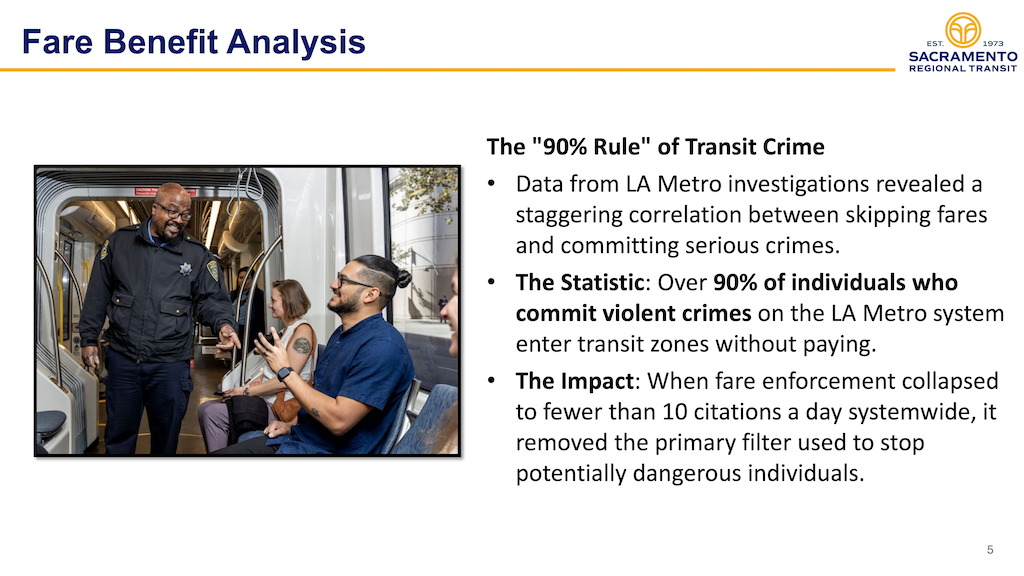
For agenda item 3.1 Customer Service Response to Feedback and Comments, Lisa Hinz gave the usual glossing-over-problems presentation. The two items of most interest to me and many transit advocates are the zero tolerance policy, particularly for fare evasion, and the policy requiring strollers and carts be emptied and folded.
Hinz presented a slide, below, the implication of which is that if there were not a zero tolerance fare evasion policy, light rail would be a completely lawless zone, unsafe for everyone. BS. The previous practice of asking people who did not have proof of payment to exit the train at the next station seemed to me to be working just fine. Zero tolerance was extended not just to people who intended to not pay, but to everyone, no matter issues with the Connect Transit Card readers, or Transit Connect app, or any other method of payment. This zero tolerance policy is a typical law enforcement response to any problem to maximize enforcement no matter what the effect on riders. This is unacceptable. Hinz said that warnings are now being given rather than tickets, but I’ve seen reports that say otherwise. No explanation was given for how this zero tolerance policy came to be, nor what would replace it if it is not continued. Let me state clearly that I am not against fare checking, but what needs to be appropriate and rational is the response to evasion. Hinz used convoluted logic to imply that every fare evader is a criminal who is almost guaranteed to commit crimes on light rail. BS.
I am a moderately frequent user of Metro (LA) subway and light rail. There is a strong presence of both law enforcement and transit ambassadors, particularly on subway, and that system has more series issues than Sacramento. What I have not observed is incidents being escalated by staff, and I have observed particularly ambassadors and to some degree law enforcement being friendly and helpful when there is not an incident. This is not what is happening on SacRT light rail.
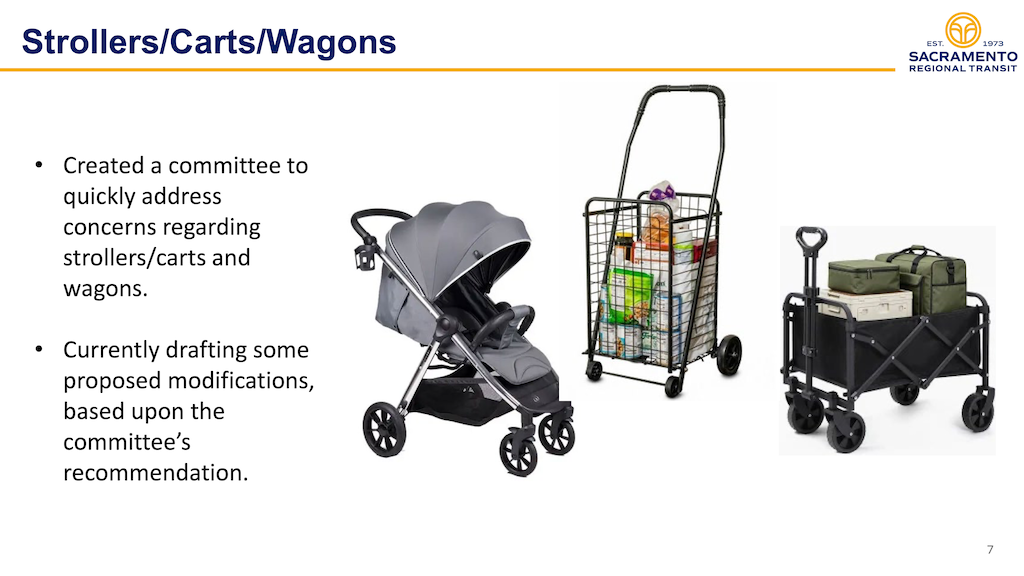
Hinz also addressed, vaguely, concerns about the stroller and cart policy. Again, this policy was being handled as zero tolerance, but I don’t know how it is being handled at the moment. Hinz said that a committee had been formed. I asked whether this committee included a representation of the Mobility Advisory Council (MAC), or a parent with kids in strollers, or a user of shopping carts, or a bicyclist, or for that matter, anyone who rides light rail. I strongly suspect not. I’m almost certain that it is an internal committee, composed of SacRT staff who don’t regularly use transit, if at all. Most SacRT employees, particularly administration, do not use transit.
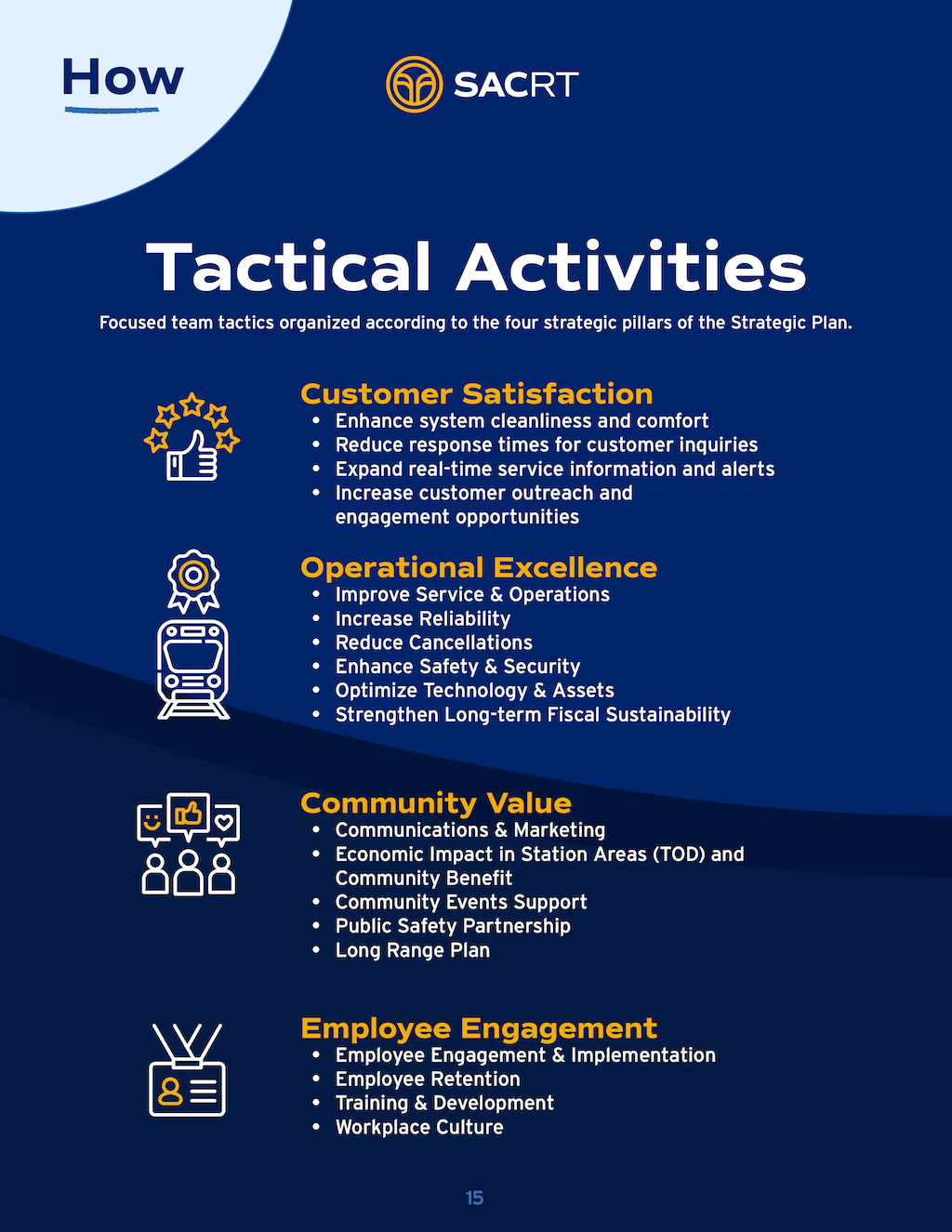
The main agenda item was 5.1 Draft Sacramento Regional Transit District Strategic Plan 2026-2030 (staff report | draft plan). This draft plan is just the executive summary, the draft plan itself is not available at this time. I had skimmed the plan before the meeting, and was left wondering what the point of the plan is. It really says almost nothing about what SacRT will do to accomplish the four pillars (Customer Satisfaction, Operational Excellence, Community Value, Employee Engagement). The Tactical Activities slide (below) perhaps comes closest. But there are no performance standards for any of these in the document. Most of the things on the list could mean anything SacRT wants them to mean. What do they mean to riders? I’m not at all sure.
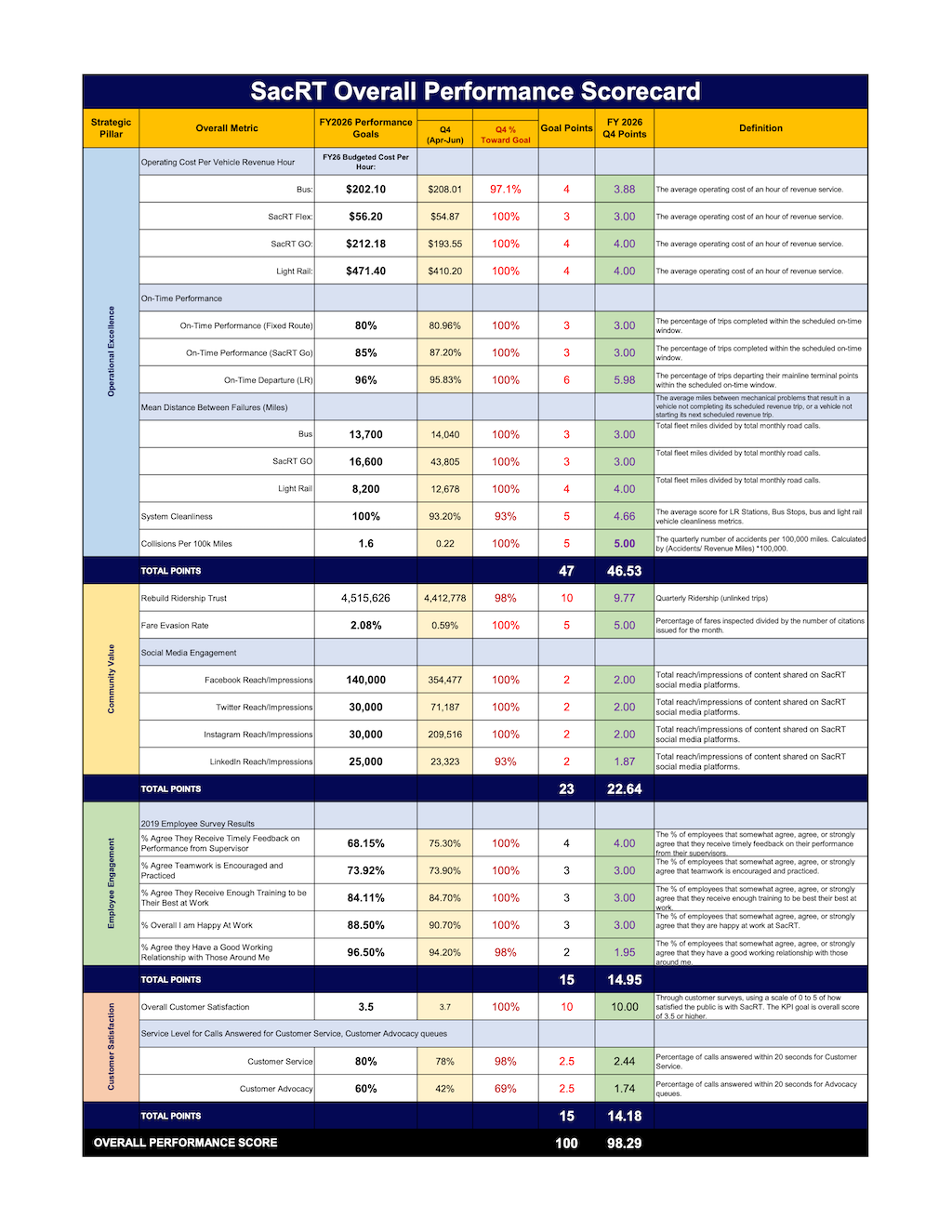
The verbal presentation used the acronym KPIs many times, without defining it. It stands for Key Performance Indicator. Reporting on implementation of the plan apparently will depend on the Quarterly Performance Reports, the most recent of which is below. This is a bean-counter approach. SacRT has been using this type of report for several years now, and every time it comes up in a board meeting, the public criticizes it for missing the point. It also always shows SacRT coming close to goals, though every rider knows that SacRT is far from reaching goals. Just more glossing over problems.
Dickinson asks where equity was in the strategic plan. The initial staff response was ‘everywhere’ but Dickinson did not accept that, and stated that it must be explicit in the document. The word equity occurs only once in the plan, on page 4. It is conspicuously absent from any of the lists. Dickinson also asked where the issue of first mile/last mile access to transit was, and why frequency of service was nowhere to be found. All good questions. Thank you!


SacBee: Rapid airport route: Sacramento RT to study faster path to SMF through Natomas, Madison Smalstig, 2026-07-28; https://www.sacbee.com/news/local/article316650249.html
LikeLike