San Francisco is a transit-first city, though it falls short of that goal. Other major cities are so clearly transit-first that they don’t even remark on it. The Sacramento region will never be a transit-first place. Density is too low, almost everywhere, except the Sacramento central city. Opposition to transit, both ideological and anti-tax, is common in the region. But we could designate transit-first roads.
SacRT’s High Capacity Bus Service Study (2021) outlines several possible BRT (bus rapid transit) routes in the county, shown on the map below. It missed critical corridors, however. It missed BRT to the airport, because at that time SacRT was still selling the idea that light rail to the airport would occur in the not too distant future. It missed Greenback Road connecting Sunrise Transit Center and Historic Folsom light rail (yes, this travels through low density areas, but would provide a connection between high use areas that do not currently have any connection whatsoever). It also missed Cosumnes River College light rail to Elk Grove, as the planning effort for BRT or light rail came to prominence after 2021. It also includes some routes of doubtful utility because they extend beyond high riderships areas into areas of low density development, Sunrise south in particular.
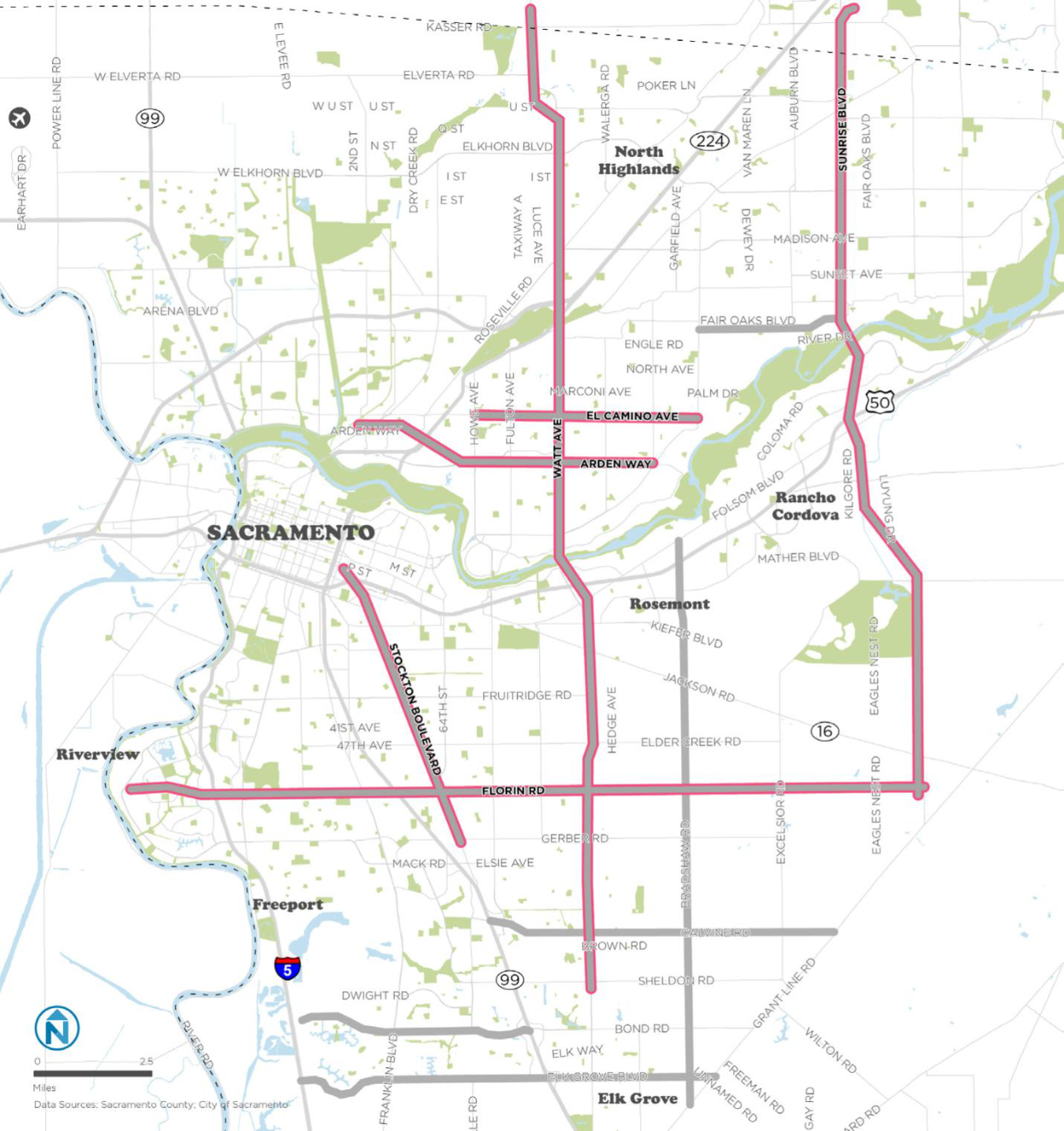
These corridors are not designated by the cities, or Sacramento County, or Sacramento Transportation Authority. But a designation of these as transit-first roads would have several benefits for planning and funding.
- A recognition that planning and projects should first consider the transit function of that road, before any consideration of motor vehicle throughput.
- A recognition that there are many possible levels of transit support, not limited to or even requiring BRT. These might include signal priority, better bus stop spacing, better bus stops, bus stops in traffic rather than requiring pull-outs that cause delay and safety issues, signal queue jumps, bus only lanes full time or at congested times.
- A recognition that existing arterials do not well meet the transportation needs of people because they were designed for and prioritize private motor vehicles, and are the primary location of traffic violence.
- A recognition that the value of a particular transit-first road varies over time with other changes to the roadway, surrounding land use, and connections to other transit service. What has happened to date is that a focus on a particular corridor is usually a political decision (ribbon cutting) and not based on current use patterns and planning for a complete transit network. Planning then completely neglects consideration of other corridors.
If we designate a corridor as a transit-first road, then it allows incremental progress towards the eventual goal of BRT, or even light rail. We don’t need to wait until political will or funding to go for the huge project, rather, we can improve transit utility with every change to the road, and with much smaller amounts of funding.

