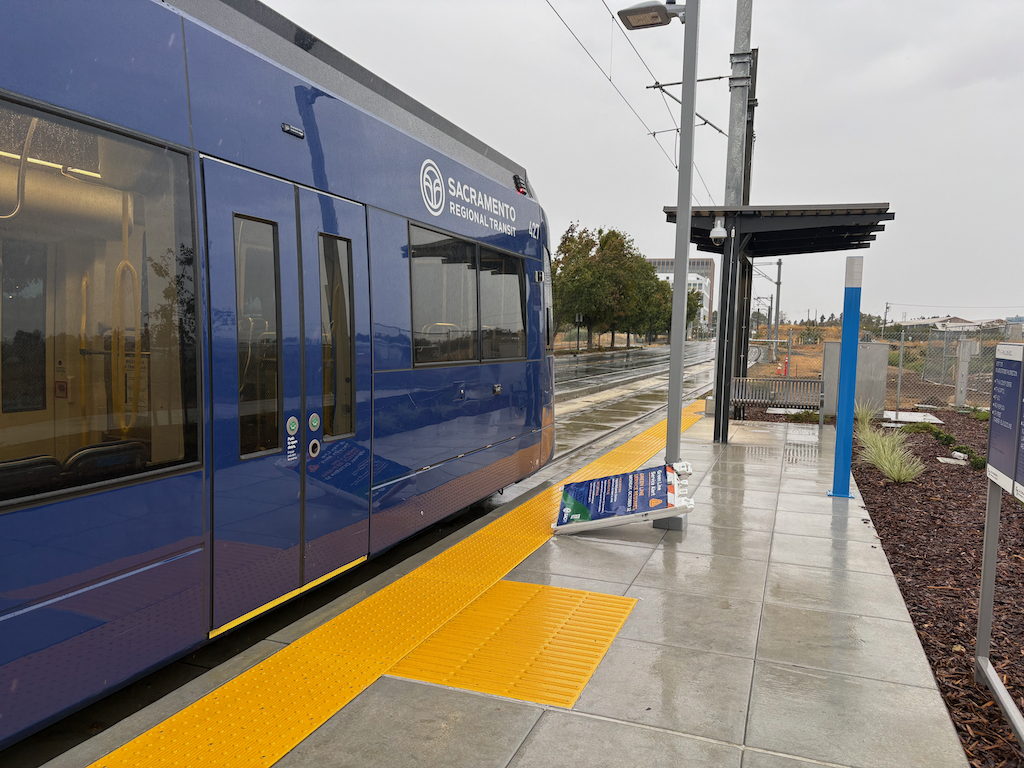
I visited the new SacRT light rail station at 7th & Railyards yesterday. The station has been open several days. Green Line service started October 12, and the station opened October 15.
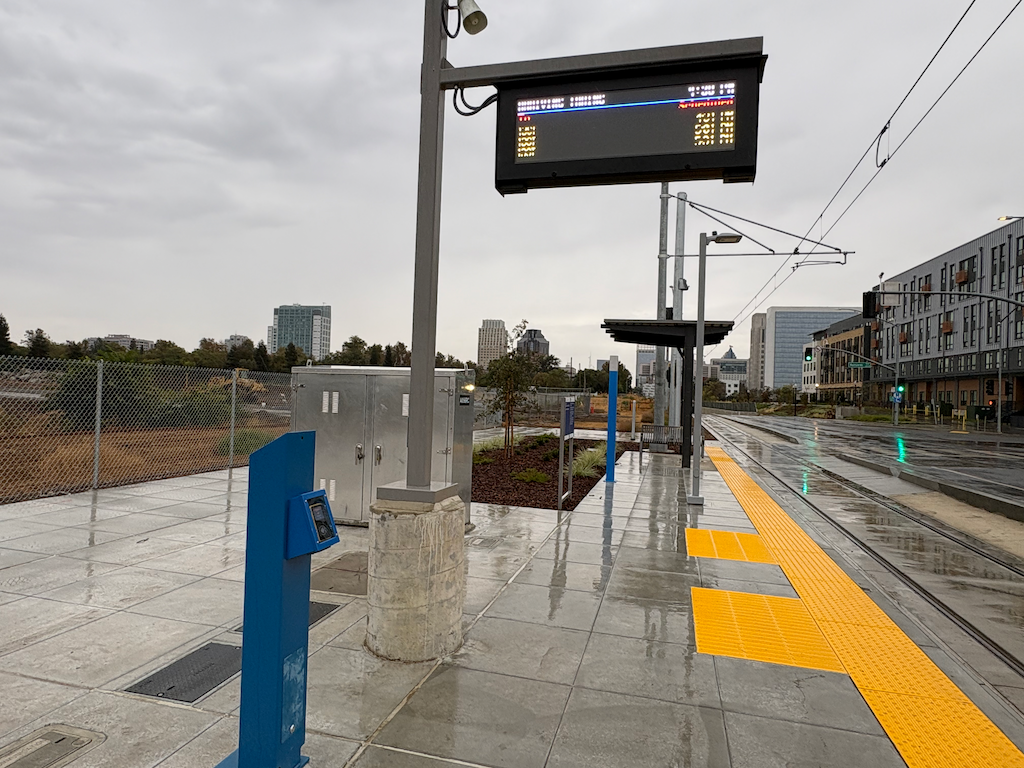
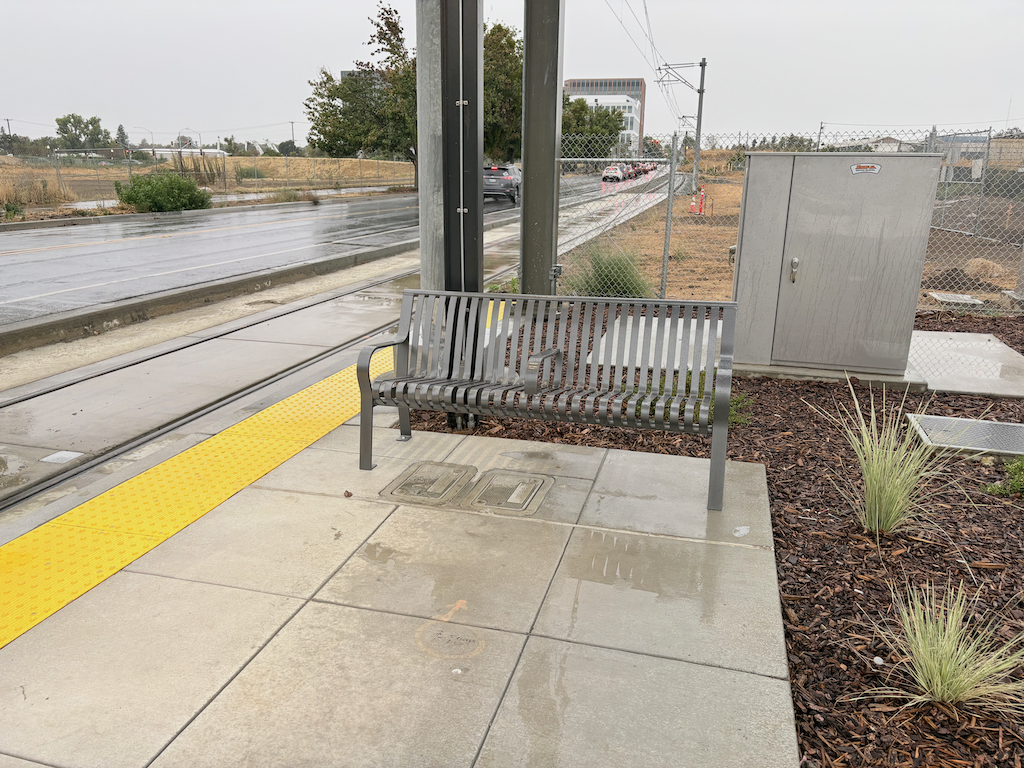
The station is very bare bones, especially compared to the new Dos Rios Station. There are two benches, at either far end of the platform. There are shelters, but they are small, don’t fully shelter the benches. I was not there at night, so I don’t know how well lit the station is. There are two trash cans, and both had been vandalized already. There is some planting, not much.
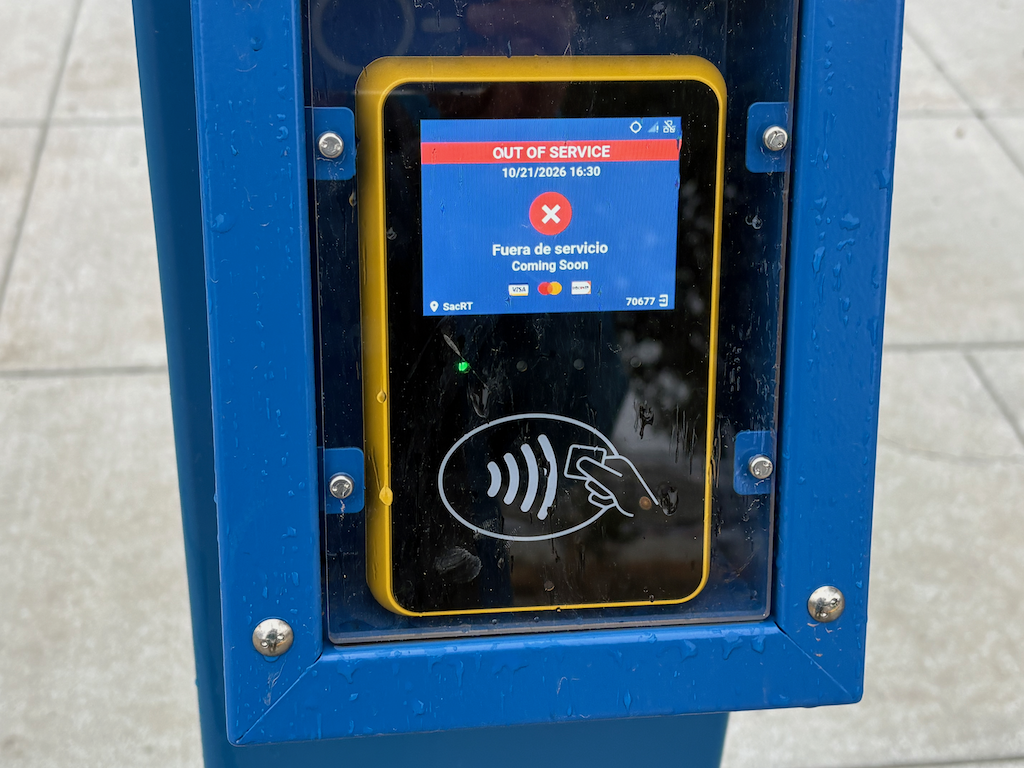
There are two Tap2Ride readers, at both ends of the platform, but they were out of service when I visited. This was supposed to be the second pilot site for Tap2Ride on light rail. There is no ticket vending machine (TVM) at the station.
There is single track, so the 30-minute headway train from the end point at 7th & Richards/Township 9 Station just returns through the same station and platform. Since there is not much to see, I caught the same train southbound that had brought me northbound. The trains are single car S700s.
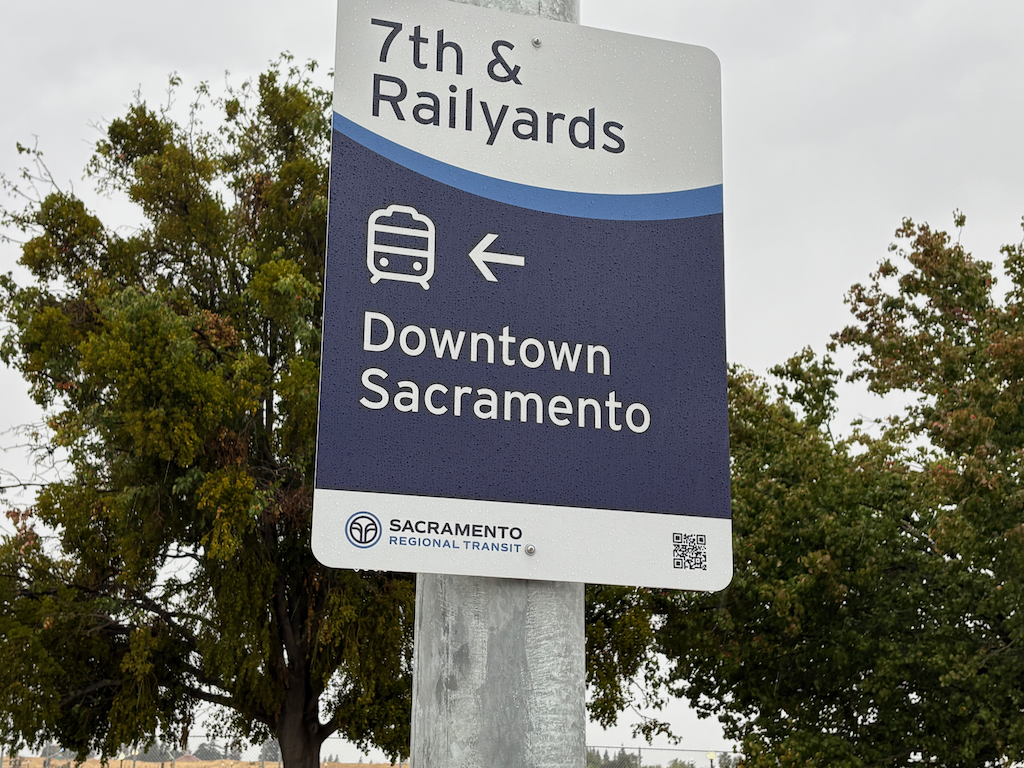
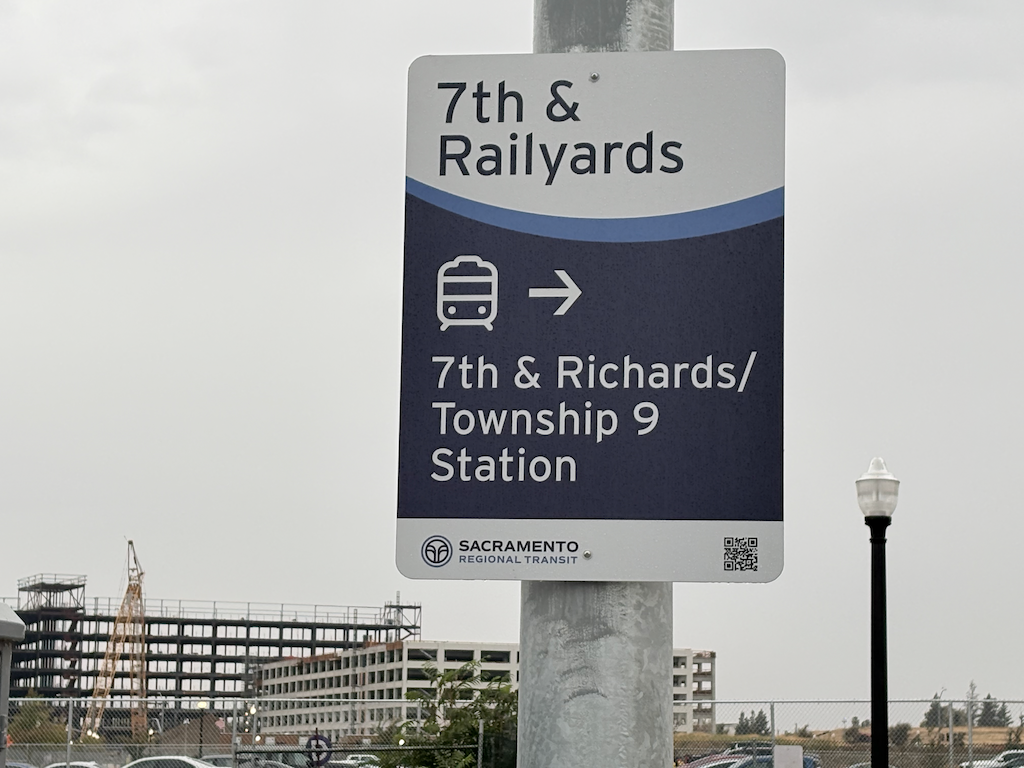
There are signs that indicate destination, but there are no signs to indicate that the northbound train stops at the north end of the platform, and the southbound train at the south end of the platform. This is a major flaw, since a person waiting at the wrong end would likely not be able to get to the other end in time to catch a train.
This station was paid for and built by the Sacramento Republic FC (soccer) owners, not by SacRT. SacRT said that when the developments in the Railyard come on line, the station will be upgraded with access to the soccer stadium, a wider plaza, and double-tracking at least for the station. It is not clear whether the route along 7th Street will ever be double-tracked.
The gallery below is my photos from the brief visit.
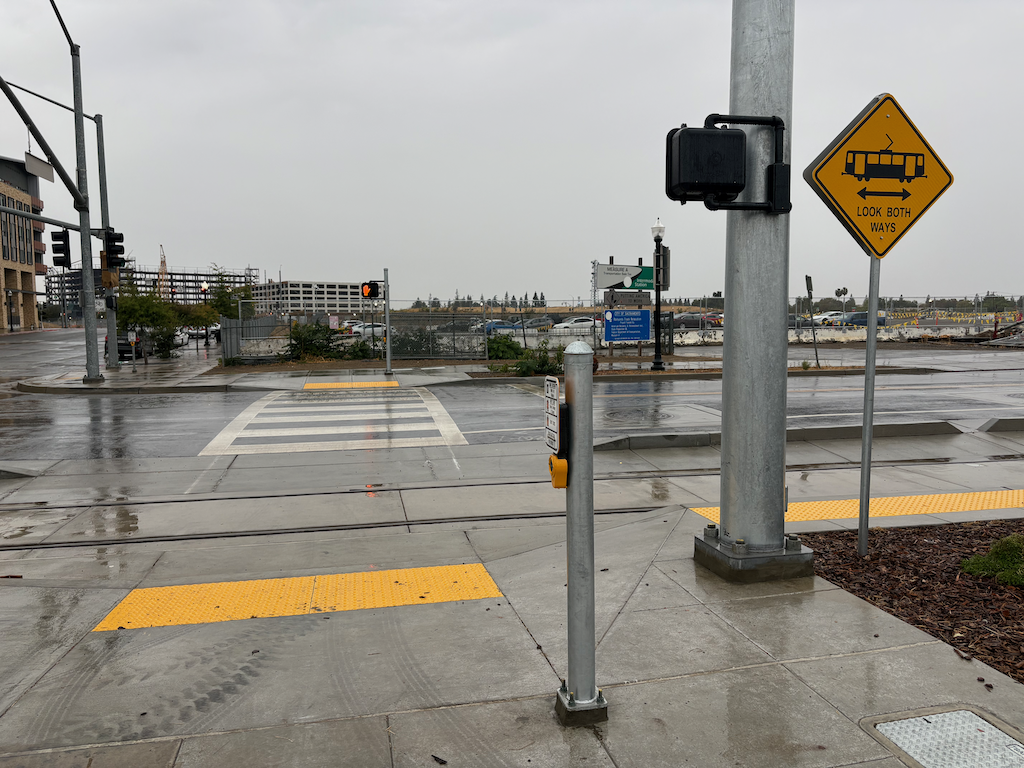
7th & Railyards Green Line train northbound7th & Railyards platform looking south7th & Railyards sign to downtown7th & Railyards sign to Township 9Tap2Ride out of servicecrosswalk over 7th St7th & Railyards bench
The SacRT Board will meet on Monday, October 26, 2026, starting at 4:00 PM. The simplified agenda is below, with selected documents of interest to me, linked.
A policy response on zero-tolerance, strollers, carts, and bicycles is not part of this agenda, so far as I can determine.
SacRT has added a ‘public participation‘ document, which addresses remote participation and comments. Comments in person and via email remain the same, as explained in the agenda.
I may have comments on agenda items between now and the board meeting.
2.1 Motion: Approval of the Action Summary of September 28, 2026
2.2 Receive and File: Quarterly Treasurer’s Report
2.3 Conditionally Awarding Contracts for Pre-Employment and DOT/DMV Certification Medical Examinations and Evaluation of Job Description Physical Requirements
a) Resolution 2026-10-119: Conditionally Awarding a Contract for Pre-Employment and DOT/DMV Certification Medical Examinations, and Evaluation of Job Description Physical Requirements to Agile Occupational Medicine PC; and
b) Resolution 2026-10-120: Conditionally Awarding a Contract for Pre-Employment and DOT/DMV Certification Medical Examinations, and Evaluation of Job Description Physical Requirements to Dignity Health Medical Foundation, A California Nonprofit Public Benefit Corporation, dba Mercy Medical Group
2.4 Resolution 2026-10-121: Approving Sole Source Procurements for Supply Purchases and Maintenance and Repair Services for Equipment, Components, and Parts for Light Rail Maintenance and Wayside Contractors and Delegating Authority to the General Manager/CEO to Execute Contracts
2.5 Resolution 2026-10-122: Approve the First Amendment to Fiscal Year 2025-2026 Transportation Development Act Claim
2.6 Resolution 2026-10-123: Rescinding Resolution No. 12-04-0050 and Revising SacRT’s Voting Procedures for Property and Business Improvement District Assessments
2.7 Resolution 2026-10-124: Authorizing the Execution of the Cycle A and Cycle B Low Carbon Transit Operations Program Project(s) and Certifications and Assurances, and Submittal of Project Nominations and Allocation Requests to Caltrans for Fiscal Year 2025-26 Low Carbon Transit Operations Program
Plans should be available to the public at least two weeks prior to the workshop that will consider them. Releasing a plan less than two weeks prior reduces the public’s chance to review and comment on the plan, particularly for people who are not able to attend the workshop.
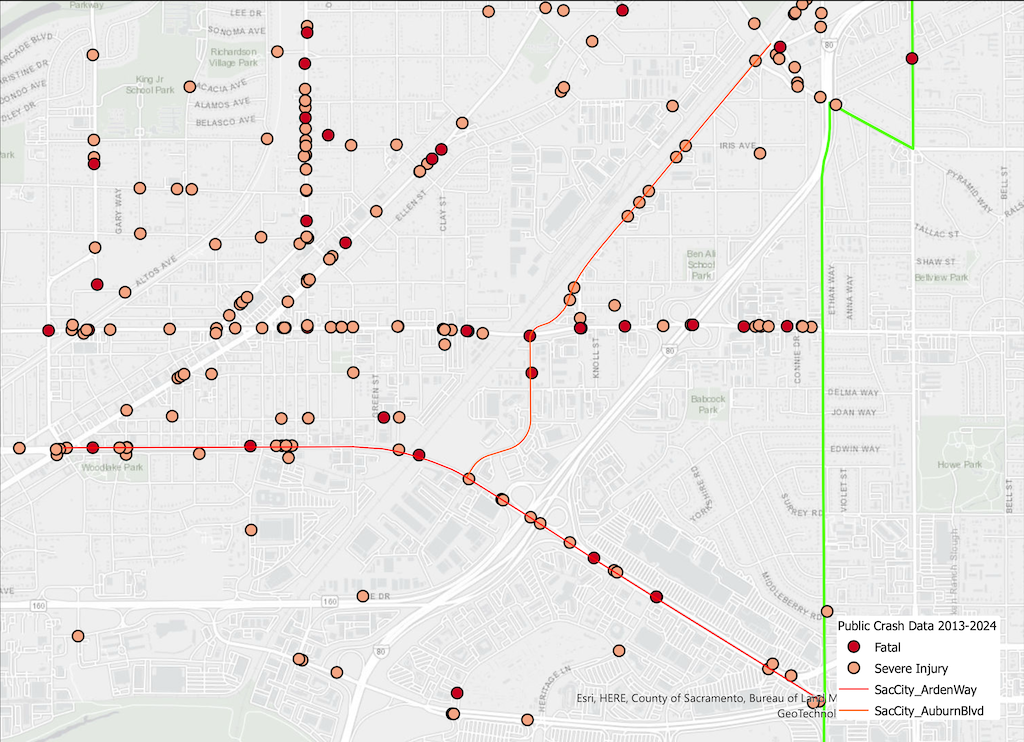
I did not see a map of crashes in the available documents, so I created one, below (pdf). Though this section of Arden Way and most of this section of Auburn Blvd are on the High Injury Network, neither is among the 2020 Vision Zero Top 5 Corridors report [I had missed that Arden Way is in the list of five ‘additional priority corridors’ that were added in 2018], nor in the draft 2026 Vision Zero Action Plan Top 10 Corridors. None of the intersections along these roadways are in the draft 2026 Vision Zero Action Plan Top 20 Intersections. I suspect that this project continues the city’s focus on big, expensive corridor projects, for which it has only a moderate chance of receiving funding, rather than focused projects on specific problem areas, which are often but not always intersections.
map of fatal & severe injury crashes (KSI) on the Arden Way and Auburn Blvd Mobility Plan corridors
The City of Sacramento will hold the third and final community workshop on the Fruitridge Road Safety and Mobility Plan (Fruitridge SMP) on Thursday, November 12, 5:30 PM to 7:00 PM, at Fruitridge Community Center, 4000 Fruitridge Rd, Sacramento, CA 95822. RSVP is available on the Fruitridge Road Safety and Mobility Plan webpage, but is not required.
As of today (2026-10-22), the draft plan is still not available. If it is not available by 2026-10-29, then the workshop is premature, as plans should be available to the public at least two weeks prior to the workshop that will consider them. Releasing a plan less than two weeks prior reduces the public’s chance to review and comment on the plan, particularly for people who are not able to attend the workshop.
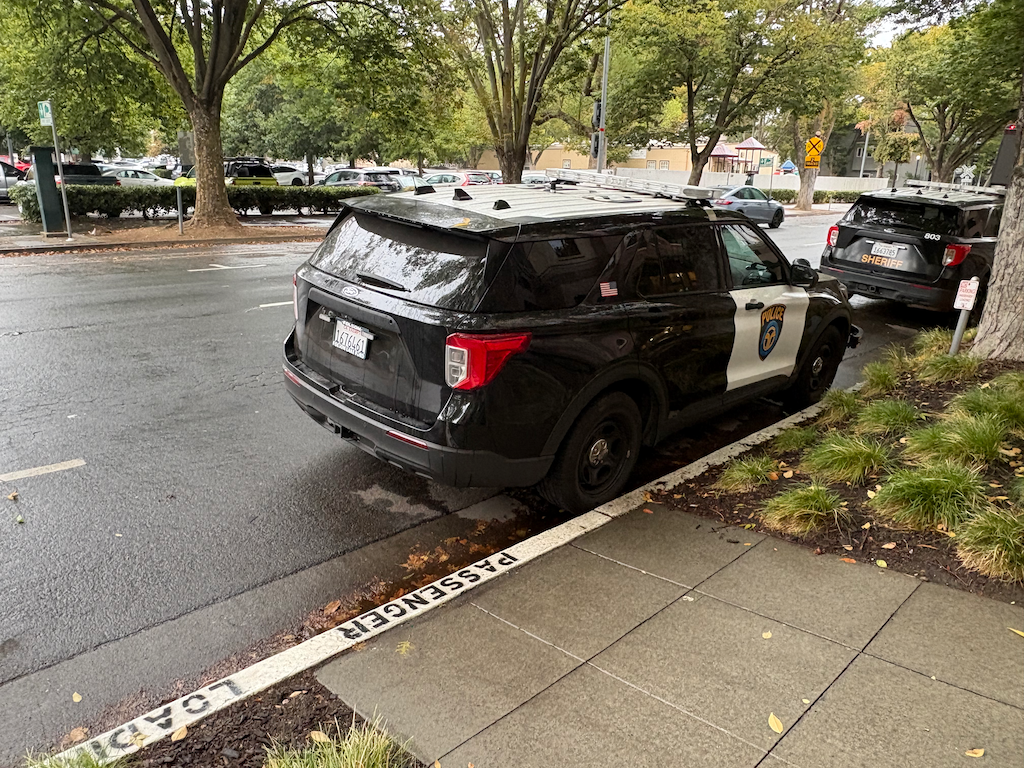
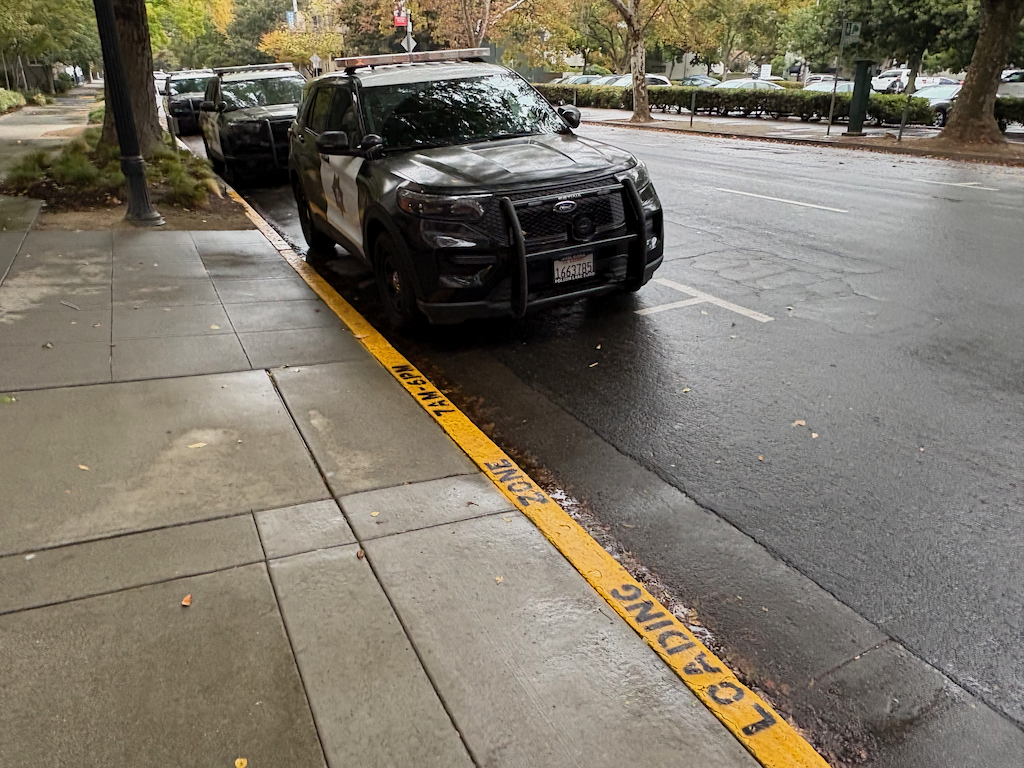
Today, I observed a UPS truck parked in the bus stop red curb zone on Q Street at 11th Street. When I asked the driver why he had parked illegally in a bus stop, he pointed out that police were parked in both the white passenger loading zone and the yellow commercial loading zone in front of 1102 Q Street, SacRT Headquarters. These police vehicles were not ‘on call’, they were still parked there an hour later. Of course there were also SacRT and Sac County Sheriffs vehicles parked illegally in a no parking zone on 12th Street. Again, these were not ‘on call’, they were simply choosing convenience for themselves over safety for the public.
Because the UPS truck was in the bus stop, the SacRT bus (presumably Route 109, though I did not catch the head sign) had to stop in the travel lane on Q Street, and the two waiting passengers had to step off the curb and cross the parking lane to reach the bus. One passenger had a disability and was challenged by stepping off the curb.
So, illegal and arrogant parking by SacRT police ends up endangering SacRT passengers. No surprise on my part.
SacRT police parked illegally in passenger loading zone, 1102 Q StSacRT police parked illegally in commercial loading zone, 1102 Q St
The SacATC 2026-10-15 meeting will receive a information and comment update on the Franklin Blvd Complete Street Phase 3 project. The project is at the 60% design stage, meaning that plans have been drawn (see the SacATC 2026-10-15 post), but details can still be improved. I have had some time to review the presentation and design diagrams, so have some comments, based on these and on my previous post on the Phase 1 and 2 project which is complete. The Phase 1 and 2 project ended at Fruitridge Road. There have been various city and county projects on other segments of Franklin.
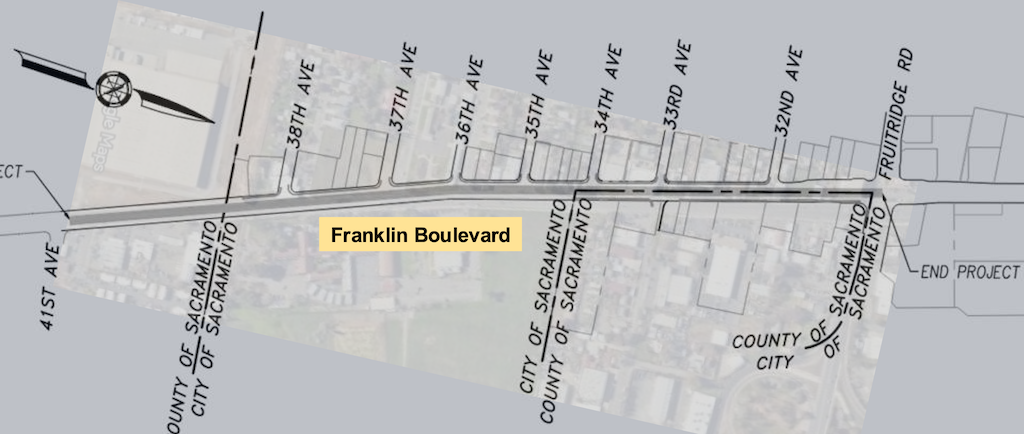
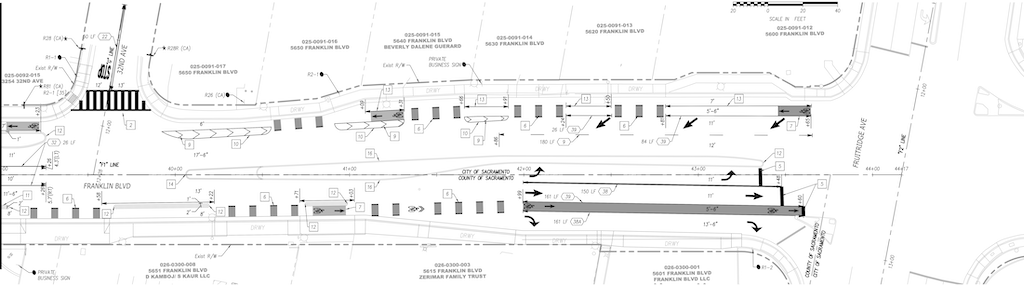
The extent of this Phase 3 project is Fruitridge Road to the county line just beyond 38th Avenue, shown below. The southern part of the project (to the left) is in the city, and the northern part (to the right) is shared city and county, but the city is taking responsibility for the entire project.
I note four areas of concern.
One: RRFB (Rectangular Rapid Flashing Beacon) at 33rd Street. RRFBs have a very low rate of compliance in the City of Sacramento, in part because we have among the worst drivers in the state. The installation here includes two beacons, one on the post, and another on an overhead mast arm. This format may slightly increase compliance, but the city has not demonstrated that it increases compliance enough to be safe for people crossing here. The city knows that existing RRFB locations are not safe, but continues to specify them, against the advice of transportation advocates. Either there should be a pedestrian hybrid signal at this location, or it should not be highlighted as a safe crossing, because it is not. Of course every intersection has a crosswalk, whether marked or unmarked, but the presence of a marked crosswalk with RRFB signal implies a level of safety that does not exist.
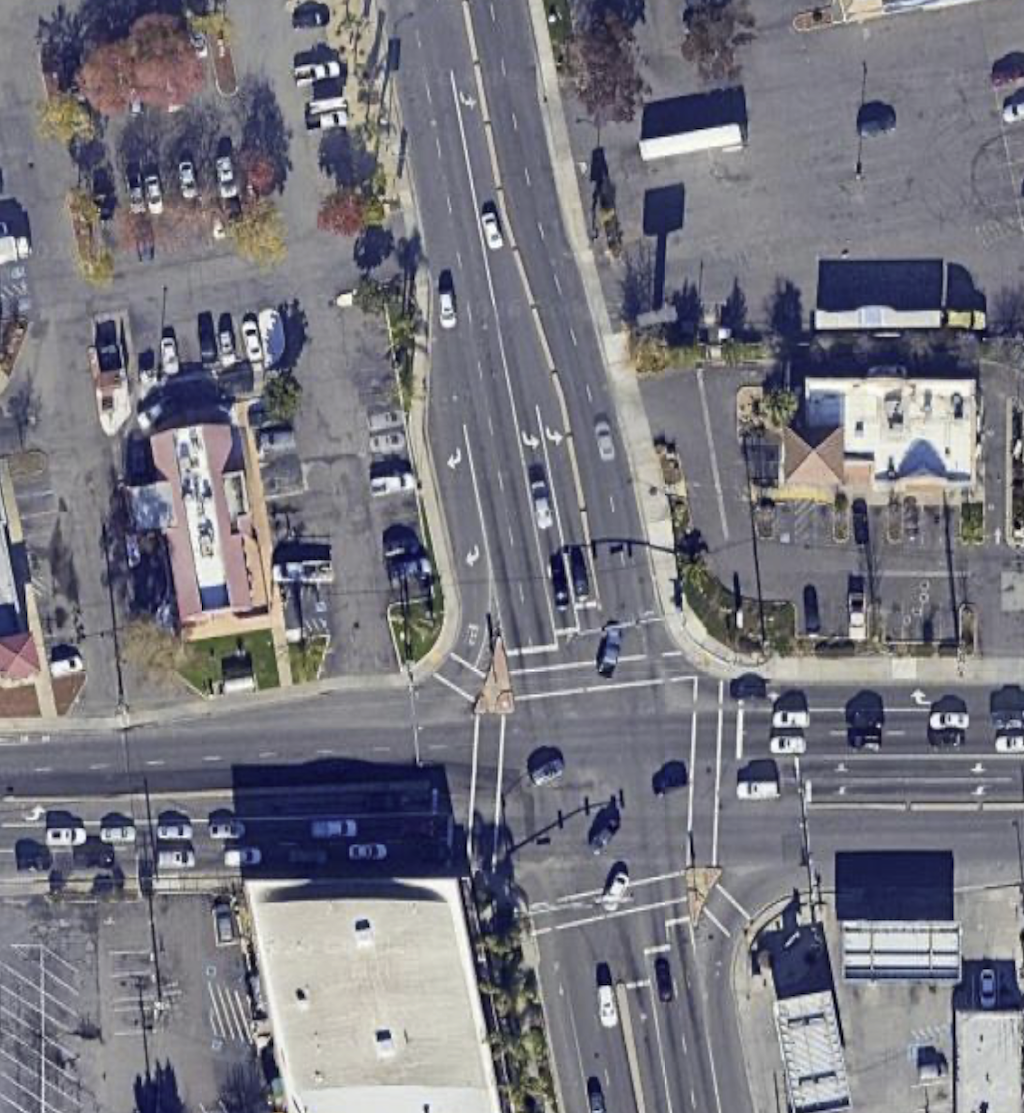
Two: Flared intersection at Fruitridge. The flared intersection of Franklin Blvd southbound at Fruitridge, which I criticized in my previous post as being unsafe for all users, is proposed to be duplicated south of the intersection in this Phase 3. The Google map overview is below. North of Fruitridge, the configuration has changed somewhat. South of Fruitridge, it is as shown, with two lanes southbound, two lanes northbound, a dedicated left turn lane, and a dedicated right turn lane which is a free-right with no traffic control whatsoever.
Google map of Franklin – Fruitridge intersection
The design diagram for Franklin at Fruitridge is below. It shows some improvement, with only one lane northbound, but is otherwise the same. Two lanes southbound, requiring a merge that could be avoided by making it one lane, as it is on the approach from the north, and one of the lanes is 12 feet, unnecessarily wide. The southbound bike lane is 5.5 feet, too narrow, and does eventually have painted buffer ‘protection’. The dangerous dedicated right turn lane is retained, though it does add a stop sign, which would be widely ignored, and encourages the same driver behavior to look left and ignore anyone in the crosswalk. The lane is 13.5 feet wide, which is ridiculous. The marked northbound bike lane is 5.5 feet, too narrow, between two motor vehicle travel lanes, with no protection whatsoever.
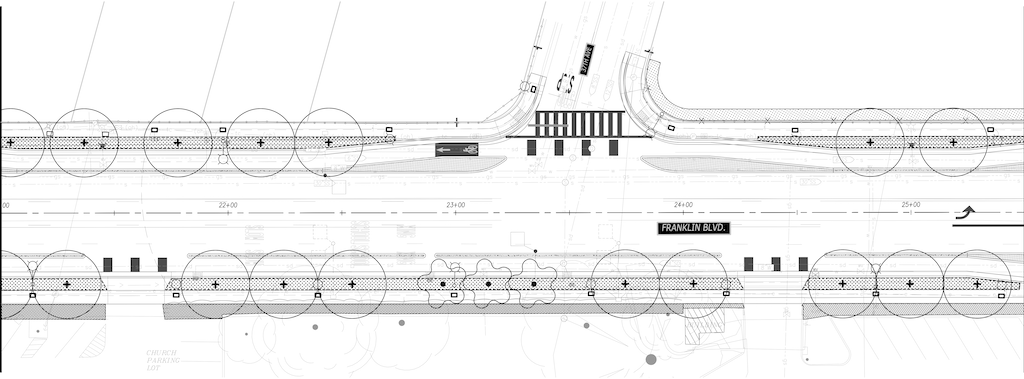
Three: Trees and sidewalk buffers (planting strips). Though sidewalk buffers and trees are being added along about half of the segment, both are missing from the remainder. This is better than it was, but far from the tree canopy/shade that the public has requested. Though I could not find a diagram where the width of the sidewalk buffer was specified, I estimate that they are mostly five feet, but narrower in a few locations. Healthy trees require eight feet or more, so the trees along this section will always be less healthy than they could be. Tree information starts on page 61 of the design diagrams document, with Landscape Planting Legend (LP002), and includes six street sections. A total of 50 trees are indicated, though it is doubtful, given past projects, that all of these will be planted. The diagram below shows the 37th Street section, with more trees than any other.
Franklin-37th Street section, Landscape Planting Plan LP102
Four: Wide concrete bikeway medians. There are a number of locations with very wide concrete medians to separate the bikeway from travel lanes. I’m all in favor of concrete medians, which provide real protection rather than the visual protection of vertical delineators. But a narrow concrete median is just as effective in providing protection as a wide median. In many cases, these medians seem overly wide, as though to simply take up excess space. Though the stamped concrete specified for many of them is slightly better aesthetically than plain concrete, it is still an unnecessary expanse of heat generating and expensive infrastructure. If possible, this width should be reallocated to sidewalks and sidewalk buffers.
The draft plan is not available at this time. The webpage says it will be available ‘by October 28’. One would hope well before that, otherwise the workshop is sooner than it should be.
The documents currently available are, in reverse chronological order, I think:
Community Workshop 3 flier (October 28): English | Spanish
The Sacramento Active Transportation Commission (SacATC) will meet this Thursday, October 15, 2026, starting at 5:30 PM, at the city council chambers. People can comment on agenda items in person at the meeting, or by making an comment ahead of time online. Though comments up through the meeting become part of the record, commission members will not see comments unless they are submitted early the day of the meeting or before.
The method for speaking in person has changed. Go to the city’s Public Participation Hub page, and then select Sacramento Active Transportation Commission (note: this page works poorly on handheld devices), and then click on the ‘View Page’ button. Select ‘Register’ to register for the meeting and to speak on an agenda item. Select ‘Comments’ to make a comment, or view other’s comments. You may also use the meeting kiosk to register in person. There are no longer speaker cards available. Once an item has been announced by the chair, it is not possible to register to speak on that item.
Select ‘Files’ to download the agenda. Within that document are links to individual agenda item documents, and these can be downloaded. All of this is much more awkward that the previous meeting mechanism. Check it out ahead of time so you can figure it out. I have made the documents for the three primary agenda items available below, so you don’t have to go through the awkward interface.
I do not have any comments to make at this time, but may tomorrow.
I have not had time to analyze Franklin Phase 3. My comments on the earlier and complete phase are at SacCity: Franklin Blvd complete street, and may be of use.
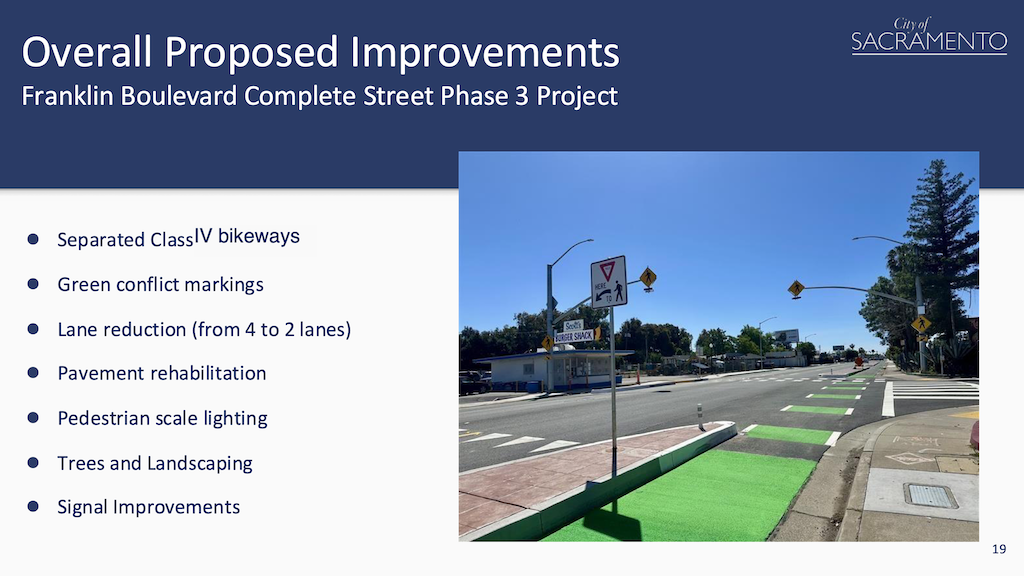
Franklin Blvd Phase 3, overall proposed improvements, slide from SacATC presentation
As mentioned in no grid: the original sin of city planning, freeways are one of the features that constrain the grid system of the central city Sacramento. Unlike the rivers, which are a natural feature, the freeways were designed to break the grid. This was a design choice by Caltrans to priority freeway travel over local travel. It doesn’t mean freeways are a bad idea, they are good and bad, but the decision to break grid streets was an intentional one, and a mistake that has harmed the city.
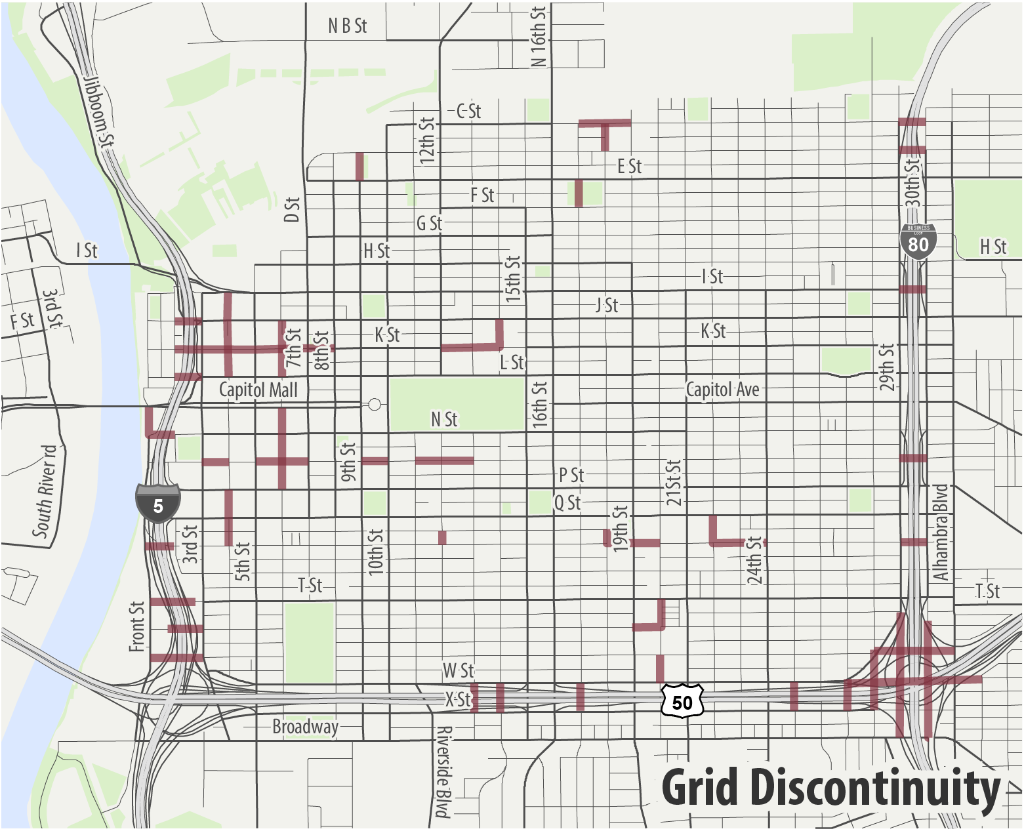
I was thinking of mapping all the broken grid streets, but realized there is a useful map in the Grid 2.0 presentation. Note that Grid 2.0 was superseded by Grid 3.0, and then the Downtown Mobility Plan, and then Central City Mobility Project. The focus on broken grid locations, and the goal of correcting some of them, was lost. In the map below, you can see seven locations where Business 80 broke the grid, eight locations where Hwy 50 broke the grid, and eight locations where Interstate 5 broke the grid. There was a proposal to reconnect N Street over Interstate 5, but I’ve not heard anything about that in years.
Some of the grid streets are broken in favor of freeway onramps and off-ramps. A reconfiguration of the ramps from long, long ramps to shorter (and safer) ramps could allow reconnection of some grid streets, but not most of them. The freeways, as designed and built, are a permanent blight on city livability.
13th Street is one that could be reconnected, and would have great utility because 13th, with its route through Capitol Park, is a critical north-south bikeway through the central city. Though K Street has a freeway underpass for walkers and bicyclists, a street connection at J Street or L Street would serve to reconnect Old Sacramento Waterfront (as it is called now) to the rest of the city. Currently, it is isolated by freeway, parking lots, and broken grid streets.
Worse, from a city amenity viewpoint, was that Hwy 50 broke Southside Park, splitting it into two sections, and with the W Street and X Street traffic sewers, making it unsafe and unpleasant to get from one part of the park to the other.
grid discontinuity map from Grid 2.0 presentation by ITE
There have been rumors for years of a curb management policy or program for the City of Sacramento, but nothing has surfaced. The Mobility and Sustainability Division of Public Works has a Mobility, Parking, and Curb Management page, but there is nothing on it about curb management.
I spend a lot of time in other cities, and am in San Francisco as I write this. Sacramento has much less of a problem than many other places. Ride hailing is all over San Francisco, both driver and automated, and traffic and bike lanes and bus lanes are blocked by ride hailing. San Francisco has a much greater density of retail business in many areas, and delivery vehicles do the same blocking. But Sacramento does have a problem, and that problem can be mitigated or eliminated by curb management.
As to curb colors, these are the patterns. California has much less clear code about curb colors than do most states, but to the degree it does, these are the colors.
red = no parking. Parking means getting out of your vehicle. Whether it is one second or hours, it is still parking. Red curbs may also be more restrictively signed as no standing or stopping.
yellow = commercial loading
white = passenger drop-off/pick-up
green = time limited parking. The amount of time is marked on the curb and/or signed
blue = disabled
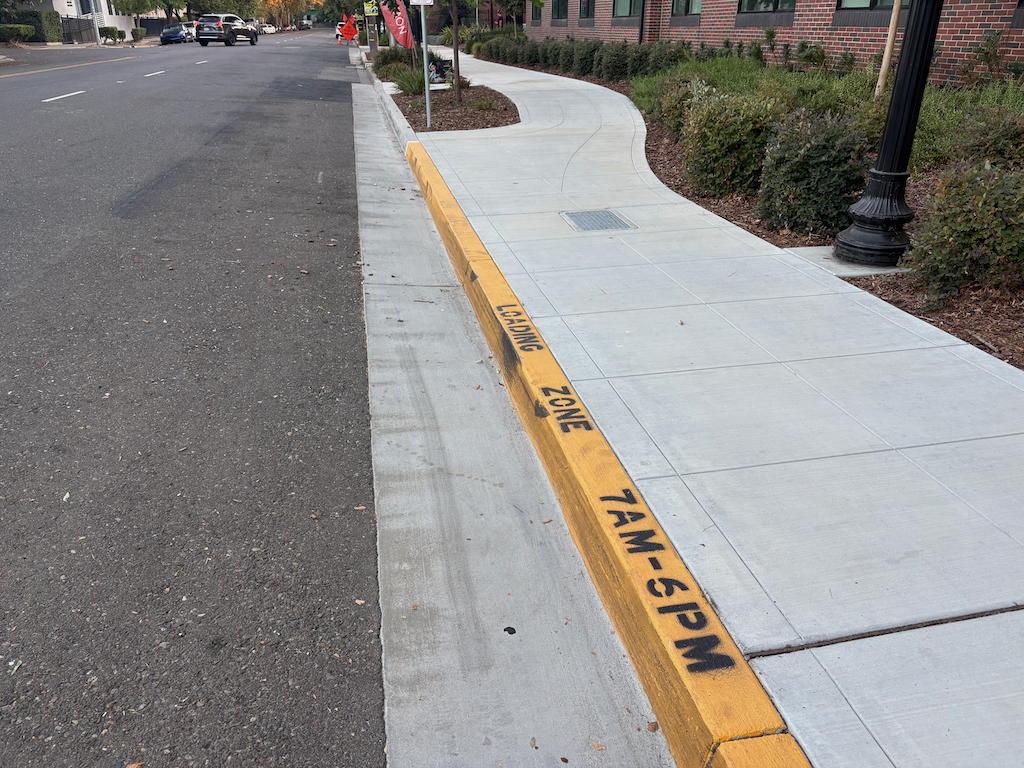
Sacramento has recently added some painted curbs, some with marking or signing, and some simply painted. One example below, on 3rd Street at The Bernice Apartments. It is not clear whether this is a city or developer installation. The time frame is unusual, but might make sense if loading is limited to certain times (see below). I suspect that this is a white curb passenger drop-off/pick-up situation that was mis-painted and mis-labeled as yellow loading. The distinction between white and yellow is often misunderstood.
yellow curb on 3rd St, Sacramento
But the rate of painting curbs is far slower than is needed. The city is not managing curb use as it should.
Whenever the city does come up with curb management policies or programs, here is what I’d like to see:
One blue disabled parking spot per block. This should not be a free spot, as is common practice, but a paid spot just like any other. Though there are certainly low income disabled people, there are also a whole lot of upper income people that park in these free handicapped spots for hours, precluding use by other handicapped users.
At least one green time limited spot on any block with retail business that cater to come and go customers, such as coffee shops. The limit should be 10 or 15 minutes. And it should be enforced! I often see drivers parked on green curbs for long periods of time, and when I report it to 311 for enforcement, the parking officers almost alway fail to ticket. The common city view of parking is that only staying over time paid for, or blocking a private driveway, is a violation, and nothing else is.
One long yellow curb spot on any block with retail business, which does not have alley access (if alley access is available, there should not be any commercial loading on the street, at all). I don’t mean ‘long’ like semi-truck long, but long like delivery truck and van long. Semi-trucks have no place in urbanized areas, and should be prohibited. Instead, there should be transfer to smaller vehicles at logistics locations.
One white passenger drop-off/pick-up spot on any block that has residential or retail. Both ride hailing and private vehicles should be required to use these spots, and be ticketed if they double park.
Limited hours for commercial deliveries. Though this could be adjusted for the characteristics of a particular block, delivery times should be limited to 3:00 AM to 10:00 AM. 3:00 AM is after the entertainment use and parking clears out. 10:00 AM is when most businesses open, and curb space is needed for other purposes.
Regular use of yellow curbs should require a permit, with permit fees going to the same purposes as other parking fees. Yes, this needs to be changed to parking benefit districts, but no need for a separate account. Though there may be occasional instances of a delivery that is not a regular user, almost all use is regular and repeated.
Regular commercial use (ride hailing) of white curbs should require a permit, with permit fees going to the same purposes as other parking fees.
These changes would result in less regular parking on each block. I am not against regular parking, but I see these other uses as higher uses that should be accommodated. Less regular parking means less driving, which is a good thing.