In contrast to the climate-friendly awards under the TIRCP program (SacRT awarded TIRCP funds for light rail), the Congested Corridors Program and Local Partnership Program are larded up with climate-unfriendly highways.
In the Congested Corridors Program, the SACOG region did well, receiving $15M for ‘Sac 5 Corridor Enhancements/1-5 HOV Lanes-Phase 1’, and $110.3M for ‘US 50 Multimodal Corridor Enhancements’. Not funded were additional ‘US 50 Multimodal Corridor Enhancements’, ‘US 50 Camino Corridor Safety and Community Access Mitigation’, ‘South Watt Avenue Improvements, Phase 1’, ‘West Capitol Avenue Road Rehabilitation and Safety Enhancements’ and ‘Electrifying Bus Transit in the Capital Region’.
In the Local Partnership Program, the SACOG region received $1.1M for ‘Placerville: Western Placerville Interchanges Phase 2’, $20M for ‘Capital SouthEast Connector Expressway’, $5M for ‘Downtown Sacramento Grid 3.0 Mobility: Network Improvements on the Grid’, and $2M for ‘Woodland: West Main Street Bicycle/Pedestrian Mobility and Safety’. These amounts are relatively small because they are matches for local funding in the self-help counties, counties which raise funds through transportation sales taxes. Not funded were ‘Pioneer Trail / U.S. 50 Intersection Safety Improvement Project’, ‘U.S. Highway 50 Camino Safety Project’, ‘Upper Broadway Bike Lanes and Pedestrian Connection Project’, ‘Broadway Sidewalks Project’, ‘Ray Lawyer Drive Overlay Project’, ‘Highway 65 Gap Closure Project’, ‘Hazel Avenue Improvement Project – Phase III’, ‘Watt Avenue Complete Street Improvements, Phase 1’, ‘South Watt Avenue Improvement Project, Phase 1’, ‘Downtown Sacramento Grid 3.0 Mobility Project: Network Improvements on the Grid’, ‘White Rock Road Four and Two Lane Improvements’, ‘Greenback Lane Complete Street Improvements, Phase 1’, ‘White Rock Road Two Lane Improvements’, ‘Grant Line Road Operational Improvements Project’, ‘Elverta Road Widening Project: Dutch Haven Boulevard to Watt Avenue’, and ‘North Beale Road Complete Streets Project- Phase II’. These rejections might be a sign that capacity-expanding, traffic-inducing, sprawl-promoting projects are less popular than they once were, though the Capital SouthEast Connector Expressway argues otherwise.
 I hope that you have found the series of posts on crosswalks (category: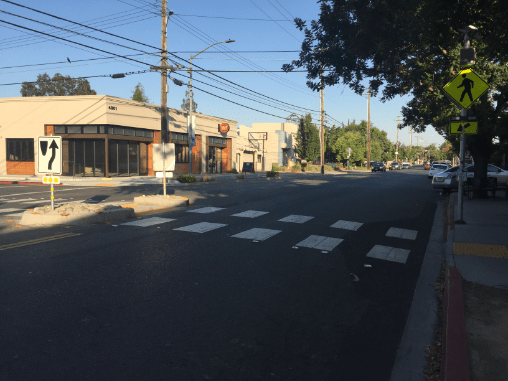
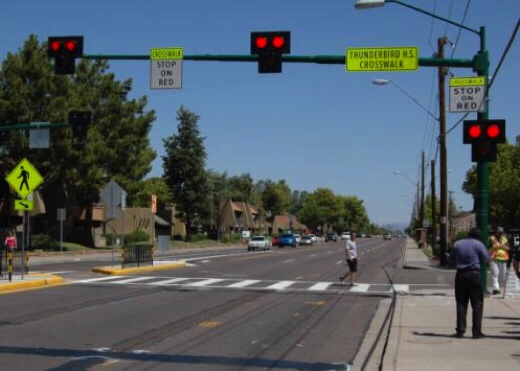
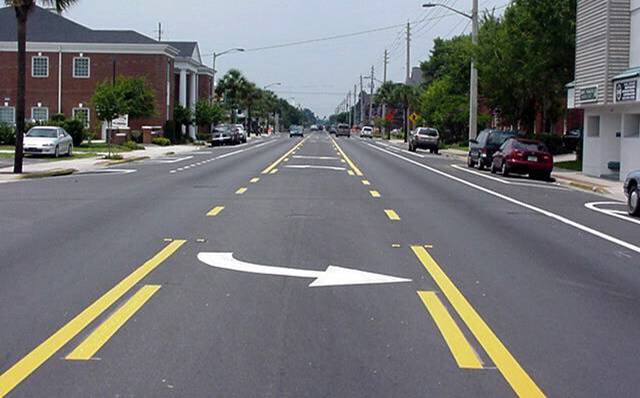
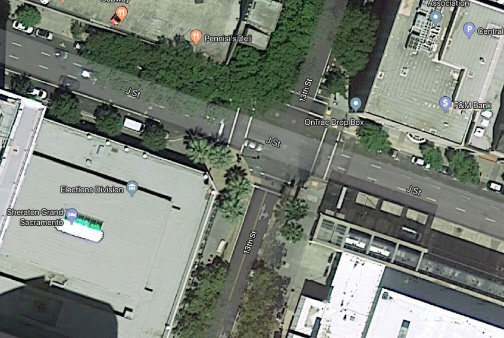
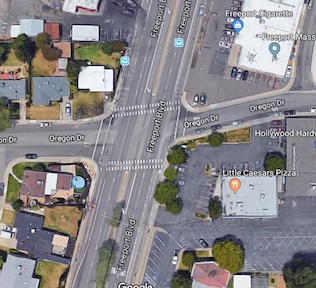 This is the research that Ryan Moore was referring to in the crosswalk removal meeting when he said that the city was following federal guidelines that required them to remove the crosswalk at Freeport and Oregon, though he did not call out Zegeer by name. Twenty-three crosswalks were removed in total, though we still don’t know where all of them are, and the city won’t provide that information.
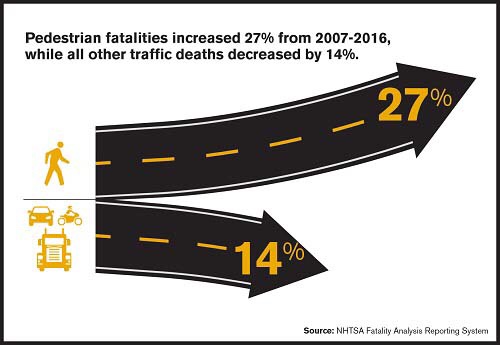 I believe that the city removed the crosswalk because they looked at the intersection and decided that removal was preferable to all other options. This is the ‘cars first’ attitude that contributes to the death of almost
  Following the post yesterday,
 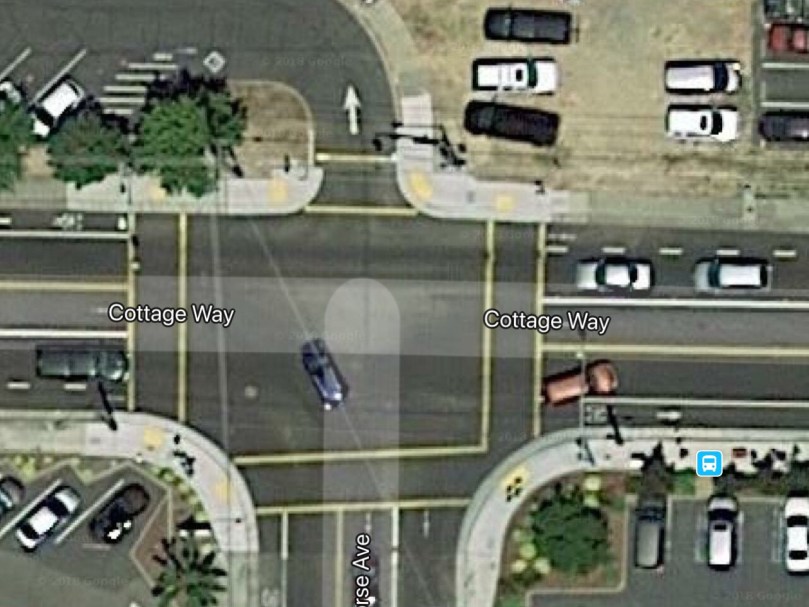 At the intersection of Morse Ave and Cottage Way in the Arden-Arcade community of Sacramento county, there is a
 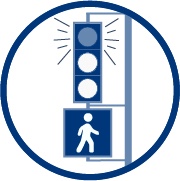 Questions about using Leading Pedestrian Interval (LPI) signals at the community meeting on crosswalks reminded me that I had information on these in the city for some while, but hadn’t shared it. A LPI signal gives the pedestrian a 3-second (or more, but the Sacramento ones are all 3 seconds) head start, with the walk sign coming on before the light turns green, so that pedestrians will already be in the crosswalk and more visible before vehicles start to move. These address the common issue of both right-turning and left-turning vehicles failing to yield to pedestrians in the crosswalk. They are one of the pedestrian safety countermeasures identified by the
