J & 13th needs a pedestrian scramble

Following the post yesterday, Morse-Cottage pedestrian scramble, here is my first suggestion for a pedestrian scramble in Sacramento. J Street and 13th Street would be a great location for one. It has high pedestrian traffic, it has pedestrian attractors on three corners (convention center, Sheraton Grand Hotel, and a parking garage), and many people cross more than one direction. I am not sure that it is the highest volume intersection, but it is quite possible the highest visitor location where people are less likely to be paying attention or to understand our signal system

Most importantly, the pedestrian signalization here is seriously screwed up, and it needs to be changed. On the west leg, the pedestrian phase is short. On the east leg,there is a ‘leading vehicle interval’ that allows southbound left turning vehicles to start before the pedestrian walk comes on, so almost every cycle creates pedestrian-vehicle conflicts. All the crossings require button pushes, none are on automatic recall that is standard at intersections in urban areas with heavy pedestrian flow. And the whole intersection cycle is much too long, giving preference to drivers on J Street over walkers, right here in the heart of a place where so many people walk. The cycle also sometimes skips the west leg completely, making pedestrians wait through two cycles of J Street traffic, which is a long, long time.

In addition to the exclusive phase, diagonal crosswalks should be marked to make it clear how the intersection works.

Let’s make this the first of many pedestrian scrambles in the central city.

Morse-Cottage pedestrian scramble

At the intersection of Morse Ave and Cottage Way in the Arden-Arcade community of Sacramento county, there is a pedestrian scramble. What this men’s is that the pedestrian signal is on, for walk, in all the directions at once. They are also called Barnes Dance, for Henry Barnes, the traffic engineer who popularized them, and exclusive pedestrian phases.

Sometimes these intersections have marked diagonal crosswalks, as a reminder that diagonal crossings are permitted, and sometimes they do not, but a pedestrian may cross diagonally whether the marked crosswalk is there or not.

I am most familiar with these from Reno (I lived in Carson City for some years), which has several along Virginia Street in downtown. I’ve seen them other places, but don’t recall exactly where right now. At every location where I’ve seen them, right turns are prohibited on red, by signing, so when pedestrians are crossing, no cars are moving at all, and there is no issue with drivers failing to yield to pedestrians using the crosswalk.

I think that every intersection that has heavy pedestrian traffic, particularly where many of the pedestrians are crossing one street and then the other, should have pedestrian scrambles. Yes, they slow traffic a bit, but they increase pedestrian safety and comfort, a great trade-off in my opinion. Many scrambled that existed in the past were removed by traffic engineers who wanted to prioritize vehicle flow over all other considerations, including safety, but it is time to bring them back, at least in select locations. See Governing Magazine, Cities Revive an Old Idea to Become More Pedestrian-Friendly, or search the Internet for pedestrian scramble for both recent and old installations.

The county had this to say about the intersection:

  1. The all-ways crossing, also known as a pedestrian scramble, at Cottage and Morse was in place/operation prior to the 2016 Cottage Way modification project. After doing some researched, we discovered it has been in place since the signal was installed in 1969.
  2. The pedestrian scramble operates 24 hours a day.
  3. The configuration of this intersection is unusual for the County. The scramble works for this location given the layout and right of way constraints that result in some of the corners only having one pedestrian push button to serve two directions.
  4. We currently do not have any plans to add diagonal crossings at this location.
  5. This is currently the only location in the County that has a pedestrian scramble.

Crosswalk removal and CVC

At the community meeting, Ryan Moore kept saying “we followed the law” in removing crosswalks. Though he was not specific, the law he may have been referring to is the section of California Vehicle Code (CVC) below. It remains to be seen if this law was followed, but it may have been since the requirements are minimal. Residents in the neighborhood were uniform in saying that they had not seen any notice, but that does not prove it did not occur. There are additional legal requirements on the city that will be addressed in future posts.

CVC 21950.5. (a) An existing marked crosswalk may not be removed unless notice and opportunity to be heard is provided to the public not less than 30 days prior to the scheduled date of removal. In addition to any other public notice requirements, the notice of proposed removal shall be posted at the crosswalk identified for removal.

(b) The notice required by subdivision (a) shall include, but is not limited to, notification to the public of both of the following:

(1) That the public may provide input relating to the scheduled removal.

(2) The form and method of providing the input authorized by paragraph (1).

Leading Pedestrian Interval (LPI) signals

Questions about using Leading Pedestrian Interval (LPI) signals at the community meeting on crosswalks reminded me that I had information on these in the city for some while, but hadn’t shared it. A LPI signal gives the pedestrian a 3-second (or more, but the Sacramento ones are all 3 seconds) head start, with the walk sign coming on before the light turns green, so that pedestrians will already be in the crosswalk and more visible before vehicles start to move. These address the common issue of both right-turning and left-turning vehicles failing to yield to pedestrians in the crosswalk. They are one of the pedestrian safety countermeasures identified by the Federal Highway Administration (FHWA), with a crash reduction factor of 60%. If you search for ‘leading pedestrian interval’ on the Internet, you’ll see a great number of useful links. The NACTO page is especially worthwhile.

My purpose in sharing the specific locations is so you can go out and experience LPI for yourself. How does it work for you?

A LPI does slow traffic very slightly since there is an additional 3 seconds per direction during which most vehicles are not moving.

Lastly, this is not a solution that could have been used at the Freeport-Oregon intersection, which is not a signalized intersection. However, it is a solution for the signalized intersections along Freeport. Ryan Moore claimed that these can’t be used at low pedestrian locations, but the response to all such reactionary claims is: “You can’t judge the need for a bridge by the number of people swimming the river.” If crossings are not safe, then fewer people are walking than otherwise could be. The demand is there, but not the facility. LPIs are one solution.

Lead Pedestrian Interval (LPI) locations in City of Sacramento (as of 2015-08-28):

  • 9th Street and I Street
  • 9th Street and P Street
  • 10th Street and I Street
  • 10th Street and J Street
  • 15th Street and K Street
  • 29th Street and K Street
  • 30th Street and K Street
  • 9th Street and Q Street
  • 13th Street and I Street
  • 8th Street and P Street
  • 8th Street and Q Street

Community meeting on crosswalks – 2

Part one, Community meeting on crosswalks, prior posts:  removal of crosswalks, Don’t use the ‘A’ word. Next related post will be about Zegeer.

Question and answer session of the meeting:

  • The city is doing a speed study on Freeport from Sutterville Rd to Meadowview Rd, and will include part of Sutterville (not clear what part)
  • There are no red light cameras on Freeport; the city piggybacks on country red light program
  • There are no lead pedestrian interval signals on Freeport, or even is south Sacramento (all are in the central city); Ryan Moore said these should not be used in low pedestrian areas (which is false)
  • Resident commented on Fruitridge Rd, 24th to Freeport, a lot of red light running and few safe crossings
  • Resident who lives on Oregon suggested changing the speed limit on Freeport
  • Steve Hansen says that the city would like to change Freeport, but to do so, the community (residents, businesses, neighborhood associations) will need to come together to decide how; people will have to give up some time for better safety; he also mentioned narrow sidewalks with obstructions
  • Several people asked about or commented on specific sections and intersections; Matt mentioned catching egregious speeders
  • South Land Park Neighborhood Association (Ryan?) asked what public notice there was before crosswalk removal and said they were not notified; not clear if the other two were notified
  • Ryan Moore said that each removal was analyzed, he says they followed the law of CA MUTCD; said most of the removals were result of complaints; said neighborhood input makes no difference; mentioned FHWA info on crosswalks, referring to Zegeer report though not by name (more info about Zegeer in a future post)
  • Neighbor said that any process that removes crosswalks is flawed; mentioned no still phase on signals (time between red one direction and green the other); going out of the way is not reasonable to ask; can’t have data on people walking because people are scared to walk
  • Steve Hansen and Jay Schenirer want to review pedestrian guidelines, not sure what document this is; said we need to talk about equity because the top corridors of Vision Zero concern are not necessarily located in disadvantaged communities
  • Neighbor said speed display signs don’t seem to have any effect on behavior; asks for immediate action and not years out
  • Ryan Moore continually says “we’d like to but we can’t” but offers no proof; continues to say that crosswalks at this volume and speed are not safe
  • Neighbor said there are bus stops close to Oregon which is true and which might make removal a violation of Title 6
  • Issue of sidewalk maintenance responsibility has come up several times; city continues to insist that it is the responsibility of the property owner (even though most sidewalks are part of the public right-of-way and all are part of the transportation network)
  • Many people pointed out that improvements could have been made at the Freeport-Oregon intesection, such as bulb-outs, refuge median, lighting; there is a median already but it is too narrow to provide refuge
  • Participant asked for a pedestrian commission, Jennifer Donlon Wyant said the the city Active Transportation Commission would be seated in April or May
  • Jay Schenirer wrapped, mentioned that McClatchy students drove the changes to Freeport north of Sutterville Rd

My overall take on the community meeting is that the city council members and the public, both residents of the neighborhood and others, want proactive changes to increase pedestrian safety and walkability. They don’t want excuses. Ryan Moore, the Interim City Traffic Engineer, seem prepared only to offer excuses.

Of all the people on stage, Ryan Moore seemed the least sympathetic to the person killed, or the issues that it raises. He said much the same thing he’d said to the SacBee: “Instead, traffic engineers hope that by removing some crosswalks, pedestrians will instinctively choose to cross at a safer, nearby intersection,” Moore said. He kept referring to federal and state standards that were being followed, though a number of people in the audience who know a great deal about traffic engineering noticed that he was mis-stating and mis-using standards and research to defend his actions and opinions.

Community meeting on crosswalks

I had promised I’d report on the community meeting to address the crosswalk removal over Freeport at Oregon and related issues, but it has taken me a while. Previous posts: removal of crosswalks, Don’t use the ‘A’ word. For background, see the SacBee article: Why Sacramento erased 23 crosswalks, including one where a grandmother died after removal.

The meeting was hosted by City of Sacramento council members Jay Schenirer and Steve Hansen, and school board president Jessie Ryan, and held March 8 at Hollywood Park Elementary which is east of the intersection where the fatality occurred.

Steve talked about the concept of a stroad, a street/road hybrid that doesn’t do either well, though he did not use the term. Freeport is a stroad. He introduced vision zero, talked about changing both infrastructure and behavior, mentioned that the traffic motor officers are gradually being built up but are far below what they should be, and said “we should enjoy the public space and not be afraid.”

Ryan Moore, Interim Traffic Safety Engineer, and the person responsible for the removal of crosswalks, repeatedly mentioned a ‘Systematic Safety Analysis Report’ but is was not clear what this is, and the city website has no mention of it. He also said that he was following all the federal and state rules, as well as research, by removing the crosswalks.

Jennifer Donlon-Wyant, the Active Transportation Specialist, gave a Vision Zero presentation similar to what many people have seen before, but highlights are that Sacramento is the second worst in the state for pedestrian fatalities per capita. She went over the ten profiles that are the core of the draft Vision Zero Action Plan, of which three are related to speed, and one related to transit stops, which all play a role in this incident. One that does NOT apply is ‘Pedestrian Crossing Outside of an Intersection or Crosswalk.’ Though the city had erased the marked crosswalk, it was and is still a valid legal crosswalk. Freeport Blvd is not one of the top five fatality and injury corridors in the city.

Matt Armstrong, Sergeant of the Motor Team (officers on motorcycles) said he has 7 officers on at a time, maximum, for the entire city. They respond to complaints, but otherwise focus on schools and high volume corridors. He said top concerns are red light running, distracted driving, and speed. He mentioned something I had not heard before, that this was a multi-lane threat crash. A multi-lane threat crash occurs on streets with more than one lane in the same direction (Freeport has two lanes in each direction), when one driver stops for a pedestrian and other drivers does not. This is a violation of CVC 21951 “Whenever any vehicle has stopped at a marked crosswalk or at any unmarked crosswalk at an intersection to permit a pedestrian to cross the roadway the driver of any other vehicle approaching from the rear shall not overtake and pass the stopped vehicle.”

Jessie Ryan said the district recognized that their policies were insufficient and were going to adopt the California School Boards Assocation Safe Routes to School policy (which is very weak), that they were creating heat maps to prioritize unsafe routes, is committed to using and reviewing data, and welcomes public input. The district, prior to this, has shown little interest in Safe Routes to School and has implemented only some minor projects.

Kirin Kumar of WALKSacramento and Jim Brown of Sacramento Area Bicycle Advocates (SABA) spoke briefly about the need for culture change in the community and in the city bureaucracy.

Next post I’ll discuss some of the public comments and questions, and the answers provided.

Serve on SacRT board

From our friends SacTRU and also noticed by Ridership for the Masses.

Mayor Steinberg is appointing a member of the private sector to the SacRT Board. This seat will replace one of the Sacramento City Council seats currently filled by Councilman Rick Jennings and will serve until the end of 2018. The member of the private sector would have full voting rights as a board member representing the city of sacramento.

Position: Seat A – A member of the private sector with an understanding of the importance of regional transit and public transportation.

Deadline to Apply: March 30, 2018 at 5:00pm

The requirements and selection process are vague, but all are encouraged to apply. We hope many qualified members of the community will apply and represent the needs of riders, and that this seat is not simply filled by an interested member of the business community.

Apply at: http://www.cityofsacramento.org/Clerk/Legislative-Bodies/Boards-and-Commissions. Scroll down to Sacramento Regional Transit Board; no direct link is available.

It has been suggested that the best candidate is a woman of color. There is only one woman serving on the board currently, Linda Budge. There are two people of color, Rick Jennings and Phil Serna, but it is Rick Jennings seat that is being offered (see board list). STAR believes it is important to have someone who is a regular user of the transit system, since the current members range from low transit use to no transit use. Finding that ideal candidate that increases the diversity of the board and better represents riders will be a challenge. If you know that person or those people, please let them know and ask them to serve.

At the same time, STAR encourages everyone to apply. This can be a transformative moment for SacRT, and a strong interest in the position may encourage the other entities, county and cities, to appoint citizens. The board suffers from having politicians as members who are already very busy with their other boards and commissions, and other interests, and don’t pay enough attention to transit. We need someone whose passion is transit that works for everyone.

Better bike share ordinance

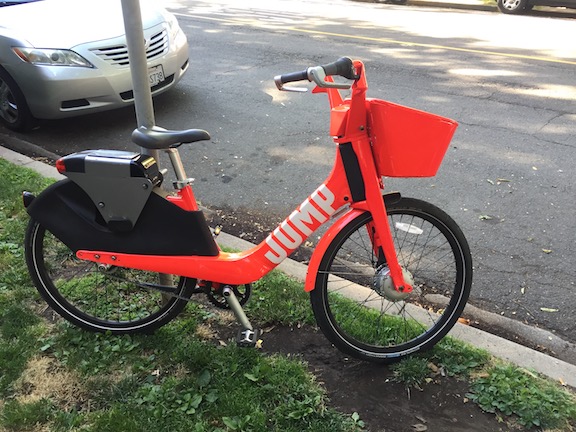
The City of Sacrament is set to adopt a bike share ordinance on Tuesday evening (agenda item 23). This is one more step along the way to bringing JUMP electric bike share to Sacramento, and on the whole the ordinance is good. But I have some suggestions for improving it.

5.18.210 Bicycle parking spaces required. No person shall operate a bicycle‐share business unless they have provided and maintain at least one and one‐half bicycle [designated] parking spaces using bicycle racks for every bicycle‐share bicycle to be operated by the bicycle‐share business, as approved by the city. The installation of bicycle parking spaces and bicycle racks are subject to encroachment permit requirements, as set forth in chapter 12.12.

I completely understand the city’s desire to have an orderly bike share system, where the bikes are in known locations and not scattered randomly. In my experience of dockless bike share in other cities, the concern about bikes left in inappropriate places is exaggerated but real. However, bike racks are not the only possible solution. The photo at right shows a solution from Seattle, still experimental, but with great promise. I would hate to see the city shut the door on other solutions by specifying bike racks when they could specify designated places, of which racks would be one. Bike racks are important, and preferred, but there will be many areas within the system boundaries which do not have racks, or do not have convenient racks.

5.18.220 Retrieval of bicycle‐share bicycles. A bicycle‐share business shall, within two hours of notice, retrieve their bicycle‐share bicycles that are in any of the following conditions.

  1. Bicycle‐share bicycles that are inoperable or not safe to operate, and parked in the public right‐of‐way;
  2. Bicycle‐share bicycles that are not locked to a bicycle rack in an upright position[, or locked within a designated bicycle parking area with the kickstand deployed];
  3. Bicycle‐share bicycles with a battery or motor determined by the city to be unsafe for public use.
  4. Bicycle‐share bicycles parked in violation of section 10.76.050.

This change is consistent with using designated areas, rather than just bike racks.

5.18.230 Electric bicycles. Electric bicycles shall comply with the California Vehicle Code and any other applicable laws and regulations[, and shall be of the Class 1 type (CVC 312.5. (a) (1): A “class 1 electric bicycle,” or “low-speed pedal-assisted electric bicycle,” is a bicycle equipped with a motor that provides assistance only when the rider is pedaling, and that ceases to provide assistance when the bicycle reaches the speed of 20 miles per hour.]. In addition, electric bicycles shall be equipped with software or other mechanisms to prevent the motor from providing assistance when the bicycle’s speed exceeds 15 miles per hour.

I would like to see the 15 mph speed limit removed. There is anecdotal evidence, no research yet that I could find, that e-bikes are somewhat more dangerous that pedal bikes, with a higher crash rate. But many of the anecdotes don’t make clear whether the bikes were pedal assist, Class 1, or throttle, Class 2. Almost none say whether speed was a contributing factor, in fact some seem to be at low speeds, just getting going with a heavy bike. Some bikes with powerful batteries do start suddenly, but my experience with JUMP bikes in San Francisco is that they are pretty smooth as the assist starts and stops. The JUMP bikes are 250 Watt, which is on the low end of power for electric bikes.

The reason speed is important is that a bike at 20 mph is transformative. In moderate to heavy congestion in a urban area, such as most of the area within the system boundary, e-bikes at 20 mph can keep up with traffic. At 15 mph, they are just a regular bike with a little less effort involved. At 20 mph, they could replace many private vehicle trips, and many ride-hailing trips. We already know that private vehicles and ride hailing trips have a negative impact on livability and the environment. Here is a solution! Let’s set them free and see what a difference they can make.

Legislation I’d like to see

In all my spare time, which means while commuting to work on my bike, I think about state legislation I’d like to see. Here is my list of the moment. Feel free to add suggestions.

Bicycling

  • Remove far-to-the-right bike lane provisions, CVC 21202
  • Flip parking in bike lanes from permissible unless posted to prohibited unless posted
  • Require that all signals detect bicycles within two years
  • Be explicit in CVC that placing waste containers in bike lanes is the same violation as leaving any material in a travel lane
  • Require that all waste containers be inscribed with ‘do not place in bike lane’, and have reflective stripes on the sides of the container
  • Implement ‘Idaho stop law’ (yield as stop) for stop sign controlled intersections

Pedestrians

  • Require full traffic studies for the removal or crosswalks or prohibition of crossing, with the default position being that crosswalks will not be removed and prohibitions will not be created or continued
  • Remove the prohibition on pedestrians crossing the street between signalized intersections on all streets 30 mph or less

Speed

  • Change the prima facie speed limit for residential and commercial streets (local) from 25 mph to 20 mph; change to 20 mph or less for posted school zones
  • Set the maximum speed allowable on collector streets to 30 mph; set the maximum allowable speed on arterial streets to 40 mph
  • Allow automated speed enforcement everywhere

Schools

  • Require law enforcement to send incident reports involving children going to or from school to school districts within 24 hours of completion, and investigations within 72 hours of completion
  • Prohibit U-turns within school zones
  • K-12 school districts and colleges/university would be required to have transportation demand management programs, since school-related traffic is a significant portion or overall traffic

Other

  • Shift the burden of proof to the motor vehicle driver for all collisions with pedestrians and bicyclists involving fatality or severe injury
  • Allow any citizen to challenge the professional license of an engineer who is aware of a traffic safety hazard and fails to request funding to mitigate that hazard
  • Decriminalize transit fare evasion
  • Allow conversion of any and all freeway lanes to toll

CEQA hearing

This is a follow-on to my Wednesday post on the CEQA Guidelines update/reform: CEQA VMT reform has a fatal flaw.

Four organizations spoke at the hearing:

  • Climate Resolve (Ella): spoke against exemption, spoke about equity and displacement, mentioned request to Caltrans to use VMT instead of LOS
  • City of San Jose: spoke against transportation exemption, apparently submitted letter signed by other cities but I didn’t catch which ones; San Jose recently adopted VMT as their measure for transportation and development (Streetsblog Cal: San Jose Becomes Fourth California City to Adopt VMT as Metric for Traffic Impacts)
  • Coalition for Clean Air: spoke to reducing VMT as the best path to reducing emissions
  • California Bicycle Coalition (Linda): spoke about equity and displacement issues, on need to monitor and determine consistency, spoke against exemption

And I spoke, the sole citizen speaker:

  • I reject the language in 15064.3, Subdivision (b)(2), which exempts transportation from any requirement to use VMT rather than LOS.
  • Overall, the changes will affect development in a positive way, encouraging infill and discouraging greenfield development, however, transportation drives greenfield development drives rather than greenfield development driving transportation, so the overall benefit will be much lessened by the transportation exemption.
  • Transportation is the largest single contributor to greenhouse gas emissions in California (about 39%), but this language does little to address transportation
  • The draft guidelines specifically say “this provision does not prohibit capacity expansion.” But capacity expansion is the largest single contributor to exist and future emissions. This is exactly the issue that most needs to be solved
  • In the Sacramento region, nearly every county and city will continue to use LOS rather than VMT, with the possible exception of Sacramento city and Davis. Even the discussion of a possible change had most transportation ‘professionals’ and politicians up in arms.
  • Though it did not talk about it, the draft clearly contravenes the intent of the legislature in SB 743, which was to kill LOS.

I hope that there is enough opposition on the transportation issue that the agencies will come back with a better proposal, but if not, the legislature will have to come back to the issue again. If this exemption stands, the state cannot possibly meet its greenhouse gas reduction targets.