Complete Streets aren’t

The Complete Streets movement, now 13 years old and with a newly released criteria for evaluating policies, is considered by some to be a success. Not by me.

There are two gaping flaws in the complete streets concept, that after all this time have not been addressed:

  • Who is responsible for sidewalks?
  • How close should safe crossings be?

Sidewalks: On the first issue, responsibility for sidewalks, most cities and counties (not all) have code that makes sidewalk maintenance the responsibility of the adjacent landowner. This includes repair and snow removal. Most cities have some money set aside to repair sidewalks, but only a tiny fraction of what is needed for the huge backlog of deteriorated sidewalks. A very few cities also clear sidewalks after snow. Sidewalks are every bit as much of the transportation network as travel lanes and bike facilities, but most places wash their hands of this reality and this responsibility, pushing it off to others. It has been pointed out that few cities and counties have the funds to also take care of sidewalks, but that is exactly the point. If we allow cities and counties to prioritize cars over walking, they will continue to do so.

How does complete streets play into this? It doesn’t. Complete Streets set no expectation that cities and counties will maintain their sidewalks. In the new policy rating documents, the word sidewalk only shows up twice, neither in this context. Even a search of the Complete Streets website only mentions sidewalks in relation to case studies and model projects. Fortunately, a few places do much better than just have a policy, but the Complete Streets movement does nothing to encourage this.

ElCamino-eb
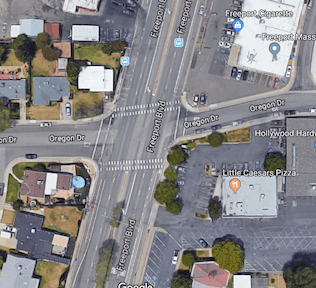
El Camino complete street, 0.3 miles to the next safe crossing

Crossings: the second great weakness of the complete streets movement and Complete Streets documents is the lack of attention to frequent safe crossings. The new criteria does not mention crosswalks or crossings. The illustrations of a complete street often show an intersection with high visibility crosswalks and sometimes curb extensions to increase visibility and shorten crossing distance. But other illustrations show long distances along a “complete” street, with the next safe crossing often not visible.

In the Sacramento region, every complete street project along arterials has added sidewalks and bike lanes, but none of them have added safe crossings. In fact, several of them have removed crossings. If a busy street is hard for walkers to cross, they won’t cross it. They will either drive, or just avoid the other side of the street. So that fancy complete streets project, with the wonderful looking wide sidewalks, does not serve the very people it is claimed to serve. People need to be able to cross any land all Streets in a safe crossing at an interval of no more than 1/8 mile. The grid in downtown Sacramento is 1/12 of a mile. Few places in the suburbs are less than 1/4 mile, and many are 1/2 mile. To me, this is unacceptable. I would think a complete streets policy would address this distance between safe crossings issue as being key to walkability. Again, the Complete Streets movement ignores this issue.

Bike share for Rancho Cordova & Folsom?

From the 50 Corridor TMA Communter Connections newsletter:

Bike Share recommendation advances to City Councils

This month, both the Rancho Cordova and Folsom City Councils will hear the 50 Corridor Bike Share Task Force recommendations in for launching a new bikeshare program using LimeBike as the program provider.

The Rancho Cordova City Council is expected to vote on the recommendation at its February 20 meeting which starts at 6 p.m.  The Folsom City Council will consider the recommendation on February 27 during its meeting which starts at 6:30 p.m.

A representative of LimeBike will make a presentation to the Folsom City Council.

Should both councils approve the recommendation, bike share should be available on the 50 Corridor by early April.

LimeBike-e
LimeBike e-bike

LimeBike features a dockless system – allowing users to park bikes at whatever destination is convenient.  The cost is expected to be $1 for 30 minutes, although a variety of pricing options will be available, including monthly subscription rates.  Electric assist bikes will also be available for $1 to unlock the bike and $1 per every 10 minutes.

The main goal of employing bike share along the 50 Corridor is to address first mile/last mile connections for Regional Transit’s Gold Light Rail Line.  However, bikes can be used for any kind of trip. And because the bikes are not linked to a particular rack (or dock), they can operate anywhere along the corridor where a need exists. 

Read More »

Bike Share Open House Feb 21

from a City of Sacramento email:


Join the City and SACOG for a Bike Share Open House!

What is bike share?

Bike Share provides short-term bike rentals that you can pick up and drop off at various locations around Sacramento, West Sacramento, and Davis. Jump will soon be rolling out 900 bikes for anyone to use, and we want to hear from you!

You can find more information about our regional bike share program here.

When and Where?
Wednesday, February 21st, 5:30-7:00pm

City Hall, 915 I St, Room 1119 (off of H Street)

Can’t attend the meeting?

Share your thoughts on the online map!

Questions?

Email: bikeshare@sacog.org

More information can be found here.

SB1 Local Partnership Program applications

The California Transportation Commission (CTC) yesterday released the list of applications for the Local Partnership Program (LPP) which is one of many programs in SB 1, the transportation bill. The SACOG projects have been selected and are below (with pdf link).

Though these are just applications, and the process of selecting and awarding projects will take many months, it is instructive to take a look at what has been submitted by the transportation agencies in the region.

The list has zero transit projects. Though there are separate programs fo transit, nothings prohibits transit projects, but the agencies were not interested.

Four of the projects are Capital Southeast Connector related (Grant Line Road Operational Improvements Project, White Rock Road Four and Two Lane Improvements, White Rock Road Two Lane Improvements, and of course Capital SouthEast Connector Expressway), which total $40M out of the list total of $88M. This sprawl-inducing gift to greenfield developers has been criticized here and many other places, cannot comply with the air quality and VMT reduction goals of the regional sustainable communities strategy (if was grandfathered in), yet accounts for 45% of all applications.

Of the remaining projects, $27M, 31%, are mostly road widening projects. 24% of the projects have at least a minor component of bicyclist or pedestrian benefit, such as complete streets projects, and a few are primarily for active transportation.

Offshore drilling and vehicles

I am glad to see that so many people are getting involved in efforts to stop the Trump administration from drilling off the California coast. I was involved in other important issues today and did not participate. However, every time these kinds of “keep it in the ground” efforts come up, I wonder if our behavior is consistent with our message.

If you don’t want drilling off our coast, you probably are not in favor of drilling anywhere. The negative environmental impact is nearly as bad – which of our lands is NOT sensitive, which of our airsheds is NOT precious, which of our waters are NOT critical to life? So, how do we stop using oil? Well, in California, where 37% or more of our carbon emissions are from transportation, we have to radically change our transportation habits.

I will suggest:

  1. Stop using your privately owned internal combustion car. Now. Today.
  2. If you have an electric or hybrid vehicle, decrease your use by 90% over the next two years. Though in an ideal world we’d get electricity from renewable resources, that’s not where it comes from today. Don’t convert from fossil to electric, that is just delaying the inevitable.
  3. Unless you are physically disabled, don’t ever drive to an anti-fossil fuel protest.
  4. If you use ride hailing services (taxi, Lyft, Uber), cut your use by 95% over the next year. It is becoming clear that these services are worse for the environment and livability than private cars are. Don’t be fooled by the techno-glitter.
  5. Move or change jobs within three years so that you live within walking or bicycling distance of work; during the transition period, use transit, bicycling or walking for 80% of your work days.
  6. Join a group that is fighting against greenfield development and suburban and exurban sprawl, for example, ECOS. Work against re-election of any politician who votes for such development or expansion of cities into agricultural lands. Talking about you, Sue Frost.
  7. Get most of your food from as close to you home as possible, and if you have the space, grow as much of your own as possible.

I’m sure there are other ideas. This is what I’m doing, though I’m falling short on the food (and related transportation) ideal.

Is law enforcement the answer?

From my post on Vision Zero and law enforcement, it might be assumed that I think increased enforcement is the answer. I’m not so sure. The problem is that law enforcement in general, and traffic enforcement specifically, has long been used as a tool by law enforcement to harass and oppress people of color, low income people, and the homeless. As a white male, or course, I don’t experience this, but I certainly observe it happening to others. I see it in Sacramento, I see it everywhere I travel. It is part of the purpose of law enforcement to maintain privilege for those in power. And it can, and does, also protect people. But the privilege function seems to me to overwhelm the protection function. It is certainly true that people of color and low income, and the homeless, do not trust law enforcement officers, because they have long been victims. Having a tail light out, which results in a stop, and frequently a search, and sometimes brutality, and sometimes even death, does not lead anyone including me to think that simple enforcement is a solution to traffic violence. And yet, ignoring the real threat of traffic violence, which affects people of color, low income, and homeless, far more than people of privilege, is not a solution either.

So, what to do?

Automated speed enforcement (ASE) is part of the answer. Cameras don’t racially profile, and assuming that there is no bias in sending tickets, does not oppress. The city has included a recommendation for ASE in the Vision Zero Action Plan: 3.4 Support state Automated Speed Enforcement legislation. Of course speeding is much better controlled by street design, but ASE can contribute to a reduction in the number and severity of collisions, particularly during the long period of time it will take to fix our unsafe streets.

I have a theory that most traffic violations, at least the ones likely to result in fatality and severe injury (KSI), are the result of what I call egregious violators, those who continuously and flagrantly violate the law. These are the ones that are not going 30 in. 25 mph zone, but going 50 in a 25. If ASE can catch these drivers, and eventually remove them from the road, I would expect a great decrease in KSI.

Another solution is to prevent law enforcement from using stops as a pretext, for the purpose of racial profiling. A stop should be just a stop, dealing with the violation and no more. That will take a change in law enforcement policies and attitudes, and probably changes in law that restrict officers in what they can do on traffic stops. When traffic stops shift from low riders to Escalade drivers, we will have made some progress.

Another solution, one implemented in some European countries, is that a traffic violations of safety significance results in a ticket whose amount depends on either the value of the vehicle or the income of the driver, and is not a flat rate. Standard violation fees, with court and processing costs added on, are a huge burden to many lower income people, while high income people hardly notice. If you don’t think that income matters, look at parking violations. Many higher income people routinely get parking tickets, every day, but it does not change their behavior, they see it just as part of the cost of getting the best parking spot and keeping it.

To implement Vision Zero in Sacramento, the community is going to have to talk about how law enforcement has long affected people of color, and continues to. We are going to have to come up with solutions that reduce and eliminate the effects of profiling based on race, income, and housing status, and the disparate impact of tickets on different income levels. I don’t have the answers, but I have faith that the WHOLE community does.

What do you think?

Vision Zero and traffic enforcement

Sacramento essentially has no traffic enforcement currently, which has led to significant increase in:

  1. running stop signs (not talking about illegal failure to come to a complete stop, but running at full speed or slowing only slightly)
  2. failure by drivers to yield to pedestrians in the crosswalk (actually in the crosswalk, not just waiting to cross).

If these issues of non-enforcement and encouragement of unsafe behaviors is not addressed, the Vision Zero effort will fail, no matter what other actions are undertaken.

I have been watching patterns of driver violation in the central city for seven years, as my profession provides me the interest and skills, while my sense of preservation as a pedestrian gives me the motivation. I can state unequivocally that both violations have increased significantly over that time. While it once felt safe and even a bit welcoming to walk in the central city, it does no longer. Why? That is harder to say, but I think that the lack of enforcement of these laws by the Sacramento Police Department has contributed to the problem. Drivers know they won’t be held accountable for failure to yield, and so they don’t. Of course a few do, but with drivers in the other lanes on multi-lane one way streets failing to yield, pedestrians are at just as much risk as if no one yielded.

I have been wanting to delve into traffic enforcement data for the City of Sacramento and all other locales in the region, but that is a major undertaking I haven’t gotten to. A sampling of data below will provide some context. Traffic stop data for years prior to 2016 is not available online, so I can’t speculate about trends in the data.

California Vehicle Code (CVC) “22450. (a) The driver of any vehicle approaching a stop sign at the entrance to, or within, an intersection shall stop at a limit line, if marked, otherwise before entering the crosswalk on the near side of the intersection.”

Using data from Sacramento Traffic Stops, 2016 had 30001 stops, 2432 of which were for 22450, 8.1%. 2017 had 32267 stops, 2642 of which were 21950, 8.2%. Stand on any single corner in the central city, and you could see this many violations in a day. Clearly, this law is being only lightly enforced.

CVC “21950: (a) The driver of a vehicle shall yield the right-of-way to a pedestrian crossing the roadway within any marked crosswalk or within any unmarked crosswalk at an intersection, except as otherwise provided in this chapter.”

Using data from Sacramento Traffic Stops, 2016 had 30001 stops, 66 of which were for 21950, 0.22%. 2017 had 32267 stops, 43 of which were 21950, 0.13%. Stand on any single corner in the central city, and you could see this many violations in an hour. Clearly, this law is not being enforced.

Vision Zero comments

Here are my comments on the draft Vision Zero Action Plan for Sacramento. Most of these were posted on the boards at the 2018-01-31 meeting, and in email to the city.

  • Sacramento essentially has no traffic enforcement currently. More about this tomorrow.
  • I was concerned by the prominence of the bicyclist fatalities increasing 150% without any contextual information. As with any data point with small numbers, as bicyclist KSI (killed and severely injured) is with respect to pedestrian and vehicular KSI, noise can lead to apparently huge changes that may not indicate a pattern. It would be sad if that one statistic were used to argue that changes to protect bicyclists should be prioritized, when it is clear from all the other data in the plan that pedestrians are at the greatest risk.
  • If 78% of KSI occurred at intersections, issues can be addressed more quickly and cheaply by focusing on intersections rather than corridors.

Profiles

All profiles should have the DAC/CES overlay, not just profile 3.

  • Profile 1: unsafe speed and profile 3: 35+ streets: Street Narrowing should say Street Narrowing and Speed Limit Reduction
  • Profile 4: 30+ streets should include lane narrowing
  • Profile 5: broadside: is there evidence that adding signals reduces crashes, anecdotal evidence would argue that it increases crashes
  • What does no bullets for efficacy mean, that there is no benefit, or that there is insufficient research?

I asked about why there was a 30+ and a 35+ profile. The answer is that collision characteristics change considerably between 25 and 35, with 30+ being an issue for bicyclists, and 35+ being an issue for all modes.

Vision Zero Actions (p. 45-50)

  • 1.5 Launch online, interactive crash data map and website. > short-term
  • 2.2 Install 10 low-cost safety improvements, including new road markings, signs, and minor signal modifications per year. > 10 locations
  • 2.3 Develop prioritized list and deliver half of engineering safety projects on the HIN in Disadvantaged Communities (commensurate with share of fatal collisions). > separate so that list is short-term, deliver is long-term
  • 4.4 Install school zones at all schools. > what about reductions at qualified locations?
  • 5.4 Update City signal timing policy to improve safety for all modes (e.g. all red time, pedestrian crossing times). > should include specific mention of LPI at high-pedestrian or high-collision intersections

Bike share…

I can’t believe that governments are allowing and even encouraging use of these for transportation, without regard to local communities and the damages they suffer. Problems include:

  • parking in inappropriate places
  • parking for free with no regard for other people’s use of the public domain
  • blocking pedestrian right-of-way
  • terrorizing pedestrians on the sidewalk
  • leaving them in yards where they are an unsightly mess
  • abandoning them to collect dust and spider webs
  • they routinely get vandalized and stolen
  • lazy people use them for ridiculously short trips
  • there are far, far more of them than can be justified by the number of users
  • the environmental impacts of production and end-of-life cycle are being ignored
  • huge corporations with deep pockets, particularly from the Far East, are largely responsible for this mess
  • they are completely out of reach for many low-income people
  • a clear sign of rich people invading historic neighborhoods – gentrification!

No, no bike share, cars!

Yes, snark. These are all criticisms that that being routinely made of bike share systems, with no apparent sense of irony.