The Customer Response and Feedback slides continue to use incorrect terminology, including the words ‘modification’ and ‘medication’. The correct disability term is ‘accommodation’. Please see SacRT Board 2026-11-09 for the full agenda.
Strollers – family hostile
The chart of other transit agency policies on strollers shows three major agencies (SFMTA Muni, LA Metro, and AC Transit) that allow the child to remain in the stroller.
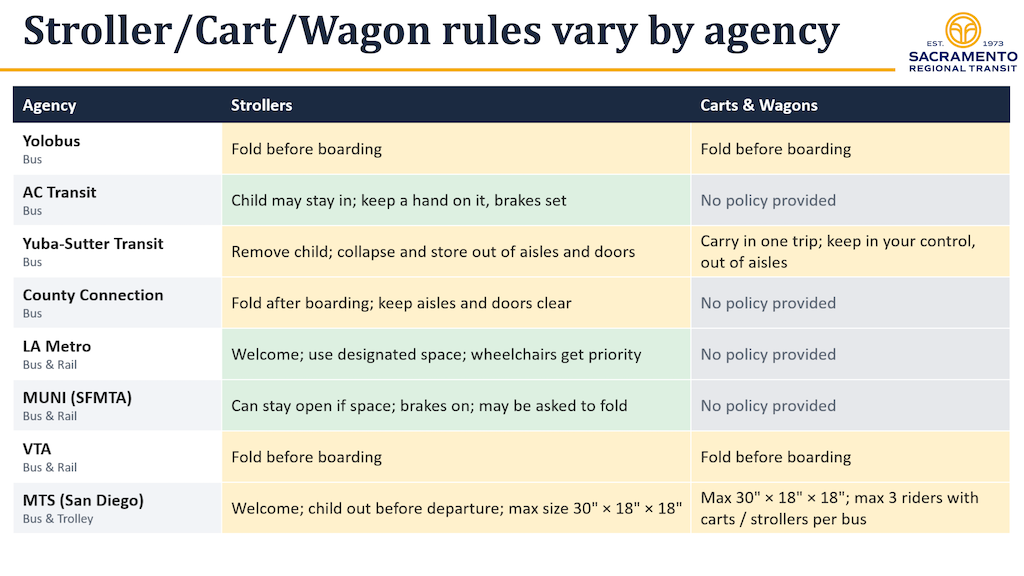
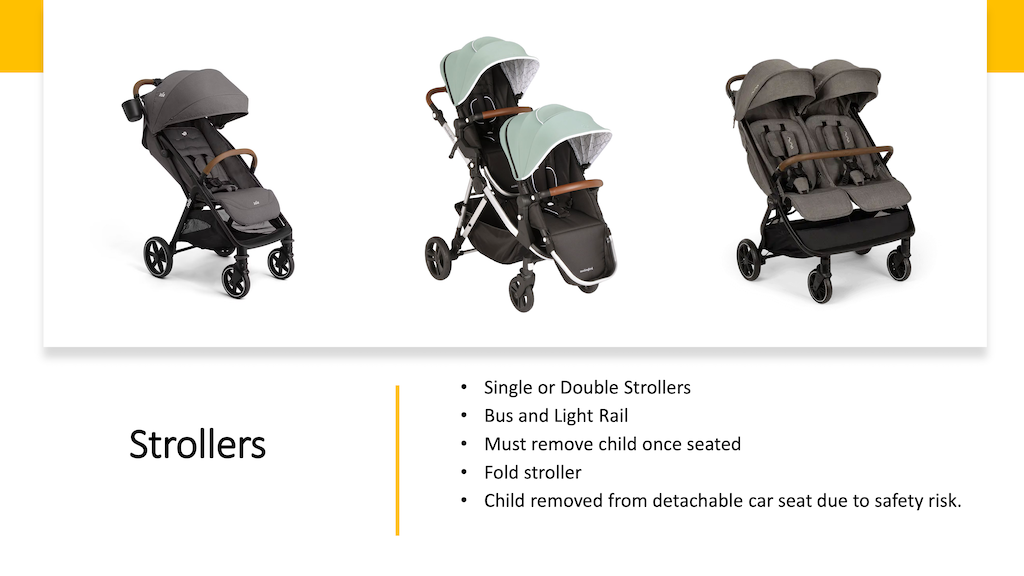
The suggested policy for strollers is an improvement over the apparent existing policy that requires the child be removed and the stroller folded before boarding, allowing be child to be removed and the stroller folded after boarding. However, this is still a family-hostile policy.
Why does SacRT feel that it must be more restrictive than major transit agencies? Does it have any actual safety informations to present? Or is this just a continuation of archaic policies that no one gave any thought of to begin with, and are now being defended?
Carts and Wagons
This policy seems reasonable.
Bicycles
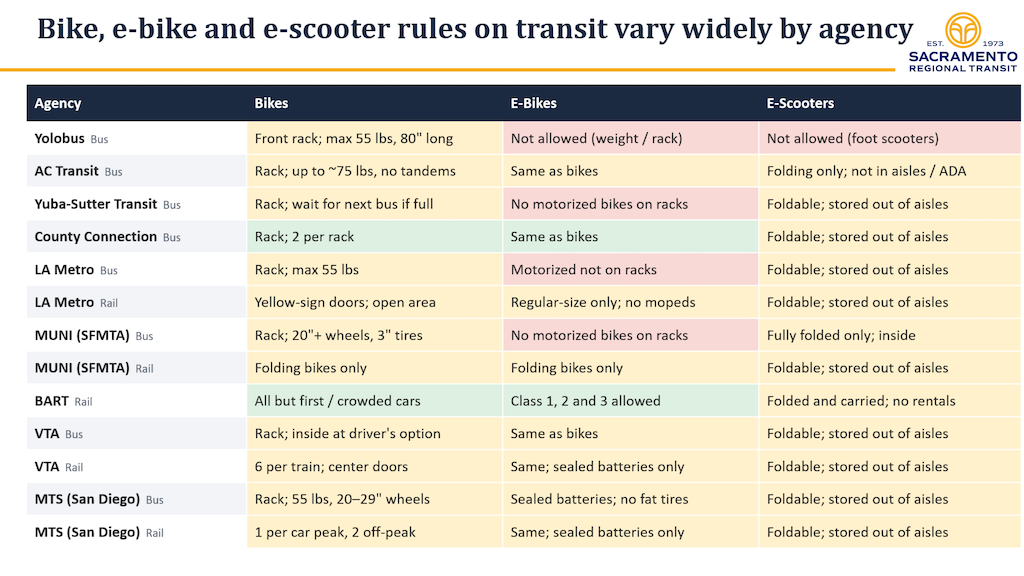
LA Metro, BART, and SFMTA Muni Metro rail cars were designed to accommodate bicycles. SacRT Siemens S700 US (ultra short) rail cars were designed to NOT accommodate bicycles, because San Diego MTS, which SacRT had a joint order, specified rail cars designed to not accommodate bicycles. This is mistake that will last as long at the S700 cars last. SacRT has made no real effort to mitigate this issue.
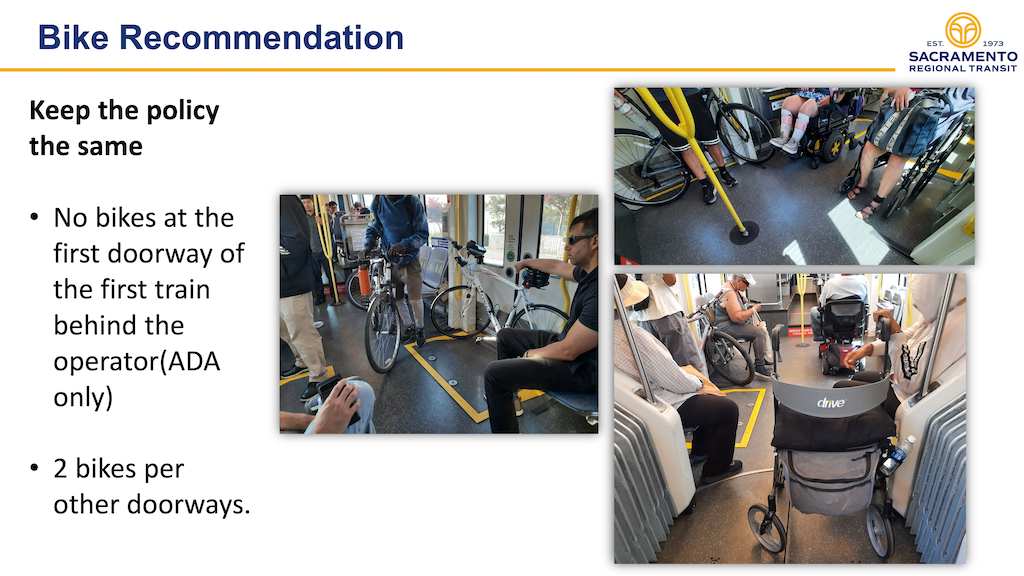
The suggested policy of no bikes at first doorway of first rail car is odd, since the first doorway is not the accessible ramp doorway. The board presentation may explain the rationale.
The ‘2 bikes per other doorways’ suggestion is actually a change from current policy of four bikes per railcar, since there are four sets of doorways on each car, meaning eight bikes. Policies must be clear and understandable by all riders, but this one is not.
The request of transit and bicycle advocates that one seat by each accessible door pair be removed in favor of a bike hook, increasing capacity by two bikes per rail car, has apparently not been considered.
Bicycle Lockers
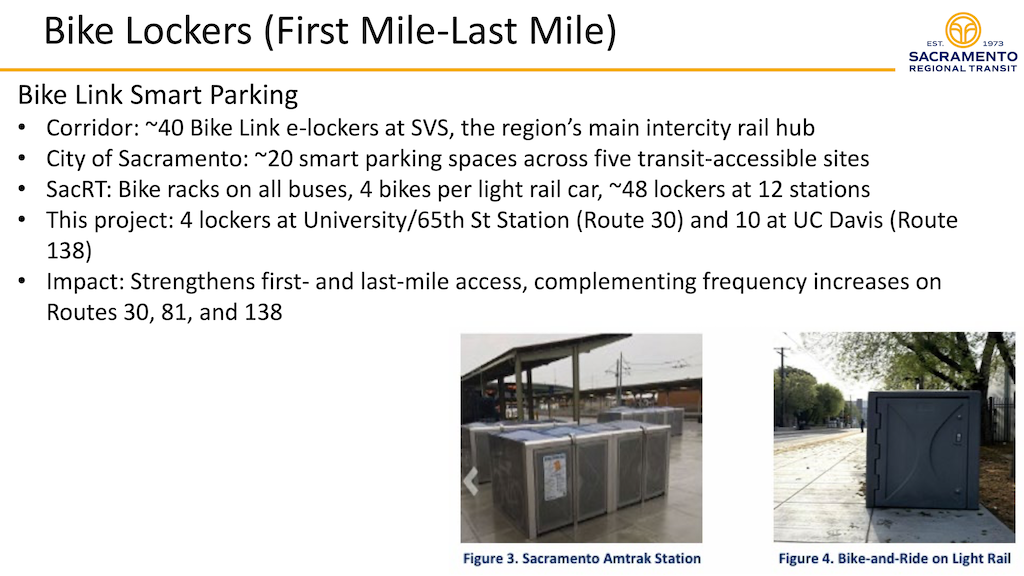
Bike Lockers (slide 11) mentions bike lockers.
Slide 4 of the 2026-09-28 agenda 3.1 presentation mentions ‘bike lockers’ but without any additional information. I have not found any other mention of bike lockers in board agendas. I assume the SacRT count of about 48 lockers at 12 stations is the rental lockers which are very lightly used. It is not clear what ‘This project: 4 lockers at University/65 St Station (Route 30) and 10 at UC Davis (Route 13)’ refers to. I have not found any mention of purchasing and service agreements for bike lockers in board agendas. If there are to be new BikeLink e-lockers at University/65th St and Davis, that is great, but it would be useful to have more information. It isn’t clear why just Route 30 is mentioned, when University/65th St is a transit hub with light rail and buses.
The front bike racks on buses work well. It would be great to have a policy that bikes may be brought on-board if the front bike rack is full, for the last bus of the day only.
Technology
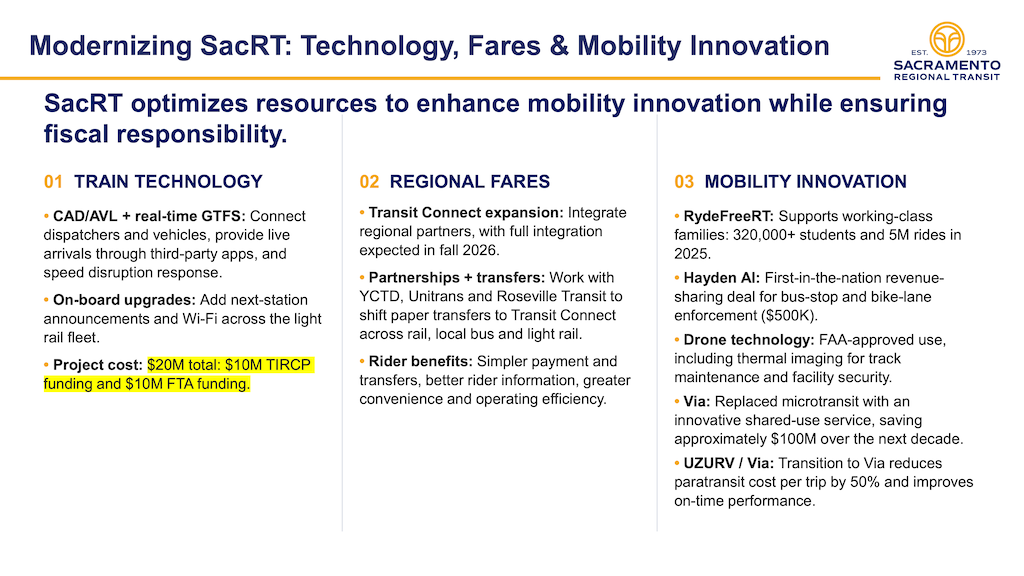
Modernizing SacRT: Technology, Fares & Mobility Innovation (slide 12) mentions several enhancement. Real-time GTFS has been requested for years, and almost every major transit agency has had this capability for years. Yay! Transit app, the most commonly used transit planning app, depends on real-time GTFS. CAD/AVL = Computer-Aided Dispatch/Automatic Vehicle Location. WiFi access on light rail will be great. Acceptance of the Transit Connect app by all regional transit agencies will be great (only SacRT and Yolobus accept at this time). No timeline for any of these enhancement has been provided.
Mobility advocates have expressed concern about the transition from UZURV to Via, but I don’t understand enough to comment.
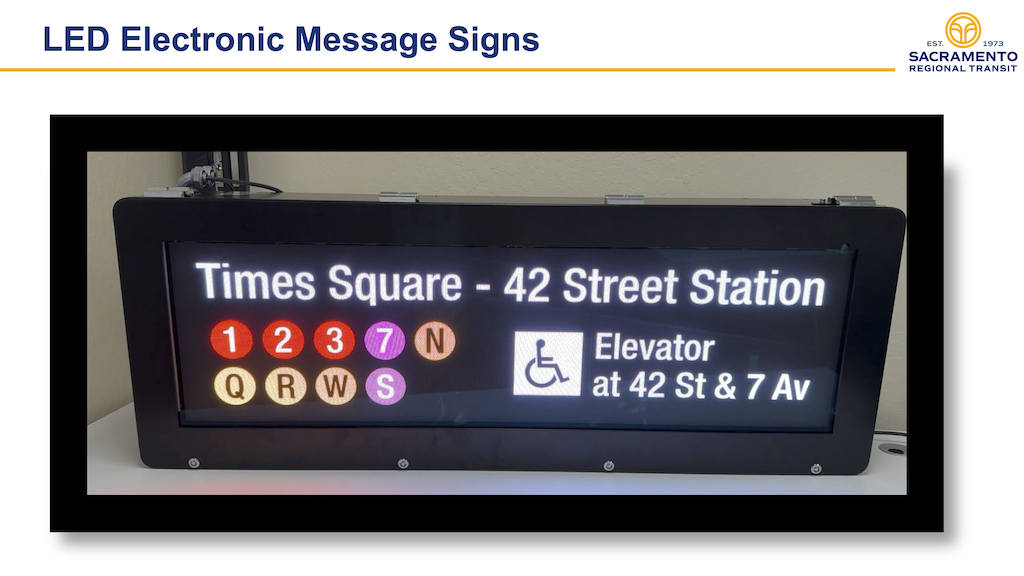
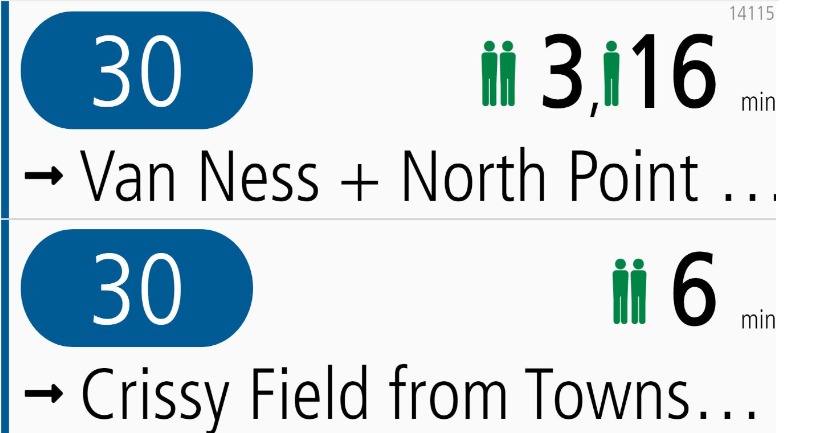
‘LED Electronic Message Signs’ (slide 13) are great. However, the sample shown is only one of many types of information. These signs can also offer next arrival for light rail trains and buses, which is the information most useful to riders. They can show bus connections at light rail stations, for example LA Metro rail cars. They can, less commonly, show maps with current train and bus locations. It is not clear what the vendor, hardware, and software selected by SacRT will offer. A contract has been awarded, for at least some signs, but SacRT has not offered a timeline. The second image below shows a SFMTA Muni real-time bus stop display. These signs also show maps in alternation.