stroller policies

As noted in a previous post (SacRT ambassador escalation, family hostility), SacRT has a regressive policy on strollers on transit, which is a family-hostile policy. I mentioned some progressive policies, but here are more details on four transit agencies. In most cases these policies were adopted after pressure from parents with young children and transit advocates, and it will likely take the same to change SacRT’s regressive policies.

SacRT often compares itself to TriMet (Portland) because the cities are similar in size. TriMet’s policy is first below.

It is apparently illegal under ADA and FTA guidelines for any transit agency to deny access to adaptive strollers for children with disabilities, or to parents whose disabilities make it impossible or unsafe to hold their child.

TriMet (Portland)

Strollers on board (Traveling with Kids)

  • You’re welcome to bring a stroller on buses and trains, but there may not always be room on board. 
  • We recommend using a folding “umbrella” style stroller. Large and double-wide strollers are not practical for use on TriMet. 
  • You can board the bus with your child in the stroller, and your baby or toddler may remain in the stroller if there is space in the priority seating area. 
  • The stroller should be positioned so that the child faces the rear of the bus and any applicable wheel locks must be secured. Make sure your stroller is not creating an obstacle for other riders. You must keep your stroller with you and it can’t block the aisle, stairs or doorway.

CTA (Chicago Transit Agency)

Traveling With Strollers (Info for parents with children)

Children in open strollers are welcome on CTA, however we encourage parents to be considerate of other customers and adhere to these rules when traveling with a stroller.

Keep strollers clear of aisles and doorways aboard buses and trains.

If a bus or train becomes crowded, please fold your stroller to make room for others. Also, if a bus or train is crowded, a CTA employee may ask you to fold your stroller or wait for another vehicle—please follow their instructions. During certain periods of high ridership, we may require that all strollers be folded before you board.

Seniors and riders with disabilities have priority use of the Priority Seating area aboard buses and trains. If these seats are not in use, open strollers may be parked in this area to help you to keep from blocking the aisle. On buses, you may also request use of the access ramp or lift to help you board and exit.

Please yield Priority Seating areas if a rider with a disability, a senior, or a person using a mobility device wishes to board. 

Children in an open stroller should be seated and secured in the stroller before boarding the bus or train. If traveling with an open stroller in a multi-level facility, please use elevators or ramps where available (strollers are never permitted on escalators). On train station platforms, position your stroller parallel to the platform edge (not facing it), use wheel locks/brakes and stay with the stroller at all times.

SEPTA (Philadelphia)

SEPTA Stroller Guidelines (Traveling with children)

SEPTA supports families, caregivers and our youngest riders by allowing open strollers onboard buses and trains. Strollers may be in the open position while riding, boarding and exiting SEPTA vehicles. Please follow the instructions of crew members as they attempt to accommodate your need for space while prioritizing everyone’s safety.

The priority seating area must be vacated to allow a person with a disability to board and ride.

  • Park open strollers in the area identified with Stroller Spot signage, when available. (Note: SEPTA has modified buses on popular routes to actually provide a spot designated for strollers.)
  • In vehicles without a Stroller Spot, park open strollers in priority seating areas and use flip-up seats.
  • Yield priority seating spaces to persons with mobility limitations.
  • Secure the child within the stroller.
  • Engage stroller brakes.
  • Hold the stroller while on board.
  • Keep the aisle and doorways clear.

Strollers on the Bus

  • In a crowded bus (full seated load), operators may ask that a stroller be moved or folded.
  • You may request the driver to kneel the bus or use the access ramp at stops that permit curb access. Not all bus stops permit curb access.
  • To avoid tipping your child out of the stroller, board the bus forward and leave the bus backward.
  • Make sure your stroller is 26” or less. Double strollers cannot be accommodated.
  • In priority seating areas, use flip-up seats by pulling the yellow handle of the seat toward you.

Strollers on the Train

  • When possible, board at doors with ADA signage.
  • Boarding trains from a low platform require strollers to be folded.
  • Strollers cannot use escalators in stations.

WMATA Metro (Washington DC)

Metro now welcomes open strollers on Metrobus

Metro’s youngest customers and those traveling with them now have one less barrier to a stress-free ride on Metrobus. Metro today announced that effective immediately, open strollers are welcome on Metrobus, replacing a policy that required strollers to be folded before boarding.

“Metro is committed to making transit accessible and convenient for everyone, and that includes those traveling with young children,” Clarke said. “This family-friendly initiative relieves a hardship many parents told us they face when riding Metrobus, and we hope it encourages more families to choose Metro.”

Those traveling on Metrobus with strollers should utilize the priority seating area with the stroller brakes locked while the bus is in motion. Strollers must not block aisles or doorways, and should be held on to at all times.

People with disabilities and seniors will continue to have first priority in the priority seating area. Metrobus operators will maintain discretion to ask that a stroller be moved or folded if they determine it is compromising the safety of other passengers.
SacRT ambassador escalation, family hostility

This morning I rode SacRT Gold Line light rail from 16th Street to Sunrise. A SacRT Transit Ambassador (see Safety and Security page for info on the program) escalated a minor issue into a major issue, for no good reason. A woman boarded with a baby in stroller. The stroller was small, and the train car mostly empty, about eight people on board. The woman and stroller were not causing any safety problem for anyone. The woman and the stroller were not blocking an aisle, a doorway, or a handicapped area (see SacRT regulations below).

The ambassador insisted that the woman fold her stroller, and said “its the law”. After some discussion, the ambassador, said, well, you are going to get a warning. Immediately after saying this, the ambassador got on her phone to ask for law enforcement backup. Of course this sent the woman into anger, since she had just been told she would get a warning, and now was being threatened with law enforcement action.

The woman and stroller were not causing any issue whatsoever for any other passenger. It was the ambassador that decided there was a problem, and created a problem. The escalation of this incident was by the ambassador, not the rider.

Law enforcement officers boarded at Sunrise. I stated to an officer that the ambassador had escalated the situation. I do not know the outcome because that was my destination, so I got off.

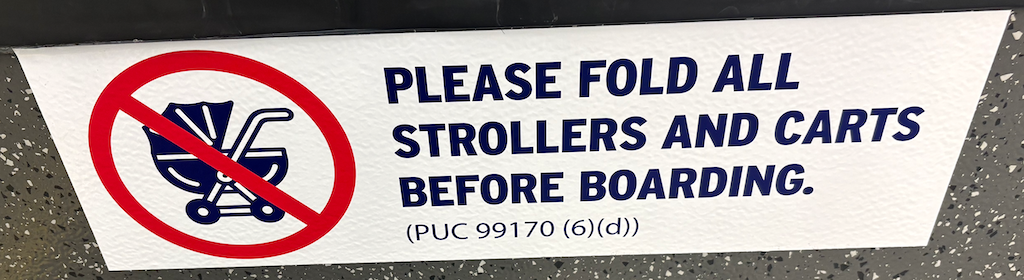
So what is the regulation that the woman was supposedly violating? The sign posted is below.

So, what is PUC 99170 (6)(d)? There is no such thing. You can look at the PUC code yourself (DIVISION 10. TRANSIT DISTRICTS, PART 11. PROVISIONS APPLICABLE TO ALL PUBLIC TRANSIT, CHAPTER 3. Miscellaneous). Perhaps the sign was intended to say (a)(6) ‘Violate a notice, prohibition, instruction, or direction on a sign that is intended to provide for the safety and security of transit passengers, or the safe and secure operation of the transit system’. Since the sign does not refer to a valid PUC code, the sign is illegal, and if any citations were given based on this sign, they should be dismissed.

What this PUC code does is allow a transit district to create regulations and supporting signs IF for the ‘safety and security of transit passengers’. Given that SacRT has not made any finding, so far as I am aware, that strollers are a safety hazard for other passengers, why did SacRT suddenly decide that this was necessary? The signs are fairly new, though I’ve been out of town for much of that last two months, so I’m not sure when they were installed. I’m pretty sure they were installed because SacRT has become an enforcement-first agency, not really concerned with riders at all.

The regulation that I found, not findable through SacRT website search, but with external search, on the Laws and Rules page, “Riding in a Vehicle with Stroller/Utility Cart unless, prior to boarding, the children or goods are removed and the Stroller/Utility Cart is folded and/or stored so that it does not block the aisle or the areas reserved for persons in wheelchairs or who use mobility aids.”

I have certainly seen large strollers that don’t fit within any area on the train (by the way, SacRT made the decision to purchase ‘US ultra-short’ versions of the Siemens cars, knowing that they did not have sufficient space for bicycles or other devices).

Where does this law-enforcement-first attitude and action come from? Lisa Hinz is the SacRT Vice President for Security, Safety and Customer Satisfaction, which includes the Transit Ambassador program. She is a former police officer with the City of Sacramento Police Department. Her view of everything is authoritarian and rule-bound. Her presentations to the board have hidden information, given wrong impressions, and included outright lies. Why SacRT put a former police officer in charge of ‘customer satisfaction’, I have no idea.

Some background. When I got on the train with my bicycle, the ambassador was standing in the space reserved for bicyclists. She refused to move. So I stood with my bicycle the entire way. The ambassador had earlier talked to a woman with a shopping cart about folding. I did not hear all of that conversation, but the other woman was not threatened with a warning, nor forced to fold her shopping cart, nor removed from the train, nor subject to law enforcement. Apparently shopping carts are not considered the threat that baby strollers are.

I did not observe the ambassador to have a positive interaction with any rider. Apparently the change from ‘fare inspector’ was just a change in terminology, not a change in approach to public service. The lead illustration on the SacRT Safety and Security page is of four officers with full gear and frowning at the camera. What message does that send to riders?

Progressive transit agencies across the US have liberalized stroller policies in order to meet the needs of parents traveling with strollers. See

While other transit agencies move forward, SacRT moves backward. This policy is family-hostile. No good reason. No surprise.

CTA (see above link) has the following text. This is what a real transit agency would do.

Traveling with strollers

Children in open strollers are welcome on CTA, however we encourage parents to be considerate of other customers and adhere to these rules when traveling with a stroller.

Keep strollers clear of aisles and doorways aboard buses and trains.

If a bus or train becomes crowded, please fold your stroller to make room for others. Also, if a bus or train is crowded, a CTA employee may ask you to fold your stroller or wait for another vehicle—please follow their instructions. During certain periods of high ridership, we may require that all strollers be folded before you board.

Seniors and riders with disabilities have priority use of the Priority Seating area aboard buses and trains. If these seats are not in use, open strollers may be parked in this area to help you to keep from blocking the aisle. On buses, you may also request use of the access ramp or lift to help you board and exit.

Please yield Priority Seating areas if a rider with a disability, a senior, or a person using a mobility device wishes to board. 

Children in an open stroller should be seated and secured in the stroller before boarding the bus or train. If traveling with an open stroller in a multi-level facility, please use elevators or ramps where available (strollers are never permitted on escalators). On train station platforms, position your stroller parallel to the platform edge (not facing it), use wheel locks/brakes and stay with the stroller at all times.