I wrote reactions to the policy suggestions that will be presented today at the SacRT board meeting: SacRT board 2026-11-09 4.1 customer service. What I did not write about is how the board should approach this.
These rider-facing policies are too important to leave to staff. Though it has never been verbalized, it seems that staff intent is that staff develop and implement the policies without board approval. The implementation of a zero-tolerance policy for all violations, without board knowledge or approval, supports this concern.
SacRT develops extensive documents, with approval by legal counsel, for a huge number of board decisions. Most of these end up on consent agenda, but some are the subject of public hearings. The current topics on strollers, carts, and bicycles are far more important than most of what is addressed by the board.
No policies on strollers, carts, and bicycles should be implemented without approval by the board.
The policies must include:
Clear language about what the policy is.
Clear language about what the potential penalties for violation are.
Clear information about what will be communicated to riders about the policy. This would include signs posted on light rail and buses, verbal announcements at light rail stations and on buses, and public outreach efforts designed to reach all riders.
Clear information about what Transit Ambassadors and other SacRT staff will communicate to riders about the policy, and appropriate responses to perceived or actual violations.
Documentation of actual safety or customer issues that justify the policy.
Documented review by the SacRT Mobility Advisory Council.
Let me be blunt. I do not trust SacRT staff to develop and implement policy on strollers, carts, and bicycles without board approval. Agenda item 4.1 is ‘for information only’, and nothing indicates that board approval will be sought for these suggestions.
Though these policies have been on the SacRT Mobility Advisory Council meeting agendas for several months, it was deferred all but one of those months, and the discussion on the remaining month was very brief. Again, this is on the board agenda when it has not previously been on the MAC agenda in any meaningful way. The next MAC meeting is November 19.
Correction: I misidentified this agenda item as 3.1. It is 4.1.
The Customer Response and Feedback slides continue to use incorrect terminology, including the words ‘modification’ and ‘medication’. The correct disability term is ‘accommodation’. Please see SacRT Board 2026-11-09 for the full agenda.
Strollers – family hostile
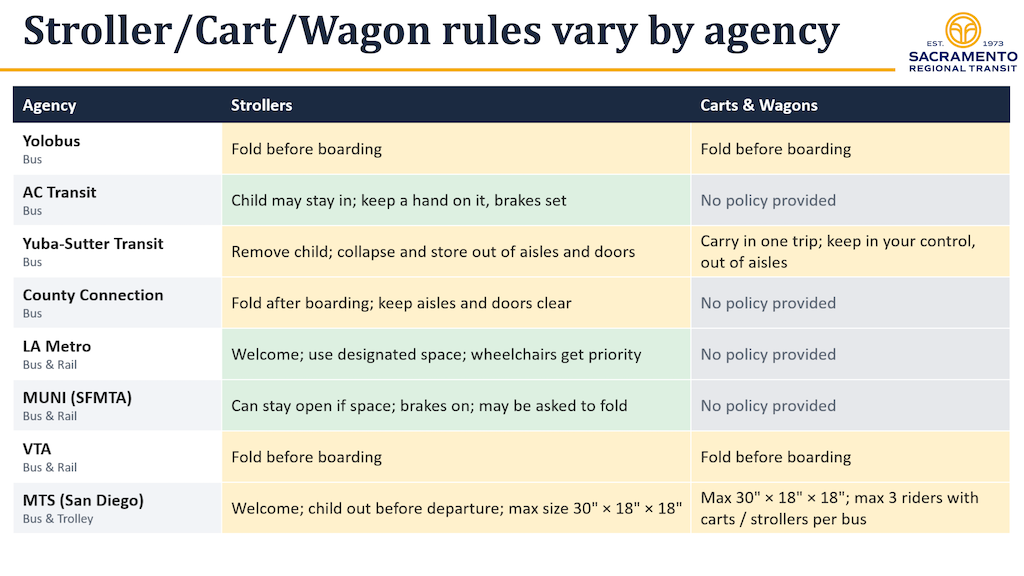
The chart of other transit agency policies on strollers shows three major agencies (SFMTA Muni, LA Metro, and AC Transit) that allow the child to remain in the stroller.
Slide 2 of Customer Response & Feedback presentation
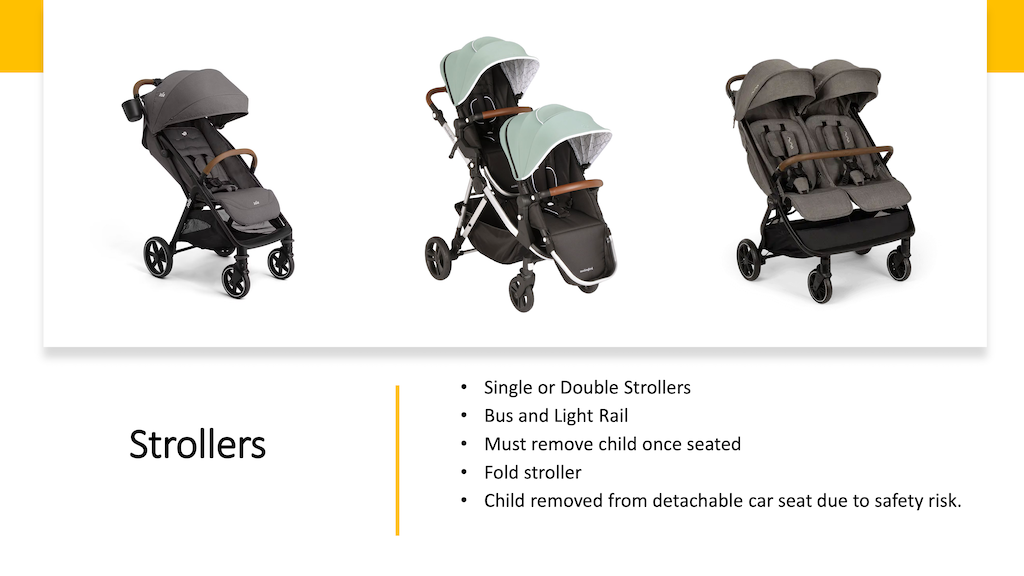
The suggested policy for strollers is an improvement over the apparent existing policy that requires the child be removed and the stroller folded before boarding, allowing be child to be removed and the stroller folded after boarding. However, this is still a family-hostile policy.
Why does SacRT feel that it must be more restrictive than major transit agencies? Does it have any actual safety informations to present? Or is this just a continuation of archaic policies that no one gave any thought of to begin with, and are now being defended?
Slide 3 of Customer Response & Feedback presentation
Added info on LA Metro code of conduct. Buses: Strollers: may be kept in the wheelchair securement area when available. Riders with wheelchairs will be given priority. Rail: Strollers: Look for the decal on the outside of the car denoting the designated space for passengers with strollers.
Added AC Transit stroller policy (for buses, AC Transit does not have rail), since SacRT staff decided to remove the AC Transit element from the slide: When boarding with a stroller, the passenger has the option of leaving the child in the stroller. At the passenger’s request, the driver will operate the lift to allow the passenger with a stroller to board more easily. Drivers are not to assist with baby strollers. While on-board, the child may remain in the stroller provided that the passenger maintains control of the stroller at all times, keeping at least one hand on the stroller while the bus is moving and the stroller doesn’t pose a safety hazard to any passenger. In no case is the stroller to be allowed to remain in a position that blocks aisles, doors, steps or emergency exits. The stroller’s brakes should be set so that the stroller will be secured and prevented from rolling and becoming a safety hazard.
Carts and Wagons
This policy seems reasonable.
Bicycles
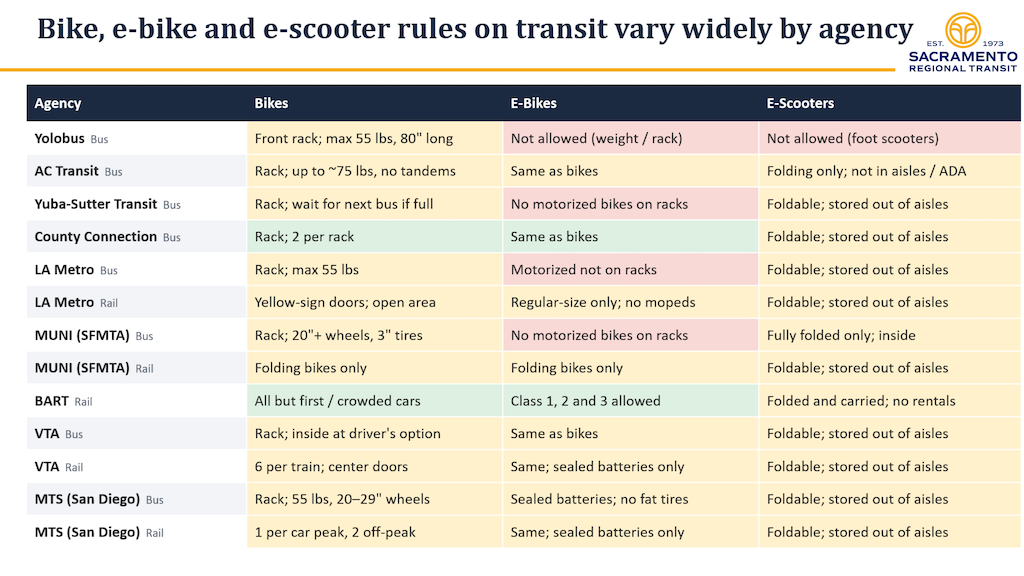
LA Metro, BART, and SFMTA Muni Metro rail cars were designed to accommodate bicycles. SacRT Siemens S700 US (ultra short) rail cars were designed to NOT accommodate bicycles, because San Diego MTS, which SacRT had a joint order, specified rail cars designed to not accommodate bicycles. This is mistake that will last as long at the S700 cars last. SacRT has made no real effort to mitigate this issue.
Slide 7 of Customer Response & Feedback presentation
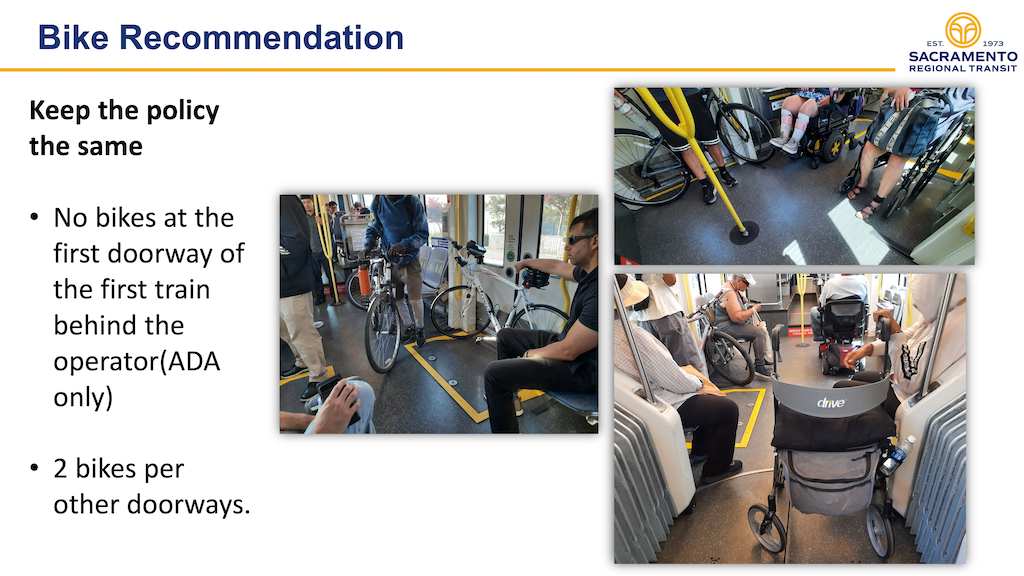
The suggested policy of no bikes at first doorway of first rail car is odd, since the first doorway is not the accessible ramp doorway. The board presentation may explain the rationale.
The ‘2 bikes per other doorways’ suggestion is actually a change from current policy of four bikes per railcar, since there are four sets of doorways on each car, meaning eight bikes. Policies must be clear and understandable by all riders, but this one is not.
The request of transit and bicycle advocates that one seat by each accessible door pair be removed in favor of a bike hook, increasing capacity by two bikes per rail car, has apparently not been considered.
Slide 9 of Customer Response & Feedback presentation
Bicycle Lockers
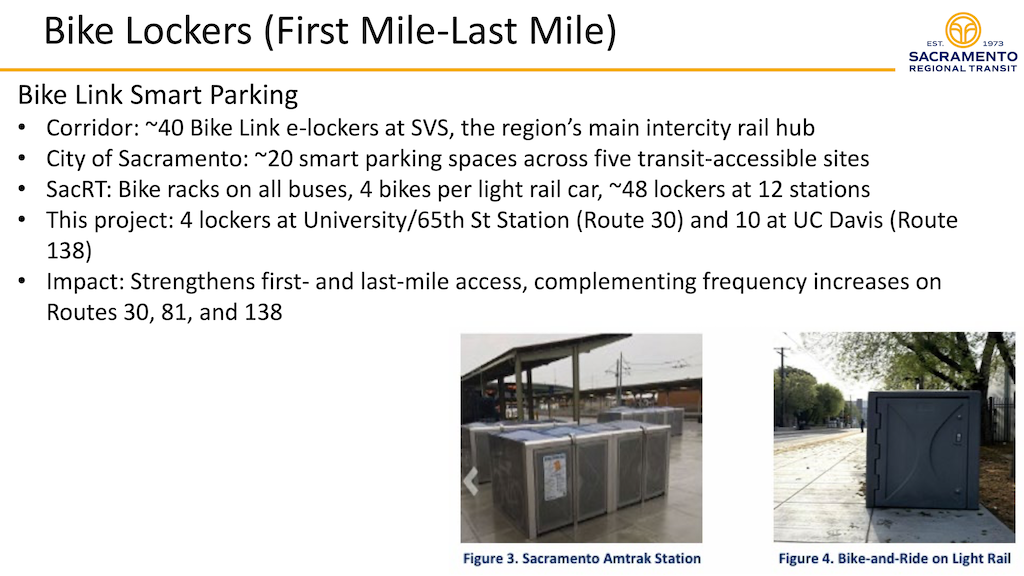
Bike Lockers (slide 11) mentions bike lockers.
Slide 4 of the 2026-09-28 agenda 3.1 presentation mentions ‘bike lockers’ but without any additional information. I have not found any other mention of bike lockers in board agendas. I assume the SacRT count of about 48 lockers at 12 stations is the rental lockers which are very lightly used. It is not clear what ‘This project: 4 lockers at University/65 St Station (Route 30) and 10 at UC Davis (Route 138)’ refers to. I have not found any mention of purchasing and service agreements for bike lockers in board agendas. If there are to be new BikeLink e-lockers at University/65th St and Davis, that is great, but it would be useful to have more information. It isn’t clear why just Route 30 is mentioned, when University/65th St is a transit hub with light rail and multiple buses.
The front bike racks on buses work well. It would be great to have a policy that bikes may be brought on-board if the front bike rack is full, for the last bus of the day only.
Slide 11 of Customer Response & Feedback presentation
Technology
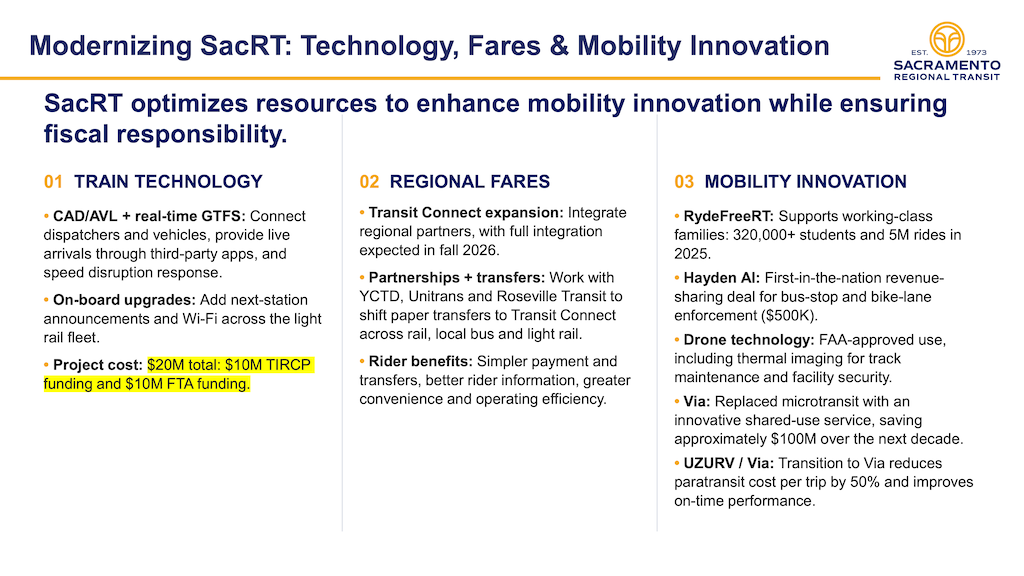
Modernizing SacRT: Technology, Fares & Mobility Innovation (slide 12) mentions several enhancement. Real-time GTFS has been requested for years, and almost every major transit agency has had this capability for years. Yay! Transit app, the most commonly used transit planning app, depends on real-time GTFS. CAD/AVL = Computer-Aided Dispatch/Automatic Vehicle Location. WiFi access on light rail will be great. Acceptance of the Transit Connect app by all regional transit agencies will be great (only SacRT and Yolobus accept at this time). No timeline for any of these enhancement has been provided.
Mobility advocates have expressed concern about the transition from UZURV to Via, but I don’t understand enough to comment.
Slide 12 of Customer Response & Feedback presentation
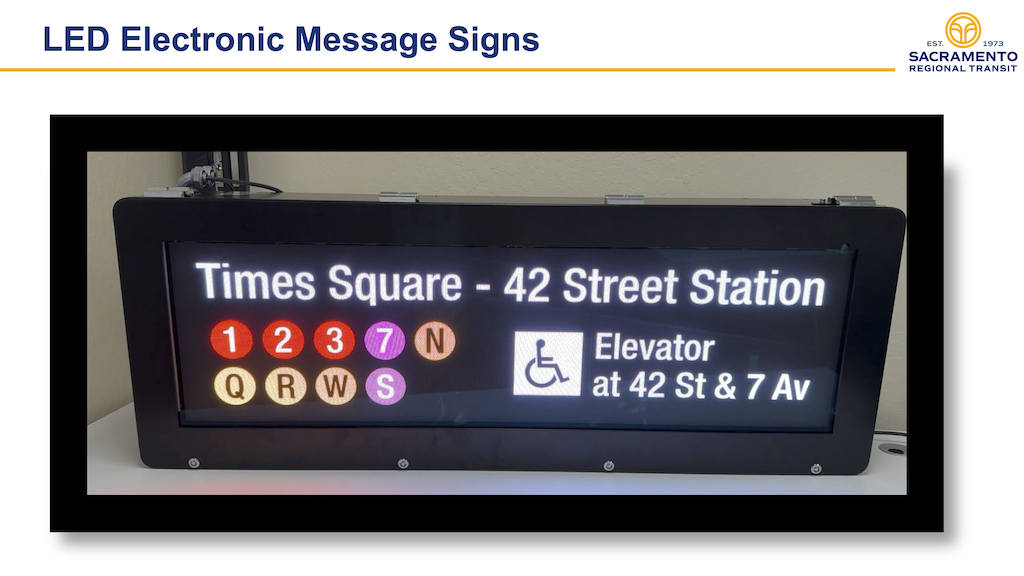
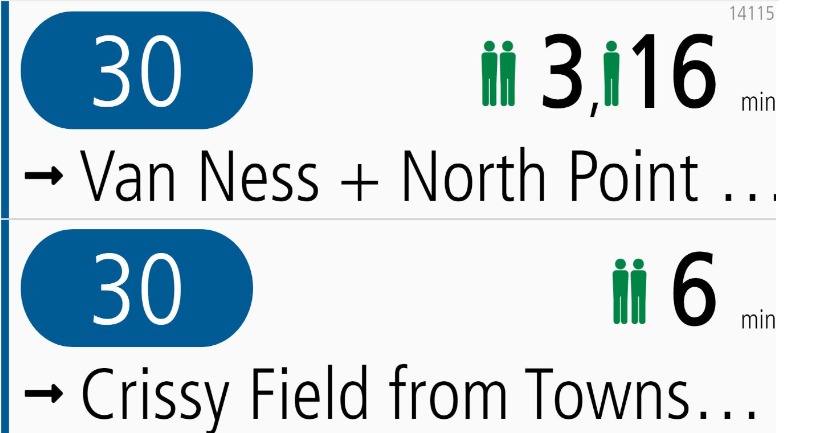
‘LED Electronic Message Signs’ (slide 13) are great. However, the sample shown is only one of many types of information. These signs can also offer next arrival for light rail trains and buses, which is the information most useful to riders. They can show bus connections at light rail stations, for example LA Metro rail cars. They can, less commonly, show maps with current train and bus locations. It is not clear what the vendor, hardware, and software selected by SacRT will offer. A contract has been awarded, for at least some signs, but SacRT has not offered a timeline. The second image below shows a SFMTA Muni real-time bus stop display. These signs also show maps in alternation.
Slide 13 of Customer Response & Feedback presentationSFMTA Muni real-time display at bus stops, with arrival and capacity information
The SacRT Board will meet on Monday, November 9, 2026, starting at 4:00 PM. The simplified agenda is below, with selected documents of interest to me, linked.
SacRT has added a ‘public participation‘ document, which addresses remote participation and comments. Comments in person and via email remain the same, as explained in the document.
I may have comments on agenda items between now and the board meeting.
2.3 Resolution 2026-11-126: Approving the Renewal of All SacRT Health and Welfare Benefits for 2027
2.4 Resolution 2026-11-127: Approval to Enter Into a Purchase and Sale Agreement with Sutter Valley Medical Foundation for Surplus Property Located in Sacramento, CA and Delegation of Authority to the General Manager/CEO to Execute One or More Grant Deeds and Lease Agreement
2.5 Resolution 2026-11-128: Approval of Building and Parking Lease Agreement (2810 O Street) with Christopher Wordlow (APN 007-0274-005)
2.6 Resolution 2026-11-129: Approving Contract for Insurance Broker Services to Alliant Insurance Services, Inc.
2.7 Resolution 2026-11-130: Conditionally Delegating Authority to the General Manager/CEO to Award a Contract for Provide and Commission Frequency Converters with Backup Battery
2.8 Resolution 2026-11-131: Approving A Good-Faith Funding Letter and Authorizing Submission of Exemption Requests from the Innovative Clean Transit Zero-Emission Bus Purchase Requirements
2.9 Approving Contract Change Orders No. 14 and No. 15 to the Contract for Low Floor Vehicle Platform Conversion Phase 2 Project with PNP Construction, Inc.
a) Resolution 2026-11-132: Approving Contract Change Order No. 14 to the Contract for Construction of the Low Floor Vehicle Platform Conversion Phase 2 Project with PNP Construction, Inc.; and
b) Resolution 2026-11-133: Approving Contract Change Order No. 15 to the Contract for Construction of the Low Floor Vehicle Platform Conversion Phase 2 Project with PNP Construction, Inc.
2.10 Resolution 2026-11-136: Delegating Authority to the General Manager/CEO to Award a Contract or Contracts for On-Call Revenue and Non-Revenue Vehicle Towing Services
INTRODUCTION OF SPECIAL GUESTS
3.1 Resolution 2026-11-134: Recognizing RiderShip for the Masses as a Transit Advocacy Champion for its Dedication and Advocacy on Behalf of Public Transportation Riders
UNFINISHED BUSINESS
4.1 Customer Service Response to Feedback and Comments: staff | presentation
PUBLIC ADDRESSES BOARD ON MATTERS NOT ON THE AGENDA*