SacRT board 2026-11-09 4.1 customer service

Correction: I misidentified this agenda item as 3.1. It is 4.1.

The Customer Response and Feedback slides continue to use incorrect terminology, including the words ‘modification’ and ‘medication’. The correct disability term is ‘accommodation’. Please see SacRT Board 2026-11-09 for the full agenda.

Strollers – family hostile

The chart of other transit agency policies on strollers shows three major agencies (SFMTA Muni, LA Metro, and AC Transit) that allow the child to remain in the stroller.
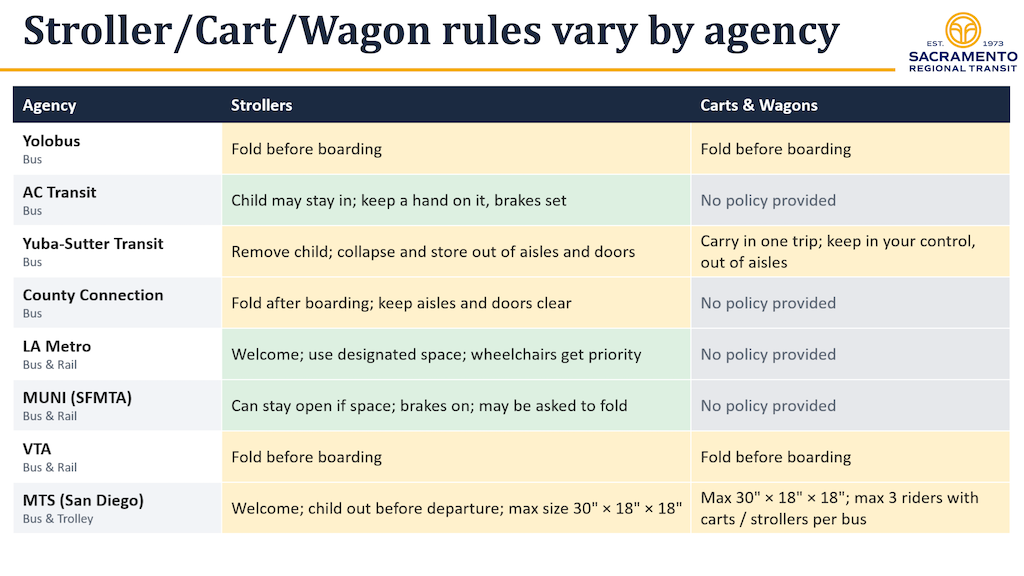
Slide 2 of Customer Response & Feedback presentation: Stroller/Cart/Wagon rules vary by agency
Slide 2 of Customer Response & Feedback presentation

The suggested policy for strollers is an improvement over the apparent existing policy that requires the child be removed and the stroller folded before boarding, allowing be child to be removed and the stroller folded after boarding. However, this is still a family-hostile policy.

Why does SacRT feel that it must be more restrictive than major transit agencies? Does it have any actual safety informations to present? Or is this just a continuation of archaic policies that no one gave any thought of to begin with, and are now being defended?
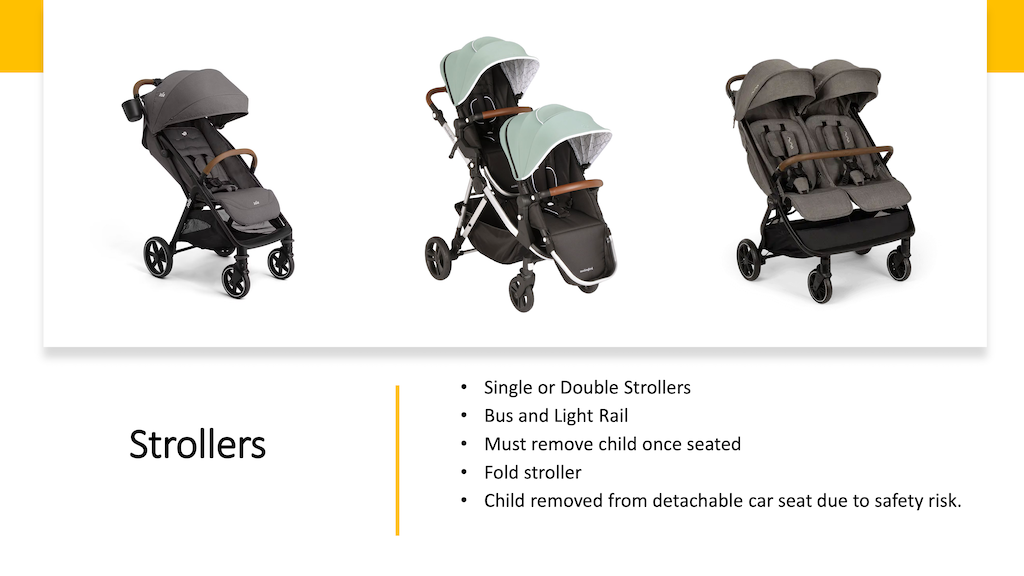
Slide 3 of Customer Response & Feedback presentation: stroller policy
Slide 3 of Customer Response & Feedback presentation

Added info on LA Metro code of conduct. Buses: Strollers: may be kept in the wheelchair securement area when available. Riders with wheelchairs will be given priority. Rail: Strollers: Look for the decal on the outside of the car denoting the designated space for passengers with strollers.

Added AC Transit stroller policy (for buses, AC Transit does not have rail), since SacRT staff decided to remove the AC Transit element from the slide: When boarding with a stroller, the passenger has the option of leaving the child in the stroller. At the passenger’s request, the driver will operate the lift to allow the passenger with a stroller to board more easily. Drivers are not to assist with baby strollers. While on-board, the child may remain in the stroller provided that the passenger maintains control of the stroller at all times, keeping at least one hand on the stroller while the bus is moving and the stroller doesn’t pose a safety hazard to any passenger. In no case is the stroller to be allowed to remain in a position that blocks aisles, doors, steps or emergency exits. The stroller’s brakes should be set so that the stroller will be secured and prevented from rolling and becoming a safety hazard.

Carts and Wagons

This policy seems reasonable.

Bicycles

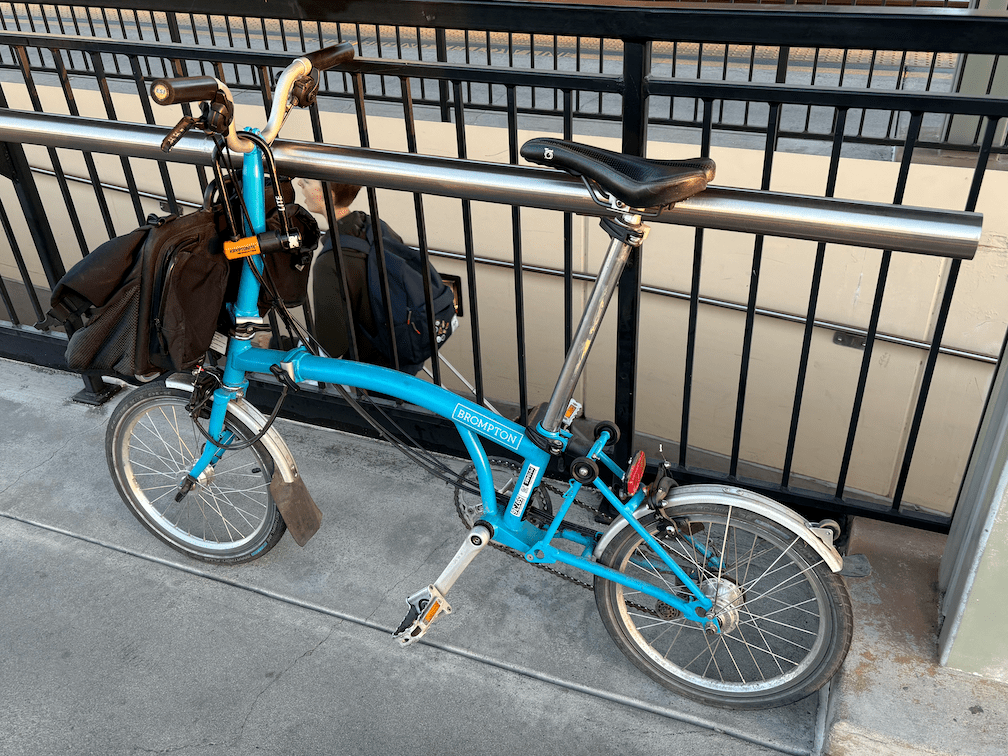
LA Metro, BART, and SFMTA Muni Metro rail cars were designed to accommodate bicycles. SacRT Siemens S700 US (ultra short) rail cars were designed to NOT accommodate bicycles, because San Diego MTS, which SacRT had a joint order, specified rail cars designed to not accommodate bicycles. This is mistake that will last as long at the S700 cars last. SacRT has made no real effort to mitigate this issue.
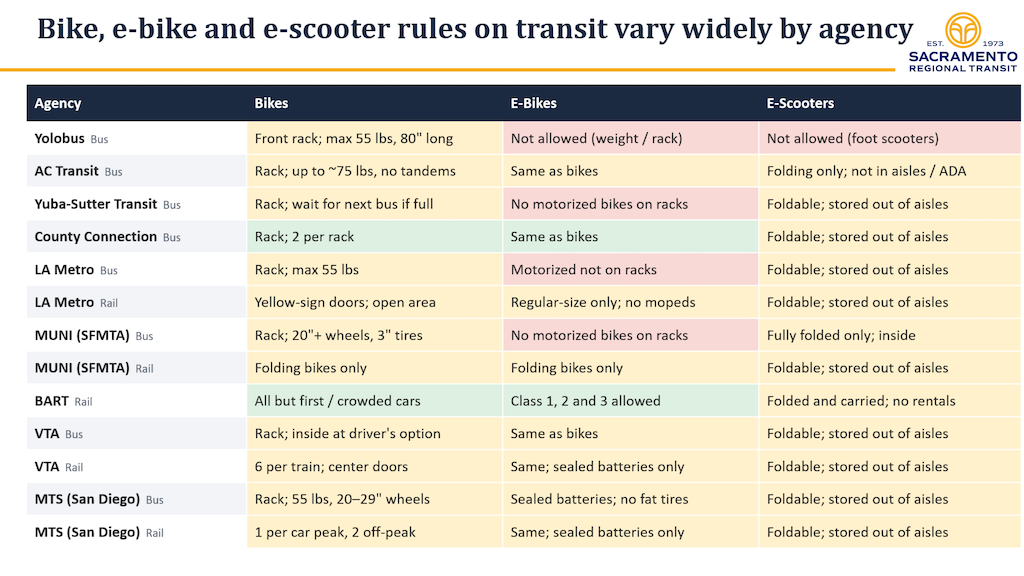
Slide 7 of Customer Response & Feedback presentation: Bike, e-bike and scooter rules on transit vary widely by agency
Slide 7 of Customer Response & Feedback presentation

The suggested policy of no bikes at first doorway of first rail car is odd, since the first doorway is not the accessible ramp doorway. The board presentation may explain the rationale.

The ‘2 bikes per other doorways’ suggestion is actually a change from current policy of four bikes per railcar, since there are four sets of doorways on each car, meaning eight bikes. Policies must be clear and understandable by all riders, but this one is not.

The request of transit and bicycle advocates that one seat by each accessible door pair be removed in favor of a bike hook, increasing capacity by two bikes per rail car, has apparently not been considered.
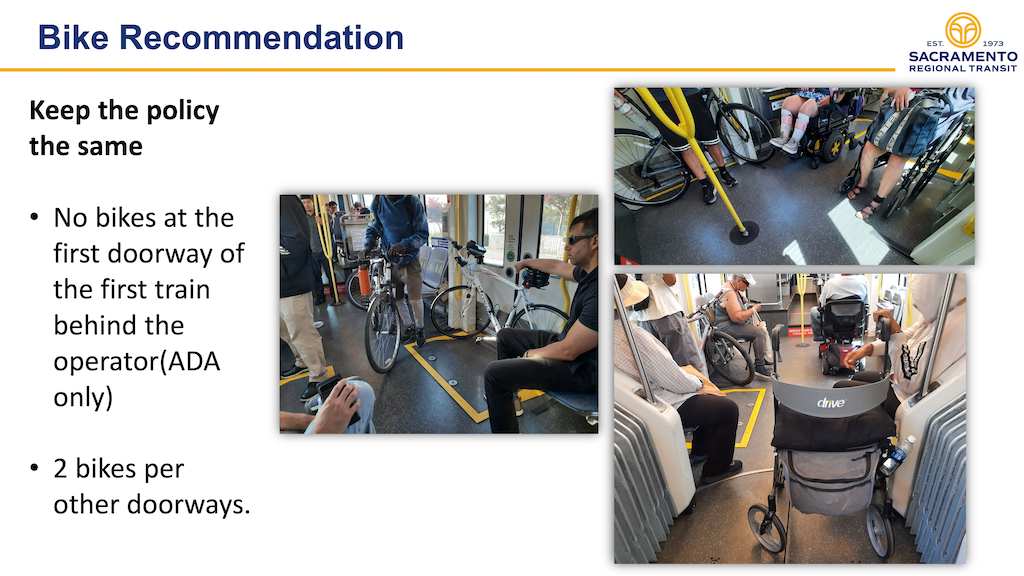
Slide 9 of Customer Response & Feedback presentation: Bike Recommendation
Slide 9 of Customer Response & Feedback presentation

Bicycle Lockers

Bike Lockers (slide 11) mentions bike lockers.

Slide 4 of the 2026-09-28 agenda 3.1 presentation mentions ‘bike lockers’ but without any additional information. I have not found any other mention of bike lockers in board agendas. I assume the SacRT count of about 48 lockers at 12 stations is the rental lockers which are very lightly used. It is not clear what ‘This project: 4 lockers at University/65 St Station (Route 30) and 10 at UC Davis (Route 138)’ refers to. I have not found any mention of purchasing and service agreements for bike lockers in board agendas. If there are to be new BikeLink e-lockers at University/65th St and Davis, that is great, but it would be useful to have more information. It isn’t clear why just Route 30 is mentioned, when University/65th St is a transit hub with light rail and multiple buses.

The front bike racks on buses work well. It would be great to have a policy that bikes may be brought on-board if the front bike rack is full, for the last bus of the day only.
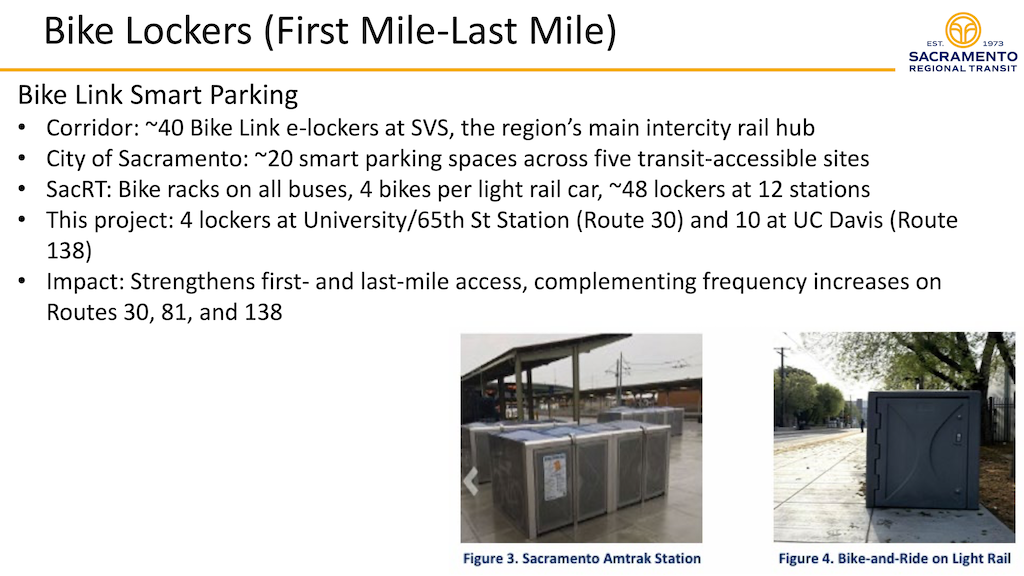
Slide 11 of Customer Response & Feedback presentation: Bike Lockers (First Mile-Last Mile)
Slide 11 of Customer Response & Feedback presentation

Technology

Modernizing SacRT: Technology, Fares & Mobility Innovation (slide 12) mentions several enhancement. Real-time GTFS has been requested for years, and almost every major transit agency has had this capability for years. Yay! Transit app, the most commonly used transit planning app, depends on real-time GTFS. CAD/AVL = Computer-Aided Dispatch/Automatic Vehicle Location. WiFi access on light rail will be great. Acceptance of the Transit Connect app by all regional transit agencies will be great (only SacRT and Yolobus accept at this time). No timeline for any of these enhancement has been provided.

Mobility advocates have expressed concern about the transition from UZURV to Via, but I don’t understand enough to comment.
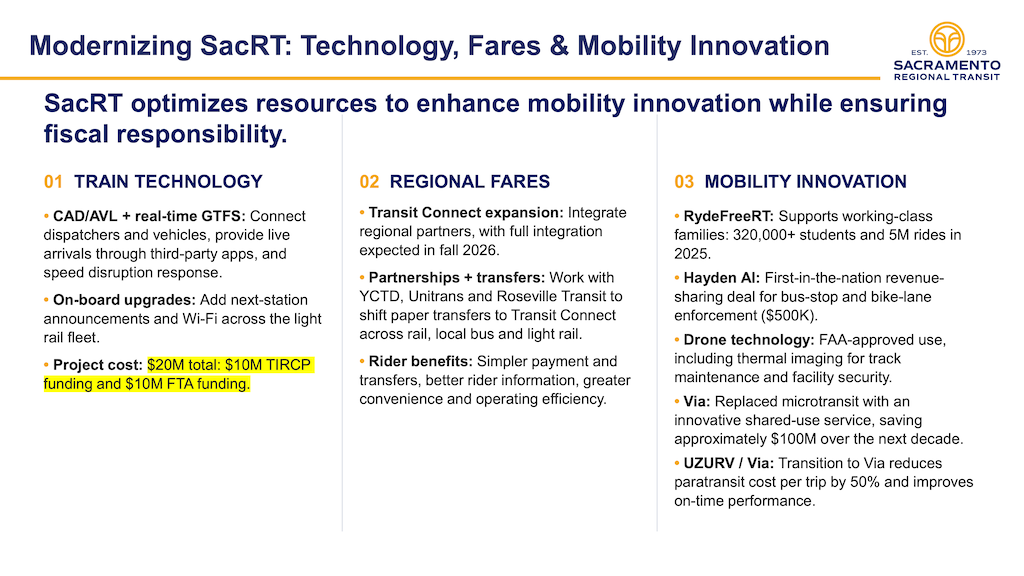
Slide 12 of Customer Response & Feedback presentation: Modernizing SacRT: Technology, Fares & Mobility Innovation
Slide 12 of Customer Response & Feedback presentation

‘LED Electronic Message Signs’ (slide 13) are great. However, the sample shown is only one of many types of information. These signs can also offer next arrival for light rail trains and buses, which is the information most useful to riders. They can show bus connections at light rail stations, for example LA Metro rail cars. They can, less commonly, show maps with current train and bus locations. It is not clear what the vendor, hardware, and software selected by SacRT will offer. A contract has been awarded, for at least some signs, but SacRT has not offered a timeline. The second image below shows a SFMTA Muni real-time bus stop display. These signs also show maps in alternation.
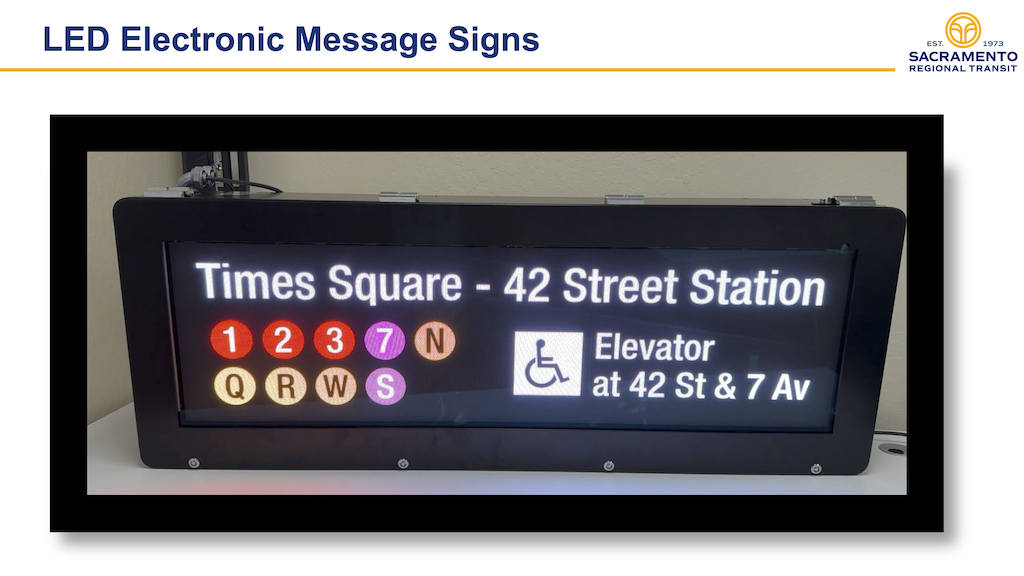
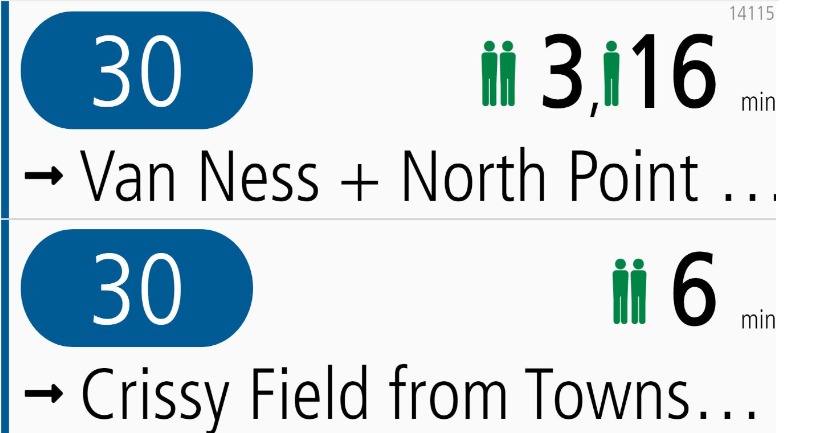
Slide 11 of Customer Response & Feedback presentation: LED Electronic Message Signs
Slide 13 of Customer Response & Feedback presentation
SFMTA Muni real-time display at bus stops, with arrival and capacity information

be the change?

I have a number of friends who are car free. Like me, they have flexibility in their lives, and time to plan traveling. But several of them also have families and manage to be car free. I recognize it is a challenge, and acknowledge them for the effort. I have a larger number of friends who are car light, own and use a car sometimes, or in some cases, do not have a car but rely on ride hail for many trips. They don’t usually drive, but do for several reasons: they are late, they have to haul more than is comfortable on a bike or walking, they have family members who need to get somewhere and don’t drive (kids and elderly), and they want to go to the mountains or the ocean, both of which are possible without a car but more awkward.

I’m not judging people for not being car free, or using a car sometimes. Life is what happens. I am privileged to lead a life where I do not want to drive, do not need to drive, and have the time to plan trips by other modes. I have no one dependent on me for transportation. I have not owned a car in 15 years, and have not driven a car in 6 years, and now I don’t even have a drivers license. I save a huge amount of money on not have a car and all the accompanying expenses, but I do spend quite a bit on train and transit travel. And I am happy with the additional time it takes to get places. I am not a stay-at-home person, I’m more active that most of the people I know.

But I challenge everyone to pause before driving. Am I driving because I am lazy, or tired? Am I driving because it seems to hot, or too cold, or too windy? Am I driving because it is more convenient or faster than other modes? Am I driving because I forgot to plan ahead to get there some other way? Am I driving because the car keys were right there by the door? Am I driving because I spent a lot of money on my car, and I feel like I need to get the value of that by driving it? Am I driving because it increases my visibility and stature with others (is my car part of how I define my worth)?

Most importantly, could I defer or cancel this trip? Is is really that important? Could I do it tomorrow, or next week, or not at all?

If you think that driving less is good for you, good for your family, good for your community, and good for the earth, then start now. One less trip a week. And another less trip next week. That is actually how I got to car free over several years, driving less and less each week, each month, each year. One attempt at a mode you don’t use, or don’t usually use. Make a plan and use transit. Plan ahead and bicycle or walk. Stay home and enjoy your home. Walk to the coffee shop or bar and enjoy the company.

Be the change you want to see.

a trip to San Rafael

Dan Allison, author of this blog, took a trip to San Rafael, California, in north bay Marin County, on Monday of Week Without Driving. To be transparent, I have been car-free for over 13 years, and car-light for about 7 years before that, so a trip on bicycle and public transportation is just the way I live life, not an exploration of the challenge that people who can’t drive face. My income is lower middle income, so I have enough money to travel, at least locally. I went to San Rafael to retrieve my phone charger and battery pack that I’d left on a Marin Transit bus last Wednesday. It took three days for Marin Transit to find the item and get it to lost and found. It was entertaining, and sad, to watch the included AirTag travel around on multiple bus routes. AirTags are bluetooth, so only report when they are close to a modern iPhone, but they do keep showing up in new locations.

So, the Monday trip:

  • bicycle from home to Sacramento Valley Station
  • Capitol Corridor train from Sacramento Valley Station to Richmond Station, $22.95
  • BART from Richmond to El Cerrito del Norte, $0.85
  • Golden Gate Transit bus 580 from El Cerrito del Norte to San Rafael Transit Center, $3.50
  • bicycle to a local coffee shop, where I worked on Week Without Driving communication
  • bicycle to Sprouts Farmers Market for lunch supplies
  • bicycle to Larkspur Ferry
  • Golden Gate Larkspur Ferry to San Francisco, $7
  • bicycle to San Francisco Bay Ferry gate G1
  • San Francisco Bay Ferry to Oakland Ferry, $2.30
  • bicycle to Oakland Jack London Station
  • Capitol Corridor from Oakland to Sacramento, $24.65
  • bicycle from Sacramento Valley Station to home

All of the public transportation was using my senior Clipper Card, on my watch. Capitol Corridor train travel was pre-purchased tickets through the app. The total was $61.25, which is rather expensive for a none day trip, but is quite a bit less than I would have spent driving. At about 83 miles there, and about 105 miles back, using the IRS rate of $0.67 per mile, driving would have cost $126. Plus $17.25 for Golden Gate Bridge and Carquinez Bridge tolls. Most people think only about gas costs, or charging costs, and forget about depreciation, insurance, maintenance, parking, and tolls.

Travel time is hard to compare, since I made so many stops along the way, and did not travel by the most direct route. Looking at the simpler Sacramento to San Rafael trip, driving would be 1 hour 20 minutes, whereas I spent about 2 hours 20 minutes on public transportation.

This is a trip that I’ve taken many times, so there was very little planning involved, and in fact I changed my plans for the leg back home several times on the fly, without problems. Less familiar trips would take more planning.

A few photos from my trip are below, but many parts are missing. I’m not used to documenting my public transportation travels, and even less for selfies.

Parkway trail management

Part three of posts on the parkway trail; part 2 Parkway trail flood signing; part 1 Parkway trail low points. This is it for now.

The Jedediah Smith Memorial Trail through the American River Parkway is a major commuting route for bicyclists from the suburbs to downtown, with some reverse commuting as well. It is also a recreational trail, getting a lot of use from recreational bicyclists, walkers, and families on weekends. It is great that one trail can serve so many purposes. However, the trail is being managed by Sacramento Regional Parks as though it were just a recreational trail. The trail is part of the transportation network in the county, and it should be managed as such, of course in a way that is compatible with its purposes of recreation and natural area conservation.

To be specific:

  1. Directional signage to indicate entry and exit points and junctions with connecting trails is almost nonexistent. Mileage/time to destinations signage is non-existent.
  2. Park ranger and maintenance vehicles regularly drive on the trail, compressing the decomposed granite walking/running shoulders that have been constructed. These then erode and become muddy, and the vehicles track mud out onto the paved trail. Much of the maintenance work could be done by cargo bike, and much of the ranger patrol could be done by bicycle, which after all works just fine for the Sacramento PD and CHP bike officers. I have never seen a regional parks employee on a bike.
  3. When the trail is closed by flooding or fire, no information is provided about alternate routes. (see Parkway trail flood signing)
  4. Low spots on the trail are regularly flooded under moderate rain and flooding events, resulting a broken network. (see Parkway trail low points)
  5. The entire parkway has remained closed after the recent severe flooding episode, but regional parks has made no effort to inform the public about the sections where easy bypasses are available, such as levee top paths (which are sometimes paved and sometimes gravel, but usually passable). For example, it has been easy to ride from Guy West bridge along the levee, duck under the overpass at Howe Avenue by using paths down to and up from University Ave, and continue on to Watt Avenue, and beyond, but instead regional parks has said the parkway is closed and has not informed anyone of these alternate route. Parts of the trail were never flooded at all, yet remain closed.
  6. Sacramento Regional Parks receives $1 million annually from the Measure A transportation sales tax in order to maintain the trail. The Sacramento Bicycle Advisory Committee (SacBAC) has questioned how the money is being spent over the years, but has never received a satisfactory answer. It is possible the money is being well spent, and I’m sure the trail is expensive to maintain, but regional parks is not being transparent.
  7. There are almost no user facilities on the western end of the trail between Watt Avenue and Discovery Park. A drinking fountain at Howe Avenue was removed three years ago and never replaced. There are no bathrooms in this section, other than the smelly pit toilet at Watt Avenue and the almost unusable pit toilet near the Expo Parkway access point (which leaks waste into the waterway, no less). There are some benches or tables, but few and far between.
  8. Root humps regularly develop in the trail, which is natural given the riparian zone and large trees. So far as I can tell, the paint markings to flag these hazards are all made by trail users, not by regional parks. When things get really bad, they are repaired, but long after the point at which they become dangerous. The same issue exists with beaver burrow slumps, common in the section between Expo Parkway access and Sac Northern trail.

If Sacramento Regional Parks cannot manage the trail as part of the transportation network in the county, then perhaps it is time to pass along management of the trail (not the parkway) to another agency.

Please check the “Storm-Related Parks Update” on the Sacramento Regional Parks homepage.

green wave

A “green wave” is a traffic signal sequence set so that vehicles will encounter green lights for some distance, so long as they are traveling at the selected speed. A green wave can also be set for bicycle speeds, though it very rarely has been, and never in Sacramento.

To some degree, all signals are set this way, though the degree and distance of sequencing varies widely. Many of the east-west streets in the Sacramento grid have signals set for motor vehicles, and when traffic is not congested, it may be possible to go all the way across downtown and midtown on green lights, for example on J Street. Very few north-south streets are set this way, I can think of only the 15th & 16th couplet, and the 9th & 10th couplet. At intersections with the east-west couplets, these north-south couplets seem to have their green wave broken. Only if the grid spacing and the selected speed calculate out is it possible to have a green wave in all directions. Sadly, many signal sequences in the Sacramento region are set above the posted speed limit, encouraging drivers to speed so that they make all lights.

Read More »

Book of Dreams adaptive bicycles

Two of the three lead projects in the Sacramento Bee’s Book of Dreams holiday effort are adaptive bicycles:

I’ve already made a donation to both, and I’d recommend that every bicyclist donate. Adaptive bikes are expensive because they have a large number of adjustments and features for the specific individual. The donations are to a fund managed by the Sacramento Region Community Foundation.

20121121-054948.jpg

News summary 2012-05-21

The Streetsblog family of blogs (NYC, LA, SF, and Capitol Hill) has Daily News posts, and for the NYC, The Weekly Carnage. I find these useful for picking up interesting information I’d otherwise miss. Though I probably only average one click per list, it is still useful. Maybe this would be useful for Sacramento. Please let me know if it is useful, and please pass along articles that you think I might miss. The only news sources that I regularly follow are the Sacramento Bee and The Sacramento News & Review, but even there I sometimes miss things.

SacRT: bikes on RT Light Rail

Bikes and light rail are a natural complement to each other. Light rail covers the longer distances quickly, while bikes get you from your origin and to your destination, directly or via connecting bus service. I’ll post about buses later.

Bikes can be taken on all Sacramento RT Light Rail trains, without time restrictions. However, there is insufficient capacity on light rail for bicyclists, for two reasons:
1. The restriction on the number of bicycles per car of four does not reflect the current demand for bicycle space. This is a relict of a time when few bicyclists used light rail, and must be modified.
2. Passengers without bicycles occupy the end spots of the cars, seemingly in preference, precluding use by bicyclists. These bicyclists then cram their bikes into other spaces and inconvenience other passengers.

Read More »