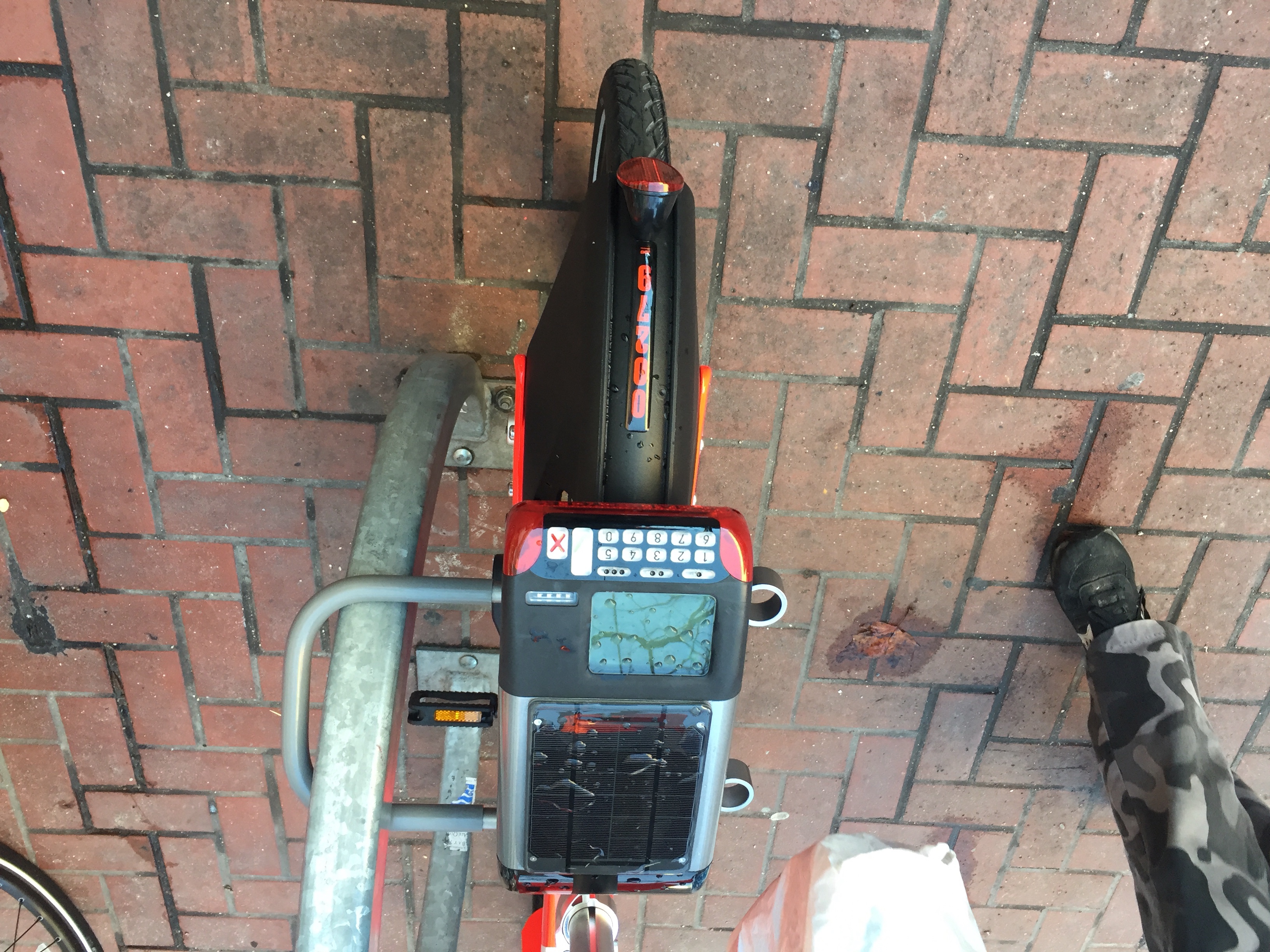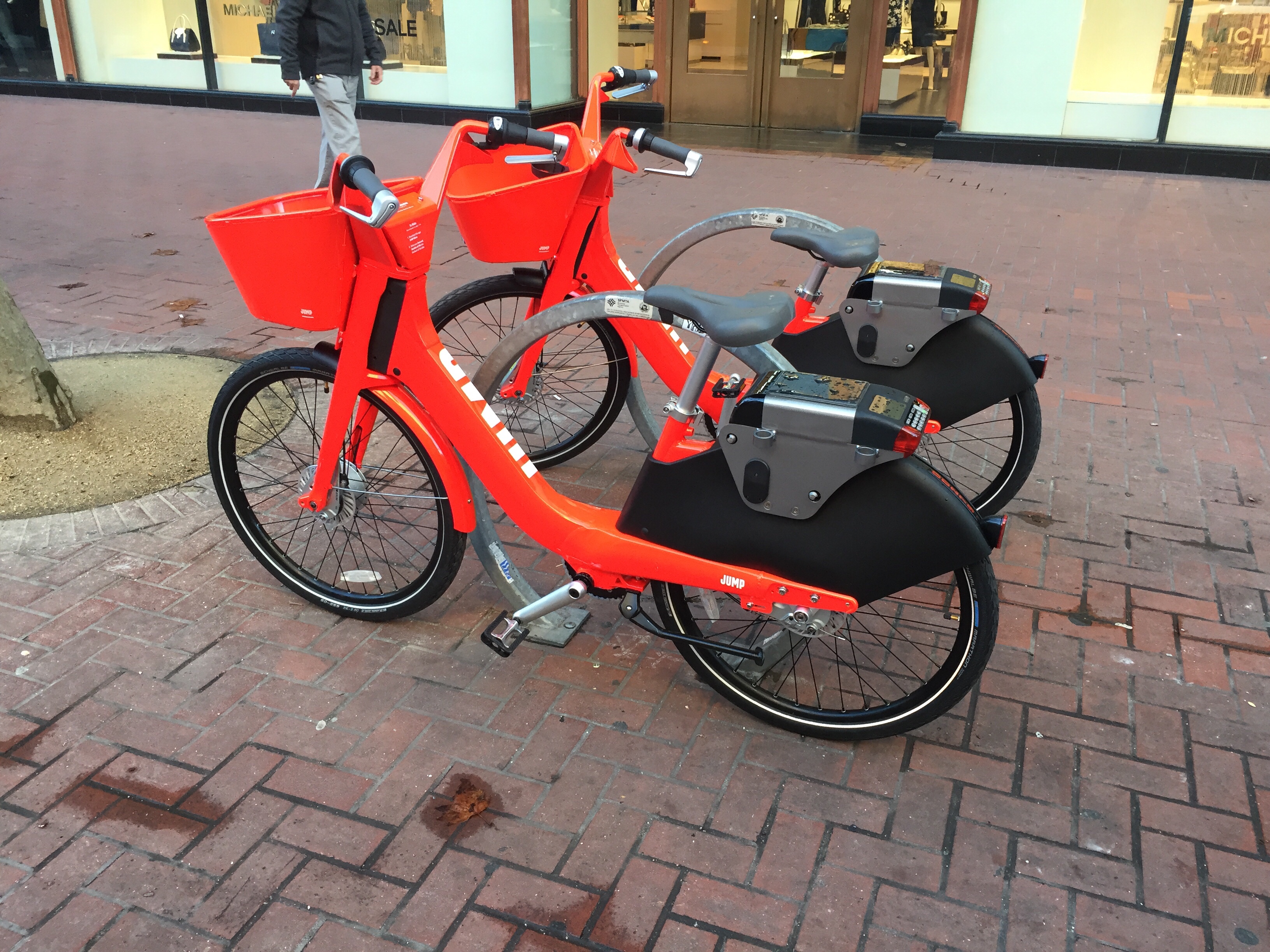
JUMP charging station at Sac City College

I thought I was through with JUMP posts for at least the day, but then I got together with Claire who clued me into the new charging hub that has been installed at Sac City College. The station is on the outside of the fence at the light rail station (which may be SacRT property rather than college property, I’m not sure). This charging hub has ten docks. So far as I know, this is the first charging hub in Sacramento, though someone else we were talking to thought maybe there were charging hubs in Davis. If you know, please comment.

I have not used this hub, so I don’t know if bringing a low battery $ icon bike to the hub earns more than the standard 50 cent credit. Let me know!

I will try to get around to the other drop zone hubs in Sacramento this week to see if any of the others are now charging hubs. Comment is you have visited any of the hubs in the region and know.

Please see my previous post on charging hubs in San Francisco for details about what they look like and how they work.

Yay!

JUMP kiosks in Santa Cruz

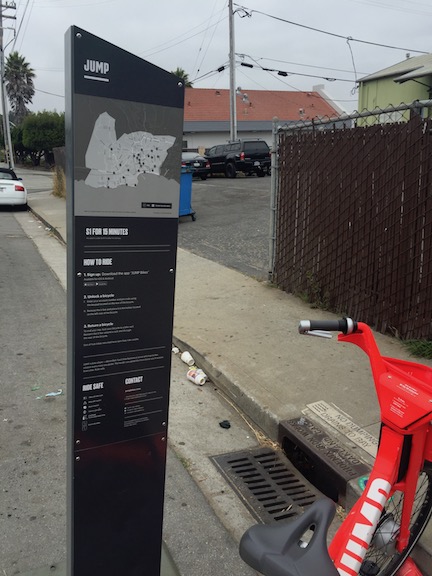
I was in Santa Cruz last weekend, which has the same JUMP system that we have here in the Sacramento region. Several of the hubs had kiosks installed, as shown to the right. The kiosk shows the map, the cost, how to rent a bike, and some safety tips. I am not sure whether Santa Cruz required these, or JUMP provided them on its own. I am not aware of any of these in the Sacramento region. I often see people standing by the JUMP bikes, looking confused. They are not quite sure how to check them out. I offer help, and it is much appreciated by most people. In fact, perhaps there should be bike-share ambassadors at heavily used locations. In Sacramento, many of the most heavily used locations are not the JUMP hubs, but regular bike racks, so I’m not sure where the ambassadors could best be located, but it is an idea.

Dock bike-share systems, such as Ford GoBike in San Francisco, have kiosks of some sort at all of their docking hubs. Most allow you to purchase passes, some just provide information, but all are oriented to help new users figure how the system works. Of course in San Francisco, a significant percentage of users are tourists who have not used the GoBike system, and may not have used bike share anywhere.

Do you think kiosks would help people here? Have you helped new or confused JUMP riders?

JUMP success!

Back in June, I suggested that the JUMP system was failing (Two weeks in – failure?). The major issues were that low battery bikes were not being picked up for recharging for several days, there were nowhere close to the 300 promised bikes, and the GPS units did not seem to be reporting correct information or communicating with the network.

We are now at 600 bikes (I think), the bikes are being picked up for charging much more quickly, the drop zones seem to be working for accumulating the bikes that needs to be charged, the GPS units and network are having many fewer problems, and most importantly, there are enough bikes out in the Sacramento central city that there is a bike available within two blocks or so. So, I’m declaring success for the central city. The number of bikes has reached a critical mass necessary for a successful system, and it is working GREAT. I have only occasionally used the bikes in West Sacramento and Davis, so can’t offer a perspective on those two cities.

Just like transit, which can be judged in part by whether a train or bus is coming soon, a bike share system can be judged by whether there is a bike easily available. There are still a few times of day, and a few locations within the central city where it may be hard to find a bike, but most of the time, they are there waiting for you.

East Sacramento, Land Park, and Oak Park are not doing as well, particularly Oak Park. There is not a sufficient density of bikes in these areas that there will be one available close by. In fact, it can be a quarter mile or more between bikes.

Another criteria for judging bike share systems is whether they are reducing motor vehicle trips. In the central city, it seems to be doing so. My impression is that there is a noticeable reduction in motor vehicle traffic, particularly in the evening. Evenings, the bikes are being used largely by young people moving between various restaurants, music venues and bars. It seems like a lot of during-the-evening travel is by bike, but I notice that many people are going home via ride hailing (Lyft and Uber), because it is late, or they are drunk, or they live outside the JUMP system boundary. I have heard from rail hail drivers that evening business is down, and from riders that the drivers are complaining about it. All of this is anecdotal, and no one has made data available yet. I’m not sure that the city would even know if there has been a shift in travel mode. But to the degree that anecdotal evidence is true, this is a good sign. More active transportation trips, fewer motor vehicle trips, is exactly what is needed.

The bikes are also being used for commute trips, and at-work errands. These bikes may only get used for the to-work and to-home trips plus maybe one more trip during the day. On evenings and weekends, each bike in the central city seems to be getting many uses a day. When I park a bike in a popular part of the central city, it is often gone within five minutes. On the other hand, some of the outlying bikes in the suburban neighborhoods are not getting much use, sitting there for several days in a few cases before someone grabs them, or they are picked up by JUMP.

No more pure office buildings downtown

The state is building several new office buildings downtown. Close to where I live, the former building at O St and 12th is gone, and will be replaced with a modern office building, and the block between O and P and 7th and 8th is seeing a new building. There are others planned, and there is a plethora of state-owned surface parking lots (a travesty of land use if ever there was one) that could be developed.

It is good, in a sense, to see the state aggregating scattered offices into more centralized locations. But what is not good is that the state is not building any housing to go with the offices. So most employees will still be driving in from the suburbs, creating air pollution and rush hour congestion in the process, while contributing nothing to life in the central city. Almost every new building, whether public or private, has some retail, at least a corner and sometimes the whole ground floor. But integrated housing and office is rare.

So, my modest proposal (in the Swiftian sense) is that every office building of one-quarter block or larger include housing for at least one-quarter of the employees of the building. Not just the daytime office drones, but the maintenance staff as well. Some percentage should be required affordable, probably 20% to cover the lower income maintenance and clerical staff. I am not saying the the residences should be limited to employees of the building, I’d leave it up to each building manager how they wanted to allocate housing.

I have mixed feelings about whether this should be required of private developments. Certainly there should be codes and city support for accomplishing the same objective in private development, but requirements, not so sure. But state owned buildings, yes, absolutely, every one of them.

I lived in midtown, close to the downtown boarder, for seven years, and have now lived in downtown, near the midtown border, for just under a year. I moved all of five blocks. These two places might as well be in different cities. Downtown is dead, dead, dead at night and on weekends, whereas midtown is alive weekdays, evenings, and weekends. The difference? I think it is primarily the lack of housing in downtown. Office towers do not make for a livable, walkable place.

Bike share is booming

I had a mindset for the last three weeks that the problem with the JUMP system was that bikes were not being used because they were not being charged and re-balanced. But my observations this weekend show that I had things flipped. The system is getting used so much that the bikes are running out of battery. Everywhere I went in the central city, I saw people riding them. I’d see a bike parked, and ten minutes later it was gone, in use by someone else. I don’t know when JUMP will provide rides-per-bike data to the partners, but I think it will indicate that, at least on weekends, each bike is getting many trips per day.

The app map this morning showed almost no bikes in the central city, and what there were were in low-battery status. On my walk, I saw five bikes in very low battery ‘in repair’ status, all within a few blocks of my home. Another had a dead GPS battery, which I think happens when they stay in ‘in repair’ mode for a long time. The bikes are still in the central city, but they are out of juice because they have been used so many times.

Two things users could do to help:

  • If you find a dead GPS battery bike, with the display blank and the keypad unresponsive, email JUMP at support@jumpbikes.com to let them know the location, street and cross-street. Include that it is in Sacramento, or West Sacramento, or Davis, as the bike numbers alone don’t pin down which city the bike is in.
  • If your destination is within a block, or perhaps two, of a hub, park at the hub. That not only makes it easier for the next person to find it, but makes it easier for the JUMP field crew to find it, particularly if it eventually goes to dead battery and drops off the system.

No hub or rack near your destination? You can submit location requests to JUMP at the same support@jumpbikes.com email address. There are a number of locations which have been identified for hubs but not yet installed. Some of them in repurposed parking spaces, marked with thick white lines and two delineators. But it doesn’t hurt to submit an already planned location, so go ahead. SACOG has promised a map of future hub locations, but I’ve not seen it. Presumably it will show up on the SACOG Bike Share page: https://www.sacog.org/bike-share.

credit for bike returns, someday

JUMP just implemented in San Francisco a credit for returning low battery bikes to ‘drop zones’. At the moment, the only drop zone in San Francisco is the Bluxome Street warehouse which I wrote about In SF. So far, there are no drop zones in Sacramento at all, though if the San Francisco pattern holds, the first would be at the JUMP distribution warehouse (no, I don’t know where it is – anyone else know?). The SoBi warehouse was near the 65th St light rail station, but I don’t know whether JUMP is there or someplace else. I had heard it was going to be in West Sacramento.

On my JUMP app, bikes are appearing with the $ bike icon. I don’t know if that is true of other people’s apps, I may have something that not everyone else has because I’m a member of both San Francisco and Sacramento systems, or because I’m an early adopter and frequent user. Anyone else?

If I tap on this icon, it offers a credit for returning the low battery bike to a drop zone, however, this is false for Sacramento; there is no drop zone and there is no credit. I’ve reported it to JUMP support and I presume they will fix it.

So, when will this come to pass in Sacramento? I don’t know, but I’ll let you know when I do.


more on JUMP Sac

Chris sent me a capture of the map from the JUMP app for Sacramento, which reminded me that a picture is worth a thousand words. At this scale, the bikes and hubs are just dots, but zooming in reveals that of the 39 hubs on the east side of the river, three have one bike, one has three bikes, and all the others are empty. There are only eight bikes out of hubs, for a total of 14 bikes. That’s it! There may be a few bikes in motion, but Sunday evenings in Sacramento are pretty slow, so there would not be many.

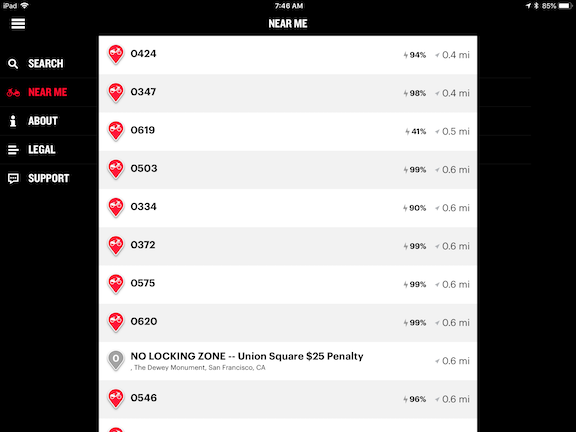
Here is another perspective. This morning I captured the list of bikes available from where I was staying in the Tenderloin. Keep in mind that the Tenderloin is the least bike-rich area urban San Francisco, but there was a bike 0.4 miles away, with nearly a full charge, and nine bikes within 0.6 miles, only one of which was low on charge.

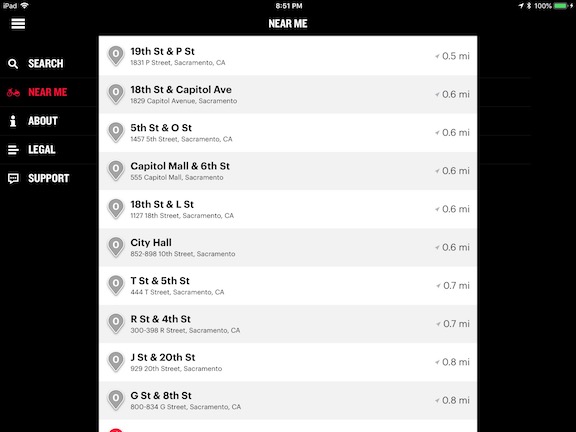
Sacramento? These was captured this evening (Sunday about 9:00PM). There is not a single bike at any hub within 0.8 miles of where I live. And I live in the central city. On the second page of locations, there are six bikes, 0.9 to 1.2 miles away, but only one of them has an acceptable charge.


Bike share and bike racks

The announced JUMP bike share coming to Sacramento (Sacramento, West Sacramento and Davis) is fuzzy on details. The announcement says “SACOG and the cities of Davis, Sacramento, and West Sacramento are currently permitting the bike share hub locations and are beginning public engagement.” The implication is that the system will be dock-optional, with hubs located in common areas and a small fee for not parking the bike at a hub, just like the existing SoBi Tower Bridge Bike Share Preview. However, the two existing JUMP systems, in Washington DC and San Francisco, are truly dockless, not dock-optional. There are no hubs, at least so far, though SF is considering some hubs to encourage people to leave the bikes at charging stations.

The JUMP bikes are of the same basic design as the SoBi bikes, they have a GPS unit and a locking U-bar that is meant to lock to bike racks or other fixed objects. Many other bike share systems such as LimeBike have a self-locking wheel lock (like European bikes), and cannot be locked to a rack. The Zagster system I used in Ashland is a hybrid: there is a cable for locking to a hub, which the bike must eventually be returned to, and another cable for locking to racks or other objects when stopping off as part of an errand trip.

When I used JUMP bikes in SF last weekend, one end of my trips had ample bike racks, but the other end did not. At the far northern edge of the geofenced system area, in a residential neighborhood, I searched four blocks without finding a bike rack, and finally used a post that was not a good location as it may have partially blocked access to a building and to parking spots. It was only there for about 20 minutes, so I felt OK, but it really brought home that a dockless system that requires bike rack use, as does the JUMP system, needs ample bike racks to work.

In the Sacramento central city, some areas have ample bike racks, but many areas, particularly neighborhoods to the east, and state building and office building areas, do not. So if the Sacramento system is to be dockless, and if it is to be successful, the city will have to install many more bike racks, in a hurry. West Sacramento and Davis probably have a similar need, but I’m less familiar with them.

My suggested criteria for bike racks is that one or more be visible when standing on a corner at any intersection, anywhere within the service area. I think electric bikes can be a great substitute for ride hailing (Lyft and the company that shall not be named), and a great complement to transit, but only if a person can find a bike close to their origin, and leave it close to their destination.

Jumping ahead (bike share update)

I rode a Jump e-bike in San Francisco yesterday. This was the first day that the program was open to the public, though there had been a low-income pilot going on for several months previously. The bright red (vermillion) bikes are pedal-assist. If you don’t pedal, they don’t go anywhere. But if you do, they really jump out. Though I haven’t ridden any really steep SF hills yet, the bike handled moderate hills with ease. I did ride most of the way across SF and back, and a chose a somewhat more hilly route than I normally would have.

Jump is operated by the company formerly known as Social Bicycles, so the GPS units and locking bar will be familiar to anyone that has used the Tower Bridge Preview bikes in Sacramento. The brakes are different, much stronger, as they should be for a bike that will go 25 mph. There are “gears,” but theses feel different with the pedal assist. The Jump system in SF is truly dockless, unlike the existing Sacramento system which is dock optional. There are no hubs or stations, the bikes can be locked at any bike rack within the system area. On the first day, the bikes were in clusters, with large areas uncovered, but they may become more dispersed over time. The coverage includes two of the lower income neighborhoods in SF, Bayview and Mission, so the user profile may be different than in Sacramento and for the existing Ford GoBike dock system in SF. There is a good article about Jump on SFgate: Jump rolls out San Francisco’s first stationless e-bike system.

The bikes must be recharged every few days, depending on use, and there are no charging stations at least so far, so rebalancing will probably be done as part of recharging. The company reported to me that they are considering hubs, but haven’t located any yet, pending data about use patterns. There seems to be a charging port on the right side of the bike below the handlebars, but it doesn’t look to me as though it was designed for docking/charging stations.

So, back to Sacramento. SACOG and partners have announced that the expanded system in the Sacramento region will use Jump e-bikes rather than the pedal bikes in the Tower Bridge pilot. It is not clear in the announcement whether the Sacramento system will be dockless or dock-optional. I think I prefer dock optional as more of the bikes will be in known locations, but with active rebalancing and recharging, dockless probably works.

The additional hubs (racks with geofences) that we were promised back in September are still not online yet, though most or all of the locations are installed. The most prominent lack is that there is still no hub at Sacramento Valley Station, even though that is the most common non-hub location where bikes get parked. With a May 15 promised opening of the different Jump system, I’m wondering if these other hubs will ever be online.

The 50 additional bikes arrived, though. They have black fenders and baskets. Unfortunately, the practical effect of the additional bikes has not been large. Before the new bikes, the Sacramento side had 20-25 bikes, and it now has 25-30 bikes, though it should have about 50. The bikes are often out of service, mostly due to gearing problems. If you have ridden the bikes, you’ve noticed that the gears slip on many of them. Sometimes this is just irritating, but sometimes it makes the bike unridable. Though this might be a maintenance issue, I suspect it is a design flaw.


The email I got when I joined Jump SF is below:

Hi Dan,

Thanks for joining JUMP SF!

Your account is now active!

Your account number is XXXXXX. Please store this number in a safe place as you will use it to access our e-bikes.

IMPORTANT SAFETY INFORMATION

JUMP is bike share–electrified. When riding the e-bike, start slowly to get familiar with its boost. You’ll feel motor assistance as you pedal. The harder you pedal the more boost you’ll feel. Be sure to try out the brakes to get a feel for stopping.

• JUMP brakes are powerful! Brake early – brake gradually.

• Ride slowly down steep hills.

• Use both brakes together at all times.

• Do not bike one-handed! Do not text while biking!

• Braking hard while riding one-handed is dangerous.

• If you are a heavier rider, ride cautiously down steep or long hills and keep your speed low. Weight limit: 210lbs.

STARTING YOUR RIDE

When you’re ready to take your first ride, enter your account number and PIN using the keypad on the back of the bike. Remove the gray U-bar and place it in the holster loops on the back left of the bike. Adjust the seat height and test your brakes.

PAYING FOR YOUR RIDE

JUMP bike rides cost $2 for the first 30 minutes and just $0.07/minute after that (plus applicable taxes). Your ride begins when you book a bike and ends when you lock a bike.

ENDING YOUR RIDE

At the end of your ride, lock the bike to a public bicycle rack within the designated system area. Bikes should always be visible from the street, and never parked on private property, in parking garages, or in parks. Improper bike locking fees may apply. If you’re ever unsure, check the system area map. Locking the bike outside of the SF system area will result in a $25 fee.

OUR BOOST

On a full charge our bikes can travel around 30 miles with pedal assist. While we do have teams regularly servicing our fleet, please understand that the bike you rent might not be at full charge. If you are riding a bike and the pedal assist runs out, please press the repair button on the bike’s keypad when ending your rental, and lock the bike to a bicycle rack. We will take care of it from there.

Please do not travel outside of the system area unless you are comfortable pedaling without the electric assist should the battery run out. Fees for retrieval of bikes due to low battery outside the system area may still apply.

RESERVING YOUR RIDE

You can walk up to a bike and check it out, or reserve one through the app. The clock starts ticking once the reservation is made. Bikes reserved in advance can be held for up to 10 minutes. Reservations will be canceled automatically if the bike is not unlocked within that time.

HOLD FEATURE

Need to make a short stop on your trip? The HOLD function guarantees that the e-bike is yours for up to 60 minutes. Press the “HOLD” button and lock the bike to a rack. Please note that reservation and hold time count toward your total minutes of riding time.

LINK CLIPPER CARD

You can link your Clipper card after unlocking the bike for the first time. Once unlocked, click Menu > Link Card > Start. Now hold the card directly up against the keypad buttons and wait for the screen to say “Success.” Next time you want to rent the bike, hold the card to the keypad to reserve.

For riding tips and safety information, please see our FAQ. We encourage all JUMP members to wear a helmet while riding. Don’t have one? Visit one of San Francisco’s many bike shops to pick one up, and if you’re a San Francisco Bicycle Coalition member, you can get 10-15% off!

You can learn more about our system and policies by reading our Rental Policy

Thank you again for joining. We think you will enjoy JUMP!

The JUMP SF Team

support@jumpbikes.com

Separated bikeway demo on P St

The City of Sacramento has created a demonstration separated bikeway on P Street (westbound) between 15th and 13th streets. Separated bikeways, also known as protected bike lanes and cycletracks, are becoming common in progressive cities, but this is the first in Sacramanto. Yesterday the city held a “ribbon cutting” on the facility, with Mayor Steinberg and Councilmember Hansen speaking and visibly excited. The demonstration will be there through Friday, then removed. The purpose of the demonstration is to show the public what a separated bikeway looks like and how it works, and gain community feedback on the project. The city wants to install parking protected separated bikeways on portions of P and Q streets, and a buffered separated bikeway on a portion of 10th St (map below), so the demonstration hopefully will lead to permanent installations. 

I was amazed at how quickly drivers adapted to the parking change. Most of the spots were filled with properly parked cars, even though the parking didn’t open until after the morning rush on parking. I was also noted that when the project was already set up for the morning inbound rush hour, there was no congestion on P St. This is the type of project that benefits drivers, bicyclists, and even people parking. 

On of the questions about these facilities is how they interact with transit. The demo was placed on the left (south side westbound) to avoid interacting with buses. However, Route 6 Land Park and Route 38 P/Q Streets are low frequency 60 minute routes that should not strongly influence street allocation. An easy solution to having both separated bikeways and bus stops on the same side of the street is bus boarding islands within the parking lane or buffer, so that the bikeway passes behind the island. 

I encourage you to get out and see, and use, the demo, and then provide your feedback to the city. The city will host an Open House on October 9 from 5-7 p.m. at City Hall. If you can go, please do! I’m sure there will be people there complaining about loss of a lane, and loss of parking (though there is only a slight decrease), and about change in general, so the city needs to hear from enthusiasts (we want it NOW) and thoughtful ideas for how to improve projects and install in more places. More information is available on the CityExpress page, and the Downtown Bikeways Project page


More photos on Flickr: https://www.flickr.com/photos/allisondan/albums/72157686958079110