An article today in the Sacramento Bee is about two traffic fatalities on Freeport Blvd, but also does an excellent job of summarizing the city’s lack of general fund investment and action street safety, and over-dependence on long-term grant funded projects. Yay, Ariane Lange for the excellent reporting on roadway safety and solutions, and the real people who are the victims of poorly designed roadways and traffic violence.
The city’s solution to fatalities and severe injuries on our our streets has been the Vision Zero effort and Vision Zero Action Plan (2018), and related documents. This resulting in a focus of grant applications on corridors with a high level of traffic violence, the high-injury corridors. For more posts on Vision Zero, see tag: Vision Zero. What has not occurred since 2018 is a significant increase of city general funds to address traffic safety. Since that time, Sacramento Police Department has largely ceased traffic enforcement, while their budget has continually increased, though there are strong safety benefits for people of color in that reduction of enforcement which tends to be pretextual and biased.
The city council has repeatedly suggested allocation of some general funds to traffic safety and fixing roadways, but City Manager Howard Chan, and perhaps Public Works, has resisted this. With the departure of Chan, this may change (more to come on that). The city has no program for quick-build projects, though a few have happened. The city’s transportation budget goes to pavement maintenance (which is a good thing, as your roadways are in poor condition for everyone), new capacity expansion, and grant matches. Almost none goes to quick-build solutions.
I am not suggested dropping the approach of grant applications for big projects, as those long-term projects are important. What I am suggesting, and the SacBee supports, is investment in fixing some of the worst roadway designs, now rather than someday.
When a fatality or severe injury occurs for walkers and bicyclists, people often ask, what can we do right now to prevent or reduce the severity of the next crash? This topic has come up a number of times at the Sacramento Active Transportation Commission (SacATC), and communication from Slow Down Sacramento and the Safety Forum, Civic Thread, SABA, Strong SacTown and other organizations.
Based on the successful program from Oakland, I am proposing that the City of Sacramento develop a similar rapid response program.
The City of Sacramento would establish a pilot Rapid Response Program with an initial budget of $100K. The pilot program would address only fatal crashes. The budget will likely be insufficient, as Sacramento has a state-leading level of fatal crashes, but the pilot would allow the city to develop expertise and program structure, and formulate a future budget. The city might respond only to fatal crashes on the high injury network, in order to extend the budget.
A Rapid Response Team will include a city planner and city traffic engineer, and may include responding law enforcement officer and walking or bicycling advocate (Civic Thread for walking and SABA for bicycling, paid for their time). I intentionally say the law enforcement officer who responded to the crash. Other law enforcement officers would likely offer only uninformed opinions and victim blaming, though the experience could be useful for educating officers about street design.
The team will review existing documents and data, and then visit the fatal crash site within two work days of the crash, or the death of a person resulting from an earlier crash.
The team will make a report within five working days which identifies and proposes quick-build features (countermeasures) to reduce or eliminate infrastructure hazards, with prioritization based on effectiveness.
The quick-build features (countermeasures) may include:
Refreshed crosswalk
Refreshed pavement markings
Temporary curb extension with flex posts
Temporary modal filter (traffic diverter) with flex posts
Temporary traffic circle with flex posts
New marked crosswalk
Changed or added signing
Temporary new stop sign; permanent stop sign would require additional analysis
Changed signal timing
At least one quick-build feature (countermeasure) will be installed within 10 work days of the site visit. Additional temporary features will be designed and scheduled.
I had previously mentioned mapping of crashes and related data by the city, because the state SWITRS system is always too far behind. I had previously mentioned a dashboard on crashes. However, these would probably best be implemented after the pilot year.
The City of Oakland Department of Transportation (OakDOT) Safe Streets Division has developed a Rapid Response Program to immediately address street infrastructure that contributes to fatal crashes.
The City of Oakland Department of Transportation (OakDOT) seems to have the best program I could find on the Internet. This is not surprising – since being formed in 2016, OakDOT has led on developing programs for safer streets that are informed by equity. Unfortunately, no single document on the program is available from OakDOT, but several presentations, case studies, and examples serve. Safe Oakland Streets (SOS) is Oakland’s version of Vision Zero.
“Rapid Response Projects: OakDOT seeks to eliminate traffic fatalities and severe injuries while promoting safe, healthy, equitable mobility for all. OakDOT’s efforts to make streets safe include rapid responses to fatal and severe crashes involving the most vulnerable users of Oakland’s roadways. A Rapid Response is a coordinated effort in the days and weeks following a traffic tragedy that may include investigations, targeted maintenance, near-term improvements, and the identification and prioritization of longer-term capital needs.”
The two elements most relevant to rapid response are:
Maintenance Treatment: If the crash location has a maintenance issue that may be related to traffic safety e.g., pavement defect, faded striping, missing sign), the maintenance issue will be rectified by field staff.
Quick-Build Improvement: If there are design treatments that could be implemented quickly at low cost, engineering staff will prepare the design and issue a work order for field staff to construct.
A presentation to Oakland BPAC summarizes the program well and provides some examples.
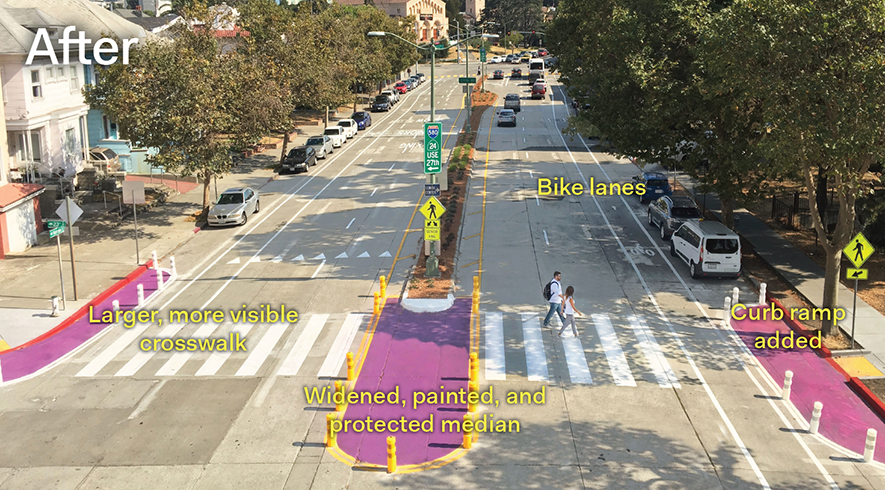
Two examples are below, Harrison Street and the streets surrounding Garfield Elementary School.
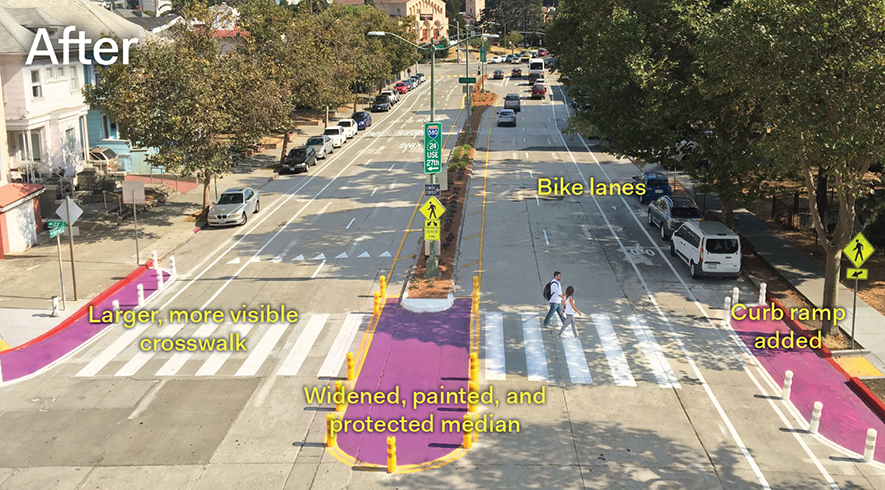
OakDOT photo Harrison St & 23rd St showing quick build improvements resulting from Rapid ResponseOakDOT graphic of safety improvements at Garfield Elementary School
OakDOT has a Crash Prevention Toolkit with photos of solutions, most of which are inexpensive and quick to implement.
OakDOT Crash Prevention Toolkit excerpt
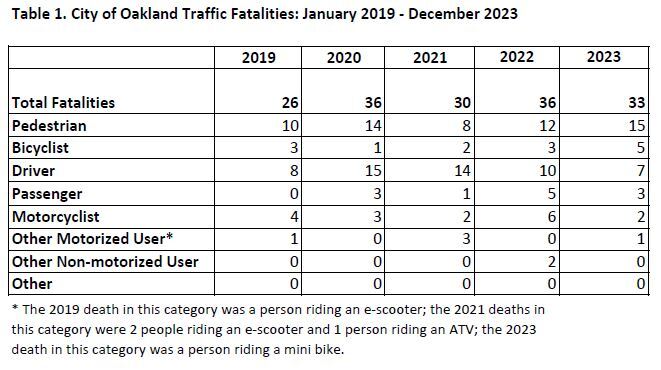
OakDOT offers a map with locations of fatality crashes and relevant features such as high injury network and equity, Traffic Fatalities, City of Oakland. A chart, below, also shows yearly data for modes of travel. A Crash Analysis Infographic also communicates data visually.
OakDOT chart of traffic fatalities by mode over time
Note: This post has been significantly revised and published as two separate posts, one on OakDOT’s Rapid Response Program, and the second a proposal for a City of Sacramento program.
When a fatality or severe injury for walkers and bicyclists, people often ask, what can we do right now to prevent or reduce the severity of the next crash? This topic has come up a number of times at the Sacramento Active Transportation Commission (SacATC), and communication by Slow Down Sacramento, Civic Thread, SABA, and other organizations. I believe now is the time for the City of Sacramento to establish and fund a crash rapid response program.
OakDOT Rapid Response Program
The City of Oakland Department of Transportation (OakDOT) seems to have the best program I could find on the Internet. This is not surprising – since being formed in 2016, OakDOT has led on developing programs for safer streets that are informed by equity. So far I have not found a single document that describes the program and procedures, so I’ve selected some information from the Safe Oakland Streets (SOS) and related pages and documents. Safe Oakland Streets is Oakland’s version of Vision Zero.
“Rapid Response Projects: OakDOT seeks to eliminate traffic fatalities and severe injuries while promoting safe, healthy, equitable mobility for all. OakDOT’s efforts to make streets safe include rapid responses to fatal and severe crashes involving the most vulnerable users of Oakland’s roadways. A Rapid Response is a coordinated effort in the days and weeks following a traffic tragedy that may include investigations, targeted maintenance, near-term improvements, and the identification and prioritization of longer-term capital needs.”
“A Rapid Response may be activated for traffic crashes resulting in pedestrian or bicyclist fatalities, or severe injuries to pedestrians or bicyclists who are youth or seniors. A Rapid Response may be activated for additional crashes based on the individual circumstances of a crash.”
The two elements most relevant to rapid response are:
Maintenance Treatment: If the crash location has a maintenance issue that may be related to traffic safety e.g., pavement defect, faded striping, missing sign), the maintenance issue will be rectified by field staff.
Quick-Build Improvement: If there are design treatments that could be implemented quickly at low cost, engineering staff will prepare the design and issue a work order for field staff to construct.
The following photos shows the setting after rapid response to a fatality that occurred at Harrison & 23rd. See Harrison & 23rd St Crash Response for more information.
photo of OakDOT rapid response project at Harrison & 23rd
OakDOT has a Crash Prevention Toolkit with photos of solutions, most of which are inexpensive and quick to implement.
OakDOT offers a map with locations of fatality crashes and relevant features such as high injury network and equity, Traffic Fatalities, City of Oakland. A chart, below, also shows yearly data for modes of travel. A Crash Analysis Infographic also communicates data visually.
OakDOT chart of traffic fatalities by mode over time
SacCity program outline
The city program should start small to make sure that there are sufficient resources of staff time and funding to do a good job. I would suggest in the first year responding only to crashes on the high injury network. Yes, those will get fixed with grants, but those are very long term projects, whereas quick fixes are also needed. An alternative would be to do only fatalities, not severe injury crashes.
A rapid response team should be composed of at least three people. One must be a traffic engineer. Others could be planners, law enforcement, and a member of an advocacy organization (Civic Thread for walkers and SABA for bicyclists). Though the participation of law enforcement may not be useful to the outcome, it is useful for educating police about street design.
It is important that the team review existing documentation and make a site visit. The full law enforcement incident report will not be available within the rapid response time frame, but sufficient detail should be available to determine the movements of the people involved in the crash.
The team should make a report within five working days of the crash, listing obvious and inexpensive fixes, prioritized by effectiveness. One or more of the fixes should be implemented within 20 working days of the crash.
Public Works staff should report to SacATC on a yearly basis on the rapid response program, the projects undertaken, staff time, and money spent. After the first year, this information should be used to develop a budget request for future years.
City of Sacramento should create a fatalities map similar to Oakland’s, with frequent updates, from SacPD information. The state SWITRS database always lags too far to be useful.
A dashboard should be developed that includes fatalities and severe injuries by type of mode and trends. SacATC has already requested a dashboard that would also show projects applied for, in progress, and complete.
As with any new program, this one would and should evolve as experience is gained and the public sees the value of the program in reducing or eliminating fatalities.
In the USDOT storymap, scroll down to the first map, Where are the Hot Spots of Fatal Crashes?, and type ‘Sacramento’ in the search box (upper left). This should be no surprise, you’ve seen this type of map before, with almost all fatality crashes located along freeways and arterial roadways (which are also called stroads or traffic sewers). Note that ‘Sacramento shows all of the city, but not the city boundary, and most but not all of the county.
If you scroll on top of a map, the storymap will show background information and highlights. The county outline and the legend will also show automatically at times when scrolling over a map.
Scroll down to the second map, Concentration of Roadway Fatalities, then click on the legend icon in the lower left. You will see that the county is in the high category. Again, no surprise. Sacramento County and City of Sacramento have always stood out from the rest of California in traffic violence.
Scroll down to the third map, Fatality Rate vs Population, enter ‘Sacramento’, and click on the legend icon. This is different, with the area falling in the low fatalities/high population quadrant. The second map of this series, for cities 5000 to 50,000, shows the City of Sacramento as red – High Fatality, High Population. I don’t know why, as the city does not fall in that population category.
The significance of the third map is that data is rarely presented this way, as a rate over population. It is almost always shown as a rate over vehicle miles traveled (VMT).
Scroll down to the fifth map, Exploring Fatalities and Equity, enter ‘Sacramento’ and click on the legend icon. The pink dots show pedestrian fatalities. Don’t be thrown by the large blocks of red, and these are low population area where this type of map does not represent the underlying data and its significance.
Scroll down to the sixth map, Vision of Zero Deaths, enter ‘Sacramento’ and click on the legend icon. The City and other other cities in the county are shown as ‘one year’, one year out of the six without a traffic fatality.
I’m not sure this storymap reveals much that wasn’t already known, and in most cases already mapped on this blog, but maybe you will see more to it than I do. Comments welcome.
The City of Sacramento adopted Vision Zero in 2017, and developed a Vision Zero Action Plan in 2018. The plan identified five high injury corridors for projects to slow traffic and increase safety for walkers and bicyclists. The city then developed a plan for these five corridors in 2021. The city has obtained grants for some of these corridors, and will apply for more. The city lowered speed limits in a number of schools zones (though street design, drop-off/pick-up procedures, and motorist behavior are the issues in most school zones, not speeding). The city also developed a public outreach education program, though there is no evidence of such programs having any effect on driver behavior (NHTSA and California OTS have thousands of programs with no demonstrated success). So far, so good.
But…
The city has intentionally ignored high injury intersections, unless they are on one of these corridors. No grant applications have been made to fix intersections, though intersections are where most fatalities and severe injuries occur. No non-grant actions have been taken to fix high injury intersections.
The city has failed to set up a crash investigation team to determine causes and solutions for every fatality. The police department (or CHP if the crash occurs on a state highway) will do an investigation, and sometimes involve traffic engineers, but never involves planners, never involves experts in nonprofit organizations (who have as much if not more expertise than city staff), and never involves citizens who walk and bike.
The Vision Zero Task Force, which met in 2016 and 2017, has never met since. That means there is no community guidance for the Vision Zero program. City staff is making all the decisions on Vision Zero.
The city has ignored all the low cost options for reducing motor vehicle crashes. As just one example, the city has been asked to remove pedestrian beg buttons and create leading pedestrian intervals (LPIs) at all signalized intersections, but did only a small beg button set to auto-recall on five crosswalks, and have not increased the number of LPIs in years.
Solutions?
The city should create an effective crash investigation team, composed of law enforcement, city traffic engineers, city planners, nonprofit experts, and citizens who walk and bike, and perhaps a representative of the neighborhood association in which the crash occurred. The team should never be led by law enforcement, which has an anti-walker and anti-bicyclist windshield bias. It has been suggested that streets where fatalities have occurred be shut down until the investigation and resulting fixes are in place, which is an idea worth considering.
The city should identify the top five high injury intersections, and commit to significant changes to eliminate crashes at those intersections, within three years. And then move on to the next five. The corridor projects and intersection projects should be considered co-equal in city funded projects or grant applications.
The city Active Transportation Commission should take on a strong leadership role in advising the council on the Vision Zero program. It may also be appropriate to re-convene the task force to provide more detailed guidance to staff.
The city should implement a Vision Zero project to change all traffic signals in the entire city to auto-recall (with removal of the physical beg buttons as staffing allows) and leading pedestrian intervals.
The city should undertake a review of peer cities that have reduced speed limits city-wide, to determine whether to implement this change and how to learn from the experiences of other cities. If the review indicates that speeds can be reduced by as little as 3 mph by a reduction from 25 mph to 20 mph, the city should implement it city-wide. Similarly for higher speed streets.
The City of Sacramento has red light cameras at the following locations:
Mack Road & La Mancha Way/Valley Hi Drive
El Camino Avenue & Evergreen Street
Howe Avenue & Fair Oaks Boulevard
Mack Road & Center Parkway
Exposition Boulevard & Ethan Way
Broadway & 21st Street
Folsom Boulevard & Howe Avenue/Power Inn Road
Arden Way & Challenge Way
5th Street & I Street
16th Street & W Street
Alhambra Boulevard & J Street
The top injury intersections are:
Stockton Blvd & Broadway
Stockton Blvd & Lemon Hill Ave
Stockton Blvd & 47th Ave & Elder Creek Rd
Watt Ave & Auburn Blvd
Del Paso Blvd & Evergreen St & Lampasas Ave
Julliard Dr & Kiefer Blvd & Folsom Blvd
Power Inn Rd & Fruitridge Rd
Freeport Blvd & Florin Rd
Center Pkwy & Cosumnes River Blvd
Bruceville Rd & Cosumnes River Blvd
Franklin Blvd & Mack Rd
Notice there is no overlap. One could optimistically say that the presence of red light cameras may be making drivers safer and reducing the crashes at these locations. But I doubt it. More likely, the city is just not prioritizing high injury intersections. Of course high injury intersections change over time, as traffic patterns change, and as the city redesigns intersections to be safer, so red light camera locations need not remain static.
I ask that the city install red light cameras at all the high injury intersections. I am not asking that the city move the existing cameras to the new locations. If someone thought a red light camera was necessary at an intersection, it probably still is, and should continue unless evidence indicates otherwise.
A lot of driver-apologists claim that red light cameras are not fair, that they are installed mostly to gain ticket revenue, and that they aren’t accurate anyway. Yes, some places have installed cameras for funding, but Sacramento is not one of them. Yes, sometimes the camera systems flag a vehicle that is not running a red light, but the photos are reviewed. Even if the city were making $1M a day on red light cameras, that would be just fine with me if it prevents one death. I value life more highly than do many drivers.
I worked in Citrus Heights for several years, which has a much higher percentage of traffic signals complemented by red light cameras. My perception is that it really did make a difference. I saw very little red light running in Citrus Heights. Other violations, sure, but not red light running.
photo from City of Sacramento Red Light Running Program page
Assembly Bill 43 (Friedman), passed in 2021, allows cities to set lower speed limits in specific situations. The 85% percentile rule says that speed limits should be set at the speed 85% of drivers are going, the prevailing speed, causes speed limits to increase, as drivers reset their normal speed to be somewhat over the posted speed limit. So speed limits continue to go up and will never go down again. This legislation is the second attempt to reverse that trend and that craziness.
The bill adds to a few limited circumstances where speed limits can be lowered to include ‘business activity districts’ (now), and concentrations of pedestrians and bicyclists and ‘safety corridors’ starting June 2024. There are a lot of details that will have to be worked out by local entities before implementation.
The first bill, AB 321 (Nava), allows cities to lower speed limits in school zones to 20 mph or 15 mph. The City of Sacramento did take advantage of this earlier law to lower speed limits at 115 schools. (City of Sacramento reduces speed limit in school zones)
A few cities are moving forward to implement lower speed limits in the situations the new law allows:
there may be other cities, but an Internet search did not surface any
This option is available to all cities and counties in the Sacramento region. Which will be the first to step up and slow down?
Yes, I know that better design of the roadway is the most effective method for reducing speeds and increasing safety, but infrastructure changes are expensive and slow to be implemented. This bill will save lives and reduce severe injury in the meanwhile.
The City of Sacramento has 11 red light camera locations: Red Light Running Program. Of these, some are at high-injury intersections, but most are not. These locations are cross-referenced with high injury intersections shown in the post Sac Vision Zero new intersections map.
Location
Top all
Top ped
Top bike
Mack Rd & La Mancha Way/Valley Hi Dr
no
no
no
El Camino Ave & Evergreen St
no
no
no
Howe Ave & Fair Oaks Blvd
no
no
no
Mack Rd & Center Parkway
no
no
no
Exposition Blvd & Ethan Way
no
no
no
Broadway & 21st St
no
no
no
Folsom Blvd & Howe Ave/Power Inn Rd
no
no
no
Arden Way & Challenge Way
no
no
no
5th St & I St
no
no
no
16th St & W St
no
no
no
Alhambra Blvd & J St
no
no
no
My first thought is that the city was putting these cameras in the wrong location. But then I thought, what if the presence of red light cameras is making these locations safer and therefore dropping them out of the highest injury intersection list. I don’t have the information to answer that question, which would take analysis of crashes at the intersections, and before/after data.
What I do know is that many more red light cameras are needed to counteract the pandemic of red light running: pandemic of red light running. I spend time around the edges of Fremont Park, close to where I live, which includes the intersection of arterial streets P, Q, 15th, and 16th, and one of the things I do is watch traffic in the intersections. It has now become rare for a signal cycle for 16th St northbound at P St to not see an incidence of red light running. The other intersections are not quite as bad, but the pattern is there. And this is happening everywhere in Sacramento that I go; these are not likely to even be the worst intersections.
I believe that most of the red light running is by egregious violators, people who routinely and continuously violate traffic law for their own convenience or thrill seeking. This is true of most traffic violations, but red light running is the one most likely to result in fatality and serious injury, for people in all modes of travel. So having a more widespread set of red light cameras would serve to catch these red light violators. Of course the follow-up is necessary, to revoke the licenses and confiscate the vehicles of these repeat offenders. The longer the city looks the other way on this issue, the more people will come to see it as normal behavior, and the less safe our streets will be.
The standard response by cars-first entitled drivers is that tickets are just a money-making scheme by the government. The purpose of red light cameras is to make streets safer, and if that results in some income, so be it. I’m more than happy to have these sociopathic drivers hit in the pocketbook, and the money can be used to make our streets safer, such as by installing more red light cameras. Red light tickets, with photos, are part of the documentation needed to revoke licenses and confiscate vehicles.
A new traffic calming feature has showed up on 16th Street approaching R Street in midtown Sacramento. Paint and flex posts have been placed between the travel lanes. Advance yield lines (‘sharks teeth’) were also painted, showing where drivers should stop when yielding to pedestrians.
16th St lane channelization
I’m not sure what to think of this. Certainly this is a problematic intersection. Cars stopped for the light rail gates between R Street and Q Street often stop throughout the intersection, blocking both the north and south crosswalks over 16th Street, as well as the intersection itself, preventing vehicles along R Street from proceeding while the traffic is stopped. As with all multilane streets, but particularly high speed, one-way arterials, drivers in one lane may stop for a walker while the others will not. I see this every day, and this intersection is worse than most. For reasons I don’t understand, traffic speeds on 16th Street northbound are noticeably higher than 15th Street southbound, even though the design of both streets in the same.
So, how’s it working. Well, I’ve so far only had the chance to observe it for 15 minutes. I’m not sure it is making much difference. About 10% of drivers stopped at or close to the advance yield lines. About 70% of drivers stopped at the forward edge of the flex posts, about 10% stopped over the crosswalk, and about 10% did not stop for people using the crosswalk. I saw three people nearly hit by drivers. This is not unusual, and it not worse than before, but it is not good.
Below is an example. The driver to the left stopped over the top of the crosswalk, even though it was clear that traffic ahead was stopped for the light rail gate, and there was no space to proceed into. The driver to the right stopped before the crosswalk, but not at the advance yield line. Not visible it the driver in the closest lane who did not stop at all because there was a space in that lane across the intersection.
walker using the crosswalk over 16th St at R St
While I appreciate the effort, I’m not sure if the results will be what is desired, which is the ability of walkers to safely cross the street.
In the long run, the reallocation of roadway on 16th Street to reduce the general purpose lanes from three to two will help this location a great deal, but I don’t know when that will happen. It could be years away.
With the new businesses on R Street to the east, and the street dining area on R Street to the west of 15th Street, this intersection has become quite busy with walkers, bicyclists, scooters, and motor vehicles. It does deserve attention.