SacCity is not sweeping separated bikeways

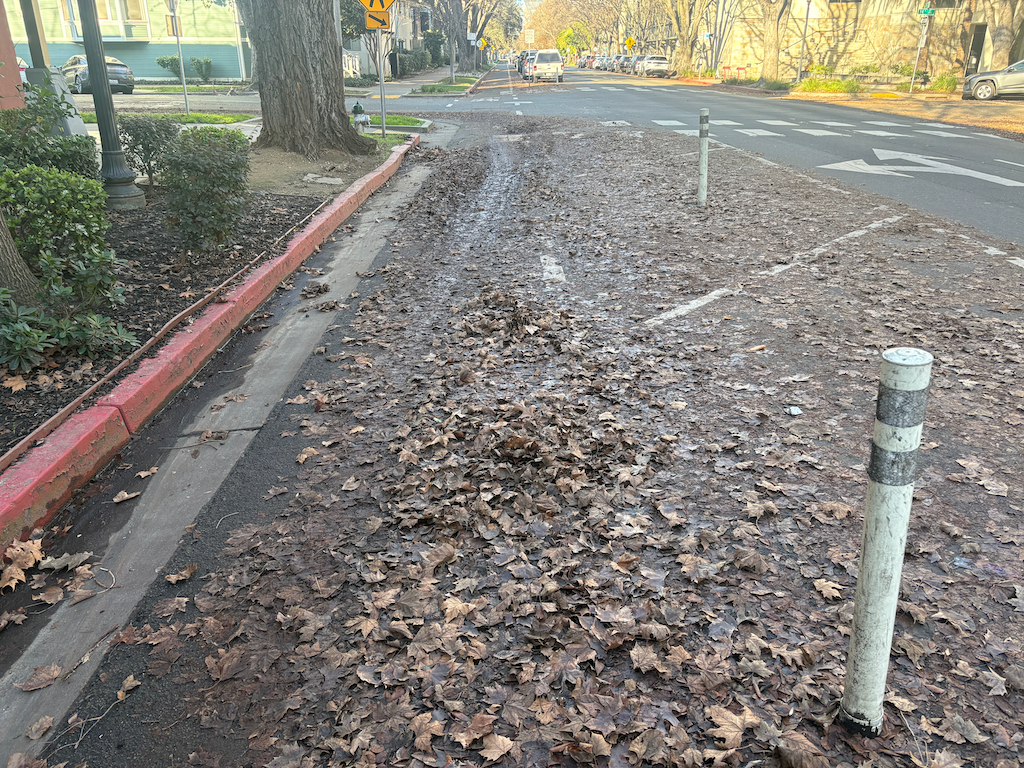
The City of Sacramento is not sweeping its separated bikeways, as it promised to do when it installed them. The separated bikeways, on I St, P St, Q St, 9th St, 10th St, 19th St, and 21st St have not been swept by the city. The city has a sweeper designed specifically for these bikeways. It may be broken down, or the city may be choosing not to sweep. Some of the bikeways are being swept by landscape maintenance services associated with adjacent properties, a few spots are being swept by individual owners or residents, and even the parks department is cleaning up, but not consistently.

photo of Q St at 14th St, separated bikeway, not swept by city
Q St at 14th St, separated bikeway, not swept by city

In a few places that have heavier bicycle and scooter traffic, such as P St between 15th and 14th, the leaves have turned into leaf slime, which is extremely hazardous for anyone on two wheels. I’ve seen people almost spin out here, and I have as well.

Most people seem to have realized that the place for piled leaves is NOT in the bikeway, but in the adjacent buffer, and in some locations that buffer is labeled as such. But some people are still piling in the bikeway.

Regular bike lanes are an issue as well. Most are not swept. Dry leaves are sometimes swept away be motor vehicle traffic, but once they are wet, they don’t move. If there is motor vehicle traffic across or along the bike lane, such as approaching an intersection, the leaves are quickly turned into slime. Very slippery! Be cautious anywhere there are leaves.

Palm trees – ack!

And just in case you need to be reminded, palm trees and the fronds they drop are an ongoing hazard to people walking and bicycling. A single frond can block a sidewalk from use by anyone with a mobility device. A single frond can block a bikeway or bike lane, and can throw a bike rider off their bike. With every wind storm or heavy rain storm, palm trees drop huge numbers of fronds. Why do we continue to allow this hazard for walkers and bicyclists? In a few locations where they have historic value, such as Capitol Park, they might be justifiable. But nowhere else. They need to be removed!

photo of palm fronds on Q St
palm fronds on Q St

SacCity Council to consider extending Howard Chan

On the agenda for the Sacramento City Council for this Tuesday, December 10, is an extension of Howard Chan’s contract for one year, to December 31, 2025. Approval of an Amendment of the City Manager’s Employment Agreement

I am opposed to this extension. The city is in crisis, a crisis due to both the City Manager form of government, and to the individual in the position of City Manager. Both must end, as soon as possible. Extending Howard Chan for a year ensures that the crisis will continue, for at least a year.

What is the crisis? There is a budgetary crisis. The City Manager failed to see a reduction in tax income coming, and so there was a sudden need to balance the city budget by cutting critical programs, but failing to reduce excess staff. The budget crunch is now being used to justify all kinds poor decisions by city staff and city council. There is a homeless crisis. The City Manager has failed to follow the direction of council to address homelessness by opening more homeless shelters, specifically in every council district.

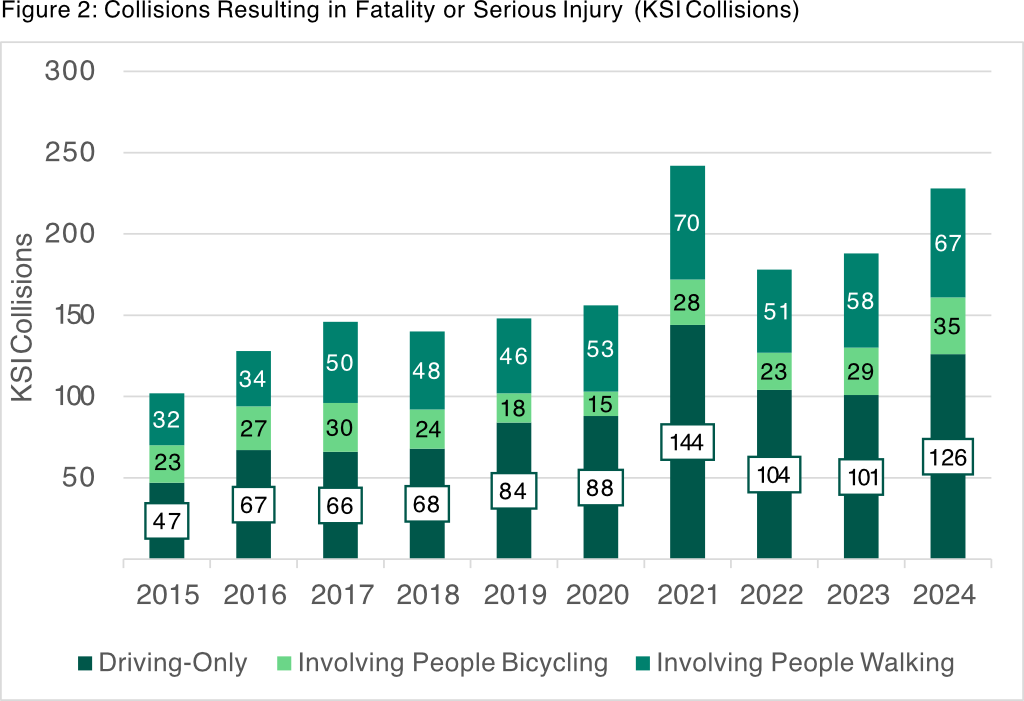
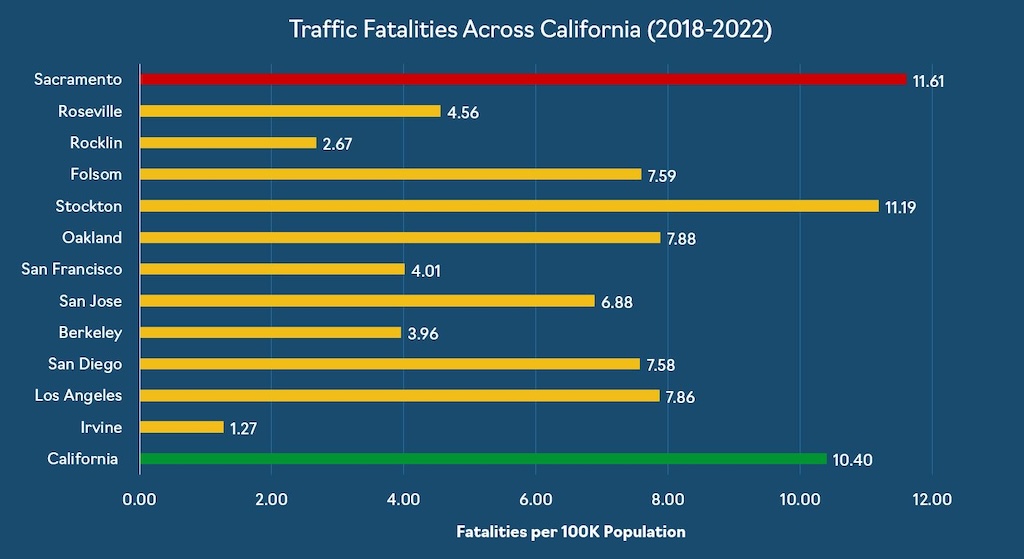
Most importantly, there is a traffic violence crisis. The rate of traffic crashes resulting in fatalities and severe injuries continues to escalate, putting Sacramento at or near the top of most dangerous cities in California. Yet Howard Chan has refused to allocate city general funds to address this issue, beyond the minimum necessary for grant matches. The grants are long term solutions, when what is also needed is immediate change to roadways, called quick build, at high risk intersections where the fatalities and severe injuries occur. Howard Chan has refused to fund this. The city is considering Declaring a State of Emergency Regarding Traffic Deaths. If Howard Chan had not resisted funding for real solutions for the last eight years, it is unlikely that we would need this emergency declaration. Not that we would not have traffic fatalities – Vision Zero has been a failure for many reasons – but the rate would likely be much less.

Howard Chan believes that the only solution to the public safety crisis is to add more police officers. This is a misunderstanding of public safety. Expenditures, and staff, should reflect actual threats to the public. In Sacramento, they do not. The number of people killed in traffic crashes is similar to the number of people killed by gun and knife violence. Traffic collisions increase, the police budget increases, but the police budget does nothing to address the problem.

Darrell Steinberg, in his ‘exit interview’ with Ryan Lillis earlier this week at New Helvetia Brewing said that a partial solution for the failure of the City Manager model would be to give the Mayor hire and fire authority over the City Manager, subject to review by the council. If this had been in place, we might already have a new city manager. Darrell said that he had a good relationship with Chan, but clearly the council does not, and Darrell acknowledged that the City Manager model is failing Sacramento.

What are the alternatives? The National League of Cities has a page: Cities 101 — Forms of Local Government, which outlines five forms of city governance. Sacramento does not have exactly any of these categories, but is closest to Council-Manager. Sacramento elects its mayor as a specific office, not a rotating selection. Most significantly, in Sacramento, the council actually has very little control over the manager. I believe we need something closer to the Mayor-Council model, where the city manager works for the council, which governs on behalf of the citizens. could a council-manager model work? Perhaps, but only with a strong council or mayor that is willing to stand up to the city manager and hold that person accountable.

Sacramento voters have twice rejected a strong mayor model, probably in part due to getting burned by Kevin Johnson who wanted to be a strong mayor. It seems unlikely that voters would support a strong mayor. What I want to see is a strong council model, where the council proactively directs the City Manager, and fires that person if they are not following direction. Something must change.

Our city is in crisis because we have a failed governance model, and the wrong person in the City Manager position. Rather than just extending the City Manager for a year, the council must come to terms with the crisis, and determine a solution. As quickly as possible.

SacCity Neighborhood Connections

City of Sacramento held the second of two workshops on the Neighborhood Connections element of the Active Transportation Plan on Wednesday at noon. About 40 people participated, and there were many questions and comments. I was not able to participate in the first workshop a week ago, but I imagine the content and discussions were similar. The presentation given during the workshop is available.

A draft plan (SacCity Neighborhood Connections Plan 2024-10) is available for public review and comment through December 1.

There are four appendices to the plan:

You can comment in the body of these documents by using the Konveio tool (scroll down on the Streets for People Active Transportation Plan webpage to the box with a green bar at the top), or submitting by email to StreetsForPeople@cityofsacramento.org.

Read More »

Whither daylighting?

See crosswalk daylighting in SacCity? for more information.

The city has confirmed that crosswalk daylighting, as required by AB 413 (2023, Lee), will not be a part of the Parking Strategies project. The city has also confirmed that it will not be a part of the Streets for All Active Transportation Plan, though that plan will recognize that where there is space created by daylighting, it may be used for bicycle and scooter parking.

So where will crosswalk daylighting be addressed? So far as can be determined, the city does not intend to address it at all. A search of the city website for ‘AB 413’ or ‘daylighting’ produces nothing. City staff seems to be suggesting that it will be addressed somewhere else, not part of the current projects, though that somewhere else has not been mentioned.

It is going to take public pressure to convince the city to take action on crosswalk daylighting.

San Francisco has been proactive in implementing the state law, with warning notices now being given, and enforcement starting January 1. Parking is far more contentious in San Francisco than Sacramento, so it is surprising that Sacramento is stalled while San Francisco is moving forward.

Howard Chan and traffic deaths emergency

Note: I have always thought it was part of my role to say the things that other people are afraid to say, for fear of rocking the boat or retribution. But this needs to be said.

On November 12, the city Law & Legislation Committee considered agenda item 6, Councilmember Proposal Request for Committee Consideration – Declaring a State of Emergency Regarding Traffic Deaths. This was introduced by Council Member/Vice Mayor Caity Maple and also sponsored by Mayor Darrell Steinberg and Mayor Pro-tem Karina Talamantes. The item was amended before the committee meeting to remove item 3, ‘Direct the City Manager to work with the Police Department to ramp up enforcement of traffic laws, especially around distracted driving, speed enforcement, and crosswalk violations’ which was opposed by most of the transportation advocacy community including Civic Thread and SABA, which led community discussion of the proposal and made recommendations for improvements. This is a sign of progress, though many have questioned whether it will make a difference, given that there is only support for and not specific funding tied to quick-build projects to make our streets safer, now.

How did we get to the point of emergency?

I believe City of Sacramento City Manager Howard Chan is the person most responsible for creating this emergency. Chan has opposed including any funds in the city budget for addressing the crisis. When the proposal from Sacramento Active Transportation Commission for $10M in funding to address the problem came before the council, he nixed it. Chan has a regressive understanding of public safety, which counts the number police officers and ignores other threats to the safety and lives of citizens. Chan is uninterested in public health. Chan has supervised the Department of Public Works, accepting and promoting the idea that roadways are for moving cars, and not community resources for access and life. Chan has created a city staff culture that avoids innovation and accountability, live in fear of getting sued or getting fired. Chan carries out projects and programs that he is interested in, and ignores everything else.

Read More »

SacATC 2024-11-21

The City of Sacramento Active Transportation Commission (SacATC) will meet this Thursday, November 21, 2024, starting at 5:30 PM. The meeting is held at city council chambers, 915 I Street, and can be viewed online via the link available when the meeting starts, on the city’s Upcoming Meetings page. People may comment in person (preferred) or make an eComment on the city’s Upcoming Meetings page. Though all eComments become part of the public record, only those submitted before noon of the meeting date will be seen by the commissioners.

The agenda is full, with the following items:

I have not had the time to review these documents, so have no comments at the moment, beyond my earlier posts on the Parking Strategy (05) which is OK for what it says, but is not OK for what it neglects, and Neighborhood Connections (04).

SacCity parking revisions meeting

Revised 2024-11-14, to add detail

Yesterday the city held a Zoom meeting entitled ‘SacCity Parking Revisions Community Project Update Meeting’. The second and last meeting is today, 5:30PM, via Zoom. Registration is required, at https://us02web.zoom.us/meeting/register/tZMlf–gqjwsHdbLbRtxQ1_-59HFgLSajWJx#/registration.

The city is developing what it calls a ‘Parking Strategy‘ with a ‘Parking Management Toolkit’. This is not a parking management plan, which the 2040 General Plan requires. Though the city keeps claiming that it already has a Parking Management Plan, that is being revised, no such plan exists. More than half the 190 page Parking Strategy document is Appendix A ‘Economic Conditions and Housing Development Funding Assessment’ (page 68 of the pdf) and Appendix B ‘Best Practices Research’ (page 83 of the pdf) with examples from other cities and standards. A twelve page Executive Summary provides key information for those who don’t have time for the whole document.

The parking revision process is led by Community Development Department, under Senior Planner Vic Randall, vrandall@cityofsacramento.org, but Public Works is also participating, under Parking Manager Staci Hovermale, shovermale@cityofsacramento.org. The presentation was mostly by the W-Trans consultant, Brian Canepa.

I encourage you to attend and comment. In particular, pay attention to what is excluded as well as included. Kendra Ramsey of CalBike had some of the best questions and comments, so I hope she can be on the Zoom again today.

In addition to the meeting, you can also comment via email to ParkingRevisions@cityofsacramento.org, or by adding comments to the document via konveio at https://sacramento.konveio.com/parking-strategy-public-review-draft.

Read More »

SacCity mayoral candidates on transportation

I don’t know anyone who hasn’t already voted, but information about the City of Sacramento mayoral candidates, Flo Cofer and Kevin McCarty, will be valuable beyond the election. SABA (Sacramento Area Bicycle Advocates) sent in a Gear’d Up email a compilation of candidate positions and perspective on transportation, which I’ve copied below.

Sacramento Mayoral Candidates on Transportation and the Environment
SABA is taking a look at the stances of the two Sacramento mayoral candidates – Dr. Flojaune Cofer and Assemblyman Kevin McCarty – related to environmental issues. While we understand that there are many important issues facing Sacramento, especially with regard to the unhoused population, our focus here is on issues related to transportation and the climate crisis. 
The views presented here are taken from forums conducted by the League of Women Voters, the Sacramento Bee, and KCRA 3.
Flo Cofer - a Black woman wearing a purple jacket and yellow blouse.Dr. Flojuane Cofer is an epidemiologist, policy director, and advocate for change. She worked at the California Department of Public Health and then as a Senior Policy Director at Public Health Advocate. Cofer served on Sacramento’s Active Transportation Commission, Mayor’s Commission on Climate Change, Sacramento County Sheriff’s Outreach Community Advisory Board, and the Measure U Community Advisory Commission. 
Kevin McCarty - a man with light brown skin wears a gray jacket and blue shirt.Since 2014, Kevin McCarty has served as Sacramento’s Assembly member – representing the 6th Assembly District. McCarty serves as Chair of the Assembly Public Safety Committee. From 2014 to 2023, he served as the Chair of the Assembly Budget Subcommittee on Education Finance. A lifelong Sacramentan, McCarty began his career as a Housing and Redevelopment Commissioner, and then served on the Sacramento City Council for a decade.
SABA does not endorse either candidate. (Disclosure: Cofer is a member of SABA and McCarty has lent financial support to a project that will launch in 2025.)
Here’s where they stand on the issues:
Climate Action & Adaptation Plan, which includes a greenhouse gas reduction target for 2030 and a carbon neutrality goal for 2045.
Cofer: As a commissioner on the Mayor’s Climate Commission, Cofer helped develop Sacramento’s Climate Action Plan and would like to move the dates up to accomplish carbon neutrality sooner. As mayor she would commit to setting priorities for the city council and plan how the city can take on more to achieve climate goals sooner.
McCarty: He would like to achieve the goals that were set out in the plan and figure out how to pull down resources from the state and federal governments. When the city was in a budget crisis, he found resources to support city services like the firefighters and would do the same for the Climate Action Plan.

Funding for the Climate Action & Adaptation Plan Including Proposed 2026 Sales Tax (the Plan is budgeted at over $3 billion)
Cofer: She believes we need to look at the Plan and figure out how to implement it; set a goal and figure out where to start; and decide on the major investments we need to make now to save money down the line and yield us dividends. Cofer says we should look at matching funds from the state and federal government, as well as local partnerships. She believes neighborhood associations, unions, nonprofits and businesses will step up and that we should see them as partners rather than adversaries. The public was frustrated that the sales tax from 2019 was not spent on homelessness, affordable housing and the arts, and Cofer says we need to build trust with the voters by righting things before going and asking for more money; and we also shouldn’t impose a tax on people with lower incomes.
McCarty: He wants to look at opportunities to leverage funding for state efforts. McCarty says the State of California is our largest employer and landowner and we need them to step up to help us achieve our climate goals. Voters are very frustrated that things aren’t getting done and McCarty believes we have to restore confidence in city leadership to pass traditional revenue. He says the sales tax is regressive and that people of lower income are disproportionately impacted by climate and should not bear disproportionate burden.

Commitments to Climate Initiatives
Cofer: She believes we need new leadership. Cofer has built coalitions and served on five different boards, committees, and coalitions. In the first 100 days, she commits to 1) set priorities for the city of Sacramento that include our climate goals and take action every year. 2) Make sure we have a standing committee on climate where we have community members helping us to figure out new innovative solutions.
McCarty: His top two initiatives are to promote active transportation and build more infill housing.

Public Transit & Active Transportation
Cofer: She supported a resolution to expand transit and make it free for kids K-12. She believes the best way to expand transit is to provide it at low or no cost and wants to get young people to ride so they become lifelong transit riders. Cofer wants to expand free rides to college students and to make public transit accessible for disabled and older people. She would like to see it kept running for major events – make it convenient and useful for everyone, not just low-income people.Cofer served on the Active Transportation Commission because she is an avid bike rider and has been hit by a car. She wants to implement design features to make it safer for people to bike and walk. When there is new construction, Cofer wants to make bikes and pedestrians a priority to signal that safety is paramount.
McCarty: When he lived in Boston, McCarty took public transportation everywhere, but Sacramento’s transit system isn’t as comprehensive. McCarty believes we need more routes and frequency, and to look at land use so people can live closer to the things they need and won’t always need to drive. He believes our transportation infrastructure prioritizes cars. As a medical consultant for a school district, McCarty tried to get kids to walk more. He says there’s a need to make walking safer by not having people camping on sidewalks and by addressing other public safety issues.  

Cycling and Pedestrian Safety
Cofer: She acknowledges that traffic is the number one cause of fatalities and serious injuries. Cofer wants to invest money to draw matches at the state and federal level. She says traffic safety should be proactive.
McCarty: He believes that roads should be fixed to proactively eliminate deaths. He would like to improve bike and pedestrian infrastructure across Sacramento, not just midtown. McCarty acknowledges that there is an equity issue – some people ride by choice; some don’t have another option.

Sprawl and Urban Development & Downtown Revitalization
Cofer: One of the things in the CAAP is prioritizing infill development. Cofer wants to develop housing and build near existing infrastructure to not increase emissions. As someone who served on the Climate commission, she doesn’t want to start building in places where we already have trouble with transit. She believes we need to start building in places where we already have rail and bus lines and not create another car-centric community. Cofer doesn’t want to offer downtown properties to developers “for free.” She would like to use adaptive re-use for example, bringing Sacramento State downtown. Cofer says downtown needs to be an entertainment hub. She believes that bringing state workers back to the office is not the way – it goes against our climate goals.
McCarty: He says we have a housing shortage and we have people coming to Sacramento. McCarty believes we’re not going to end sprawl by simply limiting construction within the city; we can’t control what happens across another border. He says we need to facilitate infill development and that telework is here to stay. 45% of downtown property is state or federally owned and they pay zero property tax. McCarty would like to instead, put that property in private hands such as housing, entertainment, restaurants. He wants to work with Sacramento State to bring student housing downtown.

SacCity Neighborhood Connections workshops

The City of Sacramento is holding two online workshops on the Neighborhood Connections portion of the Streets For All Active Transportation Plan, on Wednesday, November 13 at 6:00 PM, and Wednesday, November 20 at 12:00 noon. Registration is available on the Streets for People webpage. The Neighborhood Connections Public Draft Plan will be available on November 4 on the Streets for People webpage.

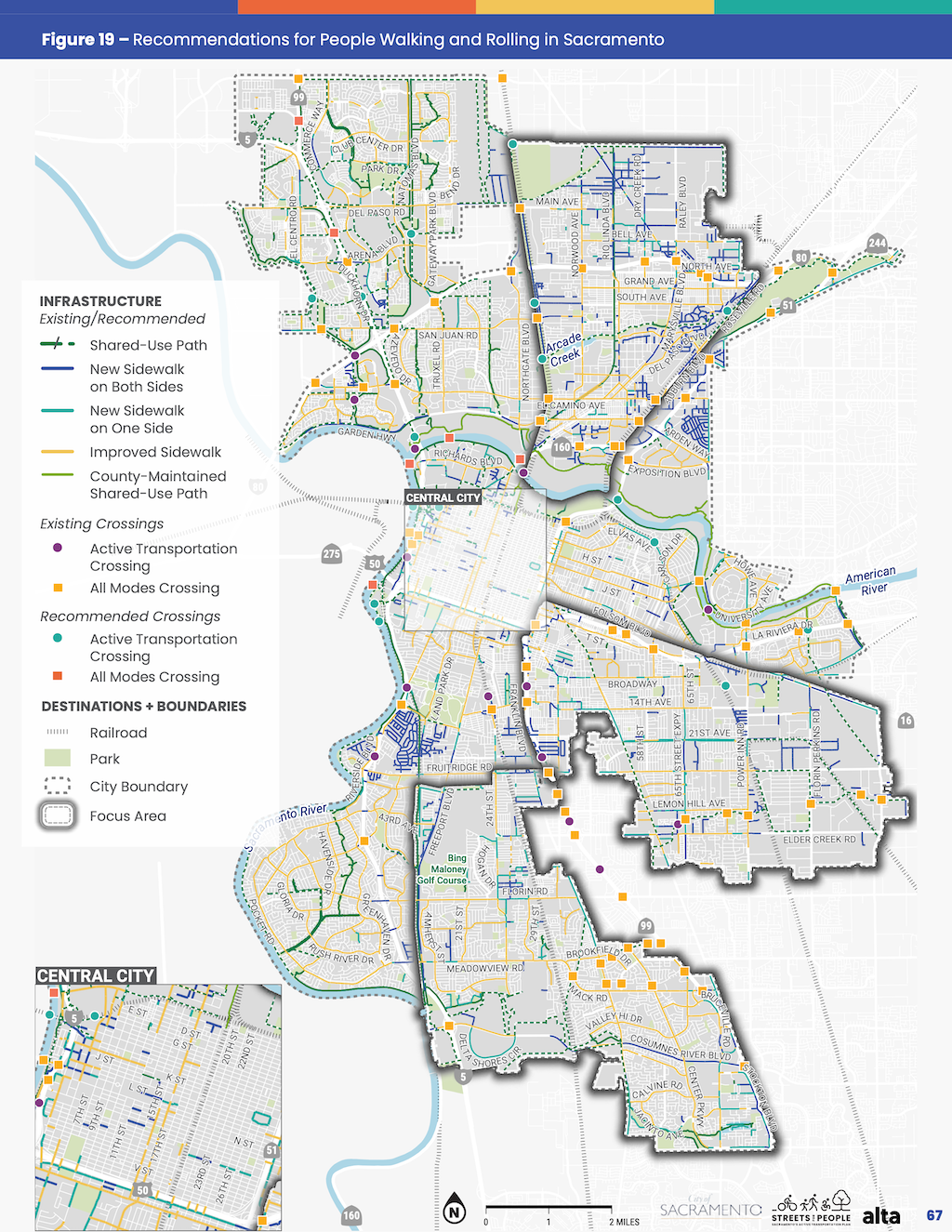
The Neighborhood Connections Story Board is the most valuable document to come out of the project so far, well worth a look. I’ve written about traffic calming features in Neighborhood Connections before, as well as other topics in Streets for People and Street Design Standards. There is a great deal of overlap, and should be, between the Streets for People Active Transportation Plan and the Street Design Standards Amendment.

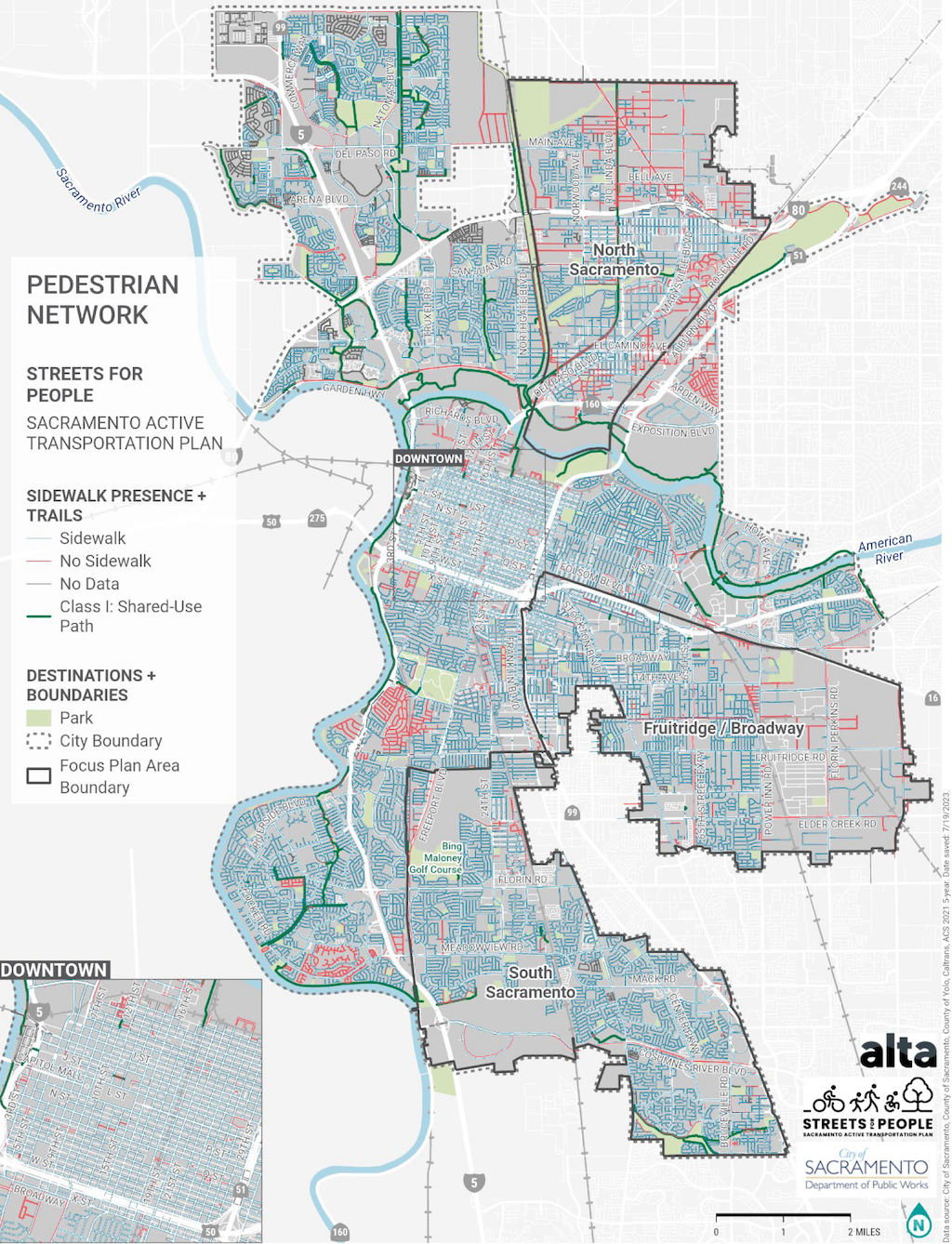
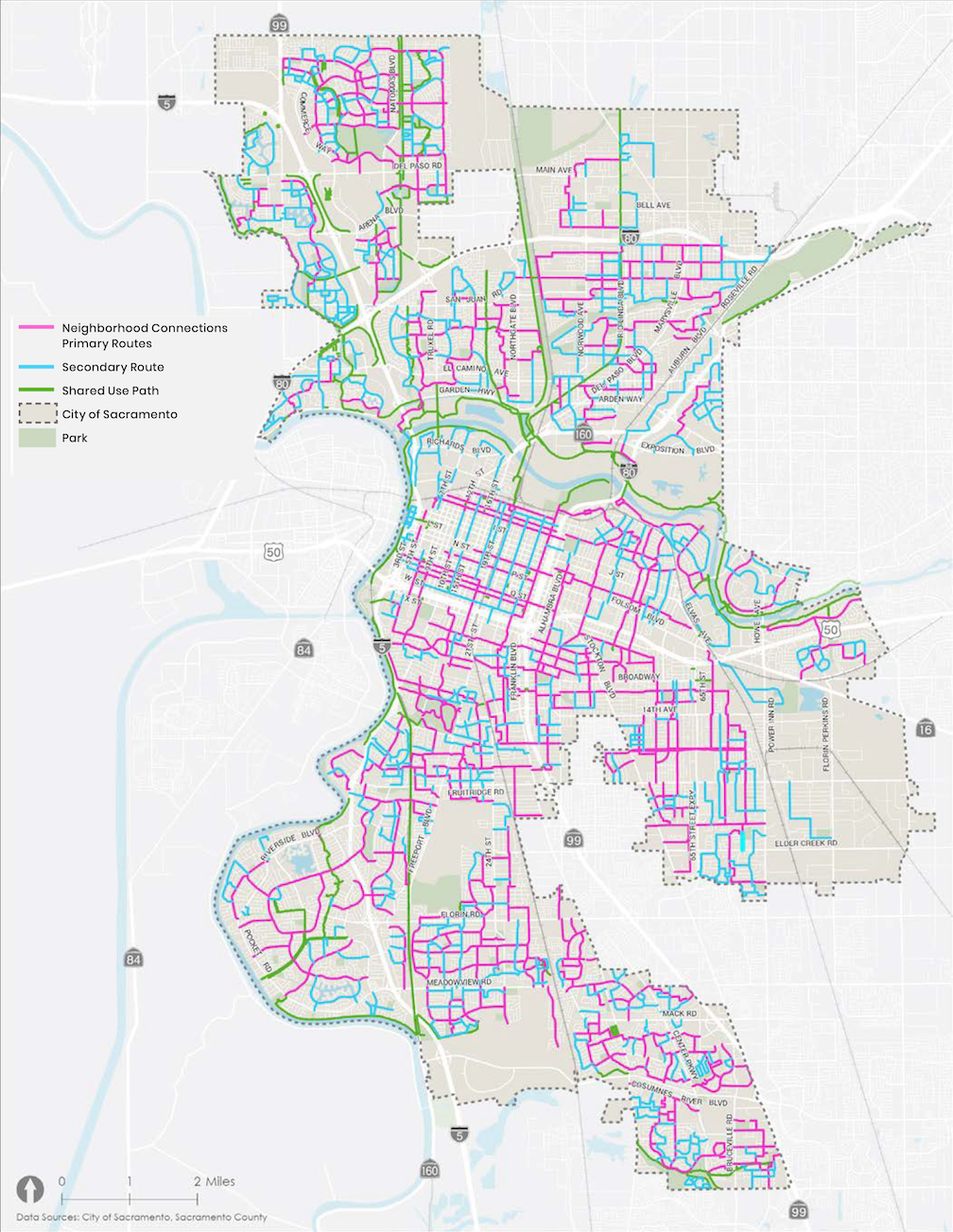
“The Neighborhood Connections Network is made up of residential streets and minor collectors that connect to neighborhood destinations, such as parks and retail. The network includes proposed traffic-calming treatments to reduce vehicle speeds and volumes to support people walking, biking, and rolling.”

diagram Streets for People Active Transportation Network, Neighborhood Connections, Neighborhood Destinations
graphic Neighborhood Connections workshops