With the exciting news that the closure of a part of JFK Drive in Golden Gate Park will remain permanently closed to private vehicles. This closure was made to provide safe open space during the pandemic, and is only a small portion of the roads in the park. Most of the people who live in San Francisco support this closure to cars (opening to walkers and bicyclists), and most of the people who visit the park from elsewhere (which includes me) also support.
People have started talking about Land Park in Sacramento. I was certainly not the first. This has been an ongoing conversation among advocates for walking and bicycling for years, but it never turned into a movement. Maybe today is the day.
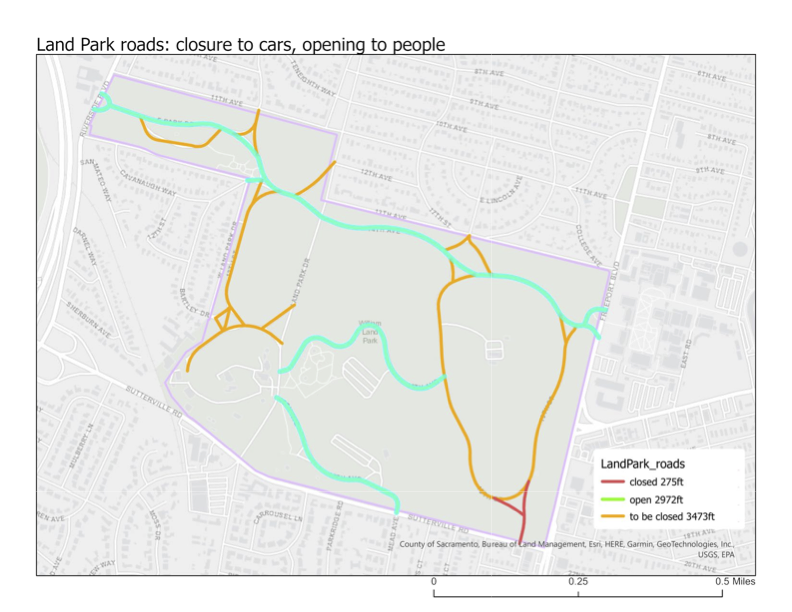
Below is my (modest) proposal for closing some of the roads in Land Park to private vehicles (pdf). There is a small existing closure, of the roadway in from the southeast corner of the park. It has gates that are permeable to bicyclists.
My proposal closes about 53% of the roads in the park, but leaves open roads that access important points such as Fairytale Town and the golf course (if that is important). It also leaves open an east-west route through the park, with ample parking along the roadside, for those who need vehicle access. People who drive are most likely to access the park from Riverside Drive, Land Park Drive, and Freeport Blvd; all those access points remain open.
Of course the use of the term ‘closed to cars’ is really an inversion. Roads that are closed to private vehicles are by nature open to walkers and bicyclists, and so are really ‘open’ to people.
So, what do you think? Constructive comments are always welcome.
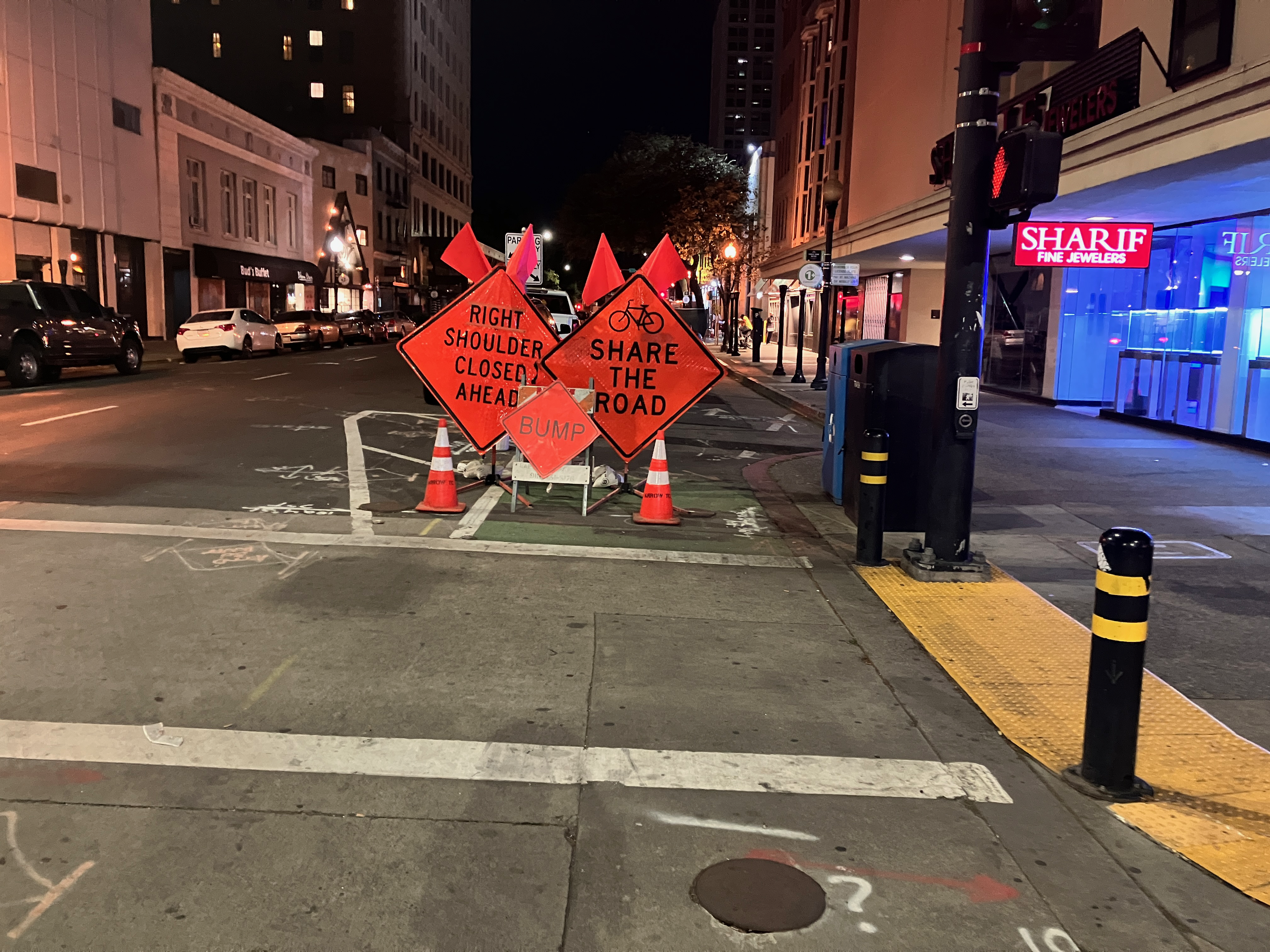
There are active utility projects on 9th Street and 10th Street that have closed parts of the separated bikeways on those streets. Upon noticing this, I thought, no big deal, a few days of work and things will be back. But the closures have been continuing for three weeks now, with no end in sight. It is interesting that the utility work on J Street is moving fairly quickly, but on 9th and 10th, not so much. I am not sure what utilities are being worked on, and whether these are city-led projects with contractors working on city-owned utilities, or whether they are private utilities such as PG&E or communications.
When there is an extended closure of a separated bikeway, more than two days, an accommodation for bicyclists should be provided. I am aware that some bicyclists are willing to ride in the traffic lanes, but the entire point of a separated bikeway is that it needs to work for all bicyclists, including people who are not comfortable riding in traffic. To allow construction to close a bikeway, without any alternative, is a failure on the part of the city. The city is again expressing its favoritism for motor vehicle drivers over bicyclists.
10th Street
10th St at K St bikeway closure10th St bikeway construction plate
For 10th Street, general purpose lanes should be reduced from two to one, making the other lane a temporary bikeway. Or, remove parking from the left (west) side of the street so as to allow two general purpose lanes and one temporary bikeway.
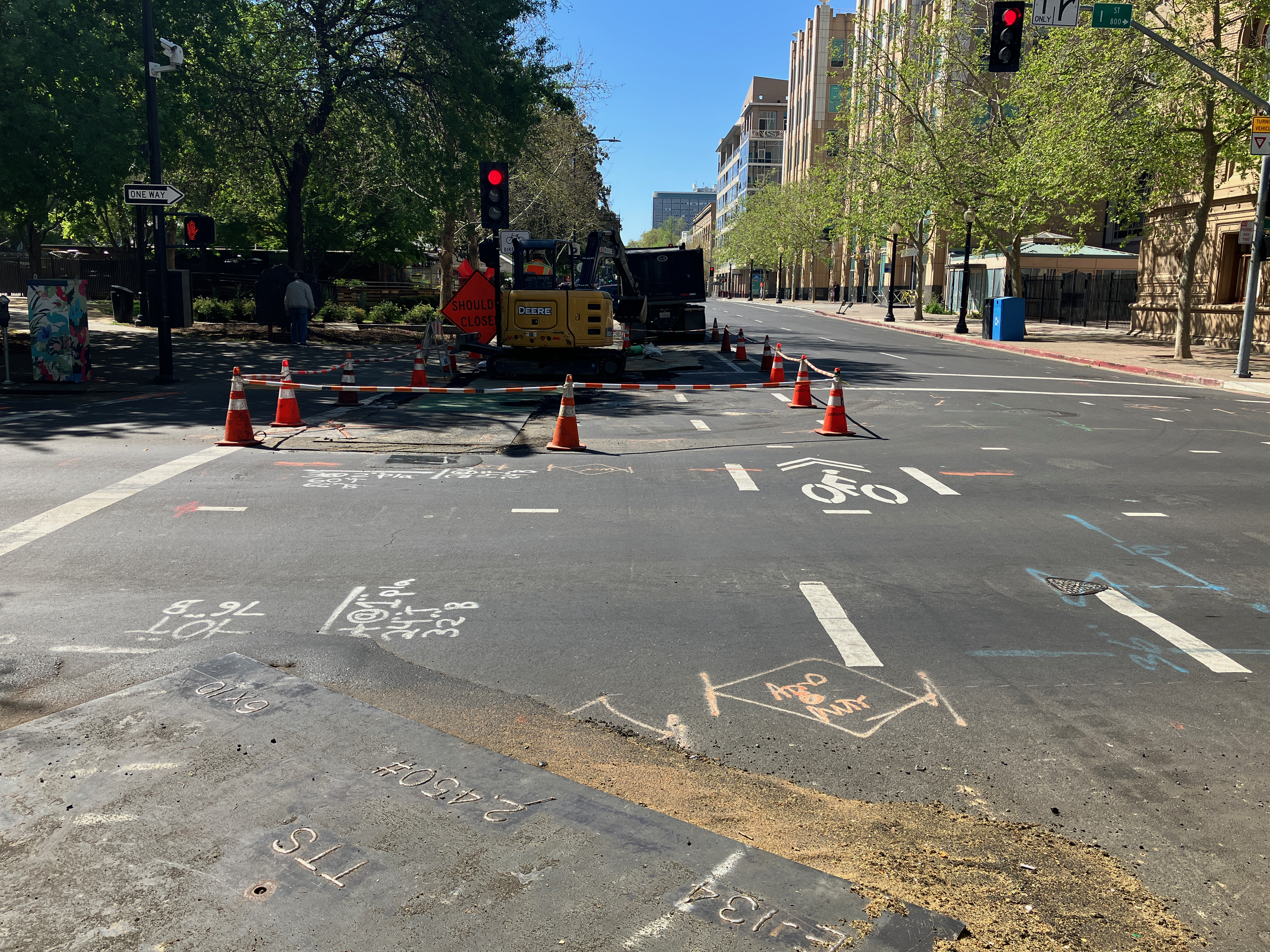
9th Street, H Street to J Street
9th St at H St bikeway/bike lane closure9th St at I St bikeway/bike lane
The bike facility on 9th St is not technically a bikeway until it crosses J St, but since it is intended to provide a similar safe route of travel, I’m including it here. Utility work has closed off the bike lane between H St and J St. No alternative has been provided. The solution is to remove one general purpose travel lane and create a bikeway, or remove parking on the right (west) side of the street in order to maintain two general purpose lanes and one bikeway.
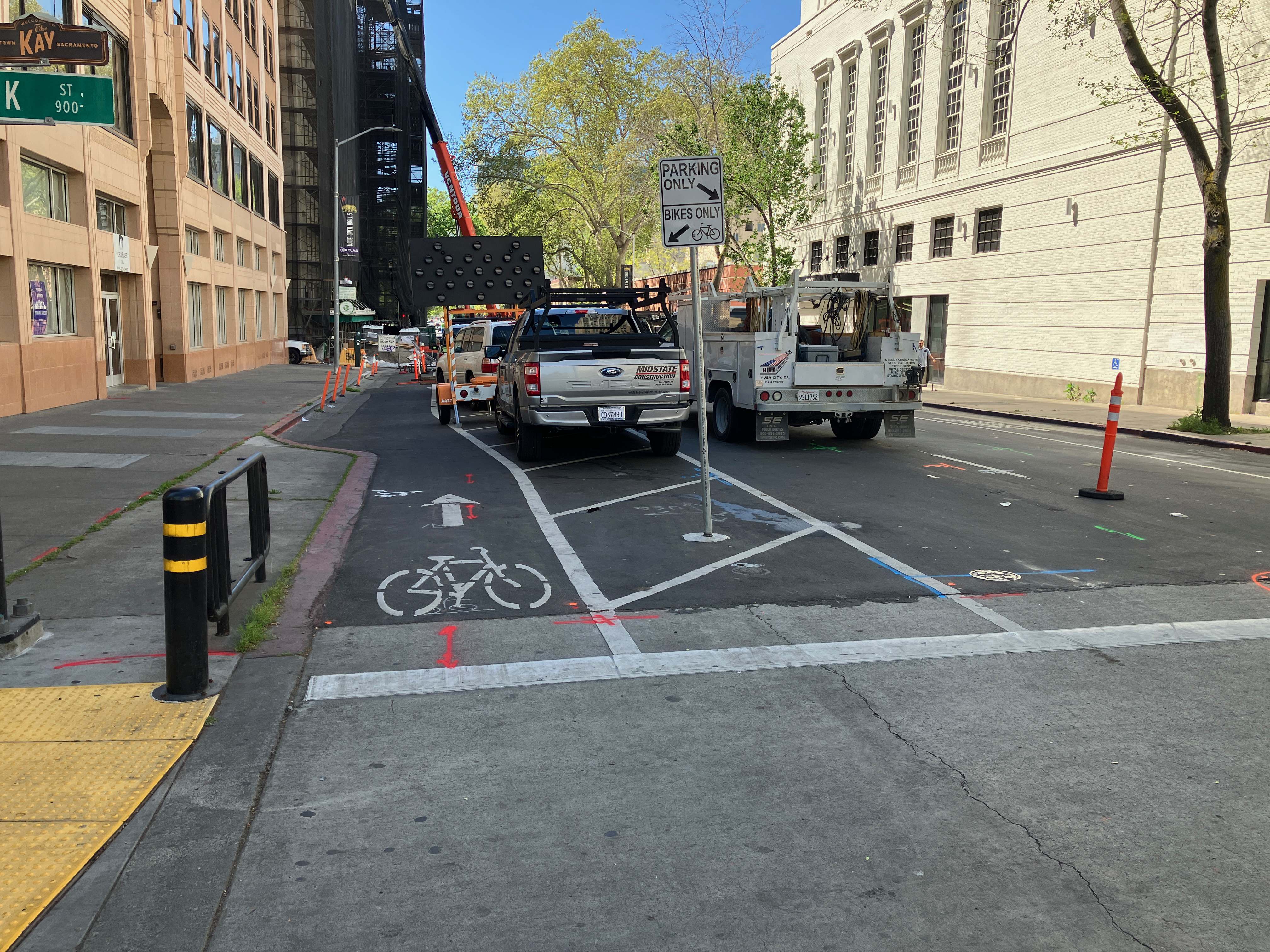
9th Street, K Street to L Street
9th St at K St, no signing for bikeway closure9th St construction materials stored in the bikeway (just south of previous photo) 9th St at Kayak Alley, walkway/bikeway gone
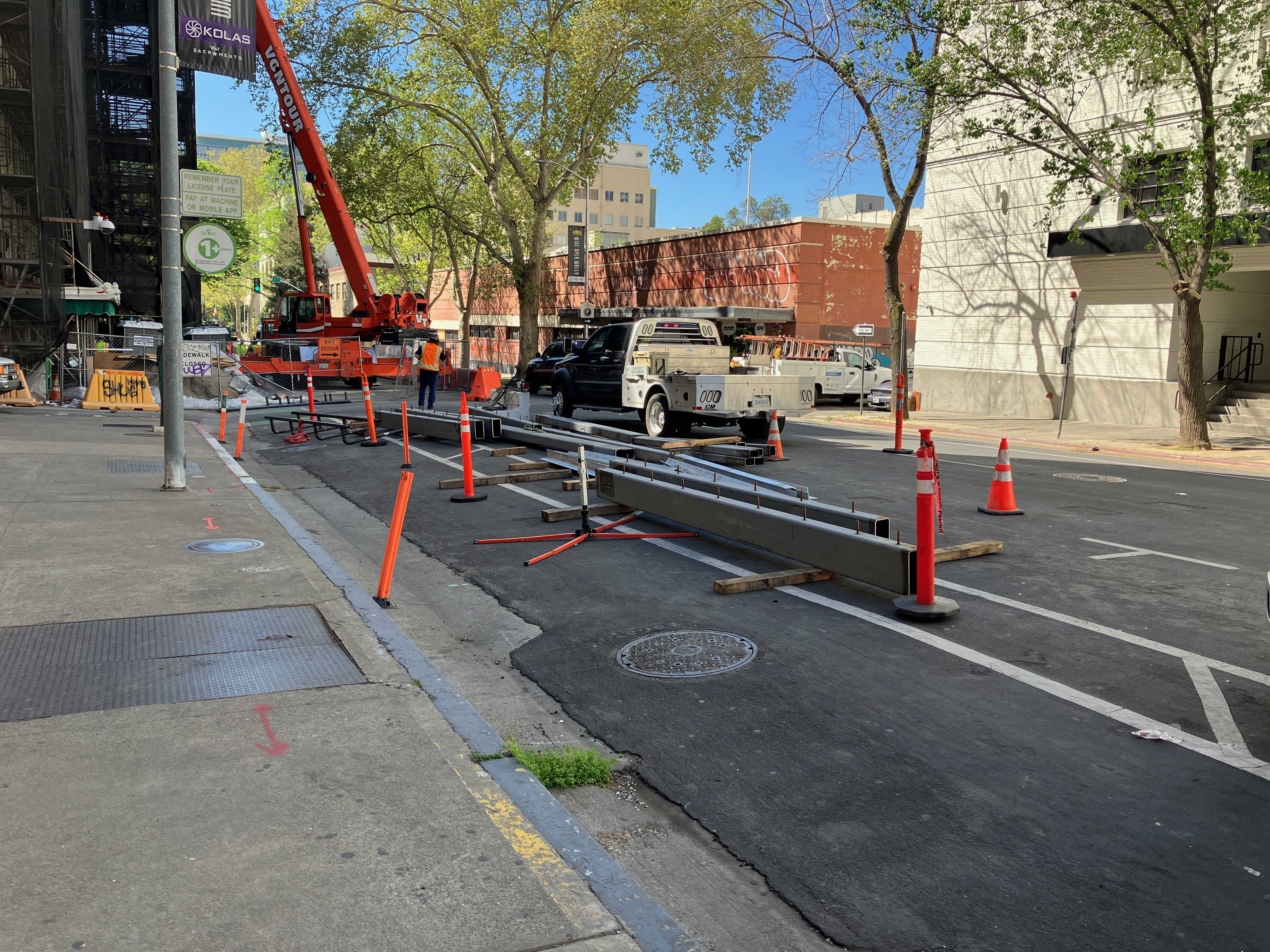
The reconstruction of Capitol Park Hotel, on the east side of 9th Street between Kayak Alley and L Street, has been going on for months. Every time I go by, something has changed about how the roadway is being handled. Today, the safe bikeway and walkway that was there is now gone. Construction has pushed the fence up against what were formerly the barriers that separated the bikeway/walkway from traffic. Today there was a crane filling the space, which may be necessary, but that doesn’t change the clear message that the entire area is now construction zone with stored construction materials.
The section between K St and Kayak Alley is now being used to store construction materials and worker vehicles. The closure of the separated bikeway is not signed in any way; there have been signs here in the past, but they are gone. If you rode the bikeway without realizing it was closed, you would crash into construction materials.
I am not sure whether there is enough space left in the roadway to provide both a separated bikeway and a travel lane. If so, it should be modified for that. If not, the travel lane should be closed until the construction footprint shrinks again to allow the original walkway/bikeway.
It should be noted that the city did not initially provide the walkway/bikeway on 9th Street, and it was only installed after considerably public outcry.
These locations are a fraction of the ones throughout the city where the city has decided that motor vehicle traffic must be accommodated, but walkers and bicyclists do not. The construction guidelines code that the public requested the city develop and implement have been back-burnered because the city has decided to use staff to apply for grants rather than solving current problems on the roadways. I get more frustrated by the city by the day. I don’t really think they care at all. The car-dominated city, which was created by city planners and engineers, is just fine with them.
I live in downtown Sacramento, and walk through the 15th Street & Q Street intersection almost every day, sometimes multiple times a day. On the southeast corner is my favorite coffee shop, Naked Lounge (I drink tea, not coffee, but they have a good selection). I often sit outside watching people and traffic, so I am very familiar with this intersection. Fremont Park is on the northeast corner, and again, I walk through the park pretty much every day. Let me say up front that this is not a high injury intersection that must be fixed soon. There are so many more dangerous intersections in the city to address first, and so many locations where poor engineering and disinvestment and discrimination has left walkers and bicyclists at great risk. But I can start here because I think about it so much.
A photo of the intersection. The trees on the northwest corner obscure the corner and part of what I’m going to talk about. The sidewalk, curb, ramps, and parking on the southwest corner are all new, as this was reconstructed along with the 1430Q apartments and ground floor retail. The other corners have not changed recently. 15th Street is a three-lane one-way street (it should be reduced to two lanes and bike facilities added), and Q Street is a two-lane one-way street with bike lane on the left side. The northwest, northeast, and southeast corners have small radii, meaning tight corners. The southwest has a high radii corner, meaning loose corners. This is new.
15th Street & Q Street, Sacramento
The wide radius corner on the southwest must have been someone’s idea of necessary for trucks turning from Q Street eastbound onto 15th Street southbound. But notice the northeast corner, which is just as likely to have such turning movements, has a small radius corner, and I’ve never seen a problem with trucks turning there.
Three of the corners do not have curb extensions. On the southwest corner, there is a curb and sidewalk extension along 15th Street, running about half way to the alley. Curb extensions (also called bulbouts) extend the curb and sidewalk out over the parking lane, slow drivers due to perceived friction, and shorten crossing distances for people walking. They are a known and frequently implemented safety solution. You can see curb extensions at a number of locations in the central city, though strangely, only about half the reconstructions install them. The extensions also create more sidewalk waiting or queueing space for walkers, important on busy pedestrians intersections such as this.
The southwest corner gets a lot of deliveries, both for the businesses below and the apartments above. The southeast corner has fewer deliveries. Delivery use should be considered in any change that is made at and near this intersection. On 15th Street, there are green 15 minute parking spots, one on the east, primarily for the coffee shop, and two on the west. On Q Street, there is one green spot on the south, along with about two white curb spots. There are no delivery (white curb) zones on the southeast corner. Green limited time parking and white commercial loading zone markings are relatively rare in Sacramento.
While having tea this afternoon, I saw a driver on 15th Street run a red light and almost collide with a Sacramento Fire Department truck turning from Q Street onto 15th Street. Lights, siren, loud horn, makes no difference to some drivers. I see a lot of close calls at this intersection, but have never witnessed a collision. A person sitting nearby mentioned that she works at another coffee shop on J Street, and sees collisons fairly regularly. Those who claim the solution to street safety is solely redesigning streets to slow traffic ignore that there are also drivers who won’t drive safely no matter what. There is nothing about street design that can prevent someone from running a red light, except of course not having a traffic signal there at all (too many traffic signals?).
To make this intersection safer for everyone (walkers, bicyclists, motorists), these changes could be implemented:
Paint high visibility crosswalks on the north and south legs of the intersection, similar to what the west and east legs already have. Sacramento is nearly unique in using these split crosswalk patterns, but they are probably as safe as any other high visibility pattern, which are often called Zebra crosswalks.
Create red curb offsets for each of the four corners, in the upstream direction. For 15th Street southbound, that means removing the last parking spot before the intersection on the west and east sides. For Q Street eastbound, that means removing the last parking spot before the intersection on the north and south sides. There is already an offset on the north side, and a small offset on the south, but it should be longer. You will notice in the photo above that there is a car stopped illegally in this area on the south side.
Immediately install temporary curb extensions on all corners. These extensions would fill the parking lane. Vertical delineators (posts or bollards) and paint (tan or purple is often used) set off this area. Why temporary? Temporary is low cost, and allows observation of how the installations are used by walkers, bicyclists, and drivers. The corner radius actually needed can be determined before any permanent installation.
Observe the temporary extensions, and then design permanent extensions with hard curbs and sidewalks. The permanent extensions must consider bike facilities on both Q Street and 15th Street. Q Street up through 14th St has a parking protected separated bikeway on the left side, and it is assumed that this will be continued to the east. 15th Street should have a parking protected separated bikeway on one side or the other, and the city will have to determine which side before installing permanent extensions. The curb and sidewalk extension on the west side of 15th Street south of Q Street may indicate the city has already made that decision, or it may be an oversight.
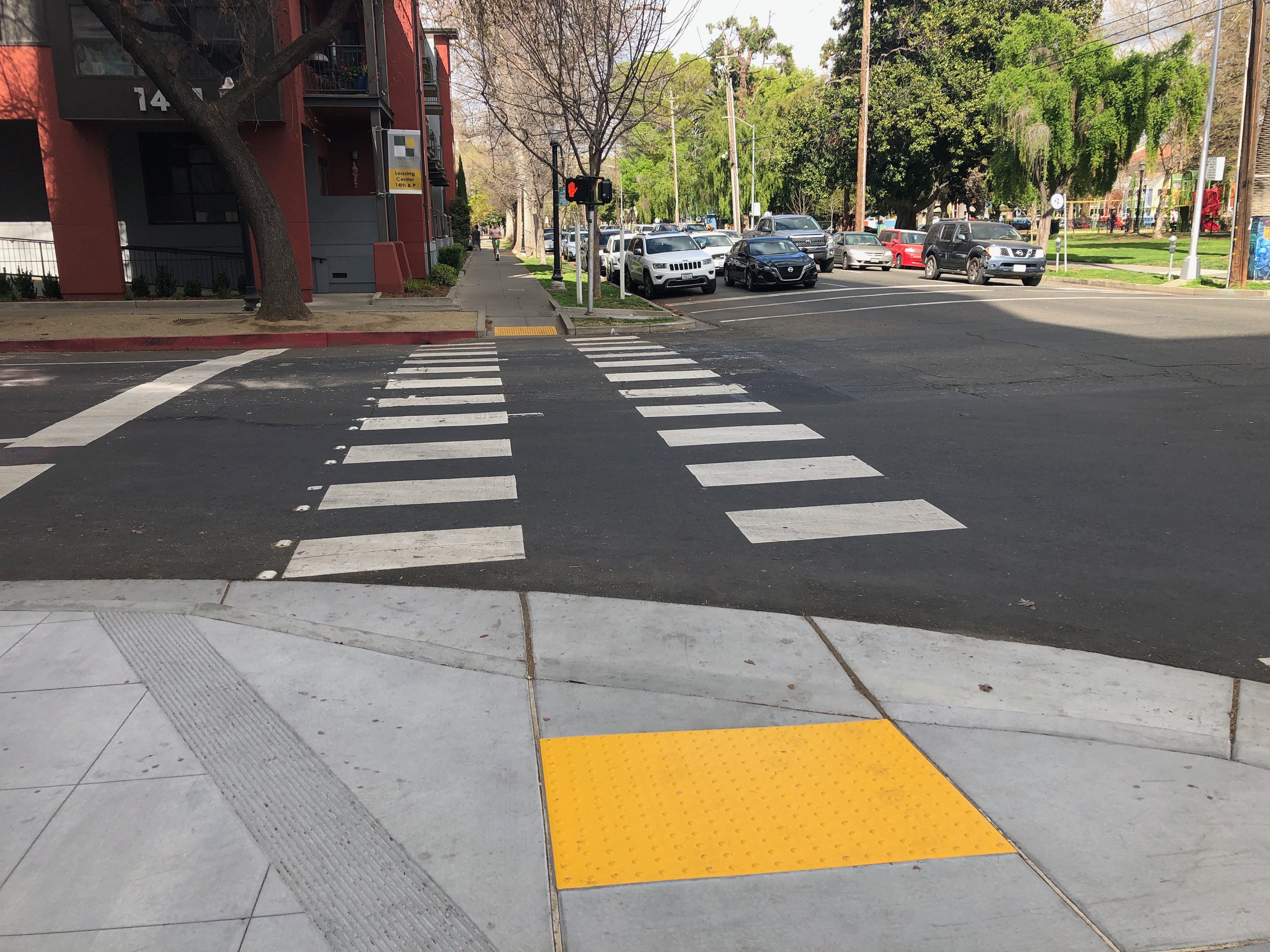
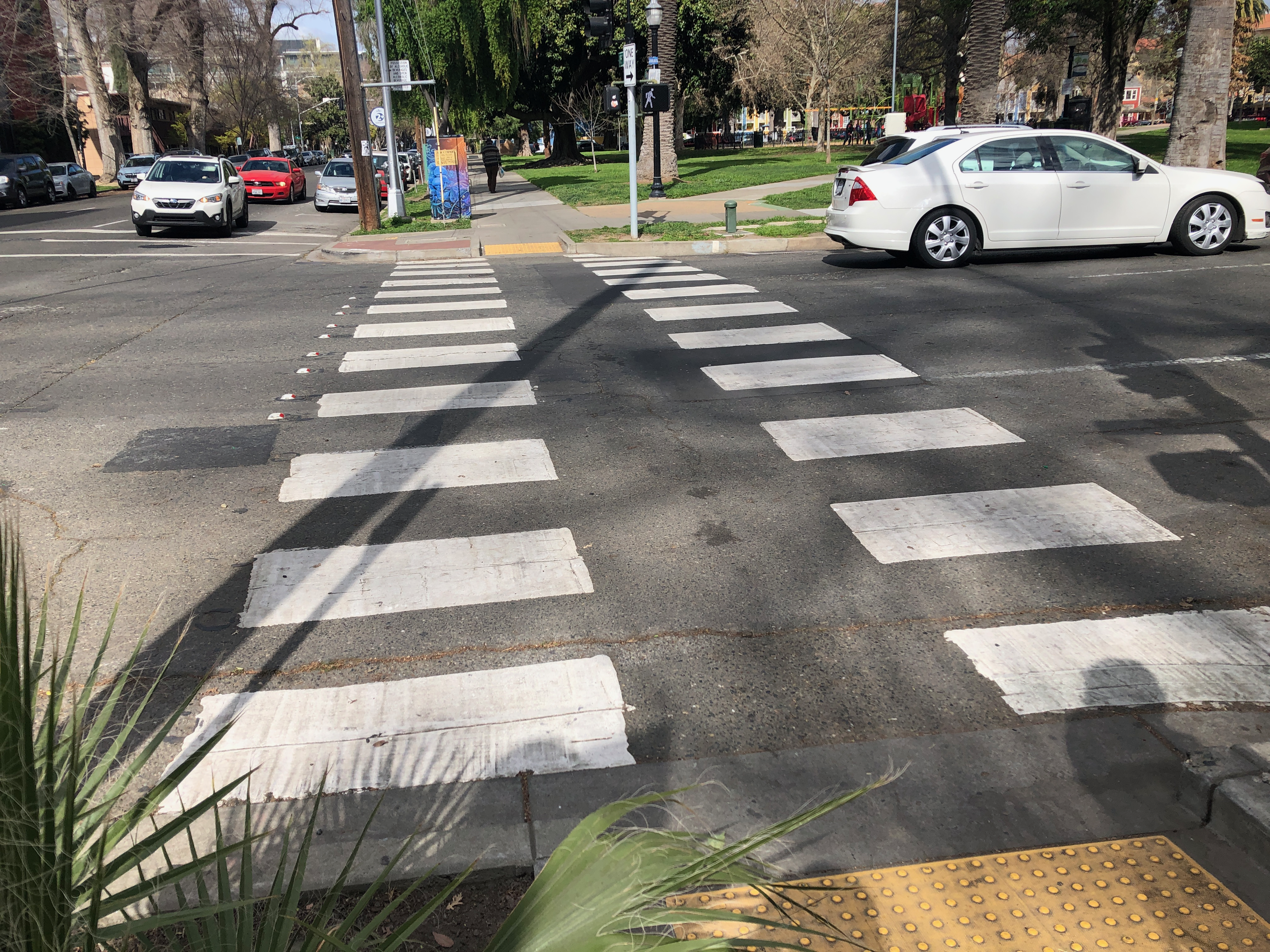
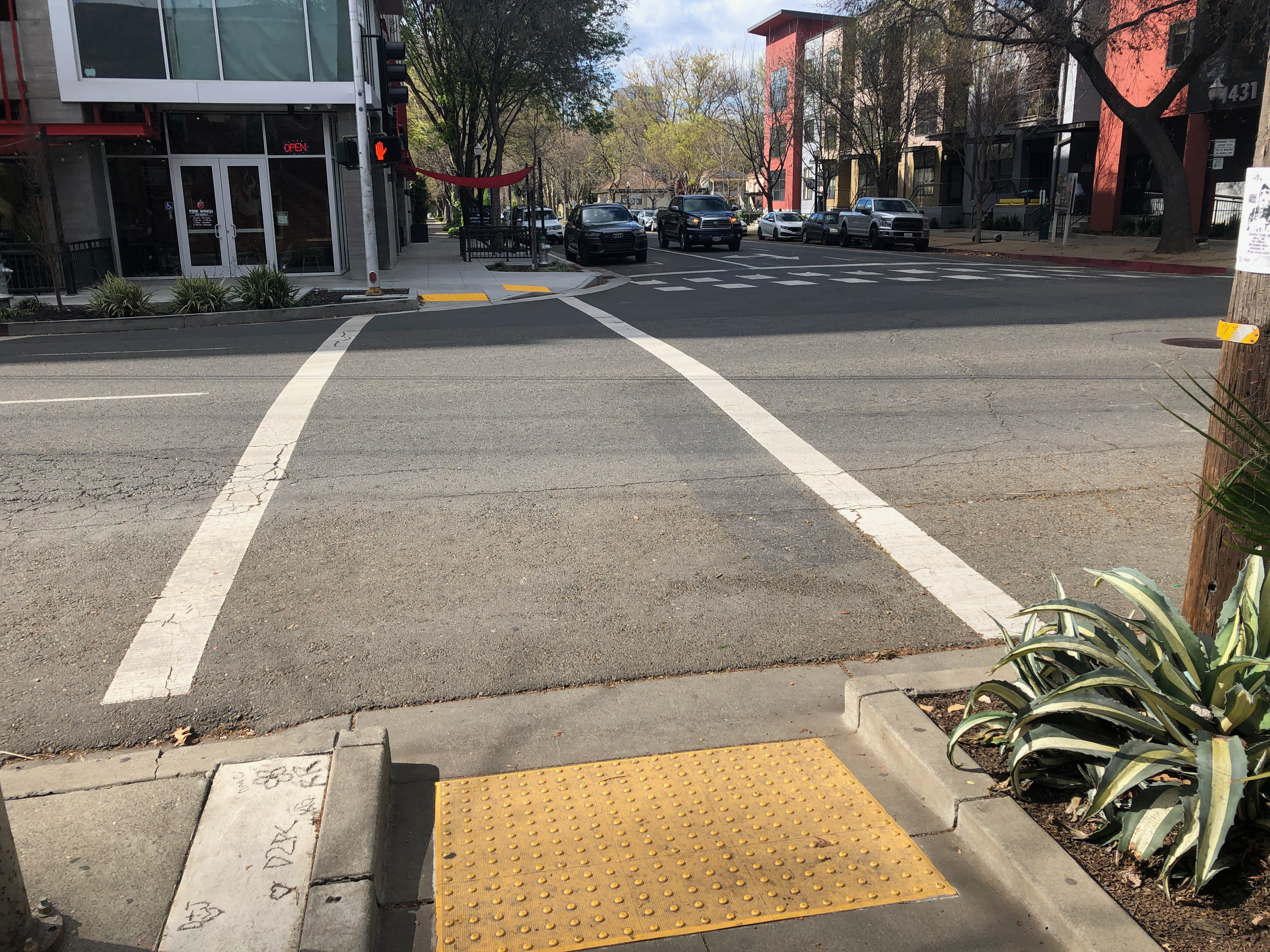
The photos below show crosswalks and offset locations for the intersection.
Q St west crosswalkQ St east crosswalkQ St short offset15th St no offset15th St south crosswalk15th St north crosswalk
The City of Sacramento has red light cameras at the following locations:
Mack Road & La Mancha Way/Valley Hi Drive
El Camino Avenue & Evergreen Street
Howe Avenue & Fair Oaks Boulevard
Mack Road & Center Parkway
Exposition Boulevard & Ethan Way
Broadway & 21st Street
Folsom Boulevard & Howe Avenue/Power Inn Road
Arden Way & Challenge Way
5th Street & I Street
16th Street & W Street
Alhambra Boulevard & J Street
The top injury intersections are:
Stockton Blvd & Broadway
Stockton Blvd & Lemon Hill Ave
Stockton Blvd & 47th Ave & Elder Creek Rd
Watt Ave & Auburn Blvd
Del Paso Blvd & Evergreen St & Lampasas Ave
Julliard Dr & Kiefer Blvd & Folsom Blvd
Power Inn Rd & Fruitridge Rd
Freeport Blvd & Florin Rd
Center Pkwy & Cosumnes River Blvd
Bruceville Rd & Cosumnes River Blvd
Franklin Blvd & Mack Rd
Notice there is no overlap. One could optimistically say that the presence of red light cameras may be making drivers safer and reducing the crashes at these locations. But I doubt it. More likely, the city is just not prioritizing high injury intersections. Of course high injury intersections change over time, as traffic patterns change, and as the city redesigns intersections to be safer, so red light camera locations need not remain static.
I ask that the city install red light cameras at all the high injury intersections. I am not asking that the city move the existing cameras to the new locations. If someone thought a red light camera was necessary at an intersection, it probably still is, and should continue unless evidence indicates otherwise.
A lot of driver-apologists claim that red light cameras are not fair, that they are installed mostly to gain ticket revenue, and that they aren’t accurate anyway. Yes, some places have installed cameras for funding, but Sacramento is not one of them. Yes, sometimes the camera systems flag a vehicle that is not running a red light, but the photos are reviewed. Even if the city were making $1M a day on red light cameras, that would be just fine with me if it prevents one death. I value life more highly than do many drivers.
I worked in Citrus Heights for several years, which has a much higher percentage of traffic signals complemented by red light cameras. My perception is that it really did make a difference. I saw very little red light running in Citrus Heights. Other violations, sure, but not red light running.
photo from City of Sacramento Red Light Running Program page
“Traffic signals are the most mindless and wasteful thing Americans routinely install to manage traffic. Removing nearly all of them within cities would improve our transportation systems and overall quality of life.”
Chuck Marohn, Confessions of a Recovering Engineer
I have long wondered what the value of traffic signals really is. As a walker, they make me wait for the signal cycle when there is no traffic coming. As a bicyclist, they stop me at almost every location, because they are set for the speed of cars, not the speed of bicyclists. There are places that set signals to work for bicyclists, but nowhere in the Sacramento region. Of course as an enlightened walker and bicyclist, I wait only for gaps in traffic and not for the signal to change. As a driver, which I once was, they make me sit at an intersection when I could be moving, and slow overall travel time.
Most signals do not sense traffic loads and respond. They are on a cycle, no matter what. Rush hour, midnight, same cycle. Signals are timed to preference one direction of traffic over the cross-traffic. And they are often very slow cycles. In the county, many of the signals are on a 2.5 minute cycle, and even in urban areas they are on a slow 1.5-2 minute cycle. Drivers have come to accept the long wait, but for walkers and bicyclists for whom a red signal can increase overall travel time by 1-1/2 to two times, they make us crazy.
Signals do not slow the speed that drivers drive. Drivers wait at the red light, and then accelerate on the green to make up for wasted time, always going over the posted speed limit. Of course these days many drivers don’t stop for red lights at all, they go through intersections on stale reds (meaning it was red before they even entered the intersection). This has become a very common behavior over the years, and is almost routine since the pandemic.
One of the things that signals seem to do is shift unsafe driving behavior from intersections to corridors, the street parts in between signals. Instead of misbehavior at intersections, causing lower speed crashes, we get misbehavior in between, with higher speed crashes.
Everyone who walks knows that signalized intersections are not safe places to cross the street. Drivers turning right look only for opposing traffic, almost never for people in the crosswalk. When the light turns green, drivers accelerate into right hand turns, across the crosswalk and any walkers in it. For intersections that permit left turns on green lights, the threat of a left turning driver crossing the crosswalk at high speed is constant. So people who value their life tend to cross mid-block, where one only has to look for two directions of traffic instead of 12.
The Confessions book suggests several alternatives to traffic signals, including roundabouts, traffic circles, and shared space intersections.
Use roundabouts rather than traditional intersections. Of course in place where the size of intersections is constrained by right-of-way and adjacent buildings, a real roundabout may not be possible, but traffic circles, of which the central city already has a number, can fit. Traffic circles are not as effective as roundabouts, but can replace signals.
Slow traffic enough that people can cross streets without having to have signals to interrupt traffic.
I realize that many people associate signals and stop signs with safety, and often demand signals and stop signs when the streets are dangerous. So what I am going to say here will be controversial. For people who think traffic signals make things safer, please spend some time observing at both signalized intersections, and unsignalized intersections. Are the ones with signals really safer? For anyone?
One of my (not) favorite signals is at 15th Street & E Street. At this point, 15th Street is not a collector or arterial, it only becomes one-way a block earlier at D Street, and has very little traffic at this point. It does not become a higher volume street until H Street and I Street to the south. E Street is a collector, though not a very busy one. Yet the signal cycles all day long, with almost no traffic at it. A perfect location for a traffic circle. Not the point of this post, but 15th Street at this location does not need two lanes, one lane would be plenty, and the excess lane can be converted to diagonal parking and/or a bike lane. A photo of the intersection is below, showing a typical amount of traffic.
What about all the signals on 14th Street? This is a low volume, fairly low traffic speed street, at all times of day. It dead-ends at the convention center, so it is not really even a through street, yet it has five signals. There are a lot more such examples. You can add yours in the comments!
15th St & E St intersection, Sacramento
All the signals in the central city that are not at the intersection of collector and/or arterial streets should be slated for removal. If the city wishes to do so, it could do a traffic study before removal, or just go ahead with removal, but it should not be leaving these signals in place without action. There are options short of complete removal. Signals could be made into signalized pedestrian crossings, so that when people walking need to cross, they still have (some) protection of a red light. (Some protection. Again, many drivers to not stop at red lights.) Curb extensions can be installed to shorten crossing distances. Traffic diverters (modal filters) can be installed so that only bicyclists have a thru route. And of course roundabouts and traffic circles. At the intersection of two collector streets, a four-way stop might be appropriate. Each intersection is unique, but each one is also a candidate for change that makes travel safer and less frustrating no matter the mode of travel.
I’m not suggesting, at this time, the removal of signals at the intersection of collector and/or arterial streets. Someday.
The map shows these signal locations, with a red X (pdf). The intersections of collectors and/or arterial streets, not marked here, are not being challenged at this time. The purple streets are designated collectors or arterials by the city (part of the Functional Classification System).
signals in Sacramento central city for possible removal
As a follow-up to the Sac Transportation & Climate Workshop big idea of bike superhighways, I was curious about how the proposed alignments matched with low income and high minority communities in Sacramento.
The map presented at the workshop is low resolution, but I decided to see if I could reproduce the routes, using a combination of the city’s existing and proposed bike network data, the road network where the proposals didn’t seem to match the bike plan, and just plain guessing. You’ll notice gaps and places where the alignment may not be correct, but overall it provide an good impression of the proposal. It is interesting that some of the on-street low-stress bikeways routes are not in the current city bike master plan.
The demographics data for low income high minority communities is from SACOG’s Environmental Justice Areas. This is just one of many possible comparisons. Population density and employment locations would also be interesting. I don’t know what demographic information the city used to come up with the bike superhighways proposal.
The map is below, and pdf. The red lines are the bike superhighways, the blue lines are the ‘on-street low stress bikeways’ that provide to some degree the connection from the bike superhighways to the central city.
bike superhighways and LIHM areas in City of Sacramento
Does the proposal serve the people who need to be served? Meh. To some degree. The Sacramento Northern Parkway, at upper right, probably does the best. It is an existing separated path (Class 1) that does need upgrades at road crossings but otherwise is ready to go. The Jackrabbit Trail at the upper left does serve high minority areas, but not low income. It is mostly an existing route, with some gaps and several completely unsafe roadway crossings. The south area is a major bikeway desert, of course, due to both city and county disinvestment and transportation discrimination, and this proposal does little to correct that.
As promised, a different map of the City of Sacramento showing low income high minority (LIHM) areas, below and in pdf. The light green = low income high minority, is probably the most significant category. There are similarities to the median household income map posted earlier, but they are not identical. It is not that either is right or wrong, just different measures.
This dataset is the Environmental Justice or LIHM developed by SACOG in 2020, for use in their MTP/SCS development process and other uses. This dataset used block groups, the smallest of the census areas, rather than census tracts, which is why the areas on this map do not necessarily match the census tract boundaries on the MHI map. The summary description is:
Environmental Justice areas as of 2020. Created with various factors related to environmental impact of the Sacramento region.
SACOG, with the assistance of the SACOG Equity Working Group, identified 2020 EJ areas as census block group level concentrations of low income, and/or high minority and/or qualification of an “other vulnerability” and/or within the CalEnviroScreen 3.0 identified areas. The other vulnerabilities take into consideration concentrations of: older adults aged 75 or more, linguistically isolated households, single parent households with children under the age of 18, low educational attainment, severely housing cost burdened households, and persons with disabilities.
This is consistent with SACOG’s 2020 MTP/SCS adopted plan. This feature has identified 548 boundaries as Environmental Justice areas for the SACOG region as of August 2021.
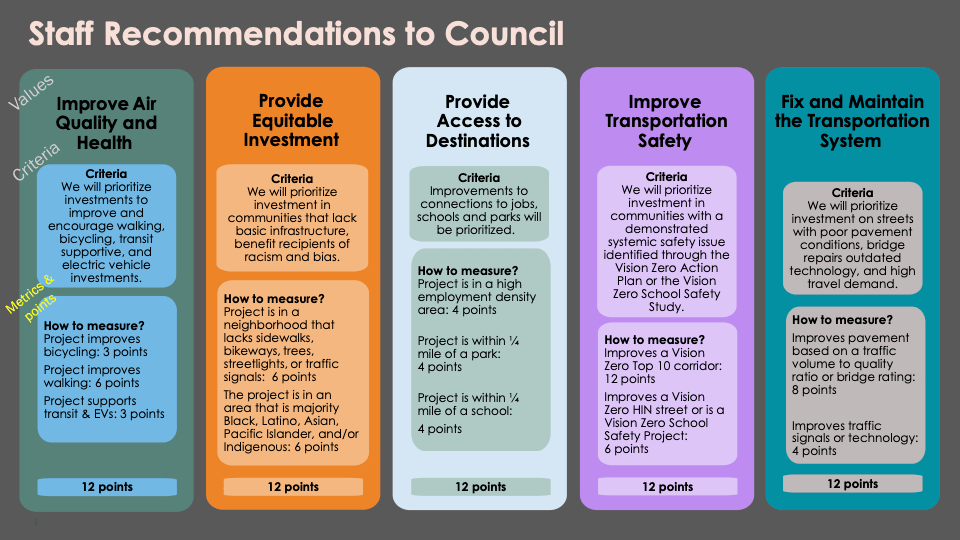
I don’t think the five categories should be weighted equally. If the city were starting with a blank slate, it would make sense, but the slate is not blank. Out existing transportation system is profoundly racist and classist, so the city must overcome past harms by focusing improvements on low income and communities of color. Rather than being 20% of the scoring, ‘Provide Equitable Investment’ should be 40%.
I’ve also come to understand this this is a technical document, not a policy document. The only real policy here is that criteria will be used to select projects, not whim. This is acknowledged to be an immense improvement. But it is only one of many needed policies.
What is a policy? A statement that controls how the city designs and operates the transportation network. An existing policy is the goal that all streets will have a pavement condition index (PCI) or at least 72. Examples of new policies:
All sidewalks will be maintained in a state of good repair by the city. Adjacent property owners will be responsible only when a tree on private property, not in the sidewalk buffer, creates root heaves, or when construction activity damages the sidewalk.
Every crash resulting in a fatality or severe injury will be investigated by a team including a traffic engineer, a planner, a representative of a walking or bicycling advocacy organization (Civic Thread and/or SABA), and a citizen who lives in the neighborhood and regularly walks and/or bicycles. A recommendation for changes will be made, and at least one recommendation implemented. ‘No change’ will not be acceptable.
What is a project? In the city’s understanding, a project is something big, a project that requires a federal, state or SACOG grant, a project that will involve concrete and/or asphalt, and constructors to install it. What is not seen as a project is lower cost changes, many of which could be accomplished with staff time and small expenditures. Examples of lower cost projects:
Change every pedestrian signal in the city to have at least a 3 second leading pedestrian interval (LPI) in which the walker gets a head start into the crosswalk. Staff time costs, no materials costs.
Remove pedestrian beg buttons from all signals in the city. Leave buttons which trigger ADA audible signals, but label them with that function. Staff time costs, some materials costs (for the new signs).
Install temporary curb extensions at the top five fatality or severe injury intersections, every year. Observe usage and transit to refine the design for permanent curb extensions some staff time, some materials costs (paint and posts).
A lot more could be said about each of these policies and projects, and I will, but for now the caution is that the TPP will only be effective if additional policies are implemented, and projects broadly defined to include the small, lower cost stuff, not just big projects.
The map below (and pdf) shows low income census tracts within the City of Sacramento. The data is from the US Census, Median Household Income, 2019, 5-year average (2015-2019). Note that the city boundary does not follow census tract boundaries, so there are census tracts that are only partly within city limits, but are included on the map. The deep red color is the lowest income tracts, less than 40% of the median household income for California (which is $75,235). There are other data and maps that could be used, including SB 535 disadvantaged communities and CalEnviroScreen. The point is that we know the locations that have been disinvested, and where we now need to invest.
This follows on to my previous post about the racist and classist nature of our existing transportation system. These are the census tracts which have been disinvested, and where most transportation investments should take place. A similar map for people of color would be desirable, but is more complicated to produce, so I have not yet.
I am not suggesting that money or projects be thrown at these census tracts by the city. Rather, that the city would sit down with people and organizations in these census tracts to determine what their needs and desires are. I’ll have more to say about investments and project selection coming up.
Angela Heering provided some progress information and links on the City of Sacramento Transportation Priorities Plan. So here is an update to my previous Sac Transportation Priorities Plan post.
There will be a presentation to city council on March 15, both on the results on Phase 1 and the plan for Phase 2. An earlier presentation to the ‘community consultants is here. The presentation to council will probably differ.
The presentation clarifies one of the questions that came up during the Big Ideas city council workshop.
How is the TPP different from the Transportation & Climate Big Ideas? The TPP is a policy document that will prioritize all City Transportation investments in projects based on community values. It does not define new projects. The Big ideas are a set of defined projects designed to think about mobility as a network and a network to encourage walking, bicycling and transit use. The Big Ideas will be prioritized with all other projects in the TPP.
I’m excited about this process. The city has never had public criteria for how projects are selected. It has been based in the past on the personal preference of the Public Works department, and sometimes, city council members. Making good investments in transportation requires criteria and performance measures for projects!










 Getting Around Sacramento