Letter to Ryan Rzepecki

To summarize: Don’t. Please, don’t.

Why? Why not be bought out by Uber? Because the objectives and culture are not a good fit.

JUMP (SoBi) has a model of disruption based on offering a better product, meeting the need of people, and making a profit in the good work. Every SoBi employee I’ve had interactions with had a passion for making the world a better place through bike share. When there were problems, each person I spoke with or emailed made sure to get it right. SoBi works with the cities it goes into, negotiating the terms but wanting to make sure it works for the company, the city, and the users.

Uber is the exact opposite. Their business model of disruption is to break every law they can get away with breaking, to cut every corner. Their intent is to drive every competitor out of business, as they must if they are ever to stop losing money. They treat employees like dirt (yes, the drivers are employees by definition of labor law, though at least in the US Uber is so lawyered up that the federal government and state governments have either not been able to compel Uber to follow the law, or don’t care to. In every city in which it operates, in the US and in Europe, Uber has violated law after law after law.

These two things do not match, and can never match.

One of the great hopes that I have for electric bike share is that it can displace many of the ride hailing trips that exist because it is time competitive with and cost positive over ride hailing in denser urban areas. I see uncontrolled ride hailing as the worst thing that could happen to our cities, and anything that lessens that damage is a great thing. That puts the ideal of bike share in direct conflict with the idea of ride hailing. The terms ‘shared mobility’ and ‘mobility as a service’ are all the rage these days, but I don’t see any mode that uses low occupancy energy guzzling cars (electric just shifts impacts from fossil fuel burning at the car to fossil fuel burning at the power plant, at least so far) as complementing any other mode. They are not a complement, they are a competition.

But the biggest conflict is on the streets. Bike riders, the users of SoBi and JUMP bikes, want more than anything to be safe. But they can’t be safe so long as poorly trained commercial drivers (Uber) terrorize bicyclists by driving over the speed limit, making sudden right and left turns, and looking at smart phones instead of at the road. Uber drivers block bike lanes more often than other ride hailing companies. I’m not sure why, but suspect it has to do with drivers adopting the attitudes of their company.

When I am bicycling in San Francisco (headed there for the weekend right now), I can hardly even use bike lanes on many streets because they are blocked so often by ride hailing. Do they look when pulling in? Do they look when pulling out? Seldom. As a vehicular bicyclist, I know how to deal with this, to just use the general purpose lane and avoid the bike lane, but I assure you, this is not the experience most bicyclists are looking for.

Bicyclists want safety. Uber does not.

I am really concerned that this is the beginning of the end of SoBi/JUMP, and that would make me very sad. Uber may kill off bike share once it realizes that the values and goals of bike share are opposed to their own. Another not unlikely possibility is that Uber will go under, under the weight of endless lawsuits that will sooner or later start to be successful. If you run a criminal enterprise, it will eventually catch up with you, whether you are Uber or the president.

To summarize: Don’t. Please don’t

@jumpbikes @ryrzny

crosswalks, for now

I hope that you have found the series of posts on crosswalks (category: walkability) useful. I could write about them forever, but for now, that is all. Besides, I’m off to the wilds of southern Utah for spring break, out of Internet range, and no crosswalks except in the small towns.
If you have improvements that you’d like to see that I did not include, or if you have specific locations you’d like to see improved, please comment. Please don’t accept the word of traffic engineers that streets can’t be made safer, or that we can’t afford to make them safer (there are a range of solutions from inexpensive to very expensive), or worst of all, that we can’t slow traffic down. We can slow traffic, we should slow traffic, we must slow traffic. Speed kills.

Pedestrian safety countermeasures

In addition to the leading pedestrian interval recently covered, three other pedestrian safety countermeasures are given prominence (among a long list of potential measures with smaller but not insignificant benefit):

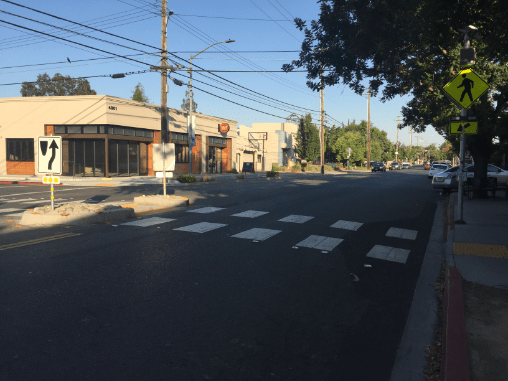
Medians and Pedestrian Crossing Islands in Urban and Suburban Areas: These medians provide a safe space for pedestrians to wait while part way across the intersection, and simplify the crossing by making so the walker only has to look at one traffic direction at a time. They are used both in mid-block and intersection settings. The photo is of a pedestrian island at Folsom and 48th in Sacramento. This is a location with frequent crossings, with popular businesses on the north and south side of Folsom. And with a popular bar on the north side, the importance of safe crossing is increased.

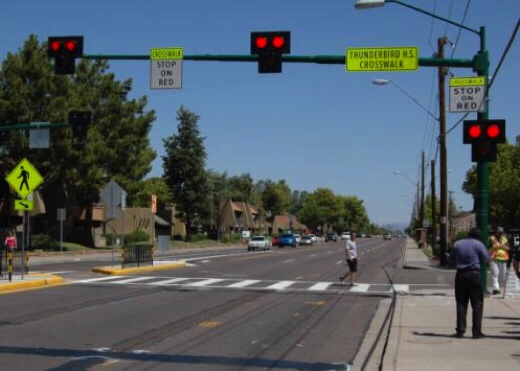
Pedestrian Hybrid Beacon: This is a specialized signal for mid-block pedestrian crossings that grabs the attention of drivers with a sequence of changing signal patterns that eventually goes to full stop. These are also known as HAWK signals (High intensity Activated crossWalK), invented in Arizona. I often hear complaints that these signals are confusing to drivers, but to me, that is exactly the point, it grabs their attention. Though I’ve seen these installed at intersections, this is a mis-application; they are designed for mid-block crossings. These signals are expensive, about 20% of the cost of a fully signalized intersection. The Rectangular Rapid Flashing Beacon (RRFB) is a much simpler and much less expensive alternative, but limited to lower traffic volume and lower speeds than the hybrid beacon.

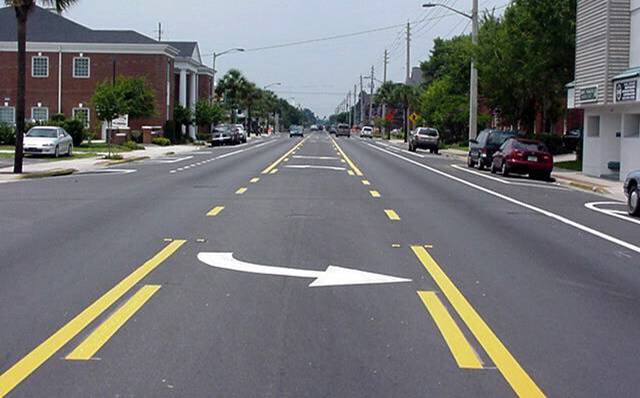
Road Diet: A road diet reallocates roadway width from regular motor vehicles lanes (called general purpose lanes) to more constructive use such as wider sidewalks, bike lanes or separated bikeways, transit lanes, and sometimes parking – where it is really needed and calms traffic). The simplest to implement is the conversion of parallel parking to diagonal parking on overly wide streets, such as has been done a number of places in Sacramento central city. More complicated reallocations are often called ‘Complete Streets,’ though complete streets are not well defined, and adding sidewalks and bike lanes to 45 mph posted (55 mph actual) arterials with infrequent safe crossings does not encourage anyone to walk or bike and may be a waste of money. But in urban areas where the capacity of multi-lane streets is not needed, or needed for only a very small part of the day, a road diet may create a safer and walkable environment.

For a full list of pedestrian safety countermeasures, see Countermeasures.

Zegeer and crosswalks

In 2005, the Federal Highway Administration (FHWA) published Safety Effects of Marked Versus Unmarked Crosswalks at Uncontrolled Locations. The authors were Charles V. Zegeer, J. Richard Stewart, Herman H. Huang, Peter A. Lagerwey, John Feaganes, and B.J. Campbell, but the research paper is usually referred to as ‘the Zegeer report.’

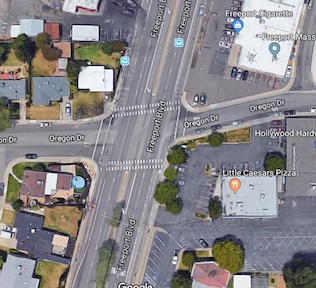
This is the research that Ryan Moore was referring to in the crosswalk removal meeting when he said that the city was following federal guidelines that required them to remove the crosswalk at Freeport and Oregon, though he did not call out Zegeer by name. Twenty-three crosswalks were removed in total, though we still don’t know where all of them are, and the city won’t provide that information.
As you would imagine, research reports contain a lot of text and figures and tables, but a key finding is that on multi-lane roads (more than one lane in a direction), with traffic volumes over 12K ADT, marked crosswalks had a somewhat higher crash rate than unmarked crosswalks. There is always an unmarked crosswalk at intersections unless there is specific signing to prohibiting crossing. It is this finding that traffic engineers have used to not install, or to remove, crosswalks on arterial roads all over the US. They don’t read beyond that.

The report says several things relevant to the crosswalk removal issue:

  • “In most cases, marked crosswalks are best used in combination with other treatments (e.g., curb extensions, raised crossing islands, traffic signals, roadway narrowing, enhanced overhead lighting, traffic calming measures). Marked crosswalks should be one option in a progression of design treatments. If one treatment does not accomplish the task adequately, then move on to the next one. Failure of one particular treatment is not a license to give up and do nothing. In all cases, the final design must accomplish the goal of getting pedestrians across the road safely.”
  • “Raised medians provided significantly lower pedestrian crash rates on multilane roads, compared to roads with no raised median.” (There is a raised median on both north and south sides of the intersection, and though they are narrower than would be required if built today, they do indeed provide pedestrian refuge.)
  • “Regardless of whether marked crosswalks are used, there remains the fundamental obligation to get pedestrians safely across the street.”
  • “Pedestrians have a right to cross roads safely, and planners and engineers have a professional responsibility to plan, design, and install safe and convenient crossing facilities. Pedestrians should be included as design users for all streets.”

Most importantly, Charles Zegeer, the lead author, said this about the key table in the report:

“This table should never be used to remove crosswalks. That will not solve the safety problem. Use this table to make crosswalks safe.” – Charlie Zegeer

I was on a webinar in which he said that he was horrified by the tendency of traffic engineers to use his research to justify crosswalk removal, and he strongly implied that this was professional malfeasance.

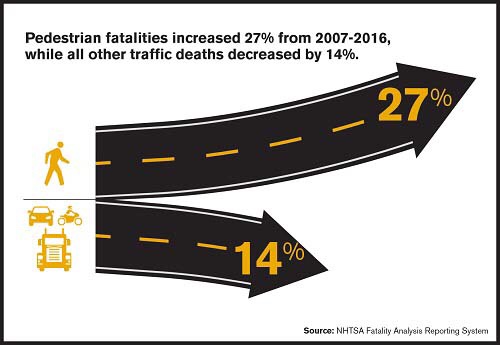
I believe that the city removed the crosswalk because they looked at the intersection and decided that removal was preferable to all other options. This is the ‘cars first’ attitude that contributes to the death of almost 6000 pedestrians a year. It preferences the convenience of people driving though a neighborhood over the safety of people in the neighborhood. This is not acceptable to me, and I doubt it is acceptable to the neighborhood around the removed crosswalk. The city needs to rethink its entire approach to pedestrian safety. Having a Vision Zero Action Plan will do no good if traffic engineers continue to make the wrong choices.
J & 13th needs a pedestrian scramble

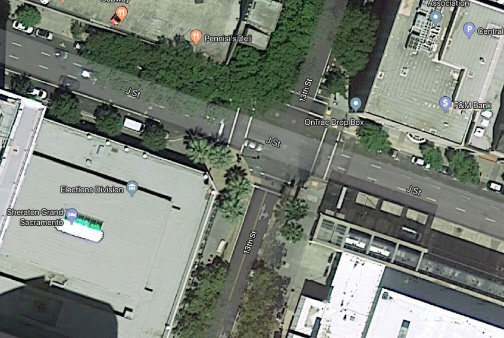
Following the post yesterday, Morse-Cottage pedestrian scramble, here is my first suggestion for a pedestrian scramble in Sacramento. J Street and 13th Street would be a great location for one. It has high pedestrian traffic, it has pedestrian attractors on three corners (convention center, Sheraton Grand Hotel, and a parking garage), and many people cross more than one direction. I am not sure that it is the highest volume intersection, but it is quite possible the highest visitor location where people are less likely to be paying attention or to understand our signal system

Most importantly, the pedestrian signalization here is seriously screwed up, and it needs to be changed. On the west leg, the pedestrian phase is short. On the east leg,there is a ‘leading vehicle interval’ that allows southbound left turning vehicles to start before the pedestrian walk comes on, so almost every cycle creates pedestrian-vehicle conflicts. All the crossings require button pushes, none are on automatic recall that is standard at intersections in urban areas with heavy pedestrian flow. And the whole intersection cycle is much too long, giving preference to drivers on J Street over walkers, right here in the heart of a place where so many people walk. The cycle also sometimes skips the west leg completely, making pedestrians wait through two cycles of J Street traffic, which is a long, long time.

In addition to the exclusive phase, diagonal crosswalks should be marked to make it clear how the intersection works.

Let’s make this the first of many pedestrian scrambles in the central city.

Morse-Cottage pedestrian scramble

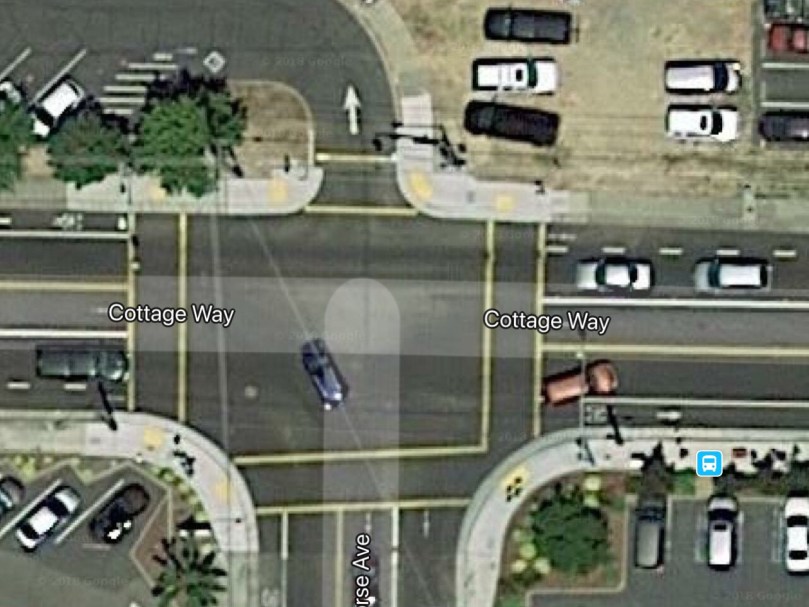
At the intersection of Morse Ave and Cottage Way in the Arden-Arcade community of Sacramento county, there is a pedestrian scramble. What this men’s is that the pedestrian signal is on, for walk, in all the directions at once. They are also called Barnes Dance, for Henry Barnes, the traffic engineer who popularized them, and exclusive pedestrian phases.
Sometimes these intersections have marked diagonal crosswalks, as a reminder that diagonal crossings are permitted, and sometimes they do not, but a pedestrian may cross diagonally whether the marked crosswalk is there or not.

I am most familiar with these from Reno (I lived in Carson City for some years), which has several along Virginia Street in downtown. I’ve seen them other places, but don’t recall exactly where right now. At every location where I’ve seen them, right turns are prohibited on red, by signing, so when pedestrians are crossing, no cars are moving at all, and there is no issue with drivers failing to yield to pedestrians using the crosswalk.

I think that every intersection that has heavy pedestrian traffic, particularly where many of the pedestrians are crossing one street and then the other, should have pedestrian scrambles. Yes, they slow traffic a bit, but they increase pedestrian safety and comfort, a great trade-off in my opinion. Many scrambled that existed in the past were removed by traffic engineers who wanted to prioritize vehicle flow over all other considerations, including safety, but it is time to bring them back, at least in select locations. See Governing Magazine, Cities Revive an Old Idea to Become More Pedestrian-Friendly, or search the Internet for pedestrian scramble for both recent and old installations.

The county had this to say about the intersection:

  1. The all-ways crossing, also known as a pedestrian scramble, at Cottage and Morse was in place/operation prior to the 2016 Cottage Way modification project. After doing some researched, we discovered it has been in place since the signal was installed in 1969.
  2. The pedestrian scramble operates 24 hours a day.
  3. The configuration of this intersection is unusual for the County. The scramble works for this location given the layout and right of way constraints that result in some of the corners only having one pedestrian push button to serve two directions.
  4. We currently do not have any plans to add diagonal crossings at this location.
  5. This is currently the only location in the County that has a pedestrian scramble.

Crosswalk removal and CVC

At the community meeting, Ryan Moore kept saying “we followed the law” in removing crosswalks. Though he was not specific, the law he may have been referring to is the section of California Vehicle Code (CVC) below. It remains to be seen if this law was followed, but it may have been since the requirements are minimal. Residents in the neighborhood were uniform in saying that they had not seen any notice, but that does not prove it did not occur. There are additional legal requirements on the city that will be addressed in future posts.

CVC 21950.5. (a) An existing marked crosswalk may not be removed unless notice and opportunity to be heard is provided to the public not less than 30 days prior to the scheduled date of removal. In addition to any other public notice requirements, the notice of proposed removal shall be posted at the crosswalk identified for removal.

(b) The notice required by subdivision (a) shall include, but is not limited to, notification to the public of both of the following:

(1) That the public may provide input relating to the scheduled removal.

(2) The form and method of providing the input authorized by paragraph (1).

Leading Pedestrian Interval (LPI) signals

Questions about using Leading Pedestrian Interval (LPI) signals at the community meeting on crosswalks reminded me that I had information on these in the city for some while, but hadn’t shared it. A LPI signal gives the pedestrian a 3-second (or more, but the Sacramento ones are all 3 seconds) head start, with the walk sign coming on before the light turns green, so that pedestrians will already be in the crosswalk and more visible before vehicles start to move. These address the common issue of both right-turning and left-turning vehicles failing to yield to pedestrians in the crosswalk. They are one of the pedestrian safety countermeasures identified by the Federal Highway Administration (FHWA), with a crash reduction factor of 60%. If you search for ‘leading pedestrian interval’ on the Internet, you’ll see a great number of useful links. The NACTO page is especially worthwhile.

My purpose in sharing the specific locations is so you can go out and experience LPI for yourself. How does it work for you?

A LPI does slow traffic very slightly since there is an additional 3 seconds per direction during which most vehicles are not moving.

Lastly, this is not a solution that could have been used at the Freeport-Oregon intersection, which is not a signalized intersection. However, it is a solution for the signalized intersections along Freeport. Ryan Moore claimed that these can’t be used at low pedestrian locations, but the response to all such reactionary claims is: “You can’t judge the need for a bridge by the number of people swimming the river.” If crossings are not safe, then fewer people are walking than otherwise could be. The demand is there, but not the facility. LPIs are one solution.

Lead Pedestrian Interval (LPI) locations in City of Sacramento (as of 2015-08-28):

  • 9th Street and I Street
  • 9th Street and P Street
  • 10th Street and I Street
  • 10th Street and J Street
  • 15th Street and K Street
  • 29th Street and K Street
  • 30th Street and K Street
  • 9th Street and Q Street
  • 13th Street and I Street
  • 8th Street and P Street
  • 8th Street and Q Street

Community meeting on crosswalks – 2

Part one, Community meeting on crosswalks, prior posts:  removal of crosswalksDon’t use the ‘A’ word. Next related post will be about Zegeer.

Question and answer session of the meeting:

  • The city is doing a speed study on Freeport from Sutterville Rd to Meadowview Rd, and will include part of Sutterville (not clear what part)
  • There are no red light cameras on Freeport; the city piggybacks on country red light program
  • There are no lead pedestrian interval signals on Freeport, or even is south Sacramento (all are in the central city); Ryan Moore said these should not be used in low pedestrian areas (which is false)
  • Resident commented on Fruitridge Rd, 24th to Freeport, a lot of red light running and few safe crossings
  • Resident who lives on Oregon suggested changing the speed limit on Freeport
  • Steve Hansen says that the city would like to change Freeport, but to do so, the community (residents, businesses, neighborhood associations) will need to come together to decide how; people will have to give up some time for better safety; he also mentioned narrow sidewalks with obstructions
  • Several people asked about or commented on specific sections and intersections; Matt mentioned catching egregious speeders
  • South Land Park Neighborhood Association (Ryan?) asked what public notice there was before crosswalk removal and said they were not notified; not clear if the other two were notified
  • Ryan Moore said that each removal was analyzed, he says they followed the law of CA MUTCD; said most of the removals were result of complaints; said neighborhood input makes no difference; mentioned FHWA info on crosswalks, referring to Zegeer report though not by name (more info about Zegeer in a future post)
  • Neighbor said that any process that removes crosswalks is flawed; mentioned no still phase on signals (time between red one direction and green the other); going out of the way is not reasonable to ask; can’t have data on people walking because people are scared to walk
  • Steve Hansen and Jay Schenirer want to review pedestrian guidelines, not sure what document this is; said we need to talk about equity because the top corridors of Vision Zero concern are not necessarily located in disadvantaged communities
  • Neighbor said speed display signs don’t seem to have any effect on behavior; asks for immediate action and not years out
  • Ryan Moore continually says “we’d like to but we can’t” but offers no proof; continues to say that crosswalks at this volume and speed are not safe
  • Neighbor said there are bus stops close to Oregon which is true and which might make removal a violation of Title 6
  • Issue of sidewalk maintenance responsibility has come up several times; city continues to insist that it is the responsibility of the property owner (even though most sidewalks are part of the public right-of-way and all are part of the transportation network)
  • Many people pointed out that improvements could have been made at the Freeport-Oregon intesection, such as bulb-outs, refuge median, lighting; there is a median already but it is too narrow to provide refuge
  • Participant asked for a pedestrian commission, Jennifer Donlon Wyant said the the city Active Transportation Commission would be seated in April or May
  • Jay Schenirer wrapped, mentioned that McClatchy students drove the changes to Freeport north of Sutterville Rd

My overall take on the community meeting is that the city council members and the public, both residents of the neighborhood and others, want proactive changes to increase pedestrian safety and walkability. They don’t want excuses. Ryan Moore, the Interim City Traffic Engineer, seem prepared only to offer excuses.

Of all the people on stage, Ryan Moore seemed the least sympathetic to the person killed, or the issues that it raises. He said much the same thing he’d said to the SacBee: “Instead, traffic engineers hope that by removing some crosswalks, pedestrians will instinctively choose to cross at a safer, nearby intersection,” Moore said. He kept referring to federal and state standards that were being followed, though a number of people in the audience who know a great deal about traffic engineering noticed that he was mis-stating and mis-using standards and research to defend his actions and opinions.

Community meeting on crosswalks

I had promised I’d report on the community meeting to address the crosswalk removal over Freeport at Oregon and related issues, but it has taken me a while. Previous posts: removal of crosswalksDon’t use the ‘A’ word. For background, see the SacBee article: Why Sacramento erased 23 crosswalks, including one where a grandmother died after removal.

The meeting was hosted by City of Sacramento council members Jay Schenirer and Steve Hansen, and school board president Jessie Ryan, and held March 8 at Hollywood Park Elementary which is east of the intersection where the fatality occurred.

Steve talked about the concept of a stroad, a street/road hybrid that doesn’t do either well, though he did not use the term. Freeport is a stroad. He introduced vision zero, talked about changing both infrastructure and behavior, mentioned that the traffic motor officers are gradually being built up but are far below what they should be, and said “we should enjoy the public space and not be afraid.”

Ryan Moore, Interim Traffic Safety Engineer, and the person responsible for the removal of crosswalks, repeatedly mentioned a ‘Systematic Safety Analysis Report’ but is was not clear what this is, and the city website has no mention of it. He also said that he was following all the federal and state rules, as well as research, by removing the crosswalks.

Jennifer Donlon-Wyant, the Active Transportation Specialist, gave a Vision Zero presentation similar to what many people have seen before, but highlights are that Sacramento is the second worst in the state for pedestrian fatalities per capita. She went over the ten profiles that are the core of the draft Vision Zero Action Plan, of which three are related to speed, and one related to transit stops, which all play a role in this incident. One that does NOT apply is ‘Pedestrian Crossing Outside of an Intersection or Crosswalk.’ Though the city had erased the marked crosswalk, it was and is still a valid legal crosswalk. Freeport Blvd is not one of the top five fatality and injury corridors in the city.

Matt Armstrong, Sergeant of the Motor Team (officers on motorcycles) said he has 7 officers on at a time, maximum, for the entire city. They respond to complaints, but otherwise focus on schools and high volume corridors. He said top concerns are red light running, distracted driving, and speed. He mentioned something I had not heard before, that this was a multi-lane threat crash. A multi-lane threat crash occurs on streets with more than one lane in the same direction (Freeport has two lanes in each direction), when one driver stops for a pedestrian and other drivers does not. This is a violation of CVC 21951 “Whenever any vehicle has stopped at a marked crosswalk or at any unmarked crosswalk at an intersection to permit a pedestrian to cross the roadway the driver of any other vehicle approaching from the rear shall not overtake and pass the stopped vehicle.”

Jessie Ryan said the district recognized that their policies were insufficient and were going to adopt the California School Boards Assocation Safe Routes to School policy (which is very weak), that they were creating heat maps to prioritize unsafe routes, is committed to using and reviewing data, and welcomes public input. The district, prior to this, has shown little interest in Safe Routes to School and has implemented only some minor projects.

Kirin Kumar of WALKSacramento and Jim Brown of Sacramento Area Bicycle Advocates (SABA) spoke briefly about the need for culture change in the community and in the city bureaucracy.

Next post I’ll discuss some of the public comments and questions, and the answers provided.