Parking in the protected bike lane

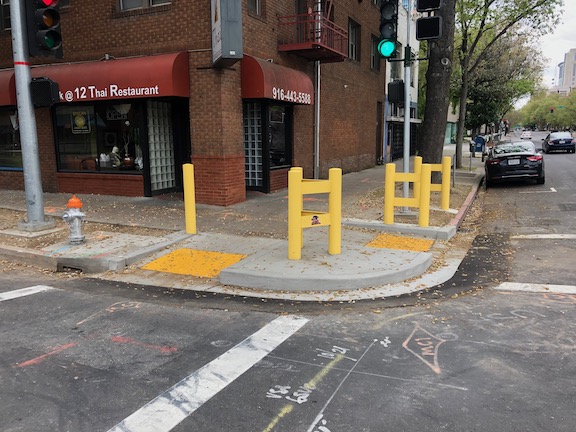
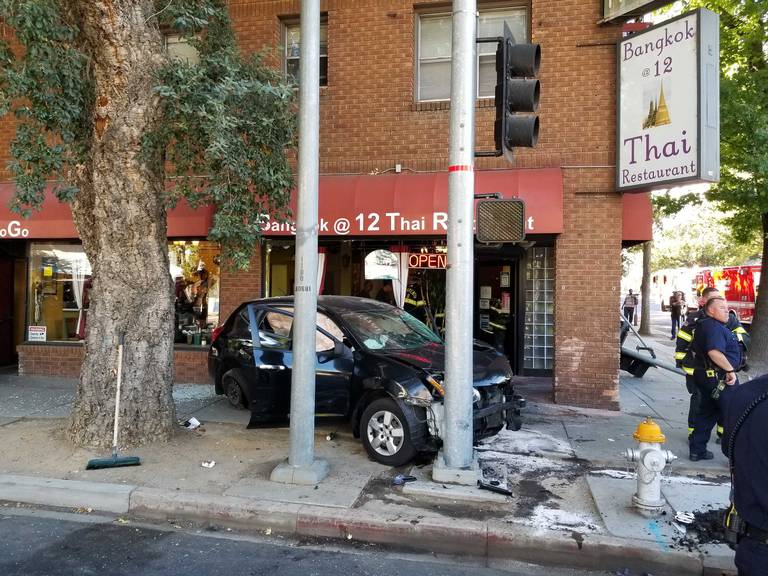
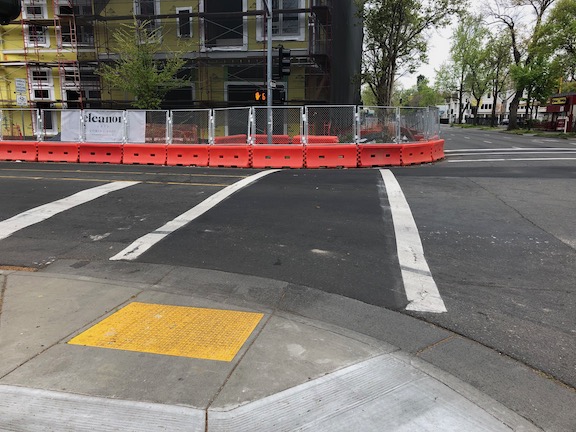
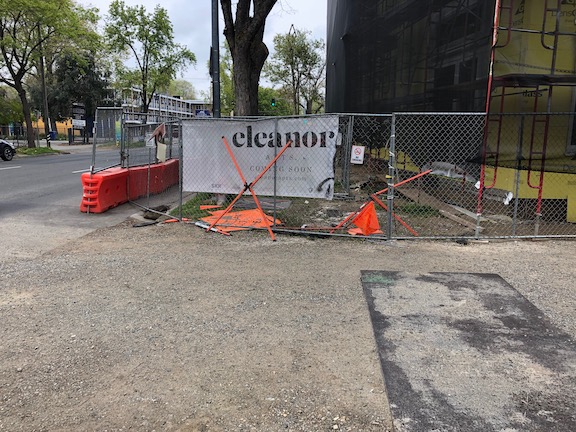
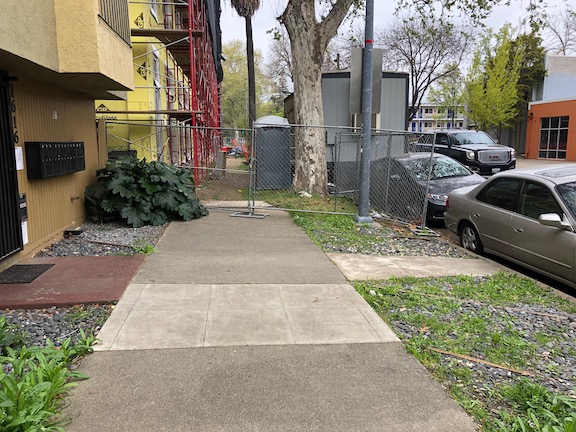
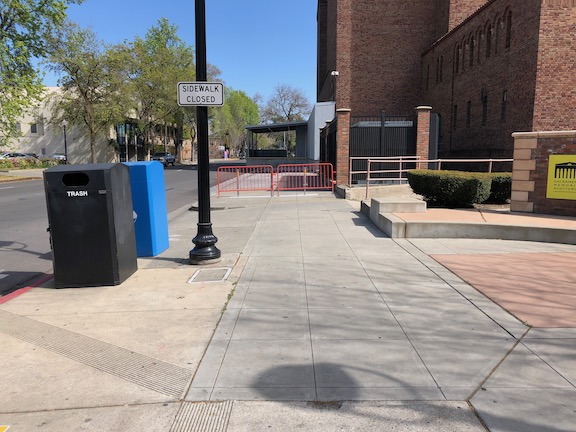
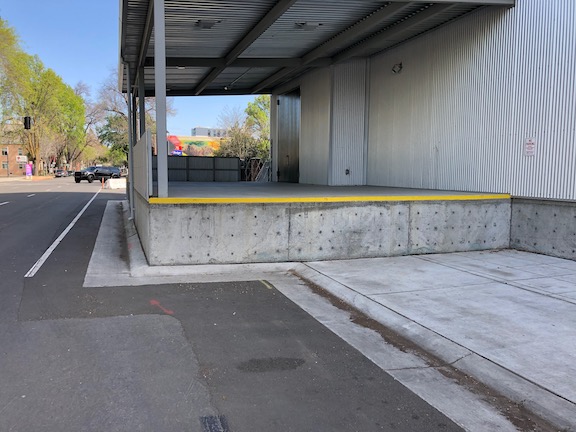
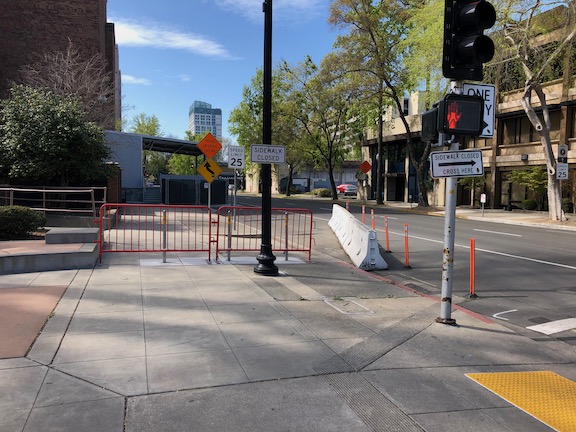
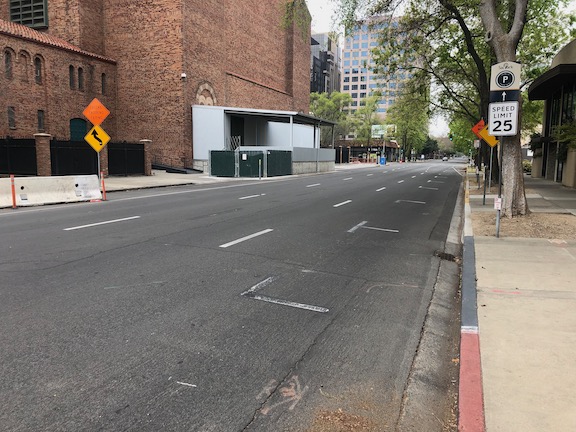
People are again parking in the protected bike lane (correctly called a separated bikeway in California) on 10th Street in Sacramento, approaching K Street. This happened for about two weeks after the facility was installed, and then seemed to stop as people adjusted to a different street configuration, but now it is happening again. I was not sure whether this is illegal or not, but the city confirmed that it is illegal. The parking meters are for the parking spaces in the parking lane to the left of the bike lane, not for the curb. Confusingly, the red curb was painted over, probably in a misguided attempt to follow city design guidelines without thinking about the real world.

The bike lane here needs to be changed to prevent this from happening. The 10th Street bikeway is full of compromises made with parking. Mostly, it works, despite that, but in this particular place, it does not.

Next year, a real earth day

I have been long frustrated with the drift of Earth Day into irrelevance. I helped organize the first Earth Day in Las Vegas, 1970, when I was 18 years old. I and my one-year-older friends who were attending the university had a lot of hope for the future and really wanted a celebration of the earth, and of the change we know had to happen. In the years since, regulation has solved a lot of our pollution problems, but forward progress on that has stalled, and been reversed by the present administration. Most people are now far more disconnected from the earth than were people back then, spending a lot of time with devices and very little with the earth. So, I’d like to suggest some ideas for the next Earth Day.

First, it is a weekend, not one day. One of the days, everyone heads for natural environments, and spends time there with friends and family, sans electronic devices. For large numbers of people in the US, access to natural areas is difficult, and almost requires a car. So I’d encourage carpooling and provision of free public transit on that day. Nationwide. In Sacramento, we are fortunate to have the American River Parkway and several other natural areas not far from transit, so long trips are not necessary. Yes, I’m serious.

The second day (the order is not important to the concept), we all gather and shut down a major road, creating an open street event. No permits, this is an action of the people having nothing to do with government and police. If the agencies who populated the booths at last year’s Earth Day really feel they have something to say and share, they can come, bring some displays and materials, as much as they can bring on a cargo bike. No driving. People will be strongly discouraged from driving to the event, in all of the publicity, so it needs to be somewhere close to transit so that people can make their entire trip, or at least the last part, on transit. Again, free transit for the day. Nationwide. The electric vehicles, which have nearly taken over Earth Day the last few years, are not welcome. They are not a significant part of the solutions we need. Electric cars running entirely on solar energy is a dream that is many years away, and in the meanwhile they are still really running on fossil fuels and nuclear energy. The better solution is just to not use cars at all. Yes, I’m serious.

The point is that the people take back Earth Day from the sponsors, and make it an event of the people. People spend the two days talking about how they can change their lives, and how we can come together to change culture and society. Hopefully we commit to taking action every day to end fossil fuels, but also end consumption and inequity and income inequality, take back our government from the rich and the corporations, end industrial agriculture, and house everyone. Earth Day should be the first day of radical action to make the world a better place. Yes, I’m serious.

Since hopefully everyone is participating in these two days, much of business as usual stops. If it doesn’t have to do with caring for and celebrating people and the earth, it doesn’t need to happen. Yes, I’m serious.

JUMP charging station at Sac City College

I thought I was through with JUMP posts for at least the day, but then I got together with Claire who clued me into the new charging hub that has been installed at Sac City College. The station is on the outside of the fence at the light rail station (which may be SacRT property rather than college property, I’m not sure). This charging hub has ten docks. So far as I know, this is the first charging hub in Sacramento, though someone else we were talking to thought maybe there were charging hubs in Davis. If you know, please comment.

I have not used this hub, so I don’t know if bringing a low battery $ icon bike to the hub earns more than the standard 50 cent credit. Let me know!

I will try to get around to the other drop zone hubs in Sacramento this week to see if any of the others are now charging hubs. Comment is you have visited any of the hubs in the region and know.

Please see my previous post on charging hubs in San Francisco for details about what they look like and how they work.

Yay!

JUMP users

I have heard many complaints from regular bicyclists and car drivers about JUMP bike riders. Since I spend a lot of my time paying attention to where the riders are and how they are riding, and I live in the central city where a large percentage of the usage is occurring (I live two blocks from the R Street corridor and three blocks from the 16th Street corridor), of course I have some perspective to offer.

Sidewalk riding: Is there a lot more sidewalk riding by JUMP riders? Well, I certainly see JUMP bikes on sidewalks, and it bothers me in part because JUMP bikes potentially go faster. However, I think the reason there are JUMPs on the sidewalk is because there a just more bike riders out. I don’t think JUMP riders are on sidewalks any more than any kind of bicycle. I fact, I’ve noticed a lot of JUMP riders in travel lanes on streets that don’t have bike lanes. Most bike riders avoid these roads, but because JUMP bikes are more able to keep up with traffic than the average bike rider, it seems like more are doing this. As SABA and many others have pointed out, most people riding on sidewalks are doing so because of their perception that the street is not a safe place to ride, and in many cases they are right. Probably a few are doing it out of habit, they learned to ride there and they continue to do so without thinking about whether and where that is appropriate, but again, the rate of sidewalk riding doesn’t seem any higher.

Parking: I hear complaints of bikes parked everywhere and blocking everything. Some of the comments are similar to those of people reacting to electric rental scooters in other cities, that civilization is ending and the sky is falling. But the more reasoned comments are worth considering. There are simply a lot more bikes needing to be parked than there were before. And there are not enough bike racks. The JUMP hubs are generally not in the most in-demand locations, but a block or two away, and so a lot of riders are parking exactly where they are going, and not at the hubs, sometimes on existing bike racks and frequently on sign poles and parking meters, and sometimes not locked to anything at all. On the whole, I see people parking JUMP bikes in appropriate locations. JUMP’s user agreement is that the bike be locked to something, and the City of Sacramento rule is that they must be locked to a bike rack (I’m not sure about West Sacramento and Davis). Very occasionally, I see a bike parked in such a way that it blocks pedestrians (both walkers and mobility devices). But this is rare.

I have been surprised by a recent trend, to lock a bike to nothing except itself (the lock mechanism locks the rear wheel, so it cannot be ridden, whether locked to anything or not). I’m seeing this even when there is something easy to lock to, right next to a bike rack or right next to a pole. Since the JUMP user agreement says the user is responsible for the bike unless it is locked to something. it surprises me that people would not lock to something when it is convenient or possible. I have not heard of any theft, but better safe than sorry. Yes, many types of bike racks are awkward to lock to, and pole and parking meters are not always easy to use.

If you do see a bike blocking pedestrian access, and you have some muscles, please move it! Yes, the bikes are heavy and not easy to move, but most people could move them a couple of feet to clear the sidewalk.

Riding skill: People who ride regularly are horrified by the skill of many of the JUMP riders. They have a point, there are a lot of unskilled riders, as many riders are people who don’t regularly ride bikes. They may not be handling it very well, particularly with the speed and acceleration. There are often riding in the wrong place on the road, which is in the travel lane if there is not a bike lane.

Traffic laws: I see JUMP riders not stopping at stop signs, and occasionally not at signals. But I don’t perceive that there is any difference between JUMP riders and other riders. And as always, I must point out that motor vehicle drivers run stop signs at a higher rate than bicyclists, though they also run red lights at a lower rate. Drivers have a perception that bicyclists always violate the law, and so they see what they expect to see, but they have a perception that drivers mostly follow the law (which is far, far from the truth), so they don’t see driver violations. Of course being on a bright red bike makes one more prominent.

Helmets: And last of all (added), people complain that JUMP users aren’t wearing helmets. I’ll keep this short, recognizing that even anything I say about helmets is likely to start a war with helmet trolls. There is no real evidence that helmets save lives. Yes, trauma nurse say so, but they only see the after-effects and know nothing about the causes. Yes, the ‘research’ of the helmet industry says so, but it has all been discredited. NHTSA (National Highway Traffic Safety Administration) has removed all reference to the ‘prevents 85% of head injuries’ statements because it turned out the research results that they cited were fabricated. I’ll accept the validity of helmets when pedestrians and motor vehicle drivers, who both have higher rates of head injuries, are also wearing them. If you are so concerned about the safety of bicyclist, then get cars off the road.

JUMP and Outside Lands in SF

I was in San Francisco the weekend of August 10-12, for a contra dance weekend. It was also the weekend of Outside Lands, one of the biggest music festivals in San Francisco, about 70K per day (I think Hardly Strictly Bluegrass is a bit bigger). JUMP set up a temporary hub in Golden Gate Park and encouraged people to ride to the festival rather than driving. The screen capture at right shows the cluster of bikes there at one point in time, 96 in the geofence and others nearby. I saw the number 147 at one point, but did not capture that one.

Since I did not go to Golden Gate Park (no person in their right mind would get close to Outside Lands if they were not attending), I don’t know what sort of parking they were using. Probably just lining the bikes up and using kick-stands, within a controlled and secure area, but this is a guess. I was unable to find any photos on the Internet.

The ironic thing about this is that I was unable to find any JUMP bikes to use in the rest of the city during the day. Of course in the evening many of those bikes came back into the neighborhoods, but during the day, pretty much no bikes anywhere. The SF system only has 250 bikes, and availability is never 100%, so almost all JUMP bikes in the city were in one single location. Sacramento, of course, does not have any events of comparable size, so I’m not sure whether JUMP would ever do this here, but it is an intriguing thing.

Ford GoBike did a similar parking offer in the park. Again, I was unable to find photos. GoBike is a dock system, requiring docks for the bikes, but in this case they may have just parked them without docks because it would be a major project to bring docks in, and remove them again. SF was not completely depopulated of GoBikes, though it was noticeable that there were fewer available. I used GoBike instead to get around, as my membership in GoBike has not expired yet. I got a membership way back when the system started, and renewed before JUMP showed up, though I doubt I will renew when it comes around.

JUMP kiosks in Santa Cruz

I was in Santa Cruz last weekend, which has the same JUMP system that we have here in the Sacramento region. Several of the hubs had kiosks installed, as shown to the right. The kiosk shows the map, the cost, how to rent a bike, and some safety tips. I am not sure whether Santa Cruz required these, or JUMP provided them on its own. I am not aware of any of these in the Sacramento region. I often see people standing by the JUMP bikes, looking confused. They are not quite sure how to check them out. I offer help, and it is much appreciated by most people. In fact, perhaps there should be bike-share ambassadors at heavily used locations. In Sacramento, many of the most heavily used locations are not the JUMP hubs, but regular bike racks, so I’m not sure where the ambassadors could best be located, but it is an idea.

Dock bike-share systems, such as Ford GoBike in San Francisco, have kiosks of some sort at all of their docking hubs. Most allow you to purchase passes, some just provide information, but all are oriented to help new users figure how the system works. Of course in San Francisco, a significant percentage of users are tourists who have not used the GoBike system, and may not have used bike share anywhere.

Do you think kiosks would help people here? Have you helped new or confused JUMP riders?

JUMP success!

Back in June, I suggested that the JUMP system was failing (Two weeks in – failure?). The major issues were that low battery bikes were not being picked up for recharging for several days, there were nowhere close to the 300 promised bikes, and the GPS units did not seem to be reporting correct information or communicating with the network.

We are now at 600 bikes (I think), the bikes are being picked up for charging much more quickly, the drop zones seem to be working for accumulating the bikes that needs to be charged, the GPS units and network are having many fewer problems, and most importantly, there are enough bikes out in the Sacramento central city that there is a bike available within two blocks or so. So, I’m declaring success for the central city. The number of bikes has reached a critical mass necessary for a successful system, and it is working GREAT. I have only occasionally used the bikes in West Sacramento and Davis, so can’t offer a perspective on those two cities.

Just like transit, which can be judged in part by whether a train or bus is coming soon, a bike share system can be judged by whether there is a bike easily available. There are still a few times of day, and a few locations within the central city where it may be hard to find a bike, but most of the time, they are there waiting for you.

East Sacramento, Land Park, and Oak Park are not doing as well, particularly Oak Park. There is not a sufficient density of bikes in these areas that there will be one available close by. In fact, it can be a quarter mile or more between bikes.

Another criteria for judging bike share systems is whether they are reducing motor vehicle trips. In the central city, it seems to be doing so. My impression is that there is a noticeable reduction in motor vehicle traffic, particularly in the evening. Evenings, the bikes are being used largely by young people moving between various restaurants, music venues and bars. It seems like a lot of during-the-evening travel is by bike, but I notice that many people are going home via ride hailing (Lyft and Uber), because it is late, or they are drunk, or they live outside the JUMP system boundary. I have heard from rail hail drivers that evening business is down, and from riders that the drivers are complaining about it. All of this is anecdotal, and no one has made data available yet. I’m not sure that the city would even know if there has been a shift in travel mode. But to the degree that anecdotal evidence is true, this is a good sign. More active transportation trips, fewer motor vehicle trips, is exactly what is needed.

The bikes are also being used for commute trips, and at-work errands. These bikes may only get used for the to-work and to-home trips plus maybe one more trip during the day. On evenings and weekends, each bike in the central city seems to be getting many uses a day. When I park a bike in a popular part of the central city, it is often gone within five minutes. On the other hand, some of the outlying bikes in the suburban neighborhoods are not getting much use, sitting there for several days in a few cases before someone grabs them, or they are picked up by JUMP.

JUMP credit, in repair, count

If you pick up one of the $ icon bonus bikes in Sacramento and return it to one of the drop zone hubs, you actually have 15 minutes to park to receive the full credit. After 15 minutes, you are charged the regular minute rate. For example, if you took a $ bike and rode it for 30 minutes, you would get the credit of 50 cents, but subtracted from that would be 15 minutes times 7 cents (the per minute charge is not exactly 7 cents, but close enough), so $1.00 would be deducted, for a total of minus 50 cents. It is still a good deal, as compared to the $2.00 you would have paid otherwise, but returning low battery bikes to drop zone hubs is a good bike share community act, valuable regardless of the credit.

The threshold for bikes going into repair mode from low battery changed about a week ago. A $ icon bike no longer goes into repair mode all the time, but rather it depends on the battery level. I have not exactly pinned down at what battery level this is, but it is below the 35% level at which a bike gets the $ icon. I think it is about 25%, which I also think is the level at which the app shows ‘low’ instead of a percentage, but I need more observations to pin this down. At any rate, you still get the drop zone credit whether or not the bike goes into repair.

Since bikes will be available at lower battery levels than before, it becomes more important for the user to look at the battery level and determine whether there is enough to reach the destination. The GPS unit display shows battery level, but it is a little hard to determine exactly what it is, and the battery level may change as the GPS unit corresponds with the network. The app gives an exact level.

I heard from a JUMP staff that there are now 600 bikes in the region. Of course some are in the warehouse being charged and some are in repair mode, so there are always fewer available, but this is a significant increase over time from the initial 300.

No more pure office buildings downtown

The state is building several new office buildings downtown. Close to where I live, the former building at O St and 12th is gone, and will be replaced with a modern office building, and the block between O and P and 7th and 8th is seeing a new building. There are others planned, and there is a plethora of state-owned surface parking lots (a travesty of land use if ever there was one) that could be developed.

It is good, in a sense, to see the state aggregating scattered offices into more centralized locations. But what is not good is that the state is not building any housing to go with the offices. So most employees will still be driving in from the suburbs, creating air pollution and rush hour congestion in the process, while contributing nothing to life in the central city. Almost every new building, whether public or private, has some retail, at least a corner and sometimes the whole ground floor. But integrated housing and office is rare.

So, my modest proposal (in the Swiftian sense) is that every office building of one-quarter block or larger include housing for at least one-quarter of the employees of the building. Not just the daytime office drones, but the maintenance staff as well. Some percentage should be required affordable, probably 20% to cover the lower income maintenance and clerical staff. I am not saying the the residences should be limited to employees of the building, I’d leave it up to each building manager how they wanted to allocate housing.

I have mixed feelings about whether this should be required of private developments. Certainly there should be codes and city support for accomplishing the same objective in private development, but requirements, not so sure. But state owned buildings, yes, absolutely, every one of them.

I lived in midtown, close to the downtown boarder, for seven years, and have now lived in downtown, near the midtown border, for just under a year. I moved all of five blocks. These two places might as well be in different cities. Downtown is dead, dead, dead at night and on weekends, whereas midtown is alive weekdays, evenings, and weekends. The difference? I think it is primarily the lack of housing in downtown. Office towers do not make for a livable, walkable place.

JUMP on Monday, August 6

We counted throughout the day of Monday, August 6, and generated the following data table and gif animation. Monday was not necessarily a typical weekday, as the middle days of the week may be more typical, and it was not a typical use day because the air quality was unhealthy for a portion of the day. The gif animation focuses on Sacramento central city. It is not possible to present much larger areas without losing icon and count detail.

JUMP_2018-08-06