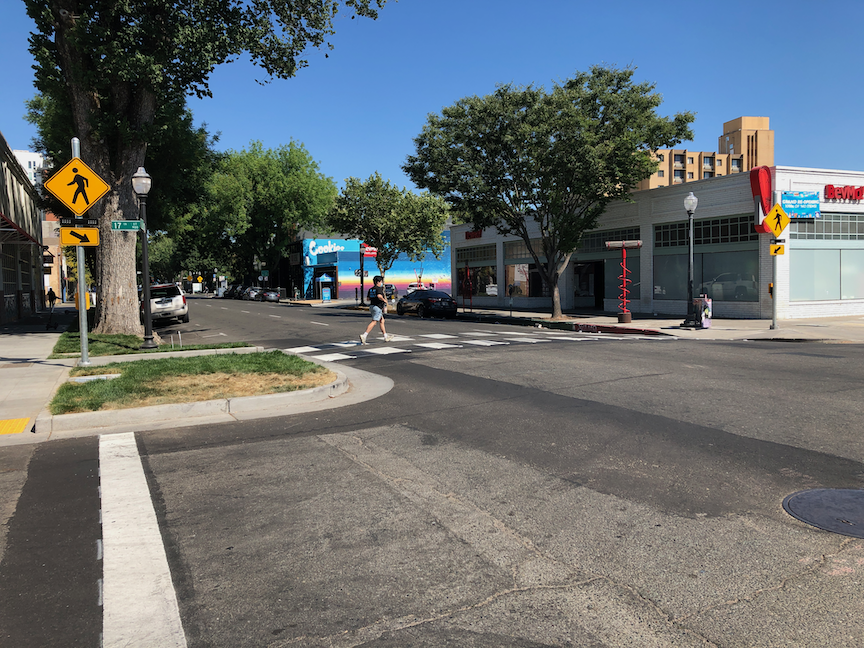
The City of Sacramento has been installing temporary curb extensions, with vertical delineators mounted on bases, at intersections. The extension is ‘temporary’ in the sense that it is not a concrete or hardened extension, though in most cases they will not be replaced with ‘permanent’ due to the expense of permanent installations. These curb extensions slow turning drivers, and reduce the crossing distance for people walking, or rolling. These are an effective countermeasure that increases safety, and I am very happy to see them being installed. In the photo below, on the northeast corner of S Street and 27th Street, the crosswalks have also been freshly painted in a high visibility pattern. The marked crosswalk over 27th Street may be new, and seems to be a new pattern for the city to use.
This particular installation also serves as daylighting, by preventing parking in the daylighting area approaching the intersection. I did not measure it, so am not sure if it meets the legal 20 foot requirement, but it does serve the purpose of increasing visibility by precluding parking. However, many of the installations do not set off the daylighting area, for example the northwest corner in the photo. I do not know why the city has decided in some cases to include daylighting in the curb extensions, and in other cases, not.
Though it would increase the materials cost of installations, requiring more delineators, all curb extension installations should also include daylighting, unless the location already has red curbs and/or signing for daylighting. AB 413 (2023), the daylighting law, does not require red curbs, signing, or delineators, however, the city’s intent is to ticket only where there is an indication for drivers of the law.
It appears that these vertical delineators are Pexco FG 300 Turnpike Grade Curb System. The bases discourage but don’t prevent motor vehicle drivers from running over the delineators ‘just for fun’, and provide more visibility than simple vertical delineators. I have so far not seen any curb extension locations where the delineators have been damaged by drivers. Delineators on the bikeway turn wedges have definitely been damaged by motor vehicle drivers.
I wonder if the lane channelizing vertical delineators on 15th Street and 16th Street should be replaced by this type (Hmm. 16th St traffic calming). These installations really do reduce lane changes at the last moment, which endanger walkers using the crosswalks, the ‘multi-lane threat’ that kills people. They are a success story for Sacramento, and should be used in more locations.
temporary curb extension at S St & 27th St, northeast corner
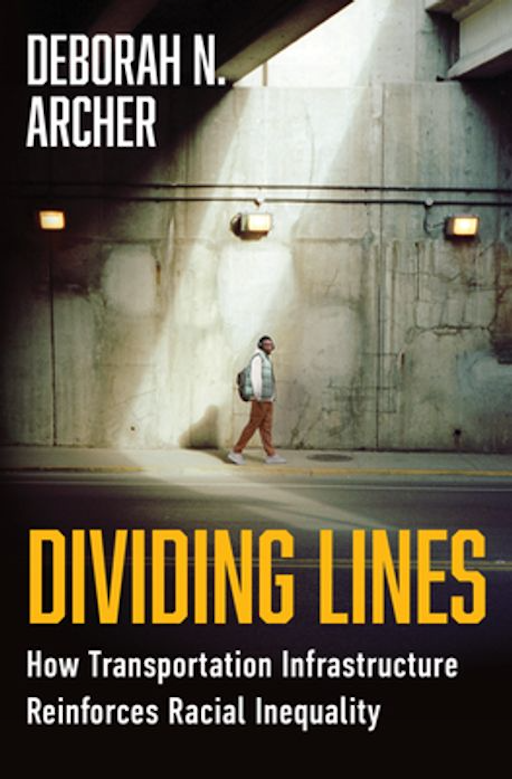
In the 2025 book Dividing Lines: How Transportation Infrastructure Reinforces Racial Inequity (2025; ISBN 978-1-324-13056-7), Deborah N Archer lays out the issues that have long plagued the Black community as their neighborhoods were underinvested, and broken up by transportation infrastructure built for the convenience of white people. She also covers the past legal frameworks that encouraged this, as well as the laws which can be used to fight it and correct it. I am part way though reading the book, but it has deepened my understanding of the racial bias built into our transportation system.
This is not just a problem of other cities. The alignment of Interstate 5 was designed to both erase low income housing and the people of color that lived there, as well as related businesses, and to isolate what remained from the rest of the city. The alignment of Highway 50 was designed to remove low income housing and the people of color that lived there, to isolate the higher income Land Park neighborhood from the city, and erased part of Southside Park. Highway 99 cut directly through south Sacramento and isolated the Black neighborhoods on both sides. And this is just the freeways. Arterial roadways were placed, and widened, and widened again, to separate people of color, and to cater to higher income while people. Many of these were not directed just at Black neighborhoods, but at all immigrant and low income people.
In Chapter 6, ‘The White Man’s Right of Way’, Archer delves more deeply into the issue of sidewalks:
“Even in cities that were not segregated by law, sidewalks in predominantly Black neighborhoods are less common and of poorer quality, often as the result of a legal regime that places greater reliance on private property owners. More than perhaps any other means of transportation, pedestrian infrastructure is highly localized in its construction, funding, and maintenance; the federal government does little to oversee or force accountability on sidewalk quality or even whether sidewalks are required on a particular road. Sidewalks are in some ways “public,” but are also closely associated with adjacent properties or lots. The result is that neighborhood socioeconomic disparities map directly onto pedestrian infrastructure quality, as poorer neighborhoods that are disproportionately Black and Brown are less able to invest private capital into maintaining their sidewalks.”
The City of Sacramento responds to complaints about sidewalk condition such as root heaves by making the adjacent property owner repair the sidewalk, or if the property owner does not do so, doing the repair through a contractor and billing the property owner. This is the city’s policy. State law allows the city to impose this, though it does not require the city to impose it. And just because something is in state law does not make it constitutional. As I have said before, requiring a private property owner to maintain city property is prima facie unconstitutional.
The city could take on responsibility, if it so chose. It is worth noting that some of the most poorly maintained sidewalks in the city are adjacent to property the city itself owns. The city often does not apply the requirement to itself.
The cost of a sidewalk repair does not fall equitably. A commercial property owner or a high income property owner may be able to handle the cost of repair, which can be quite expensive. A low income or even moderate income property owner cannot. So where are low income and moderate income property owners located? In those parts of the city where sidewalks were narrow or nonexistent, where the standards of construction were lower or overlooked, where sidewalk buffers, if they were present at all, were too narrow to allow for healthy trees. In other words, north Sacramento and south Sacramento.
Archer says: “Municipalities that require private property owners to maintain sidewalks can worsen disparities when they enforce those rules in inequitable or unreasonable ways. For example, when cities pay for the cost of repairs themselves, they often will bill the adjacent property owner. This debt can be enforced through a lien that may ultimately result in foreclosure on the property. It should not be a surprise that Black communities bear the brunt of this practice.”
I used to file 311 reports on sidewalks, before I understood that the financial burden fell on property owns, and not on the city. Once I realized this, I stopped reporting. Archer says:
“A related problem comes when cities rely on private complaints to determine where and when the city should repair damaged sidewalks. Several cities use voluntary complaint systems like “311” phone calls to assess which sidewalks need work. Low-income communities of color are far less likely to call to request help. Seattle, Washington, switched from a 311 system to a fixed repair schedule after officials realized that relying on 311 led the city to make a disproportionate number of repairs in high-income, white neighborhoods. Those residents were more comfortable filing complaints and likely had higher expectations that those complaints would be addressed. When Boston embarked on a citywide campaign to address sidewalk inequities in 2017, it opted not to use a 311 system. Instead, city officials went block by block over Boston’s 1,600 miles of sidewalk to set repair priorities. But not all cities have the interest or the resources to follow Seattle’s and Boston’s leads.”
One can argue about whether these disparities were intentional on the part of the city, or inattention by the city, or the result of private developers, or any number of other excuses. The fact remains that Black, Latinx, and immigrant communities have lower quality walking environments, and lower quality sidewalks, and many of the property owners there cannot afford to maintain these sidewalks.
Placing the burden of sidewalk repair on adjacent property owners is racist, if not in intent, then in practice. It is time to change this. It is time for the city to take on responsibility for maintaining sidewalks. I am not talking about situations where damage to a sidewalk is clearly the result of trees planted on private property too close to the sidewalk, or where driving over sidewalks by private property owners (or their tenants) caused damage. But I am most certainly talking about sidewalks where trees in the city right-of-way, which includes sidewalk buffers (planting strips), have caused the damage, and deterioration due to natural causes or substandard construction led to damage. I have looked at miles of sidewalks in the city, and can say with certainty that the city often accepted substandard sidewalk construction because it did not care about the neighborhoods where this shoddy construction was the pattern.
I have written about Denver’s solution (Denver’s approach to sidewalk maintenance, 2024-11-05), and will have more (much more) to say about sidewalks. They are the neglected part of our transportation system.
For previous posts on sidewalks and walkability, see category: sidewalks, and category: walkability.
Almost every complete streets and safety project the City of Sacramento has undertaken has focused on the roadway part of the street, the part where motor vehicles and bicycles travel. They have not focused on the sidewalks.
The ‘complete streets’ concept (note that I’ve placed it in quotes) emphasizes travel along corridors, not local travel and life. Lanes are narrowed or reduced. Bicycle facilities are added. A few safer crossings are added. Sometimes parking is reduced or eliminated. This is all good. But by designing and building this definition of ‘complete streets’, sidewalks are usually neglected. If a sidewalk is present, that is considered good enough. ADA ramps are added at corners, which is good, but the sidewalks in between corners are often untouched. There is a reason for this: repaving a street and then re-striping for different roadway width allocation is cheap (relatively). Replacing and widening sidewalks, and moving curb lines, is expensive. The result of a ‘complete street’ is a street that eases, and perhaps makes safer, travel by bicyclists and motor vehicle drivers, but does little for people walking.
It is bad enough that sidewalks are not improved, but by refusing to move curb lines, and/or to remove private development within the public right-of-way, the common issue of sidewalk buffers (which the city calls planting strips, though they may be used for many purposes in addition to planting) is perforce neglected.
Sidewalk width
Sidewalks should be a minimum of six feet, with widths up to 16 feet where the frequency of people walking justifies it. Many city sidewalks are five feet, and there are relict sidewalks of four feet. And of course there are many streets in the 50’s to 70’s developments that have no sidewalks at all. If a sidewalk is less than six feet, on a roadway that is being reconfigured or reconstructed, the sidewalk should be widened to at least six feet. Wider if justified by walking.
Driveways
In locations with sidewalk buffers, the slope of a driveway in often across the sidewalk, which makes the sidewalk dangerous for anyone in a mobility device, and uncomfortable for all walkers and rollers. Much of south and north Sacramento suffer from this design. Where it is present, it must be corrected. There is a correction available which ramps the sidewalk down and then up again across the driveway, and this is legal in PROWAG, but it is and should be the design of last resort. The better design is to slope the driveway across the buffer. And to remove unnecessary driveway. Strong SacTown and I will write more about this.
Sidewalk buffers
Sidewalk buffers, where they are present, are almost always too narrow to support healthy, mature trees. A healthy tree needs a sidewalk buffer of eight feet or more. If the buffer is six feet, as is common, an assessment should be made about the health and type of trees, to determine whether a wider buffer is needed. If the tree is healthy, and the sidewalk not heaved by roots, probably best to leave it alone. If the buffer is narrower than six feet, it should be widened, with curb line moved if necessary. And if a buffer is absent, it must be installed. Sacramento is the ‘city of trees’. Unfortunately, it is also the city of constrained and unhealthy trees that have heaved sidewalks, because the city and developers did not care to create a safe, healthy place for them to grow. In neighborhoods of north and south Sacramento, where buffers were not created, there are often almost no trees at all. The trees on private property have died and not been replaced, and the city has not provided trees. These are miserable places to live and walk.
Funding constraints
So, given that curbs and sidewalks are more expensive than re-striping a street, what is the solution? The city’s solution is to neglect the sidewalks, and thereby neglect the trees. My solution is that corridors being reconstructed need to be shortened in order to free up money to do the sidewalks, and sidewalk buffers, right. This is a long term investment. Streets usually only last about 40 years before needing significant work. Sidewalks and sidewalk buffers are a long-term investment, that pays off for livability and reduces city liabilities every day, every budget cycle. The sidewalks and 12 foot sidewalk buffers in the Poverty Ridge area of Sacramento (see sidewalk buffer widths) are in good condition after 100 years or more. Sidewalks have required minor repairs in a few places, but most of the work was for utilities. The buffers have been used for a variety of purposes: trees, gardens, seating areas, play equipment, etc. Not just planting.
If a street is being reconstructed, do it right. Make sure there are wide sidewalks and wide sidewalk buffers. If that means that 10 blocks can be completed instead of 40 blocks, so be it. Do it right, and it will last, and will contribute far more to livability and walkability that a roadway reconfiguration.
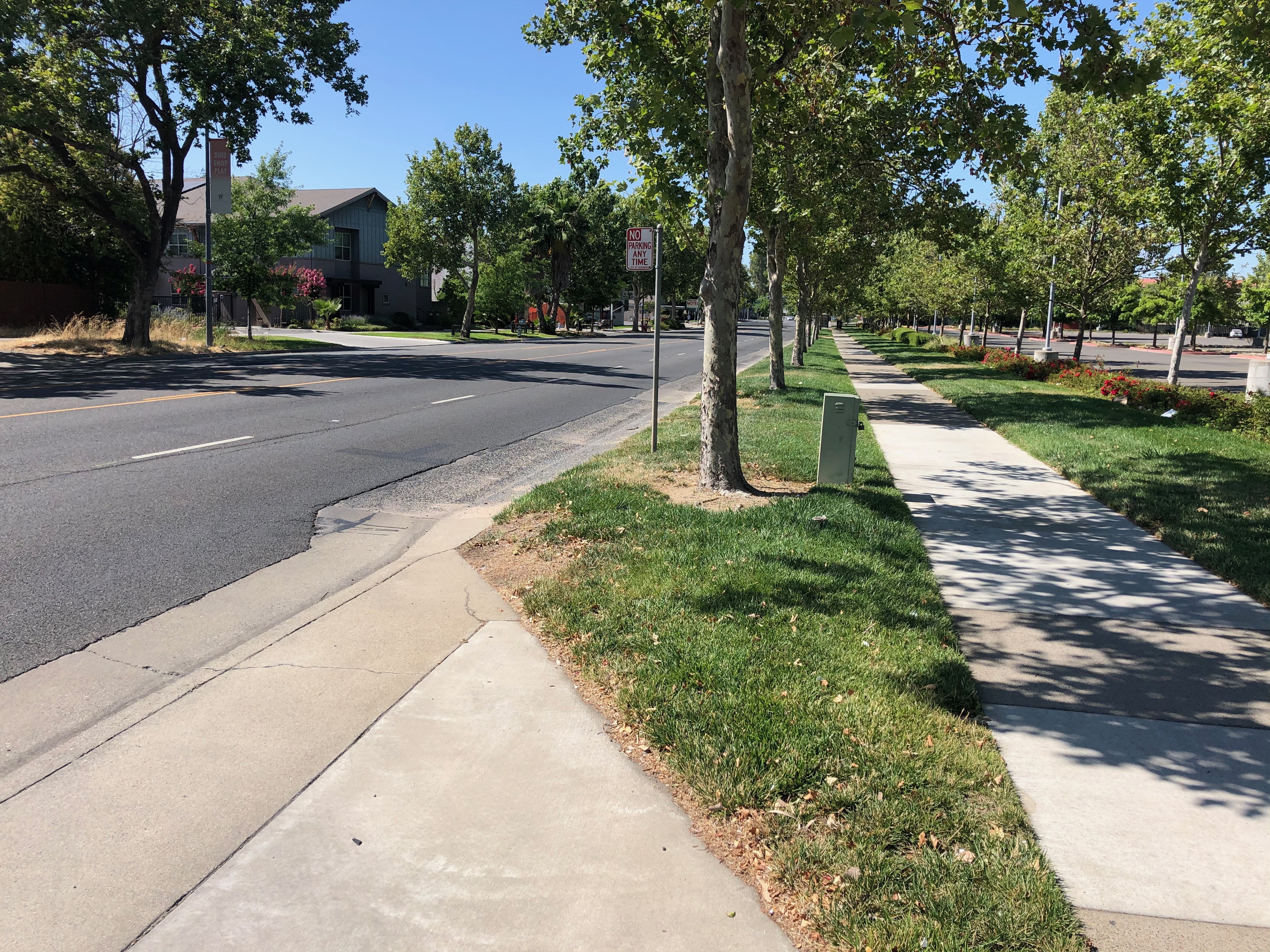
The photo below shows a section of Stockton Blvd with a sufficiently wide buffer (wider would be better), and healthy trees (at least until they mature). But this is an unusual section of Stockton. Much of Stockton has narrow sidewalks and no sidewalk buffers. The city is planning to spend a lot of money on reconfiguring the roadway on Stockton, but is not fixing the sidewalks nor adding sidewalk buffers except in a few places.
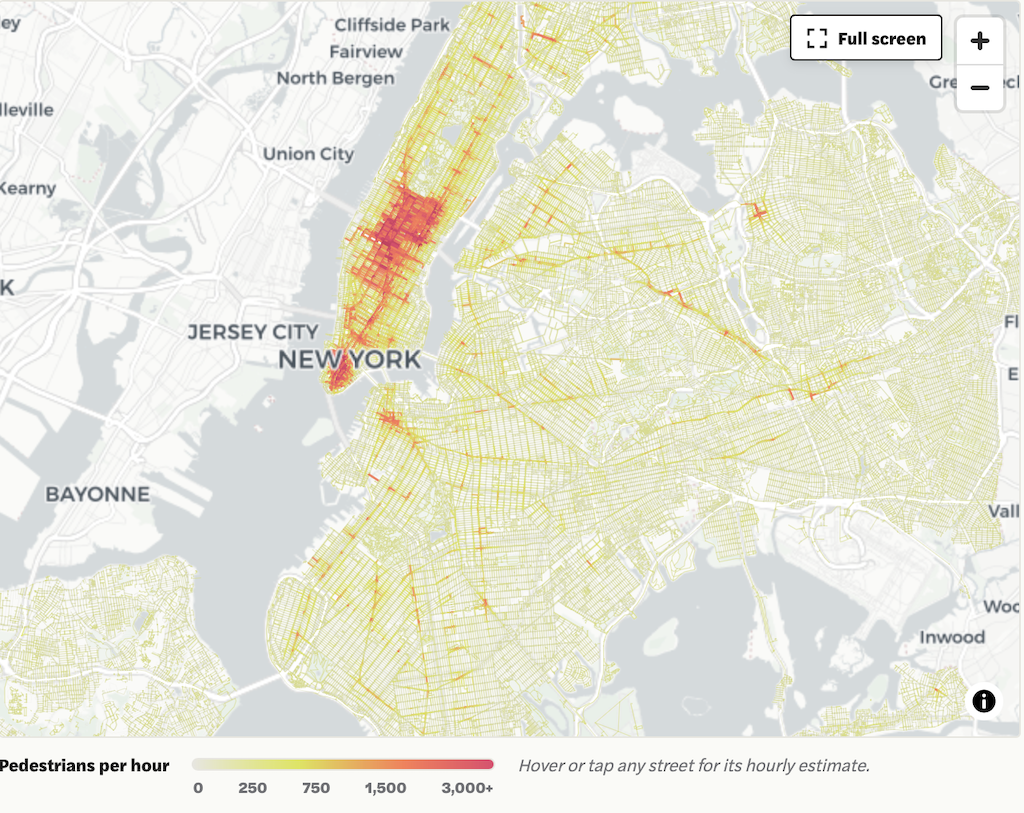
A recent article on the Vital City NYC website documents a program in New York City to not only document sidewalks, but how they are used by people walking. It was a cooperative project between MIT and the city. It is amazing what can happen when a city really pays attention to the needs of citizens who walk. Sacramento is not that city.
Of course Sacramento is nothing like Manhattan. A favorite saying of people who dislike change is that Sacramento is not New York. Or San Francisco. Or Portland. Or Paris. Or Amsterdam. Or any other city on the planet that has made progress on recognizing that people walking are the core of the city and city life. It is most certainly not any of those places people visit for its walkability. But parts of Sacramento are not dissimilar to the other boroughs of NYC, so I think this program is very indicative of what Sacramento could do, if it wanted to. If you look at the map in the article, scroll the map to the right, you will see the medium to low density boroughs.
I do travel to many places where the sidewalks are much worse than Sacramento. Looking at you, City of Los Angeles. Sacramento has decent sidewalks, where they exist, but there are sections of the city where they do not exist. And sidewalk buffers are lacking in most of the city, the topic of a future post.
The program started by documenting where the sidewalks and crosswalks are. Sacramento does not have information about where the sidewalks are and are not, where the painted crosswalks are and are not. I have done PRAs (Public Records request) for sidewalk data, and the city states that it does not exist. The fact is, some exists, but it is of low quality, and the city has apparently decided that it is better to deny existence. The Streets for People Active Transportation Plan did collect sidewalk data, but since the data has not been released to the public, it is unknown how comprehensive it is.
A good sidewalk inventory would include: presence or absence of sidewalks, width of sidewalk, presence or absence of sidewalk buffers (which the city calls planting strips) and the width of buffer, condition (deterioration, cracking, root heaves), and driveway crossings, whether flat or sloped. A crosswalk inventory would include the presence or absence of ADA ramps or ramps of any sort even if they are not PROWAG compliant, the crosswalk design (including width and length), and visibility of the crosswalk (visible or faded or non-existent).
The program then modeled sidewalk and crosswalk throughout the city, using existing studies of smaller typical areas and field counts. This is the most innovative part. That data can be used to estimate exposure, the number of people injured or killed, divided by the number of people walking. It is the measurement of rate, which is the best measure of anything related to transportation and in particular, traffic violence.
Where New Yorkers Walk, and When (MIT City Form Lab)
“Walking, after all, is not a niche activity. It is the connective tissue of urban life. It links transit to destinations, homes to neighborhoods, individuals to one another. It is also the most equitable mode of transportation we have. To take it seriously — to measure it with the same rigor we have long applied to driving — is to begin to see cities more clearly. And perhaps, in doing so, to design them more wisely.” – Andres Sevtsuk
California Streets and Highways Code (SHC) Division 7, Part 3, Chapter 22, Article 2: Repairs, states that the responsibility for repairing sidewalks lies with the adjacent property owner. This is, on its face, unconstitutional, regardless of state code. The state is saying that a government agency can require a property owner to maintain property that belongs to the government, without any compensation. It has long been hoped that a public interest entity would sue the state to declare this code unconstitutional, but so far that has not happened. The ability of the public to sue is overmatched by the power of the cities and counties to fight any such lawsuit. Therefore, it is imperative that the legislature remove this unconstitutional requirement from state law.
It is worth noting that this code dates from 1941. Society’s view of the responsibility of governments to its citizens, what characterizes a livable and walkable place, and equitable transportation systems, have evolved considerably since that time. State law, on the topic of sidewalks, has not.
Code defines sidewalk (paragraph 5600): “As used in this chapter “sidewalk” includes a park or parking strip maintained in the area between the property line and the street line and also includes curbing, bulkheads, retaining walls or other works for the protection of any sidewalk or of any such park or parking strip.” The lack of a definition for ‘parking strip’ is concerning. Is it the buffer area, or does it include parking areas on the roadway? Does the use of this term allow people to park motor vehicles in the buffer? The code is vague.
It is not clear that state code should require, or not require, adjacent property owners to maintain the ‘park or parking strip’, most commonly called sidewalk buffers. These buffers are not part of the transportation network, but they are a key part of enhancing walkability and overall livability through provision of shade trees.
Note that this does not address the day-to-day maintenance of sidewalks in the sense of removal of leaf fall and snow. However, neither does existing code. This is left to policy of the individual city or county, as it probably should be.
The replacement language would be very simple. Chapter 22 would read:
“Sidewalks and curbs are an integral part of the transportation network, and will be maintained for the benefit of all citizens using all modes of transportation, in a state of good repair, under the same requirements that apply to adjacent roadways.”
It is worth noting that the most poorly repaired sidewalks are often adjacent to government-owned property. Governments seem to view this code as applying to private property owners, and not to themselves.
Nothing in state law precludes a local government, city or county, from taking on responsibility for repairing sidewalks. They generally have not done so, because by shifting the responsibility for maintaining part of the transportation network onto private citizens, they can spend more money on infrastructure for motor vehicles. That is the real reason for this state law, and its continuance into modern times.
It has been increasingly common to refrain from blaming traffic violence on drivers, and instead to point to transportation infrastructure which encourages drivers to speed and to act in such a way as to create crashes. There is truth in this, and equity to some degree. But I think the pendulum has swung too far in that direction, and it is time to bring back driver responsibility.
We have invested trillions of dollars to create a transportation system that kills and mains countless people, with an emphasis on harming people who walk and bicycle. This was not an ‘accident’. Traffic engineers knew that their roadway designs would kill people, but absolved themselves of responsibility by pointing to the ‘standards’, which promote these designs, but are based on nothing but speculation and bias. It is always easier to blame crashes on driver behavior than to design safe roadways. Well, here we are. It will cost trillions to fix. We don’t have that money. That is not to say we should not be fixing what we can, with a priority on those designs and locations that have killed the most people, or seem most likely to.
Everywhere I travel, and walk, most other people walking will at least glance at me, and often acknowledge or smile, and sometimes say hi or good morning or good evening, or even talk. But that is rare in Sacramento. At least on the sidewalk, this is the least friendly place I’ve ever lived.
People passing look studiously at their phones, as though there were something important there, or look at the ground, or look away to the other side. 95% of people walking will not make eye contact, let alone give a positive vibe.
Why is this a transportation issue? The message is that I am an island (Simon and Garfunkel), I don’t need you, I don’t acknowledge you, I don’t care about you. Communities are built on trust, and trust does not occur if people don’t interact with other people. Sacramento (the city and region) has serious problems that can only be solved by group action and personal engagement. In particular, we have a very serious problem with traffic violence. That we are so bad at solving our problems is not surprising when we don’t think of anyone else except close friends as ‘our people’. Of course this is worse since the pandemic, but it has existing as long as I have lived in Sacramento (14 years) and spent time in Sacramento (22 years).
Is it different elsewhere? Yes, it is. In San Francisco, almost everyone I pass on the sidewalk will at least nod their head, and frequently more. Los Angeles. Portland. Seattle. Las Vegas. Denver. Salt Lake City. San Diego. And on and on.
I am very sad about this. But I do not know the cause, and I do not know the solution.
Re-upping the Elvas Ave and Hornet Tunnel post from earlier this year. It has been reported to me by a number of bicyclists, and I have experienced it myself, that this section of Elvas between the Hornet Tunnel and the signal at 62nd Street has become significantly more hazardous due to the motor vehicle traffic generated by The Line (a collection of various food vendors, opened 2022) and Garden at the Line (an outdoor eating and drinking area adjacent to The Line, opened this December). There is a lot more come and go parking on Elvas, and a lot more motor vehicle traffic in and out of the parking lots. Most bicyclists ride on the sidewalk to avoid the fast-moving traffic, otherwise the crash rate would be higher. The M Street to Elvas Avenue to Hornet Tunnel route is probably the busiest in the city.
In addition to the previous post (reblog below) about the hazards for bicyclists, this area is now hazardous for walkers along and crossing Elvas.
I was there last night for the SABA social gathering, and the place was packed. People were parking along the west side of Elvas as well as on 63rd Avenue and 64th Avenue, and then trying to cross Elvas to Garden at the Line. It was nearly impossible to cross, as there are no marked crosswalks over Elvas at either street, drivers are going fast, and Elvas is not well lit. The speed limit in this section is 40 mph, which almost guarantees that walkers hit by cars will die. Sidewalks on both sides of Elvas are in poor condition, and rolled curbs are common, which are less safe for people walking than vertical curbs. There are no sidewalk buffers. While this section of Elvas is not one of the top 5 or top 10 Vision Zero corridors, it will quickly become so. In the last five years, there have been two injury crashes on this stretch, one bicyclist and one walker, both in the vicinity of Hornet Tunnel.
The city has no plans to improve safety for bicyclists or walkers on this stretch of Elvas.
Denver is implementing a unique approach to sidewalk maintenance (Denver’s Sidewalk Program). Rather than making the individual property owner responsible for sidewalk maintenance, the city will charge all property owners a fee which will be pooled city-wide to maintain or install sidewalks. It is a flat fee for most parcels, but with a progressive fee based on sidewalk footage for parcels with a lot of sidewalk.
The City of Sacramento, and most governments in California, make sidewalk maintenance the responsibility of individual property owners. State law allows this, though does not require it. You can see the results for yourself: broken sidewalks due to root heaves, discontinuous sidewalks, lack of ADA ramps. And the city and cities within the county and the county are not the worst in California. If you want to see truly horrible sidewalks, visit the City of Los Angeles, where root heaves from too narrow sidewalk buffers have broken or destroyed most sidewalks in the city.
Denver, recognizing that the model of individual property owners paying was not working, and under the threat of lawsuits, decided to take a different approach, making maintenance and installation the responsibility of all property owners. This is an immense improvement over the Sacramento and California model, though still falls short.
Sidewalks are a part of our transportation network, in fact are the most important part of that network. As such, they should be maintained, and gaps filled, as part of the regular transportation budget of cities, counties and the state. Making them a special case with special funding, or ignoring them completely, leads to a deteriorated and missing sidewalk network that actively discriminates against people who use the sidewalks to walk, roll, and, in some cases, bicycle. Every broken sidewalk and every missing sidewalk is a abject failure of the government to fulfill its responsibility to citizens to create a transportation system that serves everyone. Transportation engineers will always, if given the choice, prioritize motor vehicles over everyone and everything else, so we must compel them to meet their true responsibilities.
I was a strong supporter of RRFBs (rectangular rapid flashing beacon), where a safer crossing of the street is intended mid-block. I worked with transportation agencies in a number of locations to get them installed, and was very happy to see them go in.
They are used where multi-use trails cross roadways, and at intersections where additional traffic calming and safety are needed, but where the transportation agency does not want to add stop signs, or is unwilling or financially unable to install a traffic signal. The cost savings of an RRFB over a traffic signal are significant, about $25K for a RRFB, and upwards of $1M for a full traffic signal.
But…
Driver behavior has rendered RRFBs untenable for protecting people walking. I have observed a number of RRFB locations over the last few months. All of them are failing. Between 25% and 50% of drivers are failing to yield to people using these crossings, bicyclists or walkers. I have seen several people almost get hit by car drivers. Some drivers are slowing but failing to stop, or yield, and some drivers are not even slowing. Apparently the attitude of many drivers is that the RRFBs are only advisory and do not require yield to people in the street. Of course the law requires yielding to people crossing the street in a crosswalk, whether there is any type of signing or signaling, or not. But drivers don’t see it that way.
So, I find myself having to withdraw support for RRFBs. I will not support them as freestanding safety improvements, not as part of project. It is sad that driver behavior has erased the benefit of a safety enhancement, but it is a fact, and driver behavior gets continuously worse, never better.