Davis regresses on sidewalks

This post was initiated by an article in the SacBee on Tuesday – SacBee (Yolo County News)/Daniel Lempres, 2026-04-07: Davis considers code update to shift liability of sidewalk maintenance. For prior (many) posts on sidewalk maintenance and responsibility, see category: sidewalks.

There is a misstatement in the article: “California law places the responsibility for sidewalks on the adjacent property owner, but Davis typically accepts responsibility for all repairs and replacements.” State law allows a city or county to make property owners responsible for sidewalks, but it does not require that a city or a county do so. It is not uncommon for a government, including the City of Sacramento, to claim that state law forces them, but this is a lie, and they know it is a lie. Davis was more responsible than most cities in that it generally did repair on its own dime. What has changed is that the budget crisis, which Davis and every other city faces, has them searching for ways to extract more money from citizens without raising taxes. This is just one example.

I will state, as I have many times before, that it is unconstitutional for the government to require a citizen to maintain city-owned property. Sidewalks are city-owned property on city-owned land. The adjacent property owner does not own the sidewalk, and does not own the land on which it sits (with a few exceptions when property boundaries do not reflect where curbs and sidewalks are). Sidewalks are an integral part of the transportation network, and should be maintained in the same way as the rest of the roadway. We don’t ask adjacent property owners to repave the street, and we should not ask them to fix the sidewalk. Unless of course the damage was caused by a privately-owned tree.

For the 2026-04-07 Davis city council agenda item (#7) on sidewalks, see Ordinance Adding Article 35.09 to Chapter 35 of the City’s Municipal Code Related to Responsibility and Maintenance of Sidewalks and Update on Sidewalk Inspection Program, staff report | presentation.

To the considerable credit of the City of Davis, it does have a sidewalk inspection program, under the Sidewalk Accessibility for Everyone program, which the City of Sacramento does not. Though the Davis presentation states that the City of Sacramento does, there is no evidence for a regular inspection program; rather the city inspects when there is a complaint. Also to the credit of Davis, fines paid by adjacent property owners who do not fix the sidewalk would go back into the sidewalk maintenance program, not into the general fund, as it would in the City of Sacramento.

Video of the staff presentation, council discussion, and decision is available on video at 2:35. One council member asked the question about responsibility if the sidewalk damage was caused by a city-owned tree (as it often the case). Legal counsel said that the ordinance still places responsibility on the adjacent property owner. Another council member asked about how low-income property owners and affordable housing would be handled. Counsel said that if the damage was caused by a utility, it would be paid for by the utility, whether the city or private (PG&E), but that city-owned trees were not included because most damage was caused by city-owned trees, and that would mean less income to the city from property owners (!). A number of other questions were raised by council members, which are not answered in the ordinance.

The ordinance presented and passed (first reading) is the first step in developing policy to underlie the ordinance. City staff was vague about when the policy would be in place, and when the ordinance would be enforced.

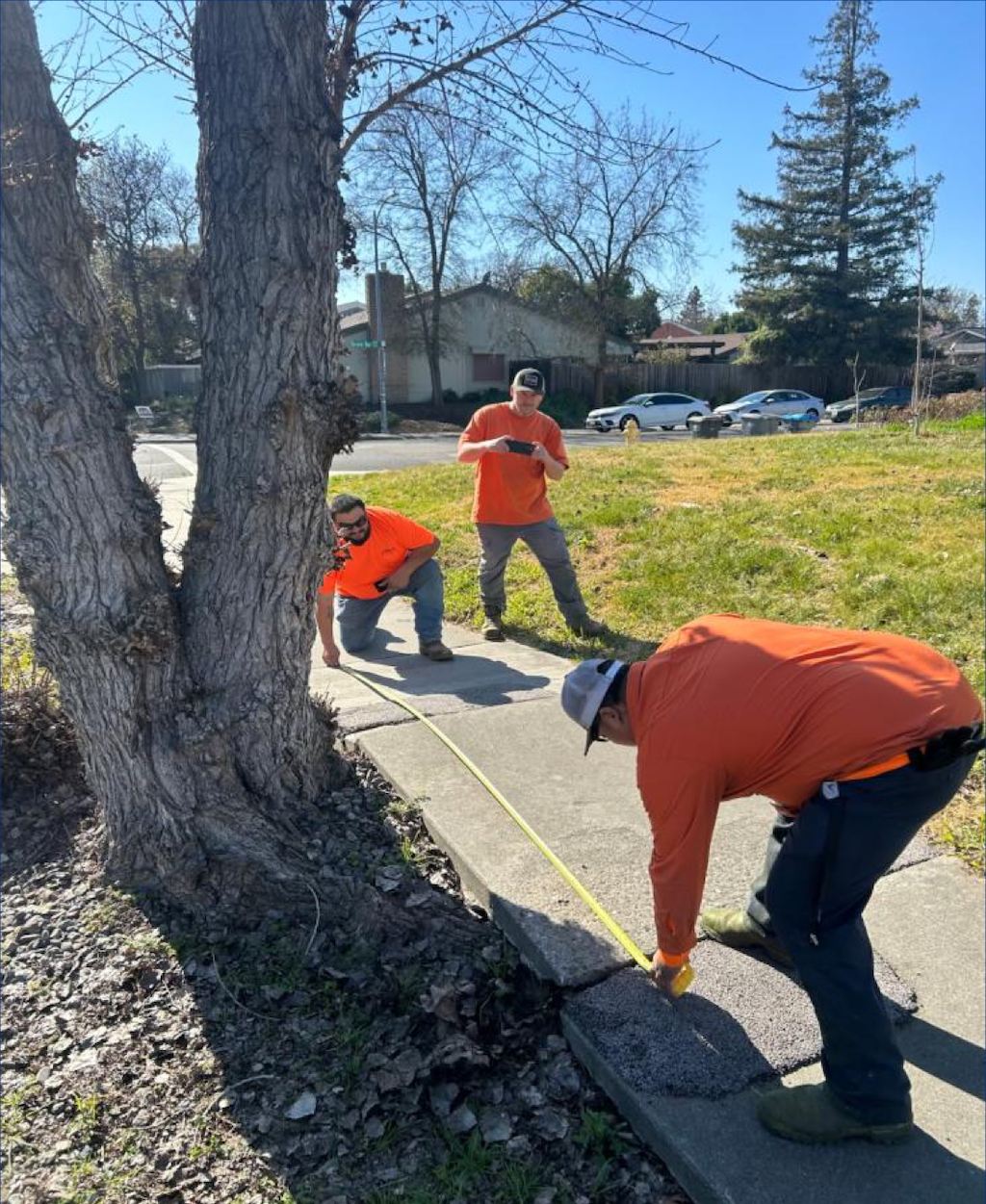
The photo below is from the City of Davis staff presentation on the sidewalk ordinance. Note that this is a city-owned tree that has caused the damage. Also, a prior repair, which did not solve the problem, is under the worker to the right side.

photo of Davis city crew measuring for sidewalk repair
Davis city crew measuring for sidewalk repair (City of Davis)

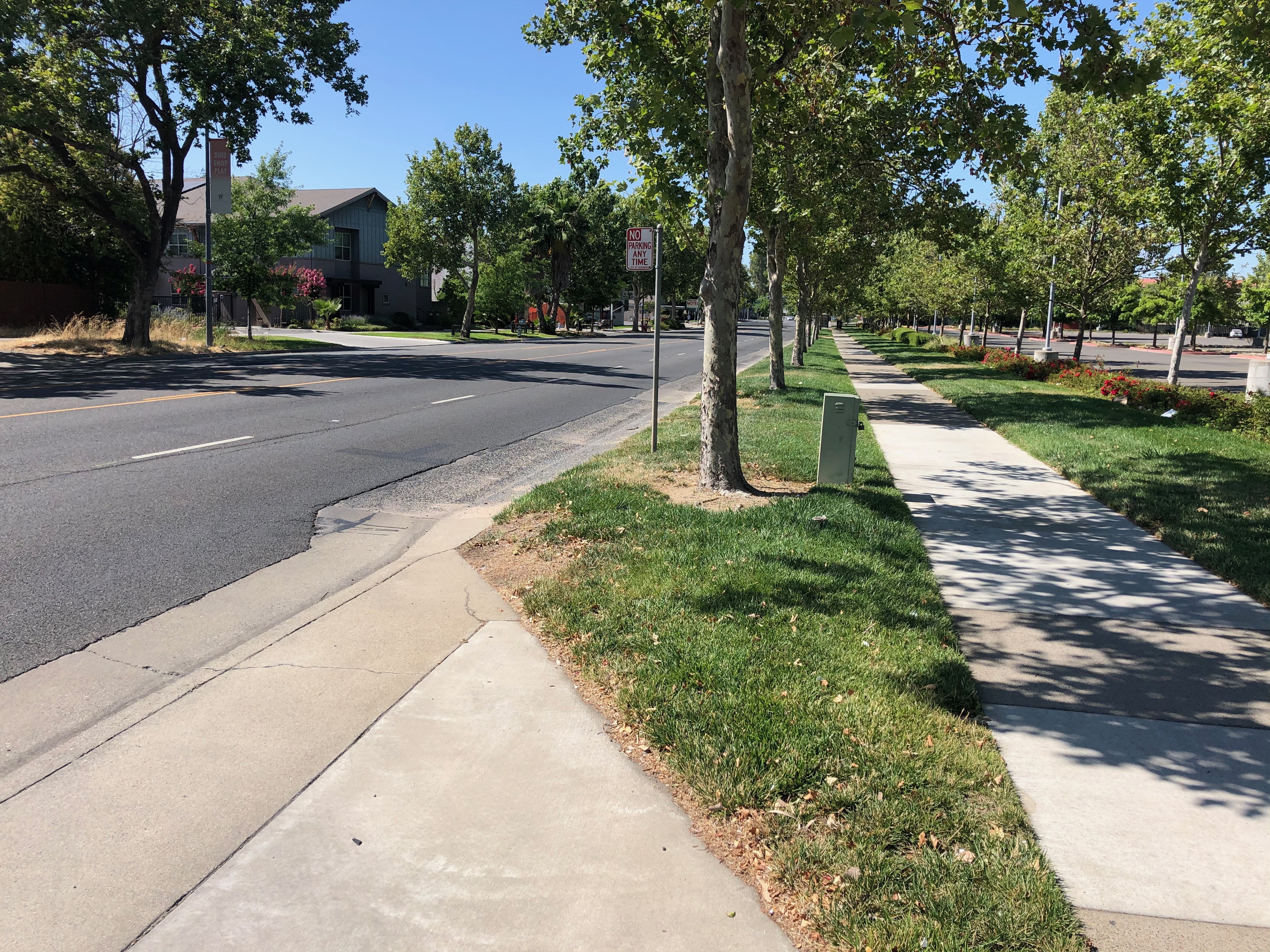
where the streets have no… sidewalks

Where the Streets Have No Name, U2, 1987

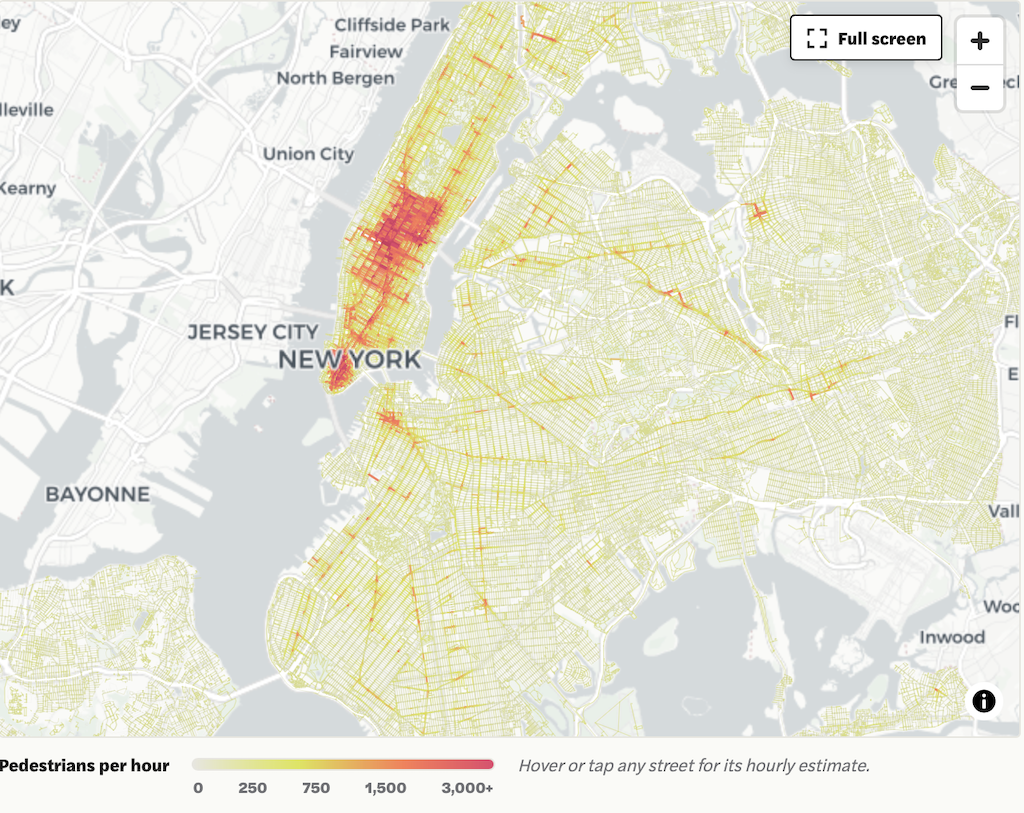
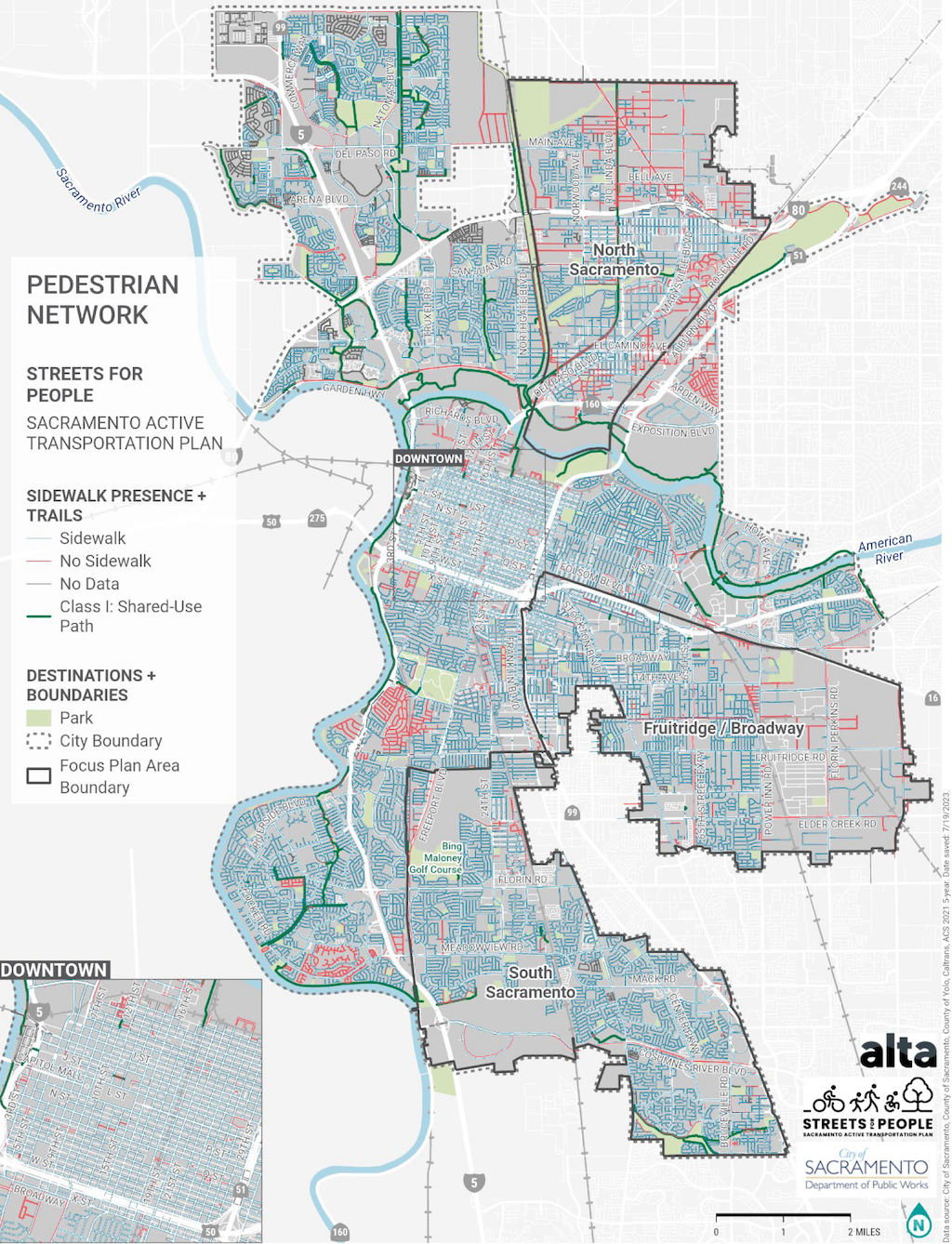
The City of Sacramento has a GIS database of sidewalks, but has not made it available to the public. The Sacramento Active Transportation Commission has requested that the data be made public. A number of active transportation advocates have requested that it be made public. The response is usually vague, but includes the excuses: the quality of the data is too low to make public; it is incomplete, as some streets were never surveyed; it was developed by the consultants and the city doesn’t have permission to publish.

It was shared in Streets for All Active Transportation Plan (Appendix 2, Gap Analysis, page 13). But this is a screen capture of a map, and can’t be zoomed in for detail. (pdf)

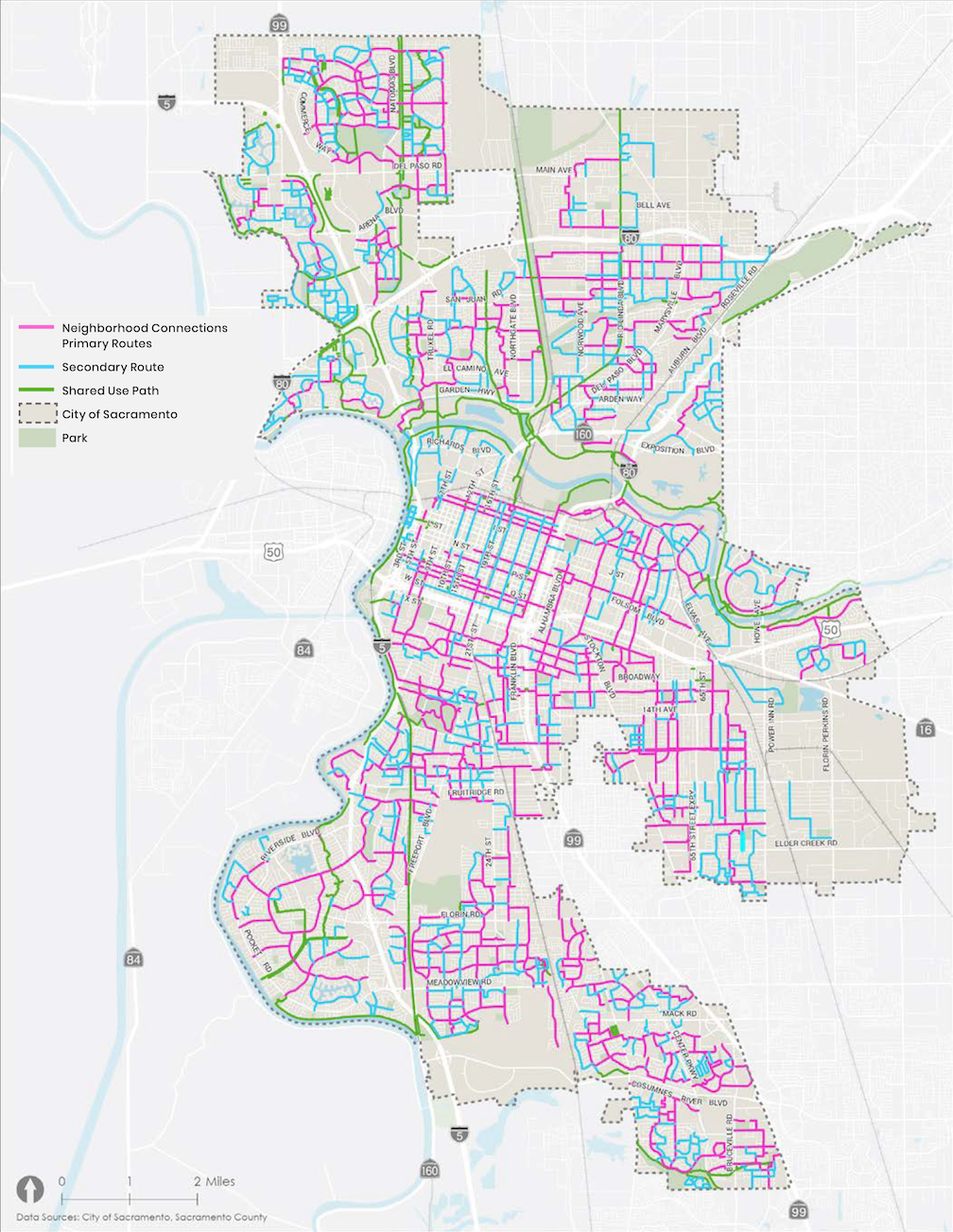
The Neighborhood Connections Network Map probably has sidewalk information, and can be zoomed in, but it shows only recommended improvements to create a network, not sidewalk details, and a legend is lacking, so it is not possible to say for certain what the lines indicate. It may be the same information as the Neighborhood Connections Network map that is in the Neighborhood Connections Existing Conditions appendix. (pdf) This map does have a legend, but can’t be zoomed.

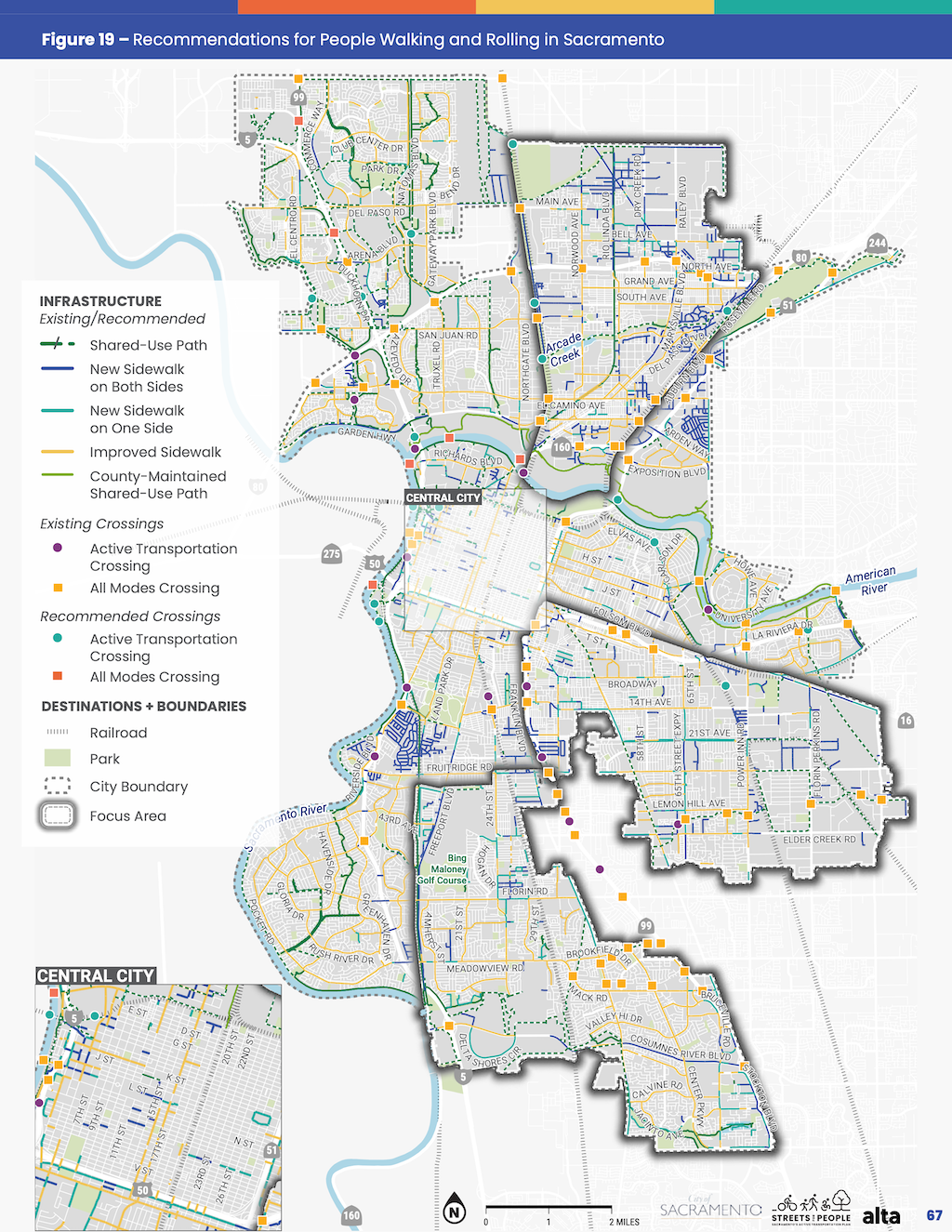
The final Streets For People Active Transportation Plan includes the ‘Recommendations for People Walking and Rolling in Sacramento map on page 67 (pdf), but again, it can’t be zoomed in, and includes recommendations, not existing sidewalk conditions. One could assume that the New Sidewalk on Both Sides indicates that there is no existing sidewalk, and New Sidewalk on One Side indicates that a sidewalk exists on the other side, but not both sides. The plan contains six detailed maps, so it is easy to pick out streets, but again, no information about existing.

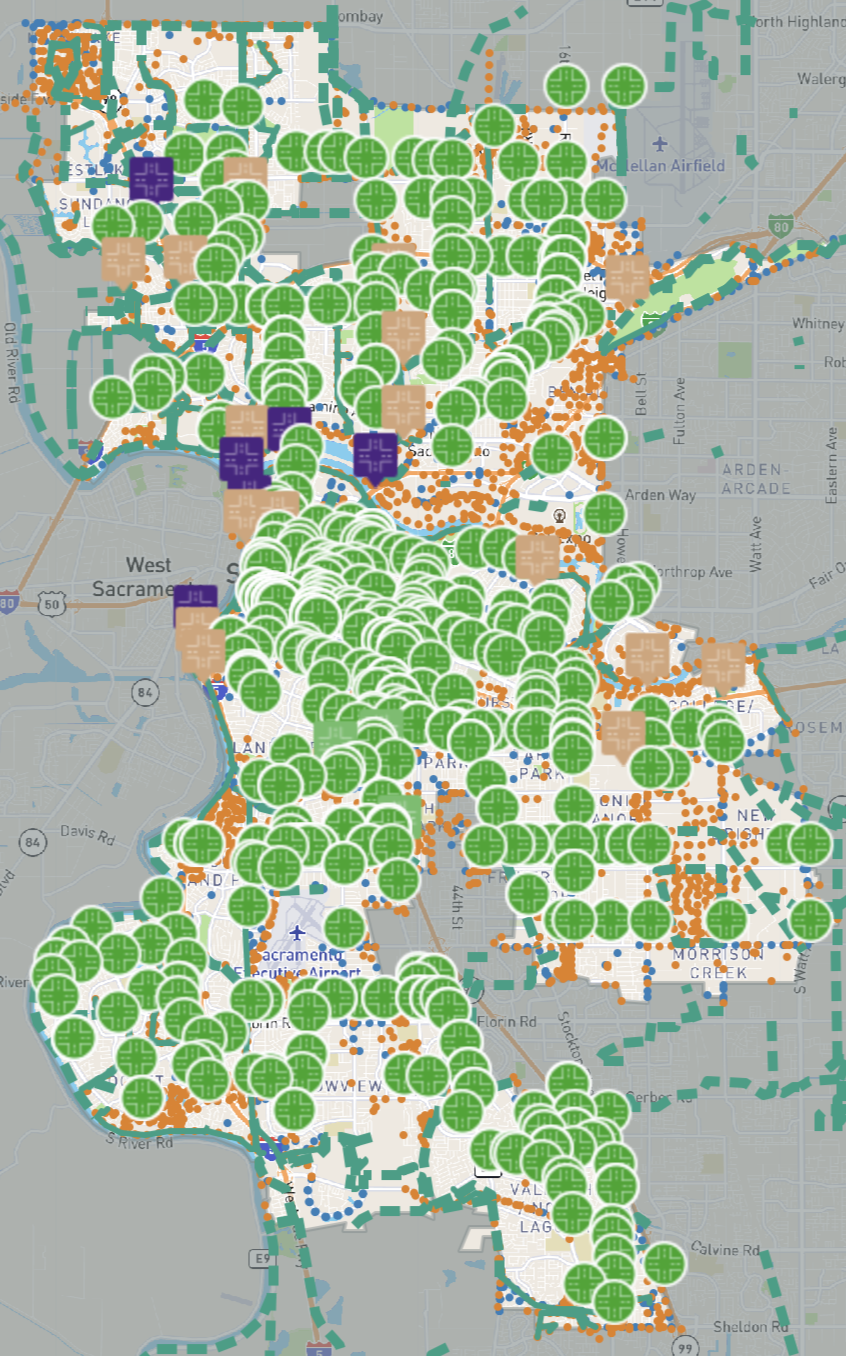
There is also a recommendations map that was part of public outreach in developing the plan, the Streets for People Draft Network Recommendations. It can be zoomed in, but it is not clear whether the street designations came from the city, or the public, or both.

All of this uncertainty could be resolved if the city would post the data to its GIS (Geographic Information Systems) portal. If the data needs a disclaimer, this is easy to include.

Sidewalks are part of the transportation network, and should be repaired as such

California Streets and Highways Code (SHC) Division 7, Part 3, Chapter 22, Article 2: Repairs, states that the responsibility for repairing sidewalks lies with the adjacent property owner. This is, on its face, unconstitutional, regardless of state code. The state is saying that a government agency can require a property owner to maintain property that belongs to the government, without any compensation. It has long been hoped that a public interest entity would sue the state to declare this code unconstitutional, but so far that has not happened. The ability of the public to sue is overmatched by the power of the cities and counties to fight any such lawsuit. Therefore, it is imperative that the legislature remove this unconstitutional requirement from state law.

It is worth noting that this code dates from 1941. Society’s view of the responsibility of governments to its citizens, what characterizes a livable and walkable place, and equitable transportation systems, have evolved considerably since that time. State law, on the topic of sidewalks, has not.

Code defines sidewalk (paragraph 5600): “As used in this chapter “sidewalk” includes a park or parking strip maintained in the area between the property line and the street line and also includes curbing, bulkheads, retaining walls or other works for the protection of any sidewalk or of any such park or parking strip.” The lack of a definition for ‘parking strip’ is concerning. Is it the buffer area, or does it include parking areas on the roadway? Does the use of this term allow people to park motor vehicles in the buffer? The code is vague.

It is not clear that state code should require, or not require, adjacent property owners to maintain the ‘park or parking strip’, most commonly called sidewalk buffers. These buffers are not part of the transportation network, but they are a key part of enhancing walkability and overall livability through provision of shade trees.

Note that this does not address the day-to-day maintenance of sidewalks in the sense of removal of leaf fall and snow. However, neither does existing code. This is left to policy of the individual city or county, as it probably should be.

The replacement language would be very simple. Chapter 22 would read:

“Sidewalks and curbs are an integral part of the transportation network, and will be maintained for the benefit of all citizens using all modes of transportation, in a state of good repair, under the same requirements that apply to adjacent roadways.”

It is worth noting that the most poorly repaired sidewalks are often adjacent to government-owned property. Governments seem to view this code as applying to private property owners, and not to themselves.

Nothing in state law precludes a local government, city or county, from taking on responsibility for repairing sidewalks. They generally have not done so, because by shifting the responsibility for maintaining part of the transportation network onto private citizens, they can spend more money on infrastructure for motor vehicles. That is the real reason for this state law, and its continuance into modern times.

Denver’s approach to sidewalk maintenance

Denver is implementing a unique approach to sidewalk maintenance (Denver’s Sidewalk Program). Rather than making the individual property owner responsible for sidewalk maintenance, the city will charge all property owners a fee which will be pooled city-wide to maintain or install sidewalks. It is a flat fee for most parcels, but with a progressive fee based on sidewalk footage for parcels with a lot of sidewalk.

The City of Sacramento, and most governments in California, make sidewalk maintenance the responsibility of individual property owners. State law allows this, though does not require it. You can see the results for yourself: broken sidewalks due to root heaves, discontinuous sidewalks, lack of ADA ramps. And the city and cities within the county and the county are not the worst in California. If you want to see truly horrible sidewalks, visit the City of Los Angeles, where root heaves from too narrow sidewalk buffers have broken or destroyed most sidewalks in the city.

Denver, recognizing that the model of individual property owners paying was not working, and under the threat of lawsuits, decided to take a different approach, making maintenance and installation the responsibility of all property owners. This is an immense improvement over the Sacramento and California model, though still falls short.

Sidewalks are a part of our transportation network, in fact are the most important part of that network. As such, they should be maintained, and gaps filled, as part of the regular transportation budget of cities, counties and the state. Making them a special case with special funding, or ignoring them completely, leads to a deteriorated and missing sidewalk network that actively discriminates against people who use the sidewalks to walk, roll, and, in some cases, bicycle. Every broken sidewalk and every missing sidewalk is a abject failure of the government to fulfill its responsibility to citizens to create a transportation system that serves everyone. Transportation engineers will always, if given the choice, prioritize motor vehicles over everyone and everything else, so we must compel them to meet their true responsibilities.

photo of broken sidewalk and missing sidewalk, Capitol Mall & 3rd St, Sacramento
broken sidewalk and missing sidewalk, Capitol Mall & 3rd St, Sacramento

SacCity sidewalk inventory

The City of Sacramento does not make available to the public an inventory of sidewalks. The city does make available on the Transportation & Infrastructure page: Bike Master Plan, EV Chargers, Off-Street Parking, Signs, Street Lights, Traffic Counts, and Traffic Signals, and other datasets. Sacramento County makes available on the Transportation page: Posted Speed Limits. SACOG makes available on the Transportation page several other transportation datasets. None have sidewalk inventories.

I have heard, unofficially, that the city has a partial dataset of sidewalks, but it is not spatially complete. It may be that it has only more recent installations, or that it focuses on some parts of the city. I have done a PRA for sidewalk inventory, but the city couldn’t figure out what I was asking for, so I will have to determine how to describe the dataset in a way they will understand.

What would a good sidewalk inventory contain?

  • total width
  • unobstructed width
  • sidewalk buffer (planting strip) width
  • available right-of-way
  • condition
  • year of installation, or reconstruction
  • gaps
  • intersection corner design
  • ramps (compliant or not)

The soon to be adopted 2040 General Plan 8-Mobility Element mentions sidewalks a number of times, suggesting widening or improving. Probably the most important are:

M-1.9 Equitable Processes and Outcomes. The City shall ensure that the transportation system is planned and implemented with an equitable process to achieve equitable outcomes and investments so that all neighborhoods one day will have similar levels of transportation infrastructure such as sidewalks, marked low stress crossings, and bikeways.

M-1.14 Walking Facilities. The City shall work to complete the network of tree-shaded sidewalks throughout the city, to the greatest extent feasible, through development project improvements and grant funding to build new sidewalks and crossings, especially within the high-injury network, in disadvantaged communities, near highridership transit stops, and near important destinations, such as schools, parks, and commercial areas. Walking facilities should incorporate shade trees.

However, there is no mention of how locations needing improvement will be identified. Is this guesswork on the part of city staff, or is there a dataset being used but not shared with the public?

My request is that the city make available to the public whatever sidewalk inventory it has, even if it is not spatially complete nor has all the elements a sidewalk inventory should have.

A sidewalk inventory is the first step in meeting the city’s goal of a continuous, high quality sidewalk network. More about that soon.

photo of deteriorated sidewalk on 24th St, near Capitol Ave
deteriorated sidewalk on 24th St, near Capitol Ave

And while we are at it, a crosswalk inventory:

  • marked or unmarked
  • width
  • length
  • design
  • median island
  • material: paint or thermoplastic
  • condition
  • date of placement or refresh
  • traffic control (yield, stop, signal, actuated crossing)
  • crossing prohibition

It should be said that sidewalks and crosswalks in the City of Sacramento are in better condition than many similar sized cities in California, but that does not mean that there isn’t a need for great improvement. Every city and county neglects its sidewalks.

Previous related posts: SacBee: sidewalk repair; SacCity sidewalk design standards; SacCity sidewalk responsibility; Sacramento and sidewalks; Walkable Sacramento #4: sidewalks.

SacBee: sidewalk repair

The SacBee published an article in January entitled ‘$20k? Homeowners in some Sacramento neighborhoods are billed more for sidewalk repair‘. The article is about the charges the City of Sacramento has made to homeowners, primarily in low income areas.

City code specifies that property owners are completely responsible for repair of sidewalks adjacent to their property. State streets and highways code seems to allow the city to claim this. The two relevant sections within Chapter 22: Maintenance of Sidewalks are: Article 2. Repairs and Article 3. Collection of Cost of Repair. I have previously made the claim that both state code and city code are unconstitutional, because they make persons responsible for maintenance of property that belongs to the city, not the person. In almost all cases, sidewalks and the land on which they lie is city property, not private property. This is particularly egregious when the sidewalk damage is due to city-owned trees in the sidewalk buffer (which the city calls planting strips).

Therefore, I believe that it is illegal for the city to charge property owners for sidewalk repair.

The major focus of the article is that low income communities are being unfairly targeted for sidewalk repair, with a graph that indicates that. That is one interpretation of the data, and it would not be surprising. The city has always and continues to treat lower income communities and people of color with bias. There is another explanation however. Sidewalks in lower income communities were very likely built to lower standards than in others, and it is likely that the city has never maintained any of them, except in some locations placing ADA ramps at corners. I notice in the central city that many sidewalk cracks are covered with asphalt patches, which were placed by the city. I have not noticed these patches in lower income neighborhoods. It is likely that the city is doing work in moderate and high income areas that they are not doing in lower income areas. The central city has more construction projects than other areas, which often result in the sidewalks being repaired or replaced. The central city has also seen a lot more installation of new corners with ADA ramps that other areas of the city. This makes some sense because much of the central city has higher pedestrian (walker) levels, but this fact does not overcome the fact that there are walkers in disinvested neighborhoods, and in particular, children walking to and from school deserve good sidewalks more than anyone else.

I have been in the habit of reporting sidewalk issues through the city’s 311 app. This article has made me rethink reporting. Am I causing unaffordable repair bills for people who can’t afford it? Is the sidewalk flaw really that bad? I’ve decided to stop reporting sidewalk locations, until these issues are resolved.

My next steps are to make a suggestion for how the city can mitigate these repair costs, and for the city to inventory its sidewalks so that it knows what the situation is throughout the city, rather than a complaint-driven system that is almost certain to have bias. Coming up!

photo of broken sidewalk, V St, Sacramento
broken sidewalk, V St, Sacramento
photo of sidewalk repaired due to damage by a city owned tree in a city owner sidewalk buffer, P St
sidewalk repaired due to damage by a city owned tree in a city owner sidewalk buffer, P St

SacCity sidewalk design standards

I’ve written about existing sidewalk buffers or lack thereof (sidewalk buffer widths), and a solution for areas without sidewalk buffers (street trees in the parking lane), and now on to sidewalk standards. Sidewalk areas are composed of the sidewalk, sidewalk buffer (also called planting strip or furniture zone), and pedestrian scale lighting.

Design criteria:

  • All new or reconstructed streets will have sidewalks, sidewalk buffers, and pedestrian scale lighting
  • Reallocated or mitigated streets will have sidewalk buffers added if right-of-way can be reallocated
  • Sidewalk areas may also include sidewalk-level bicycle facilities
  • Attached sidewalks (sidewalk adjacent to the curb) will not be used for new or reconstructed streets
  • Sidewalk width:
    • Minimum sidewalk width will be six feet in areas of 85% of more residential
    • Minimum sidewalk width will be eight feet in all other areas
    • Sidewalks must be completely free of obstructions, encroachments, or driveway aprons into their minimum width
    • Sidewalks adjacent to and within 1/8 mile of schools will be a minimum of 8 feet; sidewalks used for drop off/pickup will be a minimum of 10 feet
  • Sidewalk buffer width:
    • Minimum sidewalk buffer width will be eight feet in order to accommodate a canopy of mature trees; if a lesser width is available, parking areas will be considered for tree placement
    • Sidewalk buffer may also accommodate street related infrastructure and utilities, street furniture, bike and scooter parking, dining areas, bioswales, and other related uses
  • Sidewalks will receive priority use of right-of-way; travel and parking lanes, and bike facilities, will be placed in remaining right-of-way
  • Bus stop amenities will not be placed within the sidewalk minimum width; the sidewalk buffer may serve as clear sidewalk abutting the curb, with appropriate design and transition; transit amenities may also be placed on transit islands away from the sidewalk and sidewalk buffer
  • Sidewalks will be continuous over driveways and alleys, without interruption of design or materials
  • Pedestrian scale lighting will be provided along the street length; motor vehicle scale lighting will not be considered sufficient; intersections and crosswalks may be lit with motor vehicle scale lighting

Design diagrams:

  • Sidewalks of six or eight feet, with sidewalk buffers of at least eight feet
  • Tree planters or wells in the parking lane or curb extensions
  • Alley entrances and sidewalk crossings of alleys
  • Driveway crossings of sidewalk, with design indicating walking priority
  • Bus stop amenities (benches, shelters, etc.) with a sidewalk area clear of encroachment
  • Transit island diagram here or in the transit section
walkers at Capitol Park sidewalk N St & 15th

sidewalks across alleys

Note: Please see post on City of Sacramento Street Design Standards. It turns out that there are at least two different sets of design standards.

The City of Sacramento has Standard Specifications and Drawings that require certain designs for the public right-of-way. There were last revised April 2020, and are available on the Utilities: Development Standards page. It is not clear why these are part of Utilities rather than Public Works or Community Development, but they are. Though I haven’t done an element by element comparison, they seem to be a considerable improvement over the previous standards, which seem to be June 2009.

There are designs which are not being followed, and others that should be eliminated. Today, I’ll address sidewalks crossing alleys. Alleys are only common in the central city, but they do exist other places throughout the city.

The city design standard is below (pdf of entire page). The detail is hard to see, but the alleyway, sidewalk, and alley driveway are all concrete, none are asphalt. The T-11 Standard Alley Entrance Detail page says “Portland Cement Concrete (PCC) is the city standard pavement for alleys.”

SacCity Specification detail alley entrance

Of course there are many alleyways that are asphalt, and some that are unpaved gravel. I don’t know when the city standards changed to require pavement, or when to require concrete, but those are the current standards. That means that if an alley, or a sidewalk, or the alley driveway is changed, it must meet current standards. Below is a photo of Neighbors Alley at 17th Street, which was just redone within the last two months. It clearly does not meet city standards. Both the driveway and the sidewalk are asphalt, not concrete. Though I noticed this work being done, I failed to notice who was doing it. City? Private? Private utility? Not sure.

photo of Neighbors Alley at 17th Street
Neighbors Alley at 17th Street
Read More »

Sacramento and sidewalks

The draft City of Sacramento Climate Action Plan (CAAP) section MEASURE TR-1: Improve Active Transportation Infrastructure to Achieve 6% Active Transportation Mode Share by 2030 and 12% by 2045, includes the performance indicator “Deploy 20,000 feet of new/repaired pedestrian infrastructure by 2030”. The final CAAP will become part of the city’s 2040 General Plan.

This is less than four miles of sidewalk repair. The city has approximately 2300 miles of sidewalk. At this rate, 8 years to repair 4 miles of sidewalk, it would take 4600 years to address the sidewalks in the city. What does the city intend instead? That private property owners repair sidewalks, even though the sidewalks and the land they sit on belong to the city (in most cases, though some wider sidewalks in the central city are a mix of city and private). From the city’s Sidewalks, Curbs & Gutters page:

Q: Isn’t it the City’s responsibility to maintain the sidewalk? Isn’t it public property?

A: The sidewalk is in the City’s right-of-way. However, California Streets and Highways Code sections 5610 through 5618 allow cities throughout California to require property owners to maintain the sidewalks in front of their property. Sacramento City Code section 12.32 sets forth the City’s procedures under these sections.  Sacramento is not the only city to require sidewalk repairs to be the property owner’s responsibility. However, curb and gutter maintenance is the City’s responsibility. As the property owner may bear civil liability for a person suffering personal injury or property damage caused by a defective sidewalk: it is in the property owners best interest to maintain the sidewalk and reduce the risk of a lawsuit.

Note the word ‘allows’. Nothing requires that the city shift the burden of sidewalk maintenance to private property owners. The city has simply decided to do so, so that it may shift responsibility of a critical part of the transportation infrastructure off the city and onto adjacent property owners (so that it may spend more on roadway capacity expansion, in case you were wondering). Though it would make sense to require property owners to repair sidewalk damage from root heaving due to trees on private property, it is ridiculous (and criminal, in my opinion) for the city to demand that private property owners repair sidewalks when the trees are in the city-owned sidewalk buffer area. This is the sort of action one would expect in a dictatorship, forcing citizens to take on individual responsibility for city actions.

See previous posts: Walkable Sacramento #4: sidewalks and whose responsibility are sidewalks?.

MUTCD sidewalk construction signs

A follow-on to my previous post MUTCD revision comments, and of relevance to all my construction zone posts.

The MUTCD (Manual for Uniform Traffic Control Devices) is a bit confused (and a lot lacking) when it comes to signs for temporary traffic control devices. Orange is supposed to be the color for temporary traffic control devices, yet the manual uses regulatory (white) signs for sidewalks in construction zones. A white sign indicates permanence, an orange sign indicates temporary. That subtlety seems beyond the comprehension of the people who write the MUTCD, but I’m here to help them. Below are the pairs of signs for sidewalk closure in construction zones. On the left is the existing MUTCD sign, on the right is the sign as it should be.

R9-9 regulatory version
R9-9 TTC version
R9-11a regulatory version
R9-11a TTC version
R9-11 regulatory version
R9-11 TTC version

There might be situations in which the permanent, white regulatory sign might be appropriate, though the number of such situations is and should be rare. Sidewalks should be continuous, not broken, not closed.

Note that I did not include the R9-10 sign with arrows pointing both ways, since I can’t think of a context in which that would be the appropriate sign. Unless someone can, it should be removed from the MUTCD.

I have also suggested that all TTC signs be given a unique code, not M, not R, not W, but perhaps T.