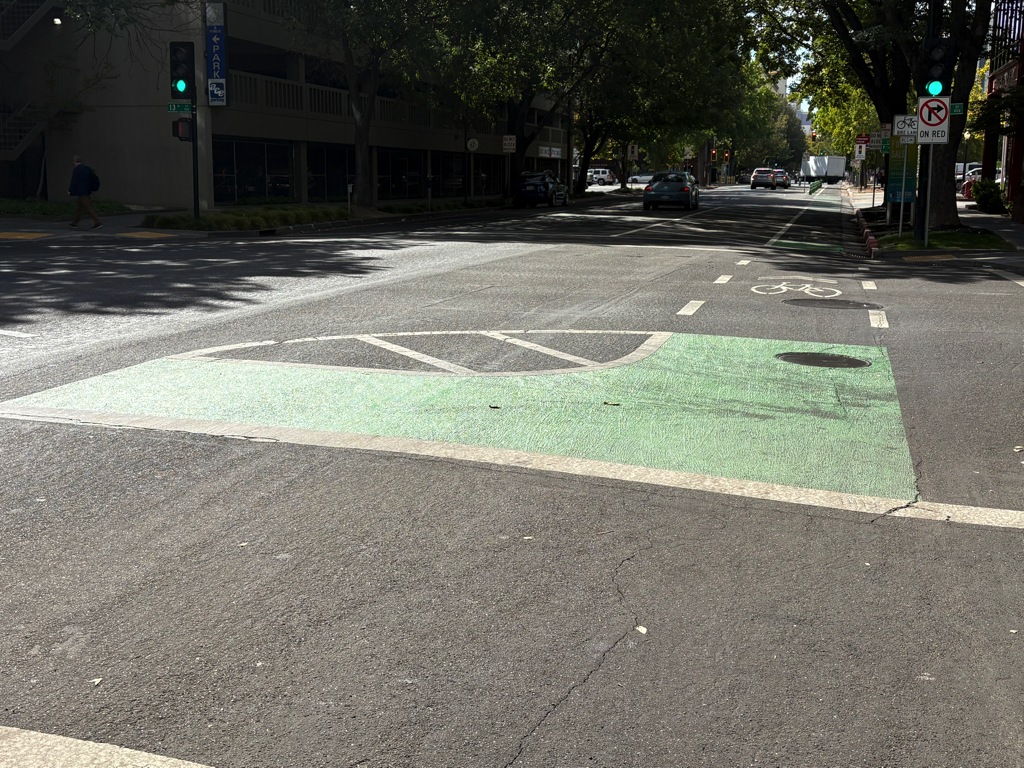
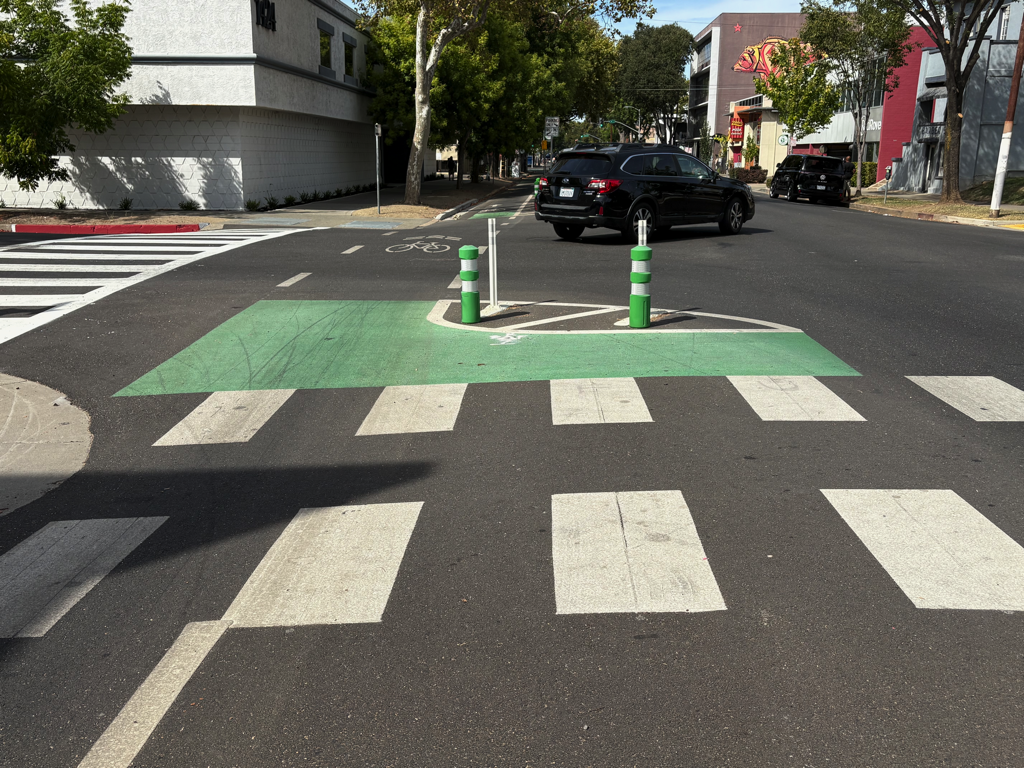
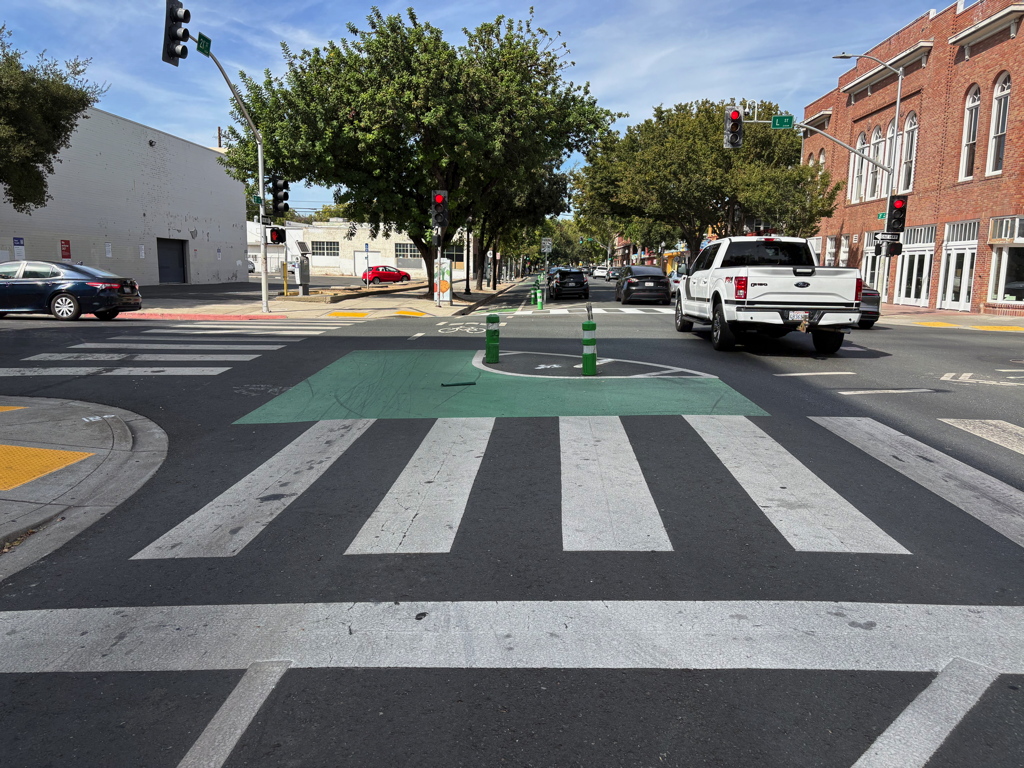
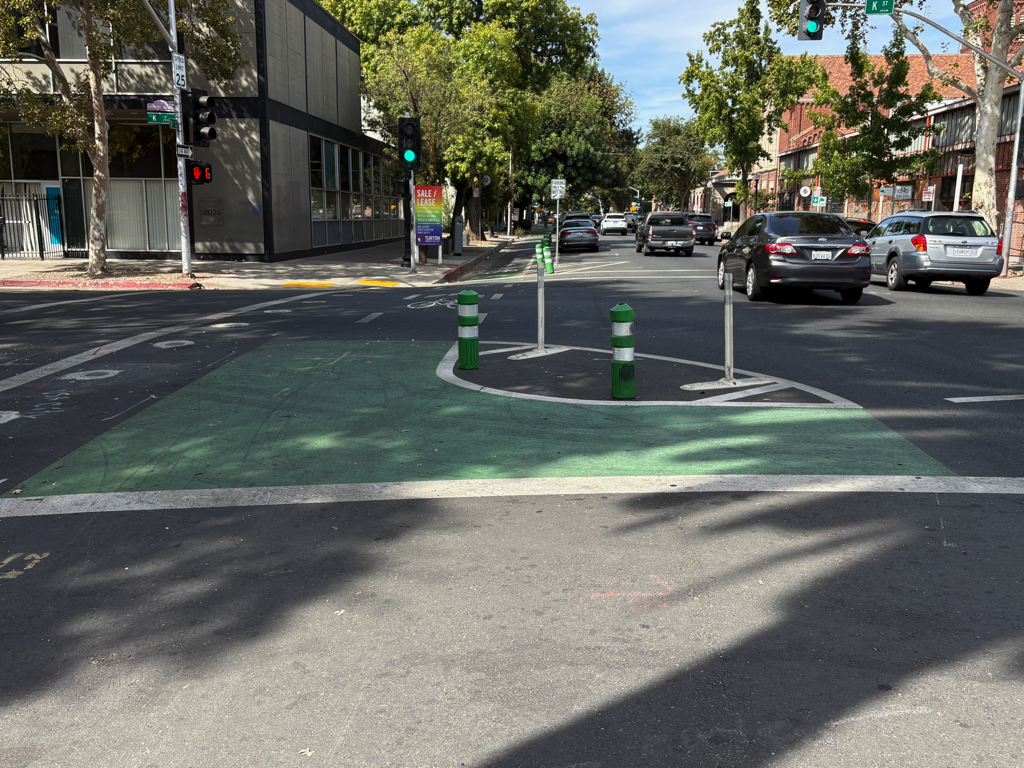
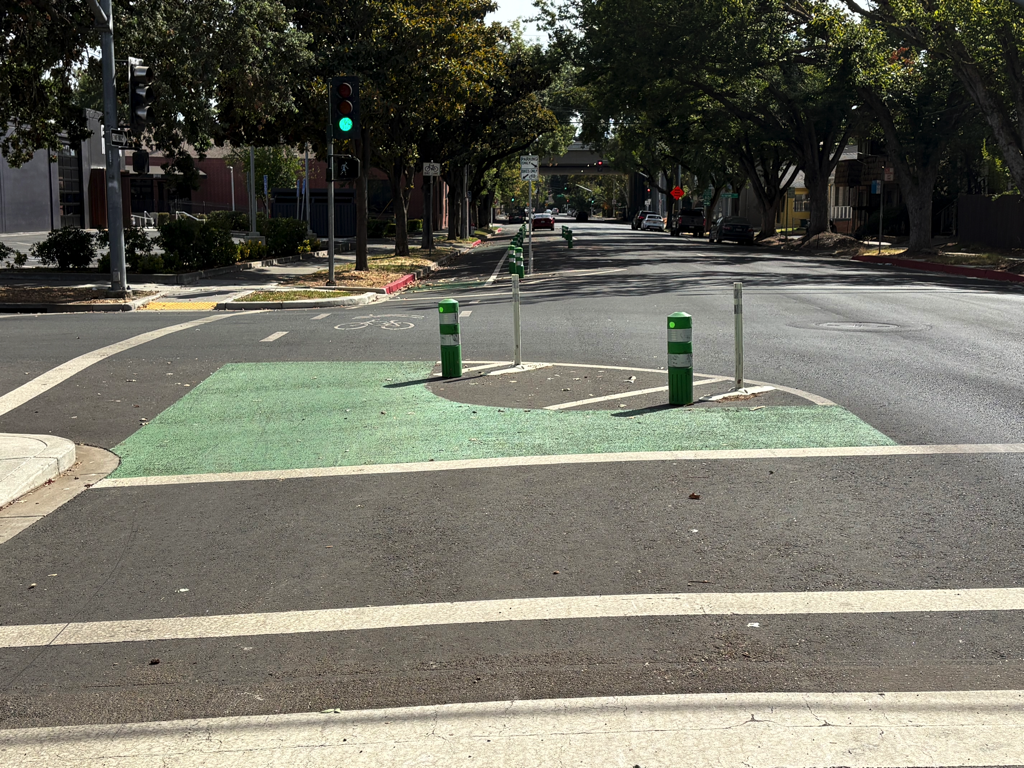
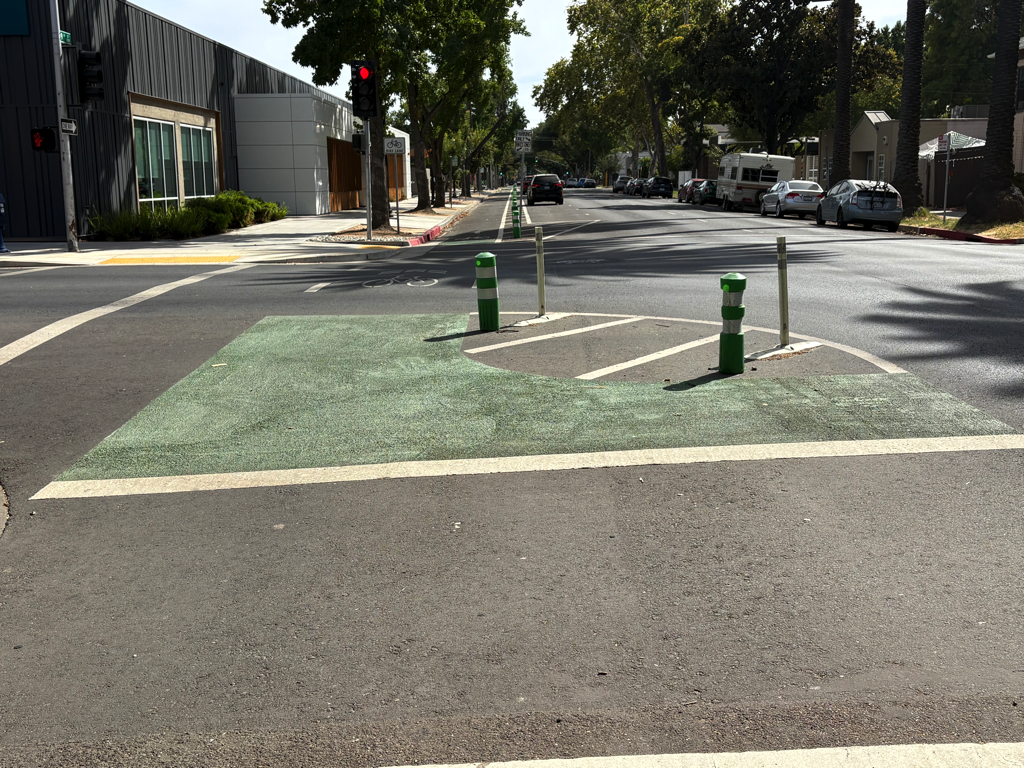
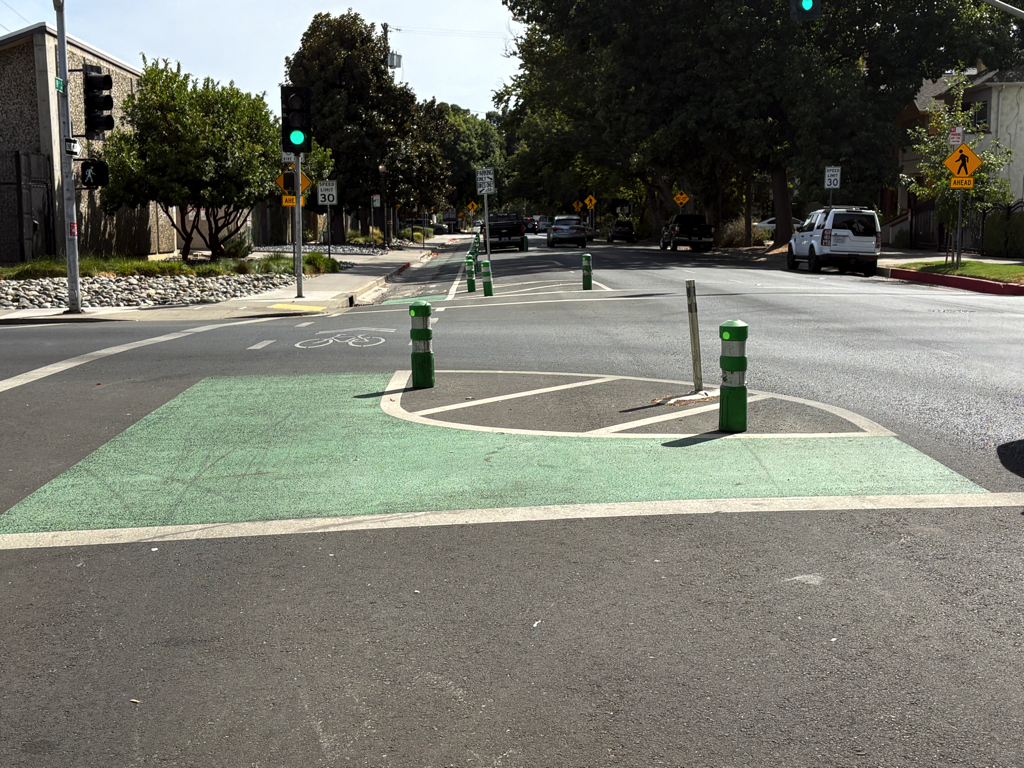
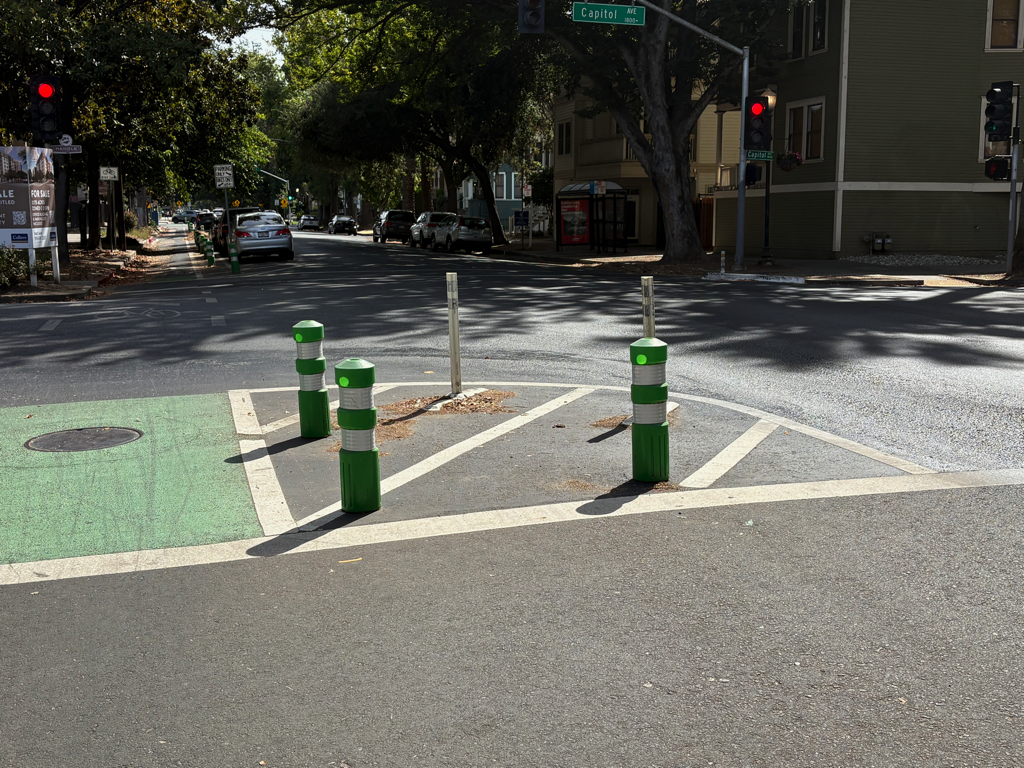
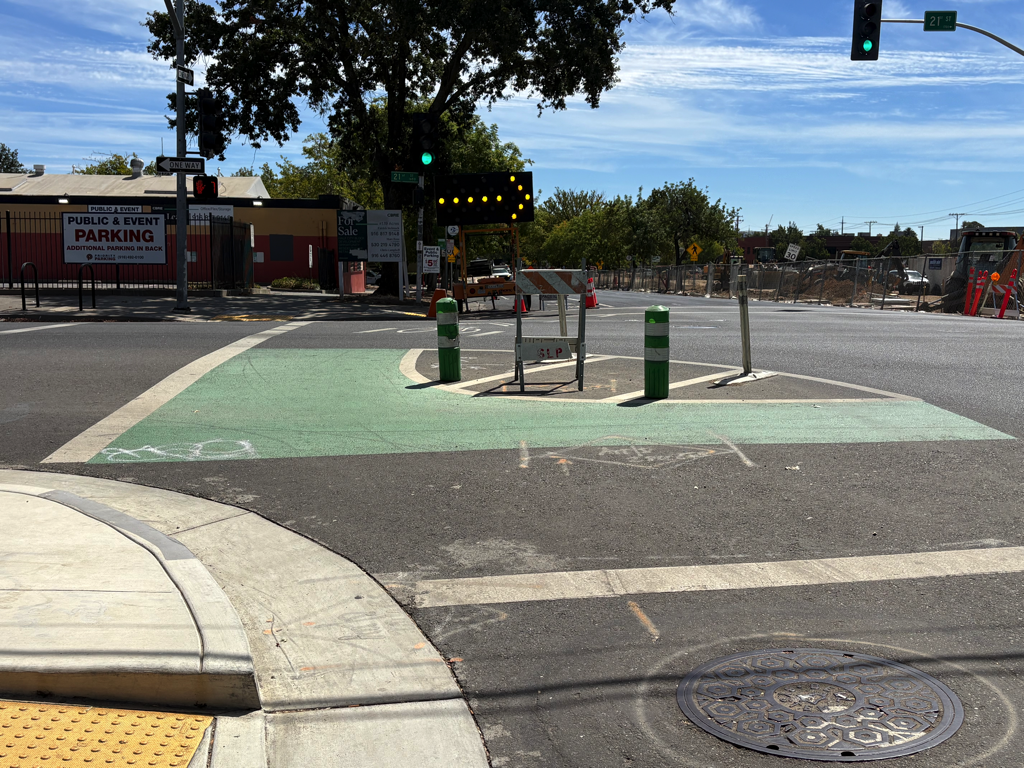
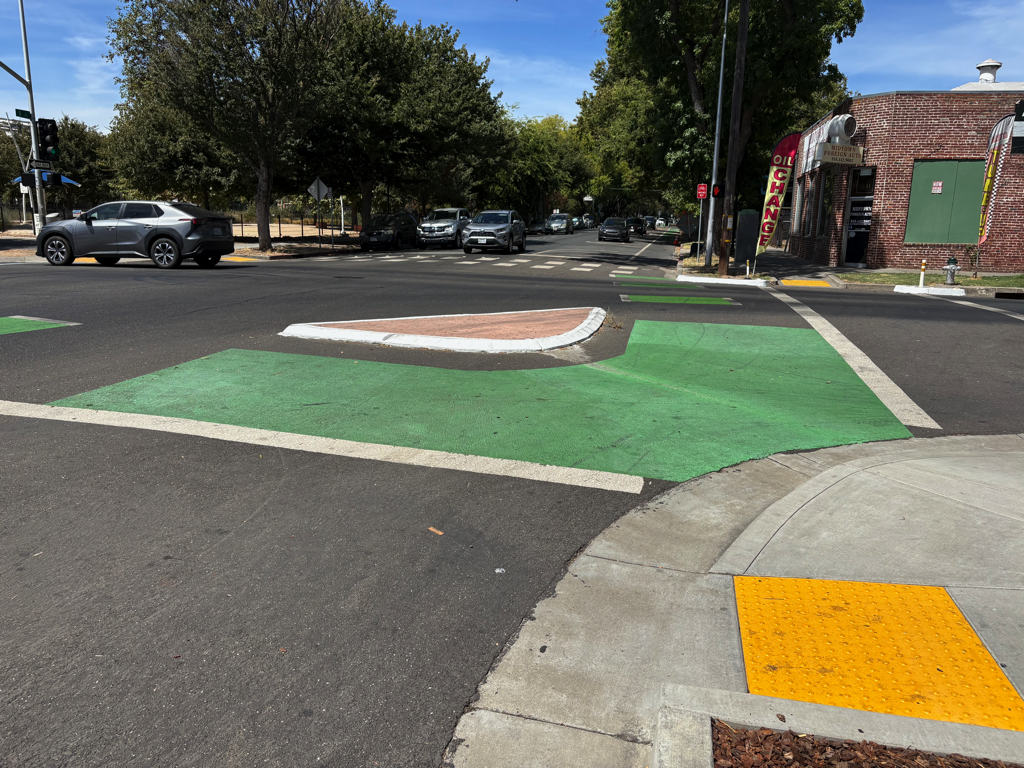
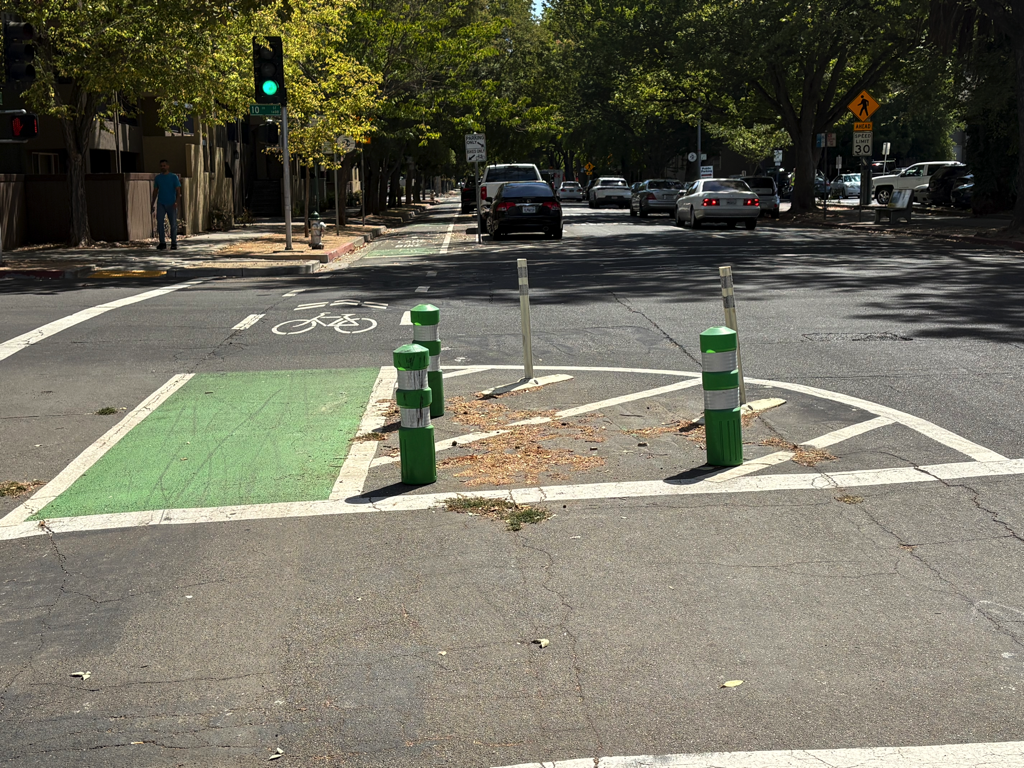
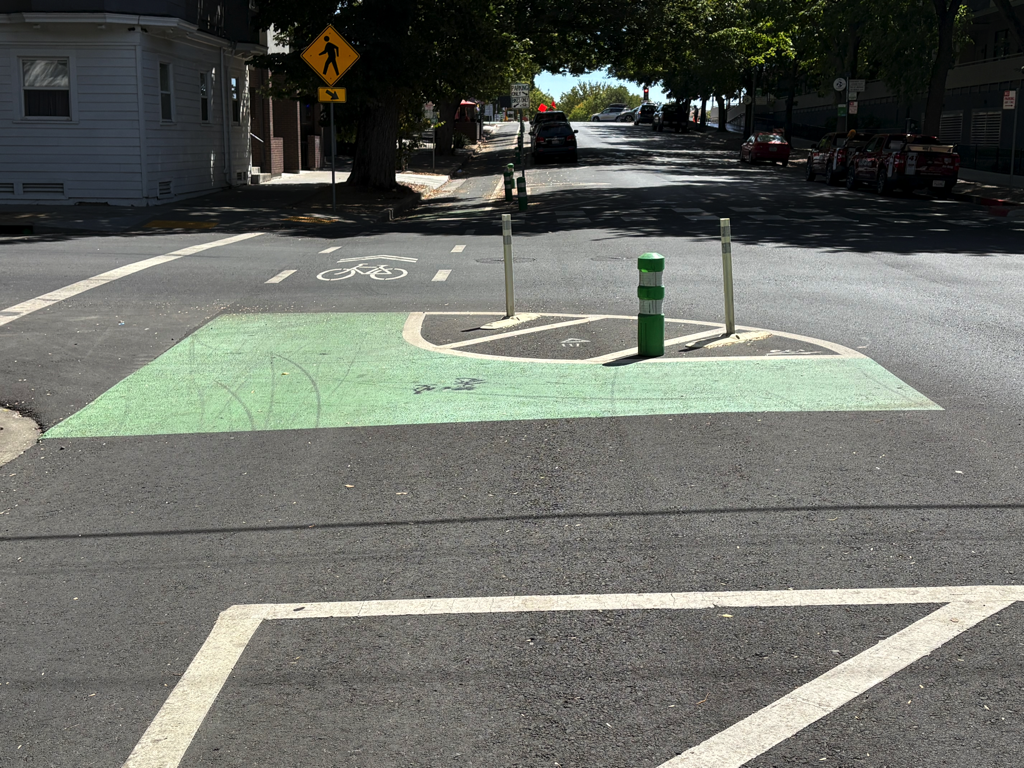
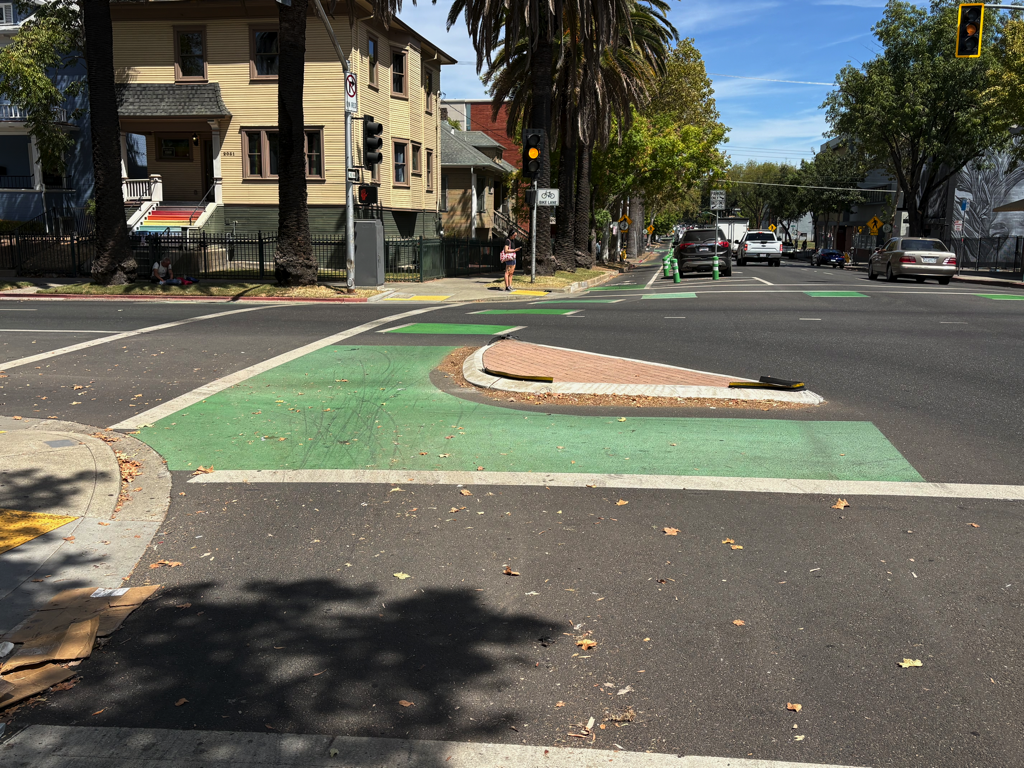
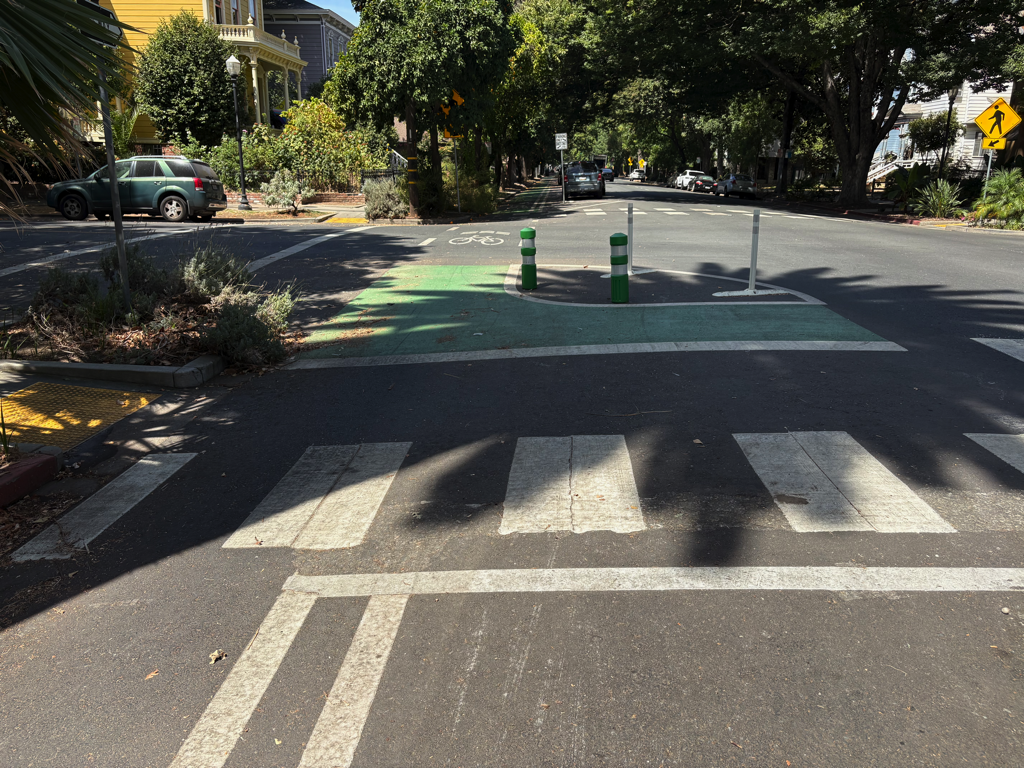
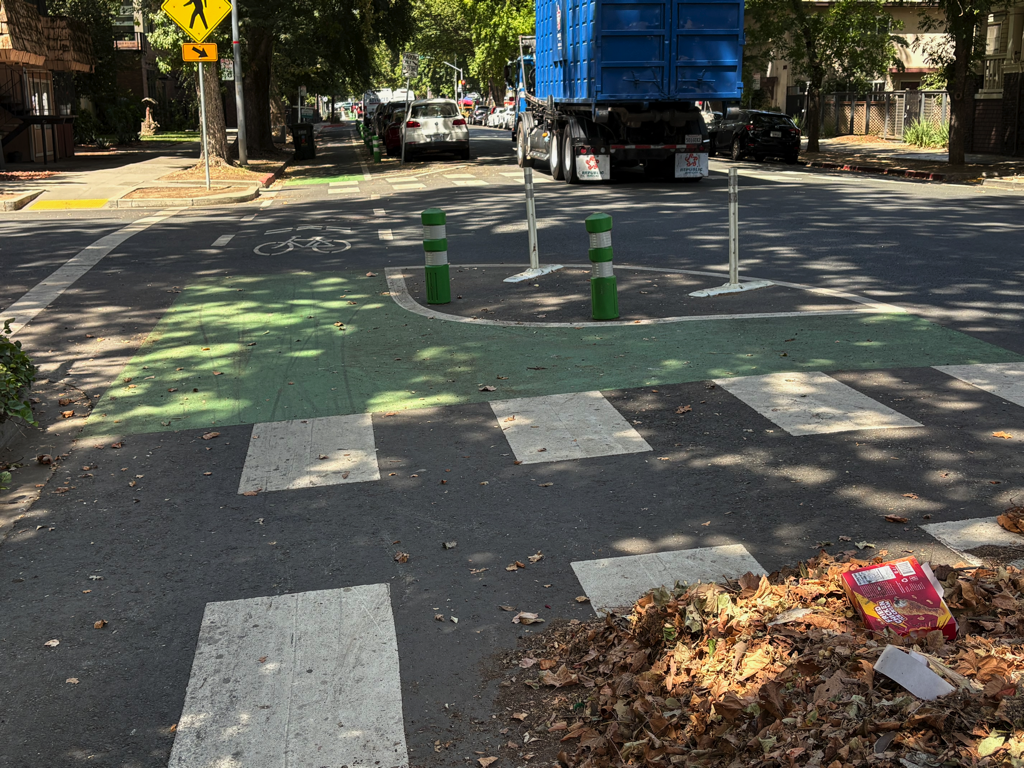
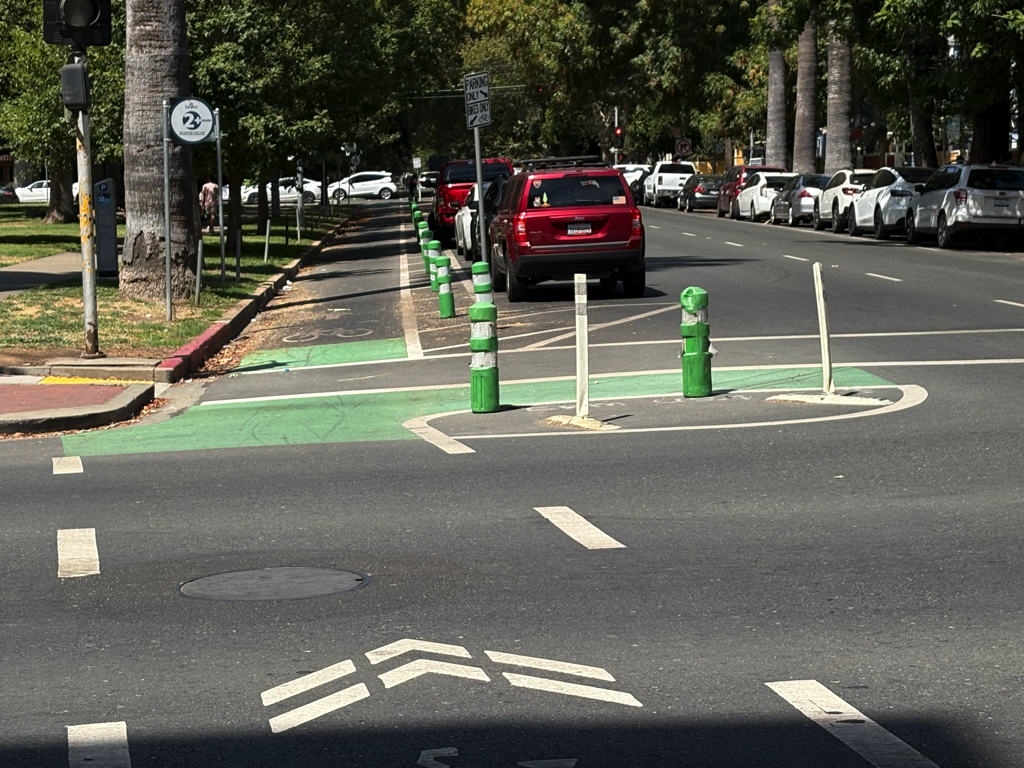
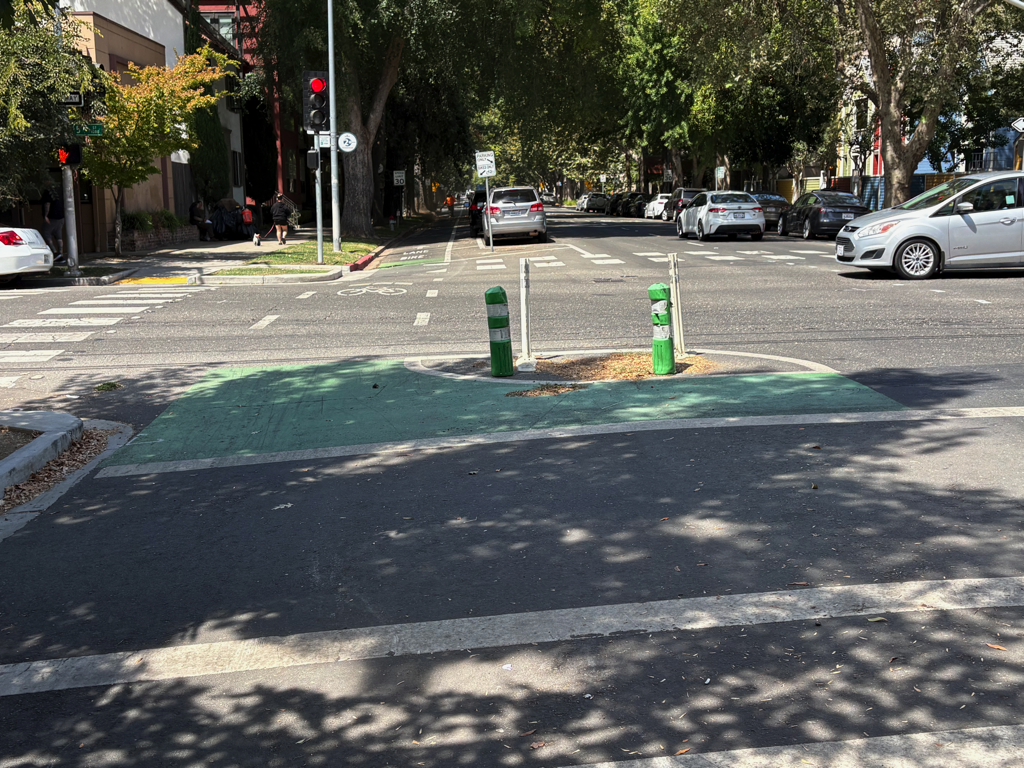
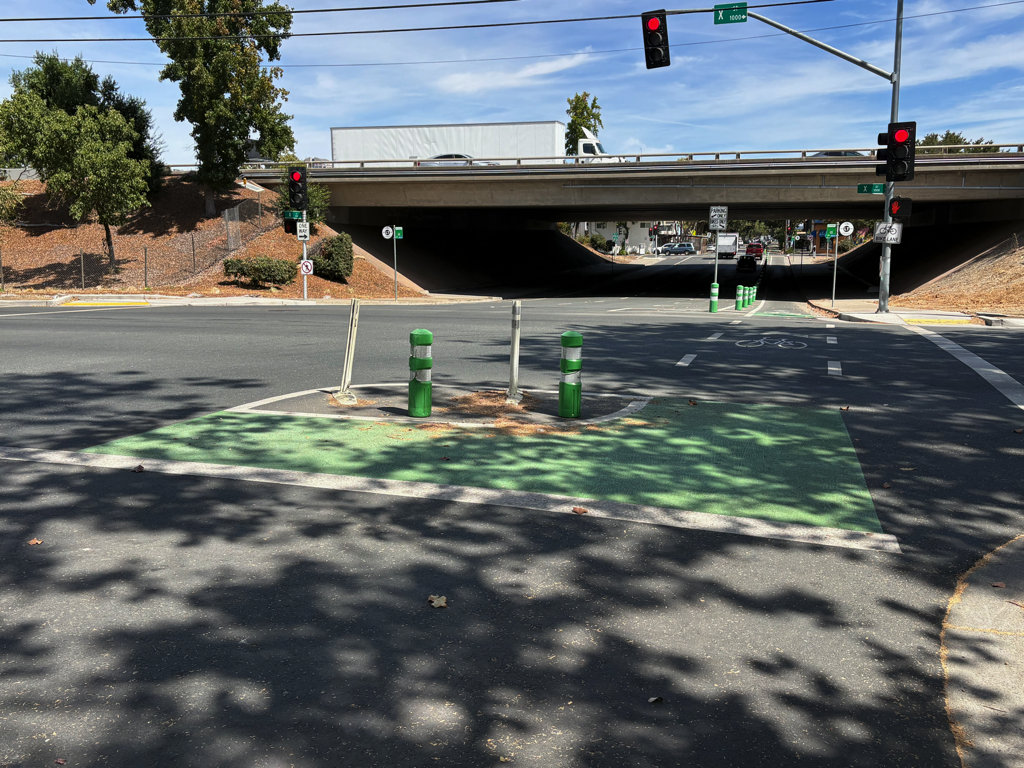
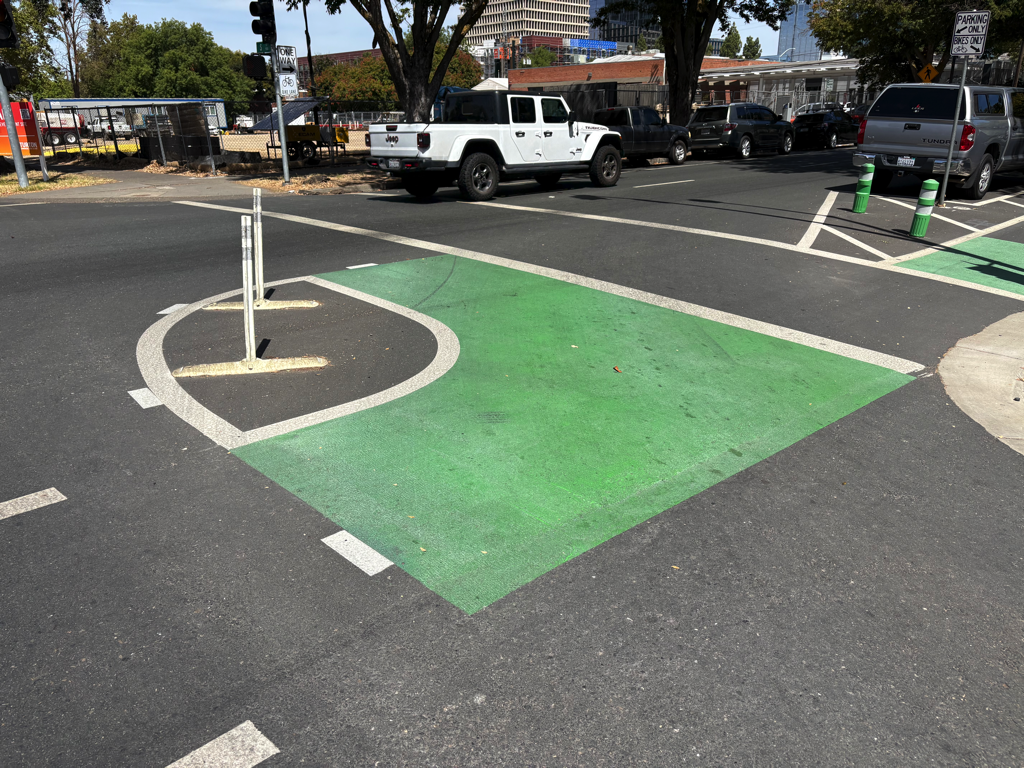
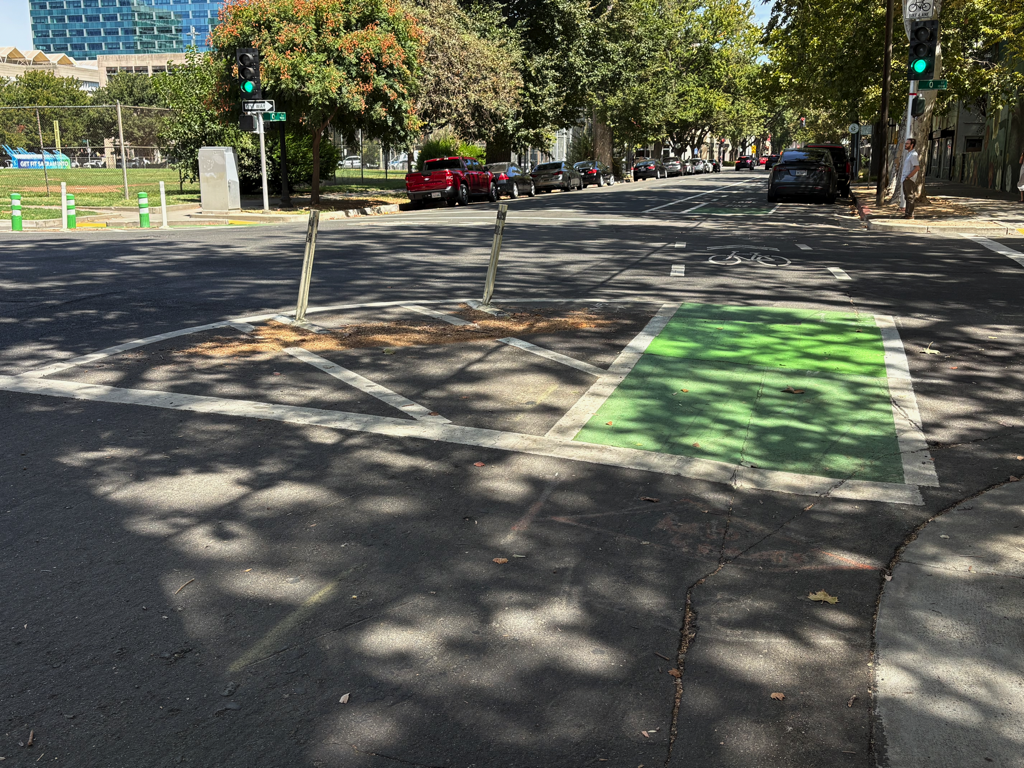
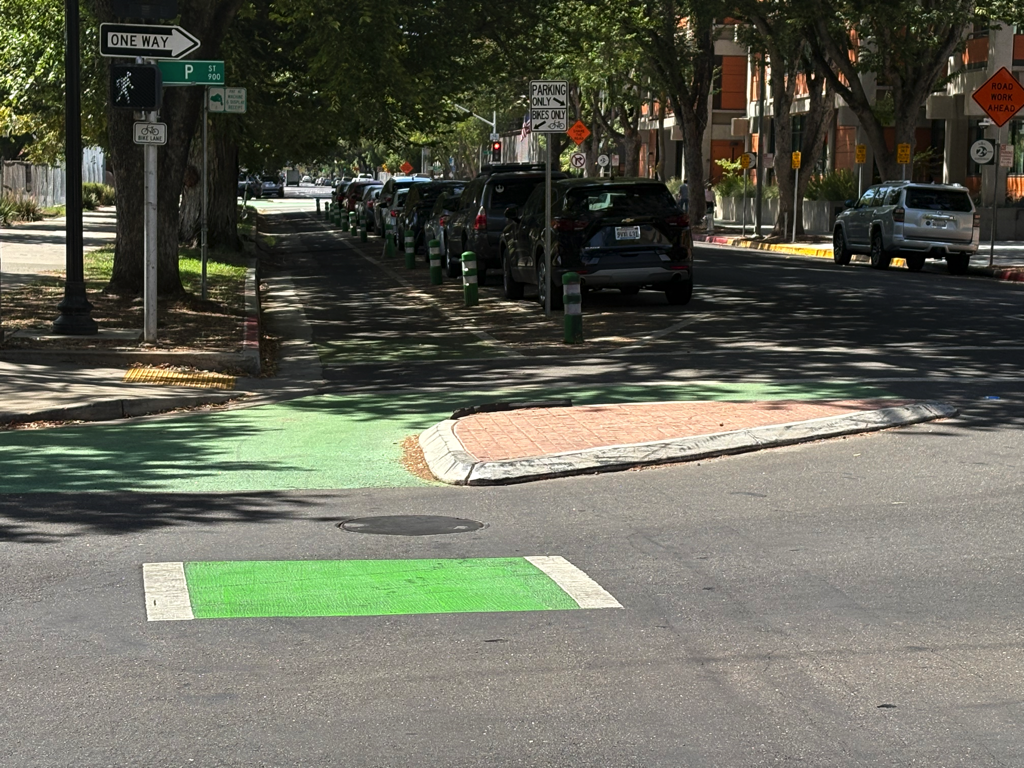
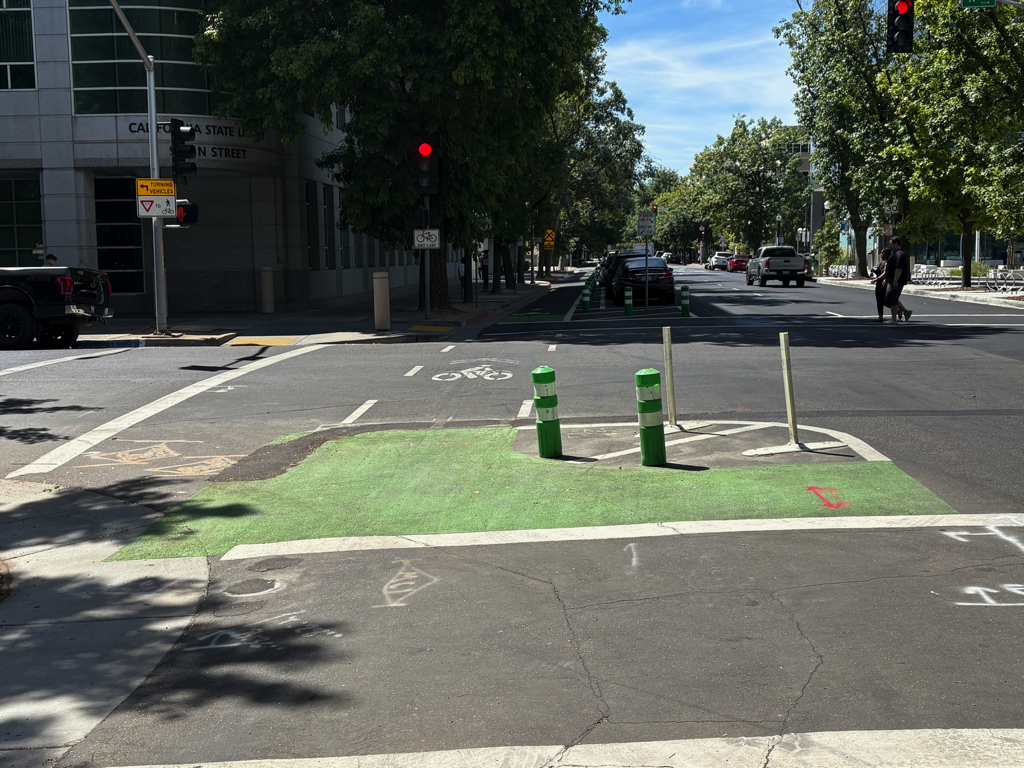
As part of the separated bikeways projects in the central city, turn wedges were installed at 30 locations, initially on the P Street and Q Street bikeways, and later on the 19th Street, 21st Street, and I Street bikeways. Though there is a bikeway on J Street, it does not have turn-wedges. My earliest posts on turn wedges, turn wedges of death and Central City Mobility update: turn wedges, I expressed doubt about these features, and added posts about real turn wedges and NACTO protected intersection and Sac semi-protected intersection showing how the designs fell short of best practice designs from NACTO and Alta Design+Planning.
However, after extensive observations of driver behavior around turn wedges, I now believe that these are a positive addition to streets in the central city. These features slow turning drivers, and cause them to face crosswalks more directly. I observe much higher rates of yielding to walkers than at other intersections. Not perfect, by any means, but better. Though these were installed as part of the Central City Mobility Project for bikeways, their greatest benefit is to people walking.
Some turn wedges work better than others, depending on the details of the wedge and the intersecting streets.
Five of the wedges are concrete. Initially, these were being hit by drivers almost constantly. You can see the tire marks on all of the concrete wedges, and even chipping of the concrete. The city added reflective strips to the edges of the wedges, though almost all of the strips have fallen off over time. It would have been good to add delineators or more reflective markings (see the Santa Monica example in real turn wedges). But drivers have adjusted, and I have not seen a driver hit a wedge in quite some time. These concrete wedges are at the intersection of two bikeways, though not all these intersections have concrete.
Two types of vertical delineators were added, initially green K-71 delineators, and later white FG 300 delineators. All of these have been hit by drivers, sometimes repeatedly with significant damage. I don’t see this as necessarily a failure – better a delineator than a walker or bicyclist. There is nothing in the world that can prevent all drivers from hitting objects in or close to the roadway, but good designs reduce the chances of those objects being walkers and bicyclists. This is critically important.
One turn wedge, northeast corner of I Street and 13th Street, is paint only, no delineators. As such, it doesn’t really serve any purpose.
Where buffers, and particularly wide buffers exist, the turn wedges work better because there is a longer approach for the driver before reaching the crosswalk.
Two wedges do not work because the gap between the wedge and the curb is too wide, inducing drivers to cut the corner inside the wedge and negating the benefit of the wedge to walkers and bicyclists. These are at the northeast corner of 9th Street southbound and Q Street eastbound, and the northeast corner of 10th Street northbound and S Street. These locations could be corrected, but they have not been. The 9th Street & Q Street location is particularly problematic because there is a high volume of turning drivers at this location, and speeds are higher due to the design of these two roadways.
There are projects to extend the bikeway on 9th Street south to Broadway, and to extend the P Street and Q Street bikeways to the west. Hopefully these projects will take the lessons of these initial turn wedges to improve the designs. The closer the designs come to the NACTO model, the better. And of course fully protected intersections, all four corners, are the optimal.
Photos of the 30 turn wedges are below. If you are aware of any other locations, please let me know. If you have experiences with any of these, as a walker, bicyclist or driver, please comment.