In today’s SacBee, two articles by Ariane Lange keep the focus on victims of traffic violence.
- The fatal car crash was an ‘accident.’ A California mom fought back, SacBee, 2026-08-06, Ariane Lange
- How did homicide by car become a special type of manslaughter in California?, SacBee, 2026-08-06, Ariane Lange
Before Ariane Lange, now joined by Madison Smalstig, the SacBee had always parroted law enforcement assessments of traffic violence crashes, which almost always blamed the victim, and rarely the driver, except in cases of egregious DUI. Law enforcement has a well-known windshield bias, in which motor vehicle drivers like themselves are blameless, whereas walkers and bicyclists, unlike themselves, are assumed to be at fault. Later investigations often reveal that law enforcement had either fabricated information or neglected to report key information, but that was never covered in follow-up articles. The SacBee went along with this bias. As result, readers assumed just what defenders of our car-centric transportation system wanted them to assume, that crashes are just accidents, that are not avoidable. We know better. Since Ariane Lange, readers know better.
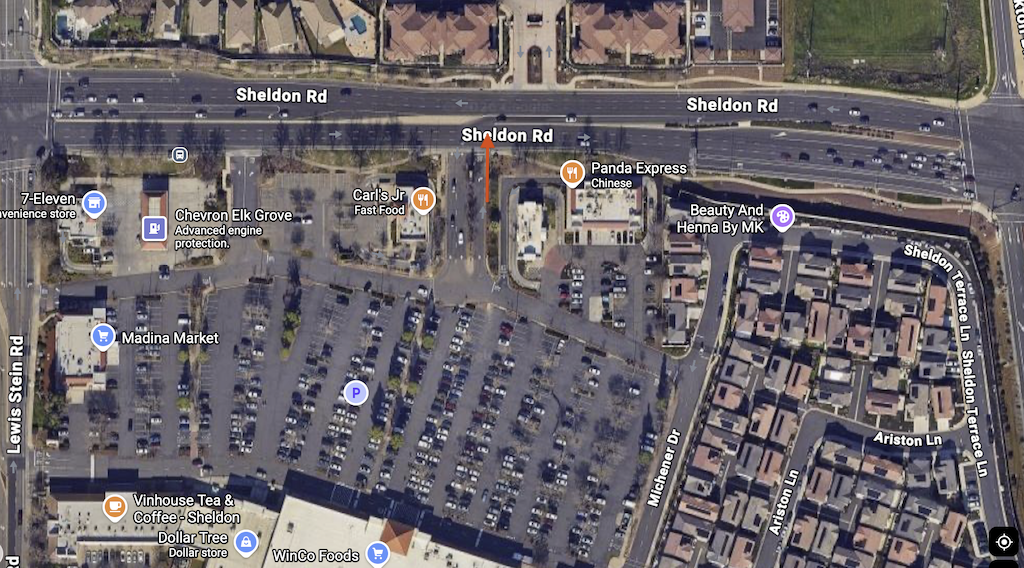
The one thing I will comment on is that Ariane let Elk Grove off the hook too easily. “The speed limit on that part of the road is 45 mph. In the immediate area of the crash, Sheldon Road has six general-purpose lanes plus the center turn lanes. It’s wide and fairly straight, with clear sightlines and few reasons to slow down.” “A spokesperson for the city of Elk Grove, Sydney Robertson, said that after Lopez was killed, the Public Works Department reviewed the site and “concluded that the intersection was properly constructed to applicable standards. Although not required, a yield sign was installed.” “The roadway, the city determined, had nothing to do with his death.”
In fact, the roadway had everything to do with the death. Six general purpose lanes means that the road is an arterial, designed to carry high speed traffic. An unprotected left turn lane into a commercial area means that the road is a street. This road/street hybrid is called a ‘stroad‘ (Strong Towns), and it is well known by all that stroads kill people, and also kill communities and livability. At 45 mph, as though most drivers are not driving way faster, crashes with walkers and bicyclists and motorcyclists, are almost guaranteed to result in death. Elk Grove designed and built that road. Just because the road meets ‘standards’ (which were written by people who believe the purpose of roads is to carry the maximum number of motor vehicles at the maximum possible speed) doesn’t mean that it is safe, and doesn’t mean that such designs are not malfeasance on the part of the city.
If a roadway is designed for high volume and high speed, it should have no commercial access. If the city wants commercial access, the roadway should be designed for lower volume and lower speed. Yet the shopping center that contains WinCo was permitted with two driveways, and the driveway that the driver was aiming for has two entry lanes, further encouraging drivers to cross the opposing lanes of traffic at a high speed. Just to make the message clear that this is a place for motor vehicles and nothing else, there are three drive-through fast food chains, and a huge parking lot for the shopping center. As a sop to people walking from their cars, there are two walkways in the parking lot. For the west one, at the north side, there is no marked crosswalk. On the south side, there is no safe crossing at all. For the east one, that leads towards WinCo, there is a marked crosswalk on the north side, but on the south side, the walkway does not align with the cross-hatched pedestrian areas, nor is it protected by the stop signs. The shopping center designers clearly do not walk, but more importantly, the city did not question the unsafe design, and permitted it.
It is bad enough that our car-centric culture and legal system largely excuse drivers of traffic violence, but it is even worse, in my opinion, that we give planners and traffic engineers a pass on the roadways they design in a way that they know will result in fatal crashes. This is no way excuses the driver at fault here of both legal and moral responsibility, but if we keep blaming crashes only on drivers, or blaming no one at all, we will never solve the problem.