An article in the SacBee today updates status on the Fix50 project to date (Sacramento Highway 50 project delayed again. When will Fix50 construction end?, SacBee, 2026-09-16, Madison Smalstig). Caltrans says the project will be ‘substantially completed’ by the end of October. October of what year? I worked for the federal government and government contractors for years early in my career, and know that the term ‘essentially complete’ is governmental-ese for ‘we are so far behind we don’t even really know when we’ll be done’.
$100M over budget, so far, and a year behind schedule, so far. But none of this really matters to Caltrans, which has its hands deep in your taxpayer pocket, and never suffers consequence for mis-managing projects. Caltrans is bad, Caltrans District 3, which includes Sacramento County, is worse. D3 is well known for its cars-first policies and projects.
And what will the project do, when it is someday complete? It will induce additional travel on Hwy 50, and on all roadways leading to and from Hwy 50, by encouraging commuters to travel longer distances and take more frequent trips. Poorer air quality, and anger-inducing congestion, guaranteed. Yet another make-work project for Caltrans engineers and construction companies. Most importantly, money spent to subsidize private motor vehicle drivers instead of meeting the multi-modal needs of citizens. Money tossed in the trash, or in this case, in the highway.
The Fix50 project is adding HOV lanes. It is well known that HOV lanes are ineffective at encouraging carpooling because they are routinely violated by many drivers, meaning the HOV lanes are just as congested, and therefore ineffective, as every other lane. This is a highway capacity expansion project, nothing more. Tolled express lanes induce some traffic, but far less than HOV lanes.
Before Ariane Lange, now joined by Madison Smalstig, the SacBee had always parroted law enforcement assessments of traffic violence crashes, which almost always blamed the victim, and rarely the driver, except in cases of egregious DUI. Law enforcement has a well-known windshield bias, in which motor vehicle drivers like themselves are blameless, whereas walkers and bicyclists, unlike themselves, are assumed to be at fault. Later investigations often reveal that law enforcement had either fabricated information or neglected to report key information, but that was never covered in follow-up articles. The SacBee went along with this bias. As result, readers assumed just what defenders of our car-centric transportation system wanted them to assume, that crashes are just accidents, that are not avoidable. We know better. Since Ariane Lange, readers know better.
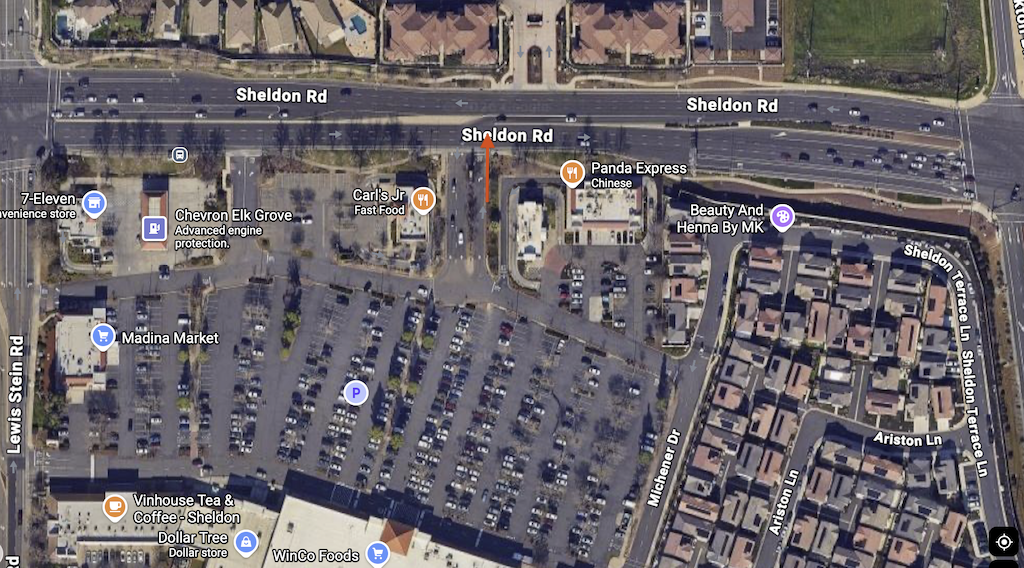
The one thing I will comment on is that Ariane let Elk Grove off the hook too easily. “The speed limit on that part of the road is 45 mph. In the immediate area of the crash, Sheldon Road has six general-purpose lanes plus the center turn lanes. It’s wide and fairly straight, with clear sightlines and few reasons to slow down.” “A spokesperson for the city of Elk Grove, Sydney Robertson, said that after Lopez was killed, the Public Works Department reviewed the site and “concluded that the intersection was properly constructed to applicable standards. Although not required, a yield sign was installed.” “The roadway, the city determined, had nothing to do with his death.”
In fact, the roadway had everything to do with the death. Six general purpose lanes means that the road is an arterial, designed to carry high speed traffic. An unprotected left turn lane into a commercial area means that the road is a street. This road/street hybrid is called a ‘stroad‘ (Strong Towns), and it is well known by all that stroads kill people, and also kill communities and livability. At 45 mph, as though most drivers are not driving way faster, crashes with walkers and bicyclists and motorcyclists, are almost guaranteed to result in death. Elk Grove designed and built that road. Just because the road meets ‘standards’ (which were written by people who believe the purpose of roads is to carry the maximum number of motor vehicles at the maximum possible speed) doesn’t mean that it is safe, and doesn’t mean that such designs are not malfeasance on the part of the city.
If a roadway is designed for high volume and high speed, it should have no commercial access. If the city wants commercial access, the roadway should be designed for lower volume and lower speed. Yet the shopping center that contains WinCo was permitted with two driveways, and the driveway that the driver was aiming for has two entry lanes, further encouraging drivers to cross the opposing lanes of traffic at a high speed. Just to make the message clear that this is a place for motor vehicles and nothing else, there are three drive-through fast food chains, and a huge parking lot for the shopping center. As a sop to people walking from their cars, there are two walkways in the parking lot. For the west one, at the north side, there is no marked crosswalk. On the south side, there is no safe crossing at all. For the east one, that leads towards WinCo, there is a marked crosswalk on the north side, but on the south side, the walkway does not align with the cross-hatched pedestrian areas, nor is it protected by the stop signs. The shopping center designers clearly do not walk, but more importantly, the city did not question the unsafe design, and permitted it.
It is bad enough that our car-centric culture and legal system largely excuse drivers of traffic violence, but it is even worse, in my opinion, that we give planners and traffic engineers a pass on the roadways they design in a way that they know will result in fatal crashes. This is no way excuses the driver at fault here of both legal and moral responsibility, but if we keep blaming crashes only on drivers, or blaming no one at all, we will never solve the problem.
The California Transportation Commission (CaTC; CTC is Commission on Teacher Credentialing) has approved yet more of your tax dollars to serve a small segment of the population, those who commute long distances. Freeways will be expanded all over the state. Why is more highway capacity needed? Because more lanes equals more driving, equals more gas tax, equals more money for highways. It is a circular loop, also known as a growth ponzi scheme.
The CTC has long been in the pocket of the highway lobby, which is composed of the asphalt and concrete providers and construction companies, the fossil fuel companies, and the politicians who love ribbon cuttings over actually doing something to benefit their voters (of course, as we all know, most politicians first consider their campaign contributors, and only if it doesn’t conflict, citizens).
But because CTC continually funds highway expansion, basically giving Caltrans everything that asks for, so long as it is capacity expansion, and refuses to give serious discussion or attention to climate change and the evolved transportation environment, it has really become the highway lobby.
Because nearly all transportation funding (otherwise known as your tax dollars) goes to highway expansion, there is little left at the state level for maintaining highways. And little at the regional (SACOG) level. And almost nothing at the county and city level. Your street is likely falling apart, because the money is going elsewhere.
Caltrans has built a transportation system based almost solely on the needs of commuters and freight, though because of congestion induced by commuters, it no longer serves freight very well. Active transportation was not just an afterthought, but was actively planned against. The most dangerous roadway locations in the state are highway onramps and off ramps, which were designed for the highest possible motor vehicle speed, and usually have minimal or no accommodation for people walking and bicycling. As if the ramps were not bad enough, Caltrans retains control of overpasses and underpasses, though they spend none of their money on improving those, forcing local entities to spend their own limited funds to fix Caltrans mistakes. And there are plenty of Caltrans mistakes to be fixed. Billions of dollars worth. Instead of fixing things, Caltrans builds more. More problems to solve, more infrastructure to maintain, but without asking for very much for that maintenance.
Nine of the eleven members of the CTC are appointed by the governor. So our windshield governor owns the misallocation of taxpayer dollars. Of these members, only two could be considered advocates for active transportation, transit, and rail: Adonia Lugo and Darnell Grisby. A few others are not opposed to these, but not very supportive. Some are actively opposed to spending state money on anything but highways.
Strong Towns has addressed this travesty by documenting how the era of Interstate Highway expansion is and should be at an end:
Of course Caltrans and its enabler CTC is not just expanding the Interstate system, which they are, but the entire state highway system.
CTC is broken. Can it be reformed? It seems to me unlikely. Since CTC largely serves to give Caltrans whatever it wants, maybe it would be better to just give the budget directly to Caltrans. Nothing would improve, but at least active transportation, transit, and rail advocates would only have to monitor one agency instead of Caltrans and CTC.
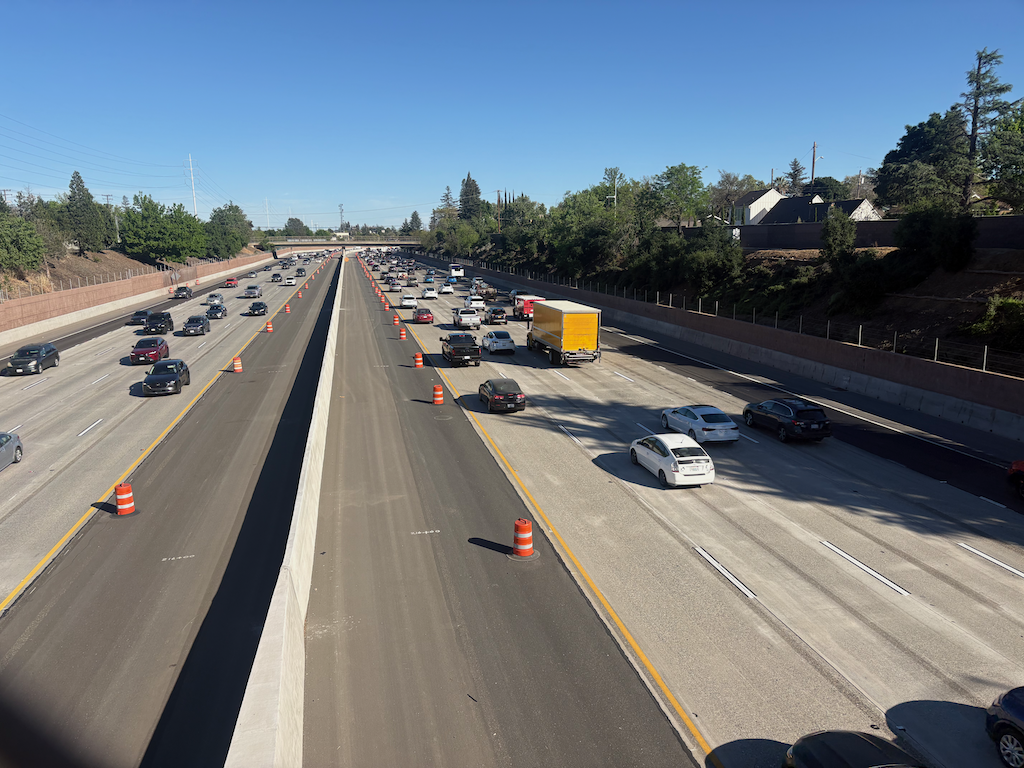
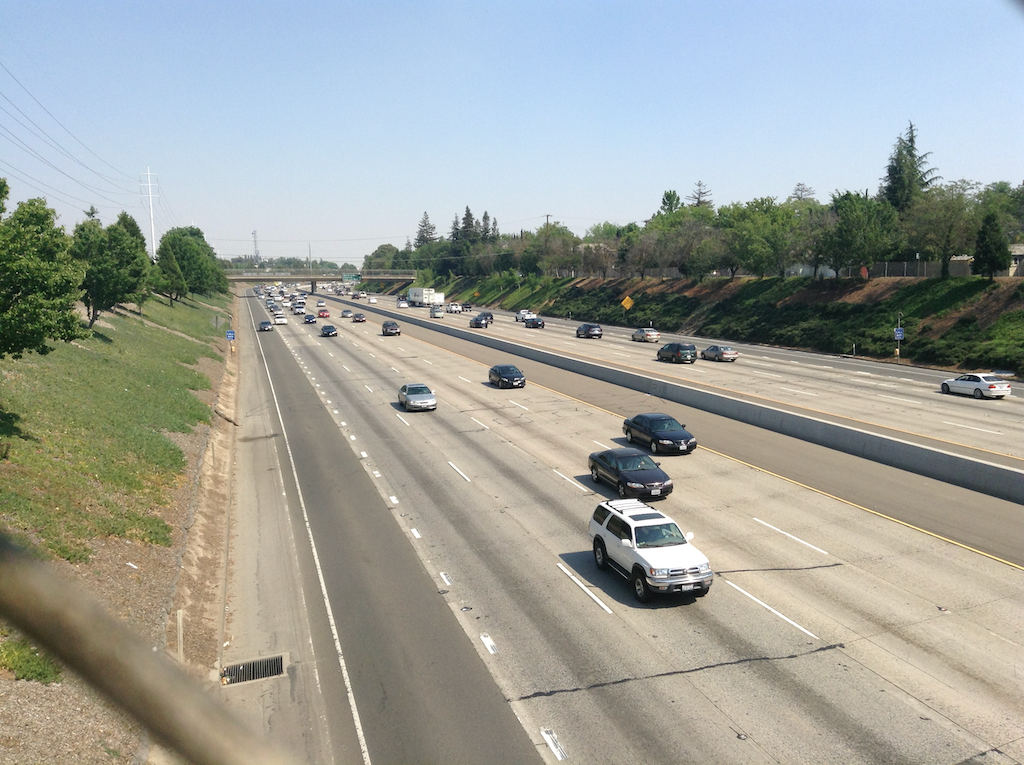
Hwy 50 at 48 St, looking east, 2026Hwy 50 at 48 St, looking east, 2013Hwy 50 at 48th St, looking east, 2026 on left, 2013 on right, $511M of your tax dollars
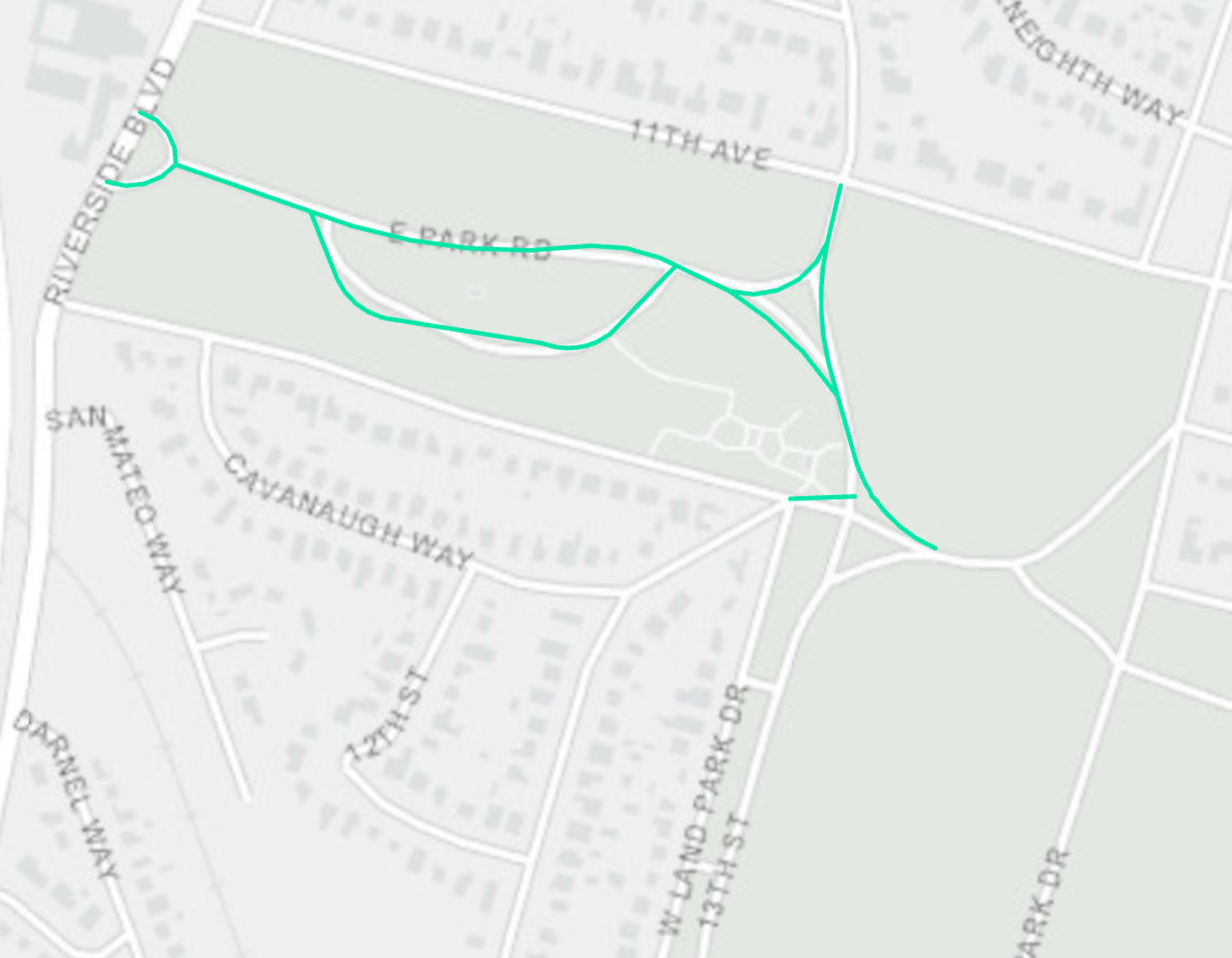
The City of Sacramento is considering closing two streets in William Land Park to cars in order to open them to people. The SacBee article has more details: City could test closing streets in Sacramento’s William Land Park. The article does not have a map, so I created one, below. This is my best guess from the text description in the SacBee article. I have not found any other documents on this proposal.
Note that the terminology ‘closing’ is not the one used by active transportation advocates. The preferred term is ‘opening’, because the road, formerly used mostly by motor vehicles, with concomitant danger to those not in a motor vehicle, is now open to walkers and bicyclists.
I wrote, way back in 2022, about my suggestion for closing roads in William Land Park to motor vehicles (Land Park open (car free) roads?). This new proposal does not match mine, but it is a good proposal. At this time, only a very small roadway and gate at the far southeast corner of the park is closed to motor vehicles.
William Land Park is dominated by motor vehicles, so any ‘closing’ / ‘opening’ is welcome. This is a good first step. Parks are for people, not for cars.
The City of Sacramento Active Transportation Commission (SacATC) will meet this Thursday, March 12, starting at 5:30 PM. This is not the usual third Thursday, but the second. The meeting may be held in the old city hall, rather than council chambers, but the agenda is not clear about that.
The agenda is below (pdf). I have not had a chance to look at the four agenda items to make comments here, but will if I am able. The linked items contain both staff reports and presentations. I find it useful to separate these into two documents, but again, only if I have the time. All of these are review and comment items, not for decision.
This SacBee article from December 11, 2024, highlights a Twin Rivers Unified School District project to add workforce housing for beginning teachers and other school district employees. Though it is less of a problem in the Sacramento region than in many cities, teachers and other employees on the lower end of the income scale can often not afford to live near their school because rents are too high.
With shrinking student populations in most, though certainly not all, of the school districts in the Sacramento region, there are empty or underutilized school district property that could be used for housing. While I worked for San Juan Unified, I encouraged the district to explore this option, as the district has many school sites that are unused, or only partially used for special programs. In fact the district office has a vast parking lot that used to be a bus yard and now grows weeds.
An article today in the Sacramento Bee is about two traffic fatalities on Freeport Blvd, but also does an excellent job of summarizing the city’s lack of general fund investment and action street safety, and over-dependence on long-term grant funded projects. Yay, Ariane Lange for the excellent reporting on roadway safety and solutions, and the real people who are the victims of poorly designed roadways and traffic violence.
The city’s solution to fatalities and severe injuries on our our streets has been the Vision Zero effort and Vision Zero Action Plan (2018), and related documents. This resulting in a focus of grant applications on corridors with a high level of traffic violence, the high-injury corridors. For more posts on Vision Zero, see tag: Vision Zero. What has not occurred since 2018 is a significant increase of city general funds to address traffic safety. Since that time, Sacramento Police Department has largely ceased traffic enforcement, while their budget has continually increased, though there are strong safety benefits for people of color in that reduction of enforcement which tends to be pretextual and biased.
The city council has repeatedly suggested allocation of some general funds to traffic safety and fixing roadways, but City Manager Howard Chan, and perhaps Public Works, has resisted this. With the departure of Chan, this may change (more to come on that). The city has no program for quick-build projects, though a few have happened. The city’s transportation budget goes to pavement maintenance (which is a good thing, as your roadways are in poor condition for everyone), new capacity expansion, and grant matches. Almost none goes to quick-build solutions.
I am not suggested dropping the approach of grant applications for big projects, as those long-term projects are important. What I am suggesting, and the SacBee supports, is investment in fixing some of the worst roadway designs, now rather than someday.
An article in the SacBee today reports that a bicyclist died when he/she swerved into the path of a motor vehicle. The article parrots the CHP spokesman, that the bicyclist swerved. No doubt the uninjured driver would say that. The bicyclist is dead and has nothing to say, so the CHP takes the word of the driver.
Note that no crash investigation has been conducted by CHP. Crash investigations take weeks, and require gathering of detailed information about the point of collision, and the direction of movement of the bicyclist and driver at the time of collision, and more information about the victim and perpetrator. But without the results of an investigation, the CHP just assumes that the bicyclist is at fault and the driver is innocent. This is victim blaming of the first order. Of course this is standard procedure for CHP, where almost every officer thinks that every bicyclist crash is the fault of the bicyclist, without evidence to support that assumption. CHP is not a safety-oriented agency, they are a victim-blaming agency. No surprise.
What is a surprise is that the SacBee would parrot the CHP’s misinformation about the crash. News media does not exist to reprint agency press releases. It should exist to question what agencies say, particularly when the agency expresses certainty about a crash that has not received an incident investigation. Please do better, SacBee. Report the facts that are known, not CHP speculation.
City code specifies that property owners are completely responsible for repair of sidewalks adjacent to their property. State streets and highways code seems to allow the city to claim this. The two relevant sections within Chapter 22: Maintenance of Sidewalks are: Article 2. Repairs and Article 3. Collection of Cost of Repair. I have previously made the claim that both state code and city code are unconstitutional, because they make persons responsible for maintenance of property that belongs to the city, not the person. In almost all cases, sidewalks and the land on which they lie is city property, not private property. This is particularly egregious when the sidewalk damage is due to city-owned trees in the sidewalk buffer (which the city calls planting strips).
Therefore, I believe that it is illegal for the city to charge property owners for sidewalk repair.
The major focus of the article is that low income communities are being unfairly targeted for sidewalk repair, with a graph that indicates that. That is one interpretation of the data, and it would not be surprising. The city has always and continues to treat lower income communities and people of color with bias. There is another explanation however. Sidewalks in lower income communities were very likely built to lower standards than in others, and it is likely that the city has never maintained any of them, except in some locations placing ADA ramps at corners. I notice in the central city that many sidewalk cracks are covered with asphalt patches, which were placed by the city. I have not noticed these patches in lower income neighborhoods. It is likely that the city is doing work in moderate and high income areas that they are not doing in lower income areas. The central city has more construction projects than other areas, which often result in the sidewalks being repaired or replaced. The central city has also seen a lot more installation of new corners with ADA ramps that other areas of the city. This makes some sense because much of the central city has higher pedestrian (walker) levels, but this fact does not overcome the fact that there are walkers in disinvested neighborhoods, and in particular, children walking to and from school deserve good sidewalks more than anyone else.
I have been in the habit of reporting sidewalk issues through the city’s 311 app. This article has made me rethink reporting. Am I causing unaffordable repair bills for people who can’t afford it? Is the sidewalk flaw really that bad? I’ve decided to stop reporting sidewalk locations, until these issues are resolved.
My next steps are to make a suggestion for how the city can mitigate these repair costs, and for the city to inventory its sidewalks so that it knows what the situation is throughout the city, rather than a complaint-driven system that is almost certain to have bias. Coming up!
broken sidewalk, V St, Sacramentosidewalk repaired due to damage by a city owned tree in a city owner sidewalk buffer, P St
I’m soon to create two posts that refer to articles in the SacBee, so it seems like a good time to express my frustration with the SacBee firewall. The Bee does make a few articles available to the public, but most require a subscription to view. When I link to a SacBee article, I know that many of my readers will not be able to access that article, because they don’t have a subscription to the Bee. That is frustrating to me, and frustrating to my readers.
The SacBee app works reasonably well, but SacBee links don’t open in the app, you have to go to the app and search for what you want. The search engine is weak. Articles that have been posted recently are often not in Latest News or More latest news. Though it isn’t clear how long articles are retained in the app, a search for an older article may (or may not) bring up the print edition facsimile, and the article of interest may or may not be in that issue.
The web version of the SacBee is quite problematic. You can log into your account, but it will make you log in again within a few day. If you do have a subscription, it will often claim you don’t, and make you go though the whole log in process again. I had a subscription for a while, and tried to use the web interface. I quickly gave up and dropped my subscription. Which was another problem. It took me a deep dive into account management, and several tries, to drop my subscription.
Of course the Bee offers incentives pretty regularly. Free for a period of time, of a price far below subscription for a period of time, but trying to drop the subscription after these incentive periods is quite frustrating. I just tried to load the subscription page in the web interface, and after 15 minutes, the page is still loading. It loads in the app, however. Month subscriptions are $15.99 per month. That seems like a whole lot of money for a newspaper that most repeats national new sources, which I can get many other places, or rewrites articles from CalMatters, and has little real local journalism outside sports. But then, just when I’m about to give up completely, a useful article pops up.
What I want from the Bee is an option to buy an article. For personal, non-commercial use, to read or excerpt a small portion of the article, maybe 50 cents per article. If I want to share the entire article on my non-commercial blog, maybe $2. The Bee knows that its readers want this sort of payment by article, but it has resisted offering this. I don’t know why. It is a chance to make more money off of its journalism. Talking to my friends about the Bee, very few of them subscribe, so the Bee is missing all of the income from these people, and additional income it might make from me.
These are modern times. Why can’t the SacBee offer per article payments? Why can’t the Bee make a website that works?