#JustSayNoToAmazon

Within hours of Amazon announcing a competition to create a second headquarters, HQ2, mayors and governors all over the country were saying “Me, me, choose me.” Including Sacramento Mayor Darrell Steinberg. This is a mistake!

I don’t have anything against Amazon, they are a company with a business model that has been remarkably sucessful. I shop there, at least when I can’t easily find an item locally. Their prices are often remarkable. Yes, and I also feel hesitant or guilty each time. But this isn’t about Amazon.

I’m also not against jobs. And I’m also not against development, though I certainly prefer small-scale development to large-scale development. A headquarters with 50,000 employees is something that would overwhelm all but the very largest cities. Sacramento is not among those cities. 

What this is about is about a city (and regional and state) economic model that says we can’t get anything good unless we soak the taxpayers for a subsidy. In this case, Amazon is asking for a huge subsidy from whatever locale “wins” the competition. 

On the positive, Amazon includes the requirement: “Direct access to rail, train, subway/metro, bus routes”. But they also seem quite willing to be in the suburbs, on a greenfield site, only asking within 30 miles of the city center. In the case of Sacramento, that includes Davis, El Dorado Hills, Roseville. Ack!

The RFP then gets to the heart of the matter, money!

Capital and Operating Costs – A stable and business-friendly environment and tax structure will be high-priority considerations for the Project. Incentives offered by the state/province and local communities to offset initial capital outlay and ongoing operational costs will be significant factors in the decision-making process. 

Incentives – Identify incentive programs available for the Project at the state/province and local levels. Outline the type of incentive (i.e. land, site preparation, tax credits/exemptions, relocation grants, workforce grants, utility incentives/grants, permitting, and fee reductions) and the amount. The initial cost and ongoing cost of doing business are critical decision drivers.

In other words, we will consider you if you come up with a bigger bribe than anyone else. I doubt that Sacramento can compete in this arena, but more to the point, no one should be in this competition. Amazon is a very successful company. They don’t need our subsidy to be successful.

So, back to the title #JustSayNoToAmazon. I’m not suggesting that Sacramento decline on its own. I’m suggesting that big city mayors show some true leadership, meet with each other, and, as a unified whole, decline the Amazon offer. This is a chance for Mayor Steinberg to show some real leadership and not just be a booster for failed economic models. 

Articles and posts on the Amazon plan are proliferating, but let me suggest two:

big smiles at Sunday Street on Broadway

Sacramento’s first open street event* took place on Sunday, Sunday Street on Broadway.  

Broadway was closed to cars and open to people from 8 to noon. The route was on Broadway from Riverside east to 26th St, jogged down to 2nd Ave, and then ended again at Broadway. People were wondering how this would work in Sacramento, the first time, and in a place that is pretty car-centric. Well it worked great! A lot of people came out. I’m sure the city will have an estimate, but the initial answer is, a lot.

If success is measured by smiles, and it should be, this event was a great success. People of all ages were there, people from the neighborhood and the region. A lot of people were bicycling, but a lot were walking, and using other wheeled devices. Slide tricycles, which I didn’t even realize were a thing in Sacramento, were common.

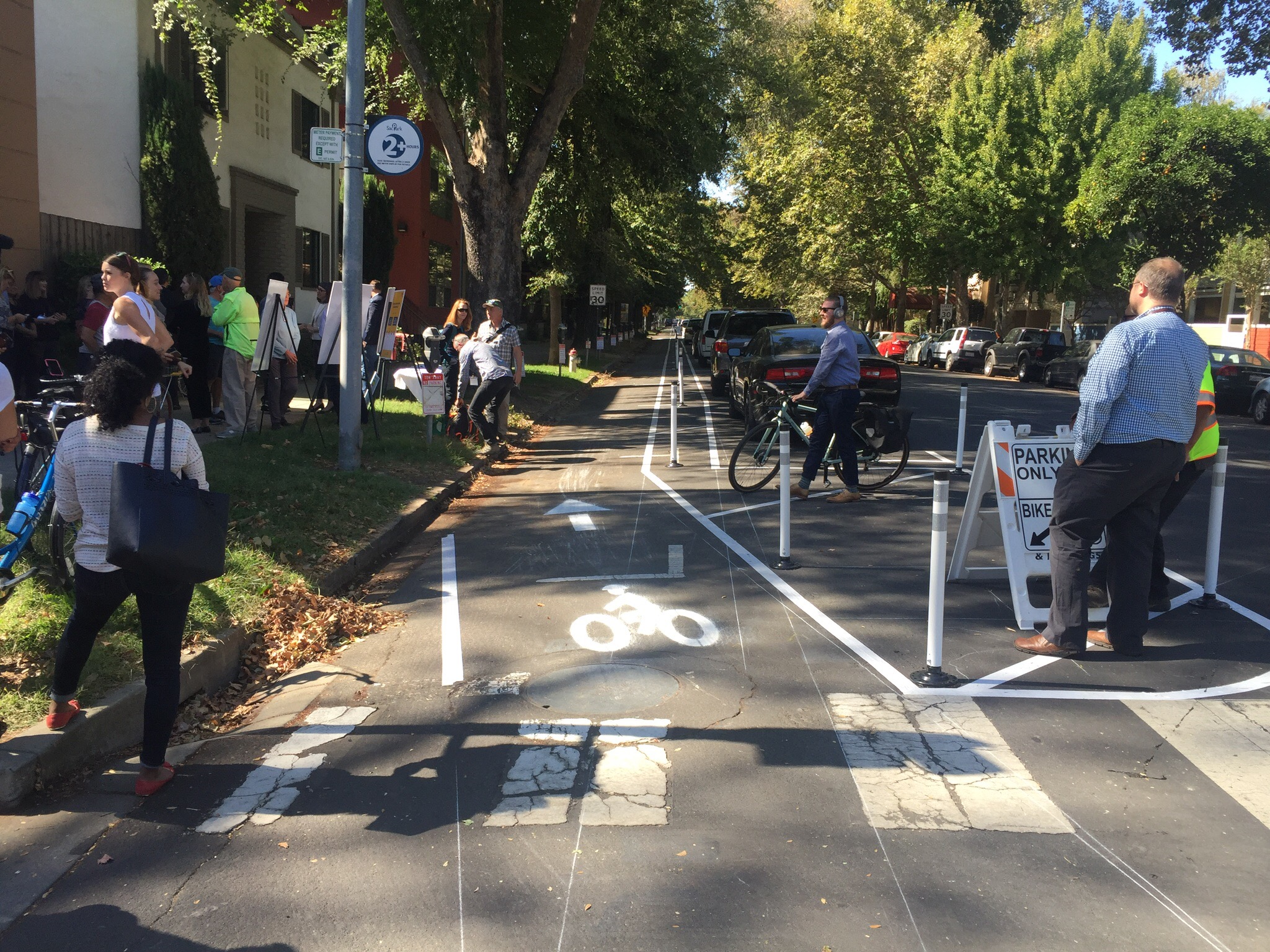
Sacramento Area Bicycle Advocates (SABA) created a separated bikeway (protected bike lane) for people to experience, which attracted a lot of attention and generated a lot of discussion about the state of bicycling in Sacramento. Adjacent, WALKSacramento asked people to add their favorite places to walk to a chalk board, all of which were NOT car-dominated places. Some people prioritized how it felt to walk, others their destination. Ice cream was a popular theme. 

Outside food vendors were prohibited in order to highlight local restaurants. For those open, business was booming. Some places missed out, though, by not being open. I’d imagine as word gets around how well it works, food retail along future events will be open and prosperous. Many business owners just assume that most of their customers come by car, but places that encourage and activate walking and bicycling all have increased business. Vintage Bicycle Supply was open and crowded with people not even aware it existed, and fans of the CycleFest cruiser bikes. New Helvetia Brewing was quenching people’s thirst and hosting running clubs. There were a lot of sports and fitness vendors, showing people what they had to offer and just providing fun. The two hula hoop groups were particularly popular with kids, and there were chalk drawings everywhere. Sidewalk chalk may be the single most important tool available to the public for activating public spaces. 

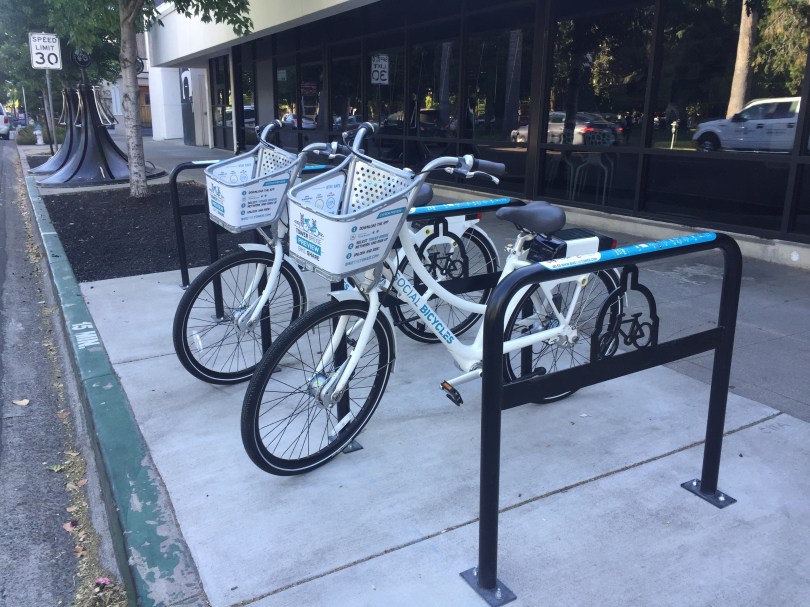
SACOG and Social Bicycles were showing off the new bike share which opened just Thursday. I heard comments from a lot of people that they found the bikes easier to ride than they thought, and were looking forward to trying it out. [previous post riding the bike share.

The section along 26th St and 2nd Ave was much quieter, with a cluster of local businesses and organizations near the end at Broadway. It was also far cooler than Broadway, with all the street trees moderating the temperature about 10 degrees below Broadway. This was not only much appreciated by people, but points out that for the new Broadway to work for pedestrians and bicyclists, it is going to need to not only not lose many of the existing trees, but to really create a welcoming tree lined street. When I participated in the public meetings the last two years, I didn’t realize how important street trees would be. Since Broadway will be a vibrant commercial corridor, it may be that the big shade trees should be in the median, with less dense trees between the street and retail, so that the view of customers is not obstructed. Interesting design issues. 

Hope you had a fun time too! I’m looking forward to the next one. 

Photos on Flickr

* Though the county claims its Great Scott road closure is an open street event, it really does not meet the widely accepted definition of an open street.

riding the bike share

Today is the second day of the Tower Bridge Bike Share Preview. I took four trips yesterday, three from hub to hub, and one picking up an out-of-bike bike. And two early morning trips today, both to move out-of-hub bikes. These two bikes were parked at a rack at the other end of the block from the hub racks on R Street. Though I wasn’t there last night, I suspect that the hub racks were full of both bike share and private bikes, and the people could not leave the bikes in the hub. Full racks may be an issue at hubs close to drinking establishments, which 16th, 18th, Capitol, and R St all are. Once the system becomes more widespread, this problem may disappear.

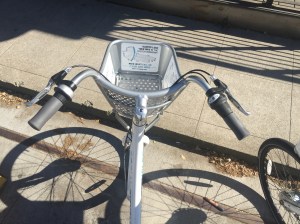
TowerBridgeBikeShare_handlebarsOne of the things I do not like about these bikes is the handlebar configuration. They are sort of like beach cruiser bikes, with the angle along the side rather than the traditional handlebar angle. I hate this hand position. After 10 minutes of riding, my forearms were sore. I can put them in a more comfortable position, but only by taking my hands off the brakes. I see other bikes with this handlebar configuration, so I’m sure some people will love these. Not me!
The seat height is adjustable over a wide range, and the seat post has numbered marks so that once you find your comfortable seat height, you can immediately adjust each bike to your height.

The bikes have eight gears, in an internal hub. This is more than flat Sacramento needs, but nice to have. I find myself riding mostly in 6th, going down to 5th at intersections. 1st is very, very low. The bikes are heavy, so the low end gears will help less strong people get moving. Once the bikes are moving, the move along pretty well. They have rod drives rather than chains.

When picking up a bike on 18th Street last night, Steve Hansen was there doing an interview about the bike share system with a TV station. Maybe you saw it on the late news (I don’t have a TV). I talked a bit to Steve, but we both had other places to go. He is obviously pleased to have the new bike share in his council district. This hub was quite busy, and went from five bikes to zero bikes in a flash. I’ve been sort of watching the bike counts throughout the day. Some hubs seem to have a lot of turnover, going up and down frequently, while others don’t change much. This is just my observation, don’t know if the data backs that up.

As I mentioned, I returned three out-of-hub bikes to hubs, and got a credit of $1.50 for each. I have mixed feelings about this. I can imagine myself leaving a bike to go into inside, not sure how long it was going to take and therefore not wanting to put the bike on “hold” but still hoping it is there when I come out. On the other hand, these out-of-hub bikes might sit there for quite some time without being part of the circulation, which hurts availability. It had occurred to me, and Steve also mentioned it, “making a living” bringing these bikes back to hubs, and maybe accomplishing some rebalancing in the process. Of course it is just bike share credit, not real money, but my account balance it larger now than when I started.

The bike hub marker placed in the east end of Capitol Park, with a geofence covering the four square block area, is now gone. This may have been a programming error, or an experiment. After looking, I did not find any racks in the part of the park. However, I thought I saw a positive number in that hub mark during the day. Maybe my imagination.

Photos on Flickr.

almost bike share

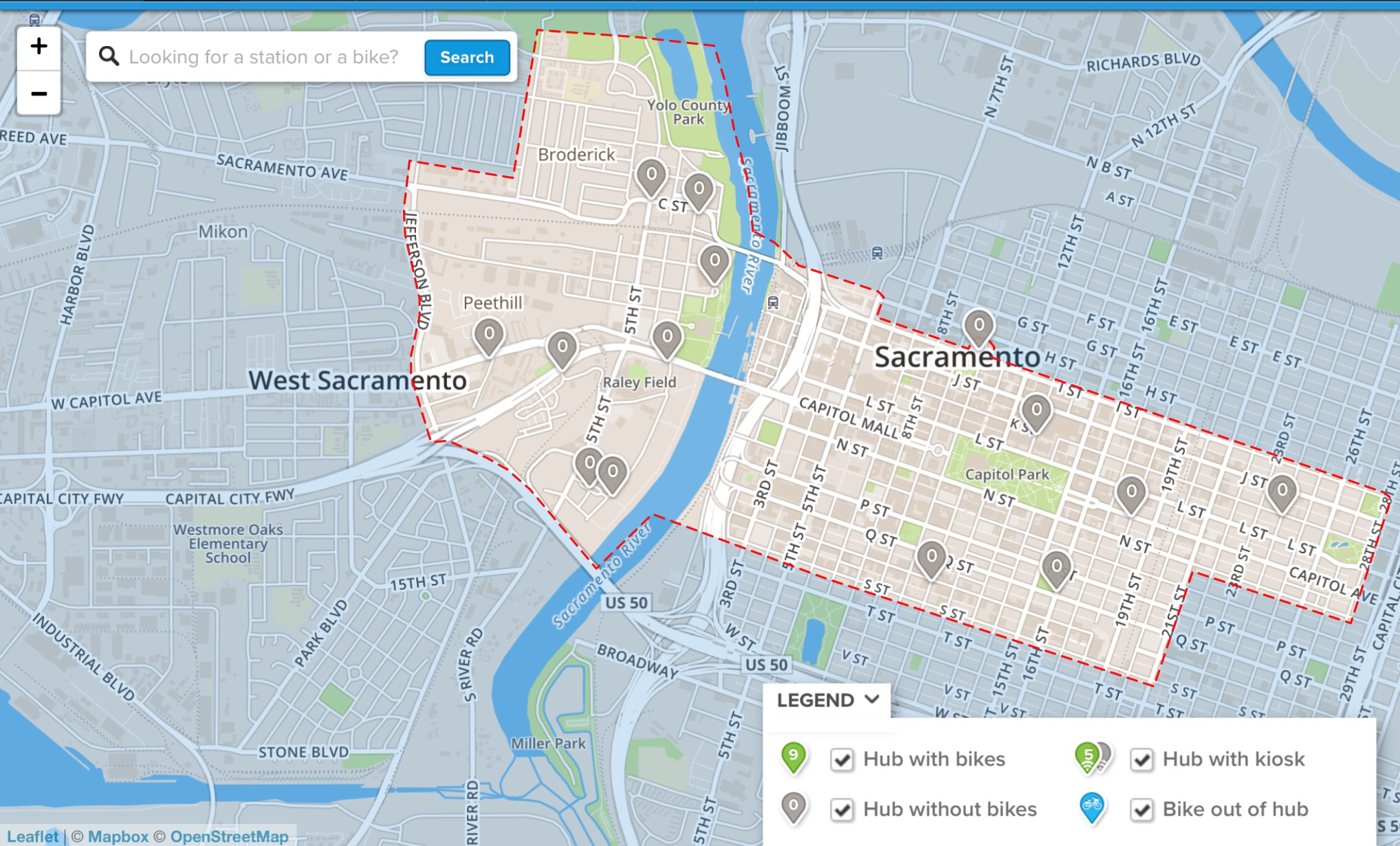
The SoBi (Social Bicycles) bike share system in Sacramento is about to launch.  The bike racks have shown up on the ground, and just yesterday, on the map.

SoBi is a kiosk-less system, unlike, for example, Bay Area Bike Share in which bikes can only be checked out from and returned to kiosks with racks that the bike are designed to lock to. SoBi will lock to any rack, anywhere, as it has an integrated U-lock. As the system opens in Preview mode, perhaps tomorrow there are 14 rack locations or hubs that will have a total of 50 bikes. The map shows the locations, and by the zero in every pin marker, you can tell there are no bikes there yet. This screen shot is from the browser app, but the mobile app is similar. 


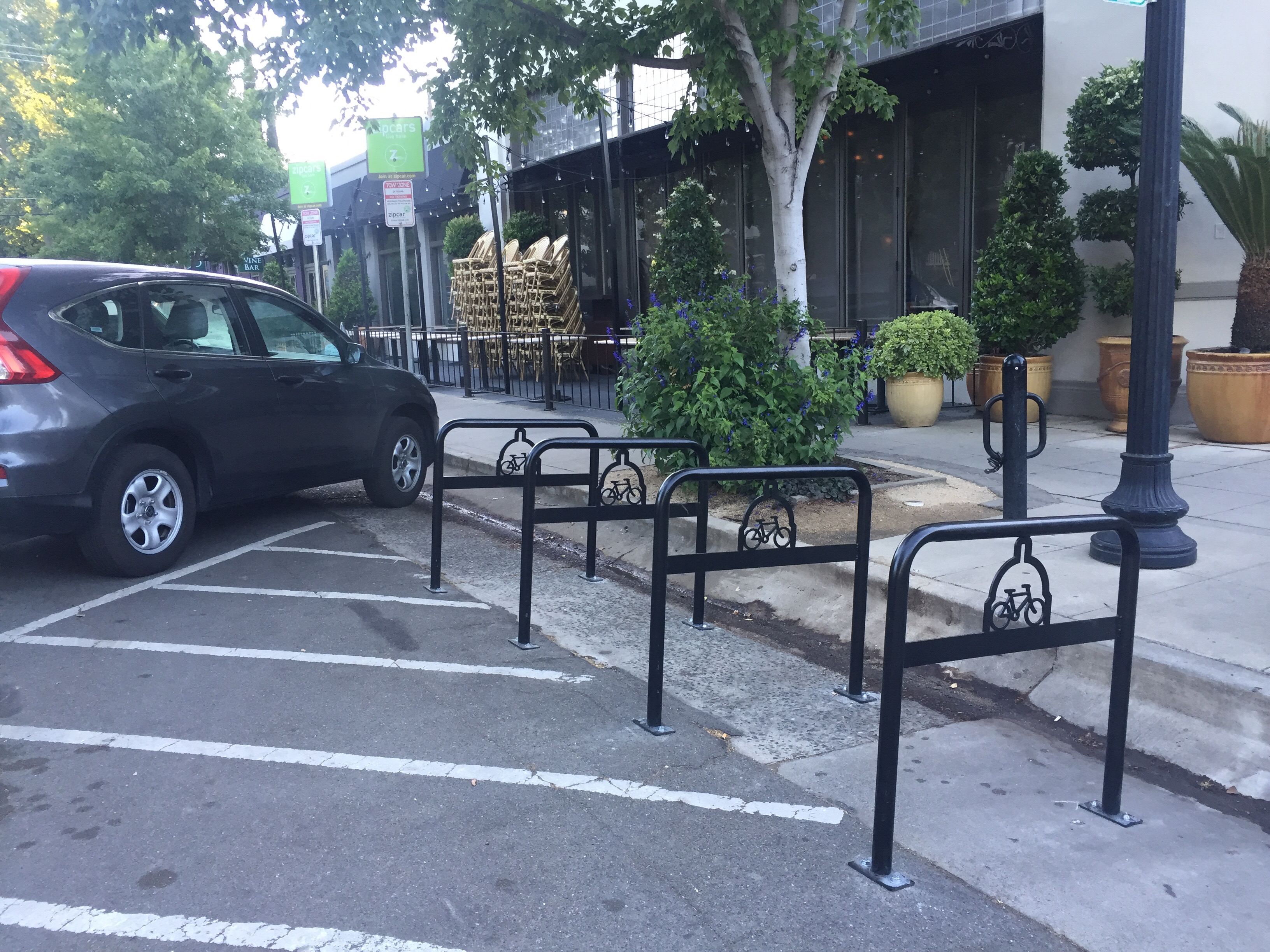
The system is called Tower Bridge, which makes sense, because the preview is in West Sacramento and downtown/midtown Sacramento, linked by the Tower Bridge. In perhaps November the system will be expanded to go as far west as Davis and as far east as Sac State. There will also be some rack locations that look more like traditional kiosks, with information signs. For now, the racks are just traditional bike racks, shown below. This location is on 18th St at Capitol Ave, next to Zocalo and the ZipCar parking spots. The other one in my neighborhood is across the street from the Fremont Park ZipCars, next to Hot Italian. These locations make sense to me, for multi-modal trips, part bicycling and part driving. 


I’ve already signed up and banked some money in my account. To be honest, I’m not the target audience for this bike share since I live in midtown and having a folding bike that I can take anywhere, rarely needing to park it outside. But I will try it out as soon as bikes show up, and will probably use it on occasion. At the moment, the only membership type is a timed charge, $4/hour, prorated, with no membership fee. The first 30 minutes free that some other systems use is not offered in this one. There will be other kinds of membership eventually. 

More photos on Flickr

For more information, go to Tower Bridge Bike Share

car-free Sacramento

corecarfree

It is amazing what one can find going through drafts of posts that were composed but never posted. Here is one from 2017.

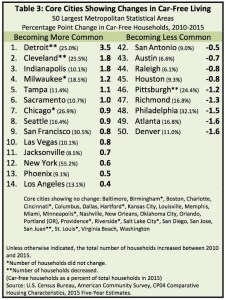
Recently reported research on car-free households in states, major metropolitan areas, and major cities, Car-Free Living in the United States: What the Data Says, indicates that Sacramento metropolitan area increased its car-free households by 0.5%, and the core city (mostly the city of Sacramento) from 9.7% to 10.7%, from 2010 to 2015. Sacramento is #6 in the list at right, not bad

My previous post on car-free workers was Central city car-free workers (2016-04-24), which indicated a central city rate of 5% to 18%, depending on zip code. Since these statistics are workers rather than households, they are related but not directly comparable, since the number of workers per household is often more than one, but sometimes zero.

Central city car-free workers

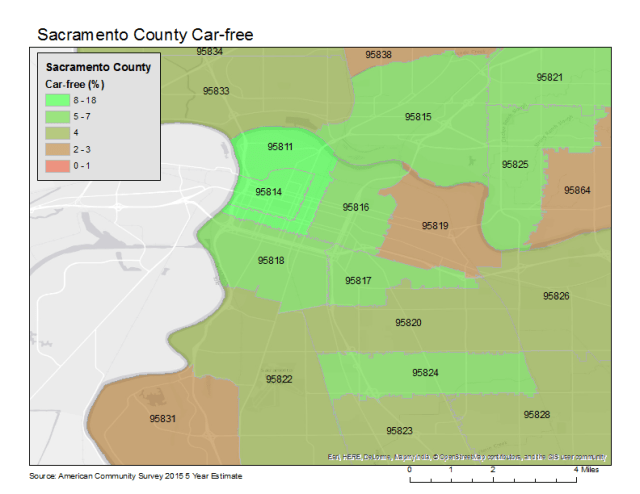
And here is the last of the three census-related maps, before I move on to other topics. This one shows the percentage of workers who are car-free (zero motor vehicles owned). Again, the 95814 zip code nails it, at 18.4%, and 95811 is close behind at 14.5%. Yes, I’m one of them.

The near suburbs also show moderate car-free percentages, probably in this case due to low income as much as choice. College (Los Rios and Sac State) students, if they are working, probably also contribute in the near suburbs. Not surprisingly, the distant suburbs have almost no one car-free. Those people are locked into the driving life by the place they have chosen to live.

It is important to remember these percentages are of workers, people who are working somewhere. They do not include people too young to work, people who have retired, or just people not working. If those people are included, the car-free rates would be much, much higher. These people are just as entitled to transportation expenditures as car drivers, but our transportation systems is set up to give them crumbs rather than a fair share.

On the other hand, there large numbers of people in the distant suburbs who have three or more cars per worker. Not per family, but per worker. The 95615 zip code (Courtland) tops the list with 54% having three or more cars, but other zip codes are close behind. Yow!

Again, the Sacramento County map (car-free) is available.

Sacramento-central-car-free


Central city commute times

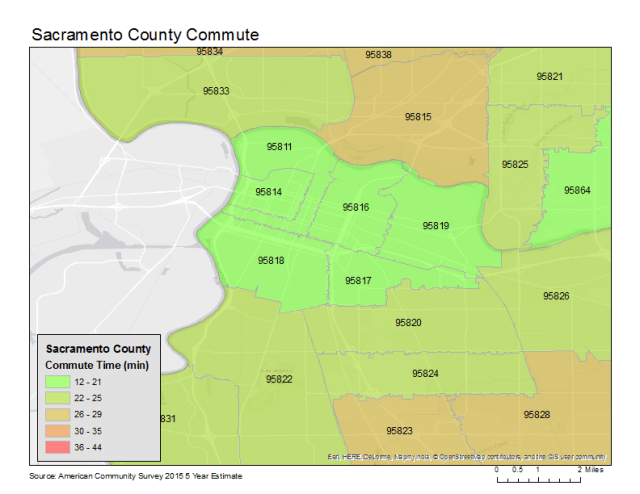
Here is the second map generated from American Community Survey data, this one showing average commute times by zip code. Nothing surprising here, the central city still compares well with other areas of the county, but there are some interesting patterns in the Sacramento County map (commute time), such as the northeast county in which I’m guessing people are commuting to Roseville rather than downtown, and therefore have reasonable commute times.

Sacramento-central-commute-time

If I were looking at commute times for surrounding counties, I suspect the average commute times would be significantly longer, since many people are commuting into employment centers such as downtown, Roseville, and Folsom. I have to admit that my own commute is long, 30 minutes to 90 minutes depending on where I’m working in the eastern suburbs. But I’d much rather be on a bike for 90 minutes than in a car for 20 minutes. I use transit at times, but for most trips it is either the same or longer to my work destination, so I use it mostly on horrible weather days and when I need to get work done on the way there or the way home.

Since this map doesn’t require much explanation, I’ll say more about census data. The American Community Survey has some very complex questions, such as whether you departed for work between 6:00AM and 6:30AM, but it can’t seem to find the bandwidth for some simple but very useful questions such as “Is your commute multi-modal? What percentage?” A person can only answer in one category: car/truck/van, bicycling, walking, transit, or other. If a trip is 51% transit and 49% bicycling, it shows up as an entirely transit trip. If a person drives 15 minutes to a parking garage and then walks 10 minutes to work, it shows up as an entirely driving trip. A number of people have suggested that this single mode constraint over-emphasizes the mode share for driving and therefore underemphasizes walking, bicycling and transit.

I will be looking at the National Household Travel Survey, last completed in 2009, to see how it compares to the American Community Survey. There is also a California Household Travel Survey, which looked at things is a much more detailed manner, but did not provide anywhere near the coverage of a census, sampling only typical parts of the state in detail.

How do central city people get to work?

Many central city residents have claimed recently that they can’t get to work if there isn’t parking both at their residence and at their work. I was curious just how central city folks do get to work, so I delved into census data (more about that below the graphic).

Turns out a lot of central city residents don’t drive to work. In 95814 (where I live) and 95811, about 56% use privately owned vehicles (POV = car/truck/van), but the other 44% walk, bicycle, use transit, or work from home. That is remarkable! When you think about how much attention and money we devote to those who drive, it eye-opening. Other areas near the central city have high active and transit use, but it falls off rapidly in most of the suburbs (but not all). The map below zeroes in on the central city. The Sacramento County Privately Owned Vehicles (POV) Commute is also available.

Sacramento-central-commute


So, where does this information come from? The American Community Survey, 2014 version, which has estimated data covering a five year period. The report from which I extracted the data is S0801, Commuting Characteristics by Sex. The field mapped above is HC01_EST_VC03, which is “Total; Estimate; MEANS OF TRANSPORTATION TO WORK – Car, truck, or van.” I think the symbology (colors) I used represent what I’m trying communicate – green is good, red is bad.

It took quite some time to find the fields I was looking for, and the search tool does not make it easy (http://factfinder.census.gov/). Then it took some time to figure out how to extract the data fields I wanted and dispose of those I did not. And then it took a LOT of time to figure out how to get ArcGIS ArcMap to match the zip coded commuting data with the county’s zip code map. Turns out that Excel does not properly label the data type of a field, so either the zip code was a number, which didn’t match the text in the zip code layer, or the rest of the data was text, which could not be symbolized properly. I had to use Apple Numbers to create an export format that retained the correct field type. But now that I know how to do this, I’ll have some more maps to share soon.


Hansen’s community meeting on parking

timed parking and residential permit

On August 12, Steve Hansen sponsored a community meeting on parking issues. This is a report and reaction. The meeting was actually quite civil, not often the case when neighborhood people get involved in issues. There was clapping for things they liked but no booing and no angry outbursts.

Matt Eierman, parking manager for the City of Sacramento, presented on the current proposals and a bit about future ideas, what the city is calling “parking modernization.” He addressed concern that there would not be enough parking for the arena by showing a map of downtown parking spaces overlaid with walking distance at the Sleep Train Arena (ARCO), with sufficient parking available.

Eierman claimed that credit card fees at parking meters cannot legally be charged back to the credit card holder, however, San Francisco and many cities outside California are doing just that.

Eierman said dismissively that he hates the idea of “dynamic” parking fees, the idea that parking rates would change with location, time of day or day of week. He said “no wants to drive up to a meter and not know how much it is going to cost.” This is an absurd statement, and I’ll provide an analogy. Would a person say they are never going to buy apples at the store again because they don’t know ahead of time whether they are $0.89 or $1.19 this week? Of course not, people make decisions based on changing information, and parking is no different. With a smart phone, the person would know the fee even before pulling into the space.

The two things being proposed to go the the city council in the near future are:

  1. An increase in the parking rate from $1.25 per hour to $1.75 per hour, at all on-street metered parking in the central city. The city pointed out that fees have not increased in some time, though costs have gone up, and that an increase for on-street parking would shift longer term parking off the streets and to city parking garages and lots, some of which are very underutilized.
  2. A SPOTZone (Special Parking Over Time) pilot in Old Sacramento and one location in midtown that would allow people to pay for time beyond the set time limit, at a higher price. The pricing would discourage long term parking, causing more spaces to be open, but through payment mechanisms (smart meters and smart phone payment) would reduce the number of parking citations.

Read More »