SacATC 2025-04-17

The Sacramento Active Transportation Commission (SacATC) will meet Thursday, Aprll 17, 2025, at 5:30 PM. The meetings are held in city council chambers at 915 I St, Sacramento, CA 95814. The meeting can be viewed online via the link provided on the city Upcoming Meeting Materials page at the time of the meeting, but comments may only be made in person, or via eComment ahead of time.

The agenda is


Consent Calendar:

  1. Approval of Active Transportation Commission Meeting Minutes
  2. Active Transportation Commission Log

Discussion Calendar:

  1. Pedestrian Crossing Enhancements – 2025; presentation
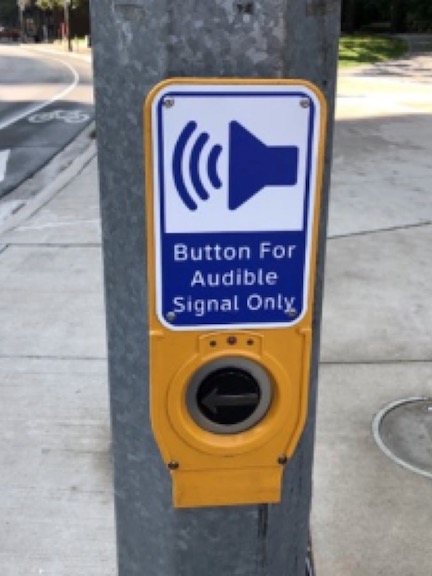
  2. Audible Signals Phase 2; presentation

I have concerns about the use of RRFBs (Rectangular Rapid Flashing Beacons) at unsignalized crosswalks. They may be better than crosswalks without, however, they may provide a false sende of security for walkers. I have noticed (anecdotal evidence only) that the rate of driver compliance with RRFBs is poor, only about 40%, which is not much better than unprotected crosswalks, and it has not improved at drivers have gotten used to the RRFB as they are installed in more locations. I would suggest that before the city install any additional RRFBs, there a literature survey to see if there are recent indications of driver non-compliance increasing hazard for people walking, and on-the-ground observation of at least two existing locations in the city. I know that compliance with the RRFB on J Street at 17th Street is poor. I have almost been hit in both the west and east crosswalks, both of which have RRFBs. I kinow not to trust drivers to yield, but what about people walking who do not know to not trust drivers. The other enhancements proposed seem good.

In Audible Signals Phase 1, a number of locations in the central city where pedestrian signals were on auto-recall were converted, or downgraded, to locations requiring the push of a button. These are called beg-buttons) because the pedestrian indicator will never come on unless the button is pushed, though with many of the locations, the pedestrian signal is set to auto-recall even though the button says it must be pressed. This is an unofficial city policy, that people walking will NOT be informed of the operation of the pedestrian signal, left to guess whether it is auto-recall or requiring a push. The recently installed ‘push or wave to cross’ signals do not overcome this issue. The staff report claims that all of the new locations already have push buttons, though it does not say whether any are on auto-recall.

The city is claiming as support for the past and proposed audible signals project that citizens are requesting beg buttons. They are not. What they are requesting is audible signals that communicate effective crossing information to visually impaired walkers (or rollers), to comply with current ProWAG requirements. The city is conflating audible signals with push buttons, but they do not need to go together. Audible signals can be installed at auto-recall intersections.

See earlier posts Central City Mobility: new beg buttons on 5th Street, update on SacCity new beg buttons on Alhambra, Sac City NEW beg buttons, beg button signs, and Beg buttons on K? Really?.

Central City Mobility: new beg buttons on 5th Street

This is Central City Mobility Project update #33. Note that 5th Street has not yet been converted from one-way to two-way.

When looking at 5th Street, part of the Central City Mobility Project to convert this from a one-way street to a two-way street, I was focused on the looking at the new signals and the mast arms. I failed to notice all the new beg buttons that have been installed. These are the ‘wave at’ variety. Installations are at Q Street, P Street, N Street and Capitol Mall. At Q, P, and N Streets, there are 8 new buttons per intersection. At Capitol Mall there are six, all on the east side of the intersection, because there is a pedestrian crossing prohibition on the west side. I don’t have documentation of what was here before these were installed, but I’m pretty sure that these intersections were on auto-recall, meaning that the button did not need to be pressed, or waved at. I have to admit I have been fooled again by City of Sacramento Public Works. I had been assuming that either things would remain the same, or things would get better. They have proved me wrong by making things worse.

photo of 5th St & Q St SE new wave beg button
5th St & Q St SE new wave beg button

There are beg button posts installed at R Street as well, but since this crossing of 5th St has not been activated, I don’t know how the beg buttons will be labeled.

Read More »

Central City Mobility: 21st & I bike signals

This is Central City Mobility Project update #31.

The bike signals and related signaling is now installed at the intersection of 21st Street and I Street, where the northbound 21st Street separated bikeway ends, and the westbound I Street separated bikeway begins. East of this intersection, I Street is two-way. The I Street bikeway is on the north side, right side, so bicyclists must transition from the southwest corner to the northwest corner. Bicyclists continuing north on 21st Street must also transition from the left side bikeway to the right side general purpose lane.

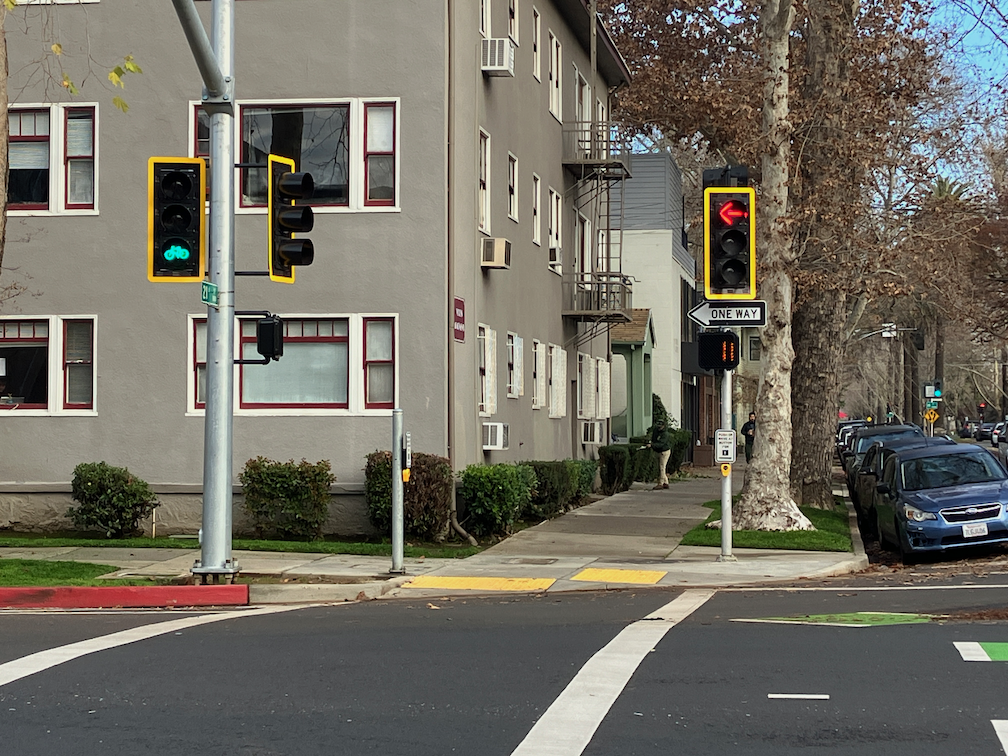
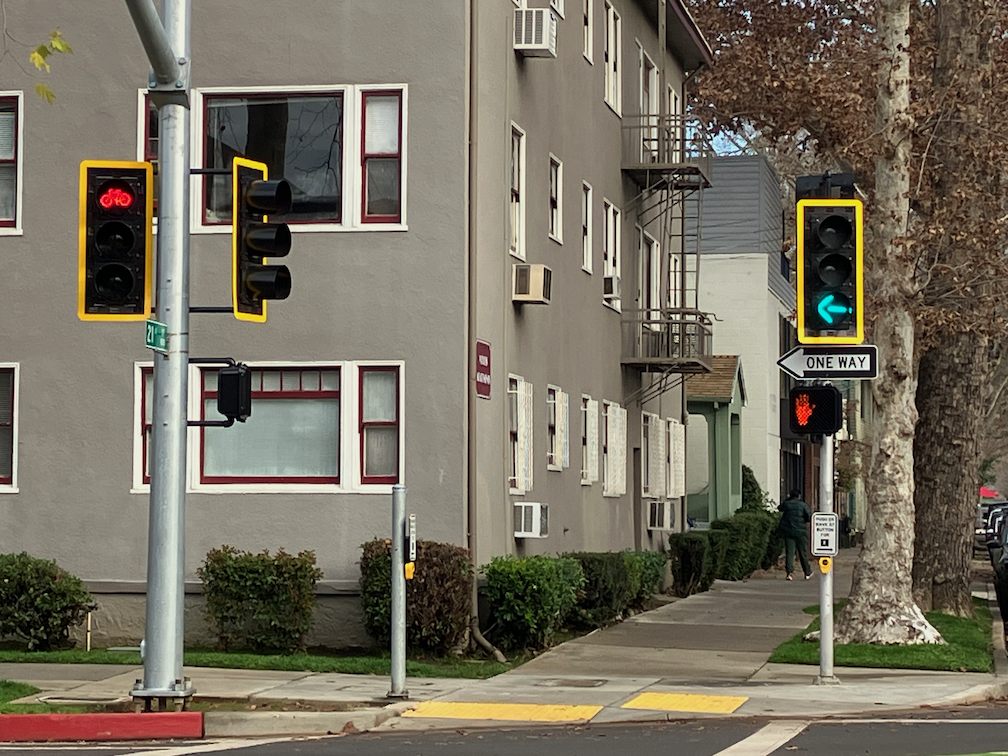
The city has attempted to solve this problem by installing bicycle signal faces on the northwest corner, for bicyclists turning left on I Street, and the northeast corner, for bicyclists going straight on 21st Street. The photos below show the northwest corner bicycle signal green and turn arrow red, bicycle signal red and turn arrow green, and the bike signal on the northeast corner.

photo of 21st & I St, bicycle signal green and turn arrow red
21st & I St, bicycle signal green and turn arrow red
photo of 21st St & I St, bicycle signal red and turn arrow green
21st St & I St, bicycle signal red and turn arrow green
photo of 21st & I St, bike signal on the northeast corner
21st & I St, bike signal on the northeast corner

The signals are set up so that bicyclists, and walkers on the west leg of the intersection, have an exclusive phase, meaning that no cars are supposed to be moving when the pedestrian signal shows walk, or the bike signal is green. Actually, triggering the bike signal also triggers the pedestrian signal, and vice versa, they are ganged together.

The problem is that drivers are turning left from 21st Street to I Street against the red arrow, endangering bicyclists going west and north, and walkers in the crosswalk. In about 30 minutes of observation over the last few days, I saw drivers turning left against the red about half of all signal cycles. Once the front driver decides to turn, all other drivers follow. I did not see any drivers turning from the right hand left-turn-straight lane.

California Vehicle Code (CVC) 21453 says: (c) A driver facing a steady red arrow signal shall not enter the intersection to make the movement indicated by the arrow and, unless entering the intersection to make a movement permitted by another signal, shall stop at a clearly marked limit line, but if none, before entering the crosswalk on the near side of the intersection, or if none, then before entering the intersection, and shall remain stopped until an indication permitting movement is shown.

So, every single one of the drivers who turned left on the red arrow was breaking the law. Sadly, the city has designed an intersection that assumes drivers will not break the law, but as every bicyclist and walker knows, drivers do so pretty much continuously. I do not know what the solution is for this intersection. It is difficult to control driver behavior. In any other situation than roadways, the behavior of routinely breaking the law is called lawlessness.

Signal actuation (beg buttons)

In addition to the new signals, there are signal actuators, generally called beg buttons. Nothing here is on auto-recall, meaning there is not a bicyclist and pedestrian phase on every signal cycle, but only when requested.

The actuator for the pedestrian signal is shown below. This is first placement of this technology in the city, so far as I know. The sign is CA-MUTCD R10-3j (CA). The ‘wave at’ function is an infrared proximity detector, that works for up to about 15 inches, and also works for standing as well as waving. An example commercial product is WiAPPS Wave, though I don’t know what vendor the city used. It is not automated pedestrian detection, which would cover the full width of the sidewalk.

photo of pedestrian actuator (beg button), 21st St & I St
pedestrian actuator (beg button), 21st St & I St

Strangely, the bicyclist actuator (beg button) does not have this technology; the bicyclist must actually touch the button.

photos of bicyclist beg button on 21st St bikeway at I St
bicyclist beg button on 21st St bikeway at I St

Sac City NEW beg buttons

I was out walking last evening, and was horrified to discover this:

photo of new beg button at Alhambra Blvd and L Street
new beg button at Alhambra Blvd & L St

This is a brand new beg button (technically called pedestrian pushbutton) on Alhambra Blvd in Sacramento. These have not been turned on yet, hence the cardboard over the button itself, but they are newly installed. There are a number of these along Alhambra Blvd, though I don’t yet know how many. For at least the ones I observed, these are all at locations where the pedestrian signal was previously on auto-recall, meaning the pedestrian signal changes as part of the regular signal cycle, not requiring any action on the part of the walker. Now, with these beg buttons, a person walking must ‘beg’ to cross the street by pressing the button. These buttons do not, at least in Sacramento, speed up the signal cycle. The person waiting must wait the same amount of time before a walk indicator comes on.

This is an affront to myself and anyone who walks. I’m sure the city considers this a pedestrian safety improvement, and I’d not be surprised if the city used pedestrian safety funds to install it. But it is a motor vehicle facility and improvement, it does absolutely nothing for someone walking. What is does do is allow the traffic engineer to favor motor vehicle traffic in signal timing.

The trend all over the US is to either remove such beg buttons completely, or to change them to accessible audible buttons. In a few places, they are being replaced by automated pedestrian detection, so that no action is required on the part of any walker. San Francisco has converted all of its beg buttons to accessible buttons. Other bay area cities have started to do so. I know of no place in the US where new beg buttons are being installed.

City of Sacramento Public Works is populated by fossil engineers and fossilized thinking. It has a cars-first attitude, and will continue to have that attitude until the fossils are cleared out. Put them in a museum of the 1970s, and get them out of our transportation system.

What City of Sacramento ISN’T doing

The City of Sacramento, that bastion of doing the least amount possible, has failed to notice that progressive cities in the US and worldwide are making changes to their environment to make is safer for people who walk and bicycle, and more efficient and welcoming for people outside of cars.

What the city is NOT doing, that it could:

  • Accept responsibility for maintaining sidewalks, as an integral part of the transportation network. The city continues to shirk its responsibility, spending funds on motor vehicle infrastructure instead of maintaining walker infrastructure.
  • Installing leading pedestrian intervals (LPIs) at every traffic signal in the city. The same eleven have been in place for years; none have been added. The recent legislation, AB 2264, only applies to state highways; it is up to cities and counties to implement on other roadways.
  • Daylighting intersections. This means removing parking from within 15-20 feet of the crosswalk or stop bar, either by painting and enforcing red curbs, or building curb extensions (bulb-outs) at every intersection. Upstream, approaching the intersection, is the big safety feature, downstream, leaving the intersection is much less important. There are interim solutions here, such as painting curb extensions and using soft-hit posts (vertical delineators).
  • Implementing construction zone requirements that accommodate walkers and bicyclists. The current city policy is to provide safe bypasses only if it does not in any way inconvenience drivers. The public has asked that a policy be developed along the lines of the Oakland construction policy, but the city has stonewalled against that.
  • Making transportation improvements that benefit walkers and bicyclists, except with county, state or federal grants. The city simply will not spend any of its general funds on improving transportation safety.
  • Waiting until a roadway is completely repaved to reallocate roadway width to bicycle lanes or separated bikeways, or transit. Compounding this issue is that the city doesn’t share with the public the repaving projects that it intends to do, so the public has no chance to comment beforehand.
  • Lowering speed limits citywide. While it is true that spot reductions have little effect on travel speeds, there are a growing number of cities that have lowered speed limits citywide, with a significant reduction in speed.
  • Enforce traffic laws. The Sacramento Police Department has essentially stopped enforcing laws related to the safety of walkers and bicyclists. This of course is also true in many other places. Police don’t see traffic safety as an issue worthy of concern. Of course so much of law enforcement is used as pretext to oppress, and I’m not in favor of any of that, but if the police won’t even enforce failure to yield to people in the crosswalk, what use are they? We would all be much safer if traffic law enforcement were removed from the police, largely automated, and the money saved diverted to real community needs. Yes, defund the police.
  • Painting marked crosswalks at every intersection. Yes, I know that unmarked crosswalks are legal crossings, but most drivers either don’t know or don’t care, so marking crosswalks is critical.
  • Remove beg buttons. These buttons, which sometimes a walker must press to get a walk sign, and sometimes don’t need to press (this is called auto-recall) are a direct attempt to discriminate against people walking. The city, after much pressure from the public at the beginning of the pandemic, set five crossings to auto-recall, out of the thousands. Of course they didn’t change the signing, so people walking don’t know this. The city it being intentionally obstinate in its defense of this outmoded requirement.
  • Remove pedestrian prohibition signs unless that is a demonstrable safety reason for the prohibition. There are numerous signs all over the city that were placed solely to preference motor vehicle drivers over people walking. The default should be that every one is removed unless the city wishes to do a traffic study to justify them.
  • Install traffic diverters (mode filters) all over the city. These diverters, which allow bicyclists free travel but turn motor vehicle drivers aside, are the single most effective safety measure that city could implement. But the city has decided to take these off the menu of solutions, for no reason that it has ever been made public. The few that exist are in the central city, almost none in other neighborhoods. Another example of privileging the already privileged over lower income neighborhoods.
  • Charge for parking, eveCavrywhere. Residential neighborhoods, where there is usually open parking space, would be charged through permits for the cost of maintaining that portion of the street. Any place where parking is in short supply, market rates for parking should be charged. Giving away free parking is subsidizing drivers and throwing your tax money in the trash.

I could go on with this list for pages. In fact, I have: walking policies for SacCity, and many related posts. But the city is still not taking meaningful action on any of these items, so I will keep reposting. For as long as it takes. And it will probably take quite some while before the city gets over its culture of doing the least amount possible.

Caveat: The city has disinvested in lower income and high minority neighborhoods, probably for its entire history. The first steps should be taken in these neighborhoods, with input from the residents, of course, and not in higher income and non-minority neighborhoods which have always gotten more than their share.

whither Sacramento Vision Zero?

The City of Sacramento adopted Vision Zero in 2017, and developed a Vision Zero Action Plan in 2018. The plan identified five high injury corridors for projects to slow traffic and increase safety for walkers and bicyclists. The city then developed a plan for these five corridors in 2021. The city has obtained grants for some of these corridors, and will apply for more. The city lowered speed limits in a number of schools zones (though street design, drop-off/pick-up procedures, and motorist behavior are the issues in most school zones, not speeding). The city also developed a public outreach education program, though there is no evidence of such programs having any effect on driver behavior (NHTSA and California OTS have thousands of programs with no demonstrated success). So far, so good.

But…

  • The city has intentionally ignored high injury intersections, unless they are on one of these corridors. No grant applications have been made to fix intersections, though intersections are where most fatalities and severe injuries occur. No non-grant actions have been taken to fix high injury intersections.
  • The city has failed to set up a crash investigation team to determine causes and solutions for every fatality. The police department (or CHP if the crash occurs on a state highway) will do an investigation, and sometimes involve traffic engineers, but never involves planners, never involves experts in nonprofit organizations (who have as much if not more expertise than city staff), and never involves citizens who walk and bike.
  • The Vision Zero Task Force, which met in 2016 and 2017, has never met since. That means there is no community guidance for the Vision Zero program. City staff is making all the decisions on Vision Zero.
  • The city has ignored all the low cost options for reducing motor vehicle crashes. As just one example, the city has been asked to remove pedestrian beg buttons and create leading pedestrian intervals (LPIs) at all signalized intersections, but did only a small beg button set to auto-recall on five crosswalks, and have not increased the number of LPIs in years.

Solutions?

  • The city should create an effective crash investigation team, composed of law enforcement, city traffic engineers, city planners, nonprofit experts, and citizens who walk and bike, and perhaps a representative of the neighborhood association in which the crash occurred. The team should never be led by law enforcement, which has an anti-walker and anti-bicyclist windshield bias. It has been suggested that streets where fatalities have occurred be shut down until the investigation and resulting fixes are in place, which is an idea worth considering.
  • The city should identify the top five high injury intersections, and commit to significant changes to eliminate crashes at those intersections, within three years. And then move on to the next five. The corridor projects and intersection projects should be considered co-equal in city funded projects or grant applications.
  • The city Active Transportation Commission should take on a strong leadership role in advising the council on the Vision Zero program. It may also be appropriate to re-convene the task force to provide more detailed guidance to staff.
  • The city should implement a Vision Zero project to change all traffic signals in the entire city to auto-recall (with removal of the physical beg buttons as staffing allows) and leading pedestrian intervals.
  • The city should undertake a review of peer cities that have reduced speed limits city-wide, to determine whether to implement this change and how to learn from the experiences of other cities. If the review indicates that speeds can be reduced by as little as 3 mph by a reduction from 25 mph to 20 mph, the city should implement it city-wide. Similarly for higher speed streets.

beg button signs

The Manual for Uniform Traffic Control Devices (MUTCD), and the California equivalent, are standards for the design and placement of traffic control signs. They have the force of law for any federal or state funded roadways, but there is no enforcement mechanism, so signs that do not meet these standards can certainly be found, both in places that just decide they know better, and in places where the public right-of-way and use is evolving rapidly and the glacial pace approval of new signs is not keeping up.

The MUTCD has 14 signs related to the use of beg buttons to cross the street, in the R10-1 through R10-4 series. One of these is shown below, the most complicated one, R10-3e. Of the 14, none offer any information about whether the beg button is required or not. This is not an oversight; it is a direct expression of traffic engineer’s disdain for pedestrians. California could, of course, add other signs with better information, after approval by FHWA, but it has not seen fit to do so.

Noting the lack of good signs that actually address real-world situations, some entities have designed their own. One example is below, which came via Don Kostelec, of whom I’ll have more to say shortly. (original source not known)

Why is the distinction between these two types of signs important? Buttons can be used by limited vision or blind people to trigger the pedestrian signal, and the auditory and sometimes vibratory message that goes with it. When the conversation started about removing beg buttons, many disability advocates were up in arms, understandably. If there is no button, there is no message.

Except, of course, for automatic detection of pedestrians, and even pedestrians types, that many other countries and a very few places in the US are installing. Traffic engineers routinely resist automatic detection as “too expensive and not practical” despite spending much larger sums on vehicle detection. Which in the case of bicyclists, often doesn’t work anyway.

Traffic engineers also frequently place buttons in places where people with disabilities, as well as everyone, can’t find them and/or can’t reach them.

So, is there a way to preserve the function of buttons needed by disabled people, while not discriminating against all pedestrians? You bet. Just label the button for its function. And put it in an accessible location.

So, Don Kostelec. He is one of my heroes, as he has done a better job than anyone I know of documenting the failures of transportation agencies to install safe and usable pedestrian facilities. Sidewalks too narrow, or that end where you really need them; ADA ramps to nowhere; crosswalks that can’t be safely used; and on and on. I highly encourage you to check out his blog (http://www.kostelecplanning.com/blog/) and Twitter feed (@KostelecPlan). He does not hesitate to call out road and traffic engineers for their failure to think, and for their failure to follow their professional code of ethics. Though he didn’t originate it, I think he is responsible for popularizing the expression “Hold my beer!” in the transportation world, implying that only an engineer drinking beer, and momentarily designing a roadway or facility before going back to drinking, could have done something that stupid.

And on this topic of beg buttons, I particularly encourage you to read his recent post, Push buttons: The good, the beg, and the ugly.

There has also been a lot of discussion about whether it is hard to change the buttons from required to not required, which is called auto recall, or just recall. A number of cities have changed hundreds of buttons in very short order because they prioritized it. Newer signal control boxes allow changes to be made remotely, changing the function and timing of pedestrian signals. Older control boxes may require that someone go out and physically change them. The older boxes are sometimes derisively called squirrel cages because they had large physical clocks with rotating dial, with pegs to change the signal on or off, as it came around. They made noises like a squirrel or hamster cage. A few idiots have been saying that pedestrian signals should not be changed remotely because of security issues. That is the whole point of modern signal controllers, part of Integrated Traffic Systems (ITS), that they can be can sense and respond to actual traffic, and can be adjusted remotely to respond to changing conditions and for changing flow when crashes occur.

There is also the issue that many transportation agencies don’t know what is at the intersection. Does it have pedestrian signals or not? Does it have pedestrian countdown or not? What is the timing of the pedestrian phase, in terms of countdown? Is the beg button required or not? They simply don’t know. Locally, Sacramento County is the worst on this issue.

Previous post on beg buttons: Don’t touch that button! Then, there are locations where pedestrian crossing is simply prohibited, for reasons having everything to do with speeding traffic and nothing to do with pedestrian safety: and crossing prohibitions, and no-ped-crossing in the grid.

Don’t touch that button!

Here in the city of Sacramento, most signalized intersections have beg buttons, the button you press to get the pedestrian crossing. Some of these are on auto-recall, which is what it is called when the pedestrian crossing (the white walker symbol) comes on every cycle. Most of them are not; the pedestrian crossing will never change unless you press the button. A few of them won’t ever change because the beg button is broken. You would think that the city would label the buttons with their function: is it required, is it not required, does it only affect the disability audible signal? Who knows. The city can’t be bothered to tell people walking how it works.

This is a huge frustration for walkers ALL the time, but now it is more, it is a public health hazard. Is there corona virus on that button? Probably yes. Is the city cleaning the buttons? Certainly no. So the city is allowing and encouraging a public health hazard by requiring walkers to use the buttons in order to cross the street. This must stop now! The city must set all pedestrian crossings to auto-recall, at least until the end of the pandemic, and hopefully forever.

I have been going on two long walks a day, or sometimes a bike ride, since self-isolating (no, I’m not sick). The only thing I have to touch in the outside world, other than my door knob when exiting and my door knob when returning, is beg buttons. Of course I don’t touch them. I cross when it is safe; I don’t waste my time waiting to see if this is one of those required, or simply decorative buttons. Because I won’t touch the button, I have to assume that every signalized intersection is broken, not accessible to pedestrians, and I therefore have a right to cross during gaps in traffic, no matter what the pedestrian signal says.

Fix this, city. Now.

Corona virus? Your guess.

Walkable Sacramento #3: pedestrian signals

Following on to the previous post on crosswalks, policies are needed for pedestrian signals, which are intended to provide some additional protection for pedestrians crossing at signalized intersections. I am not in favor of creating signalized intersections where they don’t exist (in fact, many should be considered for removal), but where they do exist, the pedestrian signals need to be done right.

It should be noted that the NCUTCD (National Committee on Uniform Traffic Control Devices) just today decided to not recommend that the MUTCD (Manual on Uniform Traffic Control Devices) require that signalized intersections have pedestrian signals. I’m not sure how I feel about this: sometimes I think that we over-sign and over-signalize roadways, causing lack of attention, but at the same time, such a limitation would never be accepted if it had to do with motor vehicle movement.

Pedestrian activation buttons are often called ‘beg buttons’ because the walker must ‘beg’ permission to cross by pressing the button and then waiting an uncertain length of time. Sometimes forever, because some buttons have failed or been disconnected, and no change has been made to the signal logic to address this. Motor vehicle drivers are not required to take any such action, they are detected in various ways, or the signal is set to change automatically without detection.

Some European cities have installed automatic pedestrian detection, which changes the signal based on the presence of a walker. I have heard that some of the detectors can even distinguish people in wheelchairs, with walkers and canes, or elderly, and adjust the cycle to accommodate. I’m not aware of any of these in the United States, but would be happy to hear about them if there are.

The policies are:

  • No crossing will require the pressing of a pedestrian button unless it is a roadway over over 30,000 ADT with a crossing frequency of less than 100 pedestrians per day, or is a mid-block crossing. 
  • All pedestrian buttons will be labeled to clearly indicate whether they have any effect on the signal cycle. Buttons may serve only the purpose of:
    • triggering infrequent crossings, as above, or
    • triggering audible information, or
    • lengthening the crossing time for walkers requiring a longer time, often seniors and the disabled
  • Existing buttons will be removed unless they provide one one of the functions above, and are signed to indicate their function. Removal of others within three years.
  • All pedestrian signals will have a countdown function, unless there is a crossing frequency of less than 50 pedestrians per day, within five years. 
  • Signals will normally have a cycle of 60 seconds or less in order to reduce pedestrian wait times. Revision within two years.
from Dhiru Thadani

Grid 2.0 pedestrian comments

The City of Sacramento Grid 2.0 project is requesting specific input on ways to improve the pedestrian experience in midtown/downtown. I encourage you to go there and add your pins.

Pedestrian beg button on a commonly used crosswalk, this location should have a pedestrian signal on every cycle, not just when someone presses the button.
Pedestrian beg button on a commonly used crosswalk (K & 9th), this location should have a pedestrian signal on every cycle, not just when someone presses the button.

Dropping pins on a map, however, doesn’t allow some more general comments that I think are very important, and perhaps just as important as any of the corridor improvements shown. For me, these points are:

  1. All signals and pedestrian signals in the grid should be set on automatic recall by default. That means that pedestrians get a walk signal on every cycle without having to find and press the beg button (many of which can’t be accessed by disabled people). If the city thinks that a particular crossing should require a button, they should have to do a traffic study to justify it, which includes both the requirements that 1) the level of pedestrian use if very low (unlikely in the grid, but possible), and 2) that there is a demonstrable delay in traffic due to automatic recall. This does not mean that pedestrian buttons will not be present, as there may be valid ADA benefits to having them, including the specific announcements now being included, but they should never be required.
  2. In heavy pedestrian use area, if pedestrian buttons are present, pressing the button should actually shorten the signal cycle to provide for pedestrian crossing on demand, rather than just changing the pedestrian signal head when the signal goes through its regular slow cycle. No regular cycle should be longer than 90 seconds because long cycles unnecessarily delay pedestrian (and bicyclist) travel in favor of motor vehicle traffic.
  3. All three-lane one-way roads should be reduced to two lanes. This will make street crossings safer (by about 1/3 – what other improvement could make such a difference!) and more comfortable. There is no excuse in a walkable urban environment for there to be three-lane one-way streets.
  4. All no-pedestrian-crossing locations should be removed and replaced with regular high visibility crosswalks. Though these prohibitions are often justified by safety concerns, they are really just for the convenience of motor vehicle drivers, so that they don’t have to slow down or wait as long at signals. If a crosswalk is not safe, it means the roadway design is unsafe, and the correct solution is to change the roadway design, not to prohibit crossing.
  5. The ability to safely and comfortably cross streets is just as important to people walking as the ability to walk along streets. I don’t know that this is the case here, but transportation agencies often get so focused on travel along corridors that they forget about the need to cross corridors. The grid pattern in midtown/downtown eases this problem, and is in fact one of the major benefits to a grid, but nevertheless, significant attention must be paid to crossing.