A group calling themselves A Committee for a Better Sacramento is sponsoring a citizen-initiated ballot measure for the November election, titled “Sacramento County Transportation Maintenance, Safety, and Congestion Relief Act of 2022—Retail Transactions and Use Tax”.
Citizen-initiated measures require only 50%+1 to pass, whereas government-initiated measures require 2/3 to pass. So this is an effort to pass the Sacramento Transportation Authority ‘Measure B’ which failed in 2016 and the ‘Measure A+’ which was never put on the ballot in 2020 because research indicated it would also fail.
This is the first in what will be a series of posts on the measure, which I’m giving the category of Measure 2022. Search for category Measure 2022 to see the posts as they are added.
The map below (and pdf) shows low income census tracts within the City of Sacramento. The data is from the US Census, Median Household Income, 2019, 5-year average (2015-2019). Note that the city boundary does not follow census tract boundaries, so there are census tracts that are only partly within city limits, but are included on the map. The deep red color is the lowest income tracts, less than 40% of the median household income for California (which is $75,235). There are other data and maps that could be used, including SB 535 disadvantaged communities and CalEnviroScreen. The point is that we know the locations that have been disinvested, and where we now need to invest.
This follows on to my previous post about the racist and classist nature of our existing transportation system. These are the census tracts which have been disinvested, and where most transportation investments should take place. A similar map for people of color would be desirable, but is more complicated to produce, so I have not yet.
I am not suggesting that money or projects be thrown at these census tracts by the city. Rather, that the city would sit down with people and organizations in these census tracts to determine what their needs and desires are. I’ll have more to say about investments and project selection coming up.
I almost continuously find myself thinking about our transportation system, as it exists now, and wondering, how did we get here? How did we get to a car dominated city, where the lives of people who walk and bicycle and take transit are valued less than those who drive? How come our sidewalks are in poor condition, and the city insists that it is not their problem to solve? How come we spend nearly all of our transportation dollars on freeways and interchanges, and relatively very little on streets? How come people outside cars don’t feel safe, both from traffic and from concerns about personal safety? How come the police don’t enforce laws against driver behavior which endangers people walking – specifically, egregious speeding on streets, and failure to yield to people in crosswalks? How come the city is so spread out that many people feel it necessary to drive? How come?
Well, the answer is obvious for those who care to look, and to think. We have a transportation system that was built around racist and classist values. The City of Sacramento (and Caltrans) built freeways through low income neighborhoods, on purpose. The freeways were built, not for the benefit of the communities they run through, but for commuters passing through, on their way from single family houses to jobs. The freeways don’t even serve freight and commerce very well, because they are congested with commuter traffic through which trucks must crawl. The city and Caltrans are further widening these freeways, as we speak.
The city approved developments, from World War II onward, that did not have sidewalks. Of course there are some neighborhoods, high income, that don’t want sidewalks because they want to preserve that rural feeling, but I doubt there was ever a middle income or low income neighborhood that didn’t want sidewalks. The city did not require them because leaving them out made for a higher profit for developers, less space taken up by sidewalks, and lower street construction costs. (I am not against developers, but governments routinely cave to developer requests to reduce infrastructure costs, rather than ensuring good infrastructure for all citizens).
And where there are sidewalks? They are often in poor condition. I live in the central city, where sidewalks get repaired, or at least patched. But I also walk in other neighborhoods populated by lower income people of color. There, the sidewalks are not in good condition. Many are too narrow for people to walk side-by-side, and certainly too narrow for people with mobility devices to pass. Curb ramps are scarce. Root heaves go unrepaired. People park blocking sidewalks, and the city does not enforce that. Most city parking enforcement is focused on the central city, where there is metered parking and therefore easy-to-write tickets. The outlying areas, where sidewalks are much more frequently blocked by illegal parking, not so much.
The city has started to pay more attention to low income neighborhoods and people of color. There have been projects completed, and awarded but not constructed, that start to address the past inequities. But it is too little, and too slow. The city is still focused on maintaining the speed and flow of motor vehicles, and not on the people who live here.
The city is also making progress on allowing a greater density of homes, both infill in the central city and incremental densification of single family house neighborhoods. But they are also encouraging and supporting greenfield developments at the periphery, which exacerbates all of these problems.
You might think I’m picking on the City of Sacramento. No. All of this is true of every other city and unincorporated place in the region. But the city is where I live, and where I experience this every day.
I am a white, male, older, middle class person. I am not the person against who these harms were directed, other than being a walker, bicyclist, and transit user.
Why is this history important? If we don’t recognize the racist and classist nature of our existing transportation system, we can’t undo the damage done in the past, and make sure that it never happens again in the future. I think the recognition of this should part of every discussion on transportation, of every engineering and planning action. In the same way that an acknowledgement of native lands helps us remember the harms of the past, the need to address these, and the people still living here, an acknowledgement of the racist and classist transportation system can help us to a better system.
These concerns fall under the category of equity, but I’ve not used that word here. Equity has largely become a checkbox for transportation agencies, and when it is taken seriously only says “we’ll do better in the future”, it does not recognize the damage to be reversed.
Our existing transportation system is profoundly racist and classist. We must acknowledge this in each and every transportation decision, so that we may work to undo the harms of the past and ensure that no harms are perpetrated in the future.
Dan Allison, Getting Around Sacramento
broken sidewalk on Sutterville Rd
Since I’d like this to be part of every discussion and decision, I welcome your input on how to make this statement more succinct and powerful.
Angela Heering provided some progress information and links on the City of Sacramento Transportation Priorities Plan. So here is an update to my previous Sac Transportation Priorities Plan post.
There will be a presentation to city council on March 15, both on the results on Phase 1 and the plan for Phase 2. An earlier presentation to the ‘community consultants is here. The presentation to council will probably differ.
The presentation clarifies one of the questions that came up during the Big Ideas city council workshop.
How is the TPP different from the Transportation & Climate Big Ideas? The TPP is a policy document that will prioritize all City Transportation investments in projects based on community values. It does not define new projects. The Big ideas are a set of defined projects designed to think about mobility as a network and a network to encourage walking, bicycling and transit use. The Big Ideas will be prioritized with all other projects in the TPP.
I’m excited about this process. The city has never had public criteria for how projects are selected. It has been based in the past on the personal preference of the Public Works department, and sometimes, city council members. Making good investments in transportation requires criteria and performance measures for projects!
The Strategic Growth Council has awarded $808M in grants for affordable housing in the sixth round of the Affordable Housing and Sustainable Communities program.
Streetsblog Cal covered one of the two in the Sacramento region:
“In Yuba City in Northern California, Richland Village, also awarded $30 million, will build 176 units in a net-zero-energy project that includes electric vehicle charging, as well as a transit center hub nearby with an electric bus charging system. It will also add sidewalks, bike lanes, new crosswalks, traffic calming measures, and pedestrian-level lighting. The award will also help fund workforce development programs, multi-lingual legal counseling services, and transit passes for residents.”
Assembly Bill 43 (Friedman), passed in 2021, allows cities to set lower speed limits in specific situations. The 85% percentile rule says that speed limits should be set at the speed 85% of drivers are going, the prevailing speed, causes speed limits to increase, as drivers reset their normal speed to be somewhat over the posted speed limit. So speed limits continue to go up and will never go down again. This legislation is the second attempt to reverse that trend and that craziness.
The bill adds to a few limited circumstances where speed limits can be lowered to include ‘business activity districts’ (now), and concentrations of pedestrians and bicyclists and ‘safety corridors’ starting June 2024. There are a lot of details that will have to be worked out by local entities before implementation.
The first bill, AB 321 (Nava), allows cities to lower speed limits in school zones to 20 mph or 15 mph. The City of Sacramento did take advantage of this earlier law to lower speed limits at 115 schools. (City of Sacramento reduces speed limit in school zones)
A few cities are moving forward to implement lower speed limits in the situations the new law allows:
there may be other cities, but an Internet search did not surface any
This option is available to all cities and counties in the Sacramento region. Which will be the first to step up and slow down?
Yes, I know that better design of the roadway is the most effective method for reducing speeds and increasing safety, but infrastructure changes are expensive and slow to be implemented. This bill will save lives and reduce severe injury in the meanwhile.
Where two previous posts come together (Reset for SacATC and don’t forget the little things) is suggested policies for the City of Sacramento that support walking for many reasons: to protect vulnerable users from drivers, to reduce vehicle miles traveled (VMT) and thereby greenhouse gas emissions (GHG), to create a walking-first city where everyone feels safe to walk, and to support infill housing that is the next most important action to reduce GHGs. I’ll make a brief suggestion for a policy that would implement each walking idea.
These are the policies that the Sacramento Active Transportation Commission (SacATC) should be addressing, and then making recommendations to the city council. I’ll be blunt: if SacATC is not addressing these issues, then why does it exist?
The ideas presented are, not in any priority order (numbers for reference only):
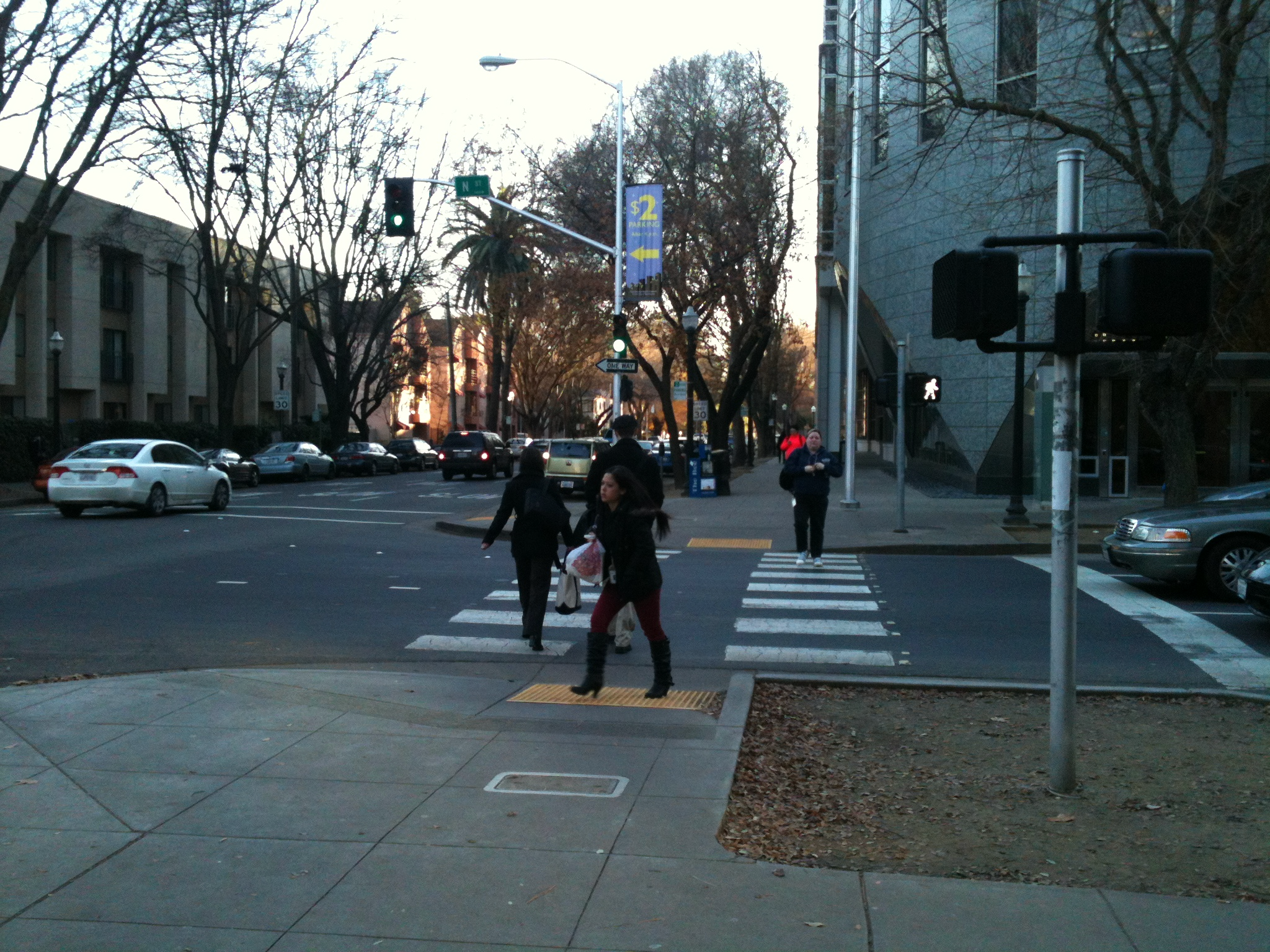
1. Mark crosswalks at every intersection. Except in purely residential neighborhoods, these should be zebra design. Policy: The city will mark (paint) every crosswalk in the city. The standard will be zebra or continental markings (the solid bars), but parallel lines are acceptable at purely residential intersections. Implementation within one year. Considerations: Yes, this will be expensive to install and to maintain. But the safety benefit makes this a great investment. Since the DMV fails to ensure that drivers understand that every intersection has crosswalks whether marked or not, it is incumbent on the city to mark crosswalks.
2. Daylight intersections by removing parking from within 15 feet of every crosswalk, at least on the near side (far side is a lesser safety benefit) Policy: Marked parking spots will be removed from within 20 feet of an intersection on the near side. Unmarked parking will be converted to no parking with red curb offsets of 20 feet. The resulting area may be used for shared rideables parking. Where a curb extension is present, parking need not be removed. Implementation within two years. Considerations: This increases visibility at every intersection by making walkers more visible to motorists (and bicyclists), and making vehicles more visible to people walking. Near side means the first crosswalk at every intersection in the direction of travel. Removal of parking on the far side confers little safety benefit.
3. Re-program traffic signals to create leading pedestrian intervals, everywhere. Policy: Every traffic signal with a pedestrian signal head will be programmed to offer a leading pedestrian interval (LPI) of at least three seconds. Implementation within one year. Considerations: The greatest risk walkers face at intersections is right-turning drivers who do not yield to people in the crosswalk. The LPI gives walkers a head start so that they are visible to drivers while the traffic light is still red. State law will soon be changed to allow bicyclists to also use the LPI.
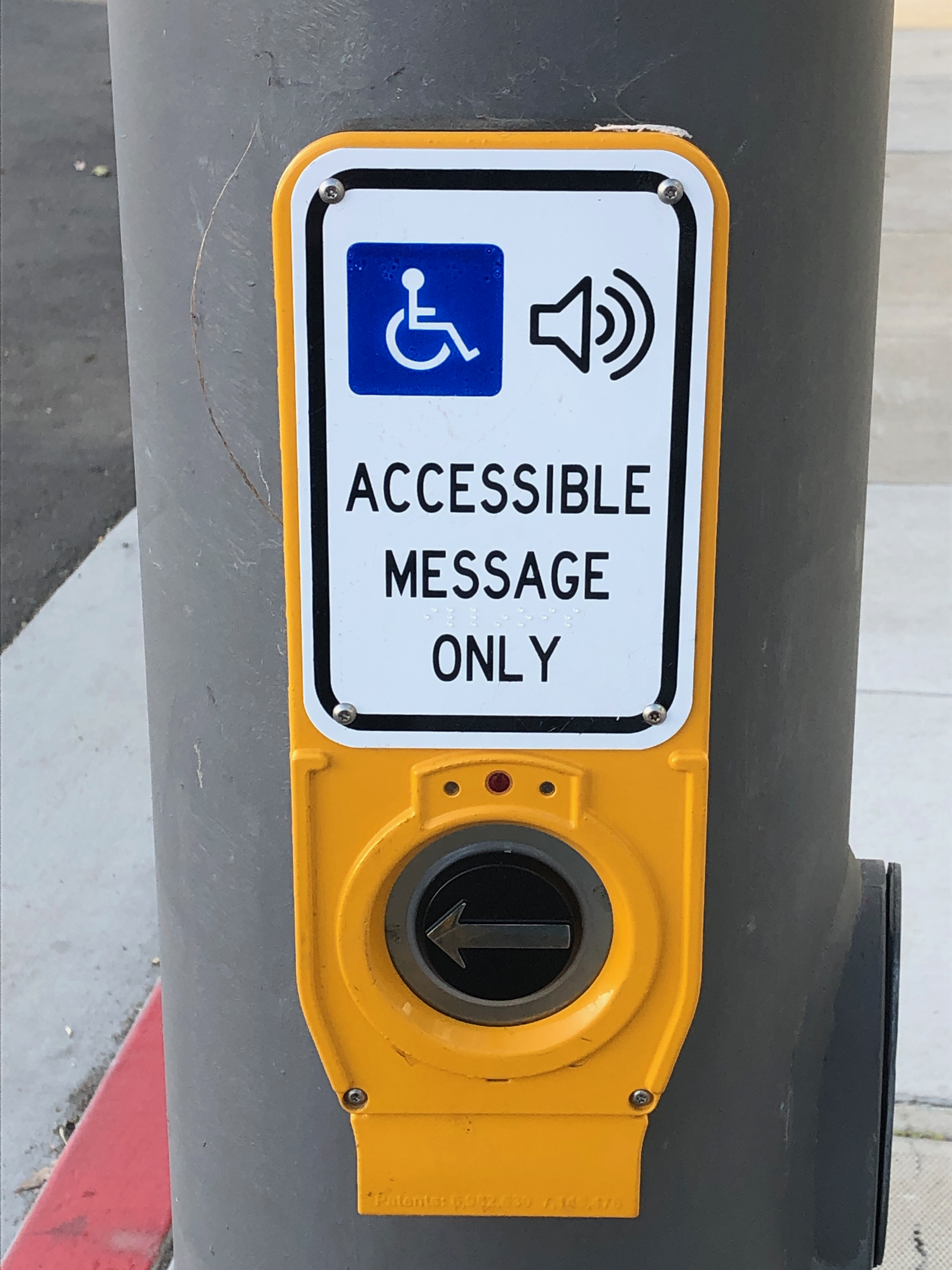
4. Remove or properly label every pedestrian push button. Don’t make walkers play the guessing game. Except at very low use intersections, pedestrian signals should be on auto-recall. Policy: Every pedestrian push button will either be removed or labeled with its function. Implementation within one year. Considerations: The presence of push buttons without indication of whether they are necessary to push is a case of clear discrimination against people walking. The city has refused to change signage to indicate whether the push button activates a signal change, triggers an audible warning only, or does nothing at all. In the long run, all pedestrian signals everywhere should be on auto-recall, meaning no push is needed, but this correctly labeling the button is the first step.
5. Remove pedestrian prohibitions which serve traffic flow rather than safety of walkers. This is the majority of them. Policy: The city will study every instance of a pedestrian prohibition to determine if the prohibition is necessary to ensure safety for people walking. Traffic flow will not be used to justify a prohibition. Each location where the study determines there is no safety benefit for walkers will be removed, crosswalks marked, and appropriate pedestrian signal heads installed. Implementation within three years. Considerations: Most, though not all, of these pedestrian prohibitions were installed to promote the flow of traffic, not to protect walkers. Studies will result in the removal of most.
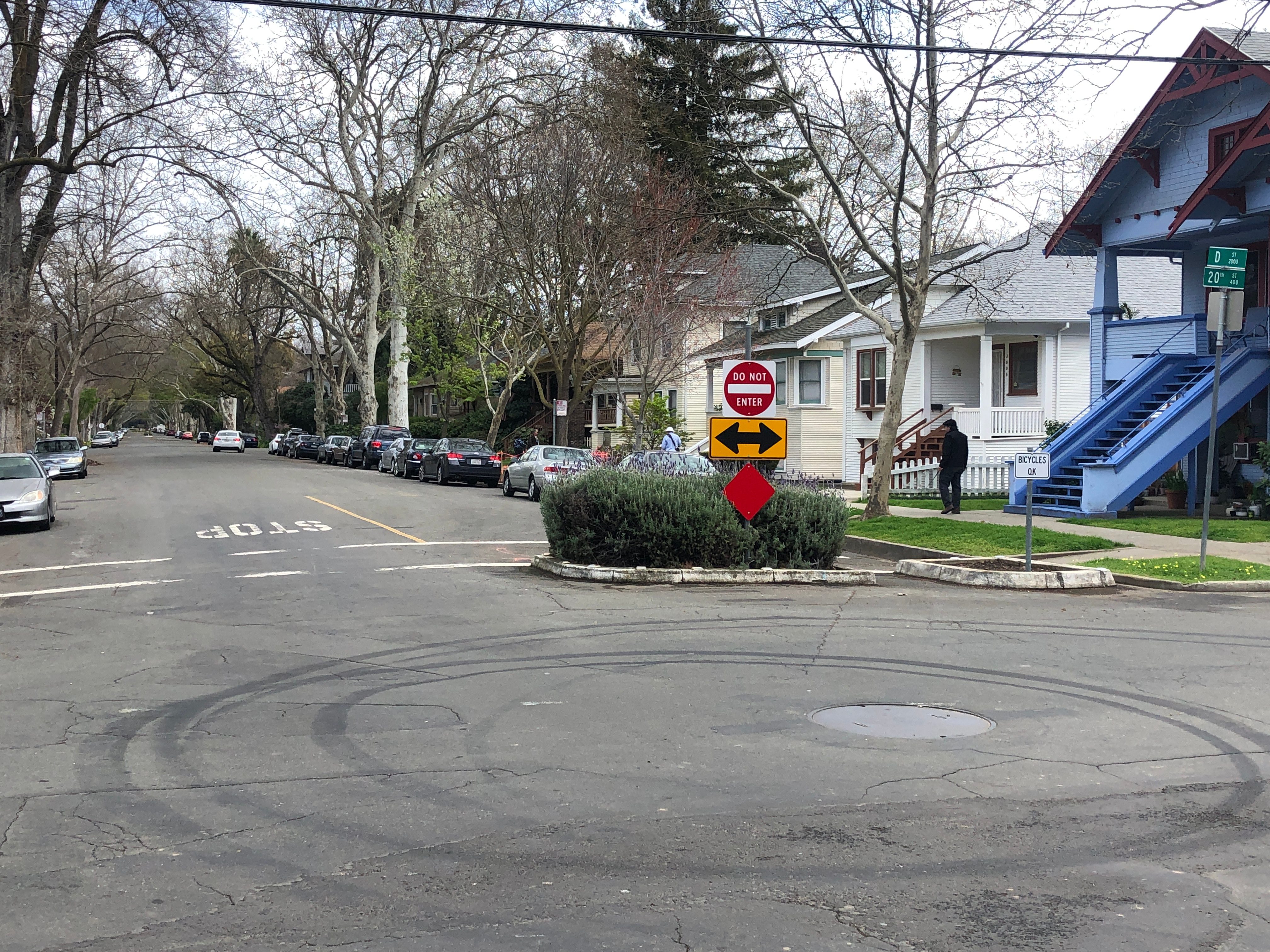
6. Install traffic diverters (modal filters) on about one-quarter of all streets, at no less than 1/8 mile intervals. This discourages through-traffic on most streets, and discourages longer driving trips, while being permeable to bicyclists and walkers. Policy: At every location in the city where a grid street system or alternate travel streets are available, the city will install traffic diverters (modal filters) which require motor vehicles to turn off current street. The interval should be no less than 1/8 mile. This will not apply to designated collector or arterial streets. Implementation within for years. Considerations: Diverters discourage drivers from traveling long distances on streets which should be low traffic, and they also slow traffic. Diverters are the most effective traffic calming device available. Despite the clear effectiveness of the existing diverters, the city has decided not to install any more. This policy would reverse that unofficial policy. Where a grid street system exists, diverters are completely appropriate. Unfortunately the winding streets and lack of connectivity in the sprawling parts of the city make these impractical.
7. Charge for all street parking, everywhere, even in residential neighborhoods. Policy: End all free street parking. Charge residents a reasonable fee for a parking permit that covers the cost of maintaining the portion of the street that contains the parking. Set fees for paid parking in such a way that there is always at least one open parking spot on every block. Implement within one year. Considerations: The city has done much better at managing paid parking, raising rates to more closely reflect (though not fully cover) the actual costs to the city. But outside of paid parking areas, drivers are getting a free ride, which encourages ownership and use of vehicles, contributing to VMT. In residential areas, it is not unusual for a single residence to own multiple vehicles, some of which are rarely used and just take up space that could better be used for other purposes.
8. Reduce speed limits to 20 mph, citywide and all at once, on every street that is not an arterial or collector street. Policy: The speed limit on all streets that are not collectors or arterials will be reduced to 20 mph. Implementation within six months. Considerations: The benefits to walkers and bicyclists (and drivers) of lower speeds are well known, reducing the severity of crashes and reducing the likelihood of crashes due to more reaction time. The ’20 is plenty’ movement is becoming widespread. Some argue that changing speed limits without changing roadway design is pointless, but my philosophy is “Yes, and…” – we should be redesigning roadways, but while that work is in progress, we can save lives now by reducing speed limits. It will take some while to change speed limit signs, so simply blocking out the existing 25 number would be acceptable in the interim.
9. Ensure that every construction project that reconstructs sidewalks also installs curb extensions (bulb-outs) where there is a parking lane present. This is not uniformly happening. Policy: Curb extensions will be required on every corner which is reconstructed for any purpose. Street faces on corners where a bicycle lane is present but parking lane is not present will be excepted. Curb extensions will be designed so as to not interfere with bicycle lanes, and existing or planned separated bikeways. Implementation immediately. Considerations: Curb extensions, also called bulb-outs, significantly increase safety by shortening crossing distances and by increasing visibility between walkers and drivers. The entity making the change to the sidewalk/corner would be responsible to the extension, though where drainage issues exist, the city might help with partial funding to move or enhance drainage. There are many instances in the city where curb extensions should be installed as part of construction projects, but are not being.
10. Create interim curb extensions with paint and flexible posts. Policy: At any intersection where a pedestrian fatality or severe injury has occurred within the last ten years, temporary curb extensions created with paint and vertical delineators will be installed. Implementation within one year. Temporary curb extensions will be replaced by permanent concrete curb extensions within ten years. Considerations: This policy would allow the ‘quick fix’ of curb extensions at relatively low cost, but eventually create curb extensions at all hazardous intersections, city-wide.
11. Take on responsibility for maintaining sidewalks, since they are an integral part of the transportation network. Policy: The city accepts maintenance responsibility for all sidewalks that are within the public right-of-way. The city will develop a plan for bringing all sidewalks to a state of good repair, with implementation first in low-income neighborhoods. Considerations: State law allows the city to shirk its responsibility for maintaining sidewalks by shifting the burden unfairly onto adjacent property owners. The result is poorly maintained sidewalks that do not serve the needs of anyone waking or rolling, but particularly discriminate against people with mobility limitations. Some sidewalks are not within the public right-of-way, but this is uncommon.
12. Buy every employee of Public Works and Community Development a copy of Walkable City Rules (Jeff Speck), and hold sessions to develop a new city mission that prioritizes walkers (and bicyclists and transit riders) over private vehicles. Policy: Buy the books! Implementation immediately. Hold sessions within six months. Develop new mission within one year. Considerations: Every city employee should be responsible for doing their part to make the city a walkable place where people are safe and welcomed on every street. City employees and politicians have in the past created a car-dominated city where it is unsafe to walk and bicycle, and now is the time to set a new vision and way forward. Note that this does not address the issue that people don’t feel safe walking in some locations, and this is a critically important issue that the city should also address.
The first City of Sacramento Transportation & Climate Workshop was held last night as part of the regular city council meeting. The first news, which was not at all clear before, is that this is the first of several workshops, which will develop the plan further. The next workshop has not been scheduled, but may be in March.
screen capture from city presentation
Some highlights:
No one spoke against the seven big idea projects.
People liked the enhanced bus lane on Stockton for SacRT route 51, but it didn’t receive much notice in the discussion.
Nailah Pope-Harden of Climate Plan and a local activist, said bold is the minimum, and said all projects should be about reconnecting communities. Many other speakers referred back to Nailah’s challenge.
The opening slide of the city presentation showed SacRT bus route 30 on J Street, pulled out of traffic and blocking the bike lane. Irony probably unintentional, but it does illustrate one of the ways in which the city does not support transit or bicycling. The bus should not be pulling out of traffic, but stopping at a bus boarding island with the separated bikeway running behind it.
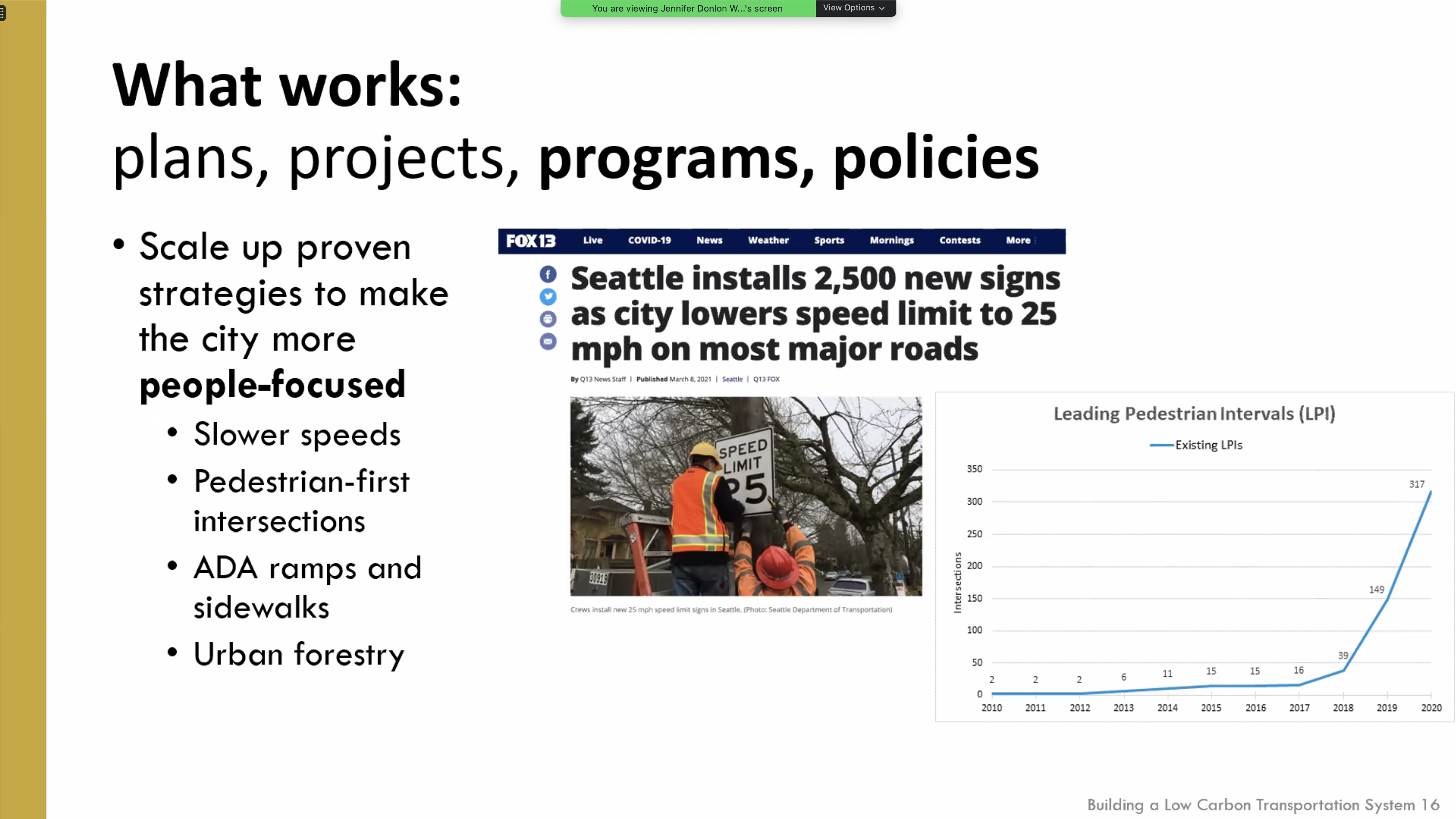
Sam Zimbabwe of Seattle DOT presented on the ways in which the city has shifted mode share to transit with projects and priorities. One of his slides showed the huge increase in the number of intersections at which they have programmed leading pedestrian intervals (LPIs) to enhance pedestrian safety.
Jeff Tumlin of San Francisco MTA said they have realized that waiting for a few big projects is an ineffective approach, and are now doing many small projects, often with temporary measures that can be improved when made permanent. He said that sales taxes don’t have to be regressive, if the benefits are directed to the right places and projects, and that well-designed congestion pricing is not regressive. He also suggested that city staff should be challenged to a higher level of productivity and innovation, and let go if they choose not to meet that. He also spoke about SFMTA’s approach, with partners, of working on transportation and housing as a unified goal, not siloed.
Darrell Steinberg mentioned several times the idea of the city doing a transportation ballot measure so that it could set its own priorities for investment rather than compromising with the county (SacTA) over projects which don’t meet the needs of the city.
City staff said transportation is now 56% of carbon emissions in the city, which is higher than numbers reported before.
Ryan Moore poo-poo’d the idea of lowering speed limits, saying the MUTCD prevents that, without mentioning the state law which allows reductions in specific circumstances. Others pushed back on this.
Rick Jennings spoke enthusiastically about getting more kids on bikes and his own experience of bicycling with kids.
Jeff Harris spoke about EVs, despite the setup of the workshop being about other transportation ideas, not EVs.
Mai Vang pointed out that the ideas are too District 4 (central city) focused, believes that there should be more focus on low-income and outlying areas. She said we need better access to light rail stations, not just bicycling access to downtown.
Civic Thread spoke (all their employees!) about the need for a city-wide Safe Routes to School program to address the recent parent death at school dismissal at Hearst Elementary, as well as safety needs at every school. They also highlighted equity and community access.
Henry Li and Jeff Harris pointed to micro-transit (SmaRT Ride) as being a great success, but SacRT has still not provided information to the community to judge that.
Henry Li spoke mostly about funding, and did not address the Stockton/Route 51 project. He again highlighted light rail to the airport, despite the transit advocacy community’s request that all light rail extensions including ARC/Citrus Heights/Roseville considered before selecting the next project.
The message from the invited speakers and the community was clear: we need to make big changes in a hurry, and city funding and commitment will be necessary for that to happen. How will the city respond?
What are your highlights from the workshop?
screen capture of Seattle DOT slide on speed limits and LPIs
The City of Sacramento is going to consider some big, transformative projects Tuesday evening. That’s great. But let’s not forget all the small things they could be doing, but aren’t:
Mark crosswalks at every intersection. Except in purely residential neighborhoods, these should be zebra design.
Daylight intersections by removing parking from within 15 feet of every crosswalk, at least on the near side (far side is a lesser safety benefit)
Re-program traffic signals to create leading pedestrian intervals, everywhere.
Remove or properly label every pedestrian push button. Don’t make walkers play the guessing game. Except at very low use intersections, pedestrian signals should be on auto-recall.
Remove pedestrian prohibitions which serve traffic flow rather than safety of walkers. This is the majority of them.
Install traffic diverters (modal filters) on about one-quarter of all streets, at no less than 1/8 mile intervals. This discourages through-traffic on most streets, and discourages longer driving trips, while being permeable to bicyclists and walkers.
Charge for all street parking, everywhere, even in residential neighborhoods.
Reduce speed limits to 20 mph, citywide and all at once, on every street that is not an arterial or collector street.
Ensure that every construction project that reconstructs sidewalks also installs curb extensions (bulb-outs) where there is a parking lane present. This is not uniformly happening.
Create interim curb extensions with paint and flexible posts.
Take on responsibility for maintaining sidewalks, since they are an integral part of the transportation network.
Buy every employee of Public Works and Community Development a copy of Walkable City Rules (Jeff Speck), and hold sessions to develop a new city mission that prioritizes walkers (and bicyclists and transit riders) over private vehicles.
The City of Sacramento Active Transportation Commission (SacATC) was established in 2018 as a replacement for the city/county Bicycle Advisory Committee (BAC). This was good, as the county’s unwillingness to consider innovative solutions, even when they were in the city, meant that very little ever happened there. There was a lot of hope in the bicycling and walking advocacy community that SacATC would turn a new page and accelerate necessary changes in the city. Unfortunately, that has not been the case. The commission has been reactive, not proactive. A number of people have resigned from the commission when they discovered that not much of importance was happening there.
Nothing here is meant to demean the contributions of city staff to seeking grant funding for critical projects. The city is paying much more attention to active transportation than it used to, but I and many other advocates believe that it is still paying too little attention, and certainly too little funding.
So, I believe it is time for a reset.
SacATC is advisory to the city council. It should therefore be communicating with council on a fairly regular basis. That does not mean that it does not collaborate with staff, but it does not take direction from them.
The primary job of the commission should be to review and to create policy. Reviewing projects is a secondary focus. That means at least half of every meeting should be spent talking about policy, not about projects.
SacATC should be setting its own agenda, not letting staff set it. If staff wants to bring something to the commission, they would contact the commission chair to request that it be on the agenda. The chair should solicit agenda ideas from commissioners at the end of each meeting, and again, in advance of the next meeting to meet whatever deadline the city sets for its agenda posting.
The purview of SacATC should be all city activities, when they may affect active transportation, not just Public Works. This would include, for example, construction traffic control plan permitting, city utility work in the streets, waste collection (trash cans in bike lanes), repaving plans, law enforcement, and parking enforcement.
SacATC supported sidewalks where they are part of complete streets projects, but has not addressed sidewalk infill, closing gaps in this critical transportation infrastructure. I believe this should be a major focus of the commission this year, developing policy to recommend to the council that makes consistent and rapid progress towards a continuous sidewalk network, properly designed ADA ramps at every corner, and frequent safe crossings.