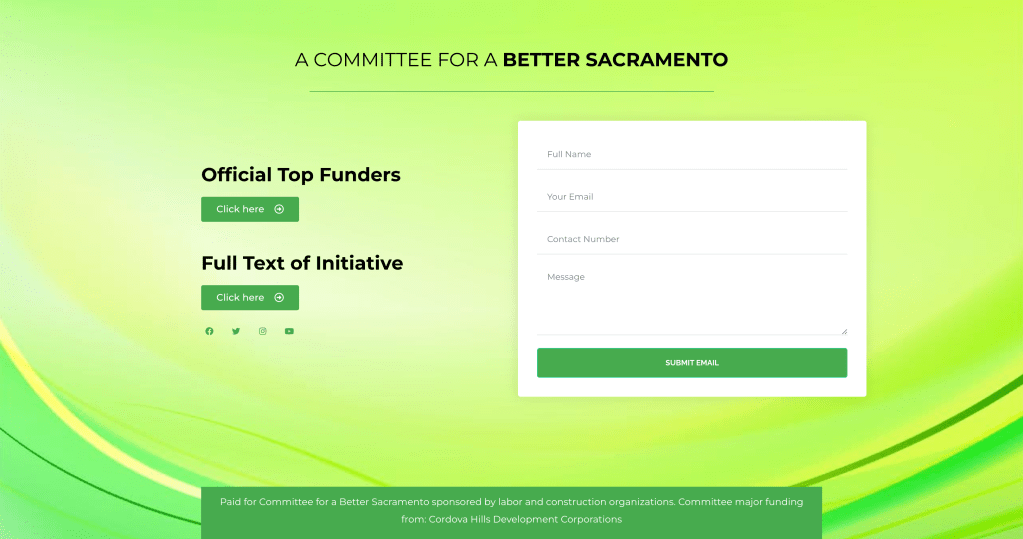
A friend pointed out the statements of support for the transportation sales tax measure which are scrolling on the A Committee for a Better Sacramento home page. These are all local politicians, and mostly well respected.
I’m disappointed. They seem to have bought into two falsehoods: 1) congestion can be solved by adding roadway capacity, and 2) congestion is a significant contributor to air pollution. I wonder if they actually read the measure with a skeptical eye before signing on. There are enough things wrong with the measure to fill up many blog posts. I hope to be able to convince these people to become neutral on the measure.
Funding generated by this initiative will enable us to complete the Capitol Southeast Connector project that will connect Interstate 5 to Highways 99 and 50 and link the Cities of Elk Grove, Rancho Cordova and Folsom to relieve congestion, improve safety and drive future economic growth.
David Sander, Chair, Capitol Southeast Connector Joint Powers Authority (also member of the Rancho Cordova City Council)
This initiative will provide a blueprint for transforming our transportation system in the decades ahead and enable us to leverage billions in state funding to help us achieve our aggressive goals.
Bobbie Singh-Allen, Chair, Sacramento Transportation Authority (also Mayor of Elk Grove)
Improving the County’s transportation system will create significant progress towards improving our air quality and addressing climate change. Less congestion will reduce transportation emissions and increased ridership on public transit will add to the positive impact to our air quality. Additionally, the measure invests tens of millions into essential air quality measures.
Eric Guerra, Sacramento Air Quality Management District (also member of the Sacramento City Council)
This initiative will create major benefits to our light rail and bus system. Having additional local funding will help secure millions in federal and state funding to expand the system, modernize our fleet, reduce greenhouse gases and improve congestion on our roadways.
Steve Miller, SacRT Board Chair (also member of the Citrus Heights City Council)
Search for category Measure 2022 to see posts as they are added.
A group calling themselves A Committee for a Better Sacramento is sponsoring a citizen-initiated ballot measure for the November election, titled “Sacramento County Transportation Maintenance, Safety, and Congestion Relief Act of 2022—Retail Transactions and Use Tax”. (Note: Some people are referring to this as Measure A, but measure letters are assigned by county elections, not by the sponsors. I’ll continue to refer to it as Measure 2022, for now.)
It has been relayed from others that the committee did not feel that it needed to do any public engagement before developing the text of the measure. The rationale is that since the Transportation Expenditure Plan (TEP) is very similar to that proposed in 2020, and before that in 2016, that is all the public engagement necessary. The TEP was indeed approved by the county and city councils, but there was no real public engagement on the issues. Transportation engineers and planners developed a wish list, and the government bodies adopted it without analysis. Except in the City of Sacramento, where the council challenged the plan developed by Public Works, and demanded a plan that better addressed the needs of the citizens and critical issues such as climate change and equity. None of the other entities did this. So the overall TEP is essentially a list of pet projects of the engineers and planners, developed without any real criteria and without reference to the desires of the community. Some board and council members will claim that they know what the public wants, and their approval is all that is necessary. But the fact is, they never asked the public what they thought.
So, the committee is running with that. No public engagement. This is a citizen-led measure, but the committee decided they didn’t need to hear from anyone else. No meetings, no outreach, no nothing.
We do not know who the committee is, and won’t know who it is until they file the measure with county elections, due July 18. I guessing since they have posted the measure and their sponsors on their website, not listing committee members is likely an effort to hide that information from the public. They will be gathering signatures between now and when they submit. I ask that you not sign their petition. To bring up the old adage: “No taxation without representation.” Therefore, no public engagement, no measure, no taxes.
Search for category Measure 2022 to see posts as they are added.
A group calling themselves A Committee for a Better Sacramento is sponsoring a citizen-initiated ballot measure for the November election, titled “Sacramento County Transportation Maintenance, Safety, and Congestion Relief Act of 2022—Retail Transactions and Use Tax”. (Note: Some people are referring to this as Measure A, but measure letters are assigned by county elections, not by the sponsors. I’ll continue to refer to it as Measure 2022, for now.)
The sponsor of the measure is Cordova Hills Development Corporation. So far as can be determined, the entity does not have a website, though there are references to the development on the website of some of the contractors who have been hired to plan the development. There is apparently an interlocking series of shell companies related to Cordova Hills, but none have websites.
So, what is Cordova Hills? It is a greenfield development proposed for former farm and ranch lands south of Rancho Cordova. Greenfield development is not needed in the Sacramento region; there is plenty of land available for infill development that can serve all the same needs as Cordova Hills. So, why does this company, and many others like it, want greenfield development? Because they can purchase land at agricultural prices, develop it, and then sell it at urban prices, with a huge profit potential. I am not against development, but it is important to remember that there are two types of development and developers: infill and greenfield. Infill is socially and environmentally sound, greenfield is not. Infill builds wealth in the community, greenfield destroys wealth because the development never ends up generating enough tax income for the infrastructure and particularly infrastructure maintenance it incurs.
What Cordova Hills is asking is that the taxpayers of Sacramento County subsidize their development by providing transportation infrastructure. There is less and less support for sprawl greenfield development in the county, so the sponsors are wrapping the subsidy in a measure with other benefits. The developers do not have a good record with the public. During the Sacramento County Board of Supervisors hearing which approved the project, the developer lied about several aspects of the development, and intimidated the supervisors with implied threats to run candidates against them. It was only a last minute agreement between SACOG and the supervisors with language that that the development would not break the MTP/SCS that allowed the development to pass.
The biggest benefit claimed by the developers was a university that was to be part of the project. The proposed university withdrew, and it has never to date been replaced with another, but since the development was approved with a university implied but not required, the developer intends to move forward without.
A group calling themselves A Committee for a Better Sacramento is sponsoring a citizen-initiated ballot measure for the November election, titled “Sacramento County Transportation Maintenance, Safety, and Congestion Relief Act of 2022—Retail Transactions and Use Tax”. (Note: Some people are referring to this as Measure A, but measure letters are assigned by county elections, not by the sponsors. I’ll continue to refer to it as Measure 2022, for now.)
As your parents no doubt told you, words have meaning. So what are the words used in the proposed measure?
congestion (in the context of congestion relief) = 24 occurrences
greenhouse gas = 6
climate = 3
low-income = 3
community engagement (only in Exhibit B ITOC) = 1
equity = 0
A major purpose of this measure is to fund capacity expansion, in an effort to provide congestion relief. But it is well documented and uncontroversial (except among greenfield developers and engineers whose jobs depend on expansion) that attempts to relieve congestion through expansion actually induce new traffic that fills every bit of added capacity. The sponsors of this measure do not believe that. They refuse to believe that. This is a 1970s version of transportation investment, that time when the only issue was building infrastructure that would allow cars to go further and faster. Walking, bicycling, and transit was either an afterthought, or actively discriminated against. We don’t live in those times any more, but the sponsors still do.
Search for category Measure 2022 to see posts as they are added.
As promised, a different map of the City of Sacramento showing low income high minority (LIHM) areas, below and in pdf. The light green = low income high minority, is probably the most significant category. There are similarities to the median household income map posted earlier, but they are not identical. It is not that either is right or wrong, just different measures.
This dataset is the Environmental Justice or LIHM developed by SACOG in 2020, for use in their MTP/SCS development process and other uses. This dataset used block groups, the smallest of the census areas, rather than census tracts, which is why the areas on this map do not necessarily match the census tract boundaries on the MHI map. The summary description is:
Environmental Justice areas as of 2020. Created with various factors related to environmental impact of the Sacramento region.
SACOG, with the assistance of the SACOG Equity Working Group, identified 2020 EJ areas as census block group level concentrations of low income, and/or high minority and/or qualification of an “other vulnerability” and/or within the CalEnviroScreen 3.0 identified areas. The other vulnerabilities take into consideration concentrations of: older adults aged 75 or more, linguistically isolated households, single parent households with children under the age of 18, low educational attainment, severely housing cost burdened households, and persons with disabilities.
This is consistent with SACOG’s 2020 MTP/SCS adopted plan. This feature has identified 548 boundaries as Environmental Justice areas for the SACOG region as of August 2021.
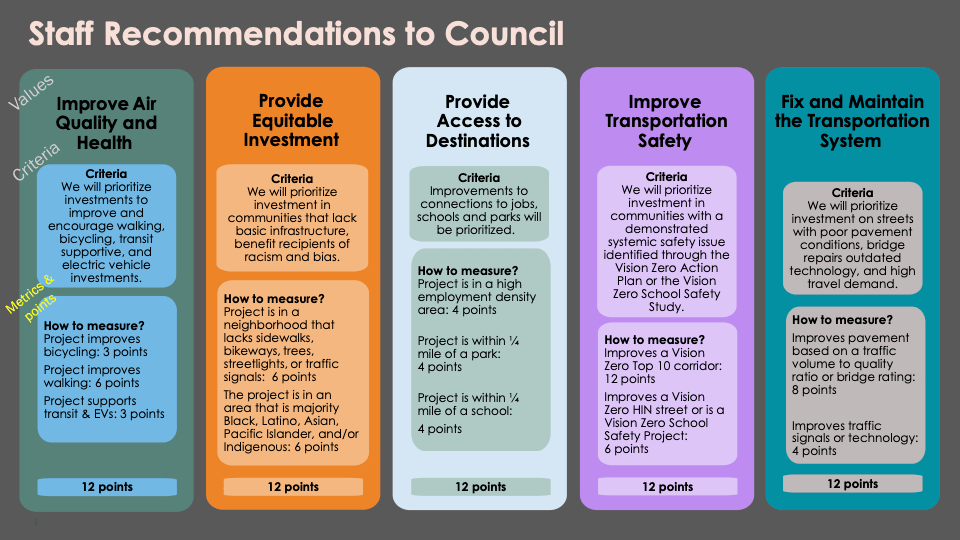
I don’t think the five categories should be weighted equally. If the city were starting with a blank slate, it would make sense, but the slate is not blank. Out existing transportation system is profoundly racist and classist, so the city must overcome past harms by focusing improvements on low income and communities of color. Rather than being 20% of the scoring, ‘Provide Equitable Investment’ should be 40%.
I’ve also come to understand this this is a technical document, not a policy document. The only real policy here is that criteria will be used to select projects, not whim. This is acknowledged to be an immense improvement. But it is only one of many needed policies.
What is a policy? A statement that controls how the city designs and operates the transportation network. An existing policy is the goal that all streets will have a pavement condition index (PCI) or at least 72. Examples of new policies:
All sidewalks will be maintained in a state of good repair by the city. Adjacent property owners will be responsible only when a tree on private property, not in the sidewalk buffer, creates root heaves, or when construction activity damages the sidewalk.
Every crash resulting in a fatality or severe injury will be investigated by a team including a traffic engineer, a planner, a representative of a walking or bicycling advocacy organization (Civic Thread and/or SABA), and a citizen who lives in the neighborhood and regularly walks and/or bicycles. A recommendation for changes will be made, and at least one recommendation implemented. ‘No change’ will not be acceptable.
What is a project? In the city’s understanding, a project is something big, a project that requires a federal, state or SACOG grant, a project that will involve concrete and/or asphalt, and constructors to install it. What is not seen as a project is lower cost changes, many of which could be accomplished with staff time and small expenditures. Examples of lower cost projects:
Change every pedestrian signal in the city to have at least a 3 second leading pedestrian interval (LPI) in which the walker gets a head start into the crosswalk. Staff time costs, no materials costs.
Remove pedestrian beg buttons from all signals in the city. Leave buttons which trigger ADA audible signals, but label them with that function. Staff time costs, some materials costs (for the new signs).
Install temporary curb extensions at the top five fatality or severe injury intersections, every year. Observe usage and transit to refine the design for permanent curb extensions some staff time, some materials costs (paint and posts).
A lot more could be said about each of these policies and projects, and I will, but for now the caution is that the TPP will only be effective if additional policies are implemented, and projects broadly defined to include the small, lower cost stuff, not just big projects.
A group calling themselves A Committee for a Better Sacramento is sponsoring a citizen-initiated ballot measure for the November election, titled “Sacramento County Transportation Maintenance, Safety, and Congestion Relief Act of 2022—Retail Transactions and Use Tax”.
Citizen-initiated measures require only 50%+1 to pass, whereas government-initiated measures require 2/3 to pass. So this is an effort to pass the Sacramento Transportation Authority ‘Measure B’ which failed in 2016 and the ‘Measure A+’ which was never put on the ballot in 2020 because research indicated it would also fail.
This is the first in what will be a series of posts on the measure, which I’m giving the category of Measure 2022. Search for category Measure 2022 to see the posts as they are added.
The map below (and pdf) shows low income census tracts within the City of Sacramento. The data is from the US Census, Median Household Income, 2019, 5-year average (2015-2019). Note that the city boundary does not follow census tract boundaries, so there are census tracts that are only partly within city limits, but are included on the map. The deep red color is the lowest income tracts, less than 40% of the median household income for California (which is $75,235). There are other data and maps that could be used, including SB 535 disadvantaged communities and CalEnviroScreen. The point is that we know the locations that have been disinvested, and where we now need to invest.
This follows on to my previous post about the racist and classist nature of our existing transportation system. These are the census tracts which have been disinvested, and where most transportation investments should take place. A similar map for people of color would be desirable, but is more complicated to produce, so I have not yet.
I am not suggesting that money or projects be thrown at these census tracts by the city. Rather, that the city would sit down with people and organizations in these census tracts to determine what their needs and desires are. I’ll have more to say about investments and project selection coming up.
I almost continuously find myself thinking about our transportation system, as it exists now, and wondering, how did we get here? How did we get to a car dominated city, where the lives of people who walk and bicycle and take transit are valued less than those who drive? How come our sidewalks are in poor condition, and the city insists that it is not their problem to solve? How come we spend nearly all of our transportation dollars on freeways and interchanges, and relatively very little on streets? How come people outside cars don’t feel safe, both from traffic and from concerns about personal safety? How come the police don’t enforce laws against driver behavior which endangers people walking – specifically, egregious speeding on streets, and failure to yield to people in crosswalks? How come the city is so spread out that many people feel it necessary to drive? How come?
Well, the answer is obvious for those who care to look, and to think. We have a transportation system that was built around racist and classist values. The City of Sacramento (and Caltrans) built freeways through low income neighborhoods, on purpose. The freeways were built, not for the benefit of the communities they run through, but for commuters passing through, on their way from single family houses to jobs. The freeways don’t even serve freight and commerce very well, because they are congested with commuter traffic through which trucks must crawl. The city and Caltrans are further widening these freeways, as we speak.
The city approved developments, from World War II onward, that did not have sidewalks. Of course there are some neighborhoods, high income, that don’t want sidewalks because they want to preserve that rural feeling, but I doubt there was ever a middle income or low income neighborhood that didn’t want sidewalks. The city did not require them because leaving them out made for a higher profit for developers, less space taken up by sidewalks, and lower street construction costs. (I am not against developers, but governments routinely cave to developer requests to reduce infrastructure costs, rather than ensuring good infrastructure for all citizens).
And where there are sidewalks? They are often in poor condition. I live in the central city, where sidewalks get repaired, or at least patched. But I also walk in other neighborhoods populated by lower income people of color. There, the sidewalks are not in good condition. Many are too narrow for people to walk side-by-side, and certainly too narrow for people with mobility devices to pass. Curb ramps are scarce. Root heaves go unrepaired. People park blocking sidewalks, and the city does not enforce that. Most city parking enforcement is focused on the central city, where there is metered parking and therefore easy-to-write tickets. The outlying areas, where sidewalks are much more frequently blocked by illegal parking, not so much.
The city has started to pay more attention to low income neighborhoods and people of color. There have been projects completed, and awarded but not constructed, that start to address the past inequities. But it is too little, and too slow. The city is still focused on maintaining the speed and flow of motor vehicles, and not on the people who live here.
The city is also making progress on allowing a greater density of homes, both infill in the central city and incremental densification of single family house neighborhoods. But they are also encouraging and supporting greenfield developments at the periphery, which exacerbates all of these problems.
You might think I’m picking on the City of Sacramento. No. All of this is true of every other city and unincorporated place in the region. But the city is where I live, and where I experience this every day.
I am a white, male, older, middle class person. I am not the person against who these harms were directed, other than being a walker, bicyclist, and transit user.
Why is this history important? If we don’t recognize the racist and classist nature of our existing transportation system, we can’t undo the damage done in the past, and make sure that it never happens again in the future. I think the recognition of this should part of every discussion on transportation, of every engineering and planning action. In the same way that an acknowledgement of native lands helps us remember the harms of the past, the need to address these, and the people still living here, an acknowledgement of the racist and classist transportation system can help us to a better system.
These concerns fall under the category of equity, but I’ve not used that word here. Equity has largely become a checkbox for transportation agencies, and when it is taken seriously only says “we’ll do better in the future”, it does not recognize the damage to be reversed.
Our existing transportation system is profoundly racist and classist. We must acknowledge this in each and every transportation decision, so that we may work to undo the harms of the past and ensure that no harms are perpetrated in the future.
Dan Allison, Getting Around Sacramento
broken sidewalk on Sutterville Rd
Since I’d like this to be part of every discussion and decision, I welcome your input on how to make this statement more succinct and powerful.
Angela Heering provided some progress information and links on the City of Sacramento Transportation Priorities Plan. So here is an update to my previous Sac Transportation Priorities Plan post.
There will be a presentation to city council on March 15, both on the results on Phase 1 and the plan for Phase 2. An earlier presentation to the ‘community consultants is here. The presentation to council will probably differ.
The presentation clarifies one of the questions that came up during the Big Ideas city council workshop.
How is the TPP different from the Transportation & Climate Big Ideas? The TPP is a policy document that will prioritize all City Transportation investments in projects based on community values. It does not define new projects. The Big ideas are a set of defined projects designed to think about mobility as a network and a network to encourage walking, bicycling and transit use. The Big Ideas will be prioritized with all other projects in the TPP.
I’m excited about this process. The city has never had public criteria for how projects are selected. It has been based in the past on the personal preference of the Public Works department, and sometimes, city council members. Making good investments in transportation requires criteria and performance measures for projects!