Cordova Hills decision today

The Sacramento County Board of Supervisors will likely make a decision on Cordova Hills today. The hearing is scheduled for 2:00 at 700 H St. Recent news items on Cordova Hills include:

News summary 2013-01-27

School closures

Sacramento City Unified School District (SCUSD) is considering the closure of 10 elementary schools which are well below capacity due to declining enrollment, in order to save money on facilities and staff. While I certainly sympathize with the need to reduce costs in the face of declining enrollment, I think that SCUSD is failing to consider several factors in making this decision. Let me say that many school districts are facing the same challenge; SCUSD is just the current example, and I am not trying to pick on them. I live within SCUSD but work in another school district; I do not have children, but have been an education professional for much of the last 39 years.

There have been a number of articles in the local media about the closures, but the SacBee article on Sunday, January 27 provides a level of detail and addresses several of the challenges.

Why is this a transportation issue? Closure of these schools will eliminate 10 neighborhood schools, which children can by and large now walk or bicycle to. True, many of the students don’t, but they could. In most cases they will not be able to walk and bike to their new school, due to increased distance and the need to cross busy arterial streets. The change will therefore greatly increase the rate of parents driving their children to school at the remaining schools. More congestion and air pollution, and less safety for the students who do walk and bike. I will clearly state two premises:

  1. Right-sized neighborhood schools have a strong social value that must be weighed along with other considerations.
  2. All children should be able to walk and bike to school, at least at the elementary level.

Read More »

Cordova Hills on Tuesday

The Sacramento County Board of Supervisors will consider the Cordova Hills sprawl development again on this coming Tuesday, January 29. The issue is agenda item #44, which will not be considered before 2:00PM, but may be considered later if the meeting is behind schedule. I don’t know whether this will again be a marathon meeting going on for hours, but if you wish to comment or observe, it is better to be there on time.

On the request of Phil Serna, SACOG considered the Greenhouse Gas (GHG) implications of the development, with and without a university. You can read the full letter SACOG_MikeMcKeever-on-CordovaHills (1.6MB), but the summary statement on page one is enough:

Cordova Hills will face challenges being included in the next MTP/SCS (to be adopted spring, 2016) largely based on market feasibility considerations, with or without a University. Those challenges are greatest if it is not clear when the University is likely to be built.

On a per capita basis (the relevant performance metric for SB375) Cordova Hills will create higher transportation greenhouse gas emissions relative to other development opportunities in the region, with or without a University. Per capita emissions will be significantly greater without a University than with a University.

An updated Air Quality Mitigation Plan has been provided, with approval from the Sacramento Metropolitan Air Quality Management District, which reflects their midnight conversion to accept the project. The primary added mitigation is the reduction of natural gas combustion through the use of tankless water heaters. As I’ve said before, if it was so easy to achieve these reductions, why were they not included in the project to begin with? [If you want to look at this and other documents (there are now about 72), go to the agenda page and download them. Some are huge.]

There have been several letters and comments in the Sacramento area media since the last hearing, urging that the development be approved because we can trust that the developer will obtain a university. There is no evidence for this, but I guess if you have enough friends in high places, you can make such claims.

I remain absolutely opposed to this project. If we can stop this one, there is hope that there won’t be any more of these sprawl-inducing, urban-services-boundary-busting proposals, but if this one goes through, the floodgates are open and quality of life in Sacramento County for all of us is down the tubes.
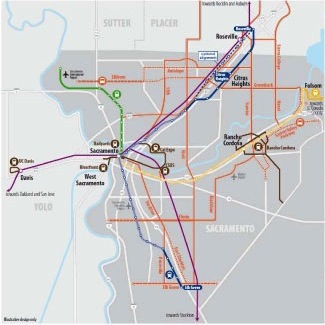
Transit projects in Sacramento region

SacTransitActionPlanScenarioC-map-only

Reconnecting America, a transportation advocacy organization, just published Transit Space Race 2013. To see the Sacramento area projects, click on the < 3 million tab, and then sort by state. The eleven projects will be at the top of the list. The transit agency link in the right-most column links back to a page or website about the project.

Though the south corridor extension is shown as engineering in the status column, construction is underway on parts of the extension, the two bridges, and will start soon on other parts, with the help of a recent federal grant as well as regional funds. The airport extension and streetcar projects also have their own webpages.

Most of the other projects link to the Sacramento TransitAction Plan, which show all possible projects in Scenario C (map at right, more detail in the plan starting on page 50). This plan does not give much detail on each project, but the name of the project gives you an idea.

News summary 2013-01-21

SacRT: bike capacity on light rail

Sportworks Interlock transit bike rack

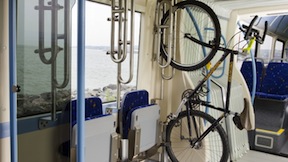
The other item I want to talk about at the Unmet Transit Needs meeting today is bicycle capacity on SacRT’s light rail system. I’ve written about bikes on light rail previously, and won’t repeat that detailed post here, except to say again that SacRT is not meeting the needs of transit users with bicycles on the light rail system.

Sportworks makes two types of transit bicycle racks that could be used on SacRT light rail, the SwingLock and the Interlock. The SwingLock is basically an improvement to the bike rack hooks installed on the 200 series light rail cars, while the Interlock is a more complicated, more expensive, and more effective rack. I spoke to a Sportworks employee at ProWalk/ProBike last year, and he said they also design custom racks for transit systems where off-the-shelf solutions won’t work. I have family in Las Vegas, and when I’m visiting, I use the RTC-Southern Nevada transit system which has the Interlock installed in many of its newer articulated buses. The racks work great!

SACOG Unmet Transit Needs Hearing

I attended the SACOG final hearing on unmet transit needs. Apparently the process is repeated every year, so this is just the last one for this fiscal year. I spoke, as planned, on the unmet needs of bicyclists on light rail and level boarding with low floor light rail cars. Board member Steve Cohn welcomed me to attend the regular SacRT board meeting to talk about these concerns. He said that SacRT is working on these very issues, but since they haven’t publicized anything yet, I’m not sure what they are thinking and where in the process they are.

Only one other person spoke, mostly about disability access and connectivity between the many transit systems in the region.

I’m not sure whether the lack of testimony indicates that people think all the issues were addressed in the earlier hearings, or whether people didn’t know of the opportunity, or if there is a lack of interest. Though SacRT has clearly improved since the low point of 2010 when the system and service were decimated, there is a long ways to go to get back to base level and then to improve on it.

SacRT: level boarding with low floor light rail cars

SacRT light rail steep steps for bicyclist

Today in Sacramento will be the last of SACOG’s Unmet Transit Needs meetings. It will start at 9:30AM in the SACOG board room at 1415 L St, Ste 300, in downtown Sacramento, near the northeast corner of Capitol Park. In preparation for that meeting, I’m thinking about the things I’d like to talk about, particularly issues that I’m not sure that others will bring up. Those two are bicycles on light rail, and level boarding for light rail. I’ve said a bit about level boarding in my Portland post, but there is plenty more to say.

The SacRT light rail system has high floor cars. Both the older 100 series cars by Siemens Transportation Systems and the newer 200 series cars by Construcciones y Auxiliar de Ferrocarriles (CAF) have high floors. People must navigate steep stairs from the ground to the car. Disabled people are accommodated by a high boarding platform, but with only one platform at each station (and none for southbound blue line at 12th & I station), those needing level boarding are restricted to one end of the lead car, and all other doors and cars exclude them. Many people who use the train don’t consider themselves disabled enough to use the high boarding platforms, yet struggle with getting up and down the steps. Many bicyclists also struggle with these steps. The handrails which are provided in the middle of the stairs to assist people with the steep steps are themselves part of the problem, as they block people who are carrying items such as strollers, groceries, luggage and bicycles.

Read More »

News summary 2013-01-13

High-speed train is a Field of Dreams (SacBee 2012-01-12; this was on the Opinion page, but doesn’t seem to have made it to the website; I’d ignore it but there is a delicious irony in use of “field of dreams” – did McCarthy and Denham not watch the movie, or did they take some strange message from it that no one else did?)