Walkable City

Sacramento Press is sponsoring a live chat with Jeff Speck, the author of Walkable City: How Downtown Can Save America One Step At A Time. The live chat is tomorrow, January 3, at 12:30PM. The offline chat is already going on, if you want to check it out. I am currently reading the book, in the Kindle version, but am only part way through.

Many of the online comments so far have focused on creating a livable city, and it is wonderful to see so many positive ideas and accurate identification of challenges. Intelligent conversation like this is rare in the Sacramento news blogs. I’ll make some comments specifically on the walkability safety aspects. I’ve written about this before, but it is worth writing about again and again, because the problems still exist.

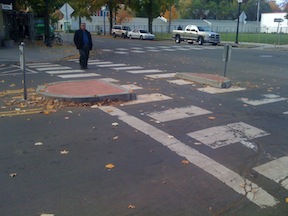
Traffic sewers: Multiple lane and one way streets are traffic sewers. This epithet is used to describe streets designed to flush traffic in and out of employment centers (and to homes in the suburbs) twice a day. They serve no other reasonable purpose, and they make a place very much less walkable. Three (or more) lane roadways are incompatible with walkability. They encourage high speed traffic, and provide too long a crossing distance to pedestrians to be comfortable with. They don’t meet the “8-80” criteria, of being safe and comfortable for people of all ages.Solutions:

  1. Therefore, I think that all three-lane roadways in Sacramento must be narrowed to two lanes. If a true refuge median is provided between two directions of travel, at least three feet wide, so that a person can cross each direction of traffic separately, then roadways with a total of four lanes are acceptable. If not, then only a total of two lanes. Six lane or more roadways, common in the northern and southern suburbs of the City of Sacramento, are not acceptable.
  2. One way streets also encourage high speed travel. I think that all of our one way streets should be converted to two way streets. This can be done over time as streets are repaved, it is not as high a priority as the narrowing of streets, above.

Read More »

Aggressive midtown drivers

I’ve only lived in midtown a while, but from the first it was clear to me that here was a walker and bicyclist paradise, at least in comparison to where I’d lived before, Carson City, and where I work, Citrus Heights. It still seems a bicyclist paradise to me, but I’m seeing the dark side for pedestrians. This may be a recent development, or perhaps I’ve just become more aware of the reality. Though I bike more than I walk, I’m certainly a pedestrian too, and there are a large number of pedestrians in midtown.

Many drivers in midtown are aggressive towards pedestrians. At times I think this is mostly commuters who live elsewhere and just work here, but at times I’m sure it includes the people who live here as well. Driver behavior I see on a daily basis:

  • Speeding: drivers exceed the posted speed limit, especially on the one-way streets
  • Failure to yield: drivers do not yield to pedestrians in marked and unmarked crosswalks; this is a violation of the law
  • Failure to stop: drivers do not stop in additional lanes when one driver has stopped; this is a violation of the law
  • Aggressiveness: drivers do not yield to pedestrians waiting to use marked and unmarked crosswalks; this is a violation of human decency

Read More »

Walk Score

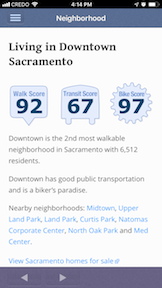
Walk Score offers an assessment of the walkability of any location. It is available in any browser at https://www.redfin.com/how-walk-score-works. The Redfin app shows walk score, bike score and transit score for each listing (scroll way down). Walk Score is based on the distance to the places people want to go, such as grocery stores, restaurants, coffee shops, bars, movie theaters, schools, parks, libraries, bookstores, fitness locations, drug stores, hardware stores, and clothing & music.

I live at O St and 16 St in mid-town Sacramento P and 12th in downtown Sacramento, which has a WalkScore of 85, very walkable, shown at right. The R St and 16th St corridors, which have higher scores, are easy walking distance. The Neighborhood section of the app offers Walk Score, Transit Score, and Bike Score, but for the entire neighborhood of downtown, not for specific address.

The browser interface offers more information, for both specific addresses and general areas such as Sacramento. The graphic below is only part of the web page. Note that the results from the app and the web site are not the same, and I don’t know why, but they are similar enough that it should not make a big difference.

The exact algorithm that weights these amenities is not public, but you can get an idea by selecting the Street Smarts Walk Score option. Having six grocery stores within 0.6 miles, eight restaurants within 0.2 miles, and eight coffee shops within 0.3 miles supports my score. One critical item not on the list is farmers’ markets, which I would weight very highly, though the seasonal nature of most farmers’ markets might be a challenge. The closest one to me is two blocks away, but it only runs May through September. It is only 1.4 miles to the year-round farmers’ market at 8th St and W St. Some performance theatres show up in the movie theaters category, but some of them do not, so I’d make that a separate category since plays are such an important part of my life.

Read More »