21950 and Vision Zero

California Vehicle Code 21950, failure to yield to pedestrians, is in my opinion the most important violation as it applies to implementing Vision Zero in Sacramento. The Vision Zero Sacramento Action Plan (draft) says “Launch high-visibility enforcement campaigns against speeding, failure to yield to pedestrians, distracted driving, and impaired driving. Campaigns will focus on HIN corridors.” The state code says:

21950.
  (a) The driver of a vehicle shall yield the right-of-way to a pedestrian crossing the roadway within any marked crosswalk or within any unmarked crosswalk at an intersection, except as otherwise provided in this chapter.
(b) This section does not relieve a pedestrian from the duty of using due care for his or her safety. No pedestrian may suddenly leave a curb or other place of safety and walk or run into the path of a vehicle that is so close as to constitute an immediate hazard. No pedestrian may unnecessarily stop or delay traffic while in a marked or unmarked crosswalk.
(c) The driver of a vehicle approaching a pedestrian within any marked or unmarked crosswalk shall exercise all due care and shall reduce the speed of the vehicle or take any other action relating to the operation of the vehicle as necessary to safeguard the safety of the pedestrian.
(d) Subdivision (b) does not relieve a driver of a vehicle from the duty of exercising due care for the safety of any pedestrian within any marked crosswalk or within any unmarked crosswalk at an intersection.

VEHICLE CODE – VEH, DIVISION 11. RULES OF THE ROAD,CHAPTER 5. Pedestrians’ Rights and Duties; http://leginfo.legislature.ca.gov/faces/codes_displaySection.xhtml?lawCode=VEH&sectionNum=21950; retrieved 2018-12-15

So, how is the Sacramento Police Department doing on enforcing this code against drivers who fail to yield to pedestrians in the crosswalk? Well, from the ‘Sacramento Police Vehicle Stop Data’ (http://data.cityofsacramento.org/datasets/sacramento-police-vehicle-stop-data) of the last two years, there were 101 violations of 21950 recorded, out of 61,151 violations. This is 0.17 percent, or, other violations were 582 times more common.

Anyone spending more than 10 minutes standing on the corner of any busy pedestrian intersection could count a hundred violations of this law. I know this because I do it. It is part of my job and it is also part of my advocacy. In two years the police only wrote 105 citations? I will also add that I have seen Sacramento Police Department officers in motor vehicles violating this very code hundreds of times, on myself and on others. Even the bicycle mounted officers are frequent violators. I will say that officers have yielded to me in the crosswalk, but it is much more common that they don’t. I’m not saying that they are trying to run me down, rather than they don’t wish to be slowed or inconvenienced, and so will cross through the crosswalk when I’m in it. They are, in this sense, just like other drivers.

So what is this disconnect between what is important and what officers do? I’m going to be blunt here. The police not partners in achieving Vision Zero, in fact they are the main impediment to Vision Zero. If they persist in their windshield perspective that pedestrians are the problems and drivers don’t mean to cause harm, pedestrians will continue to die, and drivers will continue to not face consequences for their violations, for their assaults, for their murders.

If you wish to reply that we all need to work together, and consider perspectives, well, please present evidence that this has worked in the part, or some construct that says it will work in the future. I’m not seeing it. In case you think I am picking on Sac PD, things are actually worse in other jurisdictions, but since this is where I live and observe the issue every day, it is the place I focus on.

By the way, thank you Don Kostelec @KostelecPlan for getting me fired up about all the ways in which our entire system is biased against pedestrians, and that those people whose job it is to consider and act on safety are mostly only concerned about drivers and traffic flow. I encourage you to follow his ‘The Twelve Days of Safety Myths‘ series.

change the signal at J St and 13th St

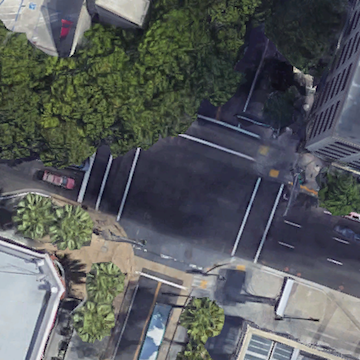
The signal at J Street and 13th Street in downtown Sacramento (shown at right) does not work well for pedestrians. The signal cycle is long, even compared to other signals on J Street, so the wait for pedestrians is quite long. I have seen the signal cycle skip both pedestrian crossings and vehicle crossings a number of times, which means that the wait is doubly long. Most walkers respond to this long wait by simply crossing the street against the pedestrian signal, and I don’t blame them at all.

A second issue is that the signal is set so that the east crosswalk walk mode occurs at the same time as the left turn from 13th Street southbound to J Street eastbound, meaning there is always a conflict between pedestrians and drivers at this point, and this conflict has been created by the signal setup. Many drivers cut directly behind or in front of people walking, as they know if they wait until the crosswalk is clear, as the law requires, they won’t make the signal.

This signal should be reconfigured so that it gives priority to pedestrians, without making them wait an unreasonable period of time, and does not create unnecessary conflict between turning drivers and people walking. The east crosswalk at a minimum needs a longer leading pedestrian interval (LPI).

Even better would be to make this a pedestrian scramble intersection, with an all-direction crossing phase during which all vehicle turning movement are prohibited. The intersection can be marked with diagonal crosswalks, and additional diagonal pedestrian signal head added, however, simply changing the signal timing is sufficient as an initial step. This is a busy crosswalk intersection, with the convention center on one corner, the Sheraton Grand on another, and the parking garage for the Sheraton and others on the third corner. It is alway busy, and the people crossing here are commonly tourists, who are likely used to more advanced ‘world class’ cities where pedestrians are not second class citizens after car drivers.

Note: There are a number of busy pedestrian crossing intersection in the Sacramento central city that deserve an upgrade, but this is the one that most irritates me, whether walking or bicycling.

preserving access during construction

Sacramento central city is booming with construction, which I consider to be a wonderful thing. Mixed use buildings, single lot apartments and  homes, state office buildings. But the construction is having a serious impact on walkability, and often bikeability. (Note: this post is not about road construction or about temporary closures, which also need to be addressed, but not today.)

Two examples, both of state developments, but with principles applicable to private developments, will illustrate the issues. For the new California Natural Resources Agency building between O and P, and 8th and 7th, the sidewalk, parking and one travel lane on the south side (P St) were removed from service. These are not being used in any way for the project. Perhaps they will be eventually, but in the meanwhile, presumably for the entire life of the construction project, they are just sitting empty and unused. For the new O Street office building at O and 12th, the sidewalk and parking were removed from the east side of 12th between the N-O alley and the O-P alley. The section to the north, where the building is being constructed, needs closure, as the underground level is being dug and the sidewalk will be replaced. But on the section to the south, which is being used for storing construction materials, do not need to be closed. There is plenty of space on this former parking lot.

12th Street construction closure

For some of the private construction going on, of which there are many examples, some closures are no doubt necessary. But the closures seem to be occurring from the very first day of construction to the very last day of construction, even though it is needed for only part of the time.

Construction companies are doing this because they can, out of convenience or laziness. And the city is allowing them to. Each construction project requires a traffic control plan, and the permit specifies allowable areas and time frames.

When I questioned the closure on the southern section of 12th Street, Matt from Construction Services in Public Works argued that since parking was removed, it was only fair that the sidewalk access be removed. His thinking was that fairness required making everyone lose something, and that the loss of parking was equivalent to the loss of sidewalk access.

This of course is a ridiculous argument. Parking is in no way equivalent to access. And priority must be given on all roadways to the most vulnerable users, which are in order of importance, pedestrians, bicyclists, and motor vehicle drivers.

At the recent Sacramento Active Transportation Commission meeting, Jennifer said that she though there might be guidance on access restrictions, but wasn’t sure, and would look into it.

In the meanwhile, let me propose:

  1. For any roadway with more than one lane in a direction, space will be taken from a general purpose travel lane:
    • If a sidewalk or informal walking path is present, pedestrian access will be preserved by the creation of a temporary sidewalk protected by delineators or barriers.
    • If a bike lane or separated bikeway is present, access will be preserved by the creation of a temporary bike lane protected by delineators or barriers.
  2. For any roadway with a single lane in a direction, space will be taken by closing the general purpose lane in one direction, with appropriate detours for motor vehicles:
    • If a sidewalk or informal walking path is present, pedestrian access will be preserved by the creation of a temporary sidewalk protected by delineators or barriers.
    • If a bike lane or separated bikeway is present, access will be preserved by the creation of a temporary bike lane protected by delineators or barriers.

crosswalks, for now

I hope that you have found the series of posts on crosswalks (category: walkability) useful. I could write about them forever, but for now, that is all. Besides, I’m off to the wilds of southern Utah for spring break, out of Internet range, and no crosswalks except in the small towns.

If you have improvements that you’d like to see that I did not include, or if you have specific locations you’d like to see improved, please comment. Please don’t accept the word of traffic engineers that streets can’t be made safer, or that we can’t afford to make them safer (there are a range of solutions from inexpensive to very expensive), or worst of all, that we can’t slow traffic down. We can slow traffic, we should slow traffic, we must slow traffic. Speed kills.

Pedestrian safety countermeasures

In addition to the leading pedestrian interval recently covered, three other pedestrian safety countermeasures are given prominence (among a long list of potential measures with smaller but not insignificant benefit):

Medians and Pedestrian Crossing Islands in Urban and Suburban Areas: These medians provide a safe space for pedestrians to wait while part way across the intersection, and simplify the crossing by making so the walker only has to look at one traffic direction at a time. They are used both in mid-block and intersection settings. The photo is of a pedestrian island at Folsom and 48th in Sacramento. This is a location with frequent crossings, with popular businesses on the north and south side of Folsom. And with a popular bar on the north side, the importance of safe crossing is increased.

Pedestrian Hybrid Beacon: This is a specialized signal for mid-block pedestrian crossings that grabs the attention of drivers with a sequence of changing signal patterns that eventually goes to full stop. These are also known as HAWK signals (High intensity Activated crossWalK), invented in Arizona. I often hear complaints that these signals are confusing to drivers, but to me, that is exactly the point, it grabs their attention. Though I’ve seen these installed at intersections, this is a mis-application; they are designed for mid-block crossings. These signals are expensive, about 20% of the cost of a fully signalized intersection. The Rectangular Rapid Flashing Beacon (RRFB) is a much simpler and much less expensive alternative, but limited to lower traffic volume and lower speeds than the hybrid beacon.

Road Diet: A road diet reallocates roadway width from regular motor vehicles lanes (called general purpose lanes) to more constructive use such as wider sidewalks, bike lanes or separated bikeways, transit lanes, and sometimes parking – where it is really needed and calms traffic). The simplest to implement is the conversion of parallel parking to diagonal parking on overly wide streets, such as has been done a number of places in Sacramento central city. More complicated reallocations are often called ‘Complete Streets,’ though complete streets are not well defined, and adding sidewalks and bike lanes to 45 mph posted (55 mph actual) arterials with infrequent safe crossings does not encourage anyone to walk or bike and may be a waste of money. But in urban areas where the capacity of multi-lane streets is not needed, or needed for only a very small part of the day, a road diet may create a safer and walkable environment.

For a full list of pedestrian safety countermeasures, see Countermeasures.

Zegeer and crosswalks

In 2005, the Federal Highway Administration (FHWA) published Safety Effects of Marked Versus Unmarked Crosswalks at Uncontrolled Locations. The authors were Charles V. Zegeer, J. Richard Stewart, Herman H. Huang, Peter A. Lagerwey, John Feaganes, and B.J. Campbell, but the research paper is usually referred to as ‘the Zegeer report.’

This is the research that Ryan Moore was referring to in the crosswalk removal meeting when he said that the city was following federal guidelines that required them to remove the crosswalk at Freeport and Oregon, though he did not call out Zegeer by name. Twenty-three crosswalks were removed in total, though we still don’t know where all of them are, and the city won’t provide that information.

As you would imagine, research reports contain a lot of text and figures and tables, but a key finding is that on multi-lane roads (more than one lane in a direction), with traffic volumes over 12K ADT, marked crosswalks had a somewhat higher crash rate than unmarked crosswalks. There is always an unmarked crosswalk at intersections unless there is specific signing to prohibiting crossing. It is this finding that traffic engineers have used to not install, or to remove, crosswalks on arterial roads all over the US. They don’t read beyond that.

The report says several things relevant to the crosswalk removal issue:

  • “In most cases, marked crosswalks are best used in combination with other treatments (e.g., curb extensions, raised crossing islands, traffic signals, roadway narrowing, enhanced overhead lighting, traffic calming measures). Marked crosswalks should be one option in a progression of design treatments. If one treatment does not accomplish the task adequately, then move on to the next one. Failure of one particular treatment is not a license to give up and do nothing. In all cases, the final design must accomplish the goal of getting pedestrians across the road safely.”
  • “Raised medians provided significantly lower pedestrian crash rates on multilane roads, compared to roads with no raised median.” (There is a raised median on both north and south sides of the intersection, and though they are narrower than would be required if built today, they do indeed provide pedestrian refuge.)
  • “Regardless of whether marked crosswalks are used, there remains the fundamental obligation to get pedestrians safely across the street.”
  • “Pedestrians have a right to cross roads safely, and planners and engineers have a professional responsibility to plan, design, and install safe and convenient crossing facilities. Pedestrians should be included as design users for all streets.”

Most importantly, Charles Zegeer, the lead author, said this about the key table in the report:

“This table should never be used to remove crosswalks. That will not solve the safety problem. Use this table to make crosswalks safe.” – Charlie Zegeer

I was on a webinar in which he said that he was horrified by the tendency of traffic engineers to use his research to justify crosswalk removal, and he strongly implied that this was professional malfeasance.

I believe that the city removed the crosswalk because they looked at the intersection and decided that removal was preferable to all other options. This is the ‘cars first’ attitude that contributes to the death of almost 6000 pedestrians a year. It preferences the convenience of people driving though a neighborhood over the safety of people in the neighborhood. This is not acceptable to me, and I doubt it is acceptable to the neighborhood around the removed crosswalk. The city needs to rethink its entire approach to pedestrian safety. Having a Vision Zero Action Plan will do no good if traffic engineers continue to make the wrong choices.

J & 13th needs a pedestrian scramble

Following the post yesterday, Morse-Cottage pedestrian scramble, here is my first suggestion for a pedestrian scramble in Sacramento. J Street and 13th Street would be a great location for one. It has high pedestrian traffic, it has pedestrian attractors on three corners (convention center, Sheraton Grand Hotel, and a parking garage), and many people cross more than one direction. I am not sure that it is the highest volume intersection, but it is quite possible the highest visitor location where people are less likely to be paying attention or to understand our signal system

Most importantly, the pedestrian signalization here is seriously screwed up, and it needs to be changed. On the west leg, the pedestrian phase is short. On the east leg,there is a ‘leading vehicle interval’ that allows southbound left turning vehicles to start before the pedestrian walk comes on, so almost every cycle creates pedestrian-vehicle conflicts. All the crossings require button pushes, none are on automatic recall that is standard at intersections in urban areas with heavy pedestrian flow. And the whole intersection cycle is much too long, giving preference to drivers on J Street over walkers, right here in the heart of a place where so many people walk. The cycle also sometimes skips the west leg completely, making pedestrians wait through two cycles of J Street traffic, which is a long, long time.

In addition to the exclusive phase, diagonal crosswalks should be marked to make it clear how the intersection works.

Let’s make this the first of many pedestrian scrambles in the central city.

Morse-Cottage pedestrian scramble

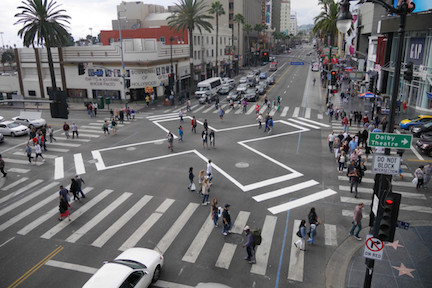
At the intersection of Morse Ave and Cottage Way in the Arden-Arcade community of Sacramento county, there is a pedestrian scramble. What this men’s is that the pedestrian signal is on, for walk, in all the directions at once. They are also called Barnes Dance, for Henry Barnes, the traffic engineer who popularized them, and exclusive pedestrian phases.

Sometimes these intersections have marked diagonal crosswalks, as a reminder that diagonal crossings are permitted, and sometimes they do not, but a pedestrian may cross diagonally whether the marked crosswalk is there or not.

I am most familiar with these from Reno (I lived in Carson City for some years), which has several along Virginia Street in downtown. I’ve seen them other places, but don’t recall exactly where right now. At every location where I’ve seen them, right turns are prohibited on red, by signing, so when pedestrians are crossing, no cars are moving at all, and there is no issue with drivers failing to yield to pedestrians using the crosswalk.

I think that every intersection that has heavy pedestrian traffic, particularly where many of the pedestrians are crossing one street and then the other, should have pedestrian scrambles. Yes, they slow traffic a bit, but they increase pedestrian safety and comfort, a great trade-off in my opinion. Many scrambled that existed in the past were removed by traffic engineers who wanted to prioritize vehicle flow over all other considerations, including safety, but it is time to bring them back, at least in select locations. See Governing Magazine, Cities Revive an Old Idea to Become More Pedestrian-Friendly, or search the Internet for pedestrian scramble for both recent and old installations.

The county had this to say about the intersection:

  1. The all-ways crossing, also known as a pedestrian scramble, at Cottage and Morse was in place/operation prior to the 2016 Cottage Way modification project. After doing some researched, we discovered it has been in place since the signal was installed in 1969.
  2. The pedestrian scramble operates 24 hours a day.
  3. The configuration of this intersection is unusual for the County. The scramble works for this location given the layout and right of way constraints that result in some of the corners only having one pedestrian push button to serve two directions.
  4. We currently do not have any plans to add diagonal crossings at this location.
  5. This is currently the only location in the County that has a pedestrian scramble.

Crosswalk removal and CVC

At the community meeting, Ryan Moore kept saying “we followed the law” in removing crosswalks. Though he was not specific, the law he may have been referring to is the section of California Vehicle Code (CVC) below. It remains to be seen if this law was followed, but it may have been since the requirements are minimal. Residents in the neighborhood were uniform in saying that they had not seen any notice, but that does not prove it did not occur. There are additional legal requirements on the city that will be addressed in future posts.

CVC 21950.5. (a) An existing marked crosswalk may not be removed unless notice and opportunity to be heard is provided to the public not less than 30 days prior to the scheduled date of removal. In addition to any other public notice requirements, the notice of proposed removal shall be posted at the crosswalk identified for removal.

(b) The notice required by subdivision (a) shall include, but is not limited to, notification to the public of both of the following:

(1) That the public may provide input relating to the scheduled removal.

(2) The form and method of providing the input authorized by paragraph (1).

Leading Pedestrian Interval (LPI) signals

Questions about using Leading Pedestrian Interval (LPI) signals at the community meeting on crosswalks reminded me that I had information on these in the city for some while, but hadn’t shared it. A LPI signal gives the pedestrian a 3-second (or more, but the Sacramento ones are all 3 seconds) head start, with the walk sign coming on before the light turns green, so that pedestrians will already be in the crosswalk and more visible before vehicles start to move. These address the common issue of both right-turning and left-turning vehicles failing to yield to pedestrians in the crosswalk. They are one of the pedestrian safety countermeasures identified by the Federal Highway Administration (FHWA), with a crash reduction factor of 60%. If you search for ‘leading pedestrian interval’ on the Internet, you’ll see a great number of useful links. The NACTO page is especially worthwhile.

My purpose in sharing the specific locations is so you can go out and experience LPI for yourself. How does it work for you?

A LPI does slow traffic very slightly since there is an additional 3 seconds per direction during which most vehicles are not moving.

Lastly, this is not a solution that could have been used at the Freeport-Oregon intersection, which is not a signalized intersection. However, it is a solution for the signalized intersections along Freeport. Ryan Moore claimed that these can’t be used at low pedestrian locations, but the response to all such reactionary claims is: “You can’t judge the need for a bridge by the number of people swimming the river.” If crossings are not safe, then fewer people are walking than otherwise could be. The demand is there, but not the facility. LPIs are one solution.

Lead Pedestrian Interval (LPI) locations in City of Sacramento (as of 2015-08-28):

  • 9th Street and I Street
  • 9th Street and P Street
  • 10th Street and I Street
  • 10th Street and J Street
  • 15th Street and K Street
  • 29th Street and K Street
  • 30th Street and K Street
  • 9th Street and Q Street
  • 13th Street and I Street
  • 8th Street and P Street
  • 8th Street and Q Street