I have been a follower of the Strong Towns blog since 2008, and founding member when it became a formal organization. It has strongly influenced my thinking about transportation, land use, and housing. I recommend to everyone that you check Strong Towns out.
What really got Strong Towns off the ground is the concept of stroad, a roadway which is neither a street nor a road, but something in between. As is said, it is the futon of roadways, something that is neither a comfortable bed nor a comfortable couch. Strong Towns defines streets and roads as follows:
Streets: The function of a street is to serve as a platform for building wealth. On a street, we’re attempting to grow the complex ecosystem of businesses and homes that produces community wealth. In these environments, people (outside of their automobiles) are the indicator species of success. Successful streets are environments where humans and human interaction flourish.
Roads: In contrast, the function of a road is to connect productive places to one another. You can think of a road as a refinement of the railroad — a road on rails — where people board in one place, depart in another and there is a high speed connection between the two.
In the Sacramento region, and really almost everywhere, streets designated as arterials and most collectors (in the Functional Classification System) are stroads. They have speeds too high for people to be safe and comfortable. They are often called traffic sewers, that flush traffic in and out of central cities every day. But they are also populated by businesses and public amenities such as schools, with so many driveways and turning movements that they can’t possibly function as high speed roads.
The reason this concept is so important right now is that transportation agencies try to make stroads better by turning them into ‘complete streets’ but do so with a poor understanding of the difference between a street and a road, leaving roadways that accommodate all modes (walking, bicycling, motor vehicles) but still don’t really work. Most complete streets are still stroads. And much of the proposed Measure 2022 sales tax measure for Sacramento County is invested in this flawed concept. So the next two posts will address those issues.
The City of Sacramento has red light cameras at the following locations:
Mack Road & La Mancha Way/Valley Hi Drive
El Camino Avenue & Evergreen Street
Howe Avenue & Fair Oaks Boulevard
Mack Road & Center Parkway
Exposition Boulevard & Ethan Way
Broadway & 21st Street
Folsom Boulevard & Howe Avenue/Power Inn Road
Arden Way & Challenge Way
5th Street & I Street
16th Street & W Street
Alhambra Boulevard & J Street
The top injury intersections are:
Stockton Blvd & Broadway
Stockton Blvd & Lemon Hill Ave
Stockton Blvd & 47th Ave & Elder Creek Rd
Watt Ave & Auburn Blvd
Del Paso Blvd & Evergreen St & Lampasas Ave
Julliard Dr & Kiefer Blvd & Folsom Blvd
Power Inn Rd & Fruitridge Rd
Freeport Blvd & Florin Rd
Center Pkwy & Cosumnes River Blvd
Bruceville Rd & Cosumnes River Blvd
Franklin Blvd & Mack Rd
Notice there is no overlap. One could optimistically say that the presence of red light cameras may be making drivers safer and reducing the crashes at these locations. But I doubt it. More likely, the city is just not prioritizing high injury intersections. Of course high injury intersections change over time, as traffic patterns change, and as the city redesigns intersections to be safer, so red light camera locations need not remain static.
I ask that the city install red light cameras at all the high injury intersections. I am not asking that the city move the existing cameras to the new locations. If someone thought a red light camera was necessary at an intersection, it probably still is, and should continue unless evidence indicates otherwise.
A lot of driver-apologists claim that red light cameras are not fair, that they are installed mostly to gain ticket revenue, and that they aren’t accurate anyway. Yes, some places have installed cameras for funding, but Sacramento is not one of them. Yes, sometimes the camera systems flag a vehicle that is not running a red light, but the photos are reviewed. Even if the city were making $1M a day on red light cameras, that would be just fine with me if it prevents one death. I value life more highly than do many drivers.
I worked in Citrus Heights for several years, which has a much higher percentage of traffic signals complemented by red light cameras. My perception is that it really did make a difference. I saw very little red light running in Citrus Heights. Other violations, sure, but not red light running.
photo from City of Sacramento Red Light Running Program page
“Traffic signals are the most mindless and wasteful thing Americans routinely install to manage traffic. Removing nearly all of them within cities would improve our transportation systems and overall quality of life.”
Chuck Marohn, Confessions of a Recovering Engineer
I have long wondered what the value of traffic signals really is. As a walker, they make me wait for the signal cycle when there is no traffic coming. As a bicyclist, they stop me at almost every location, because they are set for the speed of cars, not the speed of bicyclists. There are places that set signals to work for bicyclists, but nowhere in the Sacramento region. Of course as an enlightened walker and bicyclist, I wait only for gaps in traffic and not for the signal to change. As a driver, which I once was, they make me sit at an intersection when I could be moving, and slow overall travel time.
Most signals do not sense traffic loads and respond. They are on a cycle, no matter what. Rush hour, midnight, same cycle. Signals are timed to preference one direction of traffic over the cross-traffic. And they are often very slow cycles. In the county, many of the signals are on a 2.5 minute cycle, and even in urban areas they are on a slow 1.5-2 minute cycle. Drivers have come to accept the long wait, but for walkers and bicyclists for whom a red signal can increase overall travel time by 1-1/2 to two times, they make us crazy.
Signals do not slow the speed that drivers drive. Drivers wait at the red light, and then accelerate on the green to make up for wasted time, always going over the posted speed limit. Of course these days many drivers don’t stop for red lights at all, they go through intersections on stale reds (meaning it was red before they even entered the intersection). This has become a very common behavior over the years, and is almost routine since the pandemic.
One of the things that signals seem to do is shift unsafe driving behavior from intersections to corridors, the street parts in between signals. Instead of misbehavior at intersections, causing lower speed crashes, we get misbehavior in between, with higher speed crashes.
Everyone who walks knows that signalized intersections are not safe places to cross the street. Drivers turning right look only for opposing traffic, almost never for people in the crosswalk. When the light turns green, drivers accelerate into right hand turns, across the crosswalk and any walkers in it. For intersections that permit left turns on green lights, the threat of a left turning driver crossing the crosswalk at high speed is constant. So people who value their life tend to cross mid-block, where one only has to look for two directions of traffic instead of 12.
The Confessions book suggests several alternatives to traffic signals, including roundabouts, traffic circles, and shared space intersections.
Use roundabouts rather than traditional intersections. Of course in place where the size of intersections is constrained by right-of-way and adjacent buildings, a real roundabout may not be possible, but traffic circles, of which the central city already has a number, can fit. Traffic circles are not as effective as roundabouts, but can replace signals.
Slow traffic enough that people can cross streets without having to have signals to interrupt traffic.
I realize that many people associate signals and stop signs with safety, and often demand signals and stop signs when the streets are dangerous. So what I am going to say here will be controversial. For people who think traffic signals make things safer, please spend some time observing at both signalized intersections, and unsignalized intersections. Are the ones with signals really safer? For anyone?
One of my (not) favorite signals is at 15th Street & E Street. At this point, 15th Street is not a collector or arterial, it only becomes one-way a block earlier at D Street, and has very little traffic at this point. It does not become a higher volume street until H Street and I Street to the south. E Street is a collector, though not a very busy one. Yet the signal cycles all day long, with almost no traffic at it. A perfect location for a traffic circle. Not the point of this post, but 15th Street at this location does not need two lanes, one lane would be plenty, and the excess lane can be converted to diagonal parking and/or a bike lane. A photo of the intersection is below, showing a typical amount of traffic.
What about all the signals on 14th Street? This is a low volume, fairly low traffic speed street, at all times of day. It dead-ends at the convention center, so it is not really even a through street, yet it has five signals. There are a lot more such examples. You can add yours in the comments!
15th St & E St intersection, Sacramento
All the signals in the central city that are not at the intersection of collector and/or arterial streets should be slated for removal. If the city wishes to do so, it could do a traffic study before removal, or just go ahead with removal, but it should not be leaving these signals in place without action. There are options short of complete removal. Signals could be made into signalized pedestrian crossings, so that when people walking need to cross, they still have (some) protection of a red light. (Some protection. Again, many drivers to not stop at red lights.) Curb extensions can be installed to shorten crossing distances. Traffic diverters (modal filters) can be installed so that only bicyclists have a thru route. And of course roundabouts and traffic circles. At the intersection of two collector streets, a four-way stop might be appropriate. Each intersection is unique, but each one is also a candidate for change that makes travel safer and less frustrating no matter the mode of travel.
I’m not suggesting, at this time, the removal of signals at the intersection of collector and/or arterial streets. Someday.
The map shows these signal locations, with a red X (pdf). The intersections of collectors and/or arterial streets, not marked here, are not being challenged at this time. The purple streets are designated collectors or arterials by the city (part of the Functional Classification System).
signals in Sacramento central city for possible removal
I almost continuously find myself thinking about our transportation system, as it exists now, and wondering, how did we get here? How did we get to a car dominated city, where the lives of people who walk and bicycle and take transit are valued less than those who drive? How come our sidewalks are in poor condition, and the city insists that it is not their problem to solve? How come we spend nearly all of our transportation dollars on freeways and interchanges, and relatively very little on streets? How come people outside cars don’t feel safe, both from traffic and from concerns about personal safety? How come the police don’t enforce laws against driver behavior which endangers people walking – specifically, egregious speeding on streets, and failure to yield to people in crosswalks? How come the city is so spread out that many people feel it necessary to drive? How come?
Well, the answer is obvious for those who care to look, and to think. We have a transportation system that was built around racist and classist values. The City of Sacramento (and Caltrans) built freeways through low income neighborhoods, on purpose. The freeways were built, not for the benefit of the communities they run through, but for commuters passing through, on their way from single family houses to jobs. The freeways don’t even serve freight and commerce very well, because they are congested with commuter traffic through which trucks must crawl. The city and Caltrans are further widening these freeways, as we speak.
The city approved developments, from World War II onward, that did not have sidewalks. Of course there are some neighborhoods, high income, that don’t want sidewalks because they want to preserve that rural feeling, but I doubt there was ever a middle income or low income neighborhood that didn’t want sidewalks. The city did not require them because leaving them out made for a higher profit for developers, less space taken up by sidewalks, and lower street construction costs. (I am not against developers, but governments routinely cave to developer requests to reduce infrastructure costs, rather than ensuring good infrastructure for all citizens).
And where there are sidewalks? They are often in poor condition. I live in the central city, where sidewalks get repaired, or at least patched. But I also walk in other neighborhoods populated by lower income people of color. There, the sidewalks are not in good condition. Many are too narrow for people to walk side-by-side, and certainly too narrow for people with mobility devices to pass. Curb ramps are scarce. Root heaves go unrepaired. People park blocking sidewalks, and the city does not enforce that. Most city parking enforcement is focused on the central city, where there is metered parking and therefore easy-to-write tickets. The outlying areas, where sidewalks are much more frequently blocked by illegal parking, not so much.
The city has started to pay more attention to low income neighborhoods and people of color. There have been projects completed, and awarded but not constructed, that start to address the past inequities. But it is too little, and too slow. The city is still focused on maintaining the speed and flow of motor vehicles, and not on the people who live here.
The city is also making progress on allowing a greater density of homes, both infill in the central city and incremental densification of single family house neighborhoods. But they are also encouraging and supporting greenfield developments at the periphery, which exacerbates all of these problems.
You might think I’m picking on the City of Sacramento. No. All of this is true of every other city and unincorporated place in the region. But the city is where I live, and where I experience this every day.
I am a white, male, older, middle class person. I am not the person against who these harms were directed, other than being a walker, bicyclist, and transit user.
Why is this history important? If we don’t recognize the racist and classist nature of our existing transportation system, we can’t undo the damage done in the past, and make sure that it never happens again in the future. I think the recognition of this should part of every discussion on transportation, of every engineering and planning action. In the same way that an acknowledgement of native lands helps us remember the harms of the past, the need to address these, and the people still living here, an acknowledgement of the racist and classist transportation system can help us to a better system.
These concerns fall under the category of equity, but I’ve not used that word here. Equity has largely become a checkbox for transportation agencies, and when it is taken seriously only says “we’ll do better in the future”, it does not recognize the damage to be reversed.
Our existing transportation system is profoundly racist and classist. We must acknowledge this in each and every transportation decision, so that we may work to undo the harms of the past and ensure that no harms are perpetrated in the future.
Dan Allison, Getting Around Sacramento
broken sidewalk on Sutterville Rd
Since I’d like this to be part of every discussion and decision, I welcome your input on how to make this statement more succinct and powerful.
Angela Heering provided some progress information and links on the City of Sacramento Transportation Priorities Plan. So here is an update to my previous Sac Transportation Priorities Plan post.
There will be a presentation to city council on March 15, both on the results on Phase 1 and the plan for Phase 2. An earlier presentation to the ‘community consultants is here. The presentation to council will probably differ.
The presentation clarifies one of the questions that came up during the Big Ideas city council workshop.
How is the TPP different from the Transportation & Climate Big Ideas? The TPP is a policy document that will prioritize all City Transportation investments in projects based on community values. It does not define new projects. The Big ideas are a set of defined projects designed to think about mobility as a network and a network to encourage walking, bicycling and transit use. The Big Ideas will be prioritized with all other projects in the TPP.
I’m excited about this process. The city has never had public criteria for how projects are selected. It has been based in the past on the personal preference of the Public Works department, and sometimes, city council members. Making good investments in transportation requires criteria and performance measures for projects!
The Strategic Growth Council has awarded $808M in grants for affordable housing in the sixth round of the Affordable Housing and Sustainable Communities program.
Streetsblog Cal covered one of the two in the Sacramento region:
“In Yuba City in Northern California, Richland Village, also awarded $30 million, will build 176 units in a net-zero-energy project that includes electric vehicle charging, as well as a transit center hub nearby with an electric bus charging system. It will also add sidewalks, bike lanes, new crosswalks, traffic calming measures, and pedestrian-level lighting. The award will also help fund workforce development programs, multi-lingual legal counseling services, and transit passes for residents.”
The first City of Sacramento Transportation & Climate Workshop was held last night as part of the regular city council meeting. The first news, which was not at all clear before, is that this is the first of several workshops, which will develop the plan further. The next workshop has not been scheduled, but may be in March.
screen capture from city presentation
Some highlights:
No one spoke against the seven big idea projects.
People liked the enhanced bus lane on Stockton for SacRT route 51, but it didn’t receive much notice in the discussion.
Nailah Pope-Harden of Climate Plan and a local activist, said bold is the minimum, and said all projects should be about reconnecting communities. Many other speakers referred back to Nailah’s challenge.
The opening slide of the city presentation showed SacRT bus route 30 on J Street, pulled out of traffic and blocking the bike lane. Irony probably unintentional, but it does illustrate one of the ways in which the city does not support transit or bicycling. The bus should not be pulling out of traffic, but stopping at a bus boarding island with the separated bikeway running behind it.
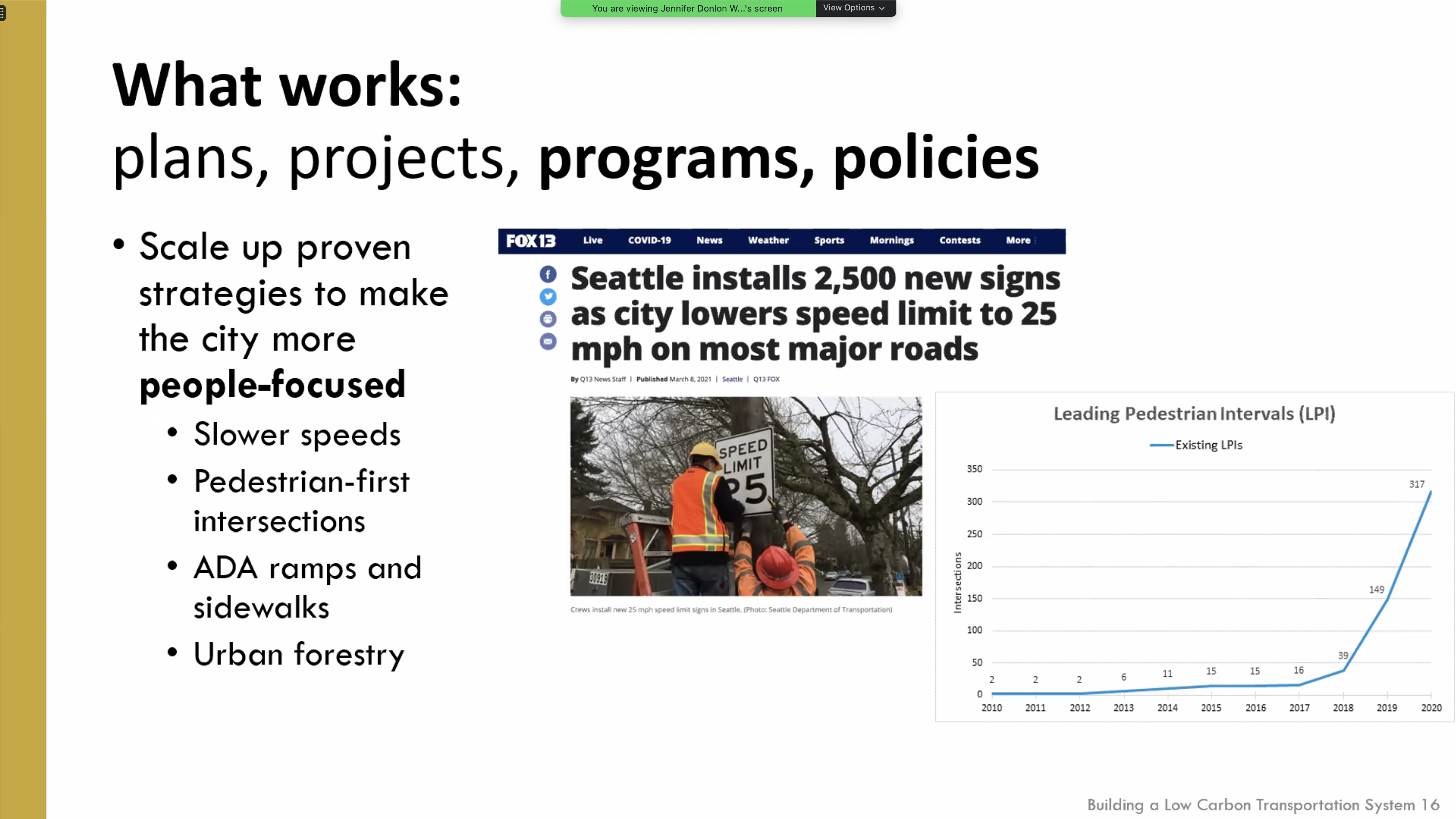
Sam Zimbabwe of Seattle DOT presented on the ways in which the city has shifted mode share to transit with projects and priorities. One of his slides showed the huge increase in the number of intersections at which they have programmed leading pedestrian intervals (LPIs) to enhance pedestrian safety.
Jeff Tumlin of San Francisco MTA said they have realized that waiting for a few big projects is an ineffective approach, and are now doing many small projects, often with temporary measures that can be improved when made permanent. He said that sales taxes don’t have to be regressive, if the benefits are directed to the right places and projects, and that well-designed congestion pricing is not regressive. He also suggested that city staff should be challenged to a higher level of productivity and innovation, and let go if they choose not to meet that. He also spoke about SFMTA’s approach, with partners, of working on transportation and housing as a unified goal, not siloed.
Darrell Steinberg mentioned several times the idea of the city doing a transportation ballot measure so that it could set its own priorities for investment rather than compromising with the county (SacTA) over projects which don’t meet the needs of the city.
City staff said transportation is now 56% of carbon emissions in the city, which is higher than numbers reported before.
Ryan Moore poo-poo’d the idea of lowering speed limits, saying the MUTCD prevents that, without mentioning the state law which allows reductions in specific circumstances. Others pushed back on this.
Rick Jennings spoke enthusiastically about getting more kids on bikes and his own experience of bicycling with kids.
Jeff Harris spoke about EVs, despite the setup of the workshop being about other transportation ideas, not EVs.
Mai Vang pointed out that the ideas are too District 4 (central city) focused, believes that there should be more focus on low-income and outlying areas. She said we need better access to light rail stations, not just bicycling access to downtown.
Civic Thread spoke (all their employees!) about the need for a city-wide Safe Routes to School program to address the recent parent death at school dismissal at Hearst Elementary, as well as safety needs at every school. They also highlighted equity and community access.
Henry Li and Jeff Harris pointed to micro-transit (SmaRT Ride) as being a great success, but SacRT has still not provided information to the community to judge that.
Henry Li spoke mostly about funding, and did not address the Stockton/Route 51 project. He again highlighted light rail to the airport, despite the transit advocacy community’s request that all light rail extensions including ARC/Citrus Heights/Roseville considered before selecting the next project.
The message from the invited speakers and the community was clear: we need to make big changes in a hurry, and city funding and commitment will be necessary for that to happen. How will the city respond?
What are your highlights from the workshop?
screen capture of Seattle DOT slide on speed limits and LPIs
The Washington state organization named Front and Centered promotes a program called Just Transition in Transportation, along with many partners including Disability Rights Washington and 350.org Washington. As part of the program, they have developed a ‘Transportation Bill of Rights’, which is linked on that page. I was curious if other organizations had developed such documents, so did a Google search 0n ‘transportation bill of rights’. The first page and a half is about the airline bill of rights, and this one doesn’t show up until page two. It is sadly ironic that the mode used by a small fraction of the population, commercial air travel, gets all the attention from Congress and the FAA and politicians.
The text of the Transportation Bill of Rights is:
“People’s needs too often get left out of the planning, funding, construction, and maintenance of transportation systems. This is why we have worked together to create a Transportation Bill of Rights. Regardless of our race, age, gender, disability, income and where we live we all deserve transportation where:
No one dies or is seriously injured traveling on state roads, streets, and sidewalks
Every household can access groceries within 20 minutes without a car
No one today is harmed by pollution or noise from transportation
Protection from the climate crisis today for future generations
All trips less than one mile are easily and enjoyably achieved by non-vehicle travel including for people with disabilities
No household should spend more than 45% of its income on housing, transportation, and energy
Every child who wants to can bike, walk, or roll safely to school
Transit service is frequent and spans the day and night so people can get to work and come back
The pursuit of happiness does not require a car”
I would like to see something similar adopted by the state of California, and Sacramento County, and City of Sacramento. If we had this bill of rights, nearly every decision made about our transportation system would be different than it is today. For me, the most important of all the items is: 7. Every child who wants to can bike, walk, or roll safely to school.
The City of Sacramento has 11 red light camera locations: Red Light Running Program. Of these, some are at high-injury intersections, but most are not. These locations are cross-referenced with high injury intersections shown in the post Sac Vision Zero new intersections map.
Location
Top all
Top ped
Top bike
Mack Rd & La Mancha Way/Valley Hi Dr
no
no
no
El Camino Ave & Evergreen St
no
no
no
Howe Ave & Fair Oaks Blvd
no
no
no
Mack Rd & Center Parkway
no
no
no
Exposition Blvd & Ethan Way
no
no
no
Broadway & 21st St
no
no
no
Folsom Blvd & Howe Ave/Power Inn Rd
no
no
no
Arden Way & Challenge Way
no
no
no
5th St & I St
no
no
no
16th St & W St
no
no
no
Alhambra Blvd & J St
no
no
no
My first thought is that the city was putting these cameras in the wrong location. But then I thought, what if the presence of red light cameras is making these locations safer and therefore dropping them out of the highest injury intersection list. I don’t have the information to answer that question, which would take analysis of crashes at the intersections, and before/after data.
What I do know is that many more red light cameras are needed to counteract the pandemic of red light running: pandemic of red light running. I spend time around the edges of Fremont Park, close to where I live, which includes the intersection of arterial streets P, Q, 15th, and 16th, and one of the things I do is watch traffic in the intersections. It has now become rare for a signal cycle for 16th St northbound at P St to not see an incidence of red light running. The other intersections are not quite as bad, but the pattern is there. And this is happening everywhere in Sacramento that I go; these are not likely to even be the worst intersections.
I believe that most of the red light running is by egregious violators, people who routinely and continuously violate traffic law for their own convenience or thrill seeking. This is true of most traffic violations, but red light running is the one most likely to result in fatality and serious injury, for people in all modes of travel. So having a more widespread set of red light cameras would serve to catch these red light violators. Of course the follow-up is necessary, to revoke the licenses and confiscate the vehicles of these repeat offenders. The longer the city looks the other way on this issue, the more people will come to see it as normal behavior, and the less safe our streets will be.
The standard response by cars-first entitled drivers is that tickets are just a money-making scheme by the government. The purpose of red light cameras is to make streets safer, and if that results in some income, so be it. I’m more than happy to have these sociopathic drivers hit in the pocketbook, and the money can be used to make our streets safer, such as by installing more red light cameras. Red light tickets, with photos, are part of the documentation needed to revoke licenses and confiscate vehicles.