red light cameras and law enforcement

Earlier posts on red light running and automated enforcement are available at category: automated enforcement.

The City of Sacramento has a crisis in biased law enforcement against people of color and low income, and also has a crisis of red light running.

The city had red light cameras at eleven locations, part of a program managed by Sacramento County Sheriff’s Office. The county dropped the program in early 2024, and all cameras were removed. The county claimed that the fines from red light running were not paying the cost of the program, and of the contractor. The City of Sacramento therefore dropped its program and has made no effort to restart it. At the dollar value of human life being $10M or more, it is hard to understand how the county saw this program as too costly. City of Sacramento paid $27M in traffic crash lawsuits over five years. The county information does not seem to be available, but it would likely be larger due to higher population, more road miles, and more poorly designed roadways and intersections.

The nature of red light running is that a motor vehicle driver T-bones someone, impacting other motor vehicles, walkers and bicyclists at a perpendicular angle at high speeds, frequently resulting in a fatality. This is not the leading cause of fatalities, but it is significant.

There are reasonable objections to any law enforcement of traffic laws. Traffic stops are often pre-textual, intended to discover illegal activity or warrants that have nothing to do with traffic law, and to oppress people of color and low income. Law enforcement officers not infrequently escalate interactions, resulting in intimidation, unlawful arrest, and death. Law enforcement often focuses on communities with people of color and low income, both because of the pre-textual nature of stops and intended intimidation of people in those communities. Even when justified, tickets for traffic violations have an outsized impact on lower income people because fines are a flat amount no matter the income of the violator, so are strongly regressive. Court fees add a great deal to the cost of a ticket, often sending low-income people in a downward economic and legal spiral. 

Automated enforcement of traffic law removes some of these concerns, but not others. By removing the interaction with officers, law enforcement intimidation and violence is eliminated. But the issue of outsized economic impact remains.

If a red light camera program were to be restarted in the City of Sacramento, it would have to have these characteristics:

  1. The program would be operated by Public Works as part of their transportation management responsibilities, not by the Police Department.
  2. Camera locations would be selected based on traffic crash location hot-spots, but adjusted so that low-income communities do not have a higher number of cameras per-capita than other areas 
  3. For camera locations with a history of traffic crashes resulting in fatalities and severe injuries, and with a higher than average number of citations issued, the city would commit to making changes to that intersection to reduce the incidence of red light running and crashes.
  4. The fines for red light running would be reduced for low-income people. The reduction could be a) across the board for income levels below a certain set percentage of the median household income, or b) based on the value of the vehicle driven by the violator. Alternatives to fines could also be implemented. Though income based fines are often mentioned, and are used in other countries, concerns about privacy and availability of the data make this impractical. The value of a vehicle is easily available, and does track to some degree with the income of the owner. It is not certain whether these options could be implemented by the city now, or if changes in state law would be required, but the city should commit to exploring options and committing to a solution.

Two other types of automated law enforcement have been discussed. Automated speed cameras are legal under a pilot program for several cities, but Sacramento is not one of them. It is unlikely that other cities would be added, or statewide implementation would occur before the pilot is completed. It is possible that active intelligent speed assistance will become law in California, and obviate the need for automated speed enforcement, at least in urban areas.

Automated enforcement of ‘failure to yield’ to walkers (pedestrians) law would be very useful. Failure to yield sometimes results in fatalities and severe injuries, but it always results in intimidation of people walking by people driving, reducing the frequency and comfort of walking trips. The technology for detection of ‘failure to yield’ is not well developed, but has been implemented in some cities and is practical. ‘Failure to yield’ is another crisis on our roadways.

This recommendation to restart the red light camera program in the city does not indicate that it is the primary solution to the traffic violence crisis. It is one among many tools. Changes to the roadway, temporary (quick-build) or permanent, are by far the most effective solution and should be the lead action by the city.
SacCity pedestrian safety emergency: enforcement

The draft City of Sacramento emergency declaration on pedestrian safety: ‘Declaring a state of emergency regarding pedestrian safety in the City of Sacramento and calling for immediate action to address pedestrian injuries and fatalities’ is available (pdf of text, 2 pages, 68KB) (pdf of attachments, 28 pages, 26MB).

This post focuses on the enforcement item.

3. “The City Manager is further directed to work with the Sacramento Police Department to ramp up enforcement of traffic laws that protect pedestrians, including speed limit enforcement, crosswalk violations, and distracted driving. The City shall prioritize enforcement in high-injury corridors and areas with frequent pedestrian activity.”

Three advocacy organizations specifically commented about the draft that it must focus on ‘equity and mobility justice’, as did most of the people who spoke at the city council meeting.

I’ll be blunt. There is a deep and well justified mistrust of Sacramento Police Department (SacPD) among people of color and low-income, particularly among, but not limited to, blacks. SacPD has a history of oppressing black people, and has often used traffic stops as a pretext to harass people. Many of these have escalated into arrest, beatings, and even death. I have seen no real evidence that SacPD has changed their stripes. They are not people that I want interacting with the public about traffic law. And, apparently, they don’t want to either. SacPD has reduced its traffic officer group to almost nothing, and does little traffic enforcement by traffic officers or any officers. It is time to move past the idea that law enforcement has much to contribute to reducing traffic violence.

At the same time, no enforcement of any sort is not the answer. People are dying when drivers violate traffic law, and these deaths are unacceptable. Speed is a contributing factor to all traffic crashes, and is sometimes the primary factor. Driving too fast for conditions, and these conditions include walkers and bicyclists on and close to the roadway, is always wrong, even though road design encourages it.

Automated enforcement is a partial answer. It avoids the pretextual stops, avoids harassment of people of color and low-income by police, at least over traffic law, avoid the escalation that police engage in, and is much less expensive than police officers.

The three main traffic violence issues to be addressed, at least at this time, are:

red light running: Red light cameras and automatic ticket issue to the owner of the vehicle are a partial solution to red light running. Of course some drivers will always run red lights, will always endanger others, and will not be deterred by tickets. But most drivers will notice that tickets are being issued, and will change their behavior. Red light running does have infrastructure solutions, including changing from far-side signals to near-side signals, and raised crosswalks and raised intersections. But there are not easy or inexpensive fixes, so automated enforcement is a good interim solution. When the county ended its red light program, which operated the red light camera in the City of Sacramento, the city made no effort to replace that program, and at least some city staff celebrated it (the red light runners?). The city should create a red light camera program of its own. It should be administered by Public Works, not by SacPD. There are equity issues, since the wide, high speed arterials that most encourage red light running are in low-income communities. Two solutions are to distribute cameras across the city in locations where red light running might occur, and not just those locations with a history. The egregious violators, which are who we really want to target, will be receive tickets eventually. The second is to adjust violation fees (and court costs) to a factor related to income. It would be awkward and perhaps invasive to base it on income, but it could easily be based on vehicle value.

failure to yield to walkers: Drivers have been trained by roadway mis-design to not yield to people in crosswalks. The recent SacPD, OTS funded, sting on J Street demonstrated how common this is. But again, as drivers have been trained to do this, they can be untrained. There are options for automated enforcement of failure to yield, but it requires more complicated and less widely used technology. The city should be experimenting with this technology (they are not), but in the meanwhile, this may be one situation in which in-person enforcement, on a limit basis and with close attention to equity concerns, may be justified. Any in-person enforcement by SacPD raises issues of police violence and over-reaction, including high-speed chases of violators. One solution is to ban high-speed chases. With technology such as helicopters (which the police love) and drones, there is no reason to endanger the lives of violations, bystanders, or officers themselves with high speed chases. Too many cops have watched too many movies with the thrill of high-speed chases. The practice must end.

speeding: There is available and highly reliable technology for automated enforcement of speeding. There is a state-authorized pilot program of speed camera enforcement in six cities and part of Pacific Coast Highway. Sacramento is not among them. To its credit, City of Sacramento asked to be part of this pilot but was not included. The city should strongly lobby the next legislative session for inclusion, and should have a program designed and ready to go when authorized. Speeding is the most common concern of the public, and it is true that speed is a factor in every crash, I’m doubtful that it is the biggest concern. I’d rather see a focus on red light running and failure to yield.

I believe that item 3 should be deleted for its likely failure on equity and mobility justice.

I have not yet written about the other six items, and don’t know when I’ll be able to get to it. However, I will say now, in case you were wondering, that by far the most effective city response is temporary (quick build or tactical urbanism) and permanent changes to roadway design. And what it will take to accomplish those changes is funding, from the city general fund. The seeking of grants, and waiting years or decades for the funding to address traffic violence, is only part of the solution. If this is truly an emergency, and it is, the city must spend significant funding to act on it, and act now.

the end of red light enforcement

A SacBee article today notes the end of the red light camera program in City of Sacramento, which was part of Sacramento County’s program: Sacramento’s red light camera program has been shut down by the Sheriff’s Office. Here’s why. (sorry about the firewall)

This is very sad news, given the epidemic of red light running in the City of Sacramento (and elsewhere). I’ve written about this before: how do we get more red light cameras?, red light running consequences, SacCity red light cameras and crashes, Sac Vision Zero intersections & red light cameras, red-light-running bullies, and pandemic of red light running. It has only gotten worse over time, and will continue to get worse unless the city takes action to reduce it.

A quote from the Sacramento County Sheriff’s Office is particularly galling: “Gandhi said the Sheriff’s Office wants to focus on its mission of suppressing violent crime and other criminal activity.” Apparently, in the view of law enforcement, traffic violence is not a violent crime. Apparently, the fact that red-light runners kill and injure walkers, bicyclists, passengers, and other drivers is of little concern. Sadly, this is a very common law enforcement attitude.

If cost-cutting were an appropriate response to criminal activity, it would be reasonable to just eliminate law enforcement. Law enforcement responds to criminal activity; it does little to nothing to prevent criminal activity. Automated red light enforcement is an effective response to criminal activity, and it does reduce future criminal activity. Why is the Sheriff’s Office and the City of Sacramento not interested?

If you think that direct law enforcement of red light running is a good replacement, you would be wrong, for two reasons. One, almost no enforcement of motor vehicle violations occurs anymore, other than some enforcement of speeding. Two, the law enforcement practice of pretextual stops, stopping people of color for traffic violations to search for other violations, and to intimidate people of color, results in law enforcement violence against drivers of color.

One of the useful things the city was doing to reduce traffic violence is no longer. Don’t you feel safer now? You can visit the city’s Red Light Running Program page, in case you wish to leave condolences, remembrances, or flowers.

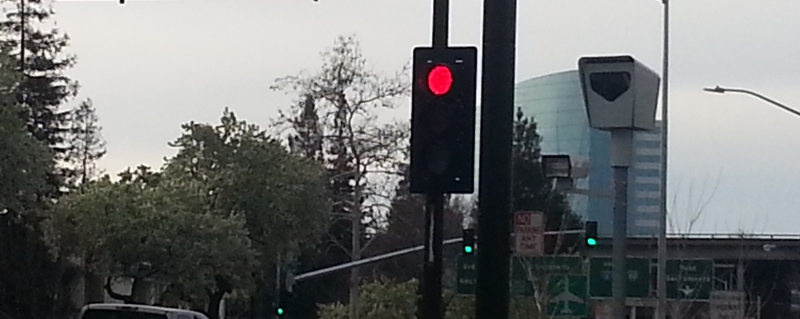
photo of red light camera, from City of Sacramento
red light camera, from City of Sacramento

how do we get more red light cameras?

I live close to Fremont Park in Sacramento’s central city. I walk through the park every day I’m in town, often multiple times. That means I’m crossing through the bounding intersections of P Street & 15th Street, Q Street & 15th Street, Q Street & 16th Street, and P Street and 16th Street, multiple times a day. I also spend a lot of time at Naked Lounge on the southeast corner of Q Street and 15th Street, and some time at Karma Brew on the northwest corner of P Street and 16th Street. That gives me a front row seat to watching the behavior of drivers at these intersections. On nearly every signal cycle, I seem a driver running the red light at each of these intersections. This is not a the exception, it is the rule. By running the red light, I don’t mean entering the intersection on yellow and finishing on red, I mean entering the intersection on red. I mean drivers that are intentionally endangering themselves, other drivers, bicyclists, and walkers. Every signal cycle.

Though I’m an able-bodied and aware walker, Fremont Park is also used by a lot of homeless individuals, families using the playground, people sitting on the benches and reading, people lying on the grass and enjoying the sun (finally) and enjoying the shade (now), people participating in a number of organized recreation activities such as yoga, and of course the festivals such as Chalk It Up. This is a place that should be safe to get to for everyone. It is not currently.

I wrote about a crash at P Street and 15th Street. I’ve written multiple times about red light cameras, pandemic of red light running, red-light-running bullies, and SacCity red light cameras and crashes.

Let me state up front that I am NOT in favor of the enforcement of traffic laws by armed police officers. I have seen first-hand the way in which traffic stops are used to harass and oppress people of color and low income. I have read and seen innumerable accounts of officers murdering the people they stop on pretext. Armed law enforcement is the problem, not the solution. On the other hand, I am strongly in favor of automated enforcement. It is my theory that most serious traffic violations are by a small number of egregious drivers. Automated enforcement can ticket these drivers, which will change the behavior of some of them, but not of many of them who are high income drivers of high end vehicles. It does, however, allow law enforcement to identify repeat offenders and hold them accountable with vehicle confiscation and drivers license suspension.

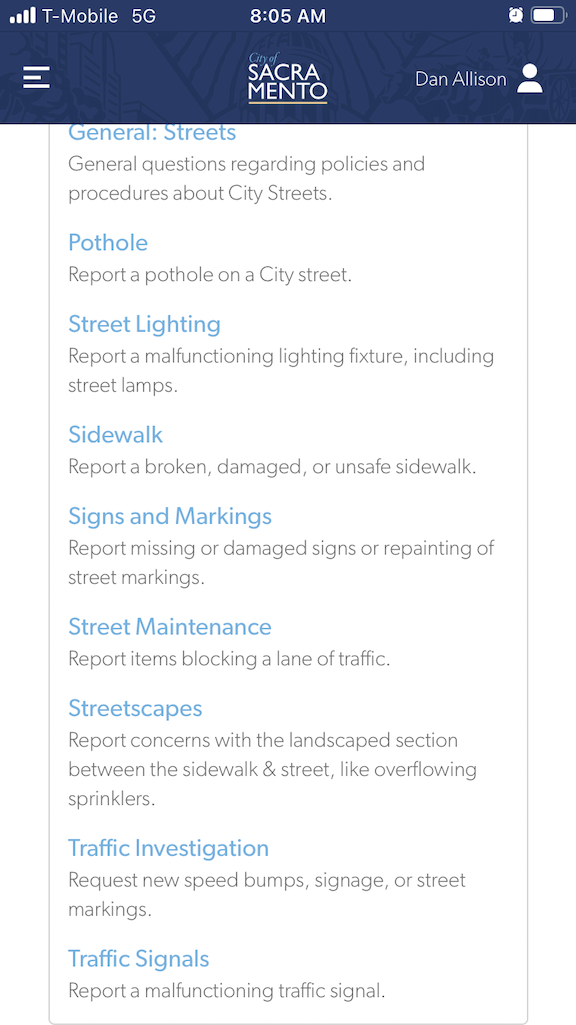
I want there to be red light enforcement cameras installed on at least one of the four intersections at Fremont Park. My observations indicate that the intersection of Q Street and 15th Street is the worst. I looked on the city’s Red Light Running Program page to see if there was a mechanism for submitting requests. No. I looked at the city’s 311 app to see if there was a place to submit a request. Not really. The closest I could find was to select Streets > Traffic Investigation, and then Signals (see screenshots below). I’ll update this when I get a response (though these days most 311 reports get no response at all).

The other way of request that might be effective is to directly contact city council members.

SacCity red light cameras and crashes

A follow on to red-light-running bullies. I’ve created a map that shows the eleven right light camera (automated enforcement) locations under the City of Sacramento’s Red Light Running Program. The city has 907 signalized intersections. These locations are (listed alphabetically by the intersection entry in the Traffic Signals GIS layer):

  • 16th Street & W Street X
  • 21st Street  & Broadway X
  • 5th Street & I Street X
  • Alhambra Boulevard & J Street
  • Arden Way & Challenge Way X
  • Arden & Exposition Boulevard & Ethan Way X
  • El Camino Avenue & Evergreen Street X
  • Fair Oaks Boulevard & Howe Avenue X
  • Folsom Boulevard & Howe Avenue/Power Inn Road X
  • Mack Road & Center Parkway X
  • Mack Road & La Mancha Way/Valley Hi Drive X

The map (pdf) shows each location, with the red signal icon, and a heat map of the crash severity for crashes occurring at intersections. Yellow means high collision severity, with severity being a weighting of the individual types [1 – Fatal; 2 – Injury (Severe); 3 – Injury (Other Visible); 4 – Injury (Complaint of Pain)]. But it does show the pattern, and you can clearly see the intersections along arterial roadways, where most crashes occur. The crashes are not necessarily red light running crashes. There is a PCF Violation category (VIOLCAT) 12 – Traffic Signals and Signs, and another Intersection (INTERSECT_), but that would not distinguish red light running from stop sign running. It might take looking at individual incident reports, but that is beyond my capacity.

There are certainly high crash severity locations in the city that are beyond the map coverage area, and there are plenty of locations without cameras.

It would be interesting to know if these red light camera locations have a lower rate of red light running crashes that comparable intersections without cameras, but that will require quite a bit more thinking an analysis.

Read More »

red-light-running bullies

If you go stand at any busy intersection in Sacramento, you will see drivers running red lights on almost every single signal cycle. Of course this problem is not unique to Sacramento, but it is where I live and walk and bicycle, and I see it every day, at every signalized intersection. I am not talking about drivers entering the intersection on the yellow light, and not making it through before it turns red. I am talking about drivers entering the intersection when the light is already red. And quite often, they accelerate into the red light, making sure they can get through.

I call this bullying behavior. It says that I (the driver) is more important than anyone else. Me (the driver) making this light is more important than anything else in the world, which translates to my (the driver’s) convenience is more important than anyone else’s life. I (the driver) know that this is dangerous behavior, but I (the driver) don’t care.

My preferred word for this is actually terrorism. Terrorism, however, implies actions by individuals against states, or more often by states against individuals (state-sponsored terrorism). This is not that. But the intent is the same, to change other people’s behavior by the threat of violence, or actual violence. This is traffic violence perpetrated by entitled drivers against everyone else on the road. Terrorism may not be technically correct, but it sure sounds right.

Most drivers have adjusted to this by not starting into the intersection on the green, but waiting until the run light running driver has cleared. Same for people bicycling and walking. Most walkers know it is not safe to enter the crosswalk until all the cars have stopped, because usually they will not stop. But not all drivers, walkers or bicyclists know, and these are the people being killed or seriously injured at intersections.

Red light running has always been a problem, but it has gotten much worse. It accelerated, I think, during the pandemic, when there was less traffic, and drivers started to gamble with running red lights. Now that the traffic is mostly back, they are still doing it. In my observation, it gets worse by the month.

Many people think that the solution to traffic violence is to change road designs so as to prevent dangerous driver behavior. I’m of course in favor of this. But in this instance, re-design does not prevent this bullying behavior.

Having near-side traffic signals, as many advanced countries do, would help a little because a driver who chose not to stop loses information about how late on the red they are and therefore is less likely to run the red light. See Near Side Signals: Thinking Outside the Pedestrian Box for more info on near side signals. But this alone would not solve the problem.

Slowing speeds would help, as the red light running driver would be a little less likely to kill the walker, bicyclist, or other driver and passengers than at higher speeds. But the red light runners are in my observation the same people who are driving well over the speed limit, adjusting their risk tolerance for to the highest possible level that won’t get them killed. Of course, these are not drivers who are much concerned about killing other people.

The City of Sacramento has a Red Light Running Program. The page says there are 11 cameras in the city. Out of 4000 plus intersections. This is not a serious response to a serious problem. It is in fact the typical city response to any transportation issue, to do the absolute minimum possible to avoid being called out for doing nothing.

I believe from extensive observation (I walk a LOT), though I have no data to prove it, that red light running is done by a fraction of drivers, and those drivers do it again and again and again. They’ve gotten away with it, so far, and will continue. At least 3/4 are drivers of expensive cars, high income, entitled people. If that is so, it would not take much to greatly reduce this behavior. Ticket them again and again and again, whether directly by law enforcement officers or by automated cameras, and their behavior would gradually change. Of course if we set ticket fines based on the value of the vehicle rather than flat rates, and impounded and/or confiscated vehicles upon repeated infractions, it would change even quicker.

Law enforcement is complicit in this red light running. I have never seen a driver stopped for running a red light. Ever. And in fact, law enforcement drivers are just as likely to run red lights as any other. Law enforcement doesn’t like automated enforcement, because it reduces the opportunity for them to do pretextual stops. It also is seen as reducing the need for officers, though since they don’t do this enforcement anyway, I can’t see how it actually reduces the need.

Many people have called on the city to install more leading pedestrian interval (LPI) lights in the city, where the pedestrian indicator turns to walk 3 seconds or more before the parallel traffic signal turns green. These of course help, but even where they already exist, the interval is now taken up by the time a walker must wait for the red light running drivers to clear the intersection before proceeding. Much less effective at promoting walking and safety than it could be.

Solutions:

  • The city could recognize that this is a serious traffic violence issue, and respond forcefully, with more enforcement and more automated cameras. The city’s Vision Zero policy obligates them to take traffic violence seriously, but they do not.
  • The CA-MUTCD could be changed to require near side traffic signals instead of far side traffic signals.
  • The state legislature and judicial council could change fines for violation of California Vehicle Code (CVC) to be based on the value of the vehicle. People often talk about basing fines on income, as some first world countries do, but income is not easily available to the law enforcement officer or processor of the red light camera mailed ticket, whereas the value of vehicles is available in the DMV database. If you run a red light in your $1000 clunker, the fine would be $1, and if you run a red light in your $200,000 trophy car, it would be $2000. To start.
  • Along with higher fines for drivers of fancy cars, the vehicles of these drivers should be impounded for the third violation of the same CVC within a year. Impound means you get the vehicle back after a certain period of time, maybe three months. And for those drivers that doesn’t control, then the vehicle should be confiscated, meaning you don’t get it back and the agency sells it. Maybe for more than six violations of the same CVC within a year, or ten within three years.
  • Walkers and bicyclists could equip themselves with paint ball guns so as to mark the vehicles of these bully drivers, so at least other people could see them coming. And perhaps other drivers would them start enforcing social pressure on them. It worked for smoking, when people who smoked in buildings and on transit were publicly shamed.
  • And of course, in the long run, we do need to re-design streets to that red light running is less likely, and less likely fatal due to lower speeds.

Sac Vision Zero intersections & red light cameras

I’ve written previously about Vision Zero high injury intersections in the City of Sacramento: Sac Vision Zero new intersections map, Sac Vision Zero top intersections all modes, Sac Vision Zero top ped intersections, Sac Vision Zero Top 5 Corridors and top intersections, and Sac Vision Zero flaws.

The City of Sacramento has red light cameras at the following locations:

  • Mack Road & La Mancha Way/Valley Hi Drive
  • El Camino Avenue & Evergreen Street
  • Howe Avenue & Fair Oaks Boulevard
  • Mack Road & Center Parkway
  • Exposition Boulevard & Ethan Way
  • Broadway & 21st Street
  • Folsom Boulevard & Howe Avenue/Power Inn Road
  • Arden Way & Challenge Way
  • 5th Street & I Street
  • 16th Street & W Street
  • Alhambra Boulevard & J Street

The top injury intersections are:

  • Stockton Blvd & Broadway
  • Stockton Blvd & Lemon Hill Ave
  • Stockton Blvd & 47th Ave & Elder Creek Rd
  • Watt Ave & Auburn Blvd
  • Del Paso Blvd & Evergreen St & Lampasas Ave
  • Julliard Dr & Kiefer Blvd & Folsom Blvd
  • Power Inn Rd & Fruitridge Rd
  • Freeport Blvd & Florin Rd
  • Center Pkwy & Cosumnes River Blvd
  • Bruceville Rd & Cosumnes River Blvd
  • Franklin Blvd & Mack Rd

Notice there is no overlap. One could optimistically say that the presence of red light cameras may be making drivers safer and reducing the crashes at these locations. But I doubt it. More likely, the city is just not prioritizing high injury intersections. Of course high injury intersections change over time, as traffic patterns change, and as the city redesigns intersections to be safer, so red light camera locations need not remain static.

I ask that the city install red light cameras at all the high injury intersections. I am not asking that the city move the existing cameras to the new locations. If someone thought a red light camera was necessary at an intersection, it probably still is, and should continue unless evidence indicates otherwise.

A lot of driver-apologists claim that red light cameras are not fair, that they are installed mostly to gain ticket revenue, and that they aren’t accurate anyway. Yes, some places have installed cameras for funding, but Sacramento is not one of them. Yes, sometimes the camera systems flag a vehicle that is not running a red light, but the photos are reviewed. Even if the city were making $1M a day on red light cameras, that would be just fine with me if it prevents one death. I value life more highly than do many drivers.

I worked in Citrus Heights for several years, which has a much higher percentage of traffic signals complemented by red light cameras. My perception is that it really did make a difference. I saw very little red light running in Citrus Heights. Other violations, sure, but not red light running.

photo from City of Sacramento Red Light Running Program page

red light cameras

The City of Sacramento has 11 red light camera locations: Red Light Running Program. Of these, some are at high-injury intersections, but most are not. These locations are cross-referenced with high injury intersections shown in the post Sac Vision Zero new intersections map.

LocationTop allTop pedTop bike
Mack Rd & La Mancha Way/Valley Hi Drnonono
El Camino Ave & Evergreen Stnonono
Howe Ave & Fair Oaks Blvdnonono
Mack Rd & Center Parkwaynonono
Exposition Blvd & Ethan Waynonono
Broadway & 21st Stnonono
Folsom Blvd & Howe Ave/Power Inn Rdnonono
Arden Way & Challenge Waynonono
5th St & I Stnonono
16th St & W Stnonono
Alhambra Blvd & J Stnonono

My first thought is that the city was putting these cameras in the wrong location. But then I thought, what if the presence of red light cameras is making these locations safer and therefore dropping them out of the highest injury intersection list. I don’t have the information to answer that question, which would take analysis of crashes at the intersections, and before/after data.

What I do know is that many more red light cameras are needed to counteract the pandemic of red light running: pandemic of red light running. I spend time around the edges of Fremont Park, close to where I live, which includes the intersection of arterial streets P, Q, 15th, and 16th, and one of the things I do is watch traffic in the intersections. It has now become rare for a signal cycle for 16th St northbound at P St to not see an incidence of red light running. The other intersections are not quite as bad, but the pattern is there. And this is happening everywhere in Sacramento that I go; these are not likely to even be the worst intersections.

I believe that most of the red light running is by egregious violators, people who routinely and continuously violate traffic law for their own convenience or thrill seeking. This is true of most traffic violations, but red light running is the one most likely to result in fatality and serious injury, for people in all modes of travel. So having a more widespread set of red light cameras would serve to catch these red light violators. Of course the follow-up is necessary, to revoke the licenses and confiscate the vehicles of these repeat offenders. The longer the city looks the other way on this issue, the more people will come to see it as normal behavior, and the less safe our streets will be.

The standard response by cars-first entitled drivers is that tickets are just a money-making scheme by the government. The purpose of red light cameras is to make streets safer, and if that results in some income, so be it. I’m more than happy to have these sociopathic drivers hit in the pocketbook, and the money can be used to make our streets safer, such as by installing more red light cameras. Red light tickets, with photos, are part of the documentation needed to revoke licenses and confiscate vehicles.

pandemic of red light running

There is a pandemic of red light running in Sacramento, and probably everywhere else. There have always been some red light runners. But since the pandemic emptied many streets of prudent drivers and left them wide open to egregious violators, the problem is much worse now. I am not talking about drivers who ignore or speed up on yellow, and are still in the intersection when the light turns red, I am talking about drivers who enter the intersection when the signal is already red. Often, they speed up approaching the intersection, guaranteeing that any crash will be more serious.

I know many people will not believe this, or will offer up one of many windshield perspectives on why this is not really a problem: bicyclists run red lights all the time and pedestrians jump into the street, so that crashes are their fault and not the fault of the driver. Bullshit. This is an intentional behavior by people who know that they are driving in a dangerous manner, but think they’ll get away with it. And they often do, since other drivers and walkers and bicyclists mostly know not to enter an intersection without looking to see if any of these criminals are coming.

So, if you are a doubter, I ask that you spend time observing a busy or moderately busy intersection. It probably won’t take more than 10 minutes before you see someone run a red light. This behavior truly is pandemic.

One of my observations is that about 2/3 of these are drivers of high value cars, BMWs and huge pickup trucks being the worst offenders. These people, in the unlikely event that they get a ticket for their violation, probably just see this as a minor expense for driving the way they want to. If you don’t believe that the drivers of different kinds of vehicles behave differently, please see Driving Drunk: Car Models with the Most DUIs.

A walker who steps off the curb when the pedestrian signal gives them the right of way are significantly more likely to be hit, or narrowly avoiding being hit, by these criminal red light runners. Same for a bicyclists or other drivers who enter the intersection when the light tells them it is their turn. The situation is slightly different for walkers, who do have the right of way, and bicyclists and drivers, who can enter the intersection when it is safe to do so. But in all cases, the violator is endangering the lives of others.

Red light running is a behavior that is certain to result, sooner or later, in serious injury or fatality. As such, it should be a high priority for enforcement. Both red light cameras and on-the-ground enforcement are needed, and must continue until this criminal behavior recedes at least to pre-pandemic levels, and then beyond that, until it is eliminated.

Some specifics:

  • red light running tickets should be based on the value of the vehicle, so that high income people with high value cars are penalized at a level that will actually change their behavior, and conversely that low income people are not penalized in a way that leads to a downward spiral
  • all red light tickets, whether camera or on-the-ground, must require an appearance before a judge; short-term suspension of the drivers license should be the default punishment meted out; repeated violations should result in permanent revocation of the drivers license and confiscation of the vehicle
  • law enforcement should prioritize observation of and enforcement of driver behaviors that are most likely to result in serious injury or fatality; these behaviors in my mind include egregious speeding (more than 20% over speed limit), failure to yield to pedestrians in the crosswalk, and of course red light running; CHP really only cars about speeding, but this must change. Other law enforcement agencies are more likely to pay attention to other violations, but still not enough.

Some places have red light cameras to catch red light runners, but many places do not. The City of Sacramento has eleven locations with red light cameras, out of about 900 intersections. Sacramento County and the City of Citrus Heights have cameras, but I’ve been unable to find locations or numbers. Rancho Cordova has four locations. The City of Folsom apparently has none.