Against Measure A

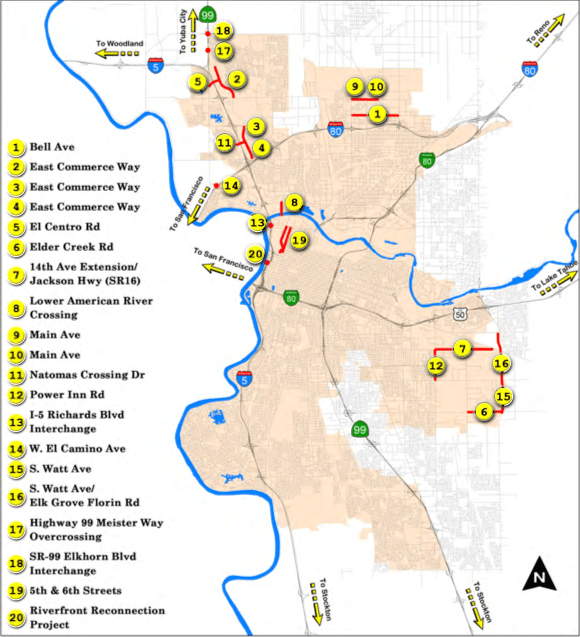
The Sacramento Transportation Authority (SacTA) has developed an ordinance and transportation expenditure plan for a new half cent transportation sales tax, intended for the November ballot. All of the cities and the county have supported the measure (some overwhelmingly, some closer), and SacTA has voted to forward the measure to the Sacramento County Board of Supervisors for placement on the ballot. There are reluctance to put a tax measure on the ballot when so many other tax increases have happened over the last few years, and in such a time of uncertainty. But it is also being sold by boosters as a jobs creation program. I can’t predict what the supervisors will do. Nonetheless, it is my time to speak out against the measure.

Here is what I believe to be wrong, first as a tax measure:

  • The proposed Measure A is in large part an attempt to bail out the existing Measure A, which is nearly out of money because almost all projects were bonded (a gift to wall street), rather than being pay-as-you-go with a few exceptions for large or very high priority projects. There is no reason to think that financial mis-management won’t continue under the new measure, and there is nothing in the ordinance language to prevent it.
  • Sales taxes are inherently regressive, and we must stop funding government with sales tax. It is time to move to property tax and other taxing mechanisms. Sales tax places the greatest burden on those least able to afford it, as low income people pay a much larger percentage of their income to sales tax than do higher income people. This is not an argument against all sales taxes, but I think we have gone far enough down that road and it is time to STOP.
  • The anti-tax arguments against the measure, however, are a red herring. The anti-tax suburbs and exurbs exist because of subsidies of their infrastructure and transportation system by the rest of the county. For these people to now object to the measure because it doesn’t continue to provide them the high level of subsidy they demand is disingenuous, to say the least.

Second, as a transportation measure:

  • Measure A perpetuates, for 40 years, the cars-first model of transportation, continuing to expand lane miles and interchanges. The fact that there is money for transit and to fix roads does not change the climate-killing expansion agenda of the measure. Transportation expenditures should now be 100% for mitigating the effects of our past misallocation of transportation funds, not reinforcing them. Anyone who is paying any attention knows that the global climate change is going to slam our existing habits and infrastructure, and to me, the idea of continuing down the road of capacity expansion is criminal.
  • No amount of transit expenditure will bring us to a balanced system so long as we continue to fund (subsidize) the competition to transit, personal motor vehicles.
  • Freeways are inherently racist, since they were created and continue to serve to allow suburban and exurban whites to access central city jobs while not have to fund or support central city infrastructure. We have seventy years of catering to the desires of suburban whites, and it is time to shift to supporting those who were disinvested.
  • Though the transportation agencies continue to give lip service to maintenance, or ‘fix-it-first’, no sooner does the tax start then they are trying to undermine maintenance. It has always been this way and will continue until there are absolute and irrevocable commitments to maintenance. Measure A contains no such commitments.
  • Substantial portions of the Measure A TEP are for highway interchanges. These projects exist solely to benefit private development, often the sprawl development of greenfields (agricultural and open space lands). Citizens are forced to subsidize private development, and that development is always large developers and large corporations, never small developers and small businesses.
  • The Capital Southeast Connector is probably the worst transportation project this region has ever seen. Its purpose is to fuel long distance commutes between El Dorado Hills (which is not even in the county) and Elk Grove, and to develop the agricultural land along the alignment. The amount of money going to the project from Measure A has been scaled back a bit, but a stake needs to be driven through the heart of this zombie project, which has been built little by little under the nose of taxpayers, without the required evaluation of the entire project.

And lastly, SacTA ignored most of the input from the SacMoves coalition that could have improved the measure. The input, based on Los Angeles County (Metro)’s successful Measure M and the perspectives of the Mayors’ Commission on Climate Change, was developed over a long period of time by a large variety of community advocacy organizations. Of the model proposals, only a small part was adopted. This despite the board members saying that they wanted to see a Measure M-like effort. When push came to shove, the board fell back on reliance on the the highway building lobby and its city and county minions.

What will happen if the sales tax measure does not go on the ballot, or if it does but fails in November? Well, I know SacRT is so concerned about this that they have placed their effort behind the measure. But the failure, either way, actually opens the window for a transit-only ballot measure, maybe with a source of income other than sales tax, and covering the parts of the county (and maybe part of Yolo County) where people actually want a successful transit system. The very recent court ruling that citizen-origination measures only need 50% plus to pass providing an intriguing possibility for a citizen-led effort to support transit.

I realized I’ve said some very radical things there. Comments that help illuminate the issues or give different perspectives on progressive change are welcome. Comments from suburban NIMBYs and people who believe the right to drive was written into the constitution and bible will be deleted, so don’t waste your time.

Though I have been or am a member of the SacMoves coalition, and several organizations which are members of the coalition, I do not speak for any of them. The words are my own.
more highways

In contrast to the climate-friendly awards under the TIRCP program (SacRT awarded TIRCP funds for light rail), the Congested Corridors Program and Local Partnership Program are larded up with climate-unfriendly highways.

In the Congested Corridors Program, the SACOG region did well, receiving $15M for ‘Sac 5 Corridor Enhancements/1-5 HOV Lanes-Phase 1’, and $110.3M for ‘US 50 Multimodal Corridor Enhancements’. Not funded were additional ‘US 50 Multimodal Corridor Enhancements’, ‘US 50 Camino Corridor Safety and Community Access Mitigation’, ‘South Watt Avenue Improvements, Phase 1’, ‘West Capitol Avenue Road Rehabilitation and Safety Enhancements’ and ‘Electrifying Bus Transit in the Capital Region’.

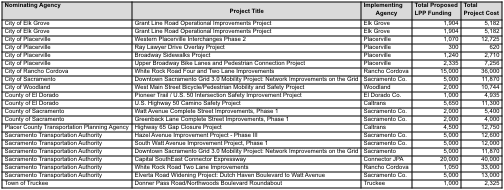
In the Local Partnership Program, the SACOG region received $1.1M for ‘Placerville: Western Placerville Interchanges Phase 2’, $20M for ‘Capital SouthEast Connector Expressway’, $5M for ‘Downtown Sacramento Grid 3.0 Mobility: Network Improvements on the Grid’, and $2M for ‘Woodland: West Main Street Bicycle/Pedestrian Mobility and Safety’. These amounts are relatively small because they are matches for local funding in the self-help counties, counties which raise funds through transportation sales taxes. Not funded were ‘Pioneer Trail / U.S. 50 Intersection Safety Improvement Project’, ‘U.S. Highway 50 Camino Safety Project’, ‘Upper Broadway Bike Lanes and Pedestrian Connection Project’, ‘Broadway Sidewalks Project’, ‘Ray Lawyer Drive Overlay Project’, ‘Highway 65 Gap Closure Project’, ‘Hazel Avenue Improvement Project – Phase III’, ‘Watt Avenue Complete Street Improvements, Phase 1’, ‘South Watt Avenue Improvement Project, Phase 1’, ‘Downtown Sacramento Grid 3.0 Mobility Project: Network Improvements on the Grid’, ‘White Rock Road Four and Two Lane Improvements’, ‘Greenback Lane Complete Street Improvements, Phase 1’, ‘White Rock Road Two Lane Improvements’, ‘Grant Line Road Operational Improvements Project’, ‘Elverta Road Widening Project: Dutch Haven Boulevard to Watt Avenue’, and ‘North Beale Road Complete Streets Project- Phase II’. These rejections might be a sign that capacity-expanding, traffic-inducing, sprawl-promoting projects are less popular than they once were, though the Capital SouthEast Connector Expressway argues otherwise.

SB1 Local Partnership Program applications

The California Transportation Commission (CTC) yesterday released the list of applications for the Local Partnership Program (LPP) which is one of many programs in SB 1, the transportation bill. The SACOG projects have been selected and are below (with pdf link).

Though these are just applications, and the process of selecting and awarding projects will take many months, it is instructive to take a look at what has been submitted by the transportation agencies in the region.

The list has zero transit projects. Though there are separate programs fo transit, nothings prohibits transit projects, but the agencies were not interested.

Four of the projects are Capital Southeast Connector related (Grant Line Road Operational Improvements Project, White Rock Road Four and Two Lane Improvements, White Rock Road Two Lane Improvements, and of course Capital SouthEast Connector Expressway), which total $40M out of the list total of $88M. This sprawl-inducing gift to greenfield developers has been criticized here and many other places, cannot comply with the air quality and VMT reduction goals of the regional sustainable communities strategy (if was grandfathered in), yet accounts for 45% of all applications.

Of the remaining projects, $27M, 31%, are mostly road widening projects. 24% of the projects have at least a minor component of bicyclist or pedestrian benefit, such as complete streets projects, and a few are primarily for active transportation.

ATP regional projects

The California Transportation Commission approved additional projects under the ATP (Active Transportation Program) statewide program, including these in the Sacramento region:

  • Yolo, Davis: Providing Safe Passage: Connecting Montgomery Elementary and Olive Drive
  • Placer, Roseville: Washington Boulevard Bikeway and Pedestrian Pathways
  • Sacramento, Citrus Heights: Citrus Heights Electric Greenway (Class 1 Multi-Use Trail); had received planning money only in original award
  • El Dorado: El Dorado Trail – Missouri Flat Road to El Dorado
  • El Dorado, Placerville: Upper Broadway Pedestrian Connection
  • Sacramento: Folsom Boulevard Complete Street Improvements, Phase 1
  • Sacramento: Two Rivers Trail (Phase II)

And one will receive advance funding so it can start earlier:

  • Yuba: Eleventh Avenue Pedestrian and Bicyclist Route Improvements

Other projects are funded at the regional MPO (SACOG) level. 

principles for transportation investment

As part of my work with transportation advocates, and my personal passions toward a transformed transportation system, here is my Principles for Transportation Investment. It applies to all government levels, but in particularly was developed as an alternative paradigm for Measure B and “Son of Measure B.” Text below, and also a pdf (Principles for Transportation Investment). This is long, but I hope you will take the time to read and reflect. And comment.


Principles for Transportation Investment

The overarching goals for investments in transportation are:

  • creation and support of livable, walkable communities that are economically vibrant for all citizens
  • reduction of distance between housing, jobs and amenities
  • reduction of vehicle miles traveled (VMT) per capita in order to reduce greenhouse gas emissions
  • reduction and eventual elimination of crash fatalities and severe injuries
  • maintenance of our transportation system in a state of good repair

Our transportation system is out of balance, emphasizing private motor vehicles over transit, walking and bicycling. A ten-year moratorium on new roadways and roadway widening, through 2028, will jump-start the process of bringing modes back into balance.

In the past and present, communities of low-income and color have been under-invested, and often dis-invested through lack of maintenance. Future investments must therefore work to return these communities to parity. Specifically,

  • communities of low-income and color must be present at the table for all major transportation decisions, and funding will be allocated to support that inclusion in all planning processes
  • 50% of transportation investments will be in or directly benefiting communities that meet the established ATP/GGRF grant criteria for disadvantaged communities, for at least 15 years or until significant parity is achieved

Transportation investments must meet the goal of reduction and eventual elimination of fatalities and severe injuries. Specifically,

  • the top intersections and corridors with fatalities and severe injuries will be identified and will be used as the primary though not sole criteria for project selection
  • projects which may increase crash rates for minor injuries and property damage while reducing or eliminating fatalities and severe injury, such as roundabouts and mid-block crossings, will be considered for funding without prejudice
  • sidewalks will be considered an integral part of the transportation system, therefore sidewalk installation and maintenance will be completed as a normal part of transportation investment
  • bicyclist and pedestrian fatality and severe injury rates are high and increasing; therefore 25% of transportation investments will be devoted to bringing fatality and injury rates back to parity with mode share

Transportation investment must depend upon a variety of income sources including user fees, property taxes, income taxes, and sales taxes. User fees should be the primary source, while sales taxes should be used in moderation because they are inherently regressive. Specifically,

  • at a state, regional, county and city level, sales tax measures must be complemented by actions to implement user fees, property taxes and income taxes to support transportation

Housing and transportation cannot be addressed in isolation and must be integrated through planning and investment. The economic impact on housing affordability and individual mobility is not just housing costs or transportation costs, but housing + transportation costs. Specifically,

  • no investment in rail transit should be made in areas where there are not existing plans or reasonable expectation of affordable housing development, and no new bus routes created where there are not existing plans or reasonable expectation of affordable housing development
  • governments must invest in affordable and “missing-middle” housing at a rate comparable to or exceeding investments in transportation

A successful transportation system must be integrated with wise land use. Specifically,

  • no transportation investments should be made which promote rapid densification and displacement
  • and conversely, no transportation investments should be made in communities or areas which are unwilling to allow a natural increment of density
  • greenfield development must pay the entire cost of transportation, including long-term maintenance, related increases in transportation capacity for roads, transit, walking and bicycling throughout the region which are engendered by the development, and transportation demand management

Transportation investments at all government levels will support the SACOG Sustainable Communities Strategy. Specifically,

  • since achievement of greenhouse gas reduction targets can only be achieved through a strong investment in transit, walking and bicycling, transportation investments will reflect those goals
  • no project will be funded which would induce increased VMT

Congestion relief in the absence of other measures has and will induce more traffic and therefore additional congestion. Therefore, all projects which are intended to relieve roadway congestion will implement controls to prevent induced demand, including congestion pricing, or will mitigate induced demand through corresponding investments in transit, walking and bicycling.

All transportation projects must address maintenance of the infrastructure in a state of good repair for all time, including eventual replacement cost. Specifically,

  • user fees must support a significant portion of ongoing roadway maintenance
  • fix-it-first must be a continuing commitment at all levels of government until the entire transportation system is in a state of good repair (SOGR), and then state of good repair must be continued
  • all agencies will have and implement a complete streets policy before receiving funding; all roadway repaving projects must consider re-allocation of roadway width to sidewalks, bike lanes, and transit lanes
  • governments will no longer take on responsibility for the cost of maintaining transportation infrastructure which serves greenfield development; therefore the development must allocate a long-term reserve to the maintenance of internal transportation facilities and any highway interchange which primarily serves greenfield development

Fiscal solvency at all government levels must be a guaranteed outcome of major transportation investments. Therefore, all major projects will include a transparent and accountable analysis of the ways in which the project will increase user fees, property taxes, income taxes, and sales taxes which meet or exceed the cost of construction and maintenance.

All transportation investments must support improvement and maintenance of public health. Specifically,

  • investment must reduce air pollution, however, the traditional assumption that congestion relief reduces air pollution must be justified by actual data
  • investment must encourage daily physical activity in all parts of society
  • transportation modes which generate air pollution (roadways and diesel rail) will not be located or expanded near schools and parks
  • transportation planning must consider the removal or reduction of existing roadway capacity such as freeways and/or conversion of diesel rail to electric rail

Education of youth in transit, walking and bicycling will reduce future demand for private motor vehicle travel, and increase demand for livable, walkable communities. Specifically,

  • elementary students will receive pedestrian and bicyclist education
  • middle and high school students will receive transit education
  • 1% of all transportation funds will be devoted to youth education
  • transportation agencies will work with California Department of Education, school districts, private schools and law enforcement to develop and fund model education programs

55% threshold for transportation maintenance

State Senator Scott Wiener has introduced SCA 6, a constitutional amendment that would change the threshold for transportation measures from 2/3 (67%) to 55%. While I understand the desire to make funding of transportation easier, I am also scared by possible outcomes. The Sacramento County Measure B would have passed under this new threshold, but it failed with 65% when 67% was required. Measure B was chock full of bad projects, including Capital Southeast Connector (a new freeway), widening of Capital City Freeway, new interchanges throughout the county (mostly to serve new and planned greenfield developments), and additional road widening and extension. It also had some good things, such as fix-it-first and light rail car replacement with low-floor/level boarding cars.

I am concerned that if this amendment were adopted, there would just be more and more investment in the same old infrastructure solutions that got us into this mess in the first place, and still less dedicated to what we really need for the time being, which is maintenance.

Read More »

transportation development impact fee

The City of Sacramento is working on a Transportation Development Impact Fee (TDIF) for the entire city, and with somewhat different requirements for subareas including downtown, river district, and North Natomas. The Sacramento Bee clued me into the proposal with Sacramento asks developers to open wallets to keep city streets from clogging (SacBee 2016-12-08). My initial guess was that this is in response to the failure of Measure B, but this proposal has been worked on since at least August, so that is not the case. The city has a webpage on development impact fees, with two documents specifically about the transportation DIF. I have not had the time to delve into the details, nor do I have any expertise in this area, so these are my initial thoughts.

Read More »

Missing the message on Measure B

This is a letter I sent to my representative on the Sacramento Transportation Authority (SacTA) board of directors.


I read the Measure B report from Executive Director Jeffrey Spencer, item 12 on Thursday’s agenda, and I have to say I’m rather disturbed by it. (here, or page 41 of the SacTA agenda packet)
In paragraph one, he is completely incorrect about the voter turnout. It was 74.5%, similar to past elections, both on-year and off-year.

In paragraph three, he claims $35K spent by Measure B opposition, and though he doesn’t provide any reference for this, I will give him the benefit of the doubt that he did an FPPC records request and used that info. However, he does not mention political spending by the pro-B group, as well as “educational” spending by SacTA, SacRT, Sacramento County, and the cities such as the glossy mailers that clogged my mailbox. His implication is that pro-B got outspent, but that simply cannot be true.

In paragraph three, he also stated “These news releases and reports are not always factual and can rely on conjecture. Although providing untrue statements, the general public cannot decipher the facts and may rely on this group’s opinions.” That is a pretty amazing statement coming from a public official. Is he really accusing anti-B of lying? He fails to mention that the pro-B glossy mailers had a number of factual errors, mis-statement, straw-men, and questionable implications.

In paragraph four, he says “Discussions with voters after the election…” What voters, whose discussion? I would think there would be documentation here. Though I’m certainly not claiming anything but anecdotal evidence, I heard two things from voters after the election: 1) anti-tax sentiment, and 2) opposition to a measure that spent so much on roadway expansion and so little on transit. Voters got that there was a focus on fixing roadways, and the pro vote was probably in large part due to that, but they also recognized that there was unnecessary roadway expansion larded onto the measure.

You can’t solve a problem if you misidentify what that problem is, and in my opinion, Mr. Spencer has failed to admit failure, has mis-identified the reasons for that failure, and therefore, cannot solve the problem.

If SacTA is to have any chance of moving forward WITH the community to address transportation issues, they need to a) listen to the public, and b) come up with innovative solutions rather than the 1970s thinking represented by the failed Measure B.

roads in California and Sacramento County

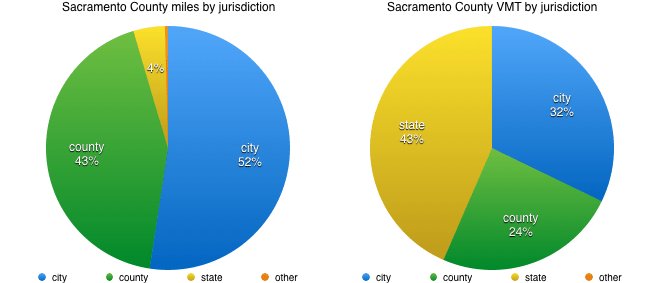
In preparation for some exploration of funding sources for roads, it helps to see what the situation is with the jurisdictions and types of roads, for mileage and VMT.

Jurisdiction means the level of government responsible for the road. This is not always clear from simply looking at a road. If there is a federal or state highway sign, it is pretty clear, but there are roads that are part of the state highway system that are not signed as such.

The types of roads, here, means functional classification, which is a federal designation of Interstate, Principal Arterial – Other Freeways and Expressways, Principal Arterial – Other, Minor Arterial, Major Collector, Minor Collector, and Local. Again, it is not always easy to distinguish classification, but as a generality, freeways fall into the first two, major roads such as Folsom Blvd and Watt Ave fall into the third, busy wide streets are the next three, and residential streets are the last. Another useful classification is that the first six categories are roads, meant to move motor vehicle traffic, and the last is a street, meant to provide access to residences and small businesses. Unfortunately, we build far too many of the road variety and then put business on them so they no longer function well to move cars. See Strong Towns for a more detailed explanation of roads, streets, and stroads.

Read More »

Measure B and air quality

Warning: nerdy detail ahead, but nerdy detail of critical importance to acheiving air quality goals in the region.

In the April 2016 draft Measure B included the following language:

Federal Air Quality Requirements. Measure_ Expenditure Plan funds programmed for a project construction phase that must be included in a federally approved air quality conformity determination to either the Metropolitan Transportation Plan (MTP) or Metropolitan Transportation Improvement Program (MTIP) shall have consistent project descriptions to the listing in the MTP & MTIP before the Authority allocates construction funding for the project phase.

The final Measure B language is:

Federal Air Quality Requirements. Measure_ Expenditure Plan funds programmed for a project construction phase shall not impair the ability of the region’s Metropolitan Transportation Plan (MTP) and Metropolitan Transportation Improvement Program (MTIP) to meet federal air quality conformity, as determined by the Sacramento Transportation Authority Governing Board.

The difference may seem subtle at first glance, but it is not! The original language meant that:

  • projects must be considered as a whole, not piecemeal
  • all projects must meet federal air quality goals
  • SACOG would make the determination of whether the project met federal air quality goals

Instead:

  • projects can be considered piecemeal
  • a specific project need not meet air quality goals as long as the overall program does
  • the Transportation Authority rather than SACOG will determine whether a project meets air quality goals

Why is this important?

The Capital Southeast Connector! The Capital Southeast Connector, at full build-out, would be an environmental disaster for the region. It will induce traffic, create more long distance commuters and further separation between housing and jobs, and very likely prevent the region from meeting greenhouse gas reduction goals.

How did it happen?

The language was changed at the Sacramento Transportation Authority board meeting on April 28. Region Business, which is a front group for greenfield developers, and California Alliance of Jobs, which represents employers who build roads, threatened board members with loss at the next election if they did not kowtow to the demands of the developers. This is not speculation: Kerri Howell, board chair, specifically said that the threat was made that candidates would be put up against her at the next election, and many other board members reported similar threats or nodded their heads in assent. And sadly, the board caved to these threats. After considerable non-public negotiation (the board members gather behind the dais), including discussion with the board members who had supported the original language and SACOG staff, compromise language was developed and passed, and is now part of Measure B ballot text.

What does it mean?

It means that Measure B has been tailored to the needs of greenfield developers. It was clear from the beginning that project allocations followed the old and discredited model of sprawl and cars-first development, but with this change it is now clear that Measure B will damage air quality in the region and prevent us from reaching greenhouse gas reduction goals.