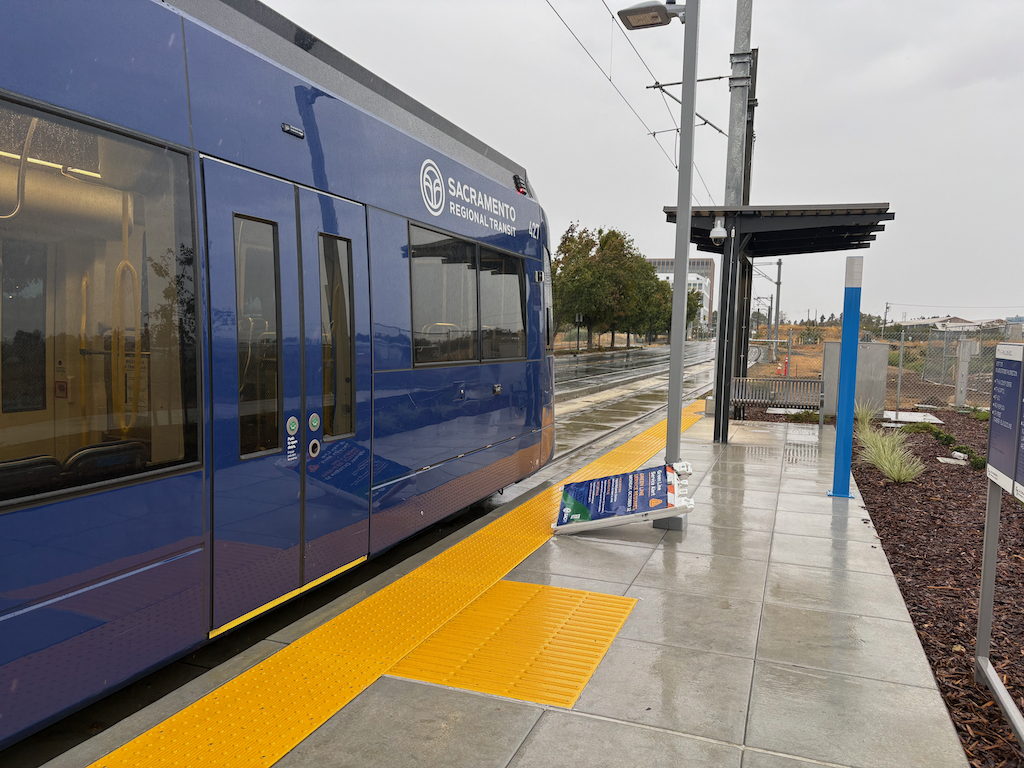
I visited the new SacRT light rail station at 7th & Railyards yesterday. The station has been open several days. Green Line service started October 12, and the station opened October 15.
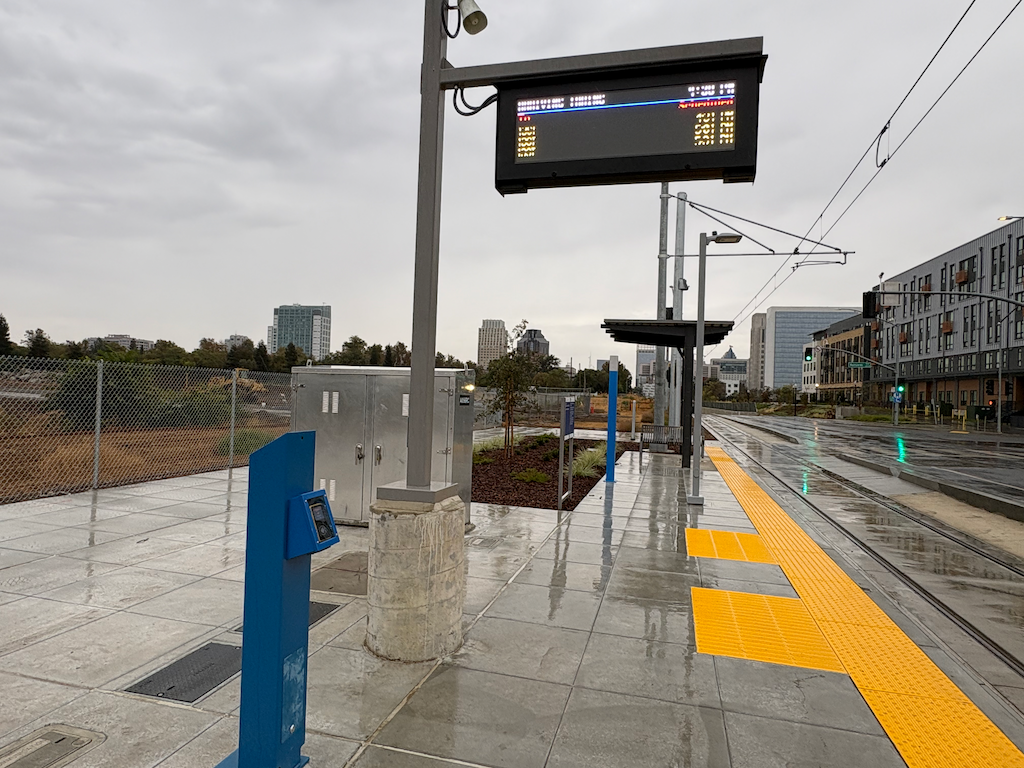
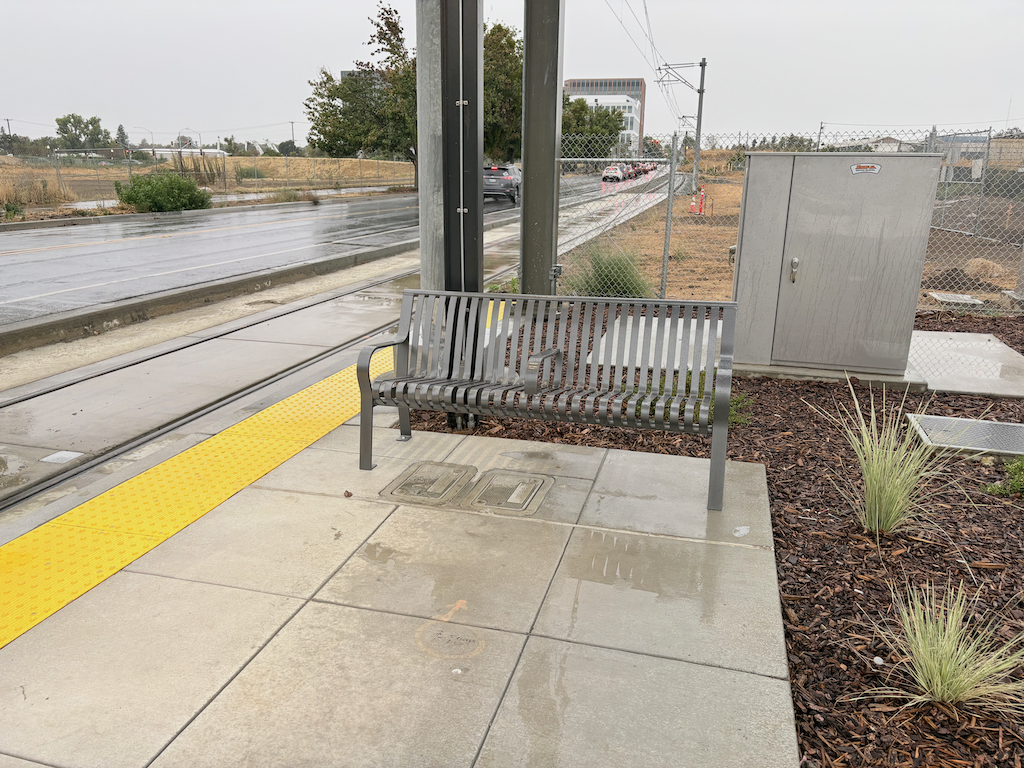
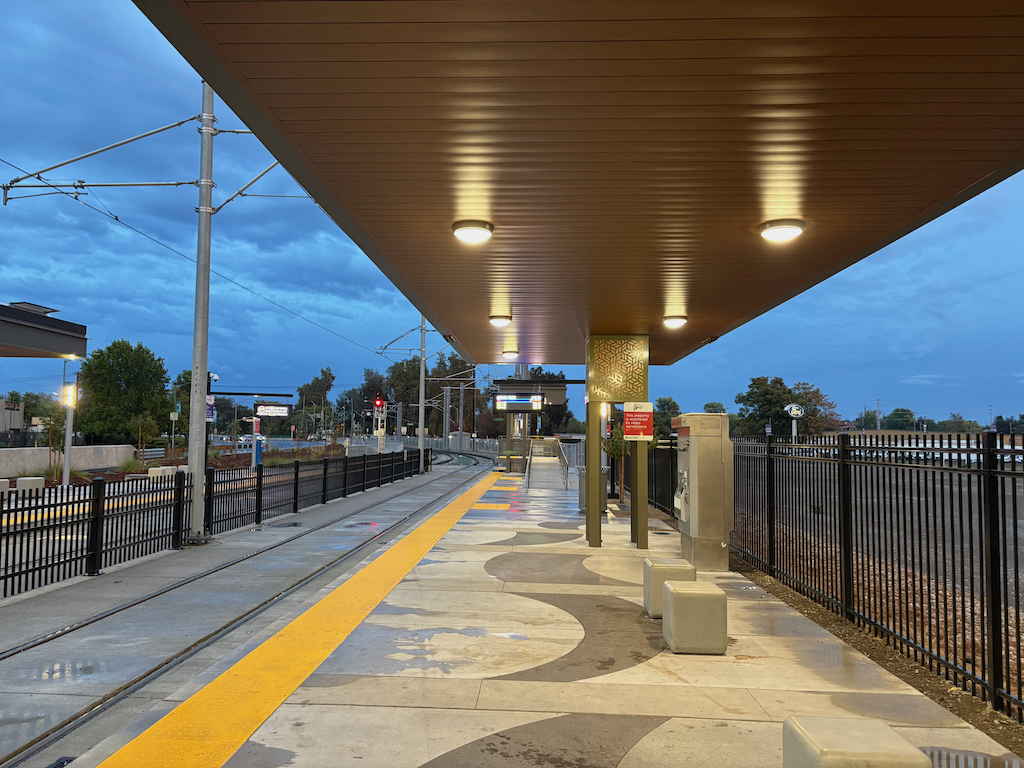
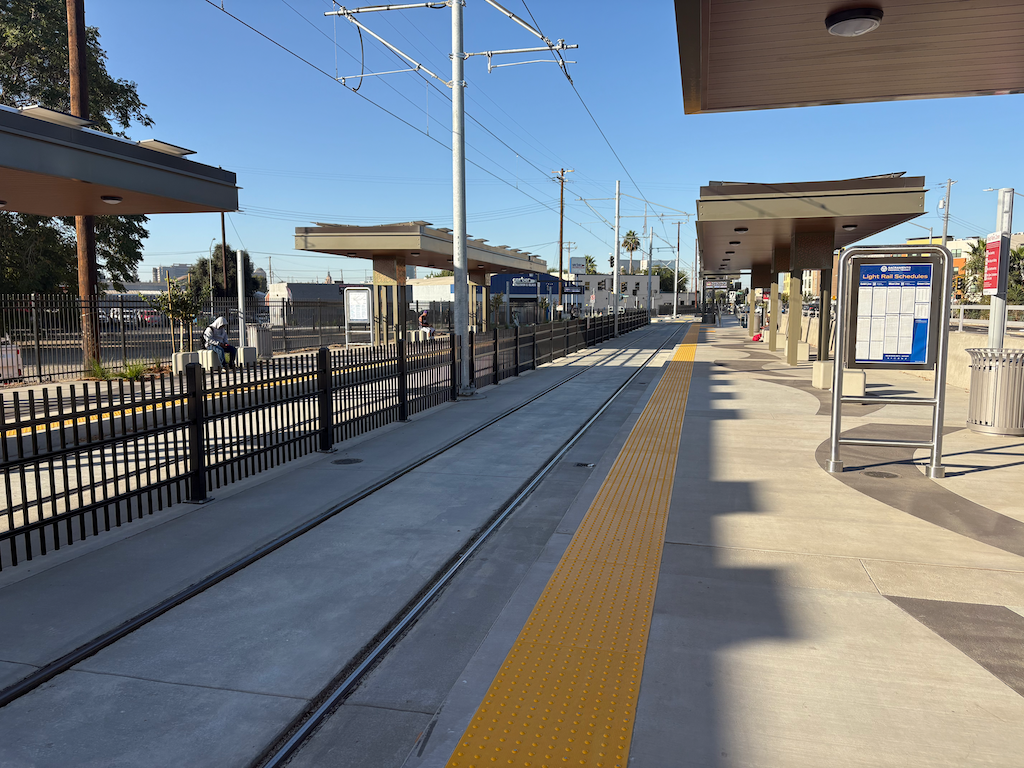
The station is very bare bones, especially compared to the new Dos Rios Station. There are two benches, at either far end of the platform. There are shelters, but they are small, don’t fully shelter the benches. I was not there at night, so I don’t know how well lit the station is. There are two trash cans, and both had been vandalized already. There is some planting, not much.
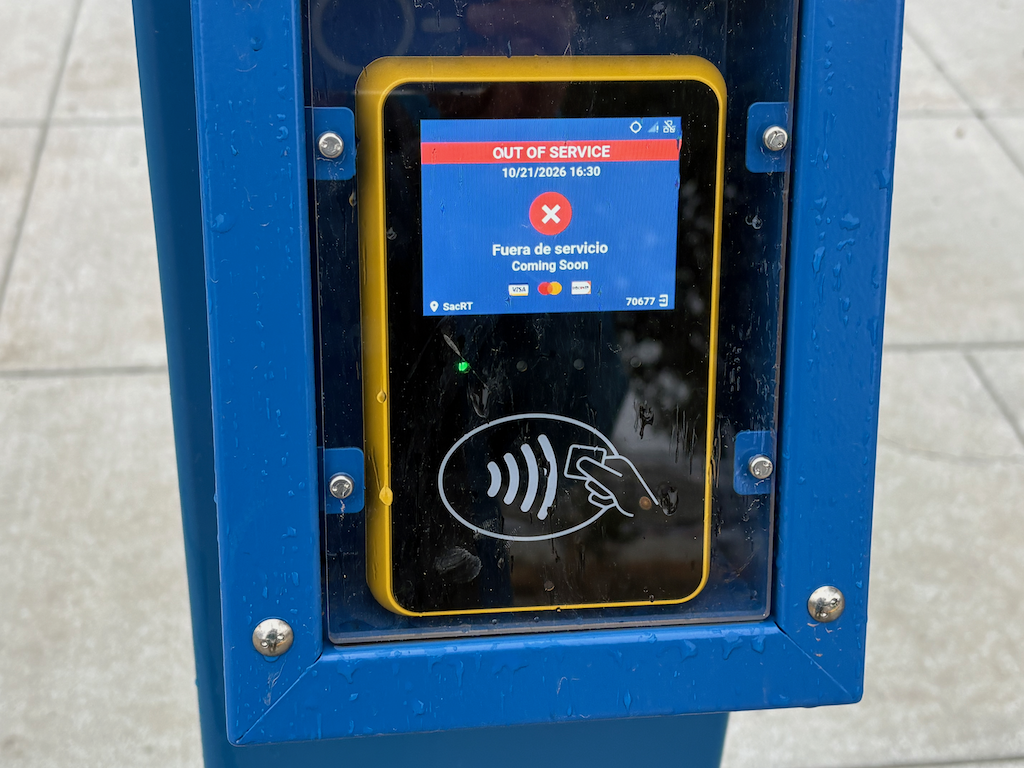
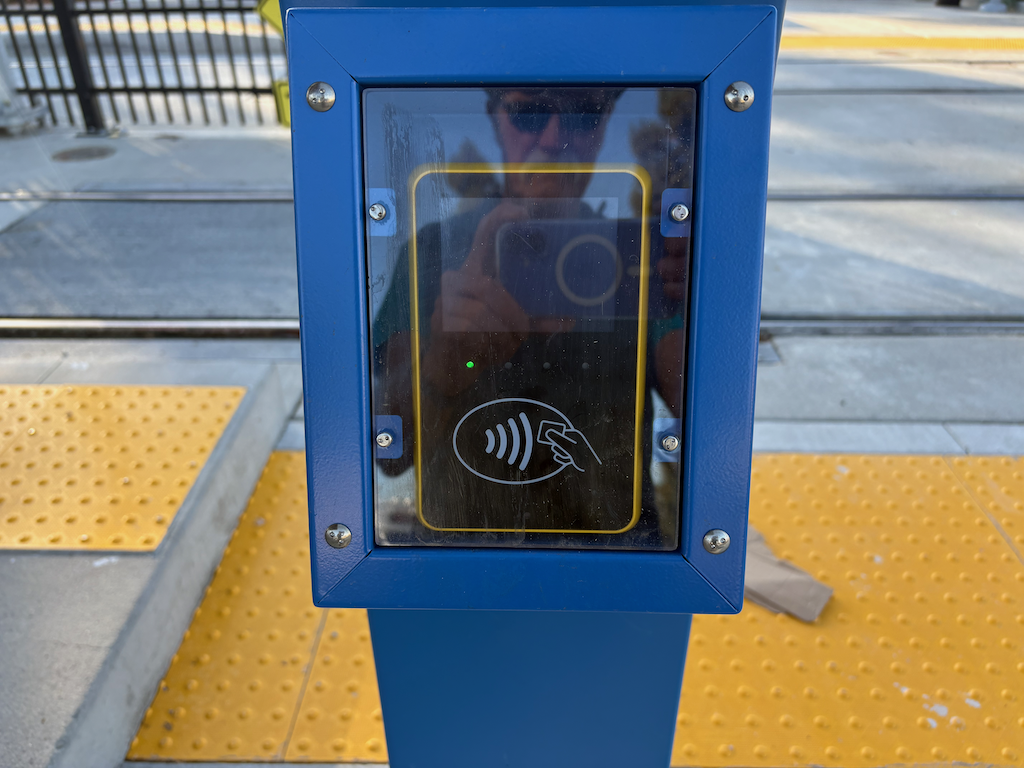
There are two Tap2Ride readers, at both ends of the platform, but they were out of service when I visited. This was supposed to be the second pilot site for Tap2Ride on light rail. There is no ticket vending machine (TVM) at the station.
There is single track, so the 30-minute headway train from the end point at 7th & Richards/Township 9 Station just returns through the same station and platform. Since there is not much to see, I caught the same train southbound that had brought me northbound. The trains are single car S700s.
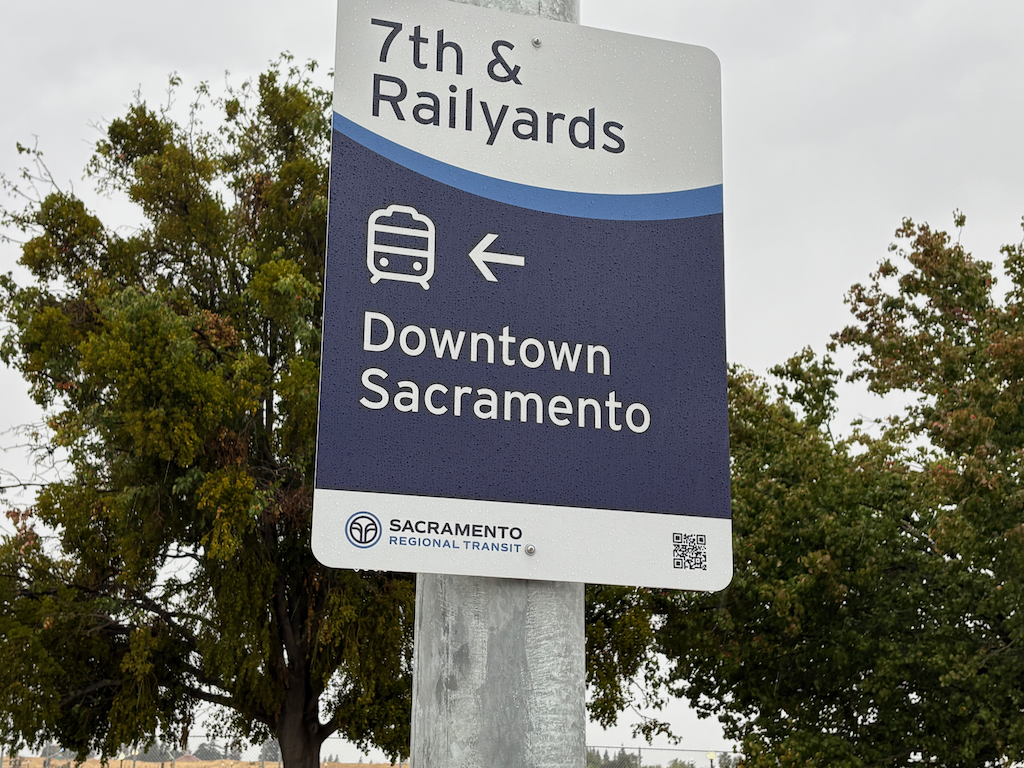
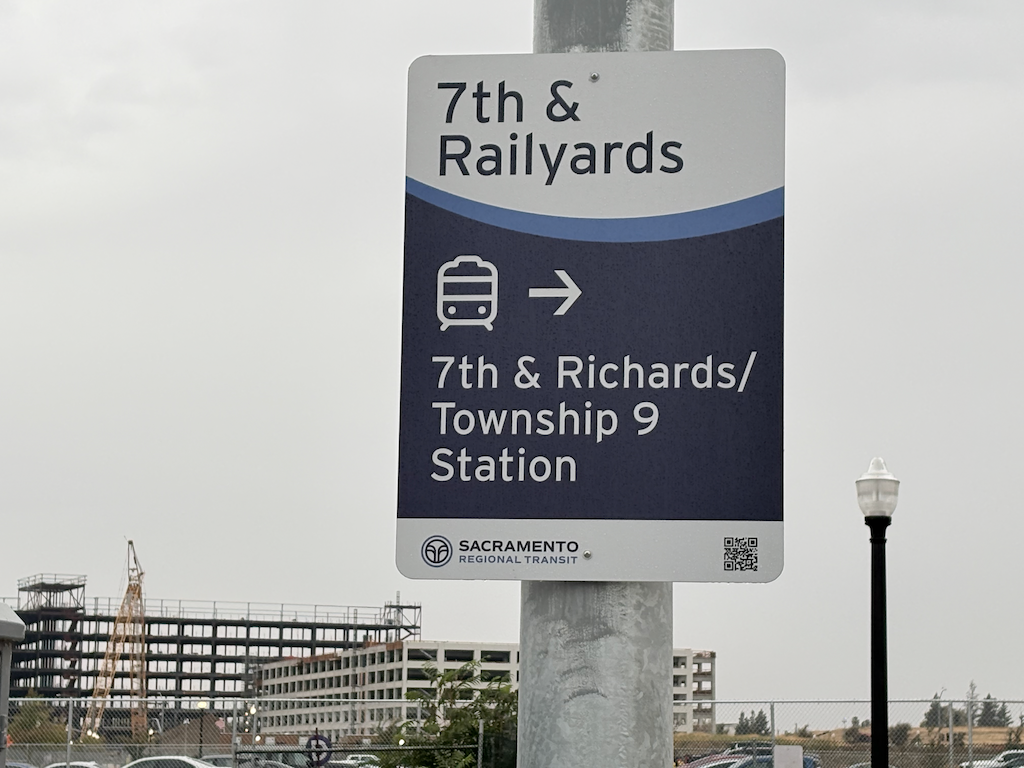
There are signs that indicate destination, but there are no signs to indicate that the northbound train stops at the north end of the platform, and the southbound train at the south end of the platform. This is a major flaw, since a person waiting at the wrong end would likely not be able to get to the other end in time to catch a train.
This station was paid for and built by the Sacramento Republic FC (soccer) owners, not by SacRT. SacRT said that when the developments in the Railyard come on line, the station will be upgraded with access to the soccer stadium, a wider plaza, and double-tracking at least for the station. It is not clear whether the route along 7th Street will ever be double-tracked.
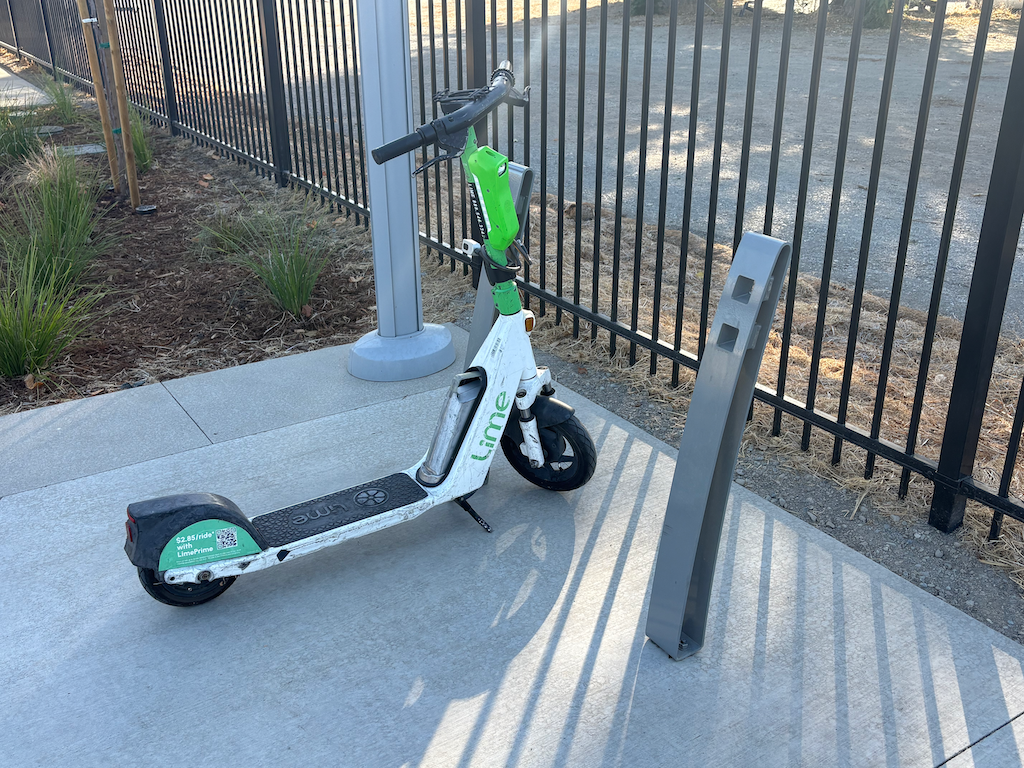
The gallery below is my photos from the brief visit.
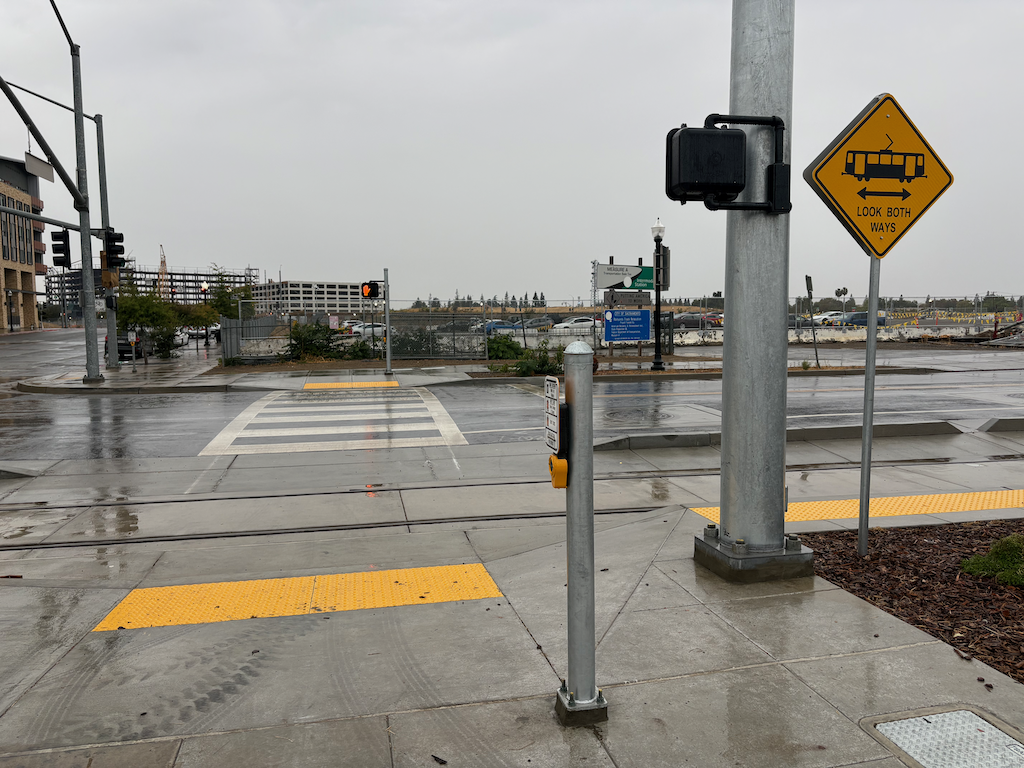
7th & Railyards Green Line train northbound7th & Railyards platform looking south7th & Railyards sign to downtown7th & Railyards sign to Township 9Tap2Ride out of servicecrosswalk over 7th St7th & Railyards bench
The SacRT Board will meet on Monday, October 26, 2026, starting at 4:00 PM. The simplified agenda is below, with selected documents of interest to me, linked.
A policy response on zero-tolerance, strollers, carts, and bicycles is not part of this agenda, so far as I can determine.
SacRT has added a ‘public participation‘ document, which addresses remote participation and comments. Comments in person and via email remain the same, as explained in the agenda.
I may have comments on agenda items between now and the board meeting.
2.1 Motion: Approval of the Action Summary of September 28, 2026
2.2 Receive and File: Quarterly Treasurer’s Report
2.3 Conditionally Awarding Contracts for Pre-Employment and DOT/DMV Certification Medical Examinations and Evaluation of Job Description Physical Requirements
a) Resolution 2026-10-119: Conditionally Awarding a Contract for Pre-Employment and DOT/DMV Certification Medical Examinations, and Evaluation of Job Description Physical Requirements to Agile Occupational Medicine PC; and
b) Resolution 2026-10-120: Conditionally Awarding a Contract for Pre-Employment and DOT/DMV Certification Medical Examinations, and Evaluation of Job Description Physical Requirements to Dignity Health Medical Foundation, A California Nonprofit Public Benefit Corporation, dba Mercy Medical Group
2.4 Resolution 2026-10-121: Approving Sole Source Procurements for Supply Purchases and Maintenance and Repair Services for Equipment, Components, and Parts for Light Rail Maintenance and Wayside Contractors and Delegating Authority to the General Manager/CEO to Execute Contracts
2.5 Resolution 2026-10-122: Approve the First Amendment to Fiscal Year 2025-2026 Transportation Development Act Claim
2.6 Resolution 2026-10-123: Rescinding Resolution No. 12-04-0050 and Revising SacRT’s Voting Procedures for Property and Business Improvement District Assessments
2.7 Resolution 2026-10-124: Authorizing the Execution of the Cycle A and Cycle B Low Carbon Transit Operations Program Project(s) and Certifications and Assurances, and Submittal of Project Nominations and Allocation Requests to Caltrans for Fiscal Year 2025-26 Low Carbon Transit Operations Program
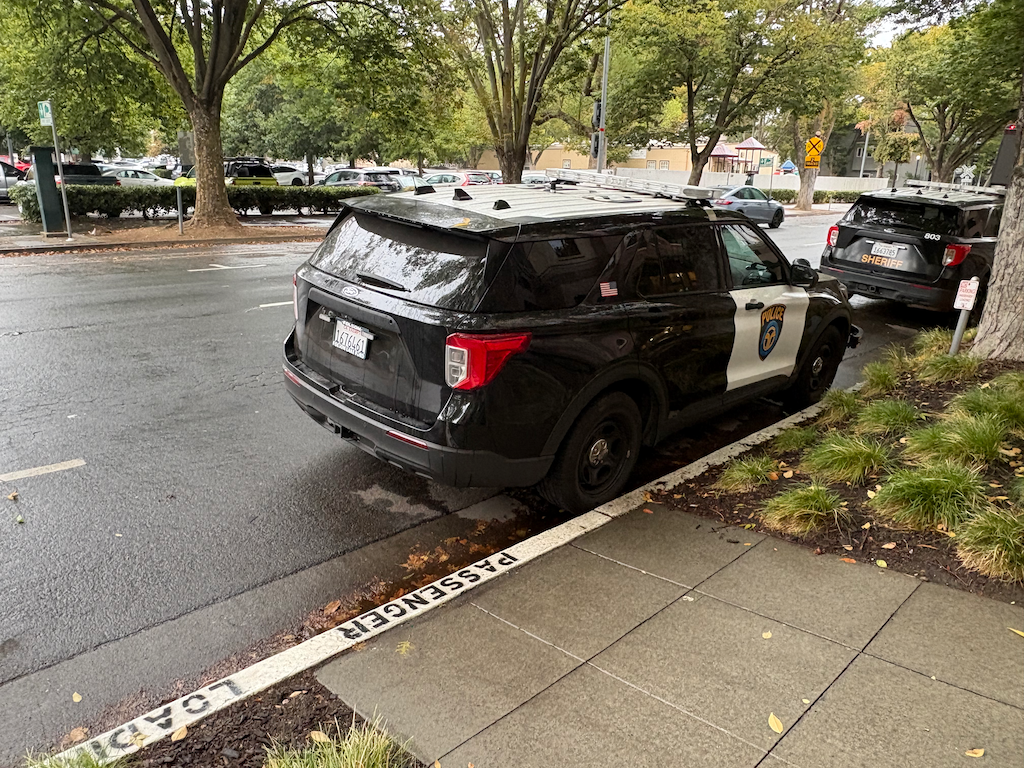
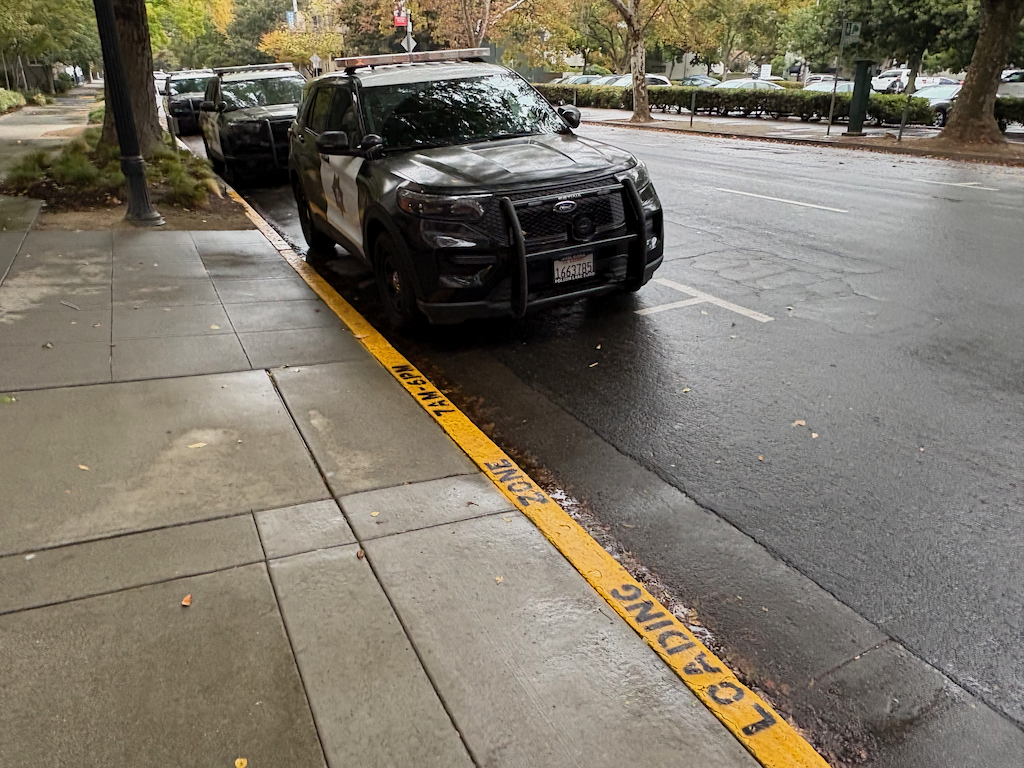
Today, I observed a UPS truck parked in the bus stop red curb zone on Q Street at 11th Street. When I asked the driver why he had parked illegally in a bus stop, he pointed out that police were parked in both the white passenger loading zone and the yellow commercial loading zone in front of 1102 Q Street, SacRT Headquarters. These police vehicles were not ‘on call’, they were still parked there an hour later. Of course there were also SacRT and Sac County Sheriffs vehicles parked illegally in a no parking zone on 12th Street. Again, these were not ‘on call’, they were simply choosing convenience for themselves over safety for the public.
Because the UPS truck was in the bus stop, the SacRT bus (presumably Route 109, though I did not catch the head sign) had to stop in the travel lane on Q Street, and the two waiting passengers had to step off the curb and cross the parking lane to reach the bus. One passenger had a disability and was challenged by stepping off the curb.
So, illegal and arrogant parking by SacRT police ends up endangering SacRT passengers. No surprise on my part.
SacRT police parked illegally in passenger loading zone, 1102 Q StSacRT police parked illegally in commercial loading zone, 1102 Q St
Whenever the topic of Green Line light rail to the airport comes up, SacRT board members and staff claim that this is the highest priority of the public. This is false. The last board meeting spent a lot of time on the Green Line, the reserved right-of-way, light rail, and BRT ideas. There is a funded BRT study: Green Line to the Airport: A Vision for the Future. Several board members said that they supported the BRT study, but that the ultimate solution was and remains light rail. Despite one of the parts of the 2026-09-28 board presentation being on the BRT study, the three maps in the presentation were all of the ultimate light rail alignment, not of the BRT project.
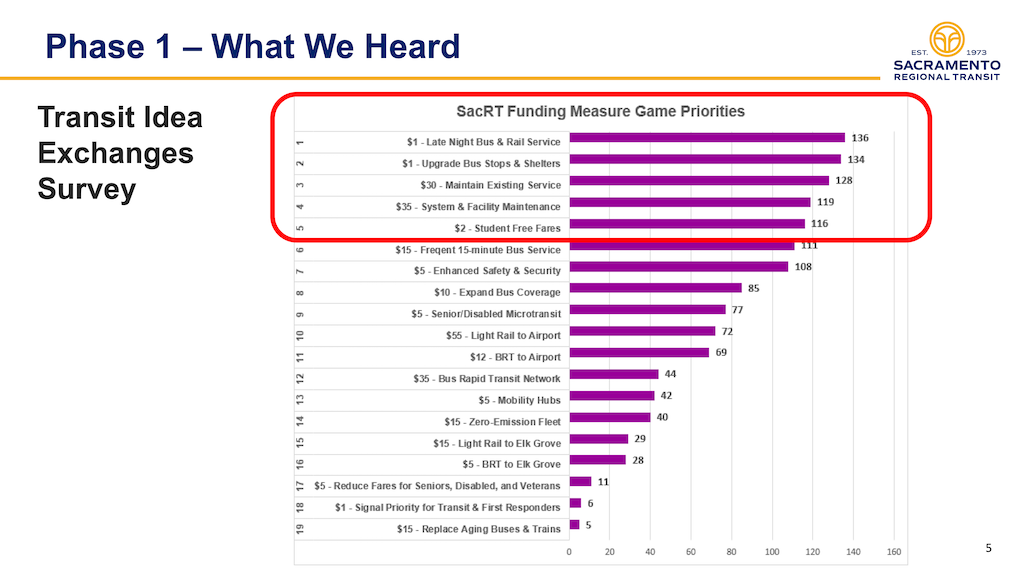
SacRT ran a public outreach process to gather input from the public on what they wanted from SacRT, as part of the Comprehensive Operational Analysis, to determine both short range and long range priorities. The Transit Idea Exchange: What We Heard & What Comes Next page provide information on the process and the outcome. The page lists five public priorities: Improving bus and light rail service frequency and reliability, Increase service hours on bus and light rail, Making stations and stops more welcoming and accessible, Enhancing safety, lighting, and cleanliness, and Keeping fares affordable for seniors, persons with disabilities, veterans and students. Light rail extensions, whether to the airport or Elk Grove, were not in the top five. The page does not contain details on process and results, but there are scattered documents that are relevant.
A presentation to the board on 2025-10-27 (https://startransit.wordpress.com/wp-content/uploads/2025/11/sacrt_2025-10-27_agenda-5-1-funding-presentation.pdf) has a chart from the Transit Ideas Exchange Funding Game (page 5). Green Line light rail to the Airport ranked 10, and light rail to Elk Grove ranked 15. A separate survey by FM3 (starting page 8) conducted to gauge support for a transit sales tax measure, again indicated that the public thought light rail extension less important than maintenance.
I was only able to attend one of the workshops, in Elk Grove (STAR: Transit Ideas Exchange in Elk Grove). Despite being located in Elk Grove, and given the City of Elk Grove’s desire to see light rail extended well into Elk Grove, and SacRT board member and Elk Grove city council member Rod Brewer’s support, the public was not interested. The public wanted better bus service.
So, given these facts, why does the board and staff continue to claim Green Line light rail to the airport is the public’s top priority? Because it is the shiny thing. ‘World class cities’ have light rail to the airport, and Sacramento city and county and region want nothing more than to be considered a world class city. The politicians on the SacRT board (all are elected officials, appointed from the cities and county) also want projects for which they can do ribbon cutting. Better bus service does not involve ribbon cutting.
World class cities also have great transit systems. We do not, far from it. Things like light rail, or subway, to the airport, which indeed many cities do have, are built on a base of high-frequency, affordable, effective bus transit. Without that, light rail to the airport is an isolated and very expensive shiny thing that is not useful because the basics have not been met.
STAR advocated, in How to build successful transit and many other posts, for an incremental approach to building transit service. Yes, light rail is on the list, but it is not the starting point. SacRT is running hourly service to the airport, Route 142 Airport. Ridership is low, in part because the service schedule does not meet the needs of workers at the airport, and in part because hourly service cannot be effective. Yolobus also runs hourly service to the airport, which is more successful because it also serves Davis and Woodland, but it is very slow. SacRT and Yolobus schedules are not coordinated. The next step for the airport is high frequency bus service with a long span of service. Not BRT, not light rail.
To use an expression, service to the airport is ‘sucking all the oxygen out of the room‘, meaning that a focus on the airport is taking up time and energy that could be devoted to improving bus service and starting to address the coming funding crisis that will require SacRT to reduce service.
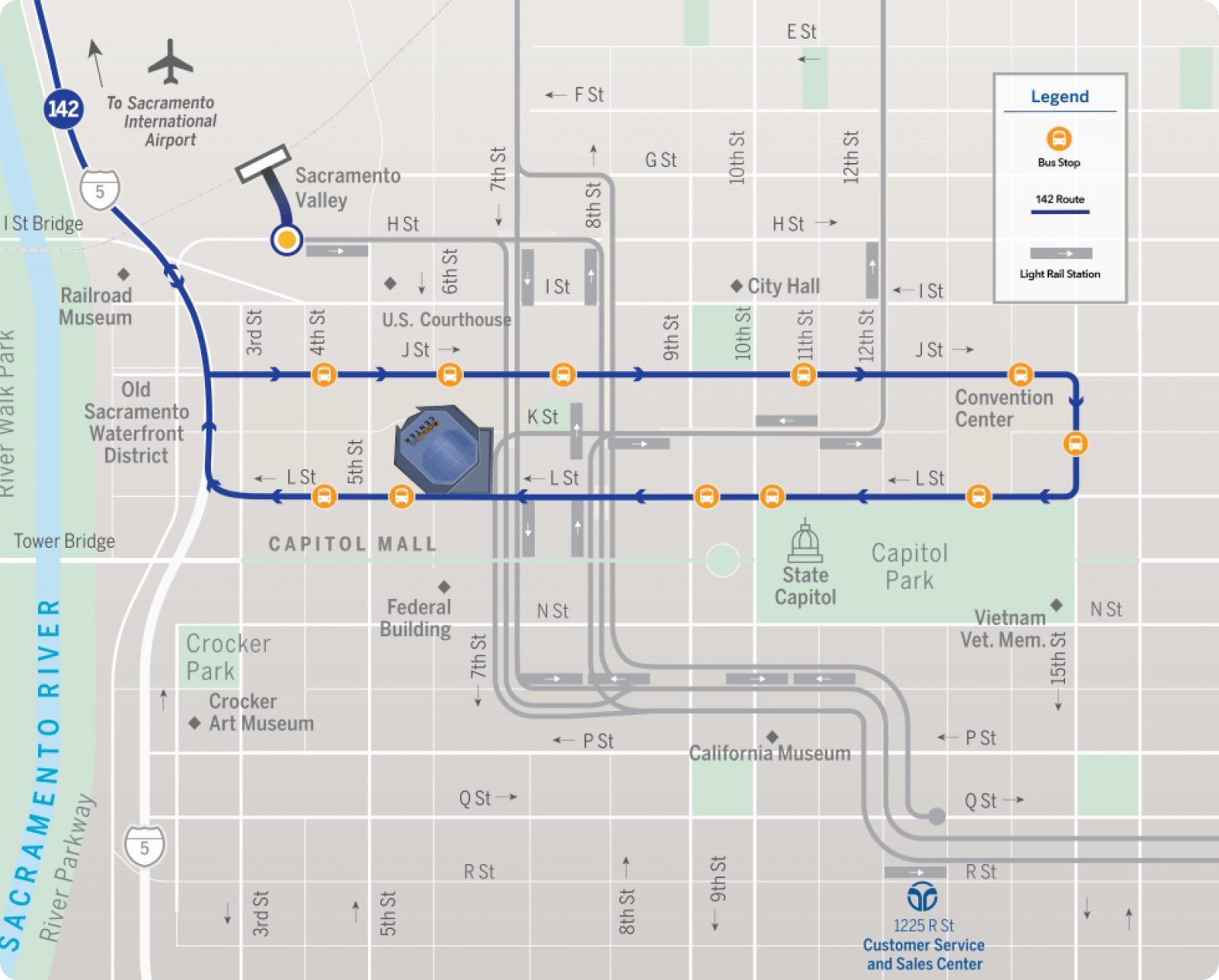
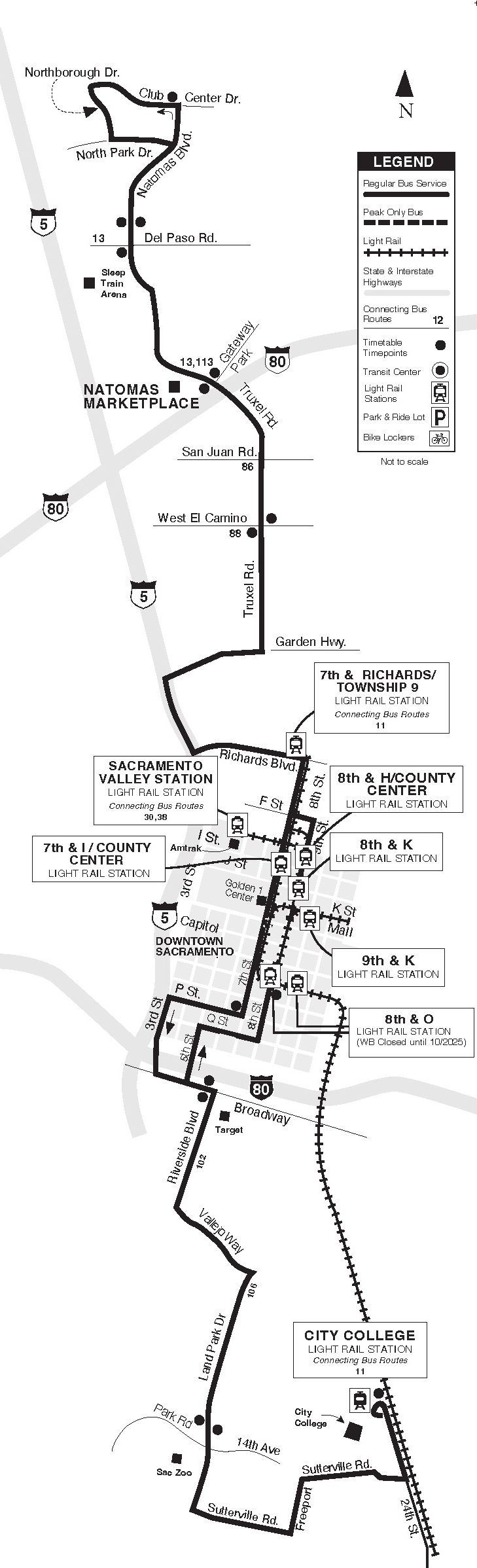
Three maps below show routes that are relevant to the effort to serve North Natomas and the airport. The first two maps show Route 142 Airport Express bus, with a frequency of 60 minutes. This route uses Interstate 5 for much of the distance. The third map shows Route 11 Natomas/Land Park bus, with a frequency of 30 to 45 minutes (one of the two lowest frequency regular bus routes). This route jogs briefly to Interstate 5 to connect Truxel Road and 7th Street.
Update 2026-10-22: At a Sacramento Transit Alliance meeting at Dos Rios Station last evening, the group was there when the lights came on. Wonderful! This is by far the best-lit station on the entire light rail system.
SacRT Dos Rios Station lights
The Dos Rios light rail station is now open, as of September 28, 2026. This station, between Alkali Flat/La Valentina and Globe stations, was built to serve Mirasol Village and other homes and businesses just south of the American River.
Though you won’t find mention of this on the SacRT website, SacRT and SACOG tried to kill this station, but Mirasol Village residents, the public, and transit advocates rose up to defend it, and it was eventually approved and constructed (SacRT board passes Dos Rios station). Construction took a long while, mostly to move utilities and address contaminated soil which was more extensive at the site than originally estimated.
The station is very nice. A SacRT employee commented that it would be great if all the light rail stations were this nice.
The station has the traditional ticket vending machines (TVMs), but to my surprise also has the new Tap2Ride readers that will eventually be installed at all light rail stations. These are the same readers that have been installed on all the SacRT buses, but here they are housed in a protective box. I noticed three readers, though there may have been a fourth, located at ends of the platforms where the track crossings are located. For two of the three, the screens were illuminated. I used one as an experiment, and it worked, deducting $1 from my account (I am registered in SacRT’s Tap2Ride as a senior). One reader had a blank screen, but it beeped at my phone, so might be working. SacRT’s original intent was to integrate Tap2Ride into the TVMs, but I am glad to see they are separate, since many functions of the TVMs do not work properly. It isn’t clear whether the eventual Transit Connect physical cards will be read by these Tap2Ride readers, or by some modification of the TVMs. No Connect Transit Card readers, the old legacy system, were installed, and the TVMs never were able to read these cards, though they claim to.
SacRT Tap2Ride reader at Dos Rios Station
The station has a fence installed between the two tracks for this side-boarding station. Though these are not required at stations with the higher platforms, 8 inches above top of rail, they may be required when the platforms are eventually raised to 14 inches above top of rail, sometime in the 2030s. There are track crossings at the north and south ends of the platform. All of the side-loading stations on the north section of the Blue Line have these median fences. I think they are a good thing.
There is a crosswalk over North 12th Street towards Mirasol Village from the southbound platform, and access to Sproule Avenue from the northbound platform.
The station has ample sun/rain shelters, and ample seating blocks (not benches), and trash cans. Though I did not visit at night, it appears lighting is good. I did not notice a drinking fountain. Many light rail stations have drinking fountains, but almost all are non-functional. I guess SacRT has decided they are not capable of maintaining drinking fountains.
SacRT Dos Rios station
At the south end of the northbound platform, there are some odd devices that might be intended to be bike/mobility racks. These do not meet the requirements of the APBP (Association of Pedestrian and Bicycle Professionals) bike parking standards, which are recognized by the City of Sacramento. Of maybe they are just intended to be for scooters, but then there aren’t any bicycle racks. I don’t know.
SacRT bike racks ? at Dos Rios station
Another infill light rail station in the River District is due to open sometime this fall. SacRT is advancing planning for an infill station on the Gold Line at Horn Road, but this one is in early stages.
I wrote about the SacRT project to upgrade Watt/I-80 light rail station and bus transit: SacRT: Watt/I-80 station upgrade, and more recently about the freeway and traffic noise issue at Watt/I-80. But I went there not just for the noise issue, but to look at some other issues.
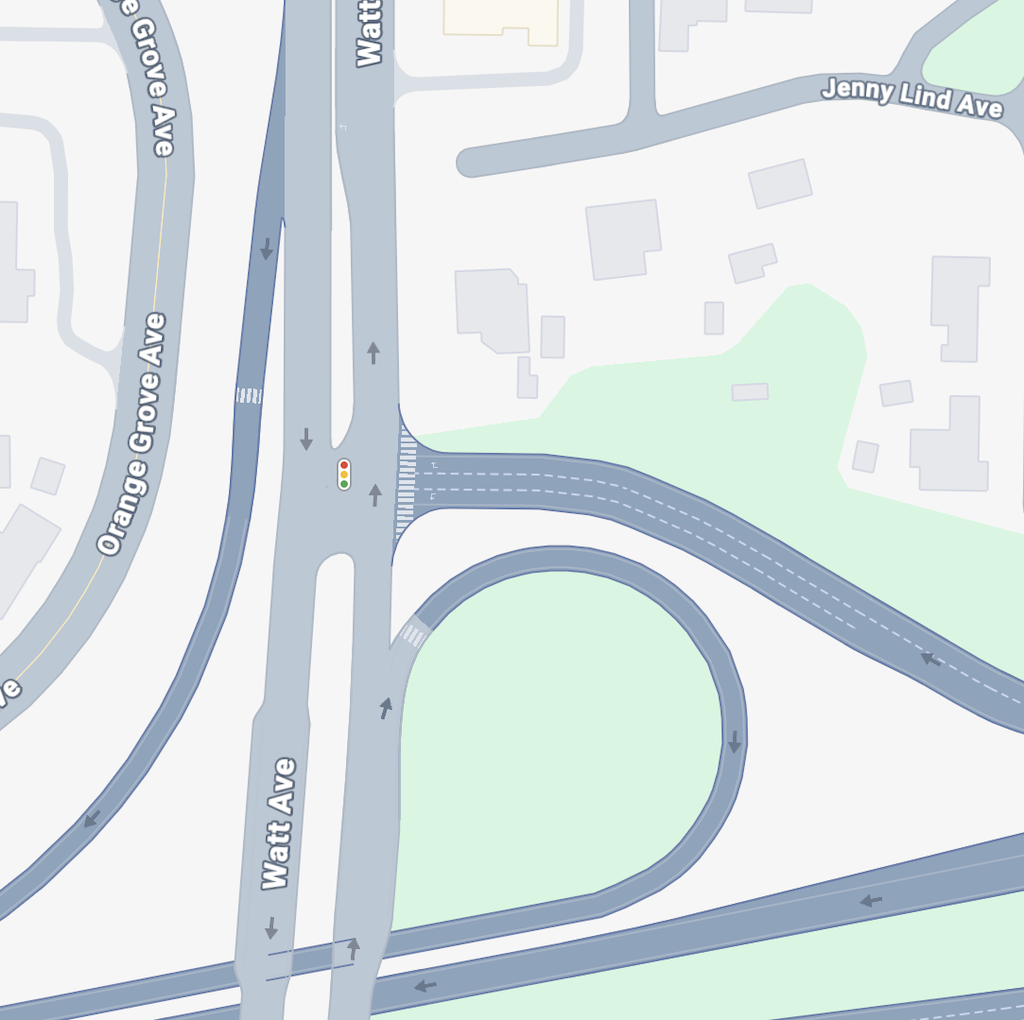
The project included changes to the freeway on-ramps/off-ramps to the north and south of the Watt/I-80 station and bus areas. They were reconstructed to make on-ramps closer to right angles, in order to slow traffic which presents an ongoing danger to people walking to and from the buses and light rail, or anywhere, for that matter.
I-80 on-ramp/off-ramps at Watt Avenue, north side, westbound traffic
The former configuration is shown in the Google map capture, below.
Watt Ave & I-80 on-ramp/off-ramp, north side, westbound
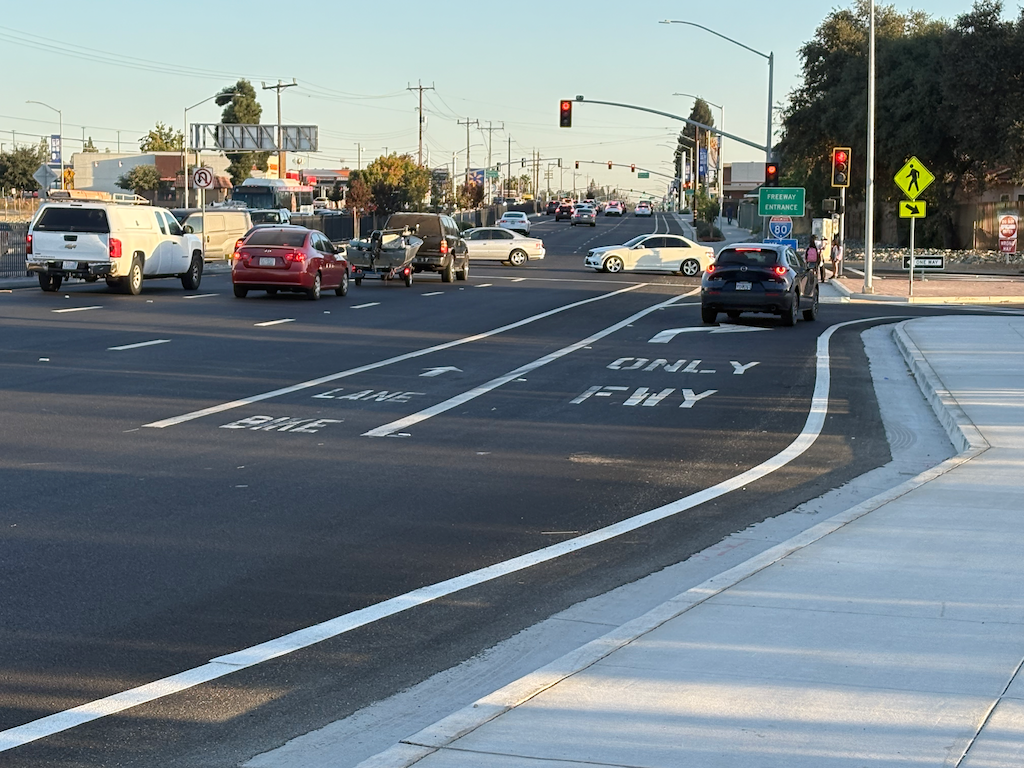
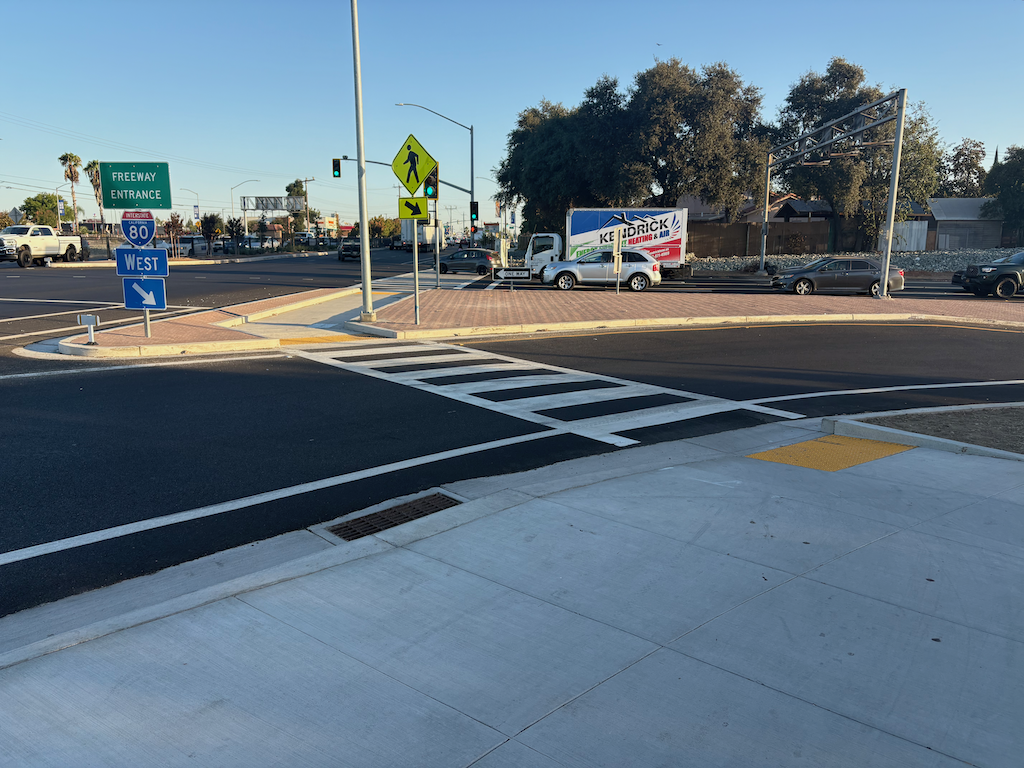
The sweeping cloverleaf on-ramp that encourages high-speed traffic and no attention to people walking and bicycling has been changed to a more right-angle turn, shown below.
The first shows a bicycle lane that was not present before, and the second a crosswalk over the on-ramp that is more prominent and somewhat safer than before. However, the bike lane lacks marking for the merge zone. There should be skipped green marking that highlights the conflict area in the merge. The current marking implies that motor vehicles have the right of way over bicyclists, when in fact this is a merge area where neither has precedence. Note that Watt Avenue north of this on-ramp/off-ramp has been reconstructed and now has bike lanes, but this is a different project.
The crosswalk over the on-ramp is better marked and better signed than what was there before. However, the implication again is that motor vehicles have the right of way over pedestrians. Though drivers are moving slower than before, there is no indication that they must yield to walkers. Drivers entering a freeway don’t think of these crosswalks as having the same rules as surface streets, if they even are aware that walkers have the right-of-way in crosswalks (many drivers do not know this, and many more know it but don’t follow it). Better, but still not safe.
I-80 westbound on-ramp from Watt Ave, bike laneWatt Ave & I-80 on-ramp/off-ramp, north side, westbound
The off-ramp has not been improved. There are three lanes. I am sure that Caltrans would not have allowed a change that reduced stacking capacity on the off-ramp.
I-80 on-ramp/off-ramp at Watt Ave, south side, eastbound traffic
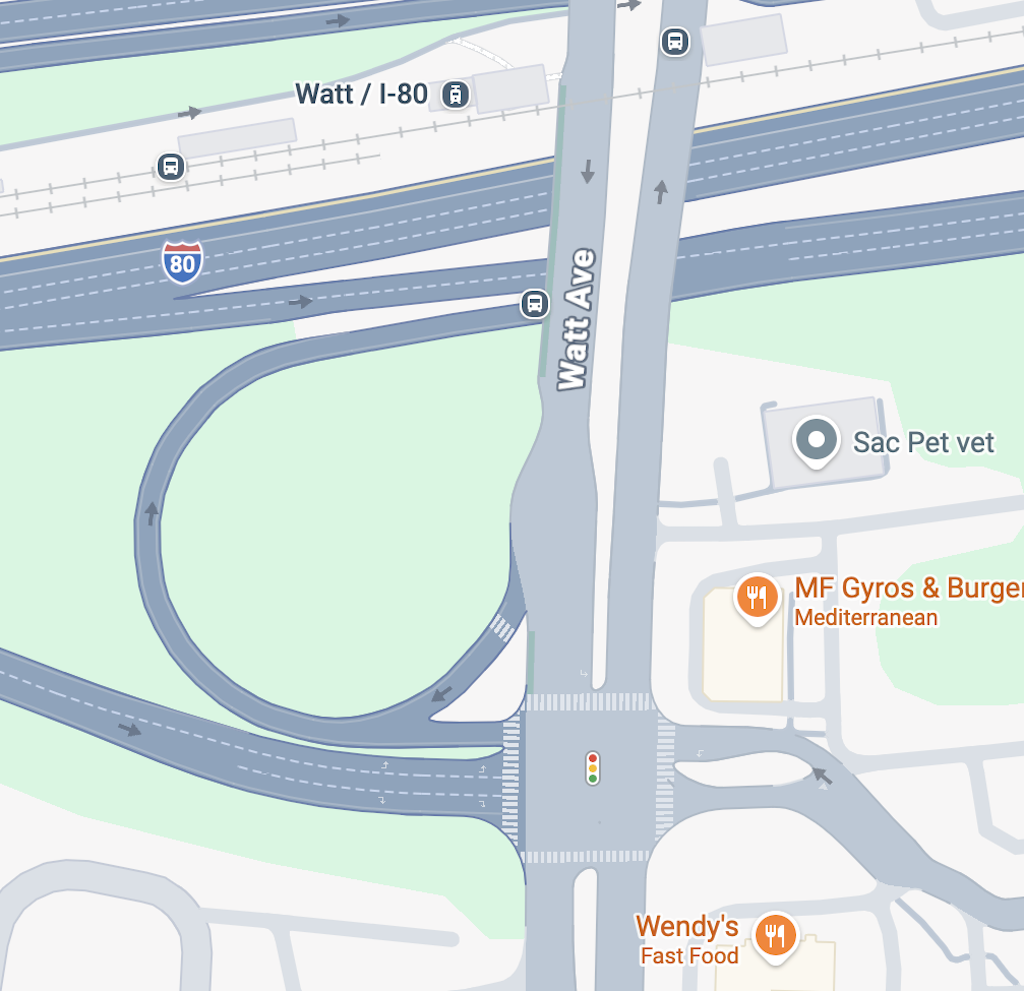
The former configuration is shown in the Google map capture, below.
I-80 on-ramp/off-ramp at Watt Ave, south side, eastbound, former
The eastbound I-80 on-ramp/off-ramp from Watt Avenue has also been improved. The sweeping cloverleaf on-ramp has been modified so that the turn is closer to right angle, slowing motor vehicles. The former on-ramp was also a barrier for people with mobility issues, as the sidewalk was extremely steep and awkward. This is a considerable improvement. However, there is no signal or signing control that prevents drivers southbound on Watt from turning across the crosswalk when it is occupied.
I-80 on-ramp & off-ramp at Watt Ave, eastbound traffic
The off-ramp has not been improved. There are three lanes. I am sure that Caltrans would not have allowed a change that reduced stacking capacity on the off-ramp.
I will comment that these freeway interchange improvements should not have been funded by SacRT, but by Caltrans. Caltrans designed and constructed on-ramps that it knew to be unsafe for people walking. It is legally and morally obligated to fix them, on their own dime.
The stair on the west side for accessing southbound buses is closed while bus shelters are being installed for the three southbound bus stops. Construction is underway, so it should not be too long before it is opened again. In the meanwhile, riders who want to board southbound buses must still walk to the bus stop adjacent to the Sacramento Inn & Suites, which has a very constrained waiting area with no shelter, and accumulates trash. At least there are now better crosswalks to access that stop. The elevator on the west side is out of service, for an indefinite period of time while a part is being ordered.
The stair on the east side for accessing northbound buses is open. The elevator on the east side is in service, but has the same issues it has always had: strong smell of urine, graffiti inside and outside the elevator, trash in the elevator, and damaged glass. SacRT made the decision to not add publicly accessible restrooms in the station upgrade, though it was a strong request of the public and transit advocates. As long as there is no restroom, urination in the elevators will continue. The other issues are vandalism, which may or may not be reduced by the better station design and aesthetics.
Though the platform at Watt/I-80 light rail was fairly clean, the track area had large quantities of litter, which has clearly been there for some while. The abandoned San Diego light rail train definitely doesn’t add to the aesthetics of the station, though it may serve some purpose in reducing freeway noise at the platform.
Since SacRT has committed itself to the freeway median for this terminus station, the most important improvement that could be made, after publicly accessible restrooms, is sound walls to block the oppressive freeway noise. The first one should be on the north side of the station, where the walkway between the east stair and elevator and the station platform is oppressively and dangerously noisy. The second would be the south side adjacent to the platform, where the noise is oppressive but not dangerous.
On this trip, I also visited the new Dos Rios light rail station, which I’ll write about soon.
I was recently in southern California to assist a seminar. The place I stayed was a ten minute walk from the C Line (Green Line) Hawthorne/Lennox station, which runs every 13 minutes. The place I worked was a twelve minute walk from the K Line, which runs ever 13 minutes. The two lines overlap at the Aviation Blvd and LAX/Metro Transit Center, so transfer between the two lines is easy, and was usually a short wait.
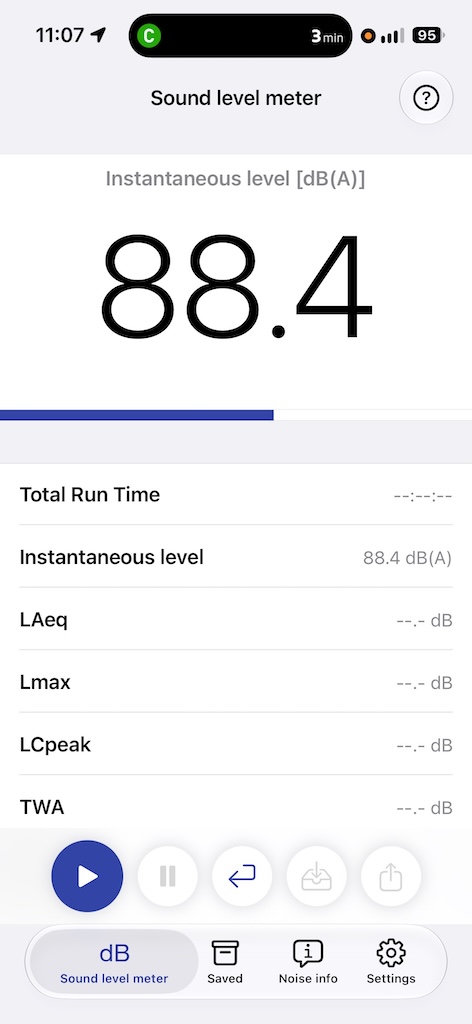
The problem with the C Line is that it was built in the median of a busy freeway, Interstate 105 (‘the 105’), the Century Freeway. It is also parallel to the ‘Imperial Highway’ which is a surface arterial and predates both the freeway and light rail. Almost every light rail station is in that median of a freeway that is 11 lanes wide at the Hawthorne/Lenox station. The freeway noise at this station is oppressive, and I was uptight the entire time I was waiting for the train. I downloaded a decibel app from NIOSH (National Institute for Occupational Safety and Health) called SLM (Sound Level Meter) to see just how bad it is. During non-commute hours, which was the only time I was there, the levels ranged from 80 db to 92 db. Prolonged levels above 85 db are considered hazardous, and levels above 100 of more than 15 minutes risks permanent hearing damage. I would guess that commute hours under free-flowing or nearly free-flowing conditions would be over 100 db. Of course significant congestion would reduce the noise level by reducing tire noise, unless of course drivers are honking their horns.
NIOSH SLM db measurement at Metro Line C Hawthorne/Lennox station
Line C (Green Line) was the second light rail line constructed in the LA area, after the Line A (Blue) line from downtown to Long Beach, which has now been extended far to the east of downtown with the same Line A name. It was opened in 1995. The alignment was picked because it was constructed at the same time as the freeway, so there were no right-of-way costs. As a plus, it is completely grade-separated. However, it is a miserable place to be. Parts of the A Line near Pasadena are in freeway median. Parts of BART are in freeway median. Each and every light rail station in a median is an oppressive place to be. These median running rail systems are popular with transit agencies because they cost less. They are extremely unpopular with riders.
I hope that light rail will never again be constructed in freeway medians. I hope that someday the Watt/I-80 station will be moved out of the I-80 freeway median. Note that the Roseville Road and Watt/I-80 West stations are also in the same freeway median, but as the median is wider at these points, the freeway noise is less oppressive. The location of all three stations is located on the right-of-way of an additional freeway that was never built.
Wikipedia: “One of the lessons learned from the line, and the Harbor Transitway built at the same time, was that freeway median stations offer a poor rider experience, requiring customers to descend from bridges or climb stairs from dimly lit underpasses to isolated stations in the middle of a noisy and exhaust-ridden freeway. While stations generally have elevators as a necessary accessibility accommodation, these sometimes fail, and have been known for having sanitation issues; escalators are also often out for maintenance or, with the C Line in particular, only available downward.”
Not to be outdone, Sacramento has a similar problem with the Watt/I-80 Blue Line light rail station. I visited this morning, more or less during commute hours, though not during the peak. At the station platform, the range was 65 to 80 db, helped a great deal by the row of vegetation between the platform and the eastbound I-80 lanes. The walkway from the platform to the east stairway and elevator ranged from 75 to 90 db, harmed a great deal by reflection off the overhead Watt Avenue bridge, and with no sound protection from the westbound I-80 lanes. Up top, where the bus stops are, with primary noise from Watt Avenue traffic and secondary noise from the freeway below, ranged from 65 to 80 db. Watt Avenue is six lanes wide, and carries heavy traffic. I-80 is eight lanes wide, with seven additional lanes of ramps and bypasses, and carries heavy traffic.
When SacRT was considering what to do with Watt/I-80 light rail station, which was an unpleasant and unsafe location, the public asked that the station be moved out of the freeway median and to a more pleasant and safe location. SacRT decided to retain the location and make ‘improvements’. The dark, urine stained, unsafe west stairway has been replaced by a wide, high visibility stairway. The dark, urine stained, unsafe east stairway has been replaced by a better visibility stairwell. The east elevator is in the same condition it always was, with a strong urine smell, graffiti on the walls, and damaged glass. Though the west elevator is closed at the moment for maintenance, I imaging it has the same issues. Wider walkways and trees have been added at a few locations. The station will indeed by nicer than it was, but nice enough to induce riders that have a choice to use it? I doubt that.
A rather disappointing board meeting (SacRT Board 2026-09-28). Again, staff is underprepared to answer board member questions, and many board members are asleep at the wheel, not asking any questions, or in some cases, not really paying attention.
I spoke on three issues, and my comments are below, in italic. These were written ahead of time, so my actual testimony may have dropped some points or added others. If you want to hear what I said, or other transit advocates said, or board members said, or staff said, you can listen to/watch the YouTube post of the meeting at https://www.youtube.com/watch?v=-0gEKiVZ_3Q&list=PLAfWRxJkwPon701gc9cUsUqqBDlmiWJnt&index=4.
Yet again, the staff report and presentation have not been made available to the public along with the rest of the agenda. With one exception since July 2025, these documents have always been late, even showing up in several cases during the board meeting. I can no longer see this as an oversight, or unintentional. I believe this is an effort on the part of staff to hide this information for as long as possible so that the public and advocates cannot review the documents and develop a response. This is unacceptable.
This item was presented by Lisa Hinz (VP of safety, security, and customer satisfaction).
Board asked about delay of 3.1 documents, Tabitha Smith (board secretary) said it was a website uploading error. Henry Li (general manager) promised it would not happen again. It is a fact that the customer service documents are almost always finished well after other board documents, often after the agenda has been posted. So this is not just a document posting issue, it is a failure to complete important documents in a timely manner.
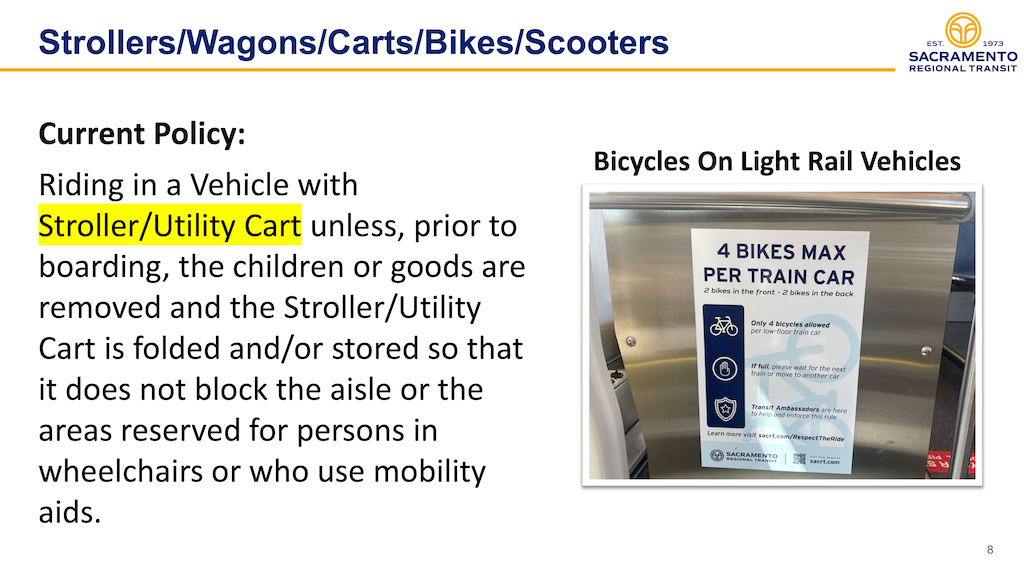
No policy was shared on fare enforcement, strollers, shopping carts or bicycles. Existing policy was restated, slide below.
slide from ‘Customer Service Response to Feedback and Comments’ presentation on stroller policy
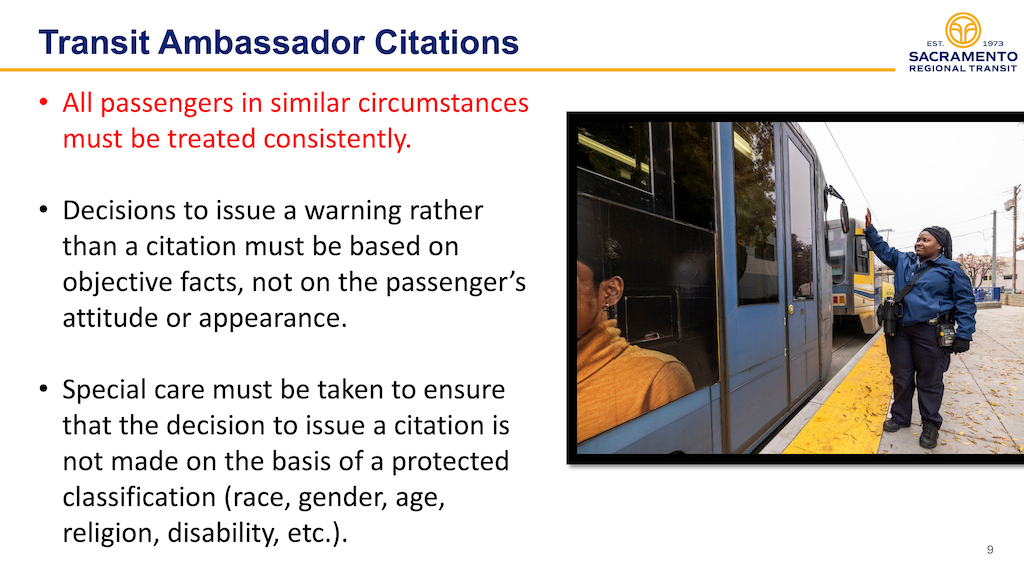
Lisa Hinz gave a vociferous defense of the idea of zero-tolerance, slide below. She said that anything less than zero-tolerance would lead to unequal treatment of passengers, followed by lawsuits against SacRT. It is clear to me that Lisa does not consider riders to be people, then are just names on citations. Her level of empathy for people is zero. Lisa’s attitude is a typical law enforcement one which believes that people are just an inconvenience to the real mission of law enforcement. Guilty until proven innocent. This face that SacRT presents to the public is horrible, and it has resulted in a significant loss of reputation for SacRT, as well, as apparently, a loss of riders.
slide from ‘Customer Service Response to Feedback and Comments’ presentation on zero tolerance
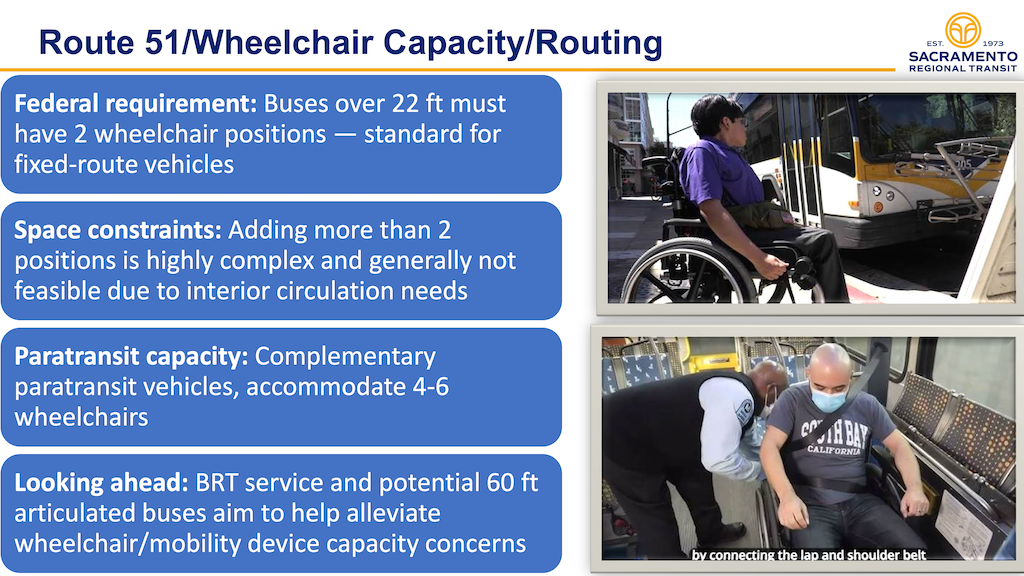
One of the slides indicated that accommodating more than two wheelchairs was impossible for the Stockton BRT, slide below. I added to my comments that AC Transit’s new buses have three to five wheelchair positions. SacRT has chosen to purchase buses that meet the FTA minimums, and not to provide additional capacity. Another advocate reminded that buses not infrequently have to leave wheelchair users behind when the two spaces are already full.
slide from ‘Customer Service Response to Feedback and Comments’ presentation
It appears that policy will go to MAC first, and then back to the board. ‘Proposed Policy for Cart and Wagon use on SacRT vehicles (Priscilla Vargas, ADA Compliance Officer)’ was on the August MAC agenda, but was tabled. It was also on the September agenda, but minutes not available yet, and I have not had time to review the YouTube recording, so I don’t know if it was addressed. (Update: There was some discussion at the September MAC. The policy is that wagons will be banned. Shopping carts will have a size limit, and apparently riders will have to make a ‘reasonable modification’ (The correct term is ‘reasonable accommodation’, but Priscilla Vargas apparently does not know the correct term.) request to the accessibility department (?). Other riders without that permission will have to remove contents and fold their carts. Lisa Hinz contradicted this interpretation. Who’s on first? It was admitted that the public has not been provided information on these policies. Ack! Strollers and bicycles were not addressed.)
This presentation is immensely complicated. It was reviewed by a number of transit advocates, including some who work in transit, and most could not make sense of it. There is too much detail and not enough clarity. The presentation violates the basic writing technique of ‘tell them what you are going to tell them, then tell them, then tell them what you told them’. It may be that some people are interested in all this detail most people want to know ‘what’s the upshot’. That is nowhere to be found.
Though it is hard to parse the information, it appears that the $1.2 billion estimate does not include the $500 American River bridge. So the project is really $1.7 billion. To assume that the city will, under its current and ongoing budget crises, and difficulty winning grants for major projects, be able to come up with a half million is questionable.
I noted several board member nodding their heads on my comment, that they thought the presentation was needlessly complicated.
Serna commented that there must not be sunk costs for conversion to light rail. He asked about a flyover for CA 99 that could be used for both buses and light rail. Hume also commented on sunk costs, and suggested considering alternative modes including autonomous vehicles. He said surface routes may not be good even if dedicated lanes, though I’m unsure what this has to do with the project. Dickinson said the traditional rail is best and questioned why the route (similar to Route 11) goes back to Natomas rather than staying on I-5. Said if people want local service, give them local service; if they want the airport, give them the airport.
It keeps getting claimed by board members and staff that Green Line to the Airport light rail is the top project for the public, but that is not what the ‘Transit Idea Exchange’ listening sessions indicated. The public was uninterested in these very expensive moon-shot projects, and primarily wanted better bus service.
4. Matters not on the agenda
The public relations debacle that resulted from SacRT’s sudden implementation of a zero-tolerance policy on fare collection, strollers, shopping carts, and bicycles, was without any discussion or decision by the board. This indicates to me that ‘customer satisfaction’ must be moved out of the organizational structure of ‘Security, Safety, and Customer Satisfaction’. The law enforcement orientation of this division cannot provide the necessary attitude and attention to the mission-critical function of customer satisfaction.
The placement of the Transit Ambassador program within this division may also be problematic. SacRT has never clearly defined the function of the TAs. If their primary function is law enforcement, leave the program here. If their primary function is customer service, then move them elsewhere in the organization structure. If SacRT does not know what their primary function is, which appears likely, then the program needs to be revisited and revised.
There were several other advocates who spoke on items not on the agenda. Crystal Lee McGee, head of ATU 256 (Amalgamated Transit Union Local 256), introduced Ms. Johnson, who spoke about being harassed by her supervisor as a new mother, and not provided a private lactation area. The SacRT Go supervisor’s name was mentioned but I did not catch it. It is rare for ATU to go to the board with personnel issues, so it is clearly one of critical importance. This may be another instance of SacRT’s anti-family orientation, along with the anti-family stroller policy.
The General Managers Report presentation often includes slides that were not in the posted document. These slides are not made available after the fact.
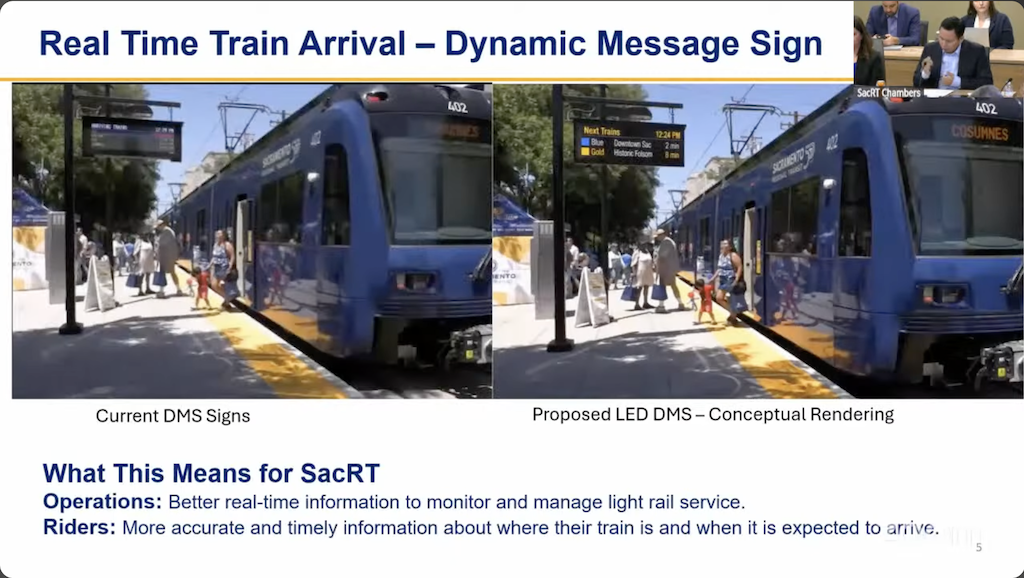
One such slide on was on modern information signs for light rail. Henry said that implementation of new signs is was intentionally delayed so that it could be integrated with the Light Rail Modernization program. This was the first the public had heard about this. Several of the existing signs are non-functional, and have been for some while. Other signs have display issues, making them hard or impossible to read. Even when the signs work, they rarely have useful information for riders. A common message is that light rail trains are running 15 minutes late, which is nonsensical since the frequency during weekday days is 15 minutes. Riders have no way of knowing whether the arriving train is on time or delayed, they just want the train to come. Part of the reason that SacRT can’t provide accurate information about light rail delays is that they did not implement high quality GPS and real-time GTFS for the new light rail cars, so they don’t know where those trains are without asking the operators for location. I did not capture that slide, unfortunately. (Update: I reviewed the YouTube video [1:44:30], and captured the slide below. The new system will be from Clever Devices/Hitachi. Their website shows internal displays but not these external station displays.)
capture from YouTube of 6.1 General Managers Report on real-time signing
In the September MAC meeting, it was announced that 45 new Siemens S700 cars have been or will shortly be on hand, but the next set of cars, 46 to 65, will not start arriving until February of 2029. New cars will gradually replace legacy cars on the Blue Line as they become available. That may mean that the new light rail information signs might not be installed until many years from now. Yow!
The GM report mentioned the following on the Transit Connect program physical cards: “This next phase also includes important updates for Connect Card pass holders. While Connect Card users should continue using their cards for now, the transition to Transit Connect will begin later in 2026. Much like the ZipPass retirement earlier this summer, Connect Card customers will receive a window of time to use any stored value on their cards before switching to the new system. Riders will have the option of moving to the Transit Connect app or obtaining a new Transit Connect smart card if they prefer a physical alternative.” I will re-state that the physical or Smart Card was not part of SacRT initial planning for Transit Connect and Tap2Ride integration. It was added after members of the transit advocacy community including state workers questioned what would replace the Connect Transit Card. It has still not been defined for the public how the physical cards will relate to the app, nor how services will be provided to unbanked people. Critical details of Transit Connect have not been shared with the public. Nothing SacRT does happens on time, so it is likely that Phase 2 will occur sometime next year, not this fall.
To be honest, I have a hard time following the GM report. It is at the end of the meeting, when everyone is tired. Henry spends a lot of time announcing events, which are already on the website and in the Next Stop News, and talking about light rail disruptions, which if reported at all, should be in a separate agenda item.
Update: Staff said that the 3.1 presentation was not available on the board documents page, due to a website upload issue. It still is not there. It was, at some unknown point, available in the agenda combined file, so I extracted it and linked it in the agenda post. Henry Li said that this will not happen again, and that the document will normally be provided at the time of the agenda release along with all other documents. However, this has not happened in the past, and I have doubts about it in the future. There will be more to be said about this agenda item, along with a report on the meeting.
Three hours before the September 28, 2026 board meeting, agenda item 3.1 ‘Customer Service Response to Feedback and Comments’ staff report still has no content, and no presentation has been made available. This is not accidental. Over the period of time since this agenda item was added to the board agenda (July 2025), only once has the staff report and presentation been made available at the same time as the rest of the board agenda. Several times the item has been added during the board meeting.
I have come to believe that this is intentional on the part of SacRT staff, to hide the staff report and the presentation from the public until the last minute, so that the public and advocates do not have the chance to review the documents and formulate a response. Even though the presentations usually gloss over issues, and present ‘solutions’ that are often fabrications, these are still an embarrassment to SacRT. Of all the issues that come before the board, this is the most critical, or perhaps equal with the budget. SacRT exists to meet the needs of riders and the public. When the public, and advocates, are unhappy with the service, SacRT is failing. And it is failing with disturbing frequency. A problem cannot be solved until it is admitted and identified. SacRT does not seem interested.
This issue is related to the location of customer service within the staffing structure of SacRT, and it must be moved elsewhere, out of security and safety (law enforcement): SacRT: move Customer Satisfaction
The SacRT Board will meet on Monday, September 28, 2026, starting at 4:00 PM. The simplified agenda is below, with selected documents of interest to me, linked.
As usual, the staff report for item 3.1, ‘Customer Service Response to Feedback and Comments’ contains no information nor presentation. This delay in making information available to the public is intentional, to make it more difficult for the public to review and comment on this item. Three hours before the board meeting, 1:00 PM on Monday, September 28, item 3.1 ‘Customer Service Response to Feedback and Comments’ is unchanged, still no real staff report or presentation.The presentation was available in the combined agenda at the time of the meeting, but was not and still is not available in the agenda item.It has been extracted and linked below.
It is unknown at this time whether a policy response on zero-tolerance, strollers, carts, and bicycles will be presented, but if so, it will not be for board decision. There are many policies not for board decision, but given the immense controversy that resulted from the staff-implemented zero-tolerance policy, this is an appropriate policy for the board to address and decide upon.
SacRT has added a ‘public participation‘ document, which addresses remote participation and comments. Comments in person and via email remain the same, as explained in the agenda.
I may have comments on agenda items between now and the board meeting.
2.1 Motion: Approval of the Action Summary of August 24, 2026
2.2 Resolution 2026-09-112: Approving the Settlement Agreement and First Amendment to Contract for ADA Paratransit Scheduling, Dispatch and Eligibility Software as a Service with HBSS Connect Corp.
2.3 Resolution 2026-09-113: Conditionally Approving the Contract for On-Call Alternator Rebuild Services (Niehoff) with Kirk’s Automotive Incorporated
2.4 Resolution 2026-09-114: Approving the First Amendment to the Contract for Real-Time Train Information System (Computer-Aided Dispatch/Automatic Vehicle Location) and Dynamic Message Signs with Hitachi Rail CD U.S. LTD. Formerly Known as Clever Devices LTD
2.5 Resolution 2026-09-115: Second Amendment to the FY 2026 Operating Budget
2.6 Resolution 2026-09-116: Formally Consenting to and Supporting the Establishment of the Sacramento Area Council of Governments and the Sacramento Regional Transit District as Dual Designated Recipients for Applicable Federal Transit Administration Formula Funding Apportioned to the Sacramento Urbanized Area
2.7 Resolution 2026-09-117: Approving the Five-Year Agreement for Peace Officer Assignment with the County of Sacramento Sheriff Department