SacRT has decided to delay the hydrogen bus (fuel cell electric) plan to meet zero emission bus (ZEB) requirements, and will buy natural gas buses instead. This was the subject of a SacBee article: Sacramento RT to buy new natural gas buses, delaying zero-emission transition, 2026-09-09, Madison Smalstig. I had missed this, I think because the decision was scattered across several board meetings, and often on consent calendar rather than regular agenda item.
SacRT will require a waiver from CARB (California Air Resources Board) Innovative Clean Transit (ICT) program. SacRT has an approved Rollout Plan from 2021, and more recent proposals for a hydrogen fueling station at McClellan and a fleet of hydrogen fuel cell buses, including a grant (see below). Sacramento Transit Advocates and Riders (STAR) had a series of posts on SacRT’s hydrogen plans and hydrogen in general (see Tag: zero emission buses). It is clear that the hydrogen plans were not well thought out, were not environmentally sound, and were only partially funded. The grant to fund hydrogen fueling at McClellan and hydrogen buses was converted to other buses and a refurbishing at McClellan. SacRT apparently still intend to pursue the idea of hydrogen buses, but will have to start over seeking money for that.
FY24 FTA Bus and Low- and No-Emission Grant Awards: “The Sacramento Regional Transportation District will receive funding to buy new hydrogen fuel cell buses to replace older buses, modernize a maintenance facility and initiate a workforce development program. The project will create jobs and improve service, reliability and air quality as SacRT works to convert its fleet to entirely zero emission by 2028. $76,847,678”
The grant to fund hydrogen fueling at McClellan and hydrogen buses was converted to other buses and a refurbishing at McClellan. SacRT apparently still intends to pursue the idea of hydrogen buses (fuel cell electric), but will have to start over seeking money for that.
SFMTA is going with diesel-hybrid buses: Muni is too broke to use more eco-friendly buses, The San Francisco Standard, 2026-09-14. I assume other transit agencies will be making similar plans. By the way, SFMTA Muni has an incredibly low carbon footprint due to light rail and electric trolleys that run on overhead wires. Sacramento could have some of the same benefit without investing in fossil fuels by considering overhead wires. But it won’t.
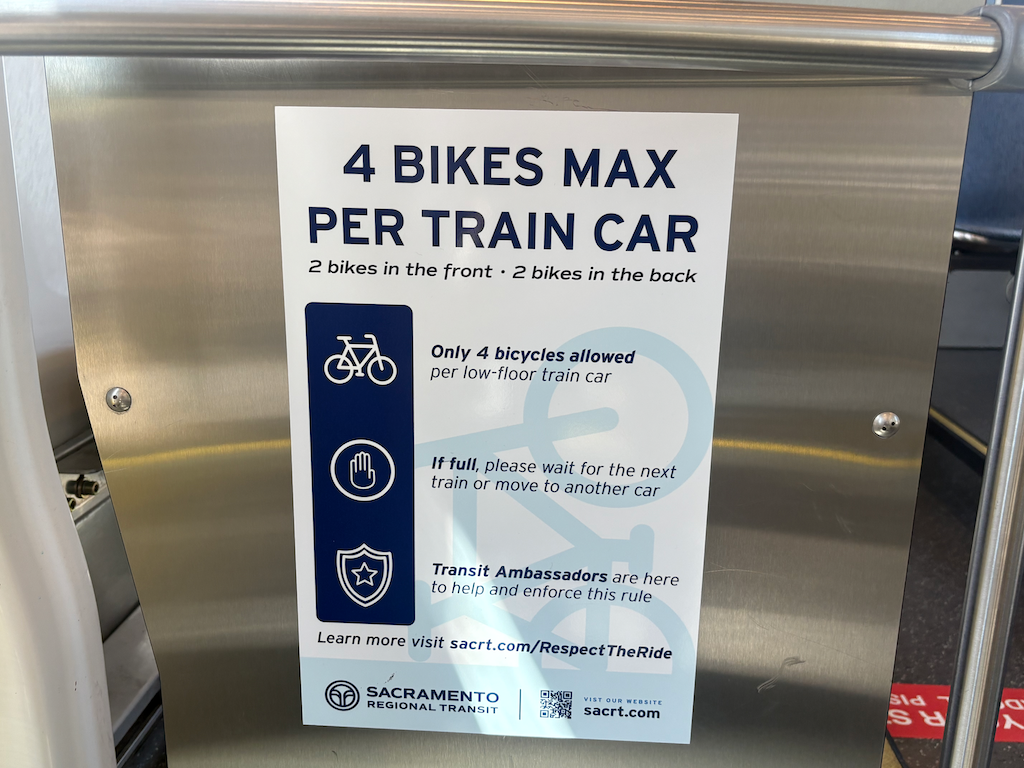
The new Siemens S700 light rail cars, in service on SacRT Gold Line and eventually on SacRT Blue Line, have very limited bicycle space. SacRT’s policy is that there can be four bicycles on each rail car, in the corner by the regular (not handicapped) doors. This policy was unchanged from that for the old light rail cars, so SacRT claimed there was no issue, however, the amount of space available is quite different. Most of the older cars had seats removed to provide additional bicycle space, in addition to the bike hooks on the 200 series cars. The practical bicycle space on these old rail cars was essentially 10 per car. The model of S700 that SacRT has purchased is designated by Siemens as ‘US’, meaning ultra-short. The cars are much shorter than the standard S700, with less space for passengers, wheelchairs, and bicycles. That mistake is not something that can be corrected – the cars are in service, and more are on order, and the light rail system will eventually be exclusively S700 ‘US’ cars.
SacRT bicycle sign four bikes per car
There are conflicts between passengers and bicyclists, and in particular with wheelchair users who have priority access to the ‘priority seating’ area of fold-down-fold-up seats. There have been incidents of bicyclists who were using the ‘priority seating’ area refusing to move. There have been times when so many bicyclists have been on board that it was difficult for other to maneuver around them.
So, what can be done? Two partial solutions:
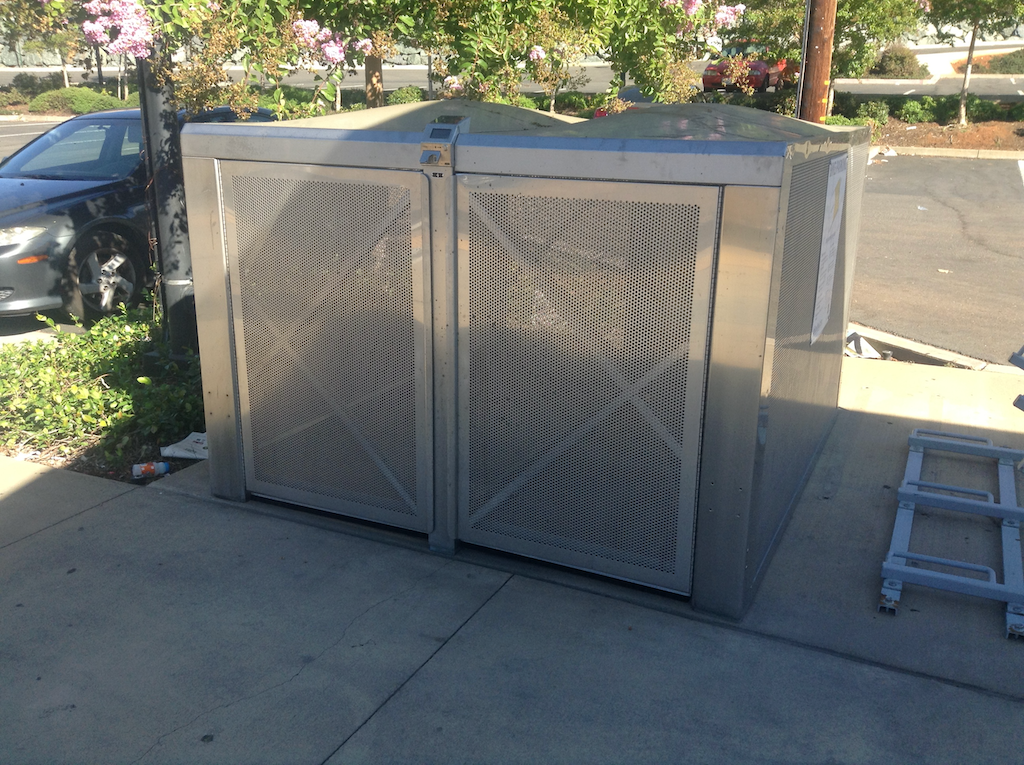
On-demand secure bicycle storage lockers at stations frequently used by bicyclists. Some bicyclists insist on bringing their bicycle on board, either because they need it at the destination, or because there is no secure bicycle storage at the station. Providing secure lockers would allow some bicyclists to leave their bike at the station, rather than bringing it on board. The standard secure bicycle storage solution is BikeLink lockers. Lockers provided by the City of Folsom at Historic Folsom, Glenn, and Iron Point are shown below. No other light rail stations have on-demand storage.
Way back in 2021, Sacramento Transit Advocates and Riders (STAR) made a formal request to SacRT that they provide on-demand secure bicycle storage lockers at light rail stations (secure bike parking). STAR had been talking to SacRT for several years before this on the same issue. The rental lockers provided at some stations were mostly not in use, and the public had no access to them except through a month-to-month rental. At that time, SacRT said they were ‘studying’ it. Meaning they weren’t actually doing anything. Bicyclist transit advocates have over the intervening years continued to ask SacRT about lockers. The answer is always the same – it is being ‘studied’. Nothing has happened. There is nothing related to the ‘study’ on the SacRT website. There is nothing in the board agenda. There is nothing in the budget.
The SACOG Mobility Zones program, which might site hubs at or near light rail stations has identified the Ben Ali/Swanston, Florin, and Rosemont/Western Rancho Cordova mobility zones. However, the zones so far defined do not guarantee co-location with stations. Note that the SACOG Mobility Zones map does not indicate light rail locations, so it is unlikely that it is a central part of site selection. The mobility hub diagrams show regular (unsecured) bike racks but do not show bike lockers.
SacRT is undertaking an apparently separate SacHub: Mobility Hubs Project for three light rail stations: Marconi/Arcade, Globe, and LaValentina/Alkalai Flat. There is no mention on the sparse page of secure bike storage, or even bike racks, for these hubs.
City of Folsom BikeLink lockers at Iron Point SacRT Gold Line station
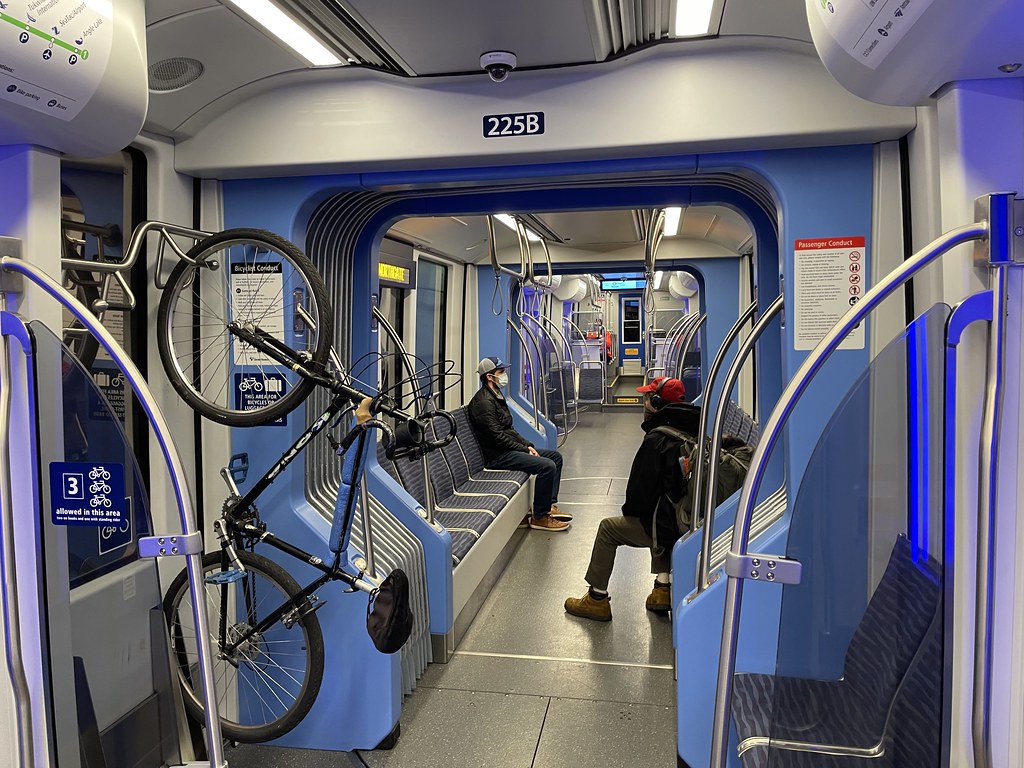
Add a bicycle hanging location in place of a seat on the S700 cars. The seat location is between the handicap ramp door and the accordion section. This would change the allowable bicycles from four to six per car. The photo below shows the bicycle hanging area on a Seattle area Sound Transit S700 light rail car. These are full size cars with more space, but the smaller space on the SacRT S700 cars would probably only allow one bicycle hook per location, or two per car. It is true that some bicyclists cannot lift their bicycle to the hook, but the on-floor locations would still be available for those people. I have been on some light rail vehicles that had bicycle storage in the middle section, between the accordion sections, but it was poorly designed and awkward to use.
Sound Transit LINK 1-Line bicycle hanging storage area
In August of 2024, bicyclists at the light rail demonstration of the new S700 cars indicated that bicycle space was insufficient, and there needed to be more space to accommodate bicyclists. SacRT decided not to add this capability to the new cars.
My conclusion is that SacRT does not take the bicycles on light rail issue seriously, and does not intend to solve the problem.
Enough posts on SacRT and transit, for now, after 10 in the last two weeks. On to other transportation topics!
The work on the Watt/I-80 light rail and bus station is almost complete, with final opening due within a month. The west side was open, but is now closed again for final work. The east side is complete and open. The station is a major connecting point between Blue Line light rail and five bus routes (1, 15, 26, 84, 93).
Capital Transit Alliance was offered a tour of the station on Wednesday, August 26, with Principal Engineer Jenny Niello hosting. The project looks great, an immense improvement over the dark, urine-stained, trash filled stairwells of the old station.
The issues not resolved by the project include:
There is no public restroom at the station. It is likely that the elevators will continue to be used as bathrooms.
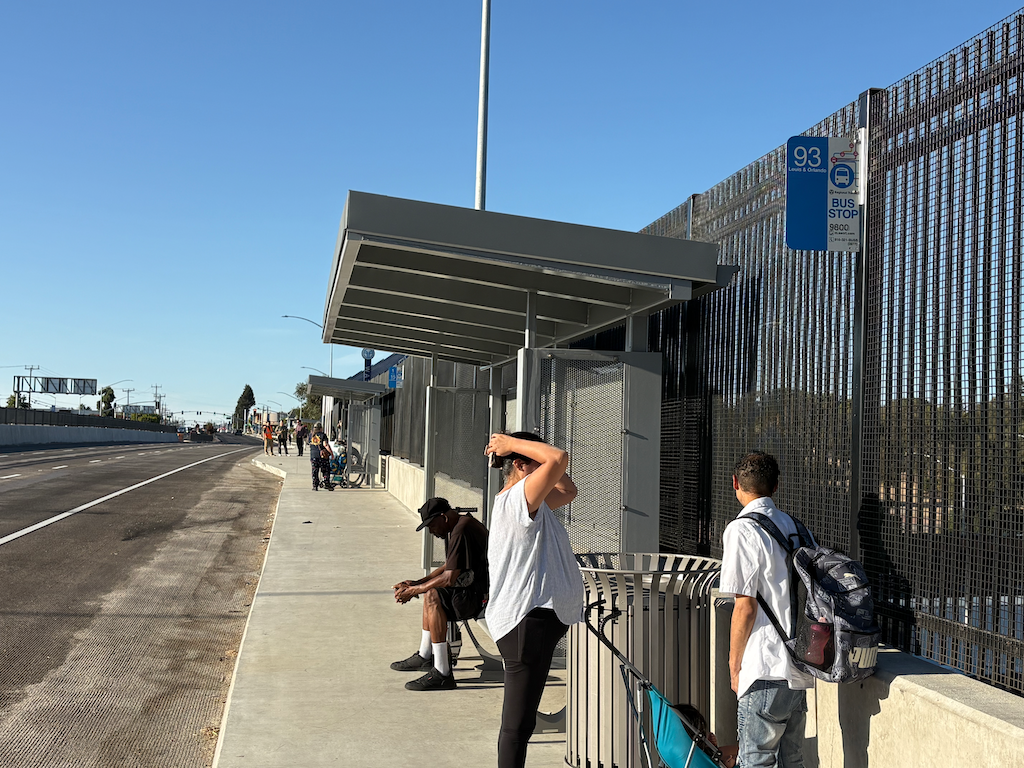
Wayfinding signs are not present. This includes wayfinding from the light rail terminus to the east side stair, during construction. For permanent wayfinding at the top of the stairs on the east side, there is nothing. One bus stop is north (26, 84), but the bus stop sign is hardly visible from the top of stairs. Two bus stops are to the south. For the first (1, 15), the sign is partly obscured by the bus shelter. For the second (93), the bus stop sign is not visible at all. There should be wayfinding signs at the top of the stairs that not only indicate which stops are to the right (north) and left (south), but a map showing the destinations of the five bus routes. As always, SacRT seems to be making the assumption that only regular riders, who know the stops and destinations, would be using this station. Nothing for new or inexperienced users.
The east side top of stairs and bus stops are very hot in the afternoon summer sun. For the three bus stops at 6:00 PM, there was not shade from the afternoon sun. There must be some additional shade available here. Roof? Canopy?
I had intended to do a comparison of management and non-management positions in SacRT compared to peer agencies. The data below is from the National Transit Database (NTD), operating expenses tables and employee tables, for the year 2024. I picked some other transit agencies for comparison. Please note that these numbers do no agree with the numbers presented in agency budgets, nor other online sources, but for comparison purposes, they serve. For the operations positions and the operations expenses, operations and operations maintenance are combined.
For the percentage of positions in operations, and the percentage of expenses in operations, a higher number is good, since operations are why the transit agency exists.
Transit Ambassadors have both a customer service and law enforcement function, as noted in SacRT: Transit Ambassadors. This dual function raises concerns and results in confusion for riders and transit advocates. Should customer service be emphasized, or law enforcement? Recently, the law enforcement role has been emphasized almost to the exclusion of the customer service role, through the zero-tolerance policy, but that may be modified or reversed.
Depending on what should be emphasized, or if the dual roles are split, the question is where Transit Ambassadors should be placed in the organizational hierarchy. At this time, they are placed within Police Services, within the Security, Safety and Customer Satisfaction function, as shown in the organizational chart below. If the law enforcement role remains as the primary one, then this may be an appropriate place. However, if customer service becomes the prominent role, then they should NOT be placed in Police Services. They should be moved out of Security, Safety, along with Customer Satisfaction, which move I recommended in SacRT: move Customer Satisfaction.
I believe that the customer service role of Transit Ambassadors should be the primary role. This is not to say TAs would not retain the citation ability for fare evasion and other issues, rather that would be a less important part of their role, and customer service become central.
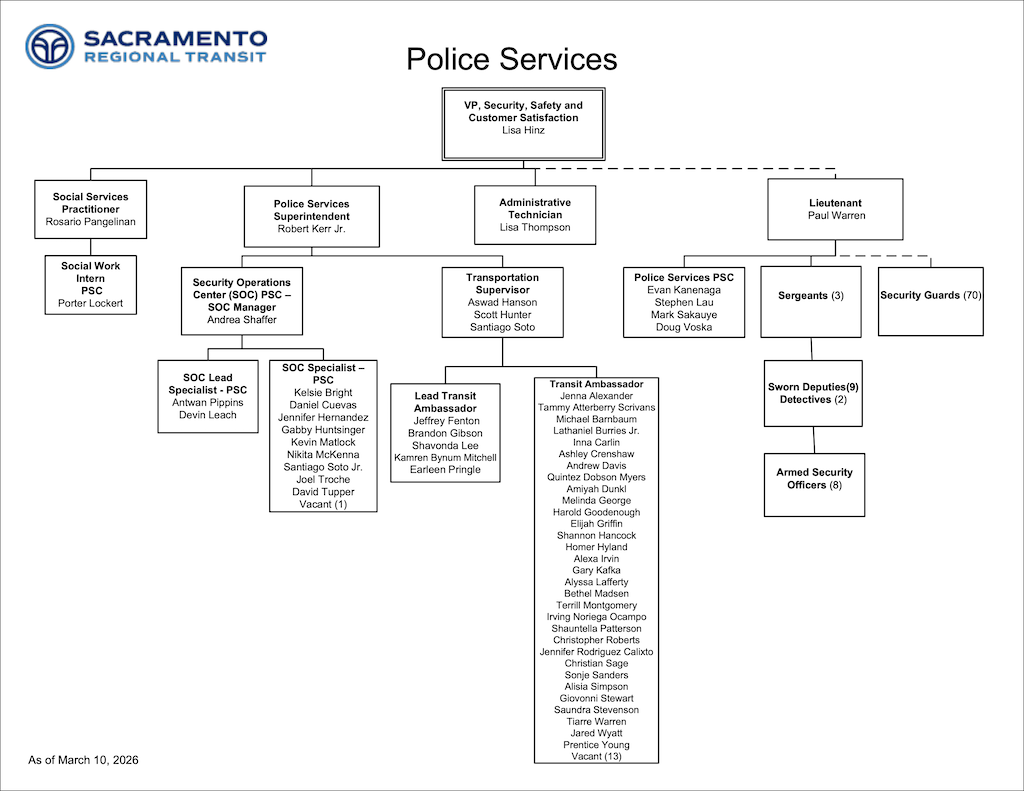
The SacRT organization charts from March 2026, the most recent available, include the Police Services page, below (pdf). Though the next post will be about where in the organizational structure Transit Ambassador (TA) program is housed, this one is just about TA staffing.
If you look at the long column below, you will see 31 TAs, and 13 vacant TA positions, which is a 30% vacancy rate. This is remarkably high. It is possible this is not the rate today, but the rate today is not available. When there are high vacancy rates in any agency or organization, there are generally two explanations: 1) the positions are intentionally not being filled to save money, or 2) the pay scale is too low to recruit qualified employees. I will speculate that the second is the explanation here. Though there are scattered vacancies throughout the organizational charts, they are usually one per function. Thirteen, and 30%, is very unusual.
SacRT organizational chart, police services including Transit Ambassadors
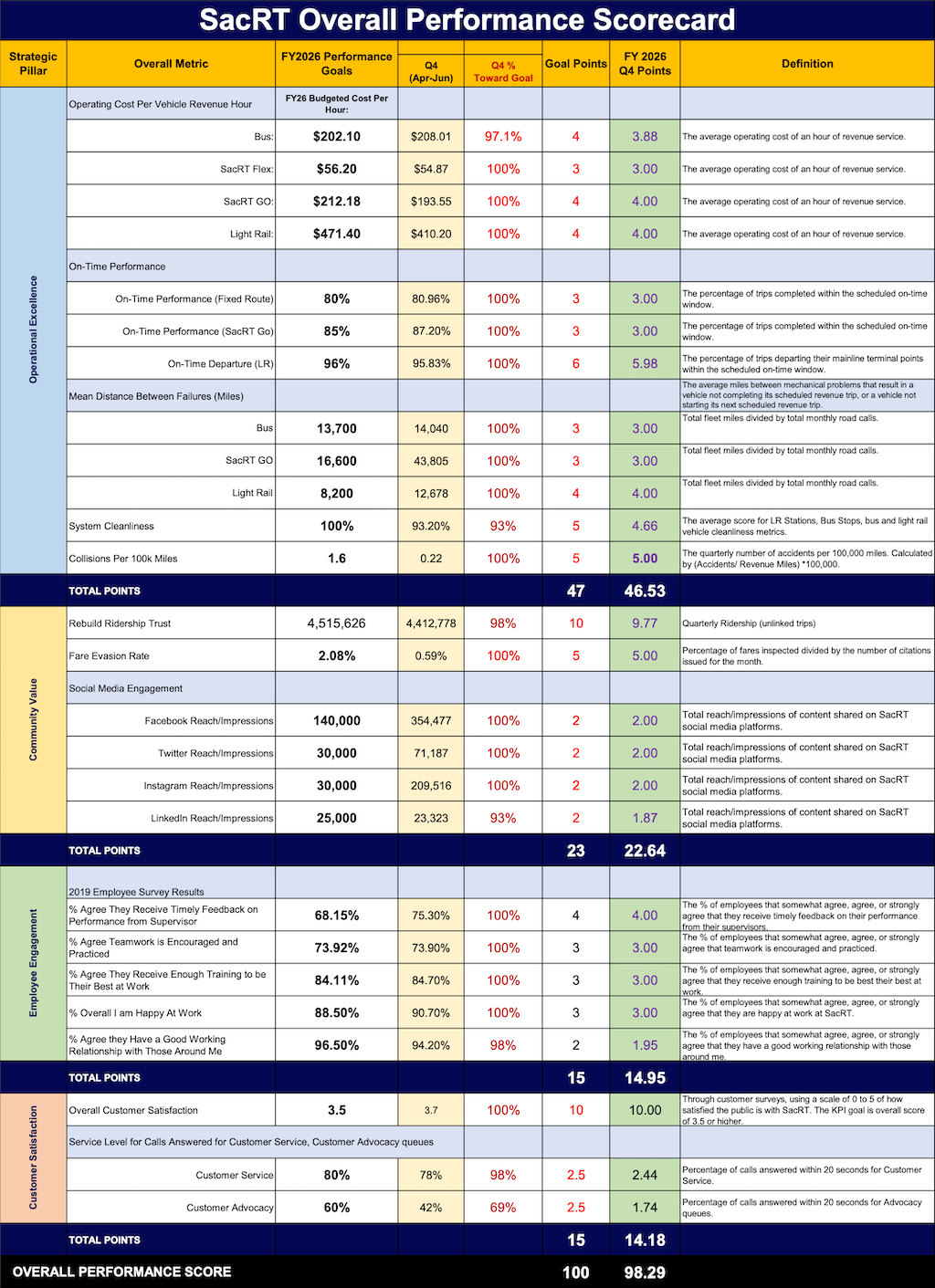
The only routine reporting to the board and public that SacRT does is the quarterly performance scorecard, which is called out in the Strategic Plan. The most recent one is below. There is an ‘Employee Engagement’ section, but there is nothing on the scorecard that indicates overall staffing levels or filling of vacant positions. Most SacRT staff and transit advocates shake their heads at the high scores SacRT gives itself, but that is an issue for another post
SacRT offers a Transit Ambassador position and program. These are the SacRT staff that riders are most likely to see on light rail. There are also private security personnel, but they are primarily at stations and not on the trains. You might on occasion see Sacramento County Sheriff’s Deputies on a train, though usually only in response to an incident. For light rail riders, Transit Ambassadors are the face of SacRT.
I am unable to find a job description for Transit Ambassador on the SacRT website, but an external website includes a job description (pdf, note the document is visually OK but internally corrupted), with excepts below.
“The purpose of this position is to provide continuous and consistent customer service to all passengers aboard light rail vehicles, at light rail stations and within light rail parking lots or other SacRT facilities. The Transit Ambassador will help resolve fare issues, address customer inquiries, assist with understanding the system routes, and handle any concerns and complaints all while maintaining a courteous and friendly attitude.”
The ‘example of duties’ list includes:
“Assists passengers with fare system issues and address any questions to help ensure payments are collected. Helps any passengers that are having difficulties using the fare system, and addresses any related complaints or questions.
Assists passengers with transfers; helps guide customers to access alternate bus or train services during regular service as well as in the event of a service disruption.
Answers passenger inquiries and maintains a courteous and friendly demeanor at all times. Maintains an expert knowledge of the bus and light rail system in order to answer all customer inquiries and provides directions when asked. Provides route, schedule and fare information to customers upon request.
Maintains vigilant watch at light rail stations and parking lots and help maintain a safe and clean environment for passengers and their vehicles. Occasionally removes and disposes of litter on trains to help maintain clean environment.
Handles customer compliments, criticisms and complaints equally with a calm and pleasant demeanor. Attempts to address customer’s issues but recognizes when issues need to be elevated to the next level of authority.
Ensures a commitment to safety through consistent and professional behaviors in performance of all job functions.
May be required to issue citations to customers that fail to pay fares and/or nuisance behavior, as well as appear in court to present evidence and testimony related to issued citations. Enters fare citation information into departmental computer system, completes required incident forms and accident reports when necessary.
Other duties as required.”
The SacRT website mentions a 3-month Transit Ambassador Training Academy, but it is not mentioned in the job description, and it is not defined anywhere that I was able to find. And it is not clear that this training is actually occurring. It seems that though most training is on-the-job, which is useful, but leads to inconsistency if it is the main training.
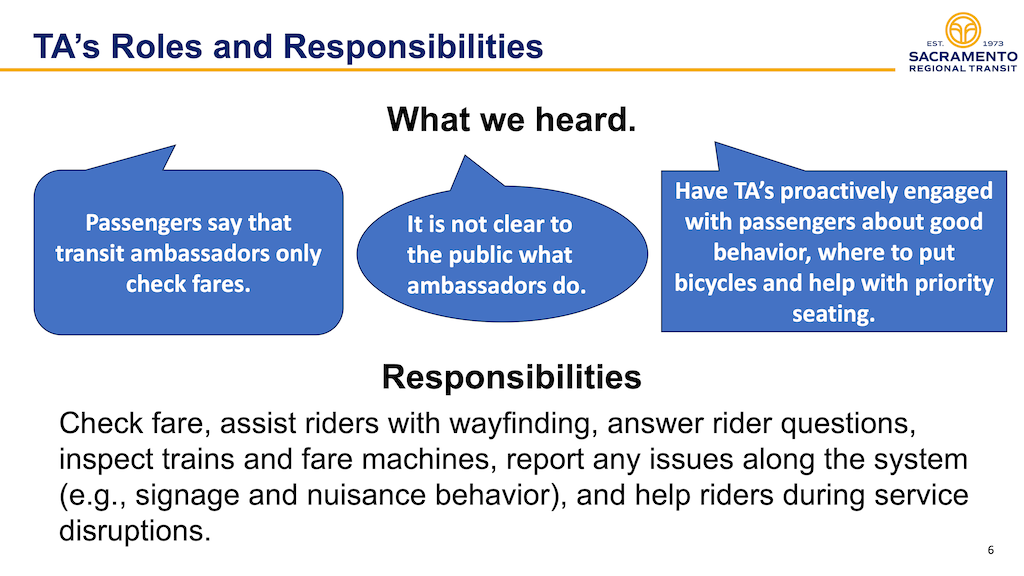
There was a period of time when the staff on board light rail trains were called fare checkers. That was their only function, and they were apparently instructed to not do anything else. Then the were instructed to fulfill many roles, similar to the list above. Recently, they were instructed to become law enforcement officers through the zero-tolerance policy. Note that though Transit Ambassadors are authorized to issue citations for transit rule violations, they are not otherwise trained law enforcement officers. At the 2025-10-27 board meeting, confusion among riders and transit advocates about what the ambassadors were supposed to do led to a presentation that included the slide below. However, the presentation did not resolve why the perception of TA roles was different for riders and for staff.
I believe that the fuzziness of roles is why there are so many complaints about Transit Ambassadors. The public certainly does not know their role, and it appears that the TAs also are not clear about their role.
except page from SacRT Board Agenda item 3.1, 2025-10-27 on Transit Ambassadors
Los Angeles Metro separates the roles of fare checkers and ambassadors. The description of the two positions is below. Of course Metro is a much larger and better funded agency, and it might not be possible to make this separation within SacRT.
Metro Transit Security Officers
Transit Security Officers are trained Metro employees who understand the unique needs of our system and our riders. These officers enforce the code of conduct and fare payment across the transit system, ensuring compliance and maintaining order.
Metro Transit Security Officers focus on:
Patrolling the system regularly.
De-escalating situations and maintain order and lawfulness on the system.
Enforcing the Metro code of conduct and issuing citations.
Communicating incidents directly with Metro Operations Centers, law enforcement partners, and emergency service providers.
Fare checks and enforcement.
Metro Ambassadors
Serving as additional support for riders, Metro Ambassadors assist passengers with various needs and report any issues they observe, contributing to a safer and more pleasant transit experience.
Metro Ambassadors:
Help passengers get where they need to go, providing directions and route information.
Are trained to provide life-saving medical support in emergencies.
Use the Metro-issued phone or tablet device to document issues and call Metro Security or 911 additional support in an emergency — this is why you may see them on a device.
The next post will be on where Transit Ambassadors should fit within the organizational structure of SacRT, and why the agency seems to be short so may TAs.
In SacRT, Customer Satisfaction is grouped under the ‘Vice President, Security, Safety and Customer Satisfaction’ position, which is held by Lisa Hinz. The grouping of customer satisfaction with security and law enforcement has led to many, many problems, the latest of which is the zero tolerance policy implemented by this position, without SacRT Board knowledge or approval. People who are trained in law enforcement (Ms. Hinz who is an ex-City of Sacramento Police Officer) do not have the job or personal skills to manage customer satisfaction. Under this arrangement, enforcement comes first, and riders come last.
The 3.1 agenda item ‘Customer Service Response to Feedback and Comments’, presented at most but not all meetings, have generally been full of misinformation, misunderstanding, and glossing over problems. They have not led to useful changes, and in general the public and transit advocates are not satisfied with these reports. The presentations to go with this agenda item are usually available well after the rest of the agenda items, even during the meeting itself, preventing the public from viewing ahead of time and developing responses. I do not believe this is an accident.
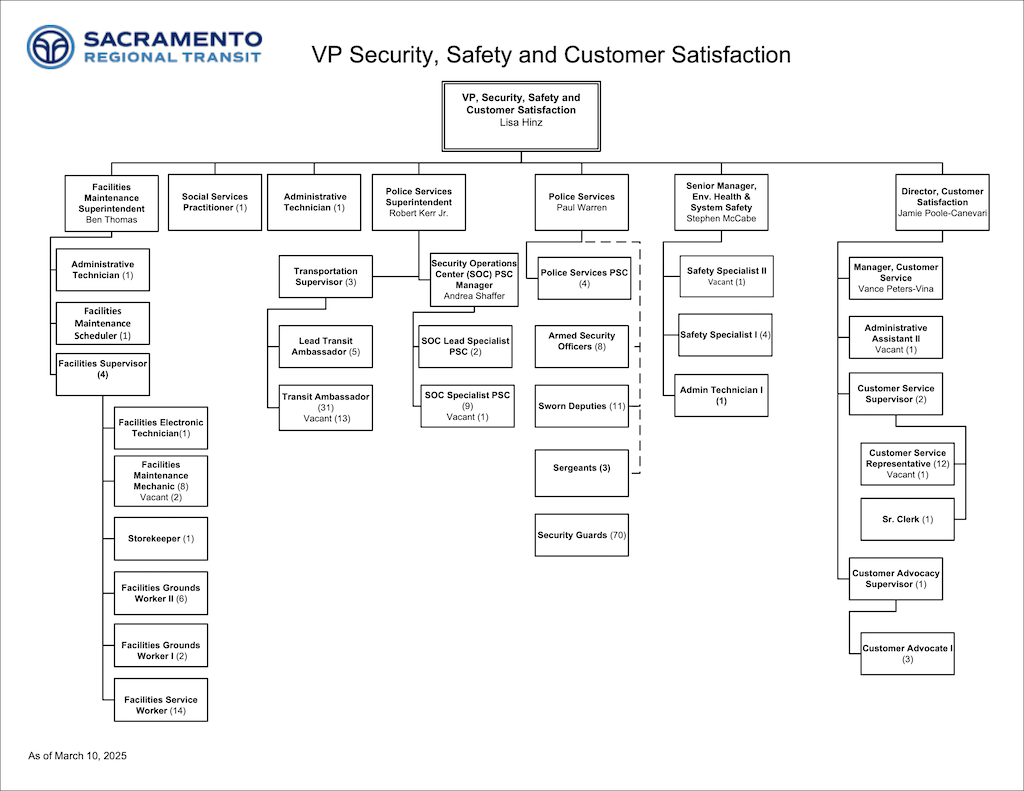
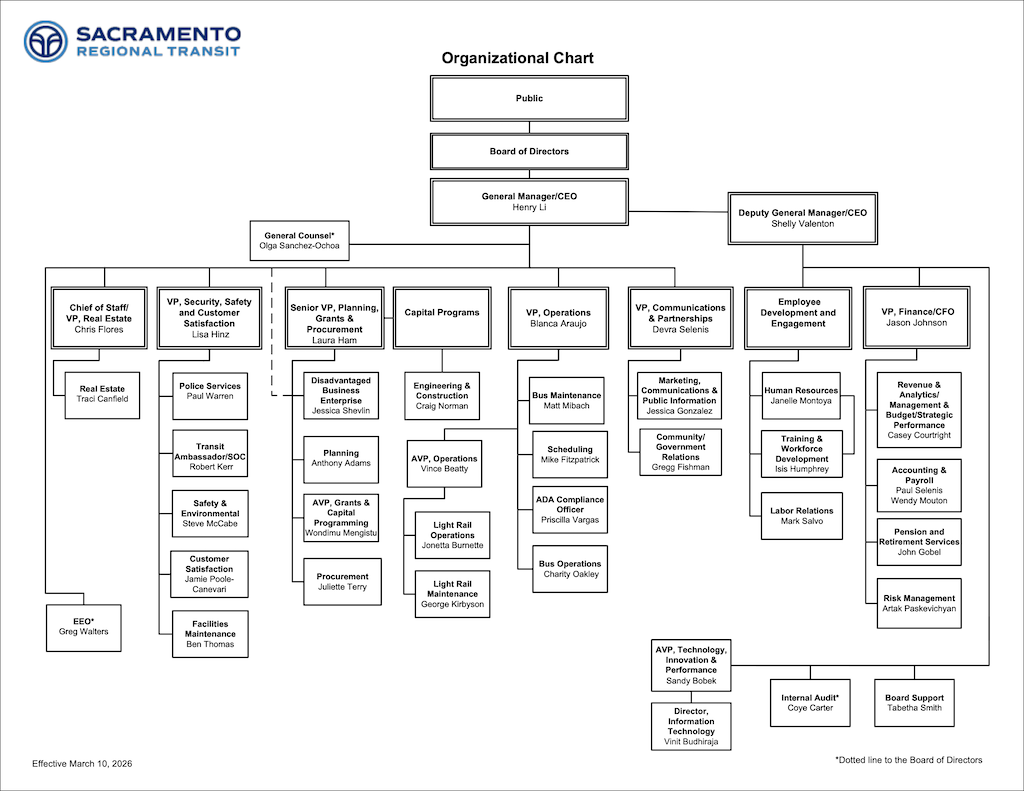
This is unacceptable. The responsibility must be moved elsewhere in the organization chart. I am not sure where the best placement is, but I am sure the current placement is wrong. The chart below shows the position of Customer Satisfaction, at right, within the Security, Safety and Customer Satisfaction grouping (pdf).
SacRT organizational chart, security, safety and customer satisfaction
This is the top-level chart for SacRT (pdf). The fact that it is not immediately obvious where to correctly place Customer Satisfaction is indicative of the approach at SacRT that puts administration above riders.
SacRT organizational chart, top level
I will have comments soon on the placement and duties of Transit Ambassadors.
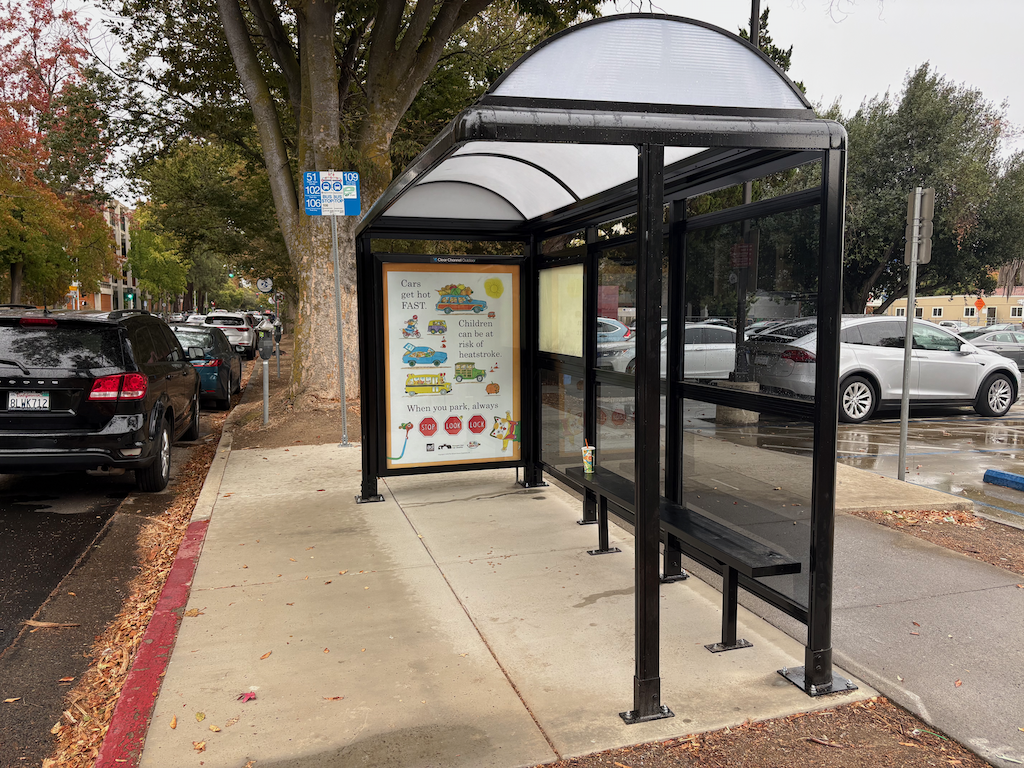
Update: There is now a bus stop sign and shelter at the Q Street at 7th Street bus stop for Route 51. Note that the city has not removed the parking spot that is within and constrains the bus stop. The electrical feed that was noted is for the advertising display board (Clear Channel), not for shelter lighting.There is still no shelter or amenities at the 9th Street at Q Street stop for Route 51. Photo at bottom.
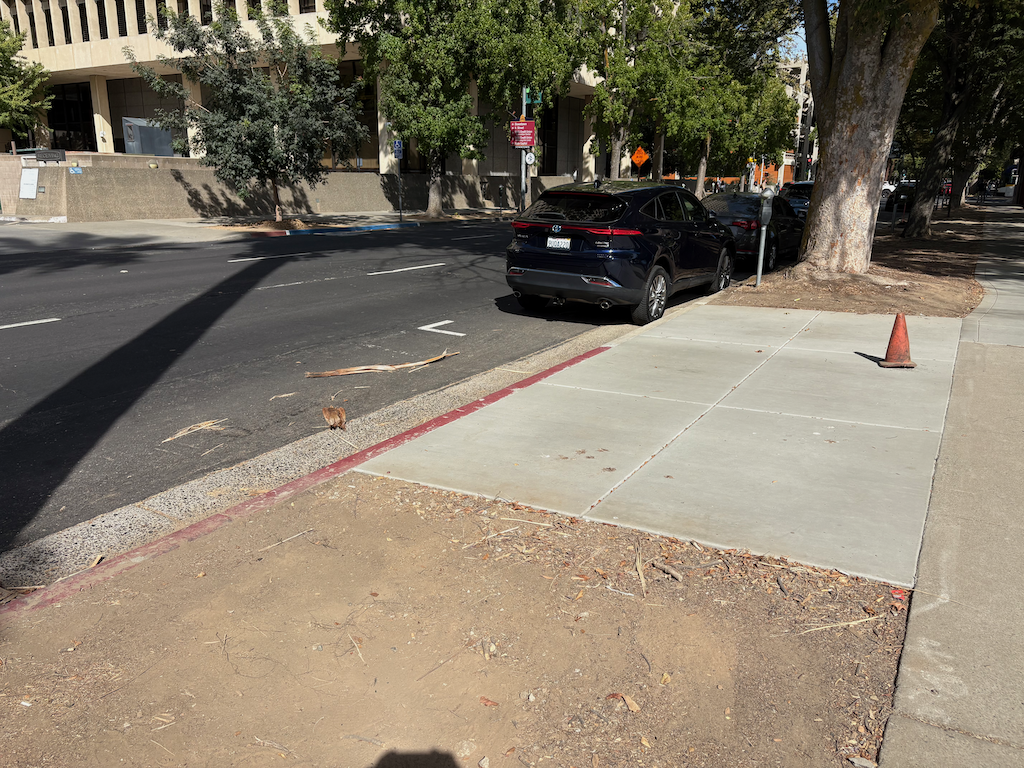
A transit advocate has flagged that her stop on Q Street at 7th Street had all indications that it was a bus stop removed. There is no bus stop sign. What is there is a new concrete pad, presumably to host some bus stop amenities. In February 2025, the most recent date, Google Maps shows a bus shelter there, with bus stop sign. Google Earth shows streetview with shelter on the same date, but the most recent aerial, February 2026, is too fuzzy to tell, and earlier ones are obscured by trees.
Google Maps and Transit.app show this as a valid bus stop, which means that it is in SacRT’s GTFS file. However, I observed a Route 51 bus taking the turn from 7th Street southbound to Q Street eastbound in such a way that they could not have pulled into the bus stop if there were a rider waiting, so perhaps some drivers are unaware that this is a bus stop. Note in the photo below that half of the pad area is also a parking space, which it should not be. A bus needs space to pull in, and pull out, and that parking space prevents a bus from using the pad area. This is a failure by the city to properly manage parking. I hadn’t realized it at the time, but the construction cone probably covers an electrical feed.
SacRT bus stop pad, no sign or amenities, Q St at 7th St
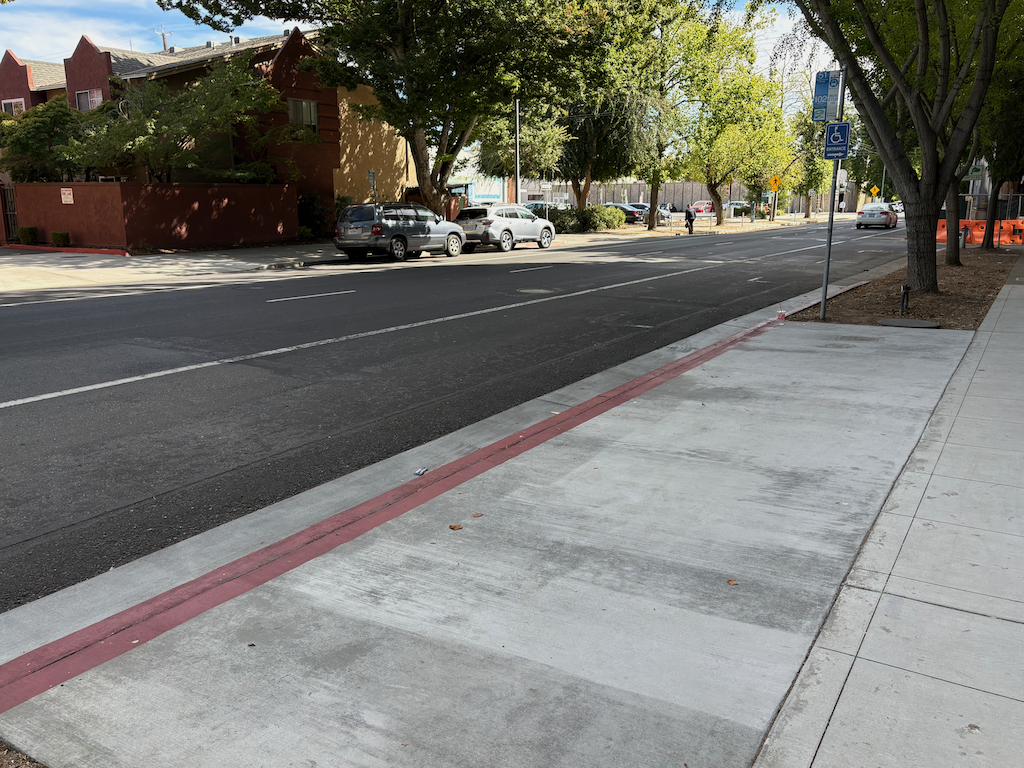
This reminded me of my experience with the bus stop on 9th Street southbound at Q Street, for Route 51 (and some other buses). This is not a stop that I often use, so don’t know the history. On June 12, 2026, there was no bus stop sign, but the Route 51 bus did stop for me. This is not a heavily used bus stop, but I always see one or more people here. A large concrete bus stop pad was installed, close to 20 feet long. Clearly, amenities were intended here, otherwise there would be no point in such an expansive pad. It appears that some construction was going on July 2025, maybe the bus stop pad, but I can’t be certain. I am certain that nothing has happened since June 2026.
SacRT bus stop pad, no amenities, 9th St at Q St
Apparently whatever was intended for these two bus stops was abandoned. By SacRT? By the city? I don’t know. What is clear is that riders on Route 51 are not being served by bus stops with amenities, or even signing.
I almost alway use light rail transit in downtown, or am walking or riding my bike, so I don’t know if there are other such locations. If you know of others, including the stop you use, please let me know and I’ll add it here.
It has been suggested that this could be part of the city’s SVS Commuter Bus Stop Consolidation Project, but neither of these stops are part of that project, which is focused solely on commuter buses. It has been suggested that this could be part of SacRT’s Bus Stop Improvement Plan (2023), but the plan does not identify any stops in the central city, since it focuses on underserved communities with priority routes. These two locations are not on the list of potential SacRT Heat-Resilient Bus Shelters Project. I’m not aware that any construction has taken place for any of these projects. Were these one-off ‘improvements’, or part of a project? Unknown.
The transit advocate said that staff later said the Q Street at 7th Street shelter would be replaced, but timeline is unknown.
SacRT bus stop, Q St at 7th St, replaced shelter and sign
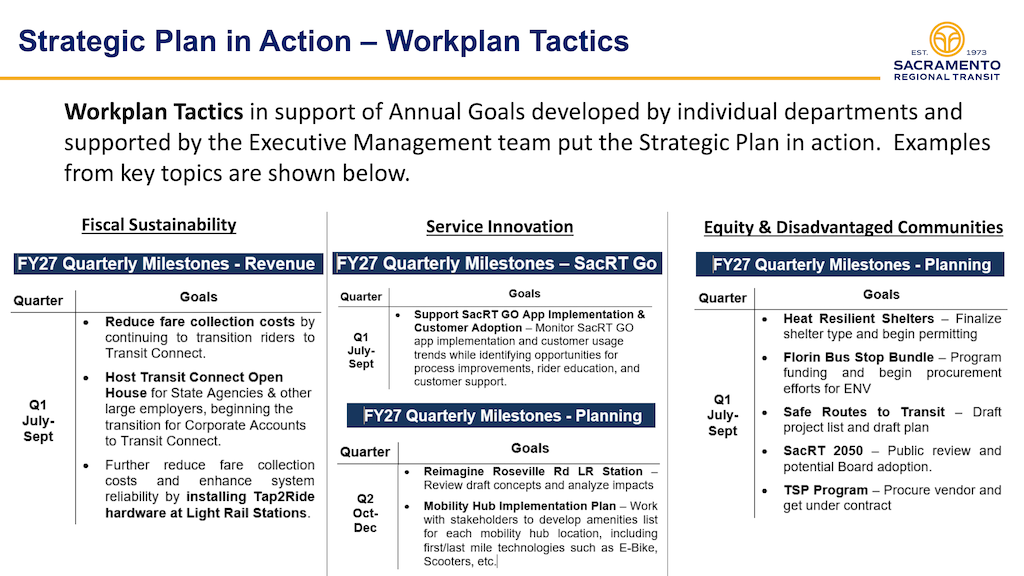
Agenda item 4.1 was to adopt the SacRT Strategic Plan 2026-2030. As I had previously commented, the plan seems very general and vague. Board member Roger Dickinson had the same impression, and specifically wondered where a budget and funding projection was for this period of time. The plan document is only 18 pages long, most of it filler, and is labeled on one page an executive summary. Where is the rest of the document? Staff member Shelley Valenton said that the plan is based on a large number of other documents, so the detail is not in the plan, as these other documents change about once per year. Roger asked where these document were. They have not been posted or linked, so the board and public can’t view them. It was promised they would be. The Strategic Plan 2021-2025 is even briefer, 12 pages. The plan webpage lists several scorecards, but does not contain a single background document.
The board presentation includes a page below, Work Plan Tactics, which is the only page that presents useful information, and this is NOT in the plan document.
If the strategic plan is general and vague, with supporting documents not available, it would not provide any information for board or staff on where SacRT is going over five years. What then is the point in having the plan, or presenting it to the board and public?
excerpt from SacRT_2026-08-24 agenda item 04, page 5
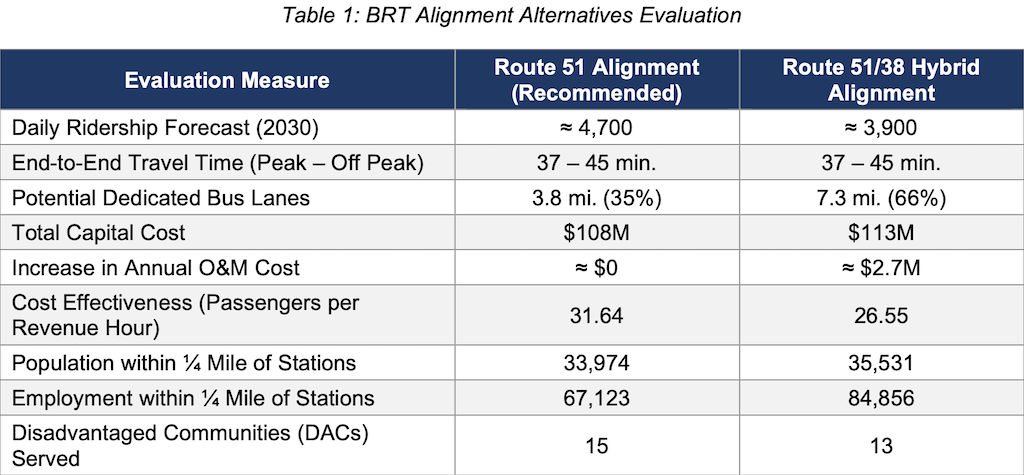
Agenda item 6.1, adoption of locally preferred alternative (LPA) for Stockton Safety and Transit Enhancement Project (STEP) was presented and adopted. Though there was lot of unrelated filler in the presentation, about the benefits and characteristics of BRT in general, the key points are that the alignment of the existing SacRT Route 51 will be the BRT route (not hybrid Route 51/38), and that the BRT will be curb running and not center running. All other decisions are for future planning, this is just the first step.
I participated in both the stakeholder meetings and the public meeting on STEP. My sense of the consensus is that there wasn’t one, that the participants saw value in both alignments, and in center running and curb running. After quite of bit of research on my part, I still was not sure. So I do appreciate SacRT doing this analysis, and it was probably time to make a decision. However, there was some fuzziness and missing information in the staff report and presentation.
The heart of the argument is in the table below, from the staff report and also in the presentation. The data point highlighted are daily ridership forecast, which favors Route 51, though I don’t believe that the analysis considered that there will be considerably more development – medical, commercial and residential – between Broadway and Alhambra, with the Aggie Square / UC Davis Medical Center developments, than on either the Stockton segment to the south or on Broadway. The second point was the ‘increase in annual O&M cost’ of $2.7M per year. I searched for why the cost for Broadway service was included, but not the savings that would result from running BRT on the former Route 38 into downtown. The two routes would essentially be swapped under the hybrid alignment. There might be some additional cost, but $2.7M per year is not justified in the report.
In the stakeholder and public meetings, representatives of UC Davis Medical Center/Aggie Square spoke enthusiastically about extending BRT north on Stockton to serve that development. They stated that they really wanted a partnership with SacRT, and the city, to make the most of transit service. This fact does not show up anywhere in the staff report or presentation. Staff did several times say, ‘well, its only a quarter mile walk’. Yes, to the middle of campus on Stockton, but not to the north edge, and not to the east edge. I think this was just a spurious justification of a decision made for other reasons.
The third point that struck me as critically important, but was not really mentioned, is the ’employment with 1/4 mile of stations’. The hybrid route would serve 25% more employees than Route 51. That is nothing to be glossed over, particularly since UC Davis Medical Center was enthusiastic about promoting transit use to employees and others.
The decision was made, and it is probably not a bad decision. The devil is in the details, as they say, and the details are yet to come. But I continue to be concerned that SacRT planning either misses important information that should be included, or suppresses information that doesn’t support a foregone conclusion. Is this report and presentation unbiased? I’m not sure.
Agenda item 5 ‘Public Addresses Board on Matters Not on the Agenda’ saw an number of comments, most of them about service and continuing issues with the zero tolerance policy. I did not capture these, so I refer you to the meeting recording.
Note that the STEP project is a joint City of Sacramento, County of Sacramento, and SacRT project. If you are looking for my previous posts on Stockton, they might be attributed to the city or SacRT.