“Not all economic development is created equal. Not all local investments build wealth in our community. Not all open markets produce optimal outcomes for all places. If we want our places to prosper over time, we have to be prepared to ask a tougher set of questions at the local level.” Charles Marohn, in Dunkin Our Future, on Strong Towns blog
Category: livability
Why Not Here?
sactown magazine has an interesting series of articles grouped under Why Not Here? which I like for its thinking outside the box. Though most of these are not directly transportation related, they are about transforming the nature of Sacramento and bringing residents into downtown. Most of the articles were written by sactown co-owner Rob Turner.
I believe that these are important goals because it is only through dream-big projects that the money to fix our transportation woes will become available. If we have to wait until our regular tax base can fix things, we will be waiting a long time, but new developments can fix things as part of their design. Several ideas are about bringing regular and high-end housing to downtown, which encourages walking, biking and transit solutions rather than more driving and more parking.
- Return of the JFDI (sactown 2013-12); this one is about the Community Center Theatre
- A Walk on the Wild Side (sactown 2013-12)
- A River Runs Through It (sactown 2013-10)
- A Sleeping Green Giant (sactown 2013-10)
- Looking for a Square Deal (sactown 2013-08
- #HereWeBuild (sactown 2013-06)
the magic water fountain on M Street

In my previous post, I complained about the non-functional water fountains at SacRT light rail stations, but in doing so, I remembered that I’d never posted about the water fountain on M Street in Sacramento. Herewith is my paean to the M Street water fountain.
In a tiny triangle park at M Street and 48th Street in East Sacramento is a wonderful thing, a public drinking fountain. Not only is there a drinking fountain, but also a decorative fountain, and benches, and flowers, and shrubs, and a patch of grass. I stop here on every trip, whether I’m thirsty or not, just to celebrate this little corner. Sometimes I’ll stop and lie on the grass, or sit on the bench and enjoy the fountain. Other times, it is just a quick drink and on with my trip. I’ve seen mothers here letting their kids play, and retired folks just passing the time. There is always a bowl beside the fountain for dogs to have a drink as well.
confronting the stop sign myth
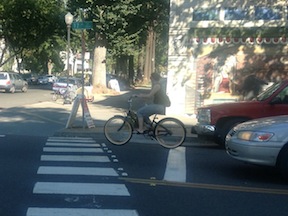
I often see or hear the statement “bicyclists run stop signs all the time.” The person making the statement is not just making an observation, but trying to justify some attitude or action on their part, such as “bicyclists shouldn’t be on the road,” “bicyclists should be on the sidewalk,” “bicyclists should be thrown in jail,” “it is OK to intimidate or run over bicyclists,” or “we should not be spending any of our transportation money on bicycle facilities.”
I think that it is time for all of us to confront that statement and end its use. Yes, it is true that some to many bicyclists run stop signs. It is also true some to many motor vehicle drivers run stop signs. To refer back to my earlier posts on stop signs, stop signs are installed largely to reduce vehicle speeds and to get drivers to take turns at intersections. Bicyclists are rarely exceeding the speed limit, so that function is not served by the stop sign, nor by a bicyclist stopping. In the case of taking turns, the issue is taking turns, not the act of stopping. If a bicyclist does not stop at a stop sign, but no other vehicles are present which should go first, then the function of the stop sign to get people to take turns is intact, it has not been violated.
clarifying my doubts
 Just before posting “doubting protected bikeways” yesterday, I’d been reading Momentum Magazine, one of my favorites. After posting, I turned the page, and there was a 14 page article entitled “The Rise of the North American Protected Bike Lane” by Angie Schmitt (not yet posted to their website, so you’ll have to read the paper or digital copy). The article is a classic defense of protected bikeways, with the standard criticism of vehicular cycling.
The heart of the article is the “by the numbers” graphic which shows the increase in bicycling in seven different cities that occurred after installation of protected lanes. The increases are impressive. The text talks about Portland research on types of bicyclists, positing that such facilities are necessary to get the “interested and concerned” 60% onto bicycles. Though safety is mentioned several times, it is clear the greatest benefit proposed is an increase in bicycling mode share. I’m not in disagreement with any of this. What I am in disagreement with is the focus on increasing bicycle share as the most important goal of changes we make to our streets.
Bicycling mode share in the U.S. ranges from below 1% in some places to as high as 6% in a few cities. Andy Clarke of The League of American Bicyclists is quoted as saying we could increase this to 10% or even 15% with the use of protected facilities. Sounds great. The problem is that it leaves a whole lot of motor vehicles on the road, making our cities unlivable and threatening the lives of pedestrians.
doubting protected bikeways
Protected bikeways, also called separated bike lanes or cycle tracks, are all the rage these days. The NACTO Urban Bikeway Design Guide codified cycle tracks, but they were already showing up in several cities, and are now being implementing in a great number more. I’ve ridden on cycle tracks in Long Beach, San Francisco (just yesterday, in fact) and other cities, and yes, they are a pleasure to ride on compared to riding in traffic or traditional bike lanes. Many people have declared the era of vehicular cycling dead, and the era of protected bikeways upon us.
So why am I doubting?
biking to the midtown farmers market
The Sacramento midtown farmers market at J and 20th has been going for two Saturdays now. The market is somewhat different from the main Sacramento Farmers Market I usually attend because it has more prepared food, though it still has a good complement of fresh and dried food. The market is only 8 blocks from my house, though the main one under the freeway on Sundays at 8th and W is only 16 blocks, Chavez Plaza on Wednesdays is 11 blocks, Fremont Park on Tuesdays is 1 block, Capitol Park and Capitol Mall on Thursdays are 3 blocks and 12 blocks respectively. Clearly I’m blessed to be in the middle of so many farmers markets. This density of urban amenities is why I love living in midtown. I’ve heard great things about the Saturday Oak Park farmers market, and will visit as soon as I can.
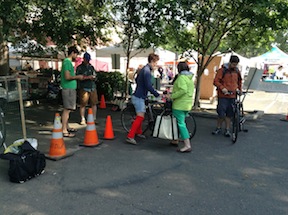
The more unique character of the Midtown Farmers Market Sacramento, however, is that it encourages shopping by bike. Sacramento Area Bicycle Advocates (SABA) is providing bike valet service for the market, and a lot of people are coming by bike. There have never been less than two cargo bikes, and sometimes many more, and the large bike valet corral has at times filled up with bikes. Impressive!
parklets for Sacramento!

SABA (Sacramento Area Bicycle Advocates) and Sacramento Metropolitan Air Quality Management District are partnering to create demonstration parklets in Sacramento. This is exciting! SABA has a couple of posts on their Facebook page, and I’m sure there will be a lot more discussion.
A parklet is a small space serving as an extension of the sidewalk to provide amenities and green space for people using the street (Wikipedia). They can remove the tension between street furniture and sidewalk life on the one hand, and sidewalks as a transportation route. Though Sacramento has wide sidewalks in some areas, it also has narrow sidewalks in a number of areas that are highly popular. As an example, 16th Street between P Street and O Street, right next to where I live, has a narrow zip-zag sidewalk, fenced cafe seating for restaurants, and a lot of people and a lot of bikes. There is a tension here, between cafe seating, bike parking, and the sidewalk’s function. A parklet would allow more street life without taking away from any of the other functions.
Parklets are often sponsored by the adjacent business, but since they are in the public right of way, they are open to all users at all times. Cafe seating is different in that the business has a permit for the exclusive use of that area, so it is often open only to customers and only when the business is open. Cafe seating and parklets are actually a great complement to each other, creating vibrant street life that neither alone could.
San Francisco has an official Pavement to Parks parklet page, with details about the spectacularly popular program and a series of photos. The photo with this post is one of my favorites. San Francisco Great Streets Project has a series of pages on parklets, with before and after photos, though it is not up to date.
arena or not…
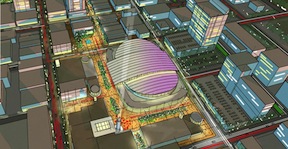
Whether the arena is built or not, I care little, and whether the Kings stay or not, I care not at all. But what I find interesting is that no one any longer talks about a public asset like this being located in the suburbs. When it was in the railyards, it was a downtown arena. As it is now proposed on the footprint of the mall, it is the downtown arena. It is the same in Seattle, where the arena location is not so central but is still part of downtown.
Sacramento has grown up! It realizes that downtown is the place for public assets. Downtown has a high density of public transit, walkable and bikeable areas, a grid street pattern, established businesses that can serve patrons of an events center, and yes, even freeways.
The ARCO/Power Balance/Sleep Train facility squats in the middle of acres of parking, a 12,000 parking space wasteland. It is far from light rail, is poorly served by bus (you can get there, but you can’t get home, for evening events, and not at all on Sunday, transit score 24, minimal), is in an un-walkable and un-bikeable area (all high speed arterial roads, walk score 48, car dependent), where almost no streets go through (the classic suburban street system of cul-de-sacs and streets that wind interminably). Why anyone ever thought an arena in Natomas was a good idea, I don’t know, but at least no one any longer thinks it is. And that is progress!
Downtown Plaza, the currently proposed location, has a walk score of 94, walker’s paradise, and a transit score of 67, good transit.
where to have open streets in Sacramento?

Sacramento Area Bicycle Advocates (SABA) posted a question on Facebook, “Where shall we hold one in Sacramento?” about the Sunday Streets event this past Sunday on the Embarcadero in San Francisco. This echoes a conversation Alexis and I had while we were attending. She liked the Embarcadero Sunday Streets because it was a long distance and showed how streets can be used for transportation in a different way than we usually use them. For Sacramento, that would argue for a long distance closure that connects together destinations.
Though I certainly enjoyed this Sunday Street, I really like the two that I’ve been to in the Mission neighborhood of San Francisco, which close stretches of Valencia St and 24th St. This route is in a neighborhood, there are people living along the streets and in the neighborhood, as well as those who come from other places to enjoy. There are a multitude of locally-owned businesses to appreciate and engage, with nary a chain in sight. The special events such as play areas, climbing walls, hula hoops, dance demonstrations and others feel more concentrated rather than scattered out along a long route. For Sacramento, this argues for a midtown location, which is the only area where there is a sufficient concentration of residents and locally owned businesses. The Mission event is about community, and more like a street fair.
Embarcadero is more about transportation, and Mission is more about community. Sacramento, of course, could do both.
For more information about the flavors and locations of open streets events, see Open Streets Project. Check out the website for background information including “models”, and then go to one! Of course San Francisco is the easiest for us here in the Sacramento region, but Berkeley will also be having one or more this year, and as you’ll see, they are becoming common on the west coast, throughout the United States, and the world.
The next San Francisco event is on April 14, and is in the Mission neighborhood which I’ve referred to above, on Valencia St and 24th St. Don’t miss it! And bring back your thoughts and commitment to making it happen in Sacramento.
Alexis and I volunteered at the event as intersection monitors. Once you’ve been to an event, you can consider volunteering, which provides a different perspective. Though I was initially assigned to an quiet intersection where there was nothing much to do, I got moved to a lively intersection, The Embarcadero and North Point, where the F streetcar line crosses The Embarcadero at an angle, and there was a lot to do, stopping the walking-biking-rolling crowd as the streetcar came through, keeping people out of the dedicated streetcar lane, and talking to people about how to safely cross tracks.
I wrote more about the Sunday Streets Mission events I attended last year.

