parking violence

On Monday evening, I observed an altercation over a parking spot in front of my apartment on O Street in Sacramento. There are several restaurants on 16th Street that are popular and generate a desire for parking, and there is already a lot of local resident parking, so spots are hard to find at times. I had noticed that cars were backed up on the street as people were waiting for others to leave, but was not paying close attention until I heard yelling. A driver of a car stopped in the middle of the street was yelling at two people who had parked and were walking towards 16th Street, claiming that they had “stolen” his parking spot and demanding that they move. He escalated into threats against their car (breaking out all the windows) and against their persons (“I’m going to take you down”). The angry driver pursued the other two, and ended up shoving and slapping the male of the couple. He also made threats against the female. He continued the confrontation even when the others were trying to end it, and he taunted the male with “I slapped you in front of your girlfriend and you were too much of a wussy to do anything about it.”

My point is not to document the assault and battery, and given that it did not show up on the SacPD daily activity log, I presume the police, when they eventually responded, did not think it important. My point, rather, is to talk about the sickness of someone threatening to harm another over a parking spot. Over a parking spot! The perpetrator was completely prepared to do harm to the other two just because he felt unjustly deprived of his parking spot. Whether he was unjustly deprived or not, I can’t say, because I didn’t observe the taking of the parking spot.

What kind of world view leads one to think that it is justified to harm others over a parking spot? Only an angry sociopath would view things that way.

As I have said before, driving causes brain damage. But let me be more specific now. Driving not only encourages and brings out sociopathic behavior, it IS sociopathic behavior. Driving is sociopathic behavior. There, I’ve said it.
schools closed

The Sacramento City USD Board voted to close seven schools, including Washington Elementary. This is a sad day for students and their communities. There is a good chance that the decision will be overturned in the courts, as the district proudly refused to consider the effects of the closure on low income and high minority communities, but nevertheless, this will take up yet more community energy and time, energy and time that could have been devoted to improving schools. What kind of feeling does this leave the communities with, when the district and the board work against the interests of the community?

Washington School meeting tonight

Washington Elementary School

The meeting on the closure of Washington Elementary School in midtown Sacramento is this evening (Wednesday, February 13) from 6:00 to 9:00PM, at the school. Though all of the eleven schools proposed to be closed are important, I’m highlighting this one because it is my neighborhood school – I live in midtown. If this school closes, there will be no schools left in midtown.

The Sacramento Press had an article yesterday (Use your voice – input needed on Washington Elementary School closure, 2013-02-12).

I posted earlier on school closures.

The district’s website has information on closures. While I believe the district’s approach of basing closure solely on “economic criteria” – meaning excess capacity – is seriously flawed, nevertheless, here is the capacity report on Washington. If the portable classrooms (X, Y, Z) with a capacity of 132 were removed, the overall capacity would then be 574 rather than 706. The school would then be 39% of capacity rather than the district’s number of 31%. Still very low. I suspect that a similar analysis of the other schools to be closed would show a similar bias against schools where the district added portables and is now counting these against the school, no matter what condition or life expectancy they have.

Marshall School, closed and abandoned

The Sacramento Bee has also had a number of articles: Video: Kindergartener asks board not to close his schoolWhy sacrifice high-performing neighborhood schools?Large crowd lobbies against planned Sacramento City school closuresTrue to their schoolSCUSD’s Community Meeting at Mark Hopkins Elementary SchoolSacramento school closings will hurt neighborhoodsJonathan Raymond pads pay of his chief of staff, closes schoolsSacramento schools will hold meetings on closuresEducation blog tracks school closures, moreEditorial: Time to match city schools with enrollmentParents question Sacramento City district school closure plans at emotional meetingSacramento school closures meetingJoseph Bonnheim Elementary serves English learnersConsider community fabric with school closuresSacramento City Unified considers closing 11 elementary schoolsReport Card: Sac City Unified identifies schools considered for closure11 elementary schools could be shuttered in Sacramento City Unified districtUnder-enrolled Sacramento district may close multiple city schoolsSchool closures, enrollment losses are top concerns in Sacramento City Unified Area 3 race

School closures

Sacramento City Unified School District (SCUSD) is considering the closure of 10 elementary schools which are well below capacity due to declining enrollment, in order to save money on facilities and staff. While I certainly sympathize with the need to reduce costs in the face of declining enrollment, I think that SCUSD is failing to consider several factors in making this decision. Let me say that many school districts are facing the same challenge; SCUSD is just the current example, and I am not trying to pick on them. I live within SCUSD but work in another school district; I do not have children, but have been an education professional for much of the last 39 years.

There have been a number of articles in the local media about the closures, but the SacBee article on Sunday, January 27 provides a level of detail and addresses several of the challenges.

Why is this a transportation issue? Closure of these schools will eliminate 10 neighborhood schools, which children can by and large now walk or bicycle to. True, many of the students don’t, but they could. In most cases they will not be able to walk and bike to their new school, due to increased distance and the need to cross busy arterial streets. The change will therefore greatly increase the rate of parents driving their children to school at the remaining schools. More congestion and air pollution, and less safety for the students who do walk and bike. I will clearly state two premises:

  1. Right-sized neighborhood schools have a strong social value that must be weighed along with other considerations.
  2. All children should be able to walk and bike to school, at least at the elementary level.

Read More »

San Francisco Sunday Streets

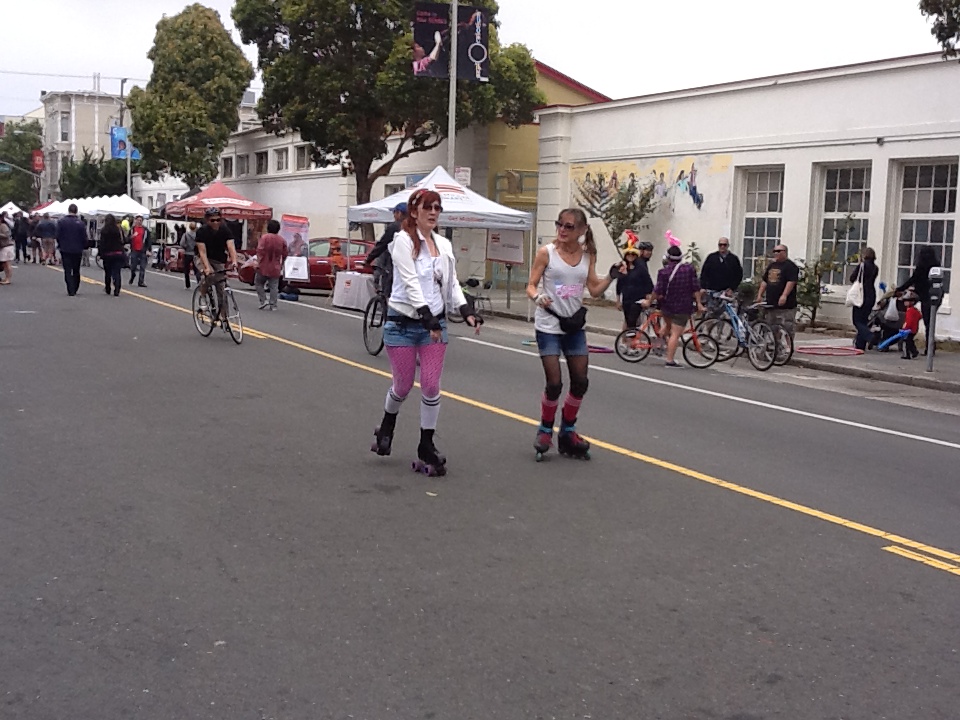
Roller dancers at SF Sunday Streets

Bicyclists, walkers, skaters, families, bands, food, fun physical activity, welcoming businesses, community organizations, craziness! And no cars. What more could you ask for?

It was my pleasure to find myself in San Francisco on Sunday, July 1, for Sunday Streets. I was in the bay area to visit friends, and just happened to notice on Streetsblog that there was a Sunday Streets event. I’ve heard about these but never participated, and really looked forward to it. At 11AM, not too much was happening, a few people wandering and many people setting up, but by 1PM, that place was hopping, with so many people that it was sometimes difficult to keep moving. But that isn’t a bad thing. The 11 blocks of Valencia Street and 12 blocks of 24th Street in the Mission District of San Francisco (south of downtown) were blocked off to car traffic, though some cross-streets were open to cars.

Read More »

Win-Win Transportation Solutions with Todd Litman

WALKSacramento cordially invites you to hear one of the best minds and voices in sustainableplanning today, Todd Litman, founder and leader of the Victoria Transport Policy Institute: (http://www.vtpi.org/). As our region moves forward on implementing the Sustainable Communities Strategy, we need to identify proven “win-win” solutions to the challenges facing us. Please come and hear a fresh, practical yet still visionary perspective.

There are two events on Wednesday, June 13:

  • Noon-1:30 p.m. at SACOG. This event is focused on the transportation and planning professional community, but all are welcome. Go here: http://toddlitman.eventbrite.com/ to register.
  • 6 – 7:30 p.m. at REI. This event is for the community at large and focuses on action for the individual. Register for the evening event at: http://tinyurl.com/ToddLitman

Transit Score

Walk Score/Transit Score offers an assessment of the transit access of any location. It is available in any browser at https://www.redfin.com/how-walk-score-works. The Redfin app shows walk score, bike score and transit score for each listing (scroll way down). Walk Score is based on the distance to the places people want to go, such as grocery stores, restaurants, coffee shops, bars, movie theaters, schools, parks, libraries, bookstores, fitness locations, drug stores, hardware stores, and clothing & music.

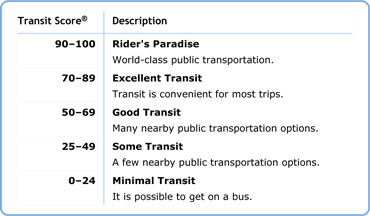
I previously wrote about Walk Score and its use in Sacramento, and now the Walk Score company has released Transit Score. Sacramento ranks 22 out of 25 cities, with a Transit Score of 32 (of 100), in the category of “some transit.” The categories are rider’s paradise, excellent transit, good transit, some transit, and minimal transit. It is worth noting that if all the major cities had provided their transit information, Sacramento would probably have not been on the list at all, because with a population of just under a half million, it is not in the usual top 25 but would show up in a top 50.

Walk Score notes “The Transit Score algorithm calculates a score for a specific point by summing the relative ‘usefulness’ of nearby routes. We define usefulness as the distance to the nearest stop on the route, the frequency of the route, and type of route.” As pointed out in the recent Streetsblog post, it does not including information about where you can go once you’ve gotten onto the transit, which also of course affects the usefulness of the transit.

Read More »

Two-waying streets in SF

StreetsBlog San Francisco had an interesting article yesterday about the conversion of one-way streets to two-way streets, SFMTA Brings Humane, Two-Way Traffic Back to Ellis and Eddy. This is an idea I’ve mentioned before for midtown, but haven’t posted any details yet, and still am not ready yet. But this article builds the justification. The […]

Sprawl

This week’s Sacramento News and Review (Thursday, April 29, 2012) has a feature story titled “Onward, Sprawl,” highlighting the impacts of the passion for growth of Sacramento County, Folsom, Rancho Cordova, and Elk Grove. I highly recommend a read. The Sacramento Bee has a short article in the Wednesday, April 18 edition titled “County kicks […]