We can’t go back

sorry, could not find a photo for Sacramento,, but if someone provides it, I will replace this one of Los Angeles (via Business Insider)

We can’t go back to the way things were before! To the car-dominated world where walkers and bicyclists were considered second-class citizens, worthy of consideration only when it did not inconvenience the privileged drivers of cars. The streets are largely empty (except for some essential drivers and too many joy-riders). The air is clean. The city is quiet. It is (other than the above-mentioned joy riders) safe to cross the street, to bicycle on the street, even in some places, to walk in the street. I don’t intend to ever go back, and will work to make sure we do not go back.

Here is a list, with brief notes, of areas in which I think we should not and cannot go back. No priority order. I think that over time my ideas can be refined and added to. Let me acknowledge the many people on Twitter, my main social platform, for giving me a lot of good ideas and food for thought.

  • Right to Move: I believe that, as humans, we have a right to move, to freedom of movement (though I also believe that reduction or even suspension of this right for public health during a pandemic is acceptable, though traumatic). However, this right is expressed through walking (or mobility devices for those not able to walk). It is not expressed through bicycles, or scooters, or even transit, and it is absolutely not expressed through privately owned vehicles. I am not saying that bicycles and scooters and transit are not good methods of movement for transportation, but walking must always be the most important and the most guaranteed, our most basic right, with other modes coming later, if at all (in the case of cars). I am tired of myself and others being terrorized by private vehicle drivers, who are all too happy to inflict their traffic violence on innocent people. Walking FIRST!
  • Transportation
    • all pedestrian signals should be set on recall; they should be labeled with their function; and if there a locations where traffic engineers claim such a low rate of pedestrian use, I’d ask for an analysis of why is there no pedestrian use; if it is an urbanized area, why aren’t there pedestrians, and if it is a rural area, why is there a signal?
    • failure to yield to pedestrians (CA CVC 21950) should be considered a sociopathic offense, similar to drunk driving and smoking in buildings, and strictly enforced; I am not just concerned about the number of pedestrians who are killed and severely injured by drivers, but about all the people who could walk, but don’t, because they are rightfully afraid of car drivers; drivers who repeatedly violate this should have their driving privileges revoked (drivers license suspended and vehicle impounded), and those who still violate should be jailed
    • #NoNewLaneMiles (a more specific version of #NoNewRoads); we have all the roads we will ever need, we just need to use them more efficiently by increasing the density of homes, jobs, and services; because there are no new roads, there will be no greenfield developments, as we have plenty of infill/redevelopment land to work with, and we have an excess of single family homes
    • expenditures on roadways will only go to maintenance, and once a level of good repair is achieved, then to true complete streets projects which reallocate roadway space and increase safe crossings
    • all roadways that are more than two lanes per direction must be reduced to no more than two lanes. Drivers have proven themselves, again and again, incapable of responsibly using wide roadways, and so these wide roadways must end. Temporarily, we can put up barricades or delineators to reduce the lanes, and in the long run, determine and then implement ways of re-allocating this space to best serve the community; some land might be available for housing development
    • freeways will be designed and sized for freight movement, not for commuting; interstate commerce is the primary legally and morally justifiable use for our Interstate system; the idea of continuously expanding freeways so that a continuously expanding number of people can choose to commute continuously expanding distances is not socially or economically rational or feasible; where there are more than two lanes on a freeway, one or more of them should be designated (and enforced) as a freight-only lane so that freight is not slowed by commuting traffic
    • private and commercial fossil-fueled vehicles must be strictly controlled on all spare-the-air days; if the air quality particulates (winter) or ozone (summer) exceeds the ‘healthy’ level, then we start shutting down vehicles; this would be much easier to do if we implemented a pricing scheme (congestion management) all the time, but if we are still working on that, we can in the meanwhile reduce traffic; I’m thinking the easiest way to do that is to control on-ramps and off-ramps, since most long distance commuters, and much commercial traffic, is using the freeways; some on-ramps already meter vehicles, and we could just slow this down so fewer vehicles are allowed to enter; we would have to add off-ramp metering; there are a lot of ways of managing traffic, some of the best controlling the amount of underpriced or free parking, but this is definitely one to explore
    • vehicles must be speed limited, so that drivers cannot exceed safe speed limits; this is one of the easiest to accomplish because all modern vehicles could be speed limited with minor software modification, but I realize that it is politically the least feasible; nevertheless, we need to be talking about it and advocating for it
  • Work from home: I fully understand that not every job is amenable to working from home, and interestingly, it turns out that almost all of the truly essential jobs are not, but nevertheless, many jobs are; employers should be required to analyze each job position to determine whether a particular job could be done from home, either all the time, or some days of the week, and then to implement work from home policies that allow the least in-person work required
  • Schools: I am part of the educational system. I like the idea of school choice, and I think it has a number of benefits. However, I also see the cost of it. A huge amount of driving, taking students to and from school. The idling of cars outside the school has a measurable and negative impact on air quality in the classrooms. Much of this driving is unnecessary, and trips could be done walking or bicyclist, but is driven for the convenience of the parents (not the students). The greatest danger students walking and bicycling face is the drivers taking their own child to school, and in addition to the direct danger, there is the intimidation that makes people less willing to walk and bike. Students are getting significantly less physical activity. Students and families feel less connected to the neighborhood they live in, and the school feels less connected to its neighborhood as well. So:
    • for any school located on an arterial with more than two lanes of traffic in a direction, lanes will be immediately closed in order to increase the safety of students walking and bicycling, and to create a less polluted and hectic environment
    • private vehicles will be prohibited on campuses, except where the parent has submitted a statement to the school detailing why a particular student must be transported directly to the school (meaning, a disability of some sort), and received a pass; schools are there to educate students, not to accommodate drivers
    • for schools located on local streets, the block on which the school is located will be closed to through traffic for the duration of arrival and dismissal (or longer); of course this means that students and families using mobility devices must be guaranteed high quality sidewalks and crosswalks, with ADA ramps, at least 6 feet in width, and in good repair
    • school districts should have a conversation with families and the public about the ways in which a non-neighborhood school supports and does not support academic learning and the needs of its community
  • Housing: Part of the reason we have a housing crisis is that single family homeowners have been able to suppress the building of homes, for some types of people (read: minorities) and for some kinds of housing (read: multi-family), for a long period of our history. We all suffer from this: un-housed people, high rents, separation of jobs and housing, climate change, air pollution, most of our transportation dollars going to long distance commuters while we have potholes in our local streets, underinvestment in transit and rail, etc. The most egregious, though largely hidden from view, aspect of this is that single family housing has bankrupted our cities, and counties, and state. Single family housing can never generate enough sales tax or property tax or user fees to pay for the maintenance required to sustain all these spread out houses and roads and utilities and law enforcement, and fire, and, and and. I think it is becoming clearer by the day how financially on edge our governments were. They have huge bond debt, huge deferred maintenance and well as current maintenance obligations, and far too much reliance on new development just to keep the old going (which is called the development ponzi scheme – see Strong Towns). Sprawl is the primary though not the only driver (pun intended) of this. So:
    • immediately remove all residential zoning classifications, so that there is only one residential zone, and no limit on the types of housing that can be constructed on a piece of land; until such time as we can analyze what we need in terms of zoning and development standards, I’d leave the rest be, but this is a step we can and should take immediately
    • no developments (even infill) larger than a certain size should be allowed to deed road and utility improvements to cities and counties, unless they pay a fee to a maintenance endowment sufficient to maintain that infrastructure for all time; I am not talking about development fees, which of course are used to maintain past infrastructure and to keep the doors open, but never retained for the future, rather, these are banked funds to meet the needs of the future
    • recognize a right to housing for all people; this is obviously a huge undertaking, for which governments may not have the money (because of the sprawl subsidy and bankruptcy detailed above), though there is certainly a lot of shifting of resources that could get us a significant way there, but we need to start working toward that goal now, and with much of our societal focus on how to solve the issue as quickly and equitably as possible

Thank you if you stuck with this long list to the end. As I said, it is preliminary, and your constructive comments here or on Twitter are welcomed.

I admit that I thought we had a decent world, many issues to work on, but sort of OK. Probably some others felt this way. But the bottom has dropped out, for those in poor health (much of that poor health due to all the actions above that we did not take), people of color, low income people, un-housed people, people dependent on employer-provided health insurance, people in essential jobs. I am very lucky! (yes, the luck of privilege).

I hope that we reflect deeply on the clean air and streets available for people (outside cars) to live, and all join together to make sure we do not go back to the old, unenlightened times, but to work hard towards a better future.

I am quite aware that I have not mentioned, or have lightly touched on, a lot of other issues that are critical to so many people. Climate change is one of the biggies for me. Please don’t think that those other issues are unimportant to me, but transportation is my expertise and advocacy, and it needs strong voices, now and always.

surface parking to residential

Wasted space for parking. This was once residences, and should be again.

Part two of posts about O Street activation, but also of more general applicability. See also my related post No more pure office buildings downtown.

The activation of O Street under the CADA-led ‘Envision O Street: A Community Planning Process to Transform the Streetscape‘ effort will be only partially successful unless there are a lot more residents along O Street and the adjacent neighborhood to activate it. As it currently stands, the street is largely dead evenings and weekends. Even the homeless folks don’t much like hanging out there.

So, forthwith, my modest proposal. All surface parking lots along N, O, P and Q streets will be transferred to CADA and developed for residential and/or mixed use. These developments might even include some office space, but no development would be purely office. We have enough state office space as it is, and we have enough parking garages (decks) as it is. Significant parts of the parking decks are empty even on weekdays, and they are completely wasted space the rest of the time. Many of them are even locked up evenings and weekends, so they could not be used even if people wanted them to be used. The state seems to not care about whether downtown and its part of midtown (extending to 17th Street) are dead. It sees downtown as just a collection of office buildings, and is fine with the buildings and streets being empty off work hours. The state also believe that it is their responsibility to provide unlimited parking for their employees, no matter how much that parking decreases the livability of the places they work. I’m not sure if these attitudes come only from DGS (Department of General Services) which manages state property, or is a more general view, but it is wrong. The state should be encouraging workers to get out of their cars and onto transit (light rail runs on O Street), bicycles and foot, not providing them free and low cost parking. The state should be encouraging livability, not thwarting it.

All surface parking lots along N, O, P and Q streets will be transferred to CADA and developed for residential and/or mixed use.

O Street Activation

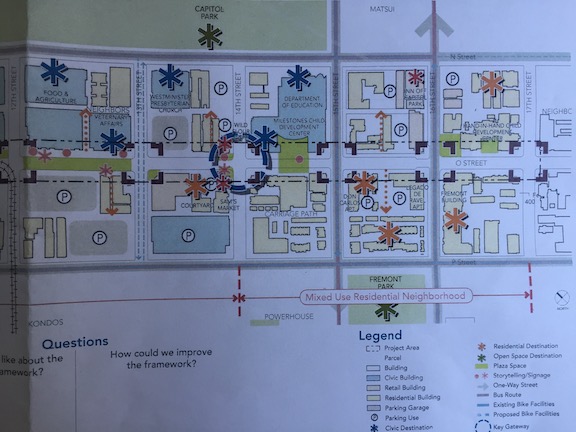
CADA (Capital Area Development Authority) is undertaking a process to activate O Street between 7th and 17th streets in downtown and midtown Sacramento. There was a community meeting at noon today, which I participated in. Not many people there, but there is also a meeting this evening which might gather residents who work during the day.

There are a lot of intriguing ideas and overall I think the draft framework is a good one. CADA said the diagrams and maps would be posted within a few days, so you will be able to see them at http://www.cadanet.org/projects/o-street-improvements-project.

Some comments I made:

  • the design needs to be compatible with the new light rail stations that will be constructed, probably in phases, to accommodate the new low-floor rail cars which require an 8-inch curb above the rails; the mini-high platforms needed for the current fleet of high-floor rail cars will eventually be removed, making for a much more pleasant street environment
  • rather than putting in bicycle facilities on O Street, separated bikeways on P Street and Q Street (partially complete) and N Street (not started) should handle most of the through bicycle traffic; instead, these things should be done to make the street bikeable without any special facilities:
    • speed limit 15 mph throughout
    • most sections become single-lane one-way, with narrowed travel lane; where two-way sections are needed (if at all), streets should be narrowed significantly
    • textured pavement, for streets or crosswalks or intersections, should either be sufficiently smooth to accommodate bicyclists, or have smooth pathways specifically for bicyclists
  • without bicycle-specific infrastructure, more of the right-of-way width can be devoted to pedestrians, sidewalks and the amenity zone; the pedestrian space will make the biggest difference in how the street is perceived
  • no section that is now closed to motor vehicles (9th to 10th and 11th to 12th) should be opened to motor vehicles, and no section that is currently one-way should become two-way
  • all corners should have bulb-outs (curb extensions) to calm motor vehicle speeds, reduce crossing distances, and preserve visibility at corners from parked vehicles; many corners are proposed for bulb-outs, but not all
  • raised intersections should be considered for all intersections
  • traffic on 15th Street (southbound) and 16th Street (northbound) must be calmed; it is currently difficult and hazardous for both walkers and bicyclists to cross through these intersections, traveling along O Street

The big issue, though, is that there is insufficient residents along the corridor, specifically between N Street and Q Street, to activate the corridor. More about that in my next post.

The improvements to O Street will be very expensive, if all are completed, but there are low cost items to start with, and I’m hopeful about seeing some of these in the near future.

Next year, a real earth day

I have been long frustrated with the drift of Earth Day into irrelevance. I helped organize the first Earth Day in Las Vegas, 1970, when I was 18 years old. I and my one-year-older friends who were attending the university had a lot of hope for the future and really wanted a celebration of the earth, and of the change we know had to happen. In the years since, regulation has solved a lot of our pollution problems, but forward progress on that has stalled, and been reversed by the present administration. Most people are now far more disconnected from the earth than were people back then, spending a lot of time with devices and very little with the earth. So, I’d like to suggest some ideas for the next Earth Day.

First, it is a weekend, not one day. One of the days, everyone heads for natural environments, and spends time there with friends and family, sans electronic devices. For large numbers of people in the US, access to natural areas is difficult, and almost requires a car. So I’d encourage carpooling and provision of free public transit on that day. Nationwide. In Sacramento, we are fortunate to have the American River Parkway and several other natural areas not far from transit, so long trips are not necessary. Yes, I’m serious.

The second day (the order is not important to the concept), we all gather and shut down a major road, creating an open street event. No permits, this is an action of the people having nothing to do with government and police. If the agencies who populated the booths at last year’s Earth Day really feel they have something to say and share, they can come, bring some displays and materials, as much as they can bring on a cargo bike. No driving. People will be strongly discouraged from driving to the event, in all of the publicity, so it needs to be somewhere close to transit so that people can make their entire trip, or at least the last part, on transit. Again, free transit for the day. Nationwide. The electric vehicles, which have nearly taken over Earth Day the last few years, are not welcome. They are not a significant part of the solutions we need. Electric cars running entirely on solar energy is a dream that is many years away, and in the meanwhile they are still really running on fossil fuels and nuclear energy. The better solution is just to not use cars at all. Yes, I’m serious.

The point is that the people take back Earth Day from the sponsors, and make it an event of the people. People spend the two days talking about how they can change their lives, and how we can come together to change culture and society. Hopefully we commit to taking action every day to end fossil fuels, but also end consumption and inequity and income inequality, take back our government from the rich and the corporations, end industrial agriculture, and house everyone. Earth Day should be the first day of radical action to make the world a better place. Yes, I’m serious.

Since hopefully everyone is participating in these two days, much of business as usual stops. If it doesn’t have to do with caring for and celebrating people and the earth, it doesn’t need to happen. Yes, I’m serious.

No more pure office buildings downtown

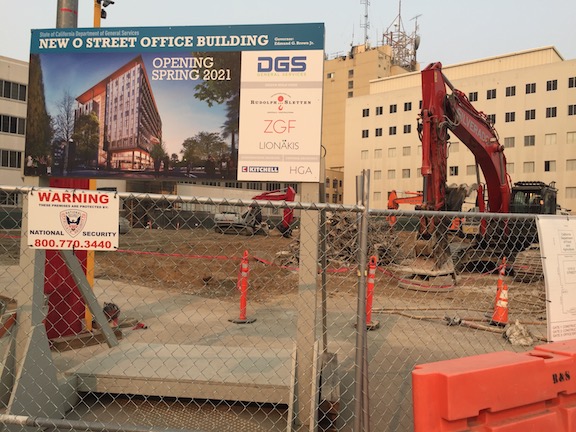
The state is building several new office buildings downtown. Close to where I live, the former building at O St and 12th is gone, and will be replaced with a modern office building, and the block between O and P and 7th and 8th is seeing a new building. There are others planned, and there is a plethora of state-owned surface parking lots (a travesty of land use if ever there was one) that could be developed.

It is good, in a sense, to see the state aggregating scattered offices into more centralized locations. But what is not good is that the state is not building any housing to go with the offices. So most employees will still be driving in from the suburbs, creating air pollution and rush hour congestion in the process, while contributing nothing to life in the central city. Almost every new building, whether public or private, has some retail, at least a corner and sometimes the whole ground floor. But integrated housing and office is rare.

So, my modest proposal (in the Swiftian sense) is that every office building of one-quarter block or larger include housing for at least one-quarter of the employees of the building. Not just the daytime office drones, but the maintenance staff as well. Some percentage should be required affordable, probably 20% to cover the lower income maintenance and clerical staff. I am not saying the the residences should be limited to employees of the building, I’d leave it up to each building manager how they wanted to allocate housing.

I have mixed feelings about whether this should be required of private developments. Certainly there should be codes and city support for accomplishing the same objective in private development, but requirements, not so sure. But state owned buildings, yes, absolutely, every one of them.

I lived in midtown, close to the downtown boarder, for seven years, and have now lived in downtown, near the midtown border, for just under a year. I moved all of five blocks. These two places might as well be in different cities. Downtown is dead, dead, dead at night and on weekends, whereas midtown is alive weekdays, evenings, and weekends. The difference? I think it is primarily the lack of housing in downtown. Office towers do not make for a livable, walkable place.

Rent control?

A group of citizens is trying to qualify a rent control measure for the November ballot in the City of Sacramento (Sacramento Community Stabilization and Fair Rent Charter Amendment). I have mixed feelings. First, some background, then my support, and then my concern.

We absolutely have a crisis of affordable housing in the City of Sacramento. People are becoming homeless due to eviction and a shortage of housing. This is unacceptable in a ‘world class city’ and in any city. We must change things to end this, and in short order.

But understanding the root of the crisis is important. It is really a transportation, housing and land use crisis. The city allowed and encouraged unsustainable suburban development, which it cannot now afford to maintain because the property and sales tax income from suburban development is not and never will be sufficient to maintain the infrastructure there. So the older suburbs have deteriorated as city, individuals, and companies disinvested. The same thing will happen to the newer suburbs, it will just take some time. This would not be as big a problem if we had a transportation system that allowed people to get from their deteriorating neighborhoods to well-paying jobs. But we don’t, and the city and county have refused over the years to fund a high quality transit system, so ours is marginally functional. Why? Because we spent all the money on freeways and arterials, instead of transportation. Our bicycling network and walking network (sidewalks) is sadly lacking outside of the central city.

Single family residences will never be affordable for many people. In fact they can never be affordable to the city or county, but that is a separate issue. We need multi-family housing in order to meet the needs of moderate and low income people. But very little of that is being built.

In the face of these problems, housing of only two types in being built: high to very high cost infill housing in the central city, and moderate to very high cost greenfield sprawl at the far edges, which has even poorer transportation than the suburbs. There is almost no development or redevelopment in the suburbs. In many cases, zoning and NIMBYism prevents redevelopment, but even if it did not, it is not clear that much would be going on there. The people who want to live in the older suburbs are people who largely don’t have other choices. So we don’t have enough housing of the right type and in the right place, and prices go up and up, while availability does not change significantly. I am not a housing expert, and people who are may contradict me on this, but I think the core issue is lack of a range of housing types and costs, and not so much specifically eviction and displacement (I don’t use the G word, as it does not explain anything and does not lead to any solutions). Can we build our way out of the housing crisis? No, but it would be a good start. Will it solve eviction and displacement issues? Only partially.

The Sacramento measure has three components:

  1. Rent regulation: limits the rate of rent increase
  2. Just cause for eviction: Limits the ability of landlords to evict except under certain conditions, and requires relocation assistance if not one of those
  3. Rental housing board: administers the rent control program

I have absolutely no problem with #2. This should be the law no matter what the circumstances, whether we are in a housing crisis or not. Though the apartment association presents a picture of the small landlord renting out a few units, this is the exception. Most rental units, as well as rental houses, are owned by huge out-of-state real estate conglomerates, in fact, in many cases, out-of-country investors. The small landlord picture plays well to people who like to think of themselves as supporting the little guy, and small landlords do deserve some support, but the huge corporations do not. Just cause for eviction is absolutely necessary to balance the power of renters against huge corporations.

I support #1 as a temporary solution, however, the measure does not make it temporary.

Let me be more specific. I think rent control is absolutely necessary to meet the housing crisis that we are in. I don’t buy the arguments of the developers (note that these are largely greenfield developers in Regional Business, not infill developers), the apartment association, or the mayor, that rent control will make things worse. It will not, in fact it can’t get much worse than it already is. There will be problems, but it is not as though we don’t already have problems. There will need to be other solutions, and they should be explored. But we need rent control, and we need it now. It is interesting that the developers and apartment owners have suddenly developed a concern for housing affordability and availability, when they were absent from the conversation before. Bogus! I don’t think the mayor really has a commitment to housing either, he is just trying to stall things as a favor to his contributors. I do not respect these people.

HOWEVER. I think the rent control section should sunset after some period of time, or when some objective is reached. That objective could be a declining rate of increase, below the consumer price index. It could be a vacancy rate above a certain level that is typical of cities outside of California. It could be average rents compared to the median household income. It could be affordable housing as a certain percentage of total housing stock. I’m not sure what the best criteria is, but I am sure there must be a criteria used to sunset. It is worth remembering that Costa Hawkins, the state legislation that severely restricts the ability of cities to manage housing supply and pricing was intended to solve a perceived problem, but here we are 23 years later still suffering from the effects of the legislation. (Some argue that it was never really intended to solve a problem but as payment to contributors, but I don’t know enough to argue one side or the other.) Costa Hawkins should be repealed (by Proposition 10) whether there is rent control in Sacramento or not.

So, I support the efforts of organizations and advocates under the Housing 4 Sacramento coalition to qualify the ballot measure. I think the arguments against it are weak. However, I’m not sure that I will vote for it if it qualifies, because it does not have a sunset. But I’m still learning, and still thinking.

Offshore drilling and vehicles

I am glad to see that so many people are getting involved in efforts to stop the Trump administration from drilling off the California coast. I was involved in other important issues today and did not participate. However, every time these kinds of “keep it in the ground” efforts come up, I wonder if our behavior is consistent with our message.

If you don’t want drilling off our coast, you probably are not in favor of drilling anywhere. The negative environmental impact is nearly as bad – which of our lands is NOT sensitive, which of our airsheds is NOT precious, which of our waters are NOT critical to life? So, how do we stop using oil? Well, in California, where 37% or more of our carbon emissions are from transportation, we have to radically change our transportation habits.

I will suggest:

  1. Stop using your privately owned internal combustion car. Now. Today.
  2. If you have an electric or hybrid vehicle, decrease your use by 90% over the next two years. Though in an ideal world we’d get electricity from renewable resources, that’s not where it comes from today. Don’t convert from fossil to electric, that is just delaying the inevitable.
  3. Unless you are physically disabled, don’t ever drive to an anti-fossil fuel protest.
  4. If you use ride hailing services (taxi, Lyft, Uber), cut your use by 95% over the next year. It is becoming clear that these services are worse for the environment and livability than private cars are. Don’t be fooled by the techno-glitter.
  5. Move or change jobs within three years so that you live within walking or bicycling distance of work; during the transition period, use transit, bicycling or walking for 80% of your work days.
  6. Join a group that is fighting against greenfield development and suburban and exurban sprawl, for example, ECOS. Work against re-election of any politician who votes for such development or expansion of cities into agricultural lands. Talking about you, Sue Frost.
  7. Get most of your food from as close to you home as possible, and if you have the space, grow as much of your own as possible.

I’m sure there are other ideas. This is what I’m doing, though I’m falling short on the food (and related transportation) ideal.

belligerent drivers

I’m back at work and doing one of my job functions, which is to observe and record driver, bicyclist and pedestrian behavior at intersections. I have noticed, at the same locations and the same time of day, that drivers are much more belligerent this year than previous years. Belligerent toward other drivers, bicyclists, and pedestrians, particularly pedestrians. I observed hundreds of incidents of drivers accelerating towards occupied crosswalks, and then stopping at the last moment. The only explanation that fits what I see is that drivers are trying to intimidate walkers out of using the crosswalks, because it causes a tiny delay in driving time. This behavior is not technically illegal, as the law just requires that a driver not enter the crosswalk while it is occupied, but the behavior is immoral, the kind of thing a scummy driver who sees themselves as the center of the universe would do. 

So what has changed since a year ago that has created this belligerent driver behavior? I can think of only one thing. Donald Trump. This is typical of the bullying, self-centered, sociopathic behavior that Donald Trump revels in. The safety and climate of the public realm has declined, and it is showing up in driver behavior as in so many other places in our society. 

What activates parks?

Now that I’ve had some things to say about individual parks in Parks in the central city and Park positives, some comments about what I think activates parks.

  1. People experiencing homelessness. Yes, I’m serious. There is nothing worse than an empty park, and I’d rather see people using a park than not.
  2. Nearby residential, something more than single family. Parks need people who live close, and parks surrounded by single family and other uses cannot gather enough people to activate them except for special events. Nothing wrong with mixed use, but if no one lives there, there won’t be a good park.
  3. Drinking fountains. In a climate like Sacramento, all public spaces should have drinking fountains.
  4. Something unique that does not exist at nearby parks. Restaurant, senior center, stage, basketball courts, water features, etc.
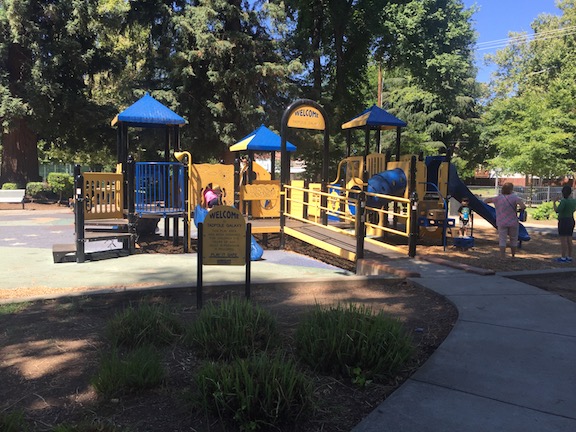
  5. Playground. Parks need kids, and kids need playgrounds. The size can be scaled to use, but the playground needs something unique that appeals to kids and isn’t just like every other playground. Creative ideas.
  6. Restroom. Any Park of a block or larger in size should have a public restroom. Park users will need restrooms, particularly kids, and they should not need to return home or seek out a local business. Of course this is part of a more general issue that Sacramento has almost no public restrooms anywhere.

I am am sure there are official answers to what parks need, and I will look for those when I have the time, but I want to provide my two cents worth.

What do you think?

Park positives

As promised, some positives to say about parks to follow up on the previous park post.

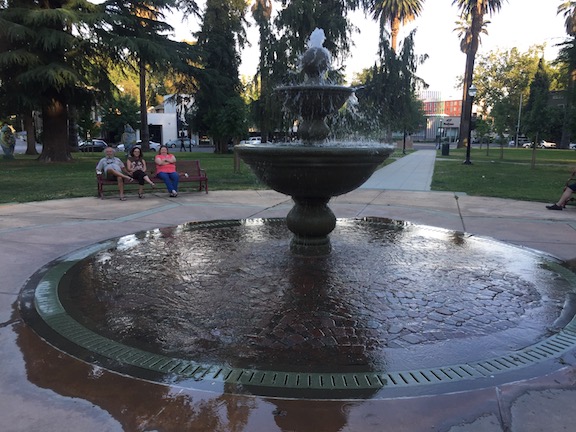
Cesar Chavez Plaza: The park always has people in it. Yes, some complain that it is the wrong (homeless) people, but I think a park full of people is a good park. The park hosts special events such as Concert in the Park, and has a seasonal farmers market. And it finally again has a restaurant. Too high-end for many of the people who use the park, but a positive nevertheless.

Roosevelt Park: The real strength of this park, in my opinion, is the basketball courts. I almost always see people there, playing and socializing. Many are not from this neighborhood, which I see as an indication that there is a much greater demand for high quality community basketball courts than is being met by the city. I'm not a fan of basketball, nor of the Kings who helped upgrade the courts, but I know park activation when I see it.

Fremont Park: This park has a playground used by every kid who lives in the neighborhood. It has a number of special events throughout the year, the biggest of which is Chalk It Up on Labor Day weekend. The park is surrounded by both housing and retail, so it gets a lot of unplanned visits.

Capitol Park: Capitol and Sutter's Fort are of course not primarily parks, but parks surrounding important state buildings. For me, the most interesting thing is the arboretum. It could be better advertised and have an app guide, but nevertheless it is a great resource.

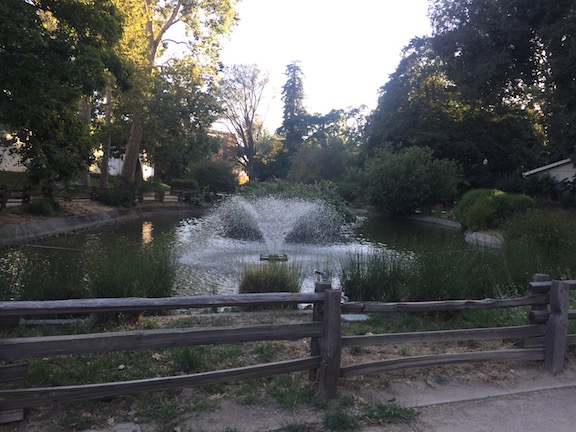
Sutter's Fort and State Indian Museum: Again, a park managed by the state primarily for other purposes, but with some nice park amenities. The ponds and fountains are my favorites.

Grant Park: This would be another big, bland water-wasting grass park, but it is saved by having a great little playground and a drinking fountain.

Zapata Park: Though small, Zapata has a playground, garden, court, grass and trees. The most distinctive thing it has is adjacent multi-family housing, so the park is always full of kids and families.

Southside Park: Southside is of course the gem of the central city, with a large number of amenities. The playgrounds are large enough to have a variety of equipment for different ages, with elements not seen in other parks, and is heavily used by families.

Next up: What activates a park?