Offshore drilling and vehicles

I am glad to see that so many people are getting involved in efforts to stop the Trump administration from drilling off the California coast. I was involved in other important issues today and did not participate. However, every time these kinds of “keep it in the ground” efforts come up, I wonder if our behavior is consistent with our message.

If you don’t want drilling off our coast, you probably are not in favor of drilling anywhere. The negative environmental impact is nearly as bad – which of our lands is NOT sensitive, which of our airsheds is NOT precious, which of our waters are NOT critical to life? So, how do we stop using oil? Well, in California, where 37% or more of our carbon emissions are from transportation, we have to radically change our transportation habits.

I will suggest:

  1. Stop using your privately owned internal combustion car. Now. Today.
  2. If you have an electric or hybrid vehicle, decrease your use by 90% over the next two years. Though in an ideal world we’d get electricity from renewable resources, that’s not where it comes from today. Don’t convert from fossil to electric, that is just delaying the inevitable.
  3. Unless you are physically disabled, don’t ever drive to an anti-fossil fuel protest.
  4. If you use ride hailing services (taxi, Lyft, Uber), cut your use by 95% over the next year. It is becoming clear that these services are worse for the environment and livability than private cars are. Don’t be fooled by the techno-glitter.
  5. Move or change jobs within three years so that you live within walking or bicycling distance of work; during the transition period, use transit, bicycling or walking for 80% of your work days.
  6. Join a group that is fighting against greenfield development and suburban and exurban sprawl, for example, ECOS. Work against re-election of any politician who votes for such development or expansion of cities into agricultural lands. Talking about you, Sue Frost.
  7. Get most of your food from as close to you home as possible, and if you have the space, grow as much of your own as possible.

I’m sure there are other ideas. This is what I’m doing, though I’m falling short on the food (and related transportation) ideal.

belligerent drivers

I’m back at work and doing one of my job functions, which is to observe and record driver, bicyclist and pedestrian behavior at intersections. I have noticed, at the same locations and the same time of day, that drivers are much more belligerent this year than previous years. Belligerent toward other drivers, bicyclists, and pedestrians, particularly pedestrians. I observed hundreds of incidents of drivers accelerating towards occupied crosswalks, and then stopping at the last moment. The only explanation that fits what I see is that drivers are trying to intimidate walkers out of using the crosswalks, because it causes a tiny delay in driving time. This behavior is not technically illegal, as the law just requires that a driver not enter the crosswalk while it is occupied, but the behavior is immoral, the kind of thing a scummy driver who sees themselves as the center of the universe would do. 

So what has changed since a year ago that has created this belligerent driver behavior? I can think of only one thing. Donald Trump. This is typical of the bullying, self-centered, sociopathic behavior that Donald Trump revels in. The safety and climate of the public realm has declined, and it is showing up in driver behavior as in so many other places in our society. 

What activates parks?

Now that I’ve had some things to say about individual parks in Parks in the central city and Park positives, some comments about what I think activates parks.

  1. People experiencing homelessness. Yes, I’m serious. There is nothing worse than an empty park, and I’d rather see people using a park than not.
  2. Nearby residential, something more than single family. Parks need people who live close, and parks surrounded by single family and other uses cannot gather enough people to activate them except for special events. Nothing wrong with mixed use, but if no one lives there, there won’t be a good park.
  3. Drinking fountains. In a climate like Sacramento, all public spaces should have drinking fountains.
  4. Something unique that does not exist at nearby parks. Restaurant, senior center, stage, basketball courts, water features, etc.
  5. Playground. Parks need kids, and kids need playgrounds. The size can be scaled to use, but the playground needs something unique that appeals to kids and isn’t just like every other playground. Creative ideas.
  6. Restroom. Any Park of a block or larger in size should have a public restroom. Park users will need restrooms, particularly kids, and they should not need to return home or seek out a local business. Of course this is part of a more general issue that Sacramento has almost no public restrooms anywhere.

I am am sure there are official answers to what parks need, and I will look for those when I have the time, but I want to provide my two cents worth.

What do you think?

Park positives

As promised, some positives to say about parks to follow up on the previous park post.

Cesar Chavez Plaza: The park always has people in it. Yes, some complain that it is the wrong (homeless) people, but I think a park full of people is a good park. The park hosts special events such as Concert in the Park, and has a seasonal farmers market. And it finally again has a restaurant. Too high-end for many of the people who use the park, but a positive nevertheless.

Roosevelt Park: The real strength of this park, in my opinion, is the basketball courts. I almost always see people there, playing and socializing. Many are not from this neighborhood, which I see as an indication that there is a much greater demand for high quality community basketball courts than is being met by the city. I'm not a fan of basketball, nor of the Kings who helped upgrade the courts, but I know park activation when I see it.

Fremont Park: This park has a playground used by every kid who lives in the neighborhood. It has a number of special events throughout the year, the biggest of which is Chalk It Up on Labor Day weekend. The park is surrounded by both housing and retail, so it gets a lot of unplanned visits.

Capitol Park: Capitol and Sutter's Fort are of course not primarily parks, but parks surrounding important state buildings. For me, the most interesting thing is the arboretum. It could be better advertised and have an app guide, but nevertheless it is a great resource.

Sutter's Fort and State Indian Museum: Again, a park managed by the state primarily for other purposes, but with some nice park amenities. The ponds and fountains are my favorites.

Grant Park: This would be another big, bland water-wasting grass park, but it is saved by having a great little playground and a drinking fountain.

Zapata Park: Though small, Zapata has a playground, garden, court, grass and trees. The most distinctive thing it has is adjacent multi-family housing, so the park is always full of kids and families.

Southside Park: Southside is of course the gem of the central city, with a large number of amenities. The playgrounds are large enough to have a variety of equipment for different ages, with elements not seen in other parks, and is heavily used by families.

Next up: What activates a park?

Parks in the central city

Winn Park

Winn Park, a block-square park between P & Q, and 27th & 28th, seems dead to me. It doesn’t matter what time of day I see the park, it is almost always empty, sometimes with some homeless folks hanging out, and more rarely, a family with kids on the playground equipment. Other parks seem lively much of the day. Why are the parks so different? I have been visiting all the parks in Sacramento central city to take photos and see if I can make sense of their characteristics.

Read More »

parks and green space

Strong Towns had a post yesterday “Why greenspace is different from a park” that got me thinking about parks and green spaces in Sacramento. As a commenter said, it is the quality and use of the land, and the relationship to space around it, that is most important, not the park or greenspace binary. 

Two dead parks come immediately to mind, Winn Park in midtown (P & Q, 27th & 28th), and Crocker Park (N & O, 2nd & 3rd). How are they dead? Very few people ever use them, certainly not enough to make the space feel used and safe, as the blog post points out is so important. In Winn, there is finally a small playground, but overall it does not make the park feel any less abandoned. Crocker Park as nothing to do. Yes, both places have trees and grass, but those thing are not in short supply in Sacramento. Several other square block parks feel alive.

Roosevelt Park (P & Q, 9th & 10th) has sports and a nearly continuous pick-up basketball game going on. Fremont Park has a larger playground, a fountain in the summer, benches, and events such as Chalk It Up. Probably most importantly, it has both residences and business on adjacent streets. The park is not the only reason to go there. Cesar Chavez Park (I & J, 9th & 10th) is probably the busiest small park in the region. It is a homeless daytime retreat, has a lot of events, now has a cafe again, and is surrounded by business and government, particularly the library. Many reasons to go there. There are several other one-block parks in downtown and midtown that I’m less familiar with. 

Crocker Art Museum is working up plans to activate Crocker Park by integrating it better with the museum. I think they’ll do a good job, though funding may slow the solutions. The city is finally talking about activating Winn Park, but I don’t think there is a plan yet. I’m sure some people in the neighborhood would be horrified, but what Winn needs is not just a park with more things to do, but more facing retail business and higher density housing. There is a bit, such as Lou’s Sushi, but it needs more. More things to do not just in the park, but around the park. 

The Strong Towns post also talks about green spaces, those areas left to grass or sometimes more interesting vegetation, but not really serving any purpose. In Sacramento, there are green spaces along some of the freeways. This is dead land, and few people want to even be there, but as the commenter points out, it can be used to handle stormwater and to filter air pollution, if designed properly. In newer subdivisions, there is often green space along the main roads. How this is of benefit escapes me. Those people whose back fences face a busy street have and will alway have lower property values, and no amount of non-native plants is going to change that. Front yard greenspaces are a horror in the suburbs, perhaps the thing most responsible for making suburbs the low value communities they are. People retreating into a set back house with a moat of grass is the problem, not the solution, to livable and responsible communities. The inner ring, older suburbs have this issue to some degree, but the setbacks are much less, and the lack of snout houses (those showing their very best two, three, four cars garages to the street) makes it acceptable. Sacramento downtown and midtown of course have a lot of temporary green space, places where housing was torn down (some which could have been repurposed or rehabilitated, and some not) and the planned replacement never built. I suppose it is good to have some land “banked” in this way, but we have far too much. 

And then there is Capitol Mall. Vast grass in between tall buildings, and never used by anyone except for a few major events each year. I suppose that someone thought a grand entrance to Sacramento was needed, along the lines of a city of skyscrapers and parks envisioned by Le Curbusier. But it is pretty much useless. It is not a park in any sense of the word. There have been suggestions over the years of how to fix this, including Rob Turner in Sactown Magazine: Boulevard of Broken Dreams. But solutions will be expensive and contentious. 

Rain swales are another type of greenspace which I have apparently not written about, but will. There ar several close to where I live. 

Walk Score update 2016-12

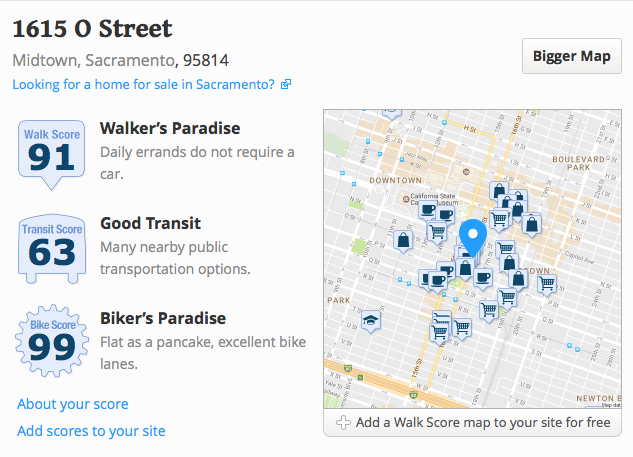
I’ve been curious about whether my Walk Score has changed with all the recent development in the area, since my earlier posts Walk Score (2012-03), Transit Score (2012-04), Bike Score (2012-05), and WalkScore update (2014-01). It has!

In March 2012, my Walk Score was 85: Very Walkable. In January 2014, my Walk Score was 82, Transit Score 62, and Bike Score 99. And today, my Walk Score is 91: Walker’s Paradise, Transit Score 63: Good Transit, and Bike Score 99: Biker’s Paradise. No big change in transit or bike, but a climb in walk score. And I am still tickled pink to be living where I do, in midtown Sacramento.

Quite a bit has changed on the Walk Score website over the years, and it is now much more focused on real estate. It has more in-depth information, but the algorithm is still proprietary. One of the beta features is a crime score, and my neighborhood ranks as a B.

walkscore_2016-12

Slow Transportation (part 3)

3. What Slow Transportation Isn’t

It isn’t flying in airplanes.

It isn’t driving over 25 mph except on roadways designed for higher speeds that connect places rather than go through places. For example, the highway to the mountains. But not the stroad arterial in your neighborhood, and never a residential street. In fact, 20 mph is a better number (see Twenty is Plenty).

It isn’t driving your kids to school.

When I ask people why they have a car, they most often answer one or more of three things:

  • to get to work
  • to buy groceries
  • to get to the mountains or the beach

There are solutions for each of these. If one choses to live far from work, or work far from home, driving is almost inevitable. But people do change jobs and housing, much more often than they admit, and could make the choice to be closer. Work and car are a classic Catch 22: I work to pay for my car, I have a car to get to work. It need not be this way. One can choose a job/housing situation allows walking, bicycling, or transit.

People’s grocery shopping patterns lean towards two extremes: 1) driving a mile to pick up a quart of milk; or 2) buying so many groceries at a time that they could not possible be carried by walking, bicycling or transit. But there is a middle ground, making more trips to the store and buying quantities that are walkable, bikeable, transit-able. That is what most of the people in the world do, and it is what we can do. Sure, maybe you do need a car every once in a while for a particular item, but most of the time, no. No. No.

I understand getting to the mountains and beach. I travel to the mountains a number of times during the summer for backpacking. I travel to the bay area about once a month for the ocean and the culture. But for neither trip do I use a car (I don’t have one, don’t want one). I use public transportation, and some bicycling, and some walking. If you are going camping, perhaps you do need a vehicle. Rent one, or find a friend with one! You don’t need that large vehicle sitting in your driveway, or driving around town. And, to be honest, you don’t need to be running to the mountains every weekend during ski season or summer, or the beach every weekend during the summer. Slow down, enjoy the place you live a little more. Yes, Sacramento during the summer can be a little hard to take, but the river is close by, or a cool bar with cold beer.

“You can have a city that is friendly to cars, or friendly to people, but you cannot have both.” —Enrique Penalosa

part 1 | part 2

Slow Transportation (part 1)

Recently I was emailing a friend about a Slow Food gathering, and facetiously used the term “slow transportation” for getting there by train rather than flying. But the more I thought about it, the more the term resonated with what I believe in and what I work on. I have not heard, so far as I’m aware, the term used anywhere else, but I think readers of this blog will immediately resonate with it as well. What follows is a first attempt to pin down a working definition of Slow Transportation.

I am going to break this topic up into several posts, but at the end I’ll make it available as a single document in case that is of use to you.

1. What is wrong with our present transportation system?

I am going to keep the list short and succinct because I think most readers of this blog will either already be aware of the issues, and/or will agree that these are the problems. Entire books have been written about each of these issues!

Note: Don’t be depressed by the list of problems below. I promise I won’t leave you there for long.

  • transportation accounts for a significant part of greenhouse gas emissions (37% in california, 26% in the US, and 14% worldwide) as is therefore a major driver of climate change
  • we have emphasized mobility over access, the ability to get somewhere – anywhere, rather than the ability to get to places we want to go; there is an incredible amount of aimless driving, just for something to do, running a small errand to take up time and fill an empty life; only about 15% of car trips these day have anything to do with commuting to work
  • the convenience and low cost of driving has encouraged the separation of functions, where we live, work, recreate and socialize, diminishing the value of each place; though this has started to reverse, we are so far down this road (literally) that it will be hard to bring these back together
  • privately owned motor vehicles isolate people rather than bring them together
  • traffic violence is inherent in a system based on private motor vehicles; even when people are not killed and injured by the drivers of motor vehicles, they are still intimidated out of the public space, knowing they are at risk there and are being actively discriminated against
  • our cities, counties and states are either already insolvent or on their way to insolvency, in part due to the fact that we do not have and cannot ever have enough money to maintain the transportation infrastructure we have already built; though roadways are the worst of this, it is also true to some degree of transit systems, and most certainly our air transport system
  • our current wars are in significant part about oil, oil wars; if you don’t think this is so, ponder the fact that the former head of Halliburton, an oil exploration and facilities company, got us into the Iraq war and Halliburton was the prime contractor for that war; it is not just the US with guilt and blood, most of the wars today are at least in part about oil
  • we transport our food long distances, disconnecting us from the source, the soil, and the people who grow it; industrial agriculture is both dependent on and a driver (literally) of our unsustainable transportation system; again, this is starting to reverse, but we have lost much of the smaller farmer and small processor capacity of our country, and it will take time to rebuild
  • the housing affordability crisis is in part due to a focus on housing costs without considering the transportation costs; the Center for Neighborhood Technology’s H+T calculations indicates that much of the current housing stock is unaffordable because it is located so far from jobs and amenities; it is not really the urban areas (so much in the news) where housing is unaffordable, since transportation costs there are so much lower, but the suburbs and exurbs
  • our transportation system takes up too much of our wealth, particularly in the preference for mega-projects like new bridges and freeways, and inattention to small projects that would have greater benefits; there are plenty of things we could be spending transportation money on instead; I dont’ want to minimize the value of transportation investments, but to ask that they have the a similar social return to other things we could spend on
  • our transportation system takes up too much of our space, not just with roadways and interchanges, but with parking garages and parking lots and on-street parking; as a result of all this space devoted to one mode of travel, the private vehicle, everything must be further apart, thereby requiring even more driving, in an ever-downward spiral
  • our transportation system both encourages and depends upon greenfield development, which leads directly to loss of wildlife habitat and agricultural lands; we already have enough housing stock, but a preference for heavily subsidized greenfield development leads to abandonment and neglect of the sufficient housing stock we already have; greenfield development must stop, now and forever
  • there are so many externalities to private car use, costs that are borne by other individuals and society as a whole, that it really amazes me that we even allow private car use
  • we have reached peak car; peak does not necessarily mean the greatest number of cars or the greatest vehicle miles traveled, but it means the point of diminishing returns; the costs are now overwhelming the benefits and nothing we do can change that, except to walk away (literally) from dependence on motor vehicles

“The automobile has not merely taken over the street, it has dissolved the living tissue of the city. Its appetite for space is absolutely insatiable; moving and parked, it devours urban land, leaving the buildings as mere islands of habitable space in a sea of dangerous and ugly traffic.” —James Marston Fitch, New York Times, 1 May 1960