red-light-running bullies

If you go stand at any busy intersection in Sacramento, you will see drivers running red lights on almost every single signal cycle. Of course this problem is not unique to Sacramento, but it is where I live and walk and bicycle, and I see it every day, at every signalized intersection. I am not talking about drivers entering the intersection on the yellow light, and not making it through before it turns red. I am talking about drivers entering the intersection when the light is already red. And quite often, they accelerate into the red light, making sure they can get through.

I call this bullying behavior. It says that I (the driver) is more important than anyone else. Me (the driver) making this light is more important than anything else in the world, which translates to my (the driver’s) convenience is more important than anyone else’s life. I (the driver) know that this is dangerous behavior, but I (the driver) don’t care.

My preferred word for this is actually terrorism. Terrorism, however, implies actions by individuals against states, or more often by states against individuals (state-sponsored terrorism). This is not that. But the intent is the same, to change other people’s behavior by the threat of violence, or actual violence. This is traffic violence perpetrated by entitled drivers against everyone else on the road. Terrorism may not be technically correct, but it sure sounds right.

Most drivers have adjusted to this by not starting into the intersection on the green, but waiting until the run light running driver has cleared. Same for people bicycling and walking. Most walkers know it is not safe to enter the crosswalk until all the cars have stopped, because usually they will not stop. But not all drivers, walkers or bicyclists know, and these are the people being killed or seriously injured at intersections.

Red light running has always been a problem, but it has gotten much worse. It accelerated, I think, during the pandemic, when there was less traffic, and drivers started to gamble with running red lights. Now that the traffic is mostly back, they are still doing it. In my observation, it gets worse by the month.

Many people think that the solution to traffic violence is to change road designs so as to prevent dangerous driver behavior. I’m of course in favor of this. But in this instance, re-design does not prevent this bullying behavior.

Having near-side traffic signals, as many advanced countries do, would help a little because a driver who chose not to stop loses information about how late on the red they are and therefore is less likely to run the red light. See Near Side Signals: Thinking Outside the Pedestrian Box for more info on near side signals. But this alone would not solve the problem.

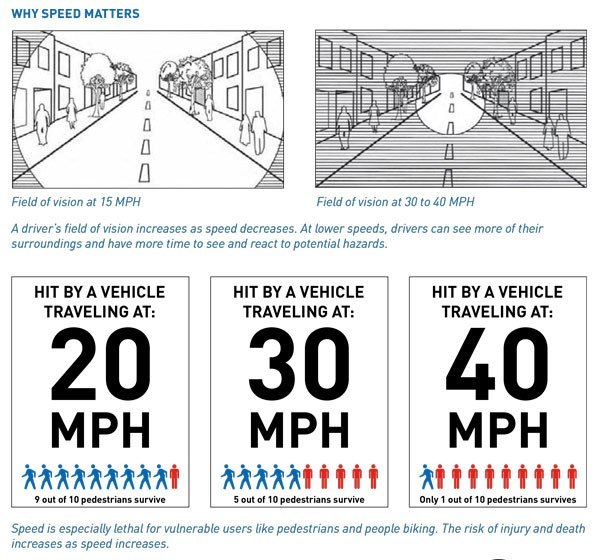
Slowing speeds would help, as the red light running driver would be a little less likely to kill the walker, bicyclist, or other driver and passengers than at higher speeds. But the red light runners are in my observation the same people who are driving well over the speed limit, adjusting their risk tolerance for to the highest possible level that won’t get them killed. Of course, these are not drivers who are much concerned about killing other people.

The City of Sacramento has a Red Light Running Program. The page says there are 11 cameras in the city. Out of 4000 plus intersections. This is not a serious response to a serious problem. It is in fact the typical city response to any transportation issue, to do the absolute minimum possible to avoid being called out for doing nothing.

I believe from extensive observation (I walk a LOT), though I have no data to prove it, that red light running is done by a fraction of drivers, and those drivers do it again and again and again. They’ve gotten away with it, so far, and will continue. At least 3/4 are drivers of expensive cars, high income, entitled people. If that is so, it would not take much to greatly reduce this behavior. Ticket them again and again and again, whether directly by law enforcement officers or by automated cameras, and their behavior would gradually change. Of course if we set ticket fines based on the value of the vehicle rather than flat rates, and impounded and/or confiscated vehicles upon repeated infractions, it would change even quicker.

Law enforcement is complicit in this red light running. I have never seen a driver stopped for running a red light. Ever. And in fact, law enforcement drivers are just as likely to run red lights as any other. Law enforcement doesn’t like automated enforcement, because it reduces the opportunity for them to do pretextual stops. It also is seen as reducing the need for officers, though since they don’t do this enforcement anyway, I can’t see how it actually reduces the need.

Many people have called on the city to install more leading pedestrian interval (LPI) lights in the city, where the pedestrian indicator turns to walk 3 seconds or more before the parallel traffic signal turns green. These of course help, but even where they already exist, the interval is now taken up by the time a walker must wait for the red light running drivers to clear the intersection before proceeding. Much less effective at promoting walking and safety than it could be.

Solutions:

  • The city could recognize that this is a serious traffic violence issue, and respond forcefully, with more enforcement and more automated cameras. The city’s Vision Zero policy obligates them to take traffic violence seriously, but they do not.
  • The CA-MUTCD could be changed to require near side traffic signals instead of far side traffic signals.
  • The state legislature and judicial council could change fines for violation of California Vehicle Code (CVC) to be based on the value of the vehicle. People often talk about basing fines on income, as some first world countries do, but income is not easily available to the law enforcement officer or processor of the red light camera mailed ticket, whereas the value of vehicles is available in the DMV database. If you run a red light in your $1000 clunker, the fine would be $1, and if you run a red light in your $200,000 trophy car, it would be $2000. To start.
  • Along with higher fines for drivers of fancy cars, the vehicles of these drivers should be impounded for the third violation of the same CVC within a year. Impound means you get the vehicle back after a certain period of time, maybe three months. And for those drivers that doesn’t control, then the vehicle should be confiscated, meaning you don’t get it back and the agency sells it. Maybe for more than six violations of the same CVC within a year, or ten within three years.
  • Walkers and bicyclists could equip themselves with paint ball guns so as to mark the vehicles of these bully drivers, so at least other people could see them coming. And perhaps other drivers would them start enforcing social pressure on them. It worked for smoking, when people who smoked in buildings and on transit were publicly shamed.
  • And of course, in the long run, we do need to re-design streets to that red light running is less likely, and less likely fatal due to lower speeds.

Sac Vision Zero intersections & red light cameras

I’ve written previously about Vision Zero high injury intersections in the City of Sacramento: Sac Vision Zero new intersections map, Sac Vision Zero top intersections all modes, Sac Vision Zero top ped intersections, Sac Vision Zero Top 5 Corridors and top intersections, and Sac Vision Zero flaws.

The City of Sacramento has red light cameras at the following locations:

  • Mack Road & La Mancha Way/Valley Hi Drive
  • El Camino Avenue & Evergreen Street
  • Howe Avenue & Fair Oaks Boulevard
  • Mack Road & Center Parkway
  • Exposition Boulevard & Ethan Way
  • Broadway & 21st Street
  • Folsom Boulevard & Howe Avenue/Power Inn Road
  • Arden Way & Challenge Way
  • 5th Street & I Street
  • 16th Street & W Street
  • Alhambra Boulevard & J Street

The top injury intersections are:

  • Stockton Blvd & Broadway
  • Stockton Blvd & Lemon Hill Ave
  • Stockton Blvd & 47th Ave & Elder Creek Rd
  • Watt Ave & Auburn Blvd
  • Del Paso Blvd & Evergreen St & Lampasas Ave
  • Julliard Dr & Kiefer Blvd & Folsom Blvd
  • Power Inn Rd & Fruitridge Rd
  • Freeport Blvd & Florin Rd
  • Center Pkwy & Cosumnes River Blvd
  • Bruceville Rd & Cosumnes River Blvd
  • Franklin Blvd & Mack Rd

Notice there is no overlap. One could optimistically say that the presence of red light cameras may be making drivers safer and reducing the crashes at these locations. But I doubt it. More likely, the city is just not prioritizing high injury intersections. Of course high injury intersections change over time, as traffic patterns change, and as the city redesigns intersections to be safer, so red light camera locations need not remain static.

I ask that the city install red light cameras at all the high injury intersections. I am not asking that the city move the existing cameras to the new locations. If someone thought a red light camera was necessary at an intersection, it probably still is, and should continue unless evidence indicates otherwise.

A lot of driver-apologists claim that red light cameras are not fair, that they are installed mostly to gain ticket revenue, and that they aren’t accurate anyway. Yes, some places have installed cameras for funding, but Sacramento is not one of them. Yes, sometimes the camera systems flag a vehicle that is not running a red light, but the photos are reviewed. Even if the city were making $1M a day on red light cameras, that would be just fine with me if it prevents one death. I value life more highly than do many drivers.

I worked in Citrus Heights for several years, which has a much higher percentage of traffic signals complemented by red light cameras. My perception is that it really did make a difference. I saw very little red light running in Citrus Heights. Other violations, sure, but not red light running.

photo from City of Sacramento Red Light Running Program page

lower speed limits?

Assembly Bill 43 (Friedman), passed in 2021, allows cities to set lower speed limits in specific situations. The 85% percentile rule says that speed limits should be set at the speed 85% of drivers are going, the prevailing speed, causes speed limits to increase, as drivers reset their normal speed to be somewhat over the posted speed limit. So speed limits continue to go up and will never go down again. This legislation is the second attempt to reverse that trend and that craziness.

The bill adds to a few limited circumstances where speed limits can be lowered to include ‘business activity districts’ (now), and concentrations of pedestrians and bicyclists and ‘safety corridors’ starting June 2024. There are a lot of details that will have to be worked out by local entities before implementation.

The first bill, AB 321 (Nava), allows cities to lower speed limits in school zones to 20 mph or 15 mph. The City of Sacramento did take advantage of this earlier law to lower speed limits at 115 schools. (City of Sacramento reduces speed limit in school zones)

A few cities are moving forward to implement lower speed limits in the situations the new law allows:

This option is available to all cities and counties in the Sacramento region. Which will be the first to step up and slow down?

Yes, I know that better design of the roadway is the most effective method for reducing speeds and increasing safety, but infrastructure changes are expensive and slow to be implemented. This bill will save lives and reduce severe injury in the meanwhile.

red light cameras

The City of Sacramento has 11 red light camera locations: Red Light Running Program. Of these, some are at high-injury intersections, but most are not. These locations are cross-referenced with high injury intersections shown in the post Sac Vision Zero new intersections map.

LocationTop allTop pedTop bike
Mack Rd & La Mancha Way/Valley Hi Drnonono
El Camino Ave & Evergreen Stnonono
Howe Ave & Fair Oaks Blvdnonono
Mack Rd & Center Parkwaynonono
Exposition Blvd & Ethan Waynonono
Broadway & 21st Stnonono
Folsom Blvd & Howe Ave/Power Inn Rdnonono
Arden Way & Challenge Waynonono
5th St & I Stnonono
16th St & W Stnonono
Alhambra Blvd & J Stnonono

My first thought is that the city was putting these cameras in the wrong location. But then I thought, what if the presence of red light cameras is making these locations safer and therefore dropping them out of the highest injury intersection list. I don’t have the information to answer that question, which would take analysis of crashes at the intersections, and before/after data.

What I do know is that many more red light cameras are needed to counteract the pandemic of red light running: pandemic of red light running. I spend time around the edges of Fremont Park, close to where I live, which includes the intersection of arterial streets P, Q, 15th, and 16th, and one of the things I do is watch traffic in the intersections. It has now become rare for a signal cycle for 16th St northbound at P St to not see an incidence of red light running. The other intersections are not quite as bad, but the pattern is there. And this is happening everywhere in Sacramento that I go; these are not likely to even be the worst intersections.

I believe that most of the red light running is by egregious violators, people who routinely and continuously violate traffic law for their own convenience or thrill seeking. This is true of most traffic violations, but red light running is the one most likely to result in fatality and serious injury, for people in all modes of travel. So having a more widespread set of red light cameras would serve to catch these red light violators. Of course the follow-up is necessary, to revoke the licenses and confiscate the vehicles of these repeat offenders. The longer the city looks the other way on this issue, the more people will come to see it as normal behavior, and the less safe our streets will be.

The standard response by cars-first entitled drivers is that tickets are just a money-making scheme by the government. The purpose of red light cameras is to make streets safer, and if that results in some income, so be it. I’m more than happy to have these sociopathic drivers hit in the pocketbook, and the money can be used to make our streets safer, such as by installing more red light cameras. Red light tickets, with photos, are part of the documentation needed to revoke licenses and confiscate vehicles.

the blind spot of roadway re-design

It has become popular these days to claim that the only real solution to traffic violence is re-design of roadways to prevent bad driver behavior, and to eliminate traffic enforcement as a solution to bad driver behavior. I’m not in disagreement with this. Re-design does prevent a lot of bad driver behavior. Traffic enforcement is very often a tool of oppression by law enforcement on people of color. All true.

But… There is also a blind spot. Roadway re-design does not force drivers to yield to walkers in the crosswalk. Sure, if traffic is going slower, it is less likely that collisions will be fatal to the walker, and perhaps slightly less likely to result in a collision at all, with more reaction time. But a driver that won’t yield at 35 mph is a driver that won’t yield at 25 mph. Failure to yield to someone in the crosswalk is sociopathic behavior, in that it intimidates people against walking, and it is psychopathic behavior in that it prioritizes driver convenience over the lives of others. These people are mentally ill, and they should be removed from our roadways. Not just ticketed, but their drivers license pulled and their vehicle confiscated.

No technology that I’m aware of will automatically enforce yielding behavior, or ticket failure to yield. Red light running cameras are legal in California, but are installed on only a tiny fraction of signalized intersections, and are not even used in many localities. Speed cameras are illegal in California (to protect the guilty). I have never heard of cameras focused on failure to yield.

Law enforcement has essentially stopped enforcing failure to yield. I’ve never seen someone stopped for this violation, and the traffic stop statistics say that it almost never happens. Law enforcement doesn’t care. It sees walkers as second class citizens. After all, they are often lower income and sometimes homeless, people that law enforcement feels obligated to oppress, not to serve. I myself have experienced law enforcement officers failing to yield to me in the crosswalk a number of times. CHP is the worst offender, but all the agencies are guilty.

What provoked this post? I was bicycling home along P Street from the store. A woman was crossing. The driver in the left hand land stopped for her, as did I. The driver in the right hand lane not only did not slow to see why, but blew through the crosswalk, very nearly hitting the woman. I caught up with the vehicle, and saw that both the driver and passenger were high-income, white, and young. When I tried to talk to them about their violation and nearly hitting the woman, they blew me off and implied that I was crazy for even caring about this. This is the drivers we share the road with.

Yes, let’s re-design the roadways. But in the meanwhile, lets enforce failure to yield with serious consequences. The lives of people walking are too valuable to sacrifice to drivers, for even one day. I realize there are equity implications of traffic enforcement, but my anecdotal observation says that the worse drivers are high-income white males. Hardly the oppressed class.

CVC 21950

AB 550 allows speed cameras

AB 550, by Assemblyman David Chui, would allow the use of Automated Speed Enforcement (ASE, or speed cameras) in certain circumstances. I can’t point you to the language for specifics, since the legislative website has not been updated yet. You might call this a gut and amend bill, but since the original subject was ‘pedestrian safety’ it is really more of an amend.

The bill would establish a pilot program, which local transportation agencies could participate in. It would not start until July 2022, more than a year from now, in order for CalSTA (California State Transportation Agency) to develop an implementation plan. The program would rest with Caltrans and local transportation agencies, not with law enforcement agencies, which is a critical distinction to reduce the use of discriminatory pretext stops by law enforcement.

This legislation for ASE is a key component of the Vision Zero movement: “Managing speed to safe levels.”

It has long been my theory that most fatal crashes, whether the victim is a driver, passenger, walker or bicyclist, are caused by egregious speeders, drivers who travel more than 10 mph over the speed limit, the sort of people that CHP occasionally catches going 120 mph on the freeway, and is the same person driving 50 mph on a residential street. If that person is getting repeated automated speeding tickets, then they (he) can be targeted for more serious consequences like loss of freedom and loss of vehicle. Of course loss of vehicle probably requires other law changes, but this bill is at least a start.

When the bill language is available and hearing scheduled, I’ll post again. Keep an eye out here, or Streetsblog, or Twitter.

Streetsblog SF: Lawmaker Tries Again on Automated Speed Enforcement

from Streetsblog SF, original source unknown

use Amazon? – support this!

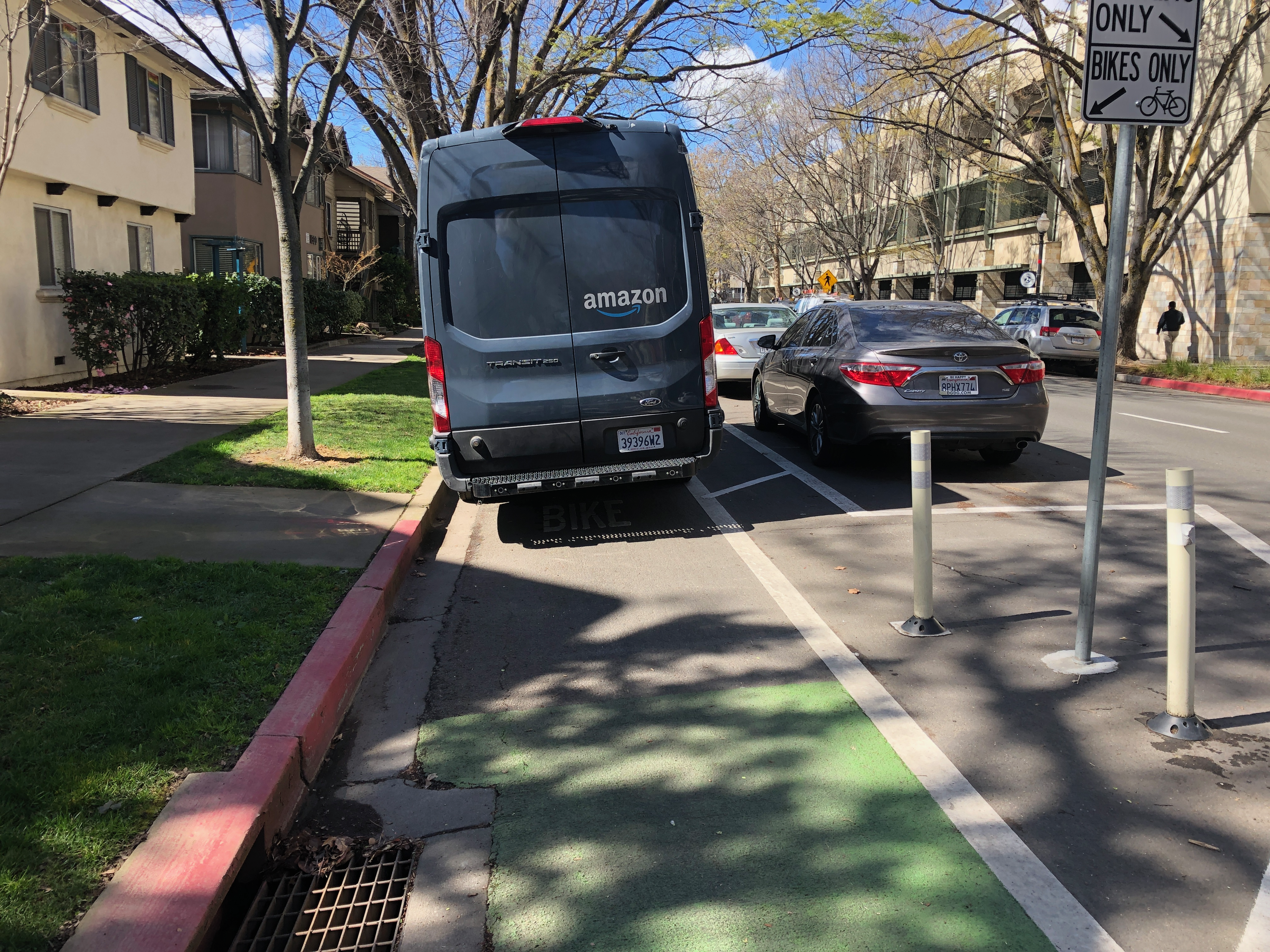
This afternoon I was walking along P Street, not riding my bicycle, when I saw this Amazon delivery van parked in the separated bikeway (cycletrack) just past 13th Street.

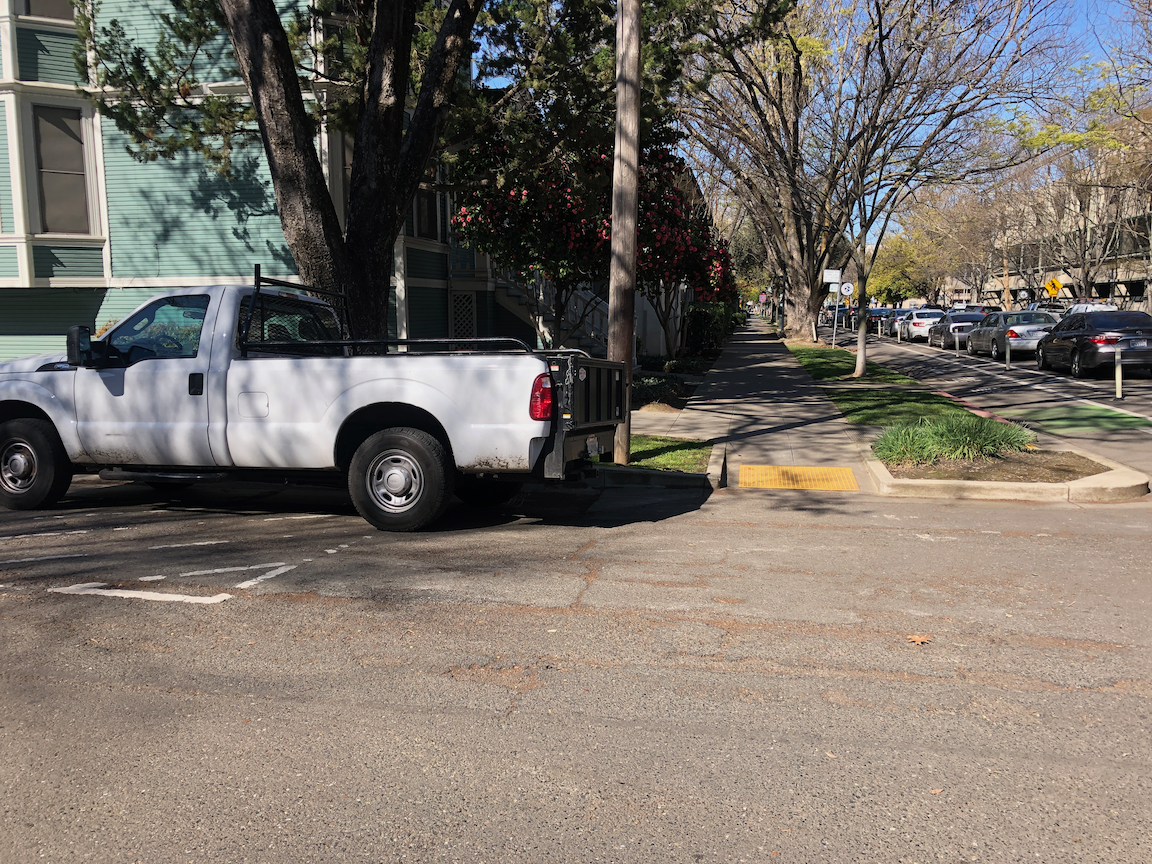
When I asked the driver why he was in the bike lane, he said there was nowhere else to park. But in fact there is a cross-hatched, implied no-parking, area just behind the photo on 14th Street, not more than 30 feet from where the van is parked. I can’t show you an aerial of this because the parking has been reconfigured since the last historical Google Earth imagery without leaves on trees, but tomorrow I’ll take a ground photo and add it here. There were also several empty parking spots on 13th Street both north and south of P Street, but apparently this was too far for the driver to walk.

Once making several deliveries, the driver finally left, traveling down the separated bikeway all the way to 13th Street. I reported the parking violation to the city’s 311 app, but of course the van was gone before they could respond. However, I think it is important for everyone to report these violations, otherwise the city can claim it was not aware of the situation.

This is the Amazon attitude, that our deliveries are more important than public safety, and if we actually get caught, the ticket is a small price for our way of doing business, which is raking in the big bucks. So, please think about this photo the next time your order from Amazon. I am not saying Amazon is the only guilty party, other delivery services do similar things, though Amazon seems to be the most brazen. And it is partly the city’s fault. When they repaved and restriped P Street to create the separated bikeway, they could have created delivery spots on both the 15th-14th block and the 14th-13th block, but they did not.

2021-03-12: Adding photo better showing context for the illegal Amazon parking. On the right is the separated bikeway that was being blocked by the Amazon driver. On the left is the crosshatched area that sets off diagonal parking on 14th Street. This morning it was being used by an exempt vehicle, perhaps CADA, but when the Amazon van was there, this was empty and available for delivery.

pandemic of red light running

There is a pandemic of red light running in Sacramento, and probably everywhere else. There have always been some red light runners. But since the pandemic emptied many streets of prudent drivers and left them wide open to egregious violators, the problem is much worse now. I am not talking about drivers who ignore or speed up on yellow, and are still in the intersection when the light turns red, I am talking about drivers who enter the intersection when the signal is already red. Often, they speed up approaching the intersection, guaranteeing that any crash will be more serious.

I know many people will not believe this, or will offer up one of many windshield perspectives on why this is not really a problem: bicyclists run red lights all the time and pedestrians jump into the street, so that crashes are their fault and not the fault of the driver. Bullshit. This is an intentional behavior by people who know that they are driving in a dangerous manner, but think they’ll get away with it. And they often do, since other drivers and walkers and bicyclists mostly know not to enter an intersection without looking to see if any of these criminals are coming.

So, if you are a doubter, I ask that you spend time observing a busy or moderately busy intersection. It probably won’t take more than 10 minutes before you see someone run a red light. This behavior truly is pandemic.

One of my observations is that about 2/3 of these are drivers of high value cars, BMWs and huge pickup trucks being the worst offenders. These people, in the unlikely event that they get a ticket for their violation, probably just see this as a minor expense for driving the way they want to. If you don’t believe that the drivers of different kinds of vehicles behave differently, please see Driving Drunk: Car Models with the Most DUIs.

A walker who steps off the curb when the pedestrian signal gives them the right of way are significantly more likely to be hit, or narrowly avoiding being hit, by these criminal red light runners. Same for a bicyclists or other drivers who enter the intersection when the light tells them it is their turn. The situation is slightly different for walkers, who do have the right of way, and bicyclists and drivers, who can enter the intersection when it is safe to do so. But in all cases, the violator is endangering the lives of others.

Red light running is a behavior that is certain to result, sooner or later, in serious injury or fatality. As such, it should be a high priority for enforcement. Both red light cameras and on-the-ground enforcement are needed, and must continue until this criminal behavior recedes at least to pre-pandemic levels, and then beyond that, until it is eliminated.

Some specifics:

  • red light running tickets should be based on the value of the vehicle, so that high income people with high value cars are penalized at a level that will actually change their behavior, and conversely that low income people are not penalized in a way that leads to a downward spiral
  • all red light tickets, whether camera or on-the-ground, must require an appearance before a judge; short-term suspension of the drivers license should be the default punishment meted out; repeated violations should result in permanent revocation of the drivers license and confiscation of the vehicle
  • law enforcement should prioritize observation of and enforcement of driver behaviors that are most likely to result in serious injury or fatality; these behaviors in my mind include egregious speeding (more than 20% over speed limit), failure to yield to pedestrians in the crosswalk, and of course red light running; CHP really only cars about speeding, but this must change. Other law enforcement agencies are more likely to pay attention to other violations, but still not enough.

Some places have red light cameras to catch red light runners, but many places do not. The City of Sacramento has eleven locations with red light cameras, out of about 900 intersections. Sacramento County and the City of Citrus Heights have cameras, but I’ve been unable to find locations or numbers. Rancho Cordova has four locations. The City of Folsom apparently has none.

prudent vs. irresponsible drivers

The previous post was about prudent drivers. The table below shows how I think of prudent drivers, and irresponsible drivers. It is so hard to not be snarky about driver behavior, but I have toned it down quite a bit. If you think I am exaggerating, then you don’t spend much time on the roads walking and bicycling. I spend a lot of time doing both, probably averaging three hours per day, all of it closely observing driver behavior and the roadway built environment, because it is both my job and my advocacy. The irresponsible behavior is something I see every day, from a significant percentage of drivers. Notice that I did not use the term negligent driver, as is the legal term in my prior post on a prudent driver, because only some of this is negligent; much of it is just sociopathic.

Prudent Driver Irresponsible Driver
yields to pedestrians in crosswalks and waiting to cross never yields to pedestrians
takes turn at stop sign intersections goes out of turn at stop sign intersections
obeys speed limits, within 5 mph drives as fast as possible in all situations
on multi-lane roads, always slows or stops if a vehicle in another lane is stopped on multi-lane roads, pulls around other vehicles that are stopped, honks, and proceeds at full speed
rarely uses their car horn, and only to prevent a crash often uses their car horn to make those other idiots pay attention and get out of the way
is aware of what is going on around them is focused on other things than the road
doesn’t use their smart phone while driving, other than wayfinding holds ongoing conversation on smart phone; texts when they think they can get away with it
passes bicyclists with a safe distance, even when it means waiting yells at, honks at, and close-passes bicyclists, because they don’t belong on the road
believes all people have a right to share the public space on the roadway believes that right to the roadway is determined by the value of their vehicle and social status
will do anything to avoid a crash revels in crashes when they know they are right
knows the the cost of building and maintaining roads is subsidized by everyone is certain that gas tax monies are being illegally diverted to other uses
knows that parking is never ‘free’ and someone, or all of us, are paying believes that the right to free parking is guaranteed in the constitution, and that the parking space in front of their house belongs to them
could be a male or female (or non-binary) is almost always a male

a prudent driver

700. Basic Standard of Care: A person must use reasonable care in driving a vehicle. Drivers must keep a lookout for pedestrians, obstacles, and other vehicles. They must also control the speed and movement of their vehicles. The failure to use reasonable care in driving a vehicle is negligence.

Judicial Council of California Civil Jury Instructions, 2019

The term ‘prudent driver’ does not exist in law or case law for California, though it does for some other states. The concept is useful enough that I’d like to explore it here. The term is closely related to other concepts such as a ‘reasonable person’, ‘prudent man‘, ‘prudent person’, ‘duty of care’, and ‘standard of care’. The Judicial Council of California Civil Jury Instructions (CACI) document, excerpted above, is often referred to a ‘case law’, instructions for how to interpret legal codes, based on court findings. Many terms in California Vehicle Code are left intentionally fuzzy, but case law removes much of, but not all of, this fuzziness. In civil law, which is what this document covers, the three criteria for establishing liability are negligence, causation, and harm, meaning that the person acted in a negligent way, and harm was caused by the negligence.

Of the two issues most relevant to people walking, speeding and failure to yield are the most significant.

706. Basic Speed Law (Veh. Code, § 22350): A person must drive at a reasonable speed. Whether a particular speed is reasonable depends on the circumstances such as traffic, weather, visibility, and road conditions. Drivers must not drive so fast that they create a danger to people or property.

Judicial Council of California Civil Jury Instructions, 2019

Section 706: Basic Speed Law (and sections 707 and 708), presents the idea that violation of the speed limit is not, per se, evidence of negligence on the part of the driver, but that the test is whether the speed was reasonable. In most European countries, violation of speed limits is negligence, but unfortunately that is not the case in the US. But the document does lay out pretty clearly that the driver is responsible for controlling their vehicle and anticipating the presence of other users on the roadway.

710. Duties of Care for Pedestrians and Drivers in Crosswalk (Veh. Code, § 21950): A driver of a vehicle must yield the right-of-way to a pedestrian who is crossing the roadway within any marked crosswalk or within any unmarked crosswalk at an intersection. When approaching a pedestrian who is within any marked or unmarked crosswalk, a driver must use reasonable care and must reduce his or her speed or take any other action necessary to ensure the safety of the pedestrian.

A pedestrian must also use reasonable care for his or her own safety. A pedestrian may not suddenly leave a curb or other place of safety and walk or run into the path of a vehicle that is so close as to constitute an immediate hazard. A pedestrian also must not unnecessarily stop or delay traffic while in a marked or unmarked crosswalk.

The failure of a pedestrian to exercise reasonable care does not relieve a driver of a vehicle from the duty of exercising reasonable care for the safety of any pedestrian within any marked crosswalk or within any unmarked crosswalk at an intersection.

Judicial Council of California Civil Jury Instructions, 2019

Section 710 covers the failure to yield to pedestrians violation, CVC 21950. The case law does have some interesting quotes:

“While it is the duty of both the driver of a motor vehicle and a pedestrian, using a public roadway, to exercise ordinary care, that duty does not require necessarily the same amount of caution from each. The driver of a motor vehicle, when ordinarily careful, will be alertly conscious of the fact that he is in charge of a machine capable of projecting into serious consequences any negligence of his own. […]”

“It is undisputed that defendant did not yield the right of way to plaintiff. Such failure constitutes a violation of the statute and negligence as a matter of law in the absence of reasonable explanation for defendant’s conduct.”

To summarize, my interpretation of the judicial guidance is:

  1. Drivers must control the speed of their vehicle, no matter what the posted speed limit, in recognition that they must always be aware of other users of the roadway and take all reasonable precautions to ensure that crashes do not occur.
  2. Drivers must yield to pedestrians who are exercising reasonable care in crossing the street, and the pedestrian has a presumption of right-of-way in the absence of other evidence.

So, a prudent driver would not be negligent, and a negligent driver would not be prudent.

Next post, more about how a prudent driver behaves.