Stockton Blvd Corridor Study

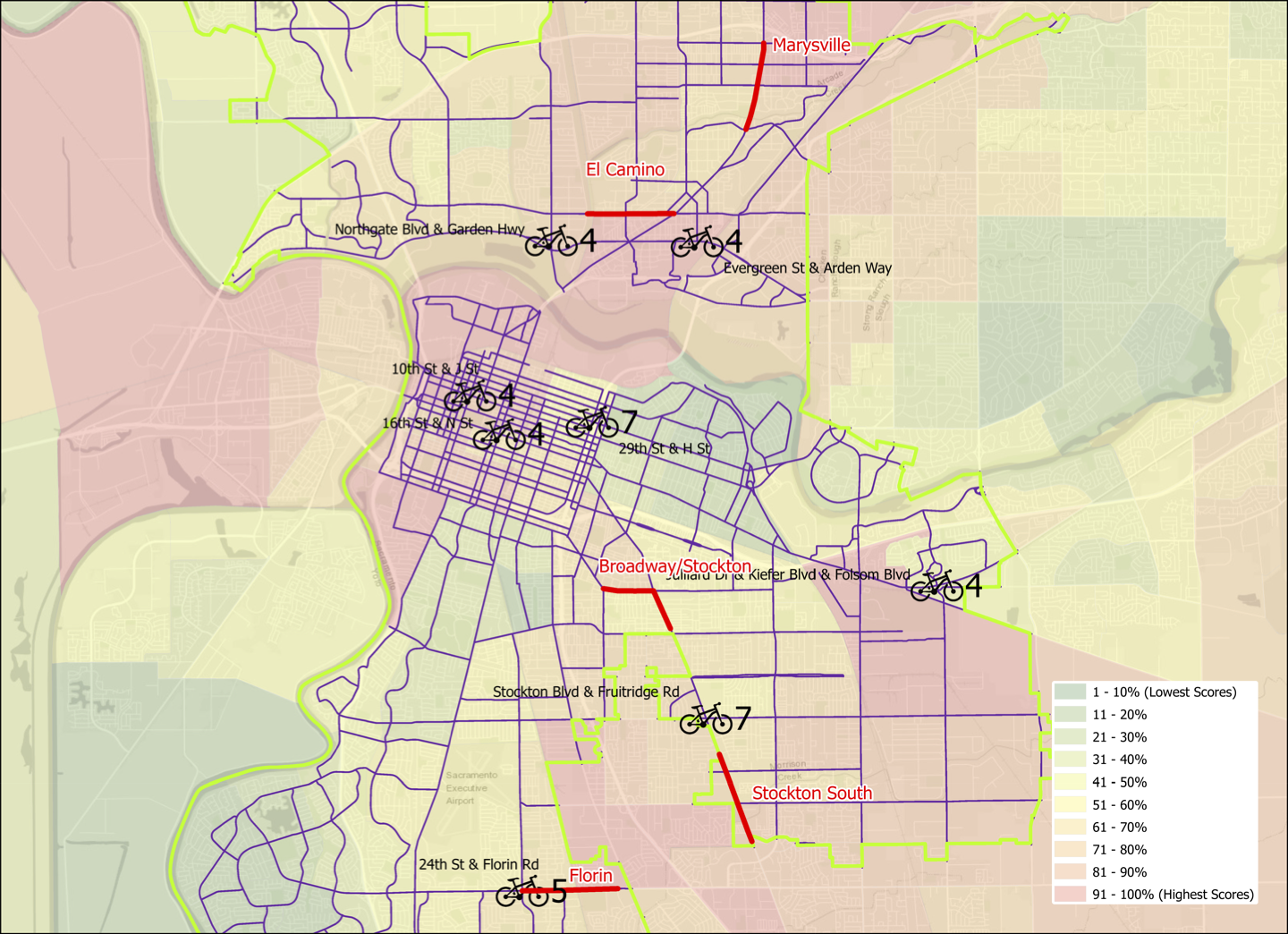
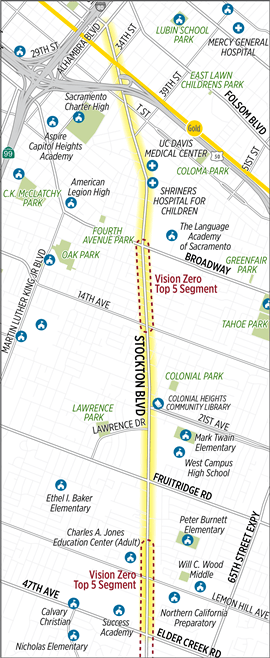
The City of Sacramento is undertaking a Stockton Blvd Corridor Study, covering the section between Alhambra Blvd and 47th Ave / Elder Creek Rd, but focused on the two high injury segments around Broadway to 14th Ave and north of Lemon Hill Ave to south of 47th Ave / Elder Creek Rd. Map below.

Tomorrow, Thursday June 25, there will be a virtual open house at 6:00 pm. There is also a survey which is open through Tuesday, June 30. The survey offers existing conditions information for each of several segments, and then presents two options are asks the user to select one of the other, and make comments if they wish. The options were developed as a result of a community engagement process which was partially led by Jackie Cole of VG Consulting. I attended one of the meetings in February, which had more actual community members than most such meetings, but was only moderately attended. I did not attend any of the other events.

I would encourage anyone who travels on Stockton Blvd, and particularly people who live on or do business on the corridor to take the survey and attend the virtual open house. Please use the comment boxes to tell stories of your personal experiences and concerns using the corridor, as they make a huge difference in the design ultimately selected (we hope).

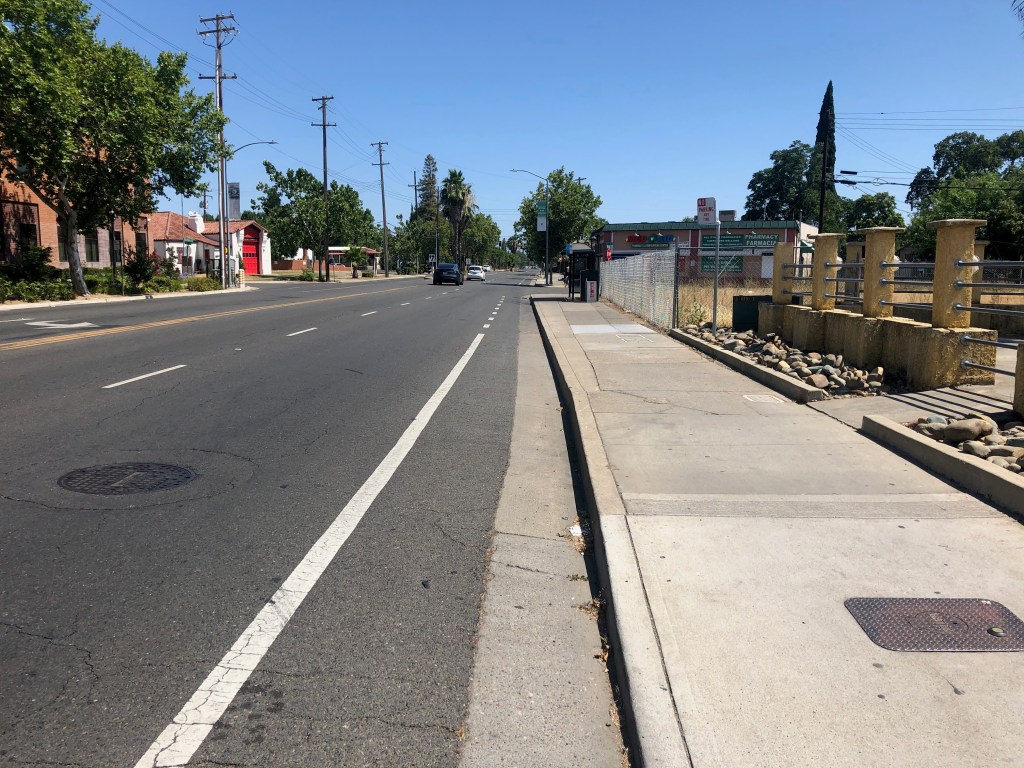
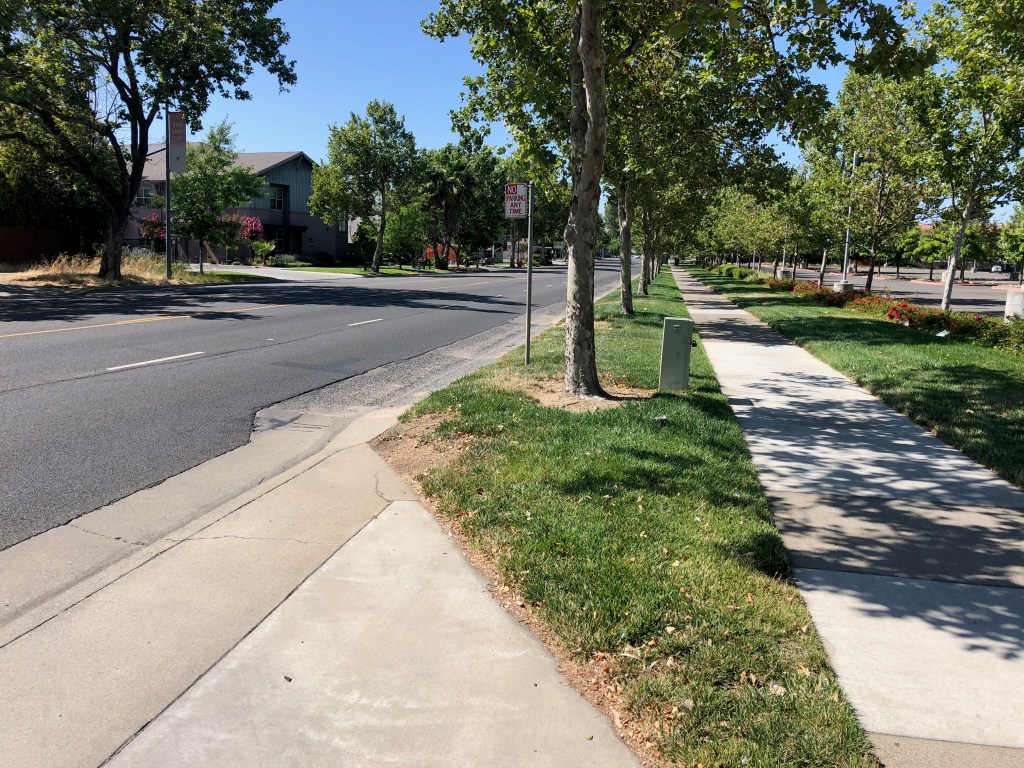
The nature and width of Stockton (both the street and the right of way) varies considerably over the length of the section, so there is not a single roadway design that can be used throughout.

The survey and background documents do not address the number of driveways along several sections of the road. In some places there are more driveways than not driveways, with each commercial property having one or more driveways. The density of driveways mean that most measures taken to make the street safer for walkers and bicyclists, and faster for transit, will fail. The city must reduce the number of driveways, whereever consolidation is possible. A key question which the survey never asks is what should be the priority of the different travel modes along the corridor. I would argue for:

  1. transit
  2. walking
  3. bicycling
    …..
  4. private motor vehicles

But your priorities may be different. The reason I place transit at the top is that SacRT Route 51, when highest ridership route in the entire system, runs on Stockton from Broadway to 47th Ave and beyond. This is the sort of ridership that would justify bus rapid transit (BRT) in most cities, and some of the options do ease bus travel but fall short of BRT. And of course people must either walk or bicycle to the bus, and so these two modes must come next. High quality sidewalks and bike facilities can ease these ‘first mile’ trips, and make it possible to reduce somewhat the frequency of bus stops, further speeding the bus.

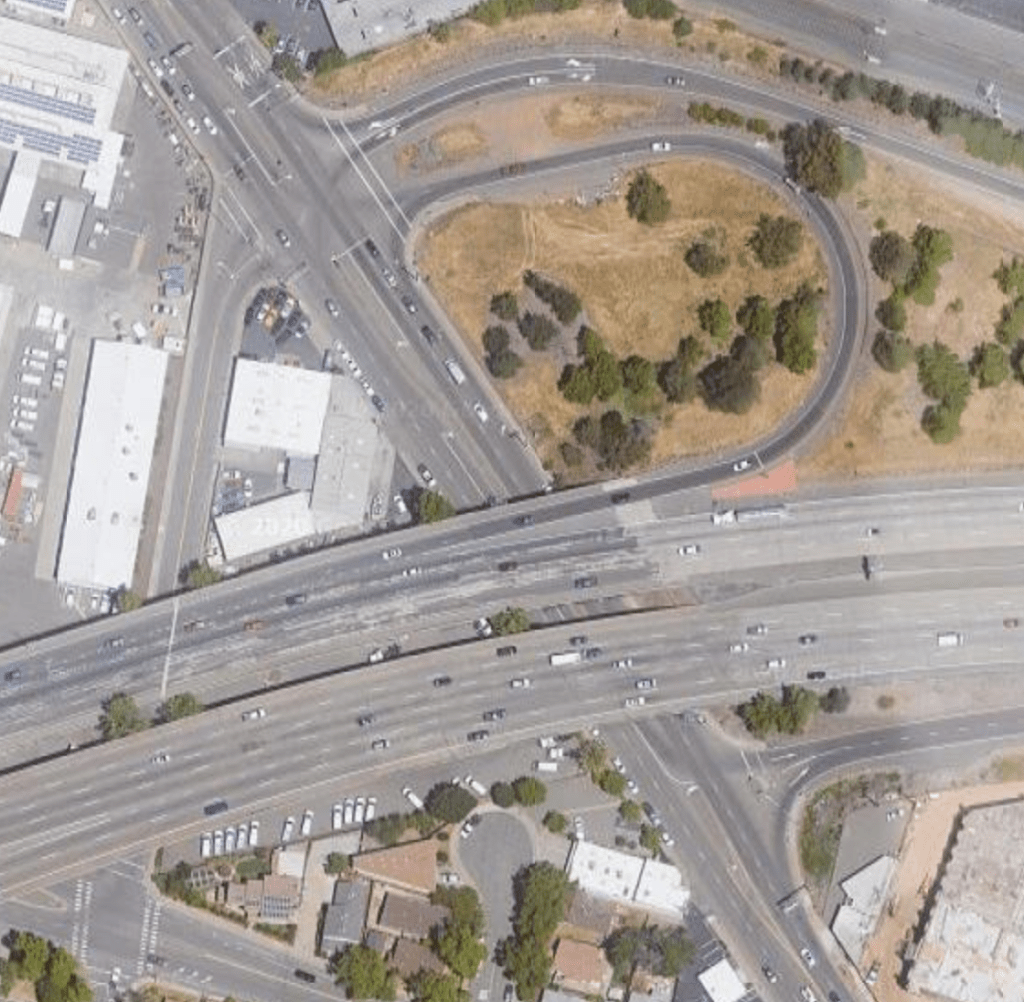
Stockton Blvd at Hwy 50, wide and ugly

city’s 311 app broken

The City of Sacramento recently release a new 311 app. I have been using this app (iOS version), mostly to report issues with construction signing. The app is broken!

What are the issues?

  • If you switch away from the app to some other app, the app logs you out, and you have to log in again.
  • Once you’ve logged in again, it asks you to confirm your contact details. Even though it asked you to do that moments ago – it doesn’t keep track.
  • It will not allow you to upload photos. Usually it give an error message, photo could not be uploaded, but sometimes it hangs the entire app. If you are wondering, it makes no difference whether you take the photo then or try to use an existing photo, nor what size you attempt to upload.
  • The app (and the website) is happy to show you requests you’ve made, but the only information on the request is the cross streets or address that you reported. It doesn’t show what the request was, so if you’ve made more than one request on the same location, or simply don’t remember what the request was, you won’t get any help from the app (or the website).

An ongoing problem, not specific to the app, is that the city closes requests without saying whether they did anything or not. The only way for you to know whether they did anything is to go back to the same location, and look to see. That’s if you remember what your request was.

Walkable Sacramento #3: pedestrian signals

Following on to the previous post on crosswalks, policies are needed for pedestrian signals, which are intended to provide some additional protection for pedestrians crossing at signalized intersections. I am not in favor of creating signalized intersections where they don’t exist (in fact, many should be considered for removal), but where they do exist, the pedestrian signals need to be done right.

It should be noted that the NCUTCD (National Committee on Uniform Traffic Control Devices) just today decided to not recommend that the MUTCD (Manual on Uniform Traffic Control Devices) require that signalized intersections have pedestrian signals. I’m not sure how I feel about this: sometimes I think that we over-sign and over-signalize roadways, causing lack of attention, but at the same time, such a limitation would never be accepted if it had to do with motor vehicle movement.

Pedestrian activation buttons are often called ‘beg buttons’ because the walker must ‘beg’ permission to cross by pressing the button and then waiting an uncertain length of time. Sometimes forever, because some buttons have failed or been disconnected, and no change has been made to the signal logic to address this. Motor vehicle drivers are not required to take any such action, they are detected in various ways, or the signal is set to change automatically without detection.

Some European cities have installed automatic pedestrian detection, which changes the signal based on the presence of a walker. I have heard that some of the detectors can even distinguish people in wheelchairs, with walkers and canes, or elderly, and adjust the cycle to accommodate. I’m not aware of any of these in the United States, but would be happy to hear about them if there are.

The policies are:

  • No crossing will require the pressing of a pedestrian button unless it is a roadway over over 30,000 ADT with a crossing frequency of less than 100 pedestrians per day, or is a mid-block crossing. 
  • All pedestrian buttons will be labeled to clearly indicate whether they have any effect on the signal cycle. Buttons may serve only the purpose of:
    • triggering infrequent crossings, as above, or
    • triggering audible information, or
    • lengthening the crossing time for walkers requiring a longer time, often seniors and the disabled
  • Existing buttons will be removed unless they provide one one of the functions above, and are signed to indicate their function. Removal of others within three years.
  • All pedestrian signals will have a countdown function, unless there is a crossing frequency of less than 50 pedestrians per day, within five years. 
  • Signals will normally have a cycle of 60 seconds or less in order to reduce pedestrian wait times. Revision within two years.
from Dhiru Thadani

21950 and Vision Zero

California Vehicle Code 21950, failure to yield to pedestrians, is in my opinion the most important violation as it applies to implementing Vision Zero in Sacramento. The Vision Zero Sacramento Action Plan (draft) says “Launch high-visibility enforcement campaigns against speeding, failure to yield to pedestrians, distracted driving, and impaired driving. Campaigns will focus on HIN corridors.” The state code says:

21950.
  (a) The driver of a vehicle shall yield the right-of-way to a pedestrian crossing the roadway within any marked crosswalk or within any unmarked crosswalk at an intersection, except as otherwise provided in this chapter.
(b) This section does not relieve a pedestrian from the duty of using due care for his or her safety. No pedestrian may suddenly leave a curb or other place of safety and walk or run into the path of a vehicle that is so close as to constitute an immediate hazard. No pedestrian may unnecessarily stop or delay traffic while in a marked or unmarked crosswalk.
(c) The driver of a vehicle approaching a pedestrian within any marked or unmarked crosswalk shall exercise all due care and shall reduce the speed of the vehicle or take any other action relating to the operation of the vehicle as necessary to safeguard the safety of the pedestrian.
(d) Subdivision (b) does not relieve a driver of a vehicle from the duty of exercising due care for the safety of any pedestrian within any marked crosswalk or within any unmarked crosswalk at an intersection.

VEHICLE CODE – VEH, DIVISION 11. RULES OF THE ROAD,CHAPTER 5. Pedestrians’ Rights and Duties; http://leginfo.legislature.ca.gov/faces/codes_displaySection.xhtml?lawCode=VEH&sectionNum=21950; retrieved 2018-12-15

So, how is the Sacramento Police Department doing on enforcing this code against drivers who fail to yield to pedestrians in the crosswalk? Well, from the ‘Sacramento Police Vehicle Stop Data’ (http://data.cityofsacramento.org/datasets/sacramento-police-vehicle-stop-data) of the last two years, there were 101 violations of 21950 recorded, out of 61,151 violations. This is 0.17 percent, or, other violations were 582 times more common.

Anyone spending more than 10 minutes standing on the corner of any busy pedestrian intersection could count a hundred violations of this law. I know this because I do it. It is part of my job and it is also part of my advocacy. In two years the police only wrote 105 citations? I will also add that I have seen Sacramento Police Department officers in motor vehicles violating this very code hundreds of times, on myself and on others. Even the bicycle mounted officers are frequent violators. I will say that officers have yielded to me in the crosswalk, but it is much more common that they don’t. I’m not saying that they are trying to run me down, rather than they don’t wish to be slowed or inconvenienced, and so will cross through the crosswalk when I’m in it. They are, in this sense, just like other drivers.

So what is this disconnect between what is important and what officers do? I’m going to be blunt here. The police not partners in achieving Vision Zero, in fact they are the main impediment to Vision Zero. If they persist in their windshield perspective that pedestrians are the problems and drivers don’t mean to cause harm, pedestrians will continue to die, and drivers will continue to not face consequences for their violations, for their assaults, for their murders.

If you wish to reply that we all need to work together, and consider perspectives, well, please present evidence that this has worked in the part, or some construct that says it will work in the future. I’m not seeing it. In case you think I am picking on Sac PD, things are actually worse in other jurisdictions, but since this is where I live and observe the issue every day, it is the place I focus on.

By the way, thank you Don Kostelec @KostelecPlan for getting me fired up about all the ways in which our entire system is biased against pedestrians, and that those people whose job it is to consider and act on safety are mostly only concerned about drivers and traffic flow. I encourage you to follow his ‘The Twelve Days of Safety Myths‘ series.

Sacramento Vision Zero Top 5 outreach

This information from the City of Sacramento via email.

Vision Zero Top 5 Corridors Banner

We have added and updated upcoming outreach events for the Vision Zero Top 5 Corridors.

Join us to learn more about the Vision Zero Top 5 Corridors Study and share your experience biking, walking and driving along these streets at one of the following events:


Date and Time Event Location Corridor of Interest
Monday, November 5th

5:00-7:00 p.m.

Community Workshop Peter Burnett Elementary School

6032 36th Ave.

South Stockton Blvd.
Wednesday, November 7th

Noon-2:00 p.m.

Pop-up Event Transit stop at Broadway and Stockton near Food Source (4401 Broadway) Broadway/Stockton Blvd.
Saturday, November 10th

9:30-10:15 a.m.

Old North Sacramento/Dixieanne Community Association GraceCity

701 Dixieanne Ave.

El Camino Ave.
Thursday, November 15th

5:00-7:00 p.m.

Community Workshop Luther Burbank High School

3500 Florin Rd.

Florin Rd.
Thursday, November 15th

6:30-8:00 p.m.

Gardenland/Northgate Neighborhood Association Stanford Settlement Conference Room

450 W. El Camino Ave.

El Camino Ave.
Friday, November 16th

4:00pm-6:00 p.m.

Pop-up Event Grocery Outlet

2308 Del Paso Blvd.

El Camino Ave.
Wednesday, December 5th

6:00-8:00 p.m.

Hagginwood Community Association William J. Kinney Police Facility

3550 Marysville Blvd.

Marysville Blvd.


About the Study


In 2017, the City of Sacramento identified the five corridors in Sacramento with the highest numbers of fatal and serious crashes involving pedestrians, bicyclists, and motorists.

The Vision Zero Top Five Corridor Study will analyze the factors that contribute to these corridors’ high crash rates.  Based on technical analysis, community input, and best practices in roadway safety and design, the study will identify improvements for each of these corridors that can be implemented in the near-term.

More information about the project is available at http://visionzerosac.org

change the signal at J St and 13th St

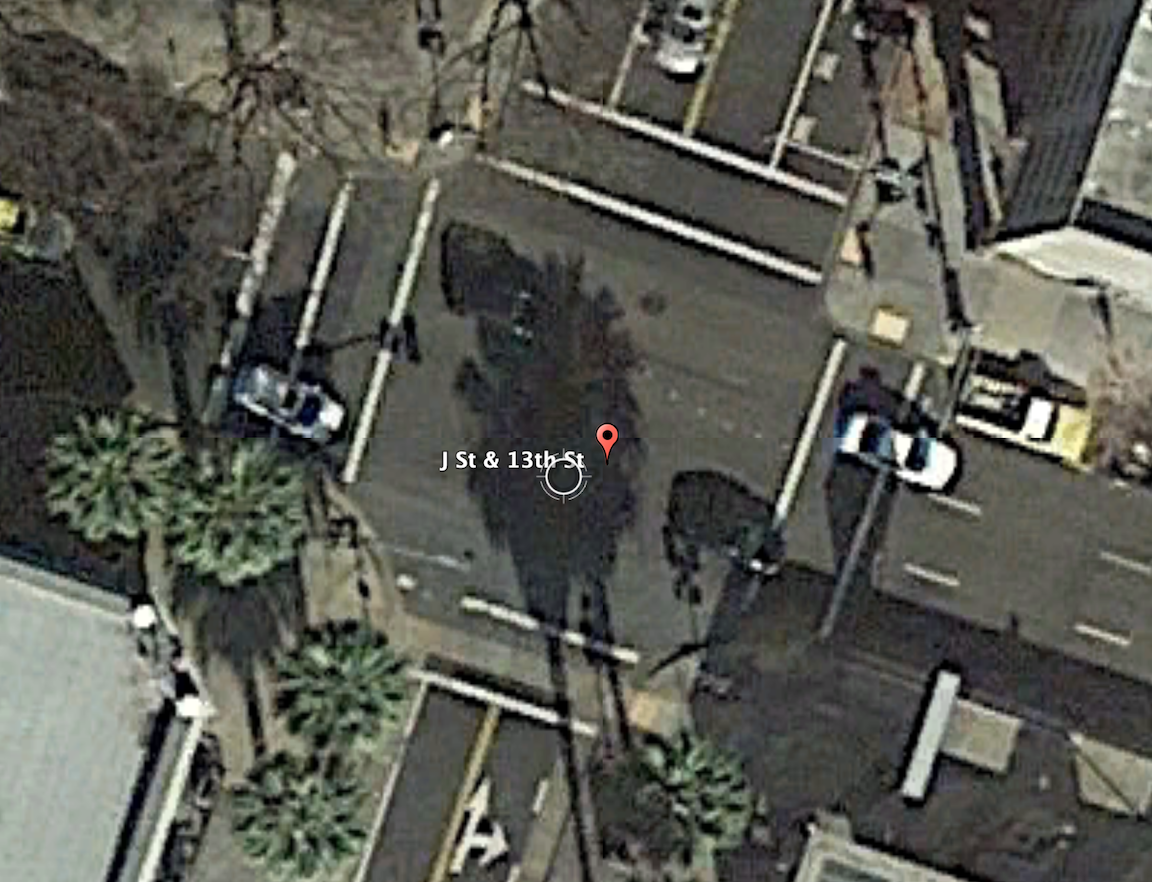
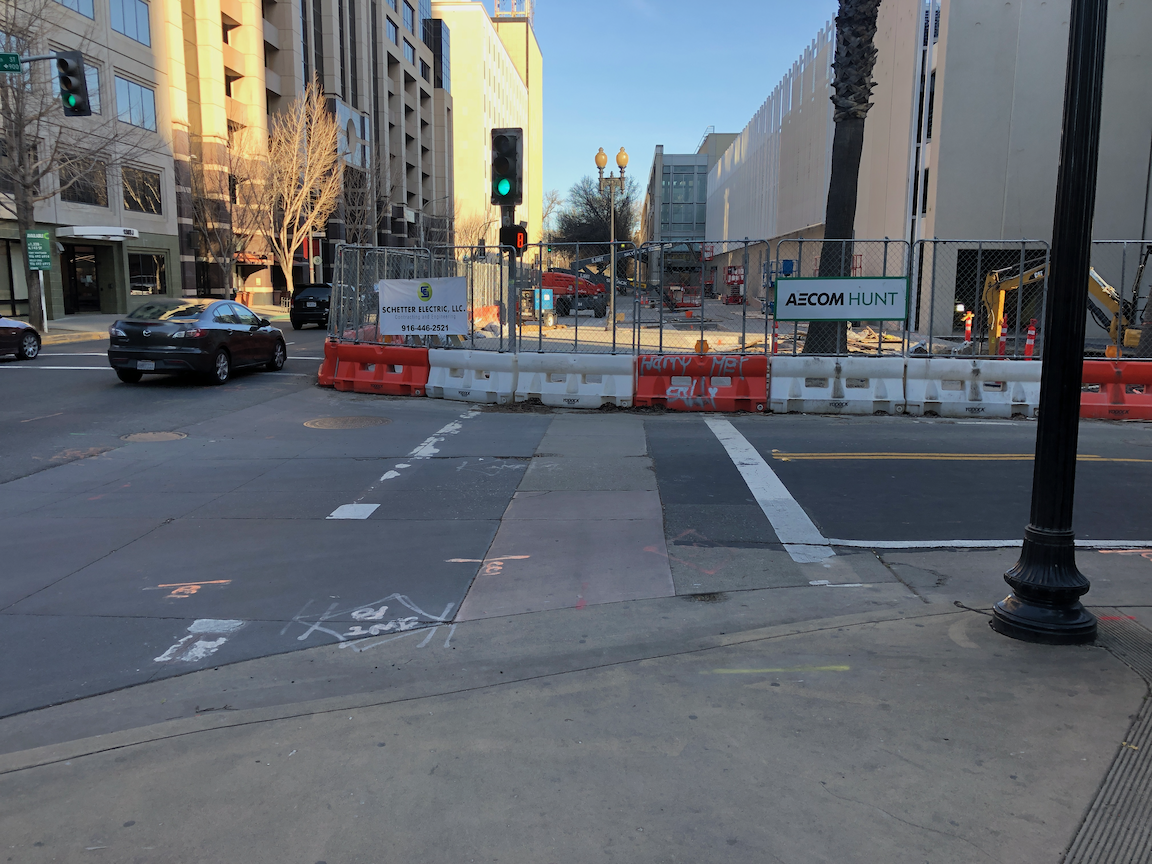
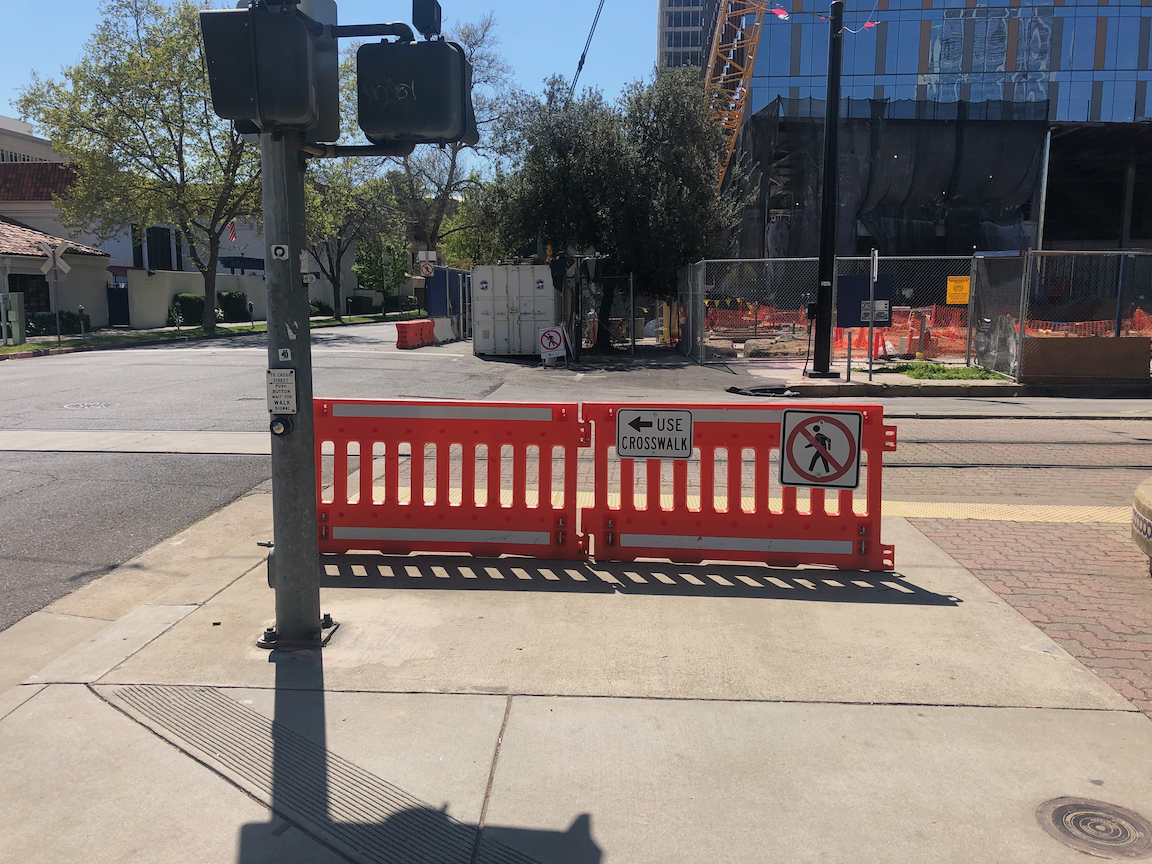
The signal at J Street and 13th Street in downtown Sacramento (shown at right) does not work well for pedestrians. The signal cycle is long, even compared to other signals on J Street, so the wait for pedestrians is quite long. I have seen the signal cycle skip both pedestrian crossings and vehicle crossings a number of times, which means that the wait is doubly long. Most walkers respond to this long wait by simply crossing the street against the pedestrian signal, and I don’t blame them at all.

A second issue is that the signal is set so that the east crosswalk walk mode occurs at the same time as the left turn from 13th Street southbound to J Street eastbound, meaning there is always a conflict between pedestrians and drivers at this point, and this conflict has been created by the signal setup. Many drivers cut directly behind or in front of people walking, as they know if they wait until the crosswalk is clear, as the law requires, they won’t make the signal.

This signal should be reconfigured so that it gives priority to pedestrians, without making them wait an unreasonable period of time, and does not create unnecessary conflict between turning drivers and people walking. The east crosswalk at a minimum needs a longer leading pedestrian interval (LPI).

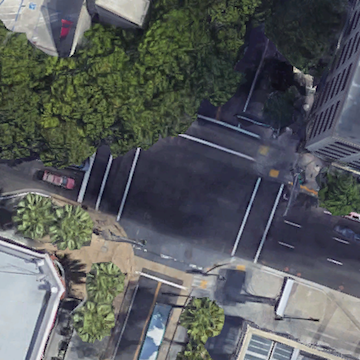
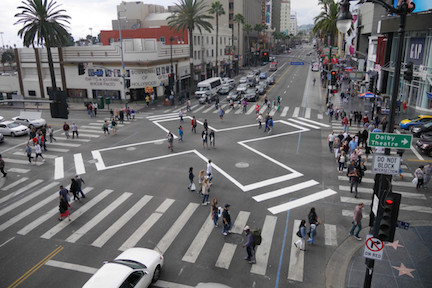
Even better would be to make this a pedestrian scramble intersection, with an all-direction crossing phase during which all vehicle turning movement are prohibited. The intersection can be marked with diagonal crosswalks, and additional diagonal pedestrian signal head added, however, simply changing the signal timing is sufficient as an initial step. This is a busy crosswalk intersection, with the convention center on one corner, the Sheraton Grand on another, and the parking garage for the Sheraton and others on the third corner. It is alway busy, and the people crossing here are commonly tourists, who are likely used to more advanced ‘world class’ cities where pedestrians are not second class citizens after car drivers.

Note: There are a number of busy pedestrian crossing intersection in the Sacramento central city that deserve an upgrade, but this is the one that most irritates me, whether walking or bicycling.

J & 13th needs a pedestrian scramble

Following the post yesterday, Morse-Cottage pedestrian scramble, here is my first suggestion for a pedestrian scramble in Sacramento. J Street and 13th Street would be a great location for one. It has high pedestrian traffic, it has pedestrian attractors on three corners (convention center, Sheraton Grand Hotel, and a parking garage), and many people cross more than one direction. I am not sure that it is the highest volume intersection, but it is quite possible the highest visitor location where people are less likely to be paying attention or to understand our signal system

Most importantly, the pedestrian signalization here is seriously screwed up, and it needs to be changed. On the west leg, the pedestrian phase is short. On the east leg,there is a ‘leading vehicle interval’ that allows southbound left turning vehicles to start before the pedestrian walk comes on, so almost every cycle creates pedestrian-vehicle conflicts. All the crossings require button pushes, none are on automatic recall that is standard at intersections in urban areas with heavy pedestrian flow. And the whole intersection cycle is much too long, giving preference to drivers on J Street over walkers, right here in the heart of a place where so many people walk. The cycle also sometimes skips the west leg completely, making pedestrians wait through two cycles of J Street traffic, which is a long, long time.

In addition to the exclusive phase, diagonal crosswalks should be marked to make it clear how the intersection works.

Let’s make this the first of many pedestrian scrambles in the central city.

Leading Pedestrian Interval (LPI) signals

Questions about using Leading Pedestrian Interval (LPI) signals at the community meeting on crosswalks reminded me that I had information on these in the city for some while, but hadn’t shared it. A LPI signal gives the pedestrian a 3-second (or more, but the Sacramento ones are all 3 seconds) head start, with the walk sign coming on before the light turns green, so that pedestrians will already be in the crosswalk and more visible before vehicles start to move. These address the common issue of both right-turning and left-turning vehicles failing to yield to pedestrians in the crosswalk. They are one of the pedestrian safety countermeasures identified by the Federal Highway Administration (FHWA), with a crash reduction factor of 60%. If you search for ‘leading pedestrian interval’ on the Internet, you’ll see a great number of useful links. The NACTO page is especially worthwhile.

My purpose in sharing the specific locations is so you can go out and experience LPI for yourself. How does it work for you?

A LPI does slow traffic very slightly since there is an additional 3 seconds per direction during which most vehicles are not moving.

Lastly, this is not a solution that could have been used at the Freeport-Oregon intersection, which is not a signalized intersection. However, it is a solution for the signalized intersections along Freeport. Ryan Moore claimed that these can’t be used at low pedestrian locations, but the response to all such reactionary claims is: “You can’t judge the need for a bridge by the number of people swimming the river.” If crossings are not safe, then fewer people are walking than otherwise could be. The demand is there, but not the facility. LPIs are one solution.

Lead Pedestrian Interval (LPI) locations in City of Sacramento (as of 2015-08-28):

  • 9th Street and I Street
  • 9th Street and P Street
  • 10th Street and I Street
  • 10th Street and J Street
  • 15th Street and K Street
  • 29th Street and K Street
  • 30th Street and K Street
  • 9th Street and Q Street
  • 13th Street and I Street
  • 8th Street and P Street
  • 8th Street and Q Street

Vision Zero and traffic enforcement

Sacramento essentially has no traffic enforcement currently, which has led to significant increase in:

  1. running stop signs (not talking about illegal failure to come to a complete stop, but running at full speed or slowing only slightly)
  2. failure by drivers to yield to pedestrians in the crosswalk (actually in the crosswalk, not just waiting to cross).

If these issues of non-enforcement and encouragement of unsafe behaviors is not addressed, the Vision Zero effort will fail, no matter what other actions are undertaken.

I have been watching patterns of driver violation in the central city for seven years, as my profession provides me the interest and skills, while my sense of preservation as a pedestrian gives me the motivation. I can state unequivocally that both violations have increased significantly over that time. While it once felt safe and even a bit welcoming to walk in the central city, it does no longer. Why? That is harder to say, but I think that the lack of enforcement of these laws by the Sacramento Police Department has contributed to the problem. Drivers know they won’t be held accountable for failure to yield, and so they don’t. Of course a few do, but with drivers in the other lanes on multi-lane one way streets failing to yield, pedestrians are at just as much risk as if no one yielded.

I have been wanting to delve into traffic enforcement data for the City of Sacramento and all other locales in the region, but that is a major undertaking I haven’t gotten to. A sampling of data below will provide some context. Traffic stop data for years prior to 2016 is not available online, so I can’t speculate about trends in the data.

California Vehicle Code (CVC) “22450. (a) The driver of any vehicle approaching a stop sign at the entrance to, or within, an intersection shall stop at a limit line, if marked, otherwise before entering the crosswalk on the near side of the intersection.”

Using data from Sacramento Traffic Stops, 2016 had 30001 stops, 2432 of which were for 22450, 8.1%. 2017 had 32267 stops, 2642 of which were 21950, 8.2%. Stand on any single corner in the central city, and you could see this many violations in a day. Clearly, this law is being only lightly enforced.

CVC “21950: (a) The driver of a vehicle shall yield the right-of-way to a pedestrian crossing the roadway within any marked crosswalk or within any unmarked crosswalk at an intersection, except as otherwise provided in this chapter.”

Using data from Sacramento Traffic Stops, 2016 had 30001 stops, 66 of which were for 21950, 0.22%. 2017 had 32267 stops, 43 of which were 21950, 0.13%. Stand on any single corner in the central city, and you could see this many violations in an hour. Clearly, this law is not being enforced.

Sacramento Vision Zero and Bicycle Plan meeting January 31

You might have thought you had other plans for the evening, but…

The City of Sacramento is holding the last of four public meetings on Vision Zero and Bicycle Master Plan implementation tonight, January 31, 5:00 to 7:00PM at city hall.

You can see the new Bicycle Master Plan and draft implementation plan at http://bit.ly/SacBicyclingProgram. You can see the Vision Zero Draft Action Plan and other documents at http://bit.ly/VisionZeroSac.

Just one of these would be reason to attend, but both! Hope to see you there.