SacATC review of work zone policy

Please see previous posts in category ‘Work Zones‘.

The City of Sacramento is hosting a webinar on the draft Work Zone and Event Detour Policy Update, today, January 24, 6:00PM. You can register for the Zoom webinar here(registration is not available on the Work Zone webpage).

I have neglected to post on the SacATC (Sacramento Active Transportation Commission) review of the Work Zone and Event Detour Policy. Commission members had several good ideas and questions, which are worth capturing. You can view the meeting video at https://sacramento.granicus.com/player/clip/5786. Note that the sound quality is very poor, with many dropouts. Since I was at the meeting, I have filled in some details on the comments.

Comments/questions from commissioners:

  • Houpt: advocates should have a chance for input, is that part of the noticing process?
  • Hodel: Old Sac boardwalk (promenade) has been completely closed to bicycles for events; should be consequences for blocking access; supports rerouting motor vehicles is necessary; hefty fines for non-compliance
  • Moore: Class 2 bike lanes are already dangerous so reproducing them as diversions or detours is still dangerous; provide physical safety; rely on automated enforcement, not police presence
  • Gonzalez: is there a definition for ‘short pinch point’?; concerned about monitoring, suggested QRcode at location for immediate report of dangerous situation
  • Gibson: asked for details on enforcement at events; should be separate for short term events versus long-term construction project
  • Banks: how will the city get word out about events and construction that impact access; suggested more photos, particularly for events
  • Erasmus: assistance for event sponsors who may not have the resources to post events
  • Doerr Westbrook: could longer term projects be reflected in Google maps?; there may be some more recent Caltrans info on bicyclist detours; is there a database for locations and TCP documents? Can the document refer to federal guidelines on bicycle facilities for ADT levels, rather than city? (Reply was that the Streets for People Active Transportation Plan will update that guidance, and replace old Bicycle Master Plan at that time)

The Community Development AgencyCounter map (https://sacramento.agencycounter.com/) could be one location to store TCP locations. It does not appear to have document links, but would at least allow people to find locations and request documents.

SacATC recommendations supported by city council

Agenda item 11 on the Sacramento City Council agenda last night (2023-08-29) was ‘Active Transportation Commission 2022 Annual Report Regarding the Status of Walking and Bicycling in the City of Sacramento and Activities of the Commission‘. Twenty members of the public and organizations spoke in support of the recommendations, no one against, and all council members spoke in support. Comments of both the public and council focused on the need for more funding to make infrastructure changes to our roadways, in order to fix the unsafe roadway network we have.

I have written twice before about the SacATC recommendations: support SacATC status on walking/biking (now!) and SacATC meeting Jan 19 with report, Northgate, Freeport. I recommend you read the full set of recommendations. Do they go far enough? No. Do they miss some important issues? Yes. But these recommendations are beyond anything that the city has considered before, and deserve the support of everyone in the city (and county and region).

Several representative from Land Park talked about how much they loved the slow streets in the park, and how disappointed they were when the city nixed them. They want them back! So do a number of other speakers. Grace Bartley talked about how she was hit by a driver while riding her bike to McClatchy High on Freeport, probably the most impactful speaker of the evening. Several speakers mentioned the imperative to control motor vehicle speeds, by whatever means necessary. (The ultimate solution to this issue is not any action of the city, but speed-limited motor vehicles.)

Eric Guerra mentioned again, as he has other times, that many parents seem to care about only their own children, once their children are safely dropped off at school, they speed away, endangering other people’s children. And some not ever their own children, encouraging their kids to run across the street at drop-off and pick-up. There was general agreement that there needs to be more money in next year’s budget for active transportation, though no one said what would be cut to accomplish that. SacATC had wanted their recommendations to go to the council for consideration in adopting this year’s budget, but a roadblock (intentional?) was thrown up by requiring that the report go first to the Personnel and Public Employees Committee, which meant that it did not come to the council until August. Katie Valenzuela suggested that Public Works come up with guidelines for citizen-initiated ‘tactical urbanism’ projects so that quick-builds can happen now, when the city does not have the funds or materials or personnel to complete in a timely manner. Jennifer Donlon Wyant was open to the idea, but I’m sure it would get nixed in Public Works. Darrell Steinberg talked about his proposal for a housing and transportation measure in 2024, that would provide some of the additional funding needed. This will be the topic of my next post.

I spoke along with the other 19 people, and my comments are below:

I strongly support all of the recommendations included in the 2022 report from the ATC to the city council. In particularly, I would like to address two of those, 3. Develop a Citywide Safe Routes to School Program, and 4. Finalize the Construction Detour Policy. 

I was the Safe Routes to School Coordinator for San Juan Unified for 10 years. Having that position funded through federal and ATC grants, and district funding, allowed the completion of many infrastructure project though collaboration with the City of Citrus Heights and Sacramento County. Most of these would not have occurred without the position. We also offered an extensive program of walking and bicycling education to students, and to the community. Civil Thread/WALKSacramento was a key partner in these efforts. I recommend that Sac City schools and the city create and fund a Safe Routes position to head an ongoing program in the support of students and their families.

It is long past time for a policy to accommodate walkers and bicyclists during construction projects. Nearly every construction project that has occurred in the central city has violated ADA guidelines, which require accommodation. City staff is on record as saying that walkers and bicyclists would be accommodated when it does not remove capacity from motor vehicles. So every project presents dangers to walkers and bicyclists. The are poorly signed and do not provide detectable barriers. I spend a lot of time reporting these violations, and over time many though not all of them are corrected. However, it should not be the responsibility of citizens to hold the city to ADA requirements. A progressive city would develop traffic plans that accommodate all travel modes, and would then inspect and enforce those plans.

support SacATC status on walking/biking (now!)

I encourage you to support the Sacramento Active Transportation Commission’s (SacATC) sending the Status of Walking/Biking committee report to city council. The report is on the agenda for SacATC on this Thursday, 6:00PM to about 8:00PM.

The report is the first attempt since the early days of the SacATC to actually address transportation policy. The SacATC has unfortunately become a rubber stamp for city grant applications, and has not delved into policy since the early days when an update of the city’s Bicycle Master Plan being completed, and the ATC was able to make some improvements to that. The commission was formed to advise council on policy (it is NOT advisory to staff, but to the council), but has not done so. Now is the time, and this status report should be supported because it finally starts to address policy.

The status report includes nine recommendations:

  1. Increase Funding for Active Transportation
  2. Expand Speed Management Program
  3. Develop a Citywide Safe Routes to School Program
  4. Finalize the Construction Detour Policy
  5. Develop an ATC Dashboard
  6. Create a Sacramento Quick-Build Bikeways Program
  7. Pilot an Electric Bike Library & Promote E-Bike Incentives
  8. Increase Bike Parking
  9. Re-establish Slow & Active Streets

I’m sure you can think of many other recommendations that might be made, but this is a great start. If the council pays attention to these recommendations, and takes action to create and fund programs, the status of walking and bicycling will have improved by next year, and more items can be added.

You an express your support in several ways:

Consult the agenda for more detail on making public comment. It used to be possible to submit email to the city clerk, but this option is no longer mentioned.

City of Sac blind adherence to ADT

Another post on the Freeport Blvd Transportation Plan. See the category Freeport Blvd for other posts.

“We are designing for the traffic we have, not for the traffic we want.”

Ali Doerr Westbrook, Chair of Sacramento Active Transportation Commission

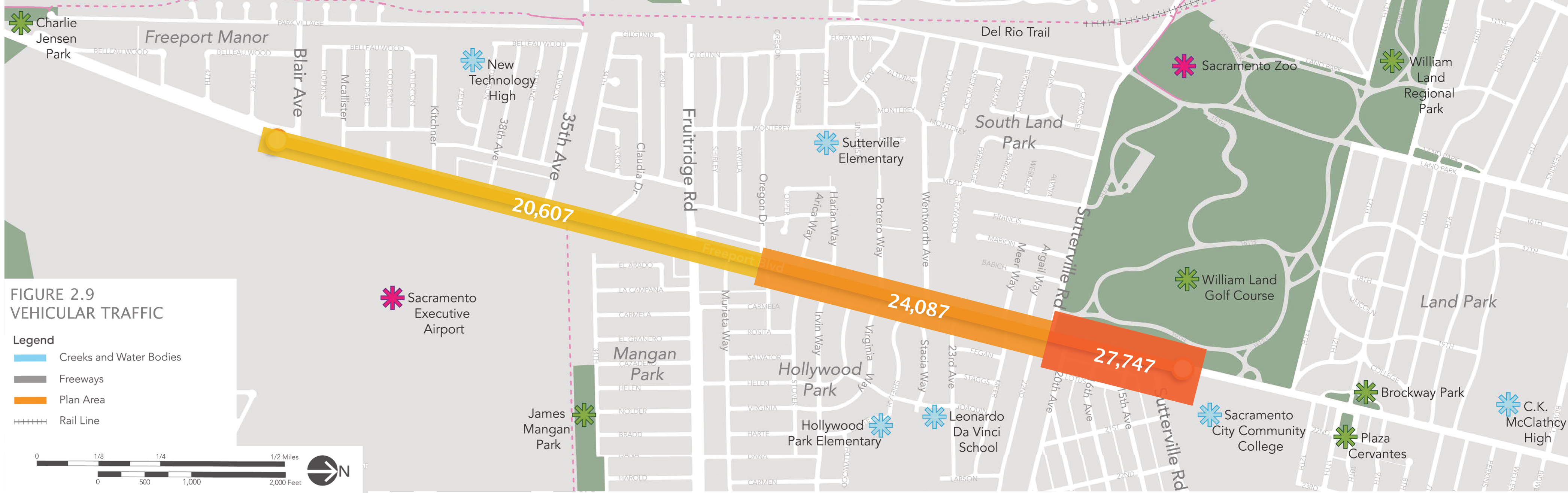
I could stop at that, but perhaps you’d like some more detail. This comment was made during the Sacramento Active Transportation Commission (SacATC) meeting on January 18, 2023. The context was the admission by the two city planners, Leslie Mancebo and Jennifer Donlon Wyant, that the city eliminated the possibility of a road diet (roadway reallocation) before even starting planning for Freeport Blvd. The reason expressed is that the ADT (Average Daily Traffic count) is above 20,000 for Freeport, and that requires more than two lanes (one each direction). Interestingly, ADT counts for various locations along Freeport are nowhere to be found in the plan or appendices. In a different location on the City of Sacramento website, Traffic Counts, the ADT for various locations along Freeport Blvd, rarely exceed 20,000, and have not exceeded 20,000 since 2011. There is no indication that the city even did new traffic counts in preparation for this planning effort. So far as can be determined, they just decided to not consider a road diet from four lanes to two lanes, or two+one lanes, 3/2 configuration) because they wanted to prioritize motor vehicle traffic over all other uses of the roadway.

The city planners also acknowledged that a road diet was a prominent request of the community during the planning process. But, community input be damned, the city is going to serve car drivers before anyone else.

A reduction of lanes from four to two is the single most important traffic calming effort that can be made on a roadway. That does not mean it is the appropriate solution for Freeport Blvd, or for all of Freeport Blvd in the planning area. What is does mean is the that city should have considered it in the planning process.

Back to Ali’s comment. The city is planning for a roadway configuration that should have already been in place years ago, before the city over-widened the roadway, and in several cases narrowed sidewalks to accommodate the widening. They are not planning for a roadway which would reduce vehicle miles traveled (VMT) or increase safety and access for those outside cars. The city’s responsibility, under the Mayors Commission on Climate Change report, is to reduce VMT in order to reduce greenhouse gas emissions (GHG), not to maintain VMT at current levels. But this Freeport plan is a plan to guarantee current VMT for at least 30 years in the future, which is about the length of time before the city will be able to reconstruct the roadway again, and correct the mistakes they made this time around.

The intent of the city in this plan is made very clear in the common design principles: “10. Maintained necessary travel lanes, turn lanes, and parking: Maintaining travel lanes and turn lanes ensures that drivers traveling along the corridor will not be compromised, and preserving parking spaces where 5 the utilization is higher so it serves better adjoining businesses.” Though this is the last item in the list of ten, it is clear that this is the highest priority for the city.

The refusal to consider a road diet/lane reduction/roadway reallocation is a fatal flaw in this plan. The effort should be sent back to staff to re-do. It should not be adopted by city council. If the city council does not reject this kind of flawed planning, city staff will continue to make the same mistake, again and again and again.

I’ll post on some of the other flaws in the plan, but this is the most important, not just because it misses the best opportunity for traffic calming, but because it retains roadway width for the exclusive use of motor vehicles that could be better used for walking, bicycling, trees, and even parking for businesses.

Added graphic below, which I had not noticed in the plan, that documents vehicular counts on sections of Freeport Blvd. Is it suspicious that half of the plan area is ‘just’ over the city’s criteria of 20,000 ADT? Remember, the plan itself and the city’s traffic counts website do not indicate this level of ADT.

SacATC meeting Jan 19 with report, Northgate, Freeport

Update: The letter on the status of walking/biking was deferred to the next meeting, where a modified letter will be considered and hopefully passed. The Freeport and Northgate Transportation Plans were forwarded to council. I spoke in favor of Northgate and against Freeport, for reasons I will detail in the near future. The applications for planning grants were supported.

The Sacramento Active Transportation Commission (SacATC) is meeting online Thursday, January 18, 2023, 6:00PM to about 8:00PM, via Zoom. See http://sacramento.granicus.com/ViewPublisher.php?view_id=21 for agenda and eComment.

The three main topics are:

A read of the subcommittee report, formatted as a letter to the mayor since the commission is advisory to the council, is good and should be supported. I particularly like the emphasis on completing the construction detour policy, since city staff otherwise do not care about the safety of walkers and bicyclists in navigating construction projects that close or change sidewalks and bikeways. Two items missing are bike/scooter share, and Vision Zero. These two items may or may not fall under the purview of SacATC, however, the city is not making information available to the public on these efforts, so it seems to fall to SacATC to do so.

In general, the Northgate and Freeport plans are an immense improvement over existing conditions, so meet needs of the moment, but it is less clear they are going to meet the needs of the future, which will be much less private motor vehicle driving, and more walking, bicycling and transit. If time is available to look at the plans more closely, I’ll add posts.

Reset for SacATC

The City of Sacramento Active Transportation Commission (SacATC) was established in 2018 as a replacement for the city/county Bicycle Advisory Committee (BAC). This was good, as the county’s unwillingness to consider innovative solutions, even when they were in the city, meant that very little ever happened there. There was a lot of hope in the bicycling and walking advocacy community that SacATC would turn a new page and accelerate necessary changes in the city. Unfortunately, that has not been the case. The commission has been reactive, not proactive. A number of people have resigned from the commission when they discovered that not much of importance was happening there.

Nothing here is meant to demean the contributions of city staff to seeking grant funding for critical projects. The city is paying much more attention to active transportation than it used to, but I and many other advocates believe that it is still paying too little attention, and certainly too little funding.

So, I believe it is time for a reset.

  1. SacATC is advisory to the city council. It should therefore be communicating with council on a fairly regular basis. That does not mean that it does not collaborate with staff, but it does not take direction from them.
  2. The primary job of the commission should be to review and to create policy. Reviewing projects is a secondary focus. That means at least half of every meeting should be spent talking about policy, not about projects.
  3. SacATC should be setting its own agenda, not letting staff set it. If staff wants to bring something to the commission, they would contact the commission chair to request that it be on the agenda. The chair should solicit agenda ideas from commissioners at the end of each meeting, and again, in advance of the next meeting to meet whatever deadline the city sets for its agenda posting.
  4. The purview of SacATC should be all city activities, when they may affect active transportation, not just Public Works. This would include, for example, construction traffic control plan permitting, city utility work in the streets, waste collection (trash cans in bike lanes), repaving plans, law enforcement, and parking enforcement.
  5. SacATC supported sidewalks where they are part of complete streets projects, but has not addressed sidewalk infill, closing gaps in this critical transportation infrastructure. I believe this should be a major focus of the commission this year, developing policy to recommend to the council that makes consistent and rapid progress towards a continuous sidewalk network, properly designed ADA ramps at every corner, and frequent safe crossings.

The next meeting of SacATC is Thursday, February 18. The agenda and eComment link will be available a few days beforehand at http://sacramento.granicus.com/ViewPublisher.php?view_id=21.

The commission is established under city code: http://www.qcode.us/codes/sacramento/view.php?topic=2-2_100&showAll=1&frames=on.