AB 1223 for wider SacTA authority

AB 1223: Local Transportation Authority and Improvement Act: Sacramento Transportation Authority (Nguyen/Krell) has been introduced in this legislative session. As of April 2, it is still in the Assembly Local Government Committee.

“The bill would provide that the allowable expenditure categories for revenues from a tax imposed by STA include the construction, modernization, and improvement of infrastructure, as defined, that supports infill or transit-oriented development and would reduce vehicle miles traveled.” It would also allow Sacramento Transportation Authority (SacTA) to develop and operate toll facilities, and to impose taxes on areas of less than the entire county.

SacTA is currently operating under general state legislation, and the Measure A code that established the authority. The authority now wishes to make clear that expenditures which broaden the mission to more transportation and infrastructure projects that support transportation are within the purview of the authority.

It isn’t clear to me how the toll facilities ability would mesh with the Capitol Area Regional Tolling Authority (CARTA) which is intended to cover the SACOG region.

The less than-full-county voting area is similar to that implemented for SacRT, but does not require that two or more cities be adjacent, as does the SacRT legislation. The idea is the same, that some areas of the county will be opposed to any sales tax measure, no matter what it contains, so creating a measure that targets supporting areas makes sense.

SACOG Transportation Committee 2025-04-03

The SACOG Transportation Committee will meet on Thursday, April 3, 2025, at 10:00 AM, in person at 1415 L Street, Suite 300, Sacramento, CA 95814. The meetings often last about two hours.

The agenda is available on the SACOG Meetings & Agendas page, but I have also provided the overall agenda and the specific agenda items below. The single, large agenda packet contains 10 agenda items, only some of which would be of interest to most readers. I have rotated all the presentations so they are readable in vertical. Usually presentations are attached as separate items, so I’m not sure whether these will be presented during the meeting or are there for information.

The meetings are also streamed, from the Meetings & Agendas page, at the time of the meeting, and can be viewed later on the SACOG YouTube channel.

Comments may be made in person, or by email ahead of time to the Board Clerk, lespinoza@sacog.org. No comments are taken via streaming or by phone.

Though nearly all items that come before the Transportation Committee also go to the Board of Directors, at the next or soon-after meeting, items are often discussed in more detail at the Transportation Committee than the Board, so if an item is of particular interest to you, you may want to follow it now. Proposals are sometimes modified at the Transportation Committee meeting, or as a result of Transportation Committee discussion, before they go to the Board.

I have skimmed the agenda items, and don’t have any strong comments now, but may if I have a chance to look at them more closely.

Agenda

  1. Approve Fiscal Year 2024-2025 Transit Operators Projects for Low Carbon Transit Operations Funds
  2. Senate Bill 125 Transit Program Funding Plan and Updated SACOG Guidelines
  3. Transit Representation on Metropolitan Planning Organizations & Governance Update/MOU
  4. From Plan to Action: Implementing the 2025 Blueprint
  5. Mobility Zones – Phase 1 Zones
  6. U.S. 50 Comprehensive Multimodal Corridor Plan Policy Framework Input
  7. Transportation Options for Upcoming A’s Games
  8. May is Bike Month 2025 Update
  9. Capital Area Regional Tolling Authority Board January-March Recap

SACOG Board 2025-03-20 (in Rocklin)

The SACOG monthly board meeting will be held in Rocklin this month, Thursday, March 20, at 9:45 AM, at Rocklin Event Center, 2650 Sunset Blvd, Rocklin, CA. It can be viewed on YouTube via the Meetings and Agendas page. Comments may be made in person (in Rocklin), or via email ahead of time to lespinoza@sacog.org. Most board meetings are held at the SACOG Board Room on L Street in Sacramento, but some meetings rotate through the cities and counties in the SACOG region.


Agenda (the official agenda has more detail for each agenda item than below, and the html agenda on the Meetings & Agendas page has staff reports and presentation links; the links below are just a few items of particular interest to me):

Consent:

  1. Approve Minutes of the February 20, 2025, Board Meeting
  2. Approve Revised Local Transportation Fund Allocations for Fiscal Year 2024-2025 for Sacramento County
  3. Approve Local Transportation Fund Findings of Apportionment for Fiscal Year 2025-2026
  4. Approve State of Good Repair Fund Allocation for Fiscal Year 2025-2026
  5. Approve State Transit Assistance Fund Allocation for Fiscal Year 2025-2026; staff report; allocation
  6. Approve Low Carbon Transit Operations Funds Allocations for Fiscal Year 2024- 2025; staff report; allocation
  7. Approve Capital Area Regional Tolling Authority Appointment
  8. Approve Contract Authorization for SB 125 Long-Term Financial Plan and Recovery Strategy and Annual Financial Analysis; staff report
  9. Approve Engage, Empower, Implement Award Correction

Action:

  1. Approve 2025 Regional Active Transportation Program Funding Recommendation (Summer Lopez), recommendations, presentation
  2. Public Hearing: Staff Vacancies (Erik Johnson)
  3. Approve Draft Budget and Overall Work Program for Fiscal Year 2025-2026, Adopt Salary Schedules and Hold Hearing on Vacancies (Loretta Su)

Information:

  1. Capital Area Regional Tolling Authority Loan and Staffing Services (Erik Johnson)

Workshop:

  1. Lessons Learned from Rocklin’s Growth (Lanette Espinoza); staff report; no presentation available yet

Reports:

  1. Chair’s Report, Board Members’ Reports and Executive Director’s Report (Lanette Espinoza)

Receive & File:

  1. Regional Transportation Demand Management Platform “NorCal GO” Launch (Nicole Porter)
  2. 2026 Regional Trail Implementation Strategy Update (Summer Lopez)
  3. U.S. 50 Comprehensive Multimodal Corridor Plan Overview (Dustin Foster)
  4. From Plan to Action: Implementing the 2025 Blueprint (Clint Holtzen)
  5. Advocacy Update (Renee DeVere-Oki)
  6. Fiscal Year 2024-2025 Quarterly Financial Report (Loretta Su)
  7. Green Means Go: Local Efforts to Accelerate Housing (Gregory Chew)
  8. Regional 511 Traveler Information Systems Contract and Service Continuity Considerations (Chase McFadden)

Adjournment:


Caltrans D3 says ‘fuck you’ to Yolo bicyclists

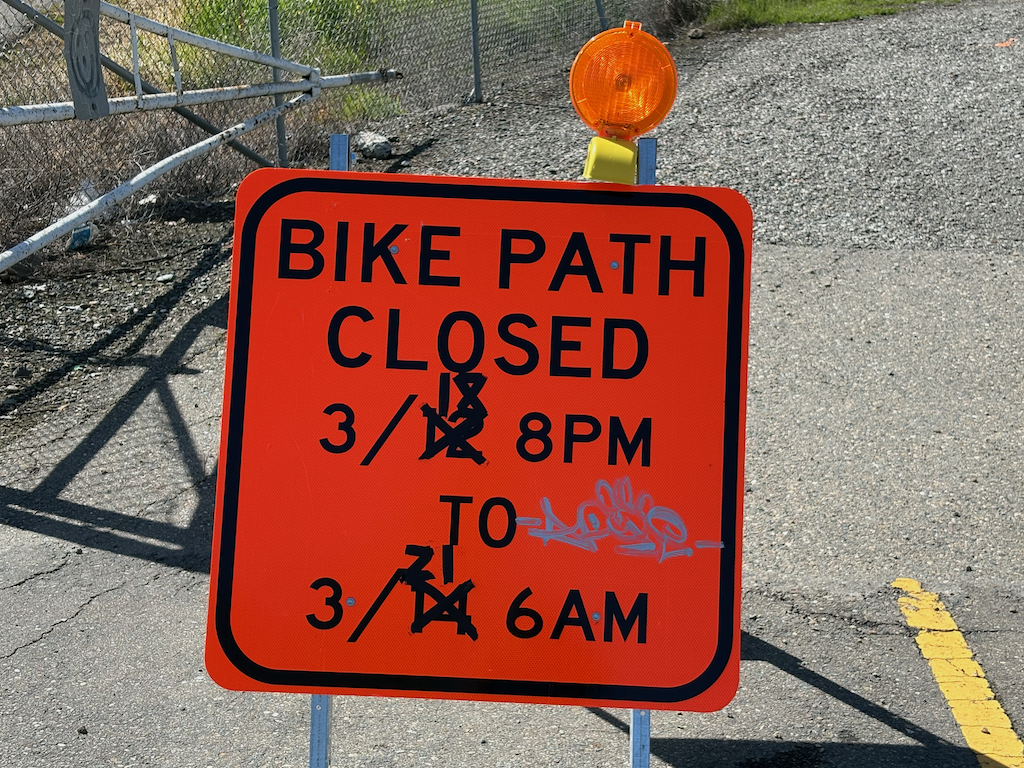
The bike path along I-80 along the Yolo causeway is closed this afternoon (Tuesday, 2:00 PM). The sign at the east entry to the bike paths says:

Bike Path Closed sign on east entry to Yolo causeway bike path

Note that this sign indicates that the path will not be closed until 8 PM on Tuesday, March 18.

This is what the Caltrans website says (UPDATE: Extended 79-hour Closure for Eastbound U.S. Highway 50 in Yolo County Postponed due to Weather Forecast, 2025-03-13, retrieved 2025-03-18 3:00 PM):

screen capture from Caltrans D3 website

Note that this press release says that the path will be open again by 6:00 AM on Tuesday, March 18.

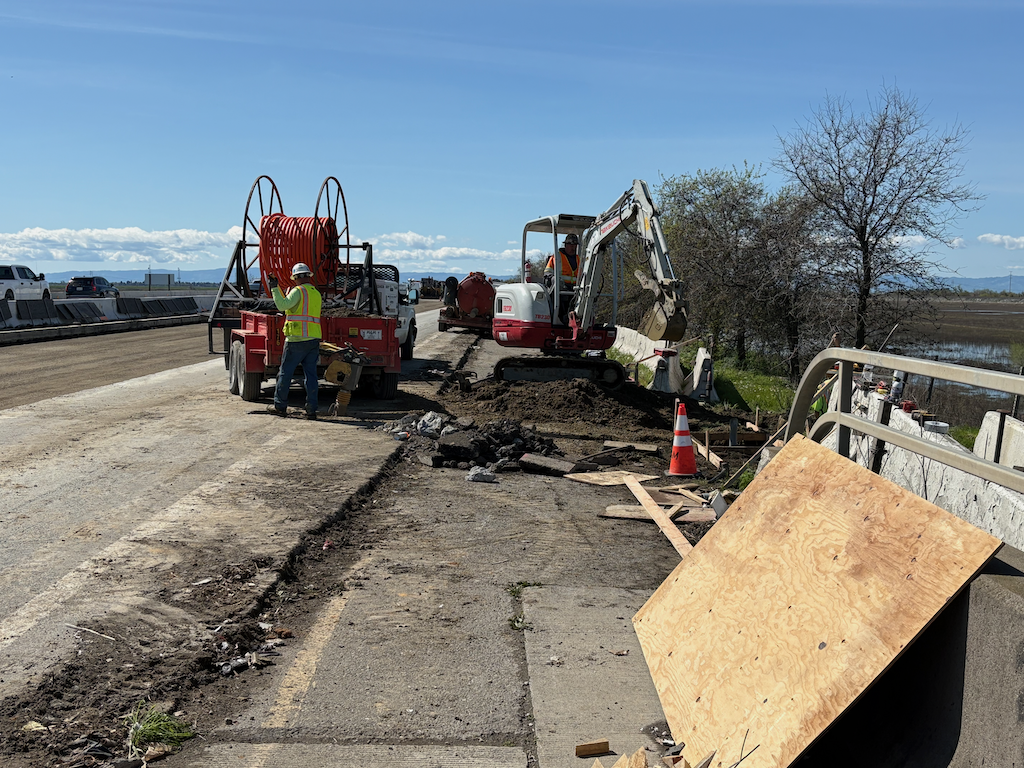
And this is the reality is:

construction on Yolo causeway bike path

Construction is completely blocking the path, at this location and several others. The work to remove the concrete barrier from the freeway is ongoing along the western section of the causeway. Some parts of the freeway are also torn up, awaiting reconstruction.

I talked to the supervisor at this construction location, and he said they are just a subcontractor, not responsible for Caltrans signing, or lack thereof. He called the general contractor, who apparently said it is my problem, not theirs. After exiting at the I-80 off-ramp (the normal entry to the path north to Yolo County 32A is not accessible), I saw a CHP officer, and reported the issue to him. He said he would pass it along. He probably will, but I doubt that either CHP nor Caltrans will do anything about it.

This is an active construction project which was not properly signed for construction. This is a violation of Caltrans procedure, and state law, and federal law.

It is absolutely typical of Caltrans District 3 (which includes Yolo and Sacramento counties) to not care about the travel or safety of bicyclists. What would it take to correct the signing, and to correct the website? Not much, but it is beyond the care and interest of Caltrans D3.

Caltrans has said that as a result of the Yolo 80 project, there would be an improved bike path. I’ve previously written about why that is very likely to be a lie: Yolo causeway bike path. Note that though Caltrans claims the current construction is just bridge rehabilitation and has nothing to do with the Yolo 80 project, that is a lie. It is safe to assume that everything Caltrans D3 says is a lie. Caltrans is a highway department, not a transportation department. They care about motor vehicles. They do not care about walkers or bicyclists or air quality or the state budget. In fact, given the high fatality rate on both under-construction and completed highway projects, they don’t really care about motor vehicle drivers either.

I will also note that the California Transportation Commission (CTC) is complicit in Caltrans D3 malfeasance, as they continue to fund projects no matter what the behavior or violation of the law. And above CTC, California State Transportation Agency, which is intended to oversee both CTC and Caltrans, but does not.

HSIP grants for SACOG region

Caltrans has released a list of $300M in projects under the HSIP (Highway Safety Improvement Program) program of federal funds. See Streetsblog: State Announces Nearly $300 Million in Grants for Safe Streets for more information. The funds are a mix of federal and state, but the awards are selected by the state. Unlike most projects funded by the federal and state, these projects really do have a focus on safety, though the various signals in these grants may be as much motor vehicle focused as walker and bicyclist focused. The City of Sacramento has installed beg buttons, replacing auto-recall pedestrian signals, in an effort to ease traffic flow and only secondarily make it safer for people walking, so there is a concern about how signals will be implemented.

Twenty-three of the projects are in the SACOG region. A pdf of those is available. Presumably descriptions of each project are available somewhere, but I’ve been unable to locate them. If I do find them, I’ll highlight a few of particular interest.

West Sacramento Vision Zero Action Plan

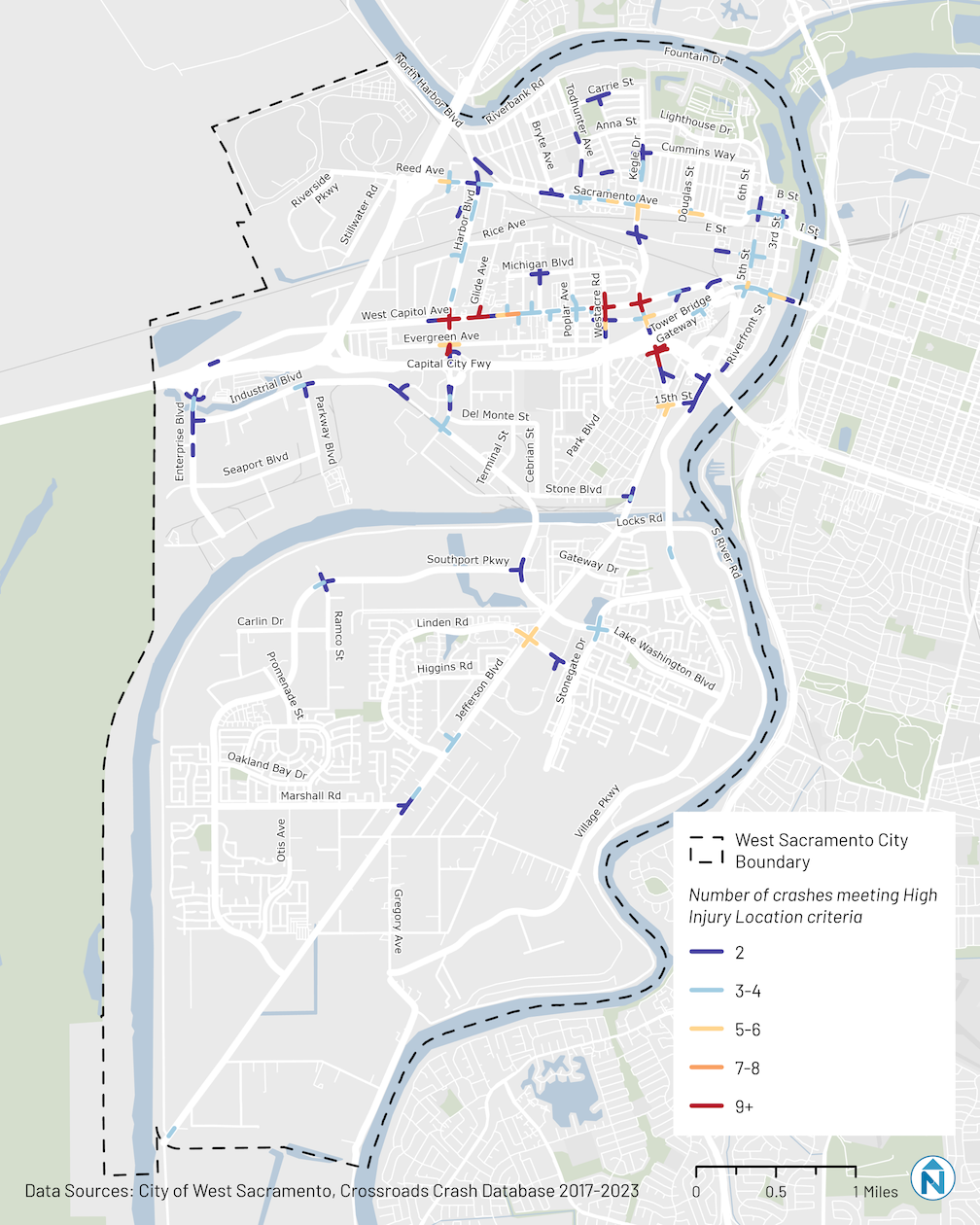
The City of West Sacramento is developing a Vision Zero Action Plan. If you live in, work in, or travel in West Sacramento, I encourage you to take a look at the VZ page. The map showing crash locations, nearly all at intersections, indicate that West Capitol Ave is the epicenter for traffic violence, with Sacramento Ave coming in second. That is my own experience in riding and walking on these arterial streets. West Capitol Ave is the route for Yolobus 42A/42B, and several other routes.

Vision Zero high-injury map for West Sacramento

State Rail Plan webinar March 4

Seamless Bay Area and Californians for Electric Rail are hosting a webinar, New State Rail Plan Explained: A vision for an integrated, cohesive California rail network on March 4, 2025, at 12:00 PM. Registration is required, but free.

The Caltrans/California State Transportation Agency 2024 California State Rail Plan (2024-12) is available for review. An earlier draft emphasized hydrogen trains to the exclusion of overhead catenary wire electric trains, but the current version includes catenary, battery electric and hydrogen fuel cell electric.

From the registration page: “The newly released State Rail Plan lays out strategies that can significantly impact how Californians and visitors get around the state – and can make California a place that’s easier for everyone to get around in an affordable, low-carbon, safe, and accessible way. The plan establishes a long-term vision for an integrated, cohesive statewide rail system that offers passenger and freight service and helps achieve California’s mobility, economic, and climate goals. Tune into this webinar to learn about the plan from California State Transportation Agency staff. Researchers and advocates will give their reaction to the updated plan including cost analysis, the political changes needed to implement reforms, and upcoming funding and reform opportunities.”

Whether or not you can attend this webinar, I encourage you to read the 2024 California State Rail Plan, focusing on the routes or concepts that are most important to you.

The Capitol Corridor, Sacramento/Roseville to San Jose, is called out for electrification, but the source power is not defined. Capitol Corridor is not specifically a single project, but part of several projects including Transbay Crossing, Leveraging Mega-Investments, Sea Level Rise, and Sacramento and San Joaquin Valleys. In stages, Capitol Corridor service is planned to reach once per hour in the mid-term, and once per 30 minutes in the long term. Current service is one hour at peak times of day, but two to three hours at other times.

Many transportation advocates strongly support catenary electrification of the Capitol Corridor route between Sacramento and San Jose. I have also advanced the idea of state purchase of the rails in heavy passenger rail corridors, which would include Capitol Corridor, either through willing seller or condemnation if necessary. Freight rolling stock would still be owned and operated by the railroads, but passenger trains would now have priority over freight trains, and the freight railroads could not resist catenary electrification.

I hope to provide more detailed analysis of the state plan in the near future.

timeline for Tier 4 diesel and zero emissions
2050 electrified corridors
long-term service plan

SACOG Regional Planning Partnership

The SACOG Regional Planning Partnership (RPP) is holding its quarterly meeting tomorrow, February 26, 2025, at 2:00 PM, online via Zoom. Registration is required. The RPP is not part of the SACOG governance structure, but is an advisory group, or forum for transportation and air quality concerns to increase coordination within the region. The agenda is not a traditional one for SACOG with staff reports and presentations, but there are a number of links in the agenda of interest.

Discussion of these items will likely be at an overview level, not the detailed discussion that happens in SACOG committees.

big day of meetings!

Once every few months, there are four transportation-related meetings on a single day, and that day is tomorrow, February 20, 2025. Except for retired folks with nothing better to do (me), no one could attend all four meetings. Three of the meetings are during the work day, which are scheduled then for two purposes: 1) because the members don’t want to do anything in the evening, and 2) to ensure that most of the public cannot participate. Nevertheless, I encourage readers to pick one meeting that seems of most interest, and attend in person or watch online. And comment! Though you may not have expertise on the topic being discussed, you have expertise and lived experience as a member of society.

Of the four meetings, one accepts comments online, the SacRT Mobility Advisory Council (MAC). The others do not. To comment, you must either attend in person, or submit comments online ahead of time. Comments submitted at the last moment will be included in the meeting record, but the board/commission/council/committee members will only see those comments submitted well ahead of time, usually three hours, though it varies with meeting. Meeting agendas, and select agenda items are below. I picked some agenda items of interest to me, but your interests may be different, so I suggest you take a look at the entire agenda and documents. You won’t find any presentations, because, well, that is the games agencies play with agenda presentations. Though, as a pleasant surprise, all the CARTA presentations are already available.

9:30 AM, SACOG Board of Directors, Meetings and Agendas page. Comments In-person: Public comment may be made in person at SACOG’s offices, or Written comments: May be submitted via email to the clerk at lespinoza@sacog.org.

12:00 noon, Capitol Area Tolling Authority, Board Meetings page. Comments In-person: Public comment may be made in person at the meeting location, or Written comments: May be submitted via email to the clerk at rtadevich@sacog.org.

2:30 PM, SacRT Mobility Advisory Council (MAC), MAC page. Comments In-person: Public comment may be made in person at the meeting location, or online via Zoom.

5:30 PM, Sacramento Active Transportation Commission (SacATC), Upcoming Meetings page. Comment In-person: Public comment may be made in person at the meeting location, or via eComment on the Upcoming Meetings page. eComment is open when the agenda is posted, and remains open until the beginning of public comment on an agenda item. Commissioners will not see eComments submitted during the meeting, but these will be part of the public record.

SacCounty Climate Action Plan, November 6

Adoption of the Sacramento County Community Climate Action Plan is item 2 on the Sacramento County Board of Supervisors meeting on Wednesday, November 6, at 2:00 PM. I have not been following the Sacramento County CAP, as it is beyond my capacity, but several organizations have, and they are opposed to the plan under consideration. To summarize, the county has created a plan that won’t stand in the way of low density development at the edge of and beyond the county growth boundary. Translation: sprawl!

The best reference I’ve found is an email from 350Sacramento, so this is duplicated below.

“Tell supervisors: Don’t Approve

In 2011 Sac County promised to adopt a climate action plan (CAP), “within a year”. We’ve pushed them hard for five years to do that, and critiqued five technically and legally insufficient drafts. The problem is that the County is committed to approving several very large, high-GHG, sprawl developments outside the County’s growth boundary, and an effective CAP would get in the way.

This Wednesday the County will try to steam-roll us, adopting a final CAP with the same deficiencies as before, claiming the CAP isn’t subject to environmental requirements. We’re not buying it… Please click and send a pre-written email to County supervisors.

We’re making legal points, but feel free to substitute or add your own thoughts and feelings. Think of pointing out that elected officials are irresponsibly embracing land speculators and sprawl over protecting our environment.

All this proposed sprawl would do nothing to solve the housing crises: The County has already approved over a 100 years-worth of growth in infill and new projects. With the new sprawl they will have adopted almost 200-years of growth capacity. That won’t build-out in anyone’s lifetime; but it will start to build-out as small tracts scatter across the County – the worst possible land use for climate stabilization.

Make your voice heard and share this issue with others in your network!”