The SACOG Regional Planning Partnership (RPP) is holding its quarterly meeting tomorrow, February 26, 2025, at 2:00 PM, online via Zoom. Registration is required. The RPP is not part of the SACOG governance structure, but is an advisory group, or forum for transportation and air quality concerns to increase coordination within the region. The agenda is not a traditional one for SACOG with staff reports and presentations, but there are a number of links in the agenda of interest.
Once every few months, there are four transportation-related meetings on a single day, and that day is tomorrow, February 20, 2025. Except for retired folks with nothing better to do (me), no one could attend all four meetings. Three of the meetings are during the work day, which are scheduled then for two purposes: 1) because the members don’t want to do anything in the evening, and 2) to ensure that most of the public cannot participate. Nevertheless, I encourage readers to pick one meeting that seems of most interest, and attend in person or watch online. And comment! Though you may not have expertise on the topic being discussed, you have expertise and lived experience as a member of society.
Of the four meetings, one accepts comments online, the SacRT Mobility Advisory Council (MAC). The others do not. To comment, you must either attend in person, or submit comments online ahead of time. Comments submitted at the last moment will be included in the meeting record, but the board/commission/council/committee members will only see those comments submitted well ahead of time, usually three hours, though it varies with meeting. Meeting agendas, and select agenda items are below. I picked some agenda items of interest to me, but your interests may be different, so I suggest you take a look at the entire agenda and documents. You won’t find any presentations, because, well, that is the games agencies play with agenda presentations. Though, as a pleasant surprise, all the CARTA presentations are already available.
9:30 AM, SACOG Board of Directors, Meetings and Agendas page. Comments In-person: Public comment may be made in person at SACOG’s offices, or Written comments: May be submitted via email to the clerk at lespinoza@sacog.org.
12:00 noon, Capitol Area Tolling Authority, Board Meetings page. Comments In-person: Public comment may be made in person at the meeting location, or Written comments: May be submitted via email to the clerk at rtadevich@sacog.org.
2:30 PM, SacRT Mobility Advisory Council (MAC), MAC page. Comments In-person: Public comment may be made in person at the meeting location, or online via Zoom.
5:30 PM, Sacramento Active Transportation Commission (SacATC), Upcoming Meetings page. Comment In-person: Public comment may be made in person at the meeting location, or via eComment on the Upcoming Meetings page. eComment is open when the agenda is posted, and remains open until the beginning of public comment on an agenda item. Commissioners will not see eComments submitted during the meeting, but these will be part of the public record.
06 Commission Log: The SacATC log is a list of topics that the commission has requested from staff a discussion or presentation. The log is a running list, so may contain items of high priority, low priority, or superseded by events. Each item has a commissioner name attached as the requestor. I believe this item will ask for sponsors of items where the commissioner is no longer on the commission, and prioritize items.
Adoption of the Sacramento County Community Climate Action Plan is item 2 on the Sacramento County Board of Supervisors meeting on Wednesday, November 6, at 2:00 PM. I have not been following the Sacramento County CAP, as it is beyond my capacity, but several organizations have, and they are opposed to the plan under consideration. To summarize, the county has created a plan that won’t stand in the way of low density development at the edge of and beyond the county growth boundary. Translation: sprawl!
The best reference I’ve found is an email from 350Sacramento, so this is duplicated below.
“Tell supervisors: Don’t Approve
In 2011 Sac County promised to adopt a climate action plan (CAP), “within a year”. We’ve pushed them hard for five years to do that, and critiqued five technically and legally insufficient drafts. The problem is that the County is committed to approving several very large, high-GHG, sprawl developments outside the County’s growth boundary, and an effective CAP would get in the way.
This Wednesday the County will try to steam-roll us, adopting a final CAP with the same deficiencies as before, claiming the CAP isn’t subject to environmental requirements. We’re not buying it… Please click and send a pre-written email to County supervisors.
We’re making legal points, but feel free to substitute or add your own thoughts and feelings. Think of pointing out that elected officials are irresponsibly embracing land speculators and sprawl over protecting our environment.
All this proposed sprawl would do nothing to solve the housing crises: The County has already approved over a 100 years-worth of growth in infill and new projects. With the new sprawl they will have adopted almost 200-years of growth capacity. That won’t build-out in anyone’s lifetime; but it will start to build-out as small tracts scatter across the County – the worst possible land use for climate stabilization.
Make your voice heard and share this issue with others in your network!”
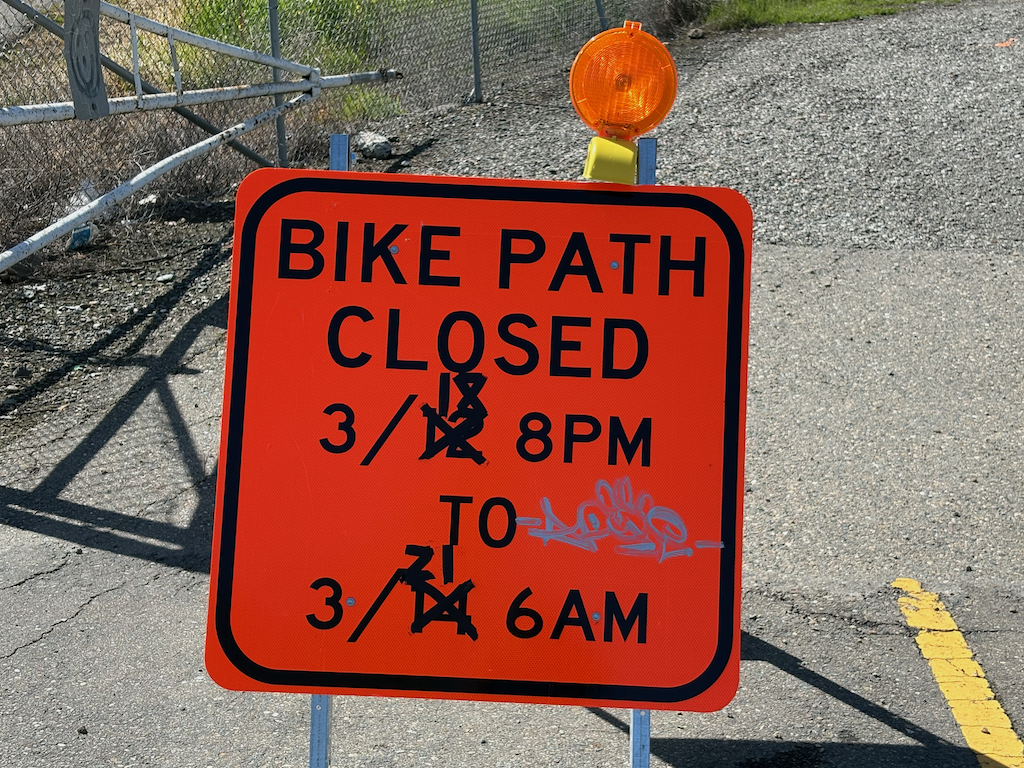
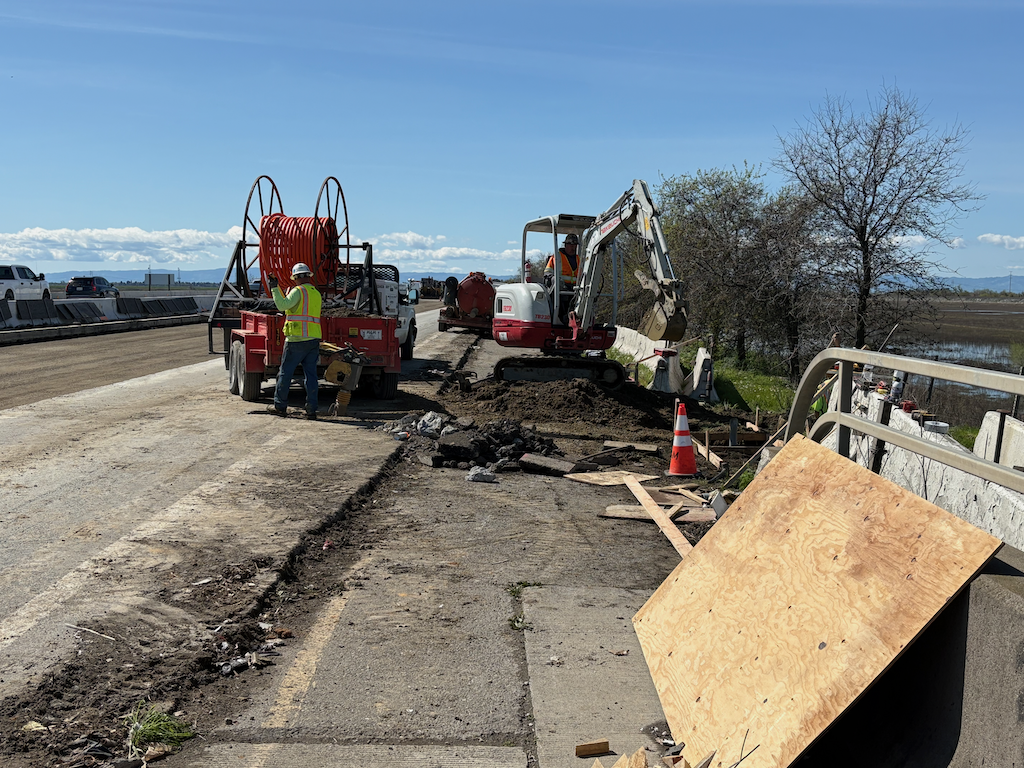
Caltrans and Yolo County Transportation District are proposing to widen a section of Interstate 80 from Sacramento to the Yolo/Solano county line, a project called Yolo 80. This is not just a future project, subject to funding shortfalls and lawsuits, but is actually underway, as Caltrans illegally spends funds for highway maintenance on highway widening. I have written a number of posts on Yolo 80 and managed lanes, but today is just about the bike path that parallels Interstate 80 from the west edge of West Sacramento to Davis.
I am not a commuter or regular rider on the causeway path, but I do average riding it about once a week (I like concerts and beer and Mishka’s tea), and have been doing so for about 13 years.
I realize that posting meetings so close to the meeting makes it impossible to schedule your possible attendance, and sometimes even to submit comments through email. But it is still useful, I think, to keep up on transportation issues and government agencies. Discussion and even decisions on the agenda are often not the final word.
The Sacramento Transportation Authority (SacTA – I label it SacTA rather than STA, to distinguish from the California State Transportation Agency which goes by STA or CalSTA) Board of Directors will meet today, Thursday, October 10, at 1:30 PM in the Sacramento County Board of Supervisors chambers, 700 H Street in downtown Sacramento. The agenda can be viewed on the SacTA Board Meetings page, or here. The entire meeting packet is available on SacTA, but it is quite a large document, and you may find looking at individual agenda items to be more efficient. I’ve commented on a linked to three items of greatest interest to me.
There are two projects to be prioritized for application to the state SB 1 Local Partnership Program, one related to the I Street Bridge Replacement project, and the other for a transit bus yard, hydrogen buses, and hydrogen refueling in north Sacramento, and other transit and transportation projects. Generally only one submitted project is funded, so the prioritization is important.
I don’t have any strong feelings about the two projects, though I will caution that the rush to hydrogen, which is fueled (pun intended) by strong federal, state and local subsidies, is risky. Though hydrogen fuel cells may turn out to be the best solution for some transit routes, the paucity of green hydrogen (that does not rely on fossil fuels or biomass conversion), and the lack of really addressing this issue, is concerning. Much of hydrogen boosterism comes from the fossil fuel industry, trying to maintain its grip on our energy system.
I think everyone would agree that the I Street Bridge replacement is critical, but the city has made sure that it is an expensive trophy bridge rather than a utilitarian bridge.
The charter for SacTA, established with the passage of the existing Measure A (not the failed Measure As) limits the agency to pass-through of transportation funds to local transportation agencies, with limited influence over the projects implemented. The ‘Measure C’ proposal by SMART (Sacramento Metro Advocates for Rail and Transit) and Mayor Steinberg, places an emphasis on transit, housing, and safe streets. And no roadway capacity expansion. The measure being considered by SacRT, for the City of Sacramento and Elk Grove portion of its service area, would provide some support for infill transit oriented development and first mile/last mile active transportation, but would be primarily for transit. SacTA does not have the authority to fund anything other than direct transportation projects. This agenda item would allow SacTA to consider legislation to broaden it mandate to include housing or housing-supportive infrastructure related to transportation.
It is not clear whether any measure proposed by SacTA would approach the model proposed by active transportation and transit advocates, but this idea is worth pursuing.
I support this agenda item.
Agenda 12: Consider the Creation of a Temporary New Transportation Funding Subcommittee
This agenda item would form a subcommittee to explore the possibility of, and chances for success, of a 2026 transportation sales tax measure sponsored by SacTA.
We know that a transportation measure heavily weighted towards roadway capacity expansion has failed and will fail, but with a possible shift in priorities to roadway maintenance (fix-it-first), transit and active transportation, there is some chance of success. If Proposition 5 passes this November, it is possible that a ballot measure in 2026 would require only a 55% yes vote, rather than a 67% yes vote, which is difficult to pass in Sacramento County with its strong suburban and semi-rural opposition to all taxes.
Several transportation advocacy organizations are opposed to any additional sales taxes since they are regressive, having a much greater impact on low-income people than other taxes. However, at this time, it does not looks as though any of the potential proposals uses alternative taxes.
Governor Newsom has signed SB 960, the complete streets bill (SB-960 Transportation: planning: complete streets facilities: transit priority facilities.), authored by Scott Wiener. That’s the good news. It is certain that the Caltrans districts will resist this law, but with oversight by CalBike and the public, things will gradually shift.
CalBike has published the first two of a series of reports on the failure of Caltrans to follow their own complete streets policy when designing and building streets which are also state highways. It is telling that the first of the series is on the failure of Caltrans District 3, which includes Sacramento county, to actually provide complete streets – Incomplete Streets Part 1: How Caltrans Shortchanges Pedestrians. District 3 is perhaps the worst of the Caltrans districts, which operate as independent (or rogue) agencies and regularly subvert Caltrans policy and direction from headquarters. Though they have a lot of competition for the title of worst.
“District 3 is perhaps best known as the district pushing through the Yolo Causeway highway expansion project. The project, which has been approved despite internal and external opposition, led to the firing of Caltrans Deputy Director Jeanie Ward-Waller after she blew the whistle on improper use of funds for freeway widening and insufficient environmental review.”
I encourage you to read these first two, and to follow CalBike investigative reporting. Caltrans must be held to account, as otherwise they will continue to design projects that kill and injure walkers and bicyclists, will continue to resist fixing the design mistakes they have made in the past, and will continue to commit fraud on the people of California by lying about what they are doing with your tax money.
This week at the legislature, the Assembly Transportation Committee is hearing SB 960 (Wiener) Transportation: planning: complete streets facilities: transit priority projects, Monday, July 1, 2:00 PM in Room 1100 at 1021 O Street in Sacramento (StreetsblogCA: Complete Streets Bill Hearing Next Week). This bill would force Caltrans to follow its own policy on Complete Streets, which is seldom does, and could have a beneficial impact on all street redesign in California as many transportation agencies look to Caltran for guideance.
The Assembly Privacy and Consumer Protection Committee is hearing SB 961 Vehicles: safety equipment (Wiener), Tuesday, July 2, 1:30 PM, in Room 126, State Capitol. The bill would implement Intelligent Speed Assistance for all vehicles except emergency vehicles. Though considerably weakened from the original version, with passive rather than active control, it is still a valuable step forward, and would encourage NHTSA to speed up their policy process, which they have been slow walking (to preserve fast driving).
If you live in Sacramento and can attend, please do. All you can do at legislative hearings is ‘support’ or ‘oppose’, but since most speakers are paid lobbyists, hearing from actual citizens can be powerful.
A report on pavement condition in Sacramento County was presented today to the Sacramento Transportation Authority (SacTA): 2023 Regional Pavement Analysis, written by consultant NCE, agenda item 12.
The report has two main sections:
What are the existing pavement conditions, countywide, and by each agency (city or county).
What are funding scenarios and how would the allow, or not allow, substandard conditions to be improved.
Existing conditions are summarized in the chart below. The countywide PCI (pavement condition index) is 53, out of a possible 100, with a target of at least 70 for ‘good condition’. Only Elk Grove has the target 70 or better, in large part because their roadways are newer than most of the county.
The second section presents five possible funding scenarios, and how pavement condition would vary over time. In each of the scenarios except the first, ‘improve PCI to 70’, pavement condition declines, sometimes slowly and sometimes quickly. SacTA already recognized that there is no likely funding source that would allow scenario one. Scenario four includes new sales tax income, but still does not keep pavement conditions from declining.
Many people question where SB 1 Road Repair and Accountability Act of 2017 funding (mostly gas tax) is going and why it hasn’t fixed our roads. SB 1’s main intent was to allow Caltrans to maintain freeways and other state-owned roads. It had only minor funding, a fraction of what would be needed, to maintain local roadways.
Why are we in this crisis of pavement condition? Because we have built roadways (and bridges and freeways) that we will never be able to maintain. It would take a tax rate many times higher than it is today to actually maintain all we have. That isn’t happening. We’ve built ourselves into a corner. But that doesn’t mean we can’t address the problem. We can shift funding from road building to road repair. This is called ‘fix my pothole’ or ‘fix-it-first’ or ‘state of good repair’.
I made these comments today about the issue:
I’m a active transportation and transit advocate, but what everyone in the county wants is to have good streets.
Under no reasonable funding scenario does pavement quality improve
There will be less money coming through the state, as demonstrated by the LAO presentation (the previous agenda item, 11)
$8.3B roadway ‘asset’ is really a $8.3B ‘liability’, requiring a significant investment to maintain
Every new pavement mile is an additional liability
Authority funding should shift from creating new pavement to maintaining and rehabilitating existing pavement
This shift is even more important for the member agencies, cities and county
Each potential infrastructure project should be evaluated on the question “Does this project add enough economic activity to pay for maintenance?” If the answer is not, they should not be built.
If the authority is going to voters for increased sales tax in the future, it will be necessary ahead of time to show that the authority and agencies are already working to solve this issue, not just waiting for more money
Two bicycle advocates spoke after me, pointing out that safety for bicyclists is actually a very high priority. I agree, even above economic productivity. But economic productivity must be considered. I roadway projects don’t create enough income to pay for them, and maintenance and rehabilitation of them, we are sliding further down the slope of pavement deterioration.
Board comments were mostly in recognition that we must invest differently than in the past, we must keep our existing roads in better condition, and that includes consideration not doing projects which increase future liability.
“Caltrans’ Environmental Impact Report (EIR) grossly underestimates increased vehicular travel, which would emit far larger quantities of greenhouse gases (GHG) and air pollutants than claimed. The EIR fails to consider viable alternatives, such as increased public transit or alternate tolling strategies. Therefore, the project neither adequately manages demand nor produces adequate revenue to fund needed transit alternatives. Also, Caltrans’ proposed mitigation is woefully inadequate to offset the resulting increased GHG and air pollutant emissions.” – Sierra Club/ECOS Press Release
“First, Caltrans improperly chopped this project into two pieces to use funding in illegitimate ways and obscure environmental impacts, as documented by a Caltrans whistleblower. The first project, already underway, is using maintenance-only transportation dollars to strengthen the shoulders of the highway so they can accommodate heavy vehicle travel. The second project would restripe the road to accommodate the additional lane of traffic in each direction.” – NRDC
I tend to be cynical about the chances of stopping this widening project. However, the lawsuits can have several beneficial impacts:
requiring Caltans to supplement or revise its Environmental Impact Report, because it failed to consider several impacts, and failed to address induced demand
requiring Caltrans to allocate more funding to environmental and GHG mitigation; the existing project only partially mitigates impacts, and depends on income from a single tolled lane, which may fall short of projections
highlighting the failure of the California Transportation Commission, and in particular Chair Carl Guardino, to provide legally required oversight of Caltrans
I am in favor of tolling freeway lanes in order to recovered construction and maintenance costs, and to fund mitigation measures, not just for GHG but for other environmental impacts. A tolling authority (CARTA) has been set up to administer the added toll lane, but there are great uncertainties about how much will be raised, and the fee structure (vehicles and time of day) has not been developed.
“The EIR does not consider tolling existing lanes, which could be based on income, with funds used to provide clean public transit and bike and pedestrian options along the corridor, facilitating affordable infill development.” – Ralph Propper, ECOS Climate Committee Chair, from the press release