Governor Newsom has signed SB 960, the complete streets bill (SB-960 Transportation: planning: complete streets facilities: transit priority facilities.), authored by Scott Wiener. That’s the good news. It is certain that the Caltrans districts will resist this law, but with oversight by CalBike and the public, things will gradually shift.
CalBike has published the first two of a series of reports on the failure of Caltrans to follow their own complete streets policy when designing and building streets which are also state highways. It is telling that the first of the series is on the failure of Caltrans District 3, which includes Sacramento county, to actually provide complete streets – Incomplete Streets Part 1: How Caltrans Shortchanges Pedestrians. District 3 is perhaps the worst of the Caltrans districts, which operate as independent (or rogue) agencies and regularly subvert Caltrans policy and direction from headquarters. Though they have a lot of competition for the title of worst.
“District 3 is perhaps best known as the district pushing through the Yolo Causeway highway expansion project. The project, which has been approved despite internal and external opposition, led to the firing of Caltrans Deputy Director Jeanie Ward-Waller after she blew the whistle on improper use of funds for freeway widening and insufficient environmental review.”
I encourage you to read these first two, and to follow CalBike investigative reporting. Caltrans must be held to account, as otherwise they will continue to design projects that kill and injure walkers and bicyclists, will continue to resist fixing the design mistakes they have made in the past, and will continue to commit fraud on the people of California by lying about what they are doing with your tax money.
This week at the legislature, the Assembly Transportation Committee is hearing SB 960 (Wiener) Transportation: planning: complete streets facilities: transit priority projects, Monday, July 1, 2:00 PM in Room 1100 at 1021 O Street in Sacramento (StreetsblogCA: Complete Streets Bill Hearing Next Week). This bill would force Caltrans to follow its own policy on Complete Streets, which is seldom does, and could have a beneficial impact on all street redesign in California as many transportation agencies look to Caltran for guideance.
The Assembly Privacy and Consumer Protection Committee is hearing SB 961 Vehicles: safety equipment (Wiener), Tuesday, July 2, 1:30 PM, in Room 126, State Capitol. The bill would implement Intelligent Speed Assistance for all vehicles except emergency vehicles. Though considerably weakened from the original version, with passive rather than active control, it is still a valuable step forward, and would encourage NHTSA to speed up their policy process, which they have been slow walking (to preserve fast driving).
If you live in Sacramento and can attend, please do. All you can do at legislative hearings is ‘support’ or ‘oppose’, but since most speakers are paid lobbyists, hearing from actual citizens can be powerful.
A report on pavement condition in Sacramento County was presented today to the Sacramento Transportation Authority (SacTA): 2023 Regional Pavement Analysis, written by consultant NCE, agenda item 12.
The report has two main sections:
What are the existing pavement conditions, countywide, and by each agency (city or county).
What are funding scenarios and how would the allow, or not allow, substandard conditions to be improved.
Existing conditions are summarized in the chart below. The countywide PCI (pavement condition index) is 53, out of a possible 100, with a target of at least 70 for ‘good condition’. Only Elk Grove has the target 70 or better, in large part because their roadways are newer than most of the county.
The second section presents five possible funding scenarios, and how pavement condition would vary over time. In each of the scenarios except the first, ‘improve PCI to 70’, pavement condition declines, sometimes slowly and sometimes quickly. SacTA already recognized that there is no likely funding source that would allow scenario one. Scenario four includes new sales tax income, but still does not keep pavement conditions from declining.
Many people question where SB 1 Road Repair and Accountability Act of 2017 funding (mostly gas tax) is going and why it hasn’t fixed our roads. SB 1’s main intent was to allow Caltrans to maintain freeways and other state-owned roads. It had only minor funding, a fraction of what would be needed, to maintain local roadways.
Why are we in this crisis of pavement condition? Because we have built roadways (and bridges and freeways) that we will never be able to maintain. It would take a tax rate many times higher than it is today to actually maintain all we have. That isn’t happening. We’ve built ourselves into a corner. But that doesn’t mean we can’t address the problem. We can shift funding from road building to road repair. This is called ‘fix my pothole’ or ‘fix-it-first’ or ‘state of good repair’.
I made these comments today about the issue:
I’m a active transportation and transit advocate, but what everyone in the county wants is to have good streets.
Under no reasonable funding scenario does pavement quality improve
There will be less money coming through the state, as demonstrated by the LAO presentation (the previous agenda item, 11)
$8.3B roadway ‘asset’ is really a $8.3B ‘liability’, requiring a significant investment to maintain
Every new pavement mile is an additional liability
Authority funding should shift from creating new pavement to maintaining and rehabilitating existing pavement
This shift is even more important for the member agencies, cities and county
Each potential infrastructure project should be evaluated on the question “Does this project add enough economic activity to pay for maintenance?” If the answer is not, they should not be built.
If the authority is going to voters for increased sales tax in the future, it will be necessary ahead of time to show that the authority and agencies are already working to solve this issue, not just waiting for more money
Two bicycle advocates spoke after me, pointing out that safety for bicyclists is actually a very high priority. I agree, even above economic productivity. But economic productivity must be considered. I roadway projects don’t create enough income to pay for them, and maintenance and rehabilitation of them, we are sliding further down the slope of pavement deterioration.
Board comments were mostly in recognition that we must invest differently than in the past, we must keep our existing roads in better condition, and that includes consideration not doing projects which increase future liability.
“Caltrans’ Environmental Impact Report (EIR) grossly underestimates increased vehicular travel, which would emit far larger quantities of greenhouse gases (GHG) and air pollutants than claimed. The EIR fails to consider viable alternatives, such as increased public transit or alternate tolling strategies. Therefore, the project neither adequately manages demand nor produces adequate revenue to fund needed transit alternatives. Also, Caltrans’ proposed mitigation is woefully inadequate to offset the resulting increased GHG and air pollutant emissions.” – Sierra Club/ECOS Press Release
“First, Caltrans improperly chopped this project into two pieces to use funding in illegitimate ways and obscure environmental impacts, as documented by a Caltrans whistleblower. The first project, already underway, is using maintenance-only transportation dollars to strengthen the shoulders of the highway so they can accommodate heavy vehicle travel. The second project would restripe the road to accommodate the additional lane of traffic in each direction.” – NRDC
I tend to be cynical about the chances of stopping this widening project. However, the lawsuits can have several beneficial impacts:
requiring Caltans to supplement or revise its Environmental Impact Report, because it failed to consider several impacts, and failed to address induced demand
requiring Caltrans to allocate more funding to environmental and GHG mitigation; the existing project only partially mitigates impacts, and depends on income from a single tolled lane, which may fall short of projections
highlighting the failure of the California Transportation Commission, and in particular Chair Carl Guardino, to provide legally required oversight of Caltrans
I am in favor of tolling freeway lanes in order to recovered construction and maintenance costs, and to fund mitigation measures, not just for GHG but for other environmental impacts. A tolling authority (CARTA) has been set up to administer the added toll lane, but there are great uncertainties about how much will be raised, and the fee structure (vehicles and time of day) has not been developed.
“The EIR does not consider tolling existing lanes, which could be based on income, with funds used to provide clean public transit and bike and pedestrian options along the corridor, facilitating affordable infill development.” – Ralph Propper, ECOS Climate Committee Chair, from the press release
Note: I’ve added text and a photo of the approach from the north.
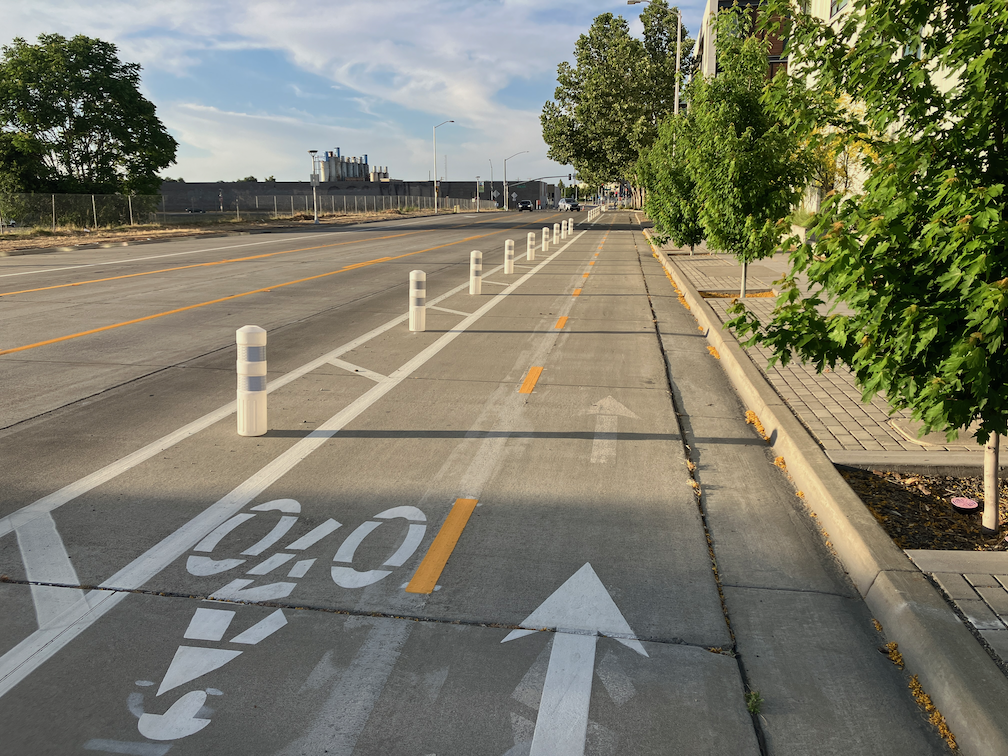
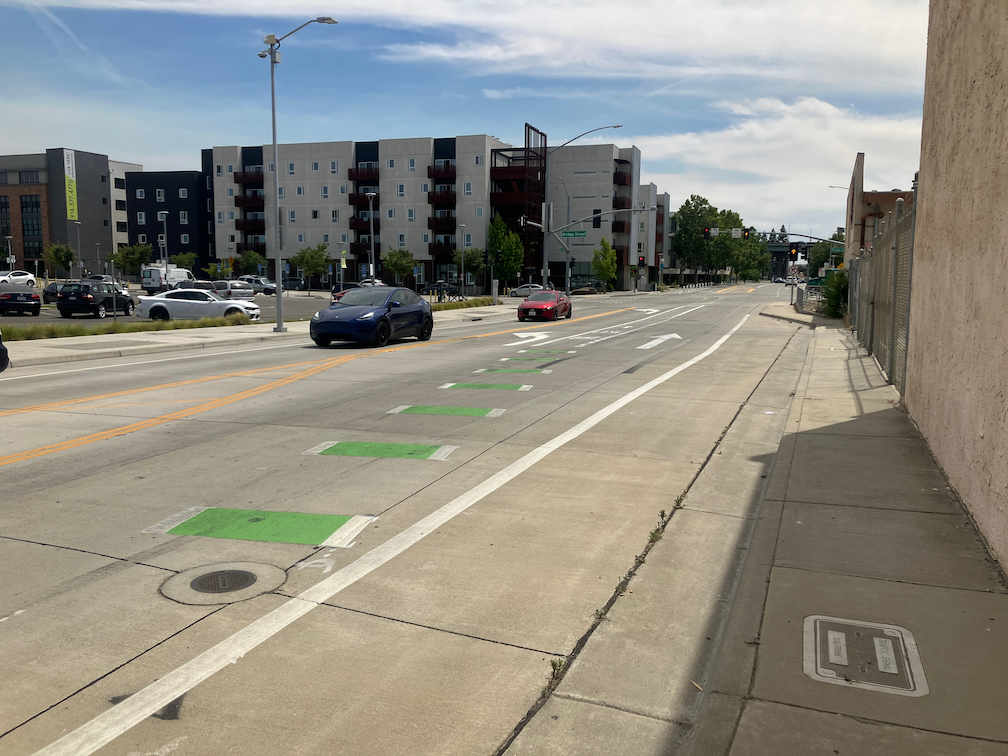
The City of West Sacramento has installed a section of cycletrack (a two-way Class 4 separated bikeway) on South River Road and 5th Street in the Bridge District. Apparently completed late 2023 (shows how long since I’ve ridden that way), it is part of the Riverfront Street Extension and 5th Street Widening Project.
From 15th Street (the connection to Jefferson Blvd) north to almost Mill Street, the bikeway is separated from motor vehicles by a hard curb divider. The on-street bike lane southbound still exists, but this bikeway provides a much safer alternative. The onramp to Hwy 50 east (or Business 80 as it is designated), was an extreme hazard for bicyclists due to drivers turning at high speeds. See two photos below.
South River Rd cycletrack / separated bikeway at 15th StSouth River Rd cycletrack / separated bikeway
From Mill Street north to Bridge Street, the cycletrack is separated by a buffer and vertical delineators (K-71). At Bridge Street and north, the roadways returns to traditional Class 2 unprotected bike lanes. Though it would have been great to extend the curb-protected cycletrack all the way north to West Capitol Avenue, at least the truly dangerous section at the freeway onramp was fixed.
To the south of 15th Street, South River Road has more traditional bike lanes, with buffers in a few locations, as it crosses the ship channel and goes through two roundabouts.
The transitions to and from the bikeway seem a little awkward as they swoop through the intersection, but are probably not unsafe. I observed several bicyclists heading westbound to 15th Street who were not following the skip green bicycle markings, but the maneuver was not unsafe. I did not observe any bicyclists at the Bridge Street intersection.
Approaching the cycletrack from the north, the southbound traditional bike lane on the west side of 5th Street transitions to the cycletrack on the east side of 5th Street at Bridge St. Though the transition does not feel safe, I think it actually is, with signals preventing inappropriate motor vehicle movements.
5th St bike lane transitioning to cycletrack approaching Bridge St signs and signals for bicyclist on 5th St at Bridge St
I have attended several SACOG board and committee meetings over the last two months, and seen the pushback that smaller cities and more rural areas are providing to the innovations of the 2025 Blueprint, in particular Scenario 3 which promotes infill rather than greenfield development. I will have more to say about this in the future, but for now, want to address the question of why these areas have such a strong voice in SACOG. It is the very structure of the Board of Directors, to give every member one vote, not matter the size of the population they represent. This is called one-member/one-vote.
The SACOG Mission and Governance page provide information about the structure and voting of the board. The table below (pdf, xlsx) shows the 31 voting members, the votes assigned to them, the population of the entity, and the votes that would be allocated if votes were population weighted, rather than one-member/one-vote. Caveats: I have not excluded the population of the Lake Tahoe basin in Placer and El Dorado counties, which are not in the SACOG region, because it is difficult to calculate, and not that significant. County supervisors represent all the citizens of a county, whether they are in unincorporated county or within a city. However, in looking a government bodies, I think it is useful to look at unincorporated population, and have used it in the table. County supervisors often seem to forget that they represent the entire county. All figures are from the 2020 census.
There are dozens of striking insights from this table, but I’ll focus on four.
In Sacramento County, the City of Isleton has 794 citizens, which is less than 0.1% of the county, and 0.1% of the region. That means the member representing Isleton has about 16 times the power of the member representing Elk Grove. Other counties have similar disparate representation.
In the region, Sacramento County has 61.5% of the population, yet only 35.5% of the vote, while Yuba County has 3.2% of the population, yet 9.7% of the vote. Sacramento County has 20 times the population of Yuba County, yet only 3-1/2 times the vote.
If Sacramento County were not assigned three voting members, and City of Sacramento two voting member, the disparity between population and voting would be even more prominent. This higher number of voting members is meant to compensate, in a minor way, for the egregious imbalance in representation that would otherwise result.
The town of Loomis, not a city, has one member, with a population of 6,836. In Sacramento County, the ‘towns’ (CDPs, census designated places) have far larger populations, yet no representation except through the county: Arden-Arcade 94,659, Carmichael 79,793, North Highlands 49,327, Orangevale 35,569, Fair Oaks 32,514, and several smaller CDPs. How did Loomis get this seat?
I am a believer in democracy. I realize that many people consider us a republic rather than a democracy, but other than the US Senate, we make the effort at all levels of government to approach as closely as possible the democratic ideal of one-person/one-vote. Yet we have entities such as SACOG (Sacramento Area Council of Governments) that, by using one-member/one-vote, are as far from representative of the people as can be.
So when you wonder, why do small cities and rural areas have such a large voice in transportation funding and sustainable communities strategies (the SCS part of the Blueprint), and why we continue to promote greenfield development in the region when we know that greenfield equals climate disaster, please refer back to this governance model.
In addition to the SacRT Mobility Hubs grant to Civic Thread, the Sacramento region received another grant from the CARB FY 2022-2023 Planning and Capacity Building (Planning), Clean Mobility in Schools (CMIS), and the Sustainable Transportation Equity Project (STEP) program.
Lead Applicant: Sacramento City Unified School District Organization Type: Public School Funding Program: Planning Project Community Location: South Sacramento (Sacramento County) Project Name: Safe Routes to School for All Sub-applicants: Civic Thread, United Latinos Funding Request: $500,000 Summary from application: The overarching goal of Sacramento City Unified School District’s Safe Routes to School for All project is to increase transportation equity by way of enhanced mobility access and safe routes to schools in our highest need school neighborhoods in South Sacramento through a community-led planning and capacity building process. The community priorities and identified solutions will be documented in the Community Transportation Needs Assessment (“Needs Assessment”). The Safe Routes to School project will encompass a one to two-mile radius surrounding up to 15 Title Idesignated elementary, middle, K-8, and high schools serving nearly 7,500 students in South Sacramento. The project will prioritize engaging those living in Sacramento’s SB 535 Disadvantaged Communities who are BIPOC-identifying; LGBTIA+ identifying; those with limited or no English proficiency; refugees or recent immigrants; those with physical and/or learning disabilities; and households with no vehicle.
Note that Civic Thread is a partner in this application and program.
Yesterday I rode the bus to and from Sacramento International Airport, to see what the ride and buses and ridership were like. I noticed that there is significant construction occurring on I-5 between Arena Blvd and Airport Blvd, the entrance to the airport. The freeway width under overcrossings is being widened by one lane in each direction, and the roadway is being widened in between the overpasses and interchanges. I had not heard or realized that this work was already going on, but then, I rarely travel on I-5. This project is titled “SAC-5 Corridor Improvement Project – Phase 1”, and is being referred to as “Sacramento I-5 Auxiliary Lanes Project”. A fact sheet is available.
Caltrans claimed a categorical exclusion for this project, meaning that they claimed they did not need to do an environmental assessment or environmental impact statement for CEQA or NEPA because the project would not have a significant environmental impact. This is laughable. Capacity expansions ALWAYS have an environmental impact. It amazes me the number of agencies, including SACOG and California Transportation Commission, that sign off on this bullshit. The project number is 03-4H580, which means it is part of the Caltrans District 3 megaproject to increase the capacity of I-5 and I-80 in the Sacramento region. It may be that part of this widening is a separate project to add an auxiliary lane between Metro Airpark and State Route 99, using Trade Corridor Enhancement Program (TCEP). It appears that the main project is funded through Solutions for Congested Corridors Program (SCCP). The project also shows up on lists of State Highway Operation and Protection Program (SHOPP) projects, though it is not clear whether it actually received any SHOPP funding. This type of widening would be illegal as a SHOPP expenditure. There are literally 70 documents that relate to this project, and it is beyond me to figure out what they all mean, or how they relate to each other. Caltrans specifically does not gather these documents onto a project page. That would entail some transparency, which Caltrans District 3 is apparently opposed to.
The photo below shows the widening of I-5 at Airport Blvd, captured from Google StreetView. The freeway is being widened to the west to the Sacramento River crossing, and the widening appears to continue all the way to Arena Blvd. Caltrans calls these auxiliary lanes, meaning they extend only between interchanges but not through, but it appears to me that they will be continuous, and that is why the freeway is being widened beneath the overpasses. These modifications of the overpasses are called tie-backs by Caltrans, meaning the the original slope under the overcrossing bridge to the freeway is being truncated to add width to the freeway.
This is phase 1 of the project. Caltrans intends to add capacity to I-5 all the way from the Yolo County line to US 50, where the earlier project greatly expanded capacity from Elk Grove north.
If readers travel this section of I-5 and have comments about this project, or more knowledge of the project than I have been able to come up with, please comment or contact me.
California State Senator Scott Wiener has introduced two bills to improve road safety in California.
The more important is SB 961, which requires changes to vehicles directly, including a first-in-the-nation requirement that all new vehicles sold in California install speed governors, smart devices that automatically limit the vehicle’s speed to 10 miles above the legal limit. The old name for these is speed governors, which limited speed with a physical device that disengaged the driver train when a certain speed was reached. They were required on all early motor vehicles before vehicle manufacturers managed to eliminate laws requiring them. Today, speed can be digitally read and limited. Already, almost all new vehicles have built in the ability to limit speeds to the posted speed limit, but it is not implemented. The bill would require it be implemented by 2027.
Speed is a contributing factor in all motor vehicle crashes. Whether it is driving too fast for conditions, or simply driving way over the speed limit, speed is a contributing factor to carnage on our roads. Of course there are other factors such as roadway design which encourages speeding. And speed limiters won’t prevent drivers from running red lights, as has become so common, but at least the resulting crashes will be at a lower speed, less likely to result in fatalities.
Speed limiting of vehicles also would remove law enforcement from most speed enforcement, which increases safety for everyone on the road, including officers.
SB 960 requires Caltrans to implement and report on a complete streets policy. In vetoing a Wiener bill to require complete streets, the governor implemented a executive order that purported to accomplish this, but Caltrans has done almost nothing since then, and has weakened and then delayed release of its complete streets policy directive. The bill also requires Caltrans to develop a transit priority policy with performance targets.
Caltrans headquarters has, to some degree, gotten on board with the idea of designing and re-designing roads for better safety and productivity, but the Caltrans districts, including our District 3, are still full speed ahead (pun intended) on building unsafe highways that kill walkers and bicyclists. They must be reigned in by the legislature.
CalBike is a sponsor of both of these bills, along with other organizations. Yay, CalBike!
note: the YouTube live version of the press conference was almost unintelligible due to poor sound quality and traffic noise, but the TV media has good sound quality from after the conference interviews)




 Getting Around Sacramento