I had promised I’d report on the community meeting to address the crosswalk removal over Freeport at Oregon and related issues, but it has taken me a while. Previous posts: removal of crosswalks, Don’t use the ‘A’ word. For background, see the SacBee article: Why Sacramento erased 23 crosswalks, including one where a grandmother died after removal.
The meeting was hosted by City of Sacramento council members Jay Schenirer and Steve Hansen, and school board president Jessie Ryan, and held March 8 at Hollywood Park Elementary which is east of the intersection where the fatality occurred.
Steve talked about the concept of a stroad, a street/road hybrid that doesn’t do either well, though he did not use the term. Freeport is a stroad. He introduced vision zero, talked about changing both infrastructure and behavior, mentioned that the traffic motor officers are gradually being built up but are far below what they should be, and said “we should enjoy the public space and not be afraid.”
Ryan Moore, Interim Traffic Safety Engineer, and the person responsible for the removal of crosswalks, repeatedly mentioned a ‘Systematic Safety Analysis Report’ but is was not clear what this is, and the city website has no mention of it. He also said that he was following all the federal and state rules, as well as research, by removing the crosswalks.
Jennifer Donlon-Wyant, the Active Transportation Specialist, gave a Vision Zero presentation similar to what many people have seen before, but highlights are that Sacramento is the second worst in the state for pedestrian fatalities per capita. She went over the ten profiles that are the core of the draft Vision Zero Action Plan, of which three are related to speed, and one related to transit stops, which all play a role in this incident. One that does NOT apply is ‘Pedestrian Crossing Outside of an Intersection or Crosswalk.’ Though the city had erased the marked crosswalk, it was and is still a valid legal crosswalk. Freeport Blvd is not one of the top five fatality and injury corridors in the city.
Matt Armstrong, Sergeant of the Motor Team (officers on motorcycles) said he has 7 officers on at a time, maximum, for the entire city. They respond to complaints, but otherwise focus on schools and high volume corridors. He said top concerns are red light running, distracted driving, and speed. He mentioned something I had not heard before, that this was a multi-lane threat crash. A multi-lane threat crash occurs on streets with more than one lane in the same direction (Freeport has two lanes in each direction), when one driver stops for a pedestrian and other drivers does not. This is a violation of CVC 21951 “Whenever any vehicle has stopped at a marked crosswalk or at any unmarked crosswalk at an intersection to permit a pedestrian to cross the roadway the driver of any other vehicle approaching from the rear shall not overtake and pass the stopped vehicle.”
Jessie Ryan said the district recognized that their policies were insufficient and were going to adopt the California School Boards Assocation Safe Routes to School policy (which is very weak), that they were creating heat maps to prioritize unsafe routes, is committed to using and reviewing data, and welcomes public input. The district, prior to this, has shown little interest in Safe Routes to School and has implemented only some minor projects.
Kirin Kumar of WALKSacramento and Jim Brown of Sacramento Area Bicycle Advocates (SABA) spoke briefly about the need for culture change in the community and in the city bureaucracy.
Next post I’ll discuss some of the public comments and questions, and the answers provided.
 Questions about using Leading Pedestrian Interval (LPI) signals at the community meeting on crosswalks reminded me that I had information on these in the city for some while, but hadn’t shared it. A LPI signal gives the pedestrian a 3-second (or more, but the Sacramento ones are all 3 seconds) head start, with the walk sign coming on before the light turns green, so that pedestrians will already be in the crosswalk and more visible before vehicles start to move. These address the common issue of both right-turning and left-turning vehicles failing to yield to pedestrians in the crosswalk. They are one of the pedestrian safety countermeasures identified by the
  To complete the story about crosswalks, the locations where crossing is prohibited must also largely be removed. These locations are marked with the ‘no crossing’ sign at right (MUTCD R9-3a). Some of these locations probably never had crosswalks, some had them but were removed when the street was ‘upgraded’. A few of these locations cannot be made safe without complete reconstruction of the street. Freeway on-ramps and off-ramps, of which Sacramento has too many because it has too many freeways and too many freeways designed around commuting instead of interstate commerce, are particularly problematic. However, most locations indicate a clear intent by traffic engineers to prioritize the movement and speed of motor vehicles over all other considerations, including safety. This bias must be ended.
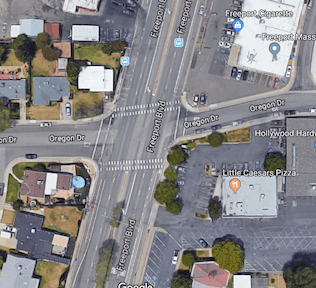 As you can see to the right, at the intersection of Freeport and Oregon, there are residences to the west and businesses to the right. There are signalized crosswalks about 700 feet to the north and about 700 feet to the south, but walking to either of these adds a one-quarter mile walk. Is this reasonable or not? It could be argued either way, but to discount it as Mr. Moore did demonstrates bias against pedestrians. The Google Map photo is from before the removal of the crosswalk.
 Curb extensions, also called bulb-outs, have been installed on all four corners at the intersection of 16th Street and N Street in midtown Sacramento. The extensions are the width of the parking lanes along both these streets. N Street has bikes lanes, which are not restricted by the extensions, while 16th Street does not have bike lanes, and won’t until the street is reconstructed into a more complete street at some unknown point in the future.