Beg buttons on K? Really?

Note: I discovered yesterday, to my chagrin, that I had a number of draft posts dating back to early 2013, which I’d never finished. So I’m going to post them now, all in a flurry. Some of these issues I’ll get back to and do an in-depth and up-to-date post, and some of them I probably never will. This is the fifth and last post, and I discarded two that were worth preserving. This just points out that I have more good ideas than I have time to carry them out.

My point here was that beg buttons should not be used on streets which are meant to encourage or emphasize walkability, of which K Street is certainly one. I will definitely be writing more about this.

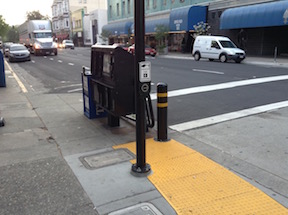
Pedestrian beg button on a commonly used crosswalk (9th St at K St), this location should have a pedestrian signal on every cycle, not just when someone presses the button.

Original 2015-04-11: I have to admit that sometimes I walk past things every day and don’t notice them, but this morning I noticed the pedestrian activated buttons on K Street in downtown Sacramento. Yes, they’ve probably been here since the street was re-opened to cars on November 12, 2011. These are technically called pedestrian pushbuttons, and their purpose is to activate the pedestrian signal head and a change of the traffic signal. They are often called beg buttons, because the pedestrian has to “beg” to cross the street by pushing the button, rather than being an accepted part of transportation on the street.

Davis protected intersection

The new protected intersection in Davis, the first in the United States to open, has been in the news recently (#Damien Talks Episode 13 – The Davis Planning Department on the Bike Protected Intersection (Streetsblog), This California city just built the country’s first protected intersection for bikes (Vox), It Just Works: Davis Quietly Debuts America’s First Protected Intersection (Streetsblog), Davis Dutch intersection, first ever in U.S., unveiled with no drama (Davis Enterprise), and others). Though it did not initiate the movement towards protected intersections, which have long existed in some form in Europe, Nick Falbo’s Protected Intersection video has popularized the idea in the United States.

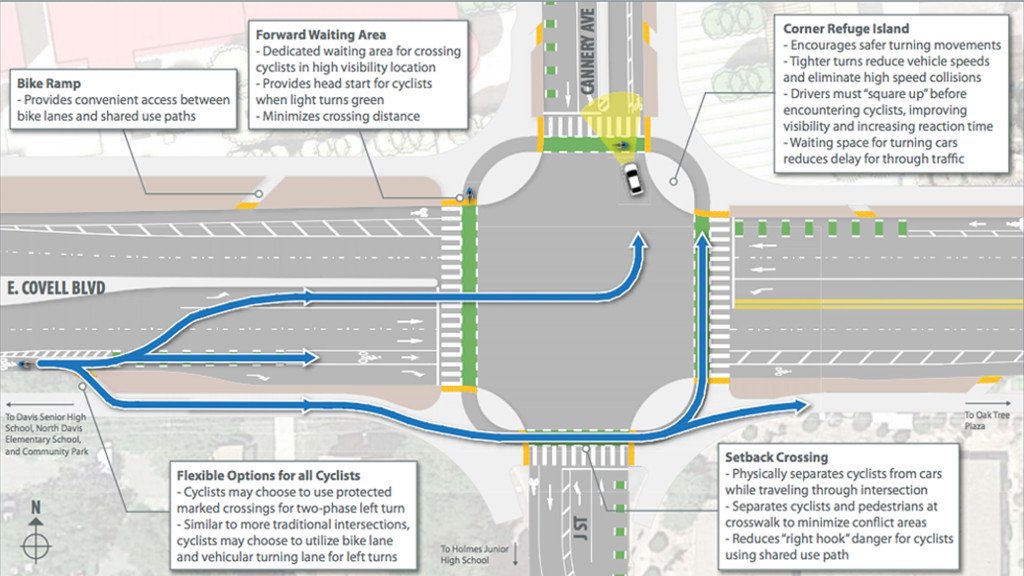
Yesterday I spent about an hour looking at the intersection. It was mid-day, so lightly used by bicyclists, pedestrians and motor vehicles. I might have a different impression at a different time of day. I was on my knee scooter, my current method of getting around, so acting as a pedestrian and not a bicyclist. The design is at the intersection of Covell Blvd and J Street/Cannery Row, on the north side of Davis. The intersection was revised because of the major new development north of Covell, The Cannery, which has recently opened but is still being developed. Some photos are on Flickr.

intersection diagram, from Davis Enterprise

With one exception (below), the intersection worked just fine for all modes. Most bicyclists were on Covell headed east or west, and they used the on-street bike lanes. I saw one person use the ramp up to sidewalk and back down, and one bicyclist use the design to turn left from Covell westbound to J southbound. No issues. I also saw a number of pedestrians crossing in various directions. No issues. The signal cycle is slower than it probably needs to be, but, again, that might be different during commute times.

Read More »

bicyclist collisions in Sacramento

This post complements my recent post on pedestrian collisions in Sacramento. Please see that post for details about data sources (SWITRS GIS Map in TIMS) and mapping.

The collisions mapped are:

  • Date: 01-01-2004 to 12-31-2012
  • Location: City of Sacramento only (no, I can’t explain why some are outside the city)
  • Victim role: Bicyclist
  • Victim degree of injury: Killed or Severe Injury
  • 143 collisions (the pedestrian collisions were 388)

The overall number of bicyclist collisions in the killed or severe injury category over this nine year period is low enough that patterns may not accurately represent hazardous roadways since a small number of collisions can significantly change the pattern.

The first map, a point map of the entire city, shows:

  • the greatest density of collisions is in downtown/midtown, but there are certainly plenty in other areas
  • almost all collisions happen at intersections, not mid-block
  • almost all collisions are associated with major streets, called arterials and collectors, which are wide and high speed, intended to move motor vehicle traffic at speed rather than provide for multi-modal transportation
bicyclist collisions, City of Sacramento, killed or severe injury

Read More »

pedestrian collisions in Sacramento

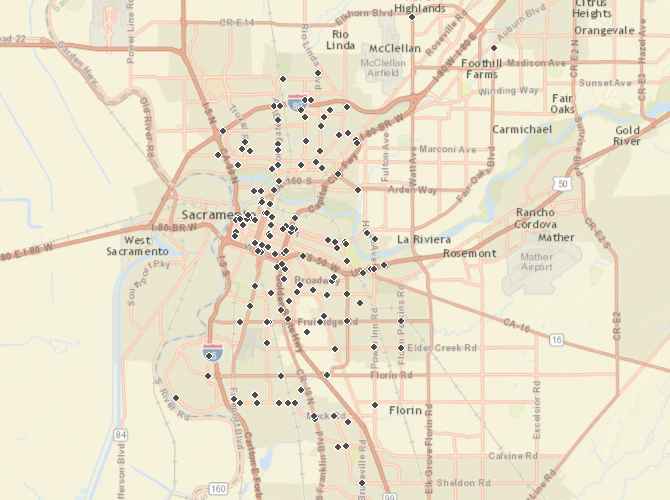
I often wonder if governments really focus on the issues rather than responding to incidents. In the case of pedestrians and the City of Sacramento, is the city really placing its attention, and its dollars, where they need to be to enhance the safety of pedestrians? I’ve created some maps to show where the problems lie (see note at bottom about data sources and how these were created).

The collisions mapped are:

  • Date: 01-01-2004 to 12-31-2012
  • Location: City of Sacramento only (no, I can’t explain why some are outside the city)
  • Victim role: Pedestrian
  • Victim degree of injury: Killed or Severe Injury
  • 388 collisions
  • ArcGIS link

The first map, a point map of the entire city, shows:

  • the greatest density of collisions is in downtown/midtown, but there are certainly plenty in other areas
  • almost all collisions happen at intersections, not mid-block
  • almost all collisions are associated with major streets, called arterials and collectors, which are wide and high speed, intended to move motor vehicle traffic at speed rather than provide for multi-modal transportation
pedestrian collisions, killed or severe injury
pedestrian collisions, killed or severe injury, point map

Read More »

no-ped-crossing in the grid

no pedestrian crossing means three crossings

As mentioned in my recommendations for improving walkability in midtown/downtown, in response to the Sacramento Grid 2.0 program, I’ve developed more information including a map (at bottom) about the locations in the grid that are signed against pedestrian crossing. The signs at these locations may be the modern MUTCD R9-3a sign, shown at right, or the older text sign, shown below, or variety of non-standard signs. Update 2015-07-27: 37 locations.

5th-St-I-St_no-ped-crossingThere are a large number of other locations where crossing is discouraged by the lack of sidewalks, curb ramps, and crosswalks, but is not specifically prohibited.

As can be seen from the map below, the majority of the no pedestrian crossing locations are along the Capitol Expressway (Business 80) and US 50 freeways. These freeways, designed and constructed by Caltrans, are barriers to pedestrian use. In fact, they are a barrier to all use and livability because many of the grid streets do no continue under the freeways, making access more difficult for pedestrians, bicyclists, and motor vehicle drivers. In many cases there are no sidewalks on the freeway side of the adjacent surface street, so whether or not there is a safe or marked crossing doesn’t mean much without a sidewalk to connect to.

Read More »

Grid 2.0 pedestrian comments

The City of Sacramento Grid 2.0 project is requesting specific input on ways to improve the pedestrian experience in midtown/downtown. I encourage you to go there and add your pins.

Pedestrian beg button on a commonly used crosswalk, this location should have a pedestrian signal on every cycle, not just when someone presses the button.
Pedestrian beg button on a commonly used crosswalk (K & 9th), this location should have a pedestrian signal on every cycle, not just when someone presses the button.

Dropping pins on a map, however, doesn’t allow some more general comments that I think are very important, and perhaps just as important as any of the corridor improvements shown. For me, these points are:

  1. All signals and pedestrian signals in the grid should be set on automatic recall by default. That means that pedestrians get a walk signal on every cycle without having to find and press the beg button (many of which can’t be accessed by disabled people). If the city thinks that a particular crossing should require a button, they should have to do a traffic study to justify it, which includes both the requirements that 1) the level of pedestrian use if very low (unlikely in the grid, but possible), and 2) that there is a demonstrable delay in traffic due to automatic recall. This does not mean that pedestrian buttons will not be present, as there may be valid ADA benefits to having them, including the specific announcements now being included, but they should never be required.
  2. In heavy pedestrian use area, if pedestrian buttons are present, pressing the button should actually shorten the signal cycle to provide for pedestrian crossing on demand, rather than just changing the pedestrian signal head when the signal goes through its regular slow cycle. No regular cycle should be longer than 90 seconds because long cycles unnecessarily delay pedestrian (and bicyclist) travel in favor of motor vehicle traffic.
  3. All three-lane one-way roads should be reduced to two lanes. This will make street crossings safer (by about 1/3 – what other improvement could make such a difference!) and more comfortable. There is no excuse in a walkable urban environment for there to be three-lane one-way streets.
  4. All no-pedestrian-crossing locations should be removed and replaced with regular high visibility crosswalks. Though these prohibitions are often justified by safety concerns, they are really just for the convenience of motor vehicle drivers, so that they don’t have to slow down or wait as long at signals. If a crosswalk is not safe, it means the roadway design is unsafe, and the correct solution is to change the roadway design, not to prohibit crossing.
  5. The ability to safely and comfortably cross streets is just as important to people walking as the ability to walk along streets. I don’t know that this is the case here, but transportation agencies often get so focused on travel along corridors that they forget about the need to cross corridors. The grid pattern in midtown/downtown eases this problem, and is in fact one of the major benefits to a grid, but nevertheless, significant attention must be paid to crossing.

Rancho Cordova achieves bronze Bicycle Friendly

RanchoCordova_wayfinding2The City of Rancho Cordova was awarded bronze level status in the League of American Bicyclist’s Bicycle Friendly Community (BFC) program. Rancho is the first of the communities within the new Bicycle Friendly 50 effort, though Folsom had earlier achieved silver status.

The Bicycle Friendly 50 group, including 50 Corridor TMA and the city hosted two Traffic Skills 101 courses and a League Cycling Instructor (LCI) Seminar in 2014, training two city employees and a number of community members. An education program is one of the requirements for achieving BFC status.

Above is a wayfinding sign in Rancho Cordova, which seems to have installed more than other communities in the Sacramento region.

More Sac county nonsense

MUTCD-2012_Figure9C-7The Bicycle Detector Pavement Marking (CA-MUTCD Figure 9C-7, shown at right) is placed to show a bicyclist where to stop so that they can trigger a traffic signal. When installed properly, they prevent the all-too-common scenario where bicyclists cannot trigger signals and must either cross against the red light when a safe gap is available, or wait until a motor vehicle arrives. They are also a clear signal to motorists that there is a reason why the bicyclist is positioned where they are. Of course “bicycles may use full lane” is true approaching any intersection where right turns are permitted, however, most motorists do not know or remember this law unless there is a sign there to remind them. The sharrow serves a similar purpose. However, these markings are often not installed in properly.

Mission southbound at Marconi, bike detector placement

Here is another fresh Sacramento County mistake, where the marking was not placed properly. On Mission Ave southbound, approaching Marconi Ave, there is a Bicycle Detector Pavement Marking in the bike lane, but not in the regular through/right turn lane. This marking is on new pavement placed in a complete streets project along Marconi from Mission westward to Fulton, and was installed within the last two years. If a bicyclist is to trigger the signal, they have to stay in the right hand edge bicycle lane, where they are at risk of getting right hooked. If they adopt a merge position between the two lanes, where they should be in order to make clear to motor vehicle drivers to either get in front or fall in behind, not beside, then the signal won’t trigger.

The solution is to place a marker in the regular lane, and adjust loop sensitivity if necessary, so that the bicyclist can choose which lane position to use.

Sac County just doesn’t get it

The photo below shows Garfield Ave southbound approaching Marconi Ave, in the Carmichael community of Sacramento County. This roadway was repaved within the last year, and this is the bicycle facility that was painted by the county. The bike lane veers to the right and then ends, running into the dedicated right hand turn lane, and another bike lane continues to the left of the right hand turn lane. These pavement marking clearly give priority to motor vehicles making a right hand turn, and ask bicyclists to yield to those vehicles, as second-class users of the roadways.

Garfield-sb-Marconi_bike-lane-shift

And this is what it could look like.Read More »

Embassy Suites is pedestrian hostile

sign adjacent to Capitol Mall sidewalk at Embassy Suites

The sign at right is posted prominently at the eastern driveway of the Embassy Suites Sacramento, on Capitol Mall at Tower Bridge. The sign is illegal, as no sign on private property can direct people on public property what to do, particularly when the sign uses the standard red octagon which is reserved for official stop signs. But more importantly, it is offensive to anyone who walks. What is the hotel saying by posting this sign? That we welcome people who drive cars, who should not have to stop for pedestrians even on the sidewalk, and we reject people who walk, because they are second class citizens, not our customers? This sign has been here at least since December 2013, and I have talked to management at the hotel twice about it, and it is still there today. They really don’t care.

TransForm’s Transportation Choices Summit took place today at the Embassy Suites. I’m not sure how many participants approached from a direction that they would have seen this sign, but I would guess that everyone who saw it was offended. This sign directly works against the efforts of every single person who attended the summit.

I have to publicly ask that TransForm, and everyone else, boycott Embassy Suites until this sign is removed.