Parkway trail management

Part three of posts on the parkway trail; part 2 Parkway trail flood signing; part 1 Parkway trail low points. This is it for now.

The Jedediah Smith Memorial Trail through the American River Parkway is a major commuting route for bicyclists from the suburbs to downtown, with some reverse commuting as well. It is also a recreational trail, getting a lot of use from recreational bicyclists, walkers, and families on weekends. It is great that one trail can serve so many purposes. However, the trail is being managed by Sacramento Regional Parks as though it were just a recreational trail. The trail is part of the transportation network in the county, and it should be managed as such, of course in a way that is compatible with its purposes of recreation and natural area conservation.

To be specific:

  1. Directional signage to indicate entry and exit points and junctions with connecting trails is almost nonexistent. Mileage/time to destinations signage is non-existent.
  2. Park ranger and maintenance vehicles regularly drive on the trail, compressing the decomposed granite walking/running shoulders that have been constructed. These then erode and become muddy, and the vehicles track mud out onto the paved trail. Much of the maintenance work could be done by cargo bike, and much of the ranger patrol could be done by bicycle, which after all works just fine for the Sacramento PD and CHP bike officers. I have never seen a regional parks employee on a bike.
  3. When the trail is closed by flooding or fire, no information is provided about alternate routes. (see Parkway trail flood signing)
  4. Low spots on the trail are regularly flooded under moderate rain and flooding events, resulting a broken network. (see Parkway trail low points)
  5. The entire parkway has remained closed after the recent severe flooding episode, but regional parks has made no effort to inform the public about the sections where easy bypasses are available, such as levee top paths (which are sometimes paved and sometimes gravel, but usually passable). For example, it has been easy to ride from Guy West bridge along the levee, duck under the overpass at Howe Avenue by using paths down to and up from University Ave, and continue on to Watt Avenue, and beyond, but instead regional parks has said the parkway is closed and has not informed anyone of these alternate route. Parts of the trail were never flooded at all, yet remain closed.
  6. Sacramento Regional Parks receives $1 million annually from the Measure A transportation sales tax in order to maintain the trail. The Sacramento Bicycle Advisory Committee (SacBAC) has questioned how the money is being spent over the years, but has never received a satisfactory answer. It is possible the money is being well spent, and I’m sure the trail is expensive to maintain, but regional parks is not being transparent.
  7. There are almost no user facilities on the western end of the trail between Watt Avenue and Discovery Park. A drinking fountain at Howe Avenue was removed three years ago and never replaced. There are no bathrooms in this section, other than the smelly pit toilet at Watt Avenue and the almost unusable pit toilet near the Expo Parkway access point (which leaks waste into the waterway, no less). There are some benches or tables, but few and far between.
  8. Root humps regularly develop in the trail, which is natural given the riparian zone and large trees. So far as I can tell, the paint markings to flag these hazards are all made by trail users, not by regional parks. When things get really bad, they are repaired, but long after the point at which they become dangerous. The same issue exists with beaver burrow slumps, common in the section between Expo Parkway access and Sac Northern trail.

If Sacramento Regional Parks cannot manage the trail as part of the transportation network in the county, then perhaps it is time to pass along management of the trail (not the parkway) to another agency.

Please check the “Storm-Related Parks Update” on the Sacramento Regional Parks homepage.

Parkway trail flood signing

Part two of posts on the parkway trail; Parkway trail low points.

When the parkway trail has been flooded this year, all the way back into December but increasingly this spring, Sacramento Regional Parks has closed various segments, and even the entire parkway at times. This is understandable. The trail is, after all, in a riparian area, and what defines riparian areas is an abundance of water.

Regional Parks has posted some information about the trail on their website, particularly as more and more of the trail has been closed, and is up-to-date with a complete closure now. In December and early January the website information was frequently out-of-date. Their Twitter account has had somewhat better information about the parkway, but it focuses mostly on motor vehicle access and not on trail access and usability.

Parts of the trail are quite usable right now, but rather than addressing those parts, all of the trail is closed.

Read More »

Parkway trail low points

There are two low spots on the American River Parkway trail (officially called the Jedediah Smith Memorial Trail) that flood even under moderate rainfall or flood conditions. It may seem strange to bring these low spots up when just last week perhaps 90% of the trail was underwater. The trail is in a riparian area, and so will and should flood during major flood events. But the trail is also a major commuter route for hundreds people who work downtown and live to the east, as well as a few reverse commuters like myself. After the jump, details and solutions for these two problem spots.

Read More »

Walk Score update 2016-12

I’ve been curious about whether my Walk Score has changed with all the recent development in the area, since my earlier posts Walk Score (2012-03), Transit Score (2012-04), Bike Score (2012-05), and WalkScore update (2014-01). It has!

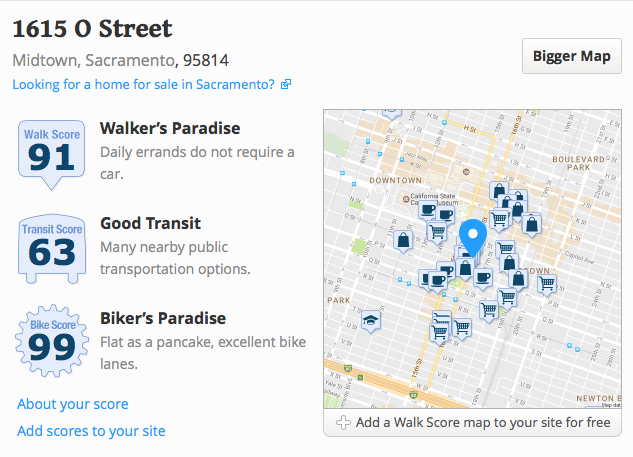
In March 2012, my Walk Score was 85: Very Walkable. In January 2014, my Walk Score was 82, Transit Score 62, and Bike Score 99. And today, my Walk Score is 91: Walker’s Paradise, Transit Score 63: Good Transit, and Bike Score 99: Biker’s Paradise. No big change in transit or bike, but a climb in walk score. And I am still tickled pink to be living where I do, in midtown Sacramento.

Quite a bit has changed on the Walk Score website over the years, and it is now much more focused on real estate. It has more in-depth information, but the algorithm is still proprietary. One of the beta features is a crime score, and my neighborhood ranks as a B.

walkscore_2016-12

car-free Sacramento

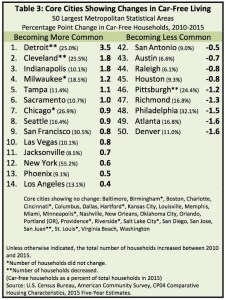
corecarfree

It is amazing what one can find going through drafts of posts that were composed but never posted. Here is one from 2017.

Recently reported research on car-free households in states, major metropolitan areas, and major cities, Car-Free Living in the United States: What the Data Says, indicates that Sacramento metropolitan area increased its car-free households by 0.5%, and the core city (mostly the city of Sacramento) from 9.7% to 10.7%, from 2010 to 2015. Sacramento is #6 in the list at right, not bad

My previous post on car-free workers was Central city car-free workers (2016-04-24), which indicated a central city rate of 5% to 18%, depending on zip code. Since these statistics are workers rather than households, they are related but not directly comparable, since the number of workers per household is often more than one, but sometimes zero.

city failure on Capitol Mall bike lane

Sacramento has nearly completed a reconstructed bridge over I-5 between 3rd Street and Tower Bridge. This is part of a project to provide access from and to Old Sacramento, but that part is not complete yet. The pavement is fresh, with bright white lines and green carpet bike lanes. But, the bike lane design is a failure. The eastbound bike lane is OK. A little strange because it varies in width, but acceptable. The westbound bike lane, though, is a hazard to bicyclists.

Below is a photo of the first problem, a bike lane to the right of a place where a right turn is permitted. This is at the entrance to the Old Sacramento access.The straight-and-right arrow indicates that the city expects heavy right turning traffic at this location.

While this design is in compliance with the law, using a dashed line to indicate that traffic from the general purpose lane and the bike lane should safely merge, the use of green paint here is the wrong message. Though green paint has no legal meaning, the general meaning taken is that this is the place for bicycles. So an average bicyclist will stay in the bike lane, not realizing that the safe manesuver is to merge into the general purpose lane. The result is a right hook danger that has been created by the design.

IMG_0769
Stay to the right of right turning cars? NO!

There are a lot of ways to solve this issue, but this is the worst possible solution. Creating a separate signal phase for bicyclists and right turning traffic is one solution. Dropping the bike lane in favor of green-back sharrows in the general purpose lane is another.

However, this problem spot is minor in comparison to what happens just on the other side of the intersection. Here, the bike lane suddenly ends and becomes a right turn only lane. There is no signing for bicyclists or motor vehicle drivers, no pavement markings, no indication of what biyclists should do. I’m a vehicular bicyclist and would not be in this bike lane fragment to begin with, but for the average bicyclist, this green paint is a clear message, “this is where you belong.” Whoops. Sorry. Turns out we needed the road for a right turn lane, and just got rid of the bike lane. Hope you are still alive, but if not, well it wasn’t our fault. But the thing is, it is the city’s fault. This is a mis-design, and the city should be sued the first time someone is injured at this location. It is not as though this was an existing location where the city did the best if could to squeeze in bike facilities. This is a new construction where things should have been done right. They were not.

IMG_0771.JPG
Bike lane ends suddenly – good luck!

There are several good solutions for this location, and the NACTO Guide to Urban Bicycling has several, but even the standard MUTCD design is better than this. Though you can’t see the turn lane due to the parked FedEx van (it was there for more than 10 minutes, double-parked, and I couldn’t wait any longer for the photo), there are no bike markings in the right turn lane at all. There is no “bicyclists may use full lane” sign. Maybe bicyclists are meant to fly over this right turn lane and return to earth at the bridge. Or maybe they are meant to die.

As I always warn people in bicyclist education classes, don’t get sucked in by paint. Paint doesn’t keep you safe. And in this particular case, paint creates a danger for you that would not exist if not for the paint. Negligent design, for sure.

people out walking!

Last evening I went for a walk, heading north to the Sac Northern trail, then the American River Parkway to Discovery Park, then across the Jibboom Bridge and into old town. I’d certainly seen bicyclists and a few walkers, but when I got to old town, there were hundreds of people walking around. I noticed they almost all had cell phones in hand, not that unusual, but still. I headed south along the river and saw yet more people. Then back along R Street where there were few people, until I got to the main part of R Street, and then into Fremont Park where there were yet more people. Remember, this was a Monday night largely after sunset, when I might see 10 people out walking in an evening, and I’d already seen at least 300. What was going on?

Well, you more culturally/technologically literate already know, but it took me some time to figure out. Pokemon GO! All of these people were playing the game on smart phones, looking for pokemons (is that the correct plural?).

I had heard a bit about the game, but didn’t realize it was taking the country by storm. Today, there were more prominent articles on all the media, even showing up on my main two news sources, Streetsblog and Strong Towns. I sat at Karma Brew with a Rasputin, and observed the goings-on in the park and along the streets.

So, what I saw, that I liked:

  1. People were out walking on a night when I would not usually see anyone. This means these people were getting physical activity when they would otherwise be in front of TV or computer.
  2. People were walking, looking at their smart phones, but they had their heads up, looking around, with the phone in their field of view but not their sole focus. Unlike most users whose heads are down and completely oblivious to what is around them. I’m not going to claim walking with a phone is safe, but I will say what I saw last night is significantly safer than what many people already do.
  3. People were talking to people in other groups, interacting with people they didn’t know. This is quite unusual. Even at bars and coffee shops, where people theoretically to to socialize, most people hang with their own group and do not interact much if at all with others.
  4. I heard people making comments like “I never knew that was there,” and “I always wondered what that was.” They were seeing things with new eyes. I am not sure how much of this discovery is designed into the app, but whatever is there results in people looking.
  5. People were hanging out in gathering places, old town, the promenade, R Street, Fremont Park. Again, whatever the design, this is where the pokemons were.
  6. People were not drinking. I have no problem with drinking, as long as you don’t drive, but I have to admit is was great to see so many people having such a good time without drinking.

As with any new technology, and any new social media, there will be hiccups. But on the whole I can see so many positives to this latest fad. I think I’m going to try it myself, though obviously not on my backpack trips. No pokemons out there!

How NOT to be nice to bicyclists

At intersections, some motor vehicle drivers offer to let bicyclists go first, even though it is not the bicyclist’s turn. To the driver, this may seem like a nice gesture, but it is often not taken that way by bicyclists.

Intersections are about taking turns, and about right-of-way rules. At a signalized intersection, the signal indicates whose turn it is and makes things simple, but at intersections with stop signs (two-way or four-way), or yield signs, or no signs, the driver (of the bicycle or motor vehicle) must use the rules and their eyes and their brain. These are the rules:

  1. First come, first served.
  2. First come, first served.
  3. First come, first served.
  4. If two vehicles (bicycles or motor vehicles) arrive at the intersection at the same time, at an angle, the one to the right goes first.
  5. If two vehicles (bicycles or motor vehicles) arrive at the intersection at the same time, facing each other, the one going straight goes before the one turning left.

Why did I repeat the first one three times, other than being funny? It is because too many people know the other two rules, and don’t seem to know the first.

When a motor vehicle driver yields to a bicyclist when it is the motor vehicle driver’s turn to go rather than the bicyclist’s turn, they are violating this most basic rule.

Why is this a big deal? When drivers do not take their correct turn, it leads to uncertainty for everyone, and uncertainty can lead to, at the least, frustration and anger, and quite possibly crashes.

As a bicyclist, I will not go when it is not my turn. If I did do that, I’d leave myself both physically and legally vulnerable. I have absolutely no guarantee of the behavior of other drivers who may be not polite, but taking their rightful turn, or who get impatient, or who push their way in, or even just are not paying attention.

So there is a stand-off. I shake my head no, and if that doesn’t work, I wave the driver whose turn it is to go. And then I wait. And sometimes wait, and wait, and wait. Meanwhile, I’m in a vulnerable position. Drivers behind me may get impatient and angry, not understanding why I’m not going. If I’m making a turn, I’m often stuck out in the intersection in a place that I don’t want to be hanging out, rather than having already safely completed my turn. This stand-off doesn’t increase the risk for people in motor vehicles significantly, but it very much does for bicyclists.

Motor vehicle drivers may say, “but most bicyclists don’t take their turn.” Yes, this is often true. I believe there are two things are work:

  • Many bicyclists ride just like they drive. They don’t take turns at intersections, pushing their way in before it is their turn. They don’t stop at stop signs, figuring if they never really stop, they have the right of way. Yep, the same thing motor vehicle drivers do. My anecdotal observation is that car-free bicyclists are much more likely to do the right thing at intersections than bicyclists who also drive motor vehicles. My data-based observation is that bicyclists and motor-vehicle drivers comply with stop signs at almost the exact same rate. Don’t believe me? Spend some time at an intersection and see how many drivers (of bicycles or motor vehicles) come to a full and complete stop, as the law requires. Not many.
  • Bicyclists have been trained by “polite” motor vehicle drivers that they don’t need to take their turn, and so they don’t. Every time a motor vehicle driver yields inappropriately to a bicyclist, it reinforces this behavior.

So, if you are one of those motor vehicle drivers, I ask you to stop yielding inappropriately.

“But, what about the bicyclist who doesn’t stop – I don’t want to run them over.” Or, “what about the bicyclist who doesn’t stop, I’m angry that they won’t follow the law and think themselves above it.” The answer is to be hyper-aware at every intersection. These are the places where most crashes occur, and so they are good places to pay extra attention, and use your brain rather than your emotions.

What everyone should be doing at every intersection (assuming no traffic signal) is:

  1. stop at the stop bar, or the edge of the crosswalk if there is no stop bar; if you can’t see from there, then creep forward until you can see, but only after having initially stopped
  2. look left, right, and left again before entering the intersection
  3. make eye contact with any person who may do something unexpected; this means other drivers, bicyclists and pedestrians, really, anyone else who is there
  4. yield to pedestrians
  5. continue looking left and right, as well as forward, going through the intersection; you can never be certain that someone else is not violating the law and endangering you

If you do this, then the “rogue” bicyclist who is not following the law and taking turns will not be a complete surprise to you. You will be able to respond appropriately, ensure that a crash does not occur, and go on your way. Everyone ends up safer, everyone ends up happier.

By the way, a bicyclist who does not stop when there is no one there to yield to or to take turns with is, yes, violating the law, but is not failing to practice safety. Bicyclists can see better and stop faster than any motor vehicle driver. So if you see a bicyclist at a distance, slowing and looking but not stopping when there is no one there to interact with, understand that they are acting in a completely safe manner. Take off your law enforcement vigilante hat, and smile.

Central city car-free workers

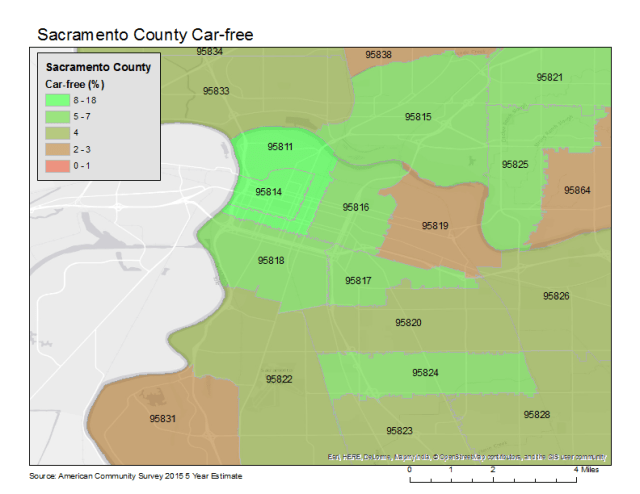
And here is the last of the three census-related maps, before I move on to other topics. This one shows the percentage of workers who are car-free (zero motor vehicles owned). Again, the 95814 zip code nails it, at 18.4%, and 95811 is close behind at 14.5%. Yes, I’m one of them.

The near suburbs also show moderate car-free percentages, probably in this case due to low income as much as choice. College (Los Rios and Sac State) students, if they are working, probably also contribute in the near suburbs. Not surprisingly, the distant suburbs have almost no one car-free. Those people are locked into the driving life by the place they have chosen to live.

It is important to remember these percentages are of workers, people who are working somewhere. They do not include people too young to work, people who have retired, or just people not working. If those people are included, the car-free rates would be much, much higher. These people are just as entitled to transportation expenditures as car drivers, but our transportation systems is set up to give them crumbs rather than a fair share.

On the other hand, there large numbers of people in the distant suburbs who have three or more cars per worker. Not per family, but per worker. The 95615 zip code (Courtland) tops the list with 54% having three or more cars, but other zip codes are close behind. Yow!

Again, the Sacramento County map (car-free) is available.

Sacramento-central-car-free


back to the old ways?

https://transportationist.org/2016/03/14/follow-the-red-brick-road-streets-mn/

A post two days ago on Transportationist, “Follow the Red Brick Road,” reminds me of a topic that has been much on my mind – how do we effectively slow motor vehicle traffic? Speed limits are ineffective, stop signs are a complete waste, physical structures such as speed humps, speed tables, and chicanes work but only where they are present, narrower lanes work pretty well but get pushback from commercial drivers and agencies (fire engines, trash trucks, buses, etc.). What is needed is something that works continuously, and street surfaces may be the answer. The post recommends the use of an old material, brick, hence, back to the old ways.

The Traffic Calming entry on Wikipedia provides a summary of traffic calming measures, and one of them is surface materials or textures, but other solutions are more prominent. A common practice in many locations is to make crosswalks visually different, and sometimes texturally different from the rest of the roadway, on the theory that the difference raises driver awareness of the crosswalk. To some degree this may be true, but it probably has much less than the desired effect on traffic speed, and textural differences can present a challenge to disabled people and even to less adept walkers. The many different crosswalks patterns are an attempt to increase visual contrast with the roadway, but again, that is only partially successful.

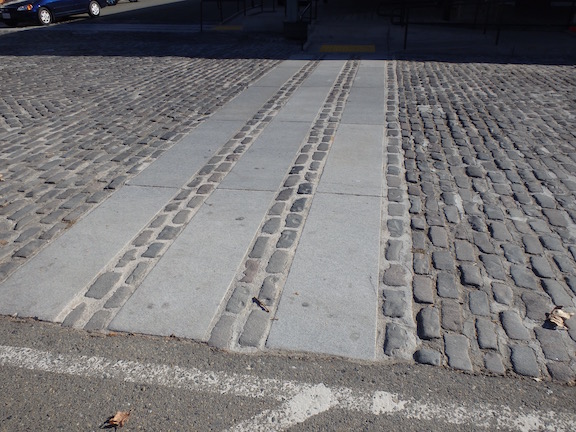
So the idea is to reverse this pattern: make the roadway rough and the crosswalk smooth. We have a great example of this right here on Front Street in Old Town Sacramento, pictured below.

Crosswalk and cobblestones, Front Street, Old Town Sacramento

If you have not observed this street in action, I encourage you to do so. No one drives too fast on this section of street, in fact all motor vehicles are going a pedestrian-friendly speed. Yet the smoother crosswalk is usable by all and still has a high contrast with the road. Compare that to nearby Second Street, where a normal pavement surface encourages some irresponsible drivers to go much faster than is safe given the tourist pedestrians that frequent the area.

Of course the cobblestones here are an historical artifact, and such a rough surface would only be appropriate in high pedestrian traffic areas. But brick would be a great middle ground between cobblestones and asphalt.

While I have long supported this reversal of textures, I doubted that it would be practical to implement. But the video at the bottom of the “red brick” post provides a solution, a machine designed to lay down brick in an efficient manner. The process is slow, but I think that is because they are changing brick patterns to demonstrate different possibilities. Where the pattern remains the same, it would go much faster, and the feed of bricks could be automated.

If you have ridden your bike on these cobblestones, you know that the surface is very rough. When cars are not parked along Front Street, the cobblestones can be bypassed on the asphalt parking area on the west, but when it is full, yow! Obviously brick is much less rough than cobblestone, but nevertheless bike access is an issue to be considered. Maybe brick would be no problem (if it is maintained, but then bike lanes often have unmaintained asphalt or concrete anyway), or maybe the bike lane would need a different surface. A visual or textural difference might cause drivers to notice and respect the bike lane more than they do now, with just a white stripe and occasional green paint to distinguish it. This needs more thought and study.

I would guess that brick streets would be more expensive than asphalt, which is sort of the lowest common denominator of pavement, but might be comparable to concrete, and cost is always an issue in constructing and maintaining streets. But I’d like to see some pilot street projects, starting with locations where it is really important to increase safety and promote walkability, right here in Sacramento. If the pilot goes well, then let’s make it the standard street surface for the grid, implemented anytime repaving is indicated.