Bike share for Rancho Cordova & Folsom?

From the 50 Corridor TMA Communter Connections newsletter:

Bike Share recommendation advances to City Councils

This month, both the Rancho Cordova and Folsom City Councils will hear the 50 Corridor Bike Share Task Force recommendations in for launching a new bikeshare program using LimeBike as the program provider.

The Rancho Cordova City Council is expected to vote on the recommendation at its February 20 meeting which starts at 6 p.m.  The Folsom City Council will consider the recommendation on February 27 during its meeting which starts at 6:30 p.m.

A representative of LimeBike will make a presentation to the Folsom City Council.

Should both councils approve the recommendation, bike share should be available on the 50 Corridor by early April.

LimeBike-e
LimeBike e-bike

LimeBike features a dockless system – allowing users to park bikes at whatever destination is convenient.  The cost is expected to be $1 for 30 minutes, although a variety of pricing options will be available, including monthly subscription rates.  Electric assist bikes will also be available for $1 to unlock the bike and $1 per every 10 minutes.

The main goal of employing bike share along the 50 Corridor is to address first mile/last mile connections for Regional Transit’s Gold Light Rail Line.  However, bikes can be used for any kind of trip. And because the bikes are not linked to a particular rack (or dock), they can operate anywhere along the corridor where a need exists. 

Read More »

Bike Share Open House Feb 21

from a City of Sacramento email:


Join the City and SACOG for a Bike Share Open House!

What is bike share?

Bike Share provides short-term bike rentals that you can pick up and drop off at various locations around Sacramento, West Sacramento, and Davis. Jump will soon be rolling out 900 bikes for anyone to use, and we want to hear from you!

You can find more information about our regional bike share program here.

When and Where?
Wednesday, February 21st, 5:30-7:00pm

City Hall, 915 I St, Room 1119 (off of H Street)

Can’t attend the meeting?

Share your thoughts on the online map!

Questions?

Email: bikeshare@sacog.org

More information can be found here.

Bike share…

I can’t believe that governments are allowing and even encouraging use of these for transportation, without regard to local communities and the damages they suffer. Problems include:

  • parking in inappropriate places
  • parking for free with no regard for other people’s use of the public domain
  • blocking pedestrian right-of-way
  • terrorizing pedestrians on the sidewalk
  • leaving them in yards where they are an unsightly mess
  • abandoning them to collect dust and spider webs
  • they routinely get vandalized and stolen
  • lazy people use them for ridiculously short trips
  • there are far, far more of them than can be justified by the number of users
  • the environmental impacts of production and end-of-life cycle are being ignored
  • huge corporations with deep pockets, particularly from the Far East, are largely responsible for this mess
  • they are completely out of reach for many low-income people
  • a clear sign of rich people invading historic neighborhoods – gentrification!

No, no bike share, cars!

Yes, snark. These are all criticisms that that being routinely made of bike share systems, with no apparent sense of irony.

Sacramento Vision Zero and Bicycle Plan meeting January 31

You might have thought you had other plans for the evening, but…

The City of Sacramento is holding the last of four public meetings on Vision Zero and Bicycle Master Plan implementation tonight, January 31, 5:00 to 7:00PM at city hall.

You can see the new Bicycle Master Plan and draft implementation plan at http://bit.ly/SacBicyclingProgram. You can see the Vision Zero Draft Action Plan and other documents at http://bit.ly/VisionZeroSac.

Just one of these would be reason to attend, but both! Hope to see you there.

Curb extensions 16th & N

Curb extensions, also called bulb-outs, have been installed on all four corners at the intersection of 16th Street and N Street in midtown Sacramento. The extensions are the width of the parking lanes along both these streets. N Street has bikes lanes, which are not restricted by the extensions, while 16th Street does not have bike lanes, and won’t until the street is reconstructed into a more complete street at some unknown point in the future.

The primary beneficiaries of curb extensions are pedestrians, who have a shorter distance to cross, with every crossing being about six feet less distance for every parking lane, so in this case, 12 feet less. There is also much better visibility of cars by walkers, and of walkers by car drivers. Sometimes they also provide an opportunity for beautification, with rainwater swales and/or planting, as can be seen in the photo.

Every street with parking lanes should have curb extensions, so almost every intersection, but implementation will be slow because they are moderately expensive to construct (curbs sidewalks, detectable warning strips, better located ped buttons), and sometimes require drainage changes and occasionally even utility relocation. These particular extensions are certainly not the first in Sacramento, in fact there are extensions on the west corners of the intersection of 16th and O, just to the south, but are notable for being installed in a high pedestrian use area along two heavily trafficked streets.

J Street Safety Improvments

The City of Sacramento is going to use street rehabilitation funds (from SB-1) to create a separated bikeway on J Street between 19th and 30th, starting this summer. The city held a public meeting last night (January 25) to gather public comments on the design elements, which have not been finalized.

I like the proposal, and see it as a significant improvement over what is there now. The general purpose travel lanes would be reduced by one, from three to two, while bike facilities would be increased from zero to one. The separated bikeway, also called a cycle track or protected bike lane (separated bikeway is the correct term in California) would be installed along the right side of the one-way street. The project will improve pedestrians safety by shortening the crossing distance over general purpose lanes, but this is more a traffic calming and bike facility project than a pedestrian project. This project is intended to be a “paint only” project that fits with the funds available. Improvements needing concrete would come later, if at all. The separated bikeways would be “protected” with flexible delineator posts between the parking lane and the bikeway, which provides increased safety but not full protection.

Though the diagrams shown last night indicate that bus stops would be at the existing curb, and the bikeway with green paint would swing around the bus stop to the left, it appears that the city is rethinking that and will use a shared bus/bike lane for the length of the bus stop. There is talk of moving bus stops to better locations, and perhaps reducing the number of stops for better service times. The only bus currently using J Street is SacRT Route 30, which has a 15 minute frequency on weekday day times, 30 minute evenings and Saturdays, and 60 minute Sundays. This is a route whose ridership probably justifies 10 minute frequency day times.

The intersections will be daylighted by removing the parking spaces that currently are right up against the crosswalks and reduce visibility between drivers and pedestrians. I completely support that and feel that the safety benefits make the loss of a few parking spaces worthwhile. I’m not against on-street parking, in fact I like it because it slows traffic, but safety is even more important.

I would like to recommend some improvements to the project as presented:

  • Reduce lane widths from 11 feet to 10 feet. This is the most important action that could be taken to enhance safety. The best action for pedestrian and bicyclist safety is to #SlowTheCars (@StrongTowns). The narrower the lanes, the slower the traffic, and the slower the traffic, the less severe collisions that do occur, and the less collisions. The city currently has an 11 foot standard they don’t seem ready to change, but what better time than now to create a significant project with narrower lanes, so we can directly experience the safety benefits.
  • Reduce the speed limit to 20 mph, and stripe the street in a way that encourages this actual speed. Again, the city is reluctant to go below 25, but there is a growing national movement to 20 mph in urban areas. Goes hand-in-hand with the lane width reduction, and is very inexpensive to implement.
  • Stripe the separated bikeway and street in such a way that the shared bus/bike lane at bus stops can be converted to floating bus islands with the bike lane at the curb. This configuration keeps the bus in the flow of traffic, which greatly speeds bus times as they don’t have to wait for a gap in traffic to continue. I do not know how wide the islands need to be to accommodate bus shelters, but am looking into that and will report. Another advantage of the lane width narrowing is that it would provide another two feet for the islands. The separated bikeway “lane” is seven feet, and that seems fine to me. Since this is a “paint only” project, concrete bus islands would delay it for additional finding, which I don’t want to see, but the design should be ready for bus islands as soon as they can be funded.
  • Reduce the number of bus stops to one every three or four blocks. The increase in service speed makes the greater walking distance worthwhile, and since the walking environment will be more appealing and safer, this is a good trade-off.

The meeting last night was the only formal opportunity to have input to this project, but I encourage you to email Jennifer Donlon-Wyant with support for the project, for these improvements I’ve presented, or you own ideas. You can also comment here, but emailing Jennifer is the first step.

Bike share and bike racks

The announced JUMP bike share coming to Sacramento (Sacramento, West Sacramento and Davis) is fuzzy on details. The announcement says “SACOG and the cities of Davis, Sacramento, and West Sacramento are currently permitting the bike share hub locations and are beginning public engagement.” The implication is that the system will be dock-optional, with hubs located in common areas and a small fee for not parking the bike at a hub, just like the existing SoBi Tower Bridge Bike Share Preview. However, the two existing JUMP systems, in Washington DC and San Francisco, are truly dockless, not dock-optional. There are no hubs, at least so far, though SF is considering some hubs to encourage people to leave the bikes at charging stations.

The JUMP bikes are of the same basic design as the SoBi bikes, they have a GPS unit and a locking U-bar that is meant to lock to bike racks or other fixed objects. Many other bike share systems such as LimeBike have a self-locking wheel lock (like European bikes), and cannot be locked to a rack. The Zagster system I used in Ashland is a hybrid: there is a cable for locking to a hub, which the bike must eventually be returned to, and another cable for locking to racks or other objects when stopping off as part of an errand trip.

When I used JUMP bikes in SF last weekend, one end of my trips had ample bike racks, but the other end did not. At the far northern edge of the geofenced system area, in a residential neighborhood, I searched four blocks without finding a bike rack, and finally used a post that was not a good location as it may have partially blocked access to a building and to parking spots. It was only there for about 20 minutes, so I felt OK, but it really brought home that a dockless system that requires bike rack use, as does the JUMP system, needs ample bike racks to work.

In the Sacramento central city, some areas have ample bike racks, but many areas, particularly neighborhoods to the east, and state building and office building areas, do not. So if the Sacramento system is to be dockless, and if it is to be successful, the city will have to install many more bike racks, in a hurry. West Sacramento and Davis probably have a similar need, but I’m less familiar with them.

My suggested criteria for bike racks is that one or more be visible when standing on a corner at any intersection, anywhere within the service area. I think electric bikes can be a great substitute for ride hailing (Lyft and the company that shall not be named), and a great complement to transit, but only if a person can find a bike close to their origin, and leave it close to their destination.

Jumping ahead (bike share update)

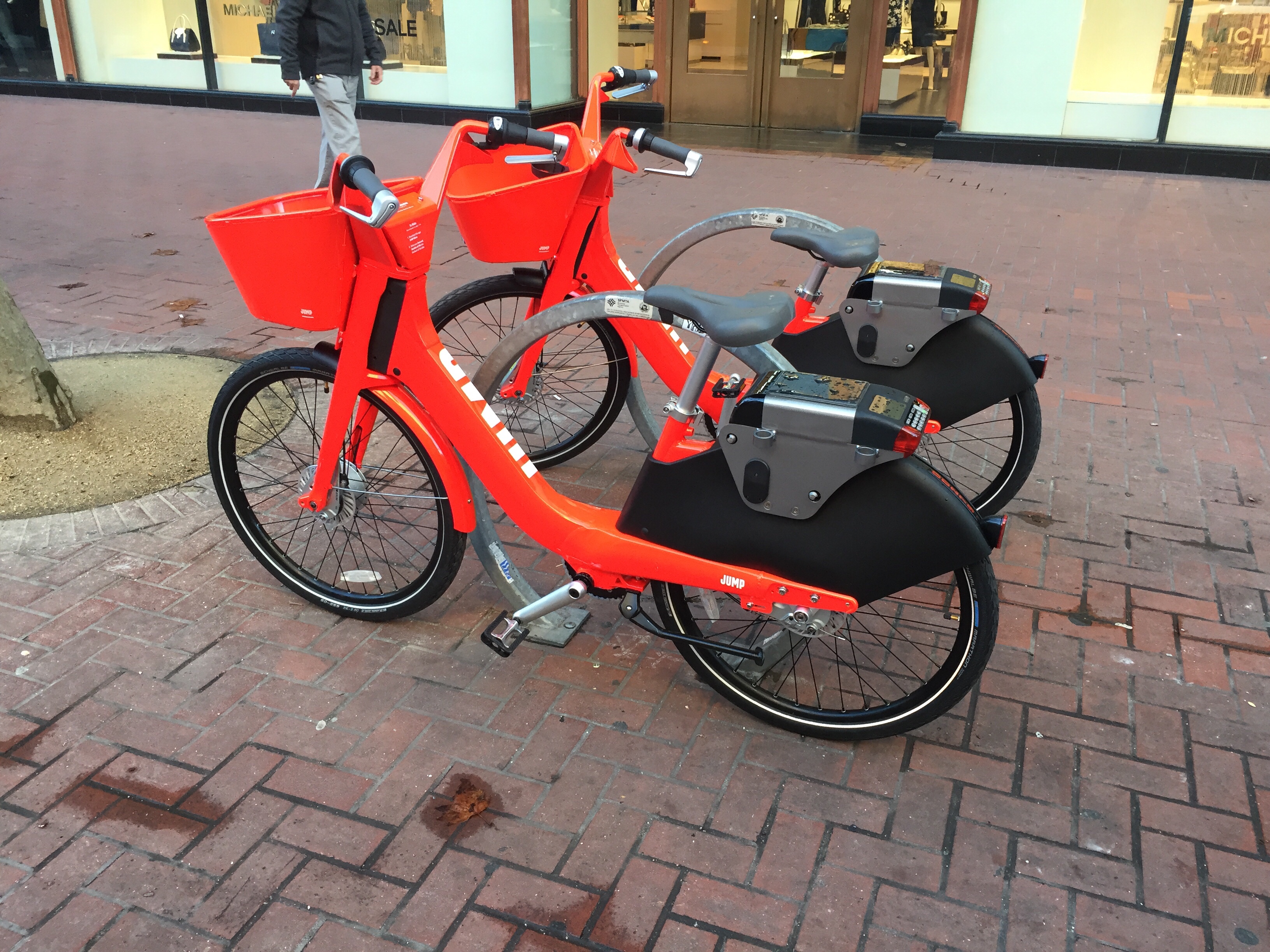
I rode a Jump e-bike in San Francisco yesterday. This was the first day that the program was open to the public, though there had been a low-income pilot going on for several months previously. The bright red (vermillion) bikes are pedal-assist. If you don’t pedal, they don’t go anywhere. But if you do, they really jump out. Though I haven’t ridden any really steep SF hills yet, the bike handled moderate hills with ease. I did ride most of the way across SF and back, and a chose a somewhat more hilly route than I normally would have.

Jump is operated by the company formerly known as Social Bicycles, so the GPS units and locking bar will be familiar to anyone that has used the Tower Bridge Preview bikes in Sacramento. The brakes are different, much stronger, as they should be for a bike that will go 25 mph. There are “gears,” but theses feel different with the pedal assist. The Jump system in SF is truly dockless, unlike the existing Sacramento system which is dock optional. There are no hubs or stations, the bikes can be locked at any bike rack within the system area. On the first day, the bikes were in clusters, with large areas uncovered, but they may become more dispersed over time. The coverage includes two of the lower income neighborhoods in SF, Bayview and Mission, so the user profile may be different than in Sacramento and for the existing Ford GoBike dock system in SF. There is a good article about Jump on SFgate: Jump rolls out San Francisco’s first stationless e-bike system.

The bikes must be recharged every few days, depending on use, and there are no charging stations at least so far, so rebalancing will probably be done as part of recharging. The company reported to me that they are considering hubs, but haven’t located any yet, pending data about use patterns. There seems to be a charging port on the right side of the bike below the handlebars, but it doesn’t look to me as though it was designed for docking/charging stations.

So, back to Sacramento. SACOG and partners have announced that the expanded system in the Sacramento region will use Jump e-bikes rather than the pedal bikes in the Tower Bridge pilot. It is not clear in the announcement whether the Sacramento system will be dockless or dock-optional. I think I prefer dock optional as more of the bikes will be in known locations, but with active rebalancing and recharging, dockless probably works.

The additional hubs (racks with geofences) that we were promised back in September are still not online yet, though most or all of the locations are installed. The most prominent lack is that there is still no hub at Sacramento Valley Station, even though that is the most common non-hub location where bikes get parked. With a May 15 promised opening of the different Jump system, I’m wondering if these other hubs will ever be online.

The 50 additional bikes arrived, though. They have black fenders and baskets. Unfortunately, the practical effect of the additional bikes has not been large. Before the new bikes, the Sacramento side had 20-25 bikes, and it now has 25-30 bikes, though it should have about 50. The bikes are often out of service, mostly due to gearing problems. If you have ridden the bikes, you’ve noticed that the gears slip on many of them. Sometimes this is just irritating, but sometimes it makes the bike unridable. Though this might be a maintenance issue, I suspect it is a design flaw.


The email I got when I joined Jump SF is below:

Hi Dan,

Thanks for joining JUMP SF!

Your account is now active!

Your account number is XXXXXX. Please store this number in a safe place as you will use it to access our e-bikes.

IMPORTANT SAFETY INFORMATION

JUMP is bike share–electrified. When riding the e-bike, start slowly to get familiar with its boost. You’ll feel motor assistance as you pedal. The harder you pedal the more boost you’ll feel. Be sure to try out the brakes to get a feel for stopping.

• JUMP brakes are powerful! Brake early – brake gradually.

• Ride slowly down steep hills.

• Use both brakes together at all times.

• Do not bike one-handed! Do not text while biking!

• Braking hard while riding one-handed is dangerous.

• If you are a heavier rider, ride cautiously down steep or long hills and keep your speed low. Weight limit: 210lbs.

STARTING YOUR RIDE

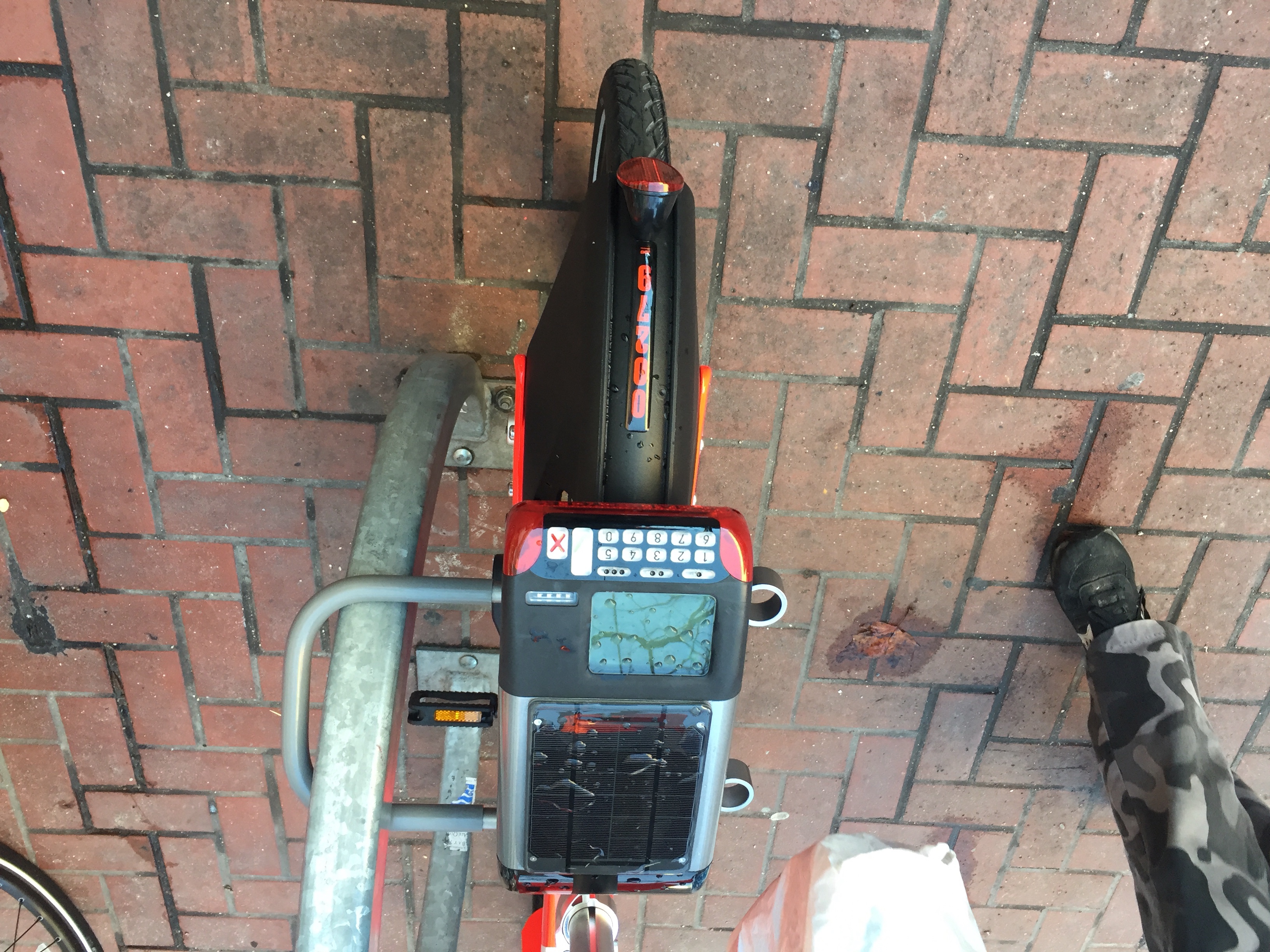
When you’re ready to take your first ride, enter your account number and PIN using the keypad on the back of the bike. Remove the gray U-bar and place it in the holster loops on the back left of the bike. Adjust the seat height and test your brakes.

PAYING FOR YOUR RIDE

JUMP bike rides cost $2 for the first 30 minutes and just $0.07/minute after that (plus applicable taxes). Your ride begins when you book a bike and ends when you lock a bike.

ENDING YOUR RIDE

At the end of your ride, lock the bike to a public bicycle rack within the designated system area. Bikes should always be visible from the street, and never parked on private property, in parking garages, or in parks. Improper bike locking fees may apply. If you’re ever unsure, check the system area map. Locking the bike outside of the SF system area will result in a $25 fee.

OUR BOOST

On a full charge our bikes can travel around 30 miles with pedal assist. While we do have teams regularly servicing our fleet, please understand that the bike you rent might not be at full charge. If you are riding a bike and the pedal assist runs out, please press the repair button on the bike’s keypad when ending your rental, and lock the bike to a bicycle rack. We will take care of it from there.

Please do not travel outside of the system area unless you are comfortable pedaling without the electric assist should the battery run out. Fees for retrieval of bikes due to low battery outside the system area may still apply.

RESERVING YOUR RIDE

You can walk up to a bike and check it out, or reserve one through the app. The clock starts ticking once the reservation is made. Bikes reserved in advance can be held for up to 10 minutes. Reservations will be canceled automatically if the bike is not unlocked within that time.

HOLD FEATURE

Need to make a short stop on your trip? The HOLD function guarantees that the e-bike is yours for up to 60 minutes. Press the “HOLD” button and lock the bike to a rack. Please note that reservation and hold time count toward your total minutes of riding time.

LINK CLIPPER CARD

You can link your Clipper card after unlocking the bike for the first time. Once unlocked, click Menu > Link Card > Start. Now hold the card directly up against the keypad buttons and wait for the screen to say “Success.” Next time you want to rent the bike, hold the card to the keypad to reserve.

For riding tips and safety information, please see our FAQ. We encourage all JUMP members to wear a helmet while riding. Don’t have one? Visit one of San Francisco’s many bike shops to pick one up, and if you’re a San Francisco Bicycle Coalition member, you can get 10-15% off!

You can learn more about our system and policies by reading our Rental Policy

Thank you again for joining. We think you will enjoy JUMP!

The JUMP SF Team

support@jumpbikes.com
Separated bikeway demo on P St

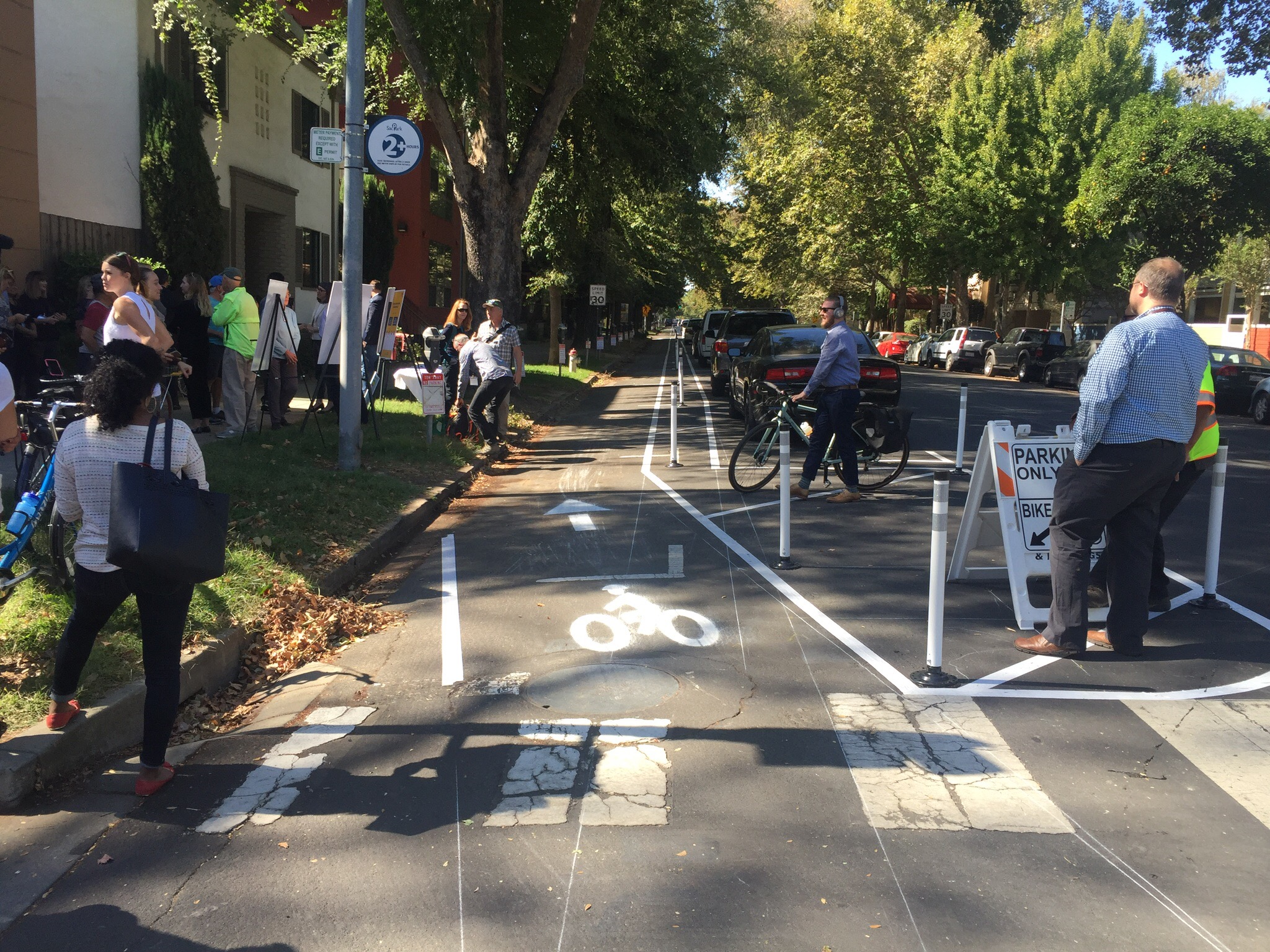
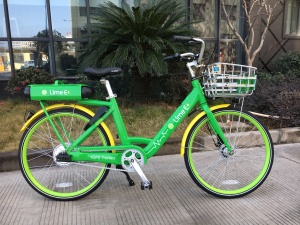
The City of Sacramento has created a demonstration separated bikeway on P Street (westbound) between 15th and 13th streets. Separated bikeways, also known as protected bike lanes and cycletracks, are becoming common in progressive cities, but this is the first in Sacramanto. Yesterday the city held a “ribbon cutting” on the facility, with Mayor Steinberg and Councilmember Hansen speaking and visibly excited. The demonstration will be there through Friday, then removed. The purpose of the demonstration is to show the public what a separated bikeway looks like and how it works, and gain community feedback on the project. The city wants to install parking protected separated bikeways on portions of P and Q streets, and a buffered separated bikeway on a portion of 10th St (map below), so the demonstration hopefully will lead to permanent installations. 

I was amazed at how quickly drivers adapted to the parking change. Most of the spots were filled with properly parked cars, even though the parking didn’t open until after the morning rush on parking. I was also noted that when the project was already set up for the morning inbound rush hour, there was no congestion on P St. This is the type of project that benefits drivers, bicyclists, and even people parking. 

On of the questions about these facilities is how they interact with transit. The demo was placed on the left (south side westbound) to avoid interacting with buses. However, Route 6 Land Park and Route 38 P/Q Streets are low frequency 60 minute routes that should not strongly influence street allocation. An easy solution to having both separated bikeways and bus stops on the same side of the street is bus boarding islands within the parking lane or buffer, so that the bikeway passes behind the island. 

I encourage you to get out and see, and use, the demo, and then provide your feedback to the city. The city will host an Open House on October 9 from 5-7 p.m. at City Hall. If you can go, please do! I’m sure there will be people there complaining about loss of a lane, and loss of parking (though there is only a slight decrease), and about change in general, so the city needs to hear from enthusiasts (we want it NOW) and thoughtful ideas for how to improve projects and install in more places. More information is available on the CityExpress page, and the Downtown Bikeways Project page


More photos on Flickr: https://www.flickr.com/photos/allisondan/albums/72157686958079110

Distracted walkers are not the problem

It has become popular recently to blame pedestrians for their own death. Some have always done this, from the beginning of the auto industry and its “jaywalking” campaign, but it is amazing how much law enforcement promotes this blame, how much the media buys into it, and how much transportation and safety agencies (Caltrans and OTS) market it. 

So let me share my experience. I walk, a lot, in addition to bicycling, a lot. Every day drivers refuse to yield my right of way when I am making legal street crossings. It makes little difference if I am waiting on the curb (where they are not required to yield, except by common courtesy), or waiting in the street, where they are absolutely required to yield to me. On multi-lane streets, when one driver stops for me, it is quite common for drivers in other lanes to not stop, though the law requires them to. I am never walking distracted, I make the personal choice to not look at my phone while crossing the street. But for anyone to suggest that it is the fault of someone walking distracted when a driver fails to yield right of way to a pedestrian, and kills them, is deeply, deeply offensive. This is similar to someone saying, well, I was just firing my gun and someone happened to walk in front of it. Cars are deadly weapons, and drivers are potential killers. It is time our society grew up and took responsibility for the harm that can be caused, and is caused, by our addiction to driving, and to the imputed freedom to run down someone who is just crossing the street.