I posted Friday evening about the lack of bikes. Things have changed a great deal in a short period. As of Monday evening, on the east side of the river, there are 19 bikes at hubs, and 50 bikes out of hubs. Friday, the numbers were zero and 14. And there are 42 bikes in the central city, whereas Friday there were only 16. This is progress. I suspect it just took someone rocking the boat to make a movement. But there is a long ways to go. There should be about 200 bikes in Sacramento, 50 in West Sacramento, and 50 in Davis. West Sac has 21 available, and Davis 16.
Category: Active Transportation
out of system area fee
If you look at the fee page in the JUMP app, it will presumably look like mine:

I was surprised to see no ‘Out of system area fee’, so I asked support, who said “There is a $25 out of system fee for locking bikes out of the system area in Sacramento. In general, the first instance is waived and an email is sent educating the user about the system area. Any future out of system locks will result in the fee being charged.”
more on JUMP Sac
Chris sent me a capture of the map from the JUMP app for Sacramento, which reminded me that a picture is worth a thousand words. At this scale, the bikes and hubs are just dots, but zooming in reveals that of the 39 hubs on the east side of the river, three have one bike, one has three bikes, and all the others are empty. There are only eight bikes out of hubs, for a total of 14 bikes. That’s it! There may be a few bikes in motion, but Sunday evenings in Sacramento are pretty slow, so there would not be many.

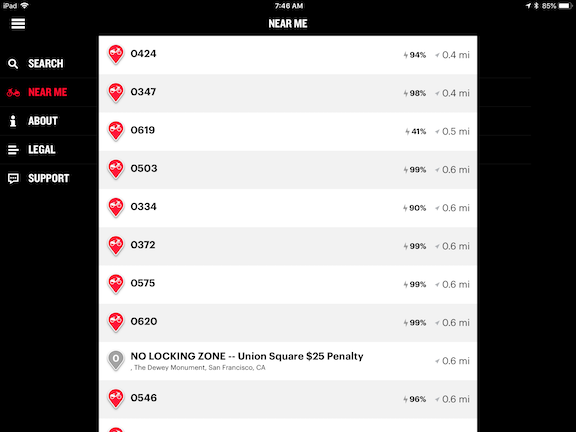
Here is another perspective. This morning I captured the list of bikes available from where I was staying in the Tenderloin. Keep in mind that the Tenderloin is the least bike-rich area urban San Francisco, but there was a bike 0.4 miles away, with nearly a full charge, and nine bikes within 0.6 miles, only one of which was low on charge.
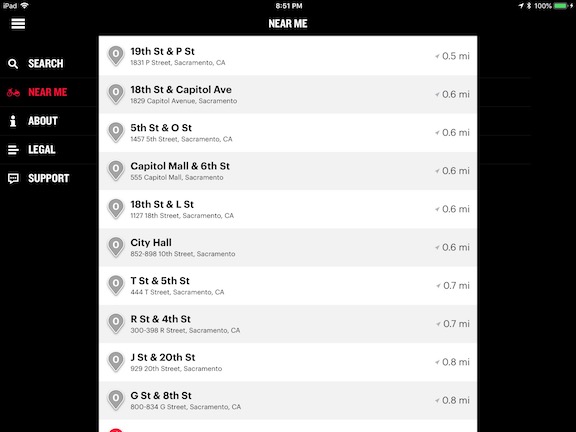
Sacramento? These was captured this evening (Sunday about 9:00PM). There is not a single bike at any hub within 0.8 miles of where I live. And I live in the central city. On the second page of locations, there are six bikes, 0.9 to 1.2 miles away, but only one of them has an acceptable charge.

two weeks in – failure?
The JUMP bike share system was rolled out for Sacramento, West Sacramento, and Davis two weeks ago, on May 16. I was very excited, as I’ve used the JUMP system in San Francisco a number of times, and have used the non-electric SoBi (JUMP was formerly SoBi – Social Bicycles) here and many other cities. I’ve been watching the bikes and app during the two weeks, and used the bikes occasionally. Let me be blunt – the system is failing.
 There were supposed to be 300 bikes at roll-out, another 600 later, but there were never 300 bikes out, and there are far less now. More than half the bikes I see are ‘in repair’. Some of these may actually be in repair for maintenance reasons, but if so, it doesn’t bode well for brand new bikes that they are breaking down so soon., I strongly suspect most of them have batteries to low to operate, and the bikes puts itself into repair mode rather than letting the battery get run down completely. I’ve seen bikes in repair be in the same place several days later, still in repair.
 While out this evening looking at hub locations and bikes, I saw four young people get dropped off at a hub with four bikes by a ride hail. They were excited about using the bikes, until they discovered that only two of the bikes were working, the other two were in repair. They were stuck. I bet that they won’t use the system again.
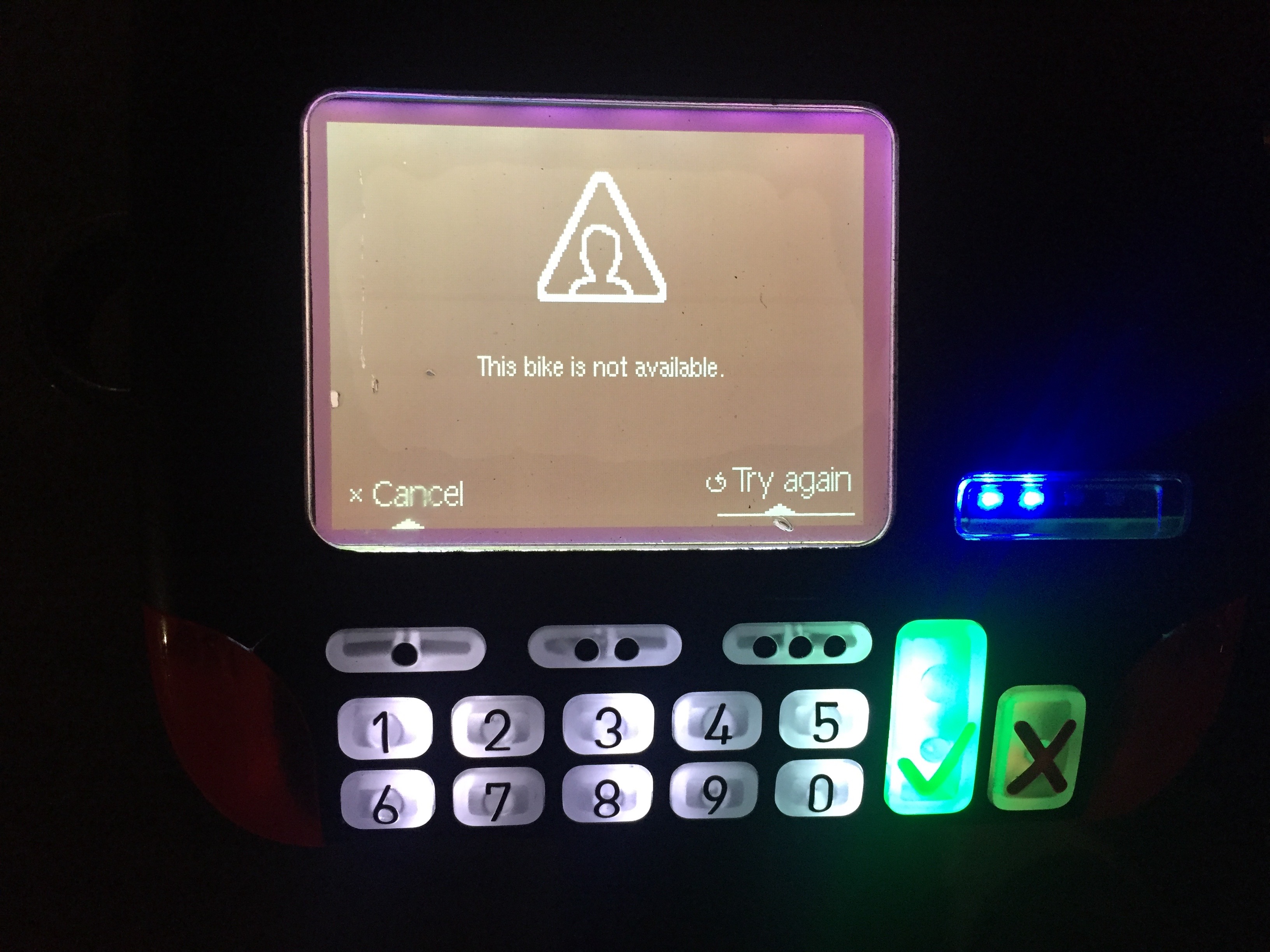
I saw another bike on the app, and tried to rent it, but after quite some time, the display said the bike was not available. What does that mean? Why? It was not in repair, it was not on hold, it just wasn’t available. I tried it three times, same result.
I’m seeing little rebalancing going on. There are almost no bikes in downtown/midtown, what bikes there are are scattered around the edges. This is not a daily flow of bikes in and out of the central city, rather, the bikes have gone out of the central city and are not returning.
 I found two bikes that showed up on the app but the bike itself said they were on on hold/reserve, but neither actually were. They had been unused for more than an hour, probably all day, and supposedly bikes can’t be placed on hold for more than 60 minutes. Since they were on hold, they could not be rented through the keypad. However, I was able to reserve one of the bikes, and then rent it, so it wasn’t really on hold.
I rode that bike, taking it back to a hub, and locking it, with the display showing the rental finished and the bike again available. But the app still shows the bike in use, and is accruing time against my account. Did the bike put itself into hold? Not sure yet, still waiting to see what happens. After an hour and a half, getting tired of being locked out of the app, I went back to the bike. The keypad said the bike was on hold. So I put in my code, and it said the bike was in use. It cancelled itself out after a few minutes, but the app was still counting. So I rented the bike again (remember, the display said the bike is available), The app started counting at 43 minutes. I locked the bike and the app finally let go and returned to the map. I can’t see how much it cost because the app is now locked into JUMP SF, and there is no way to change it to JUMP Sacramento. Interesting, you can use http://app.socialbicycles.com to switch between systems, but the app won’t let you switch.
At 4:00AM, well past the time when it is likely that any bikes would be in use, I count 54 bikes in Sacramento (only 16 in the central city), 11 bikes in West Sacramento, and 32 bikes in Davis, for a total of 97 bikes. If there really were 300 bikes, that means that more than 2/3 of them are out of service.
Disappointed, concerned…
Letter to Ryan Rzepecki
To summarize: Don’t. Please, don’t.
Why? Why not be bought out by Uber? Because the objectives and culture are not a good fit.
JUMP (SoBi) has a model of disruption based on offering a better product, meeting the need of people, and making a profit in the good work. Every SoBi employee I’ve had interactions with had a passion for making the world a better place through bike share. When there were problems, each person I spoke with or emailed made sure to get it right. SoBi works with the cities it goes into, negotiating the terms but wanting to make sure it works for the company, the city, and the users.
Uber is the exact opposite. Their business model of disruption is to break every law they can get away with breaking, to cut every corner. Their intent is to drive every competitor out of business, as they must if they are ever to stop losing money. They treat employees like dirt (yes, the drivers are employees by definition of labor law, though at least in the US Uber is so lawyered up that the federal government and state governments have either not been able to compel Uber to follow the law, or don’t care to. In every city in which it operates, in the US and in Europe, Uber has violated law after law after law.
These two things do not match, and can never match.
One of the great hopes that I have for electric bike share is that it can displace many of the ride hailing trips that exist because it is time competitive with and cost positive over ride hailing in denser urban areas. I see uncontrolled ride hailing as the worst thing that could happen to our cities, and anything that lessens that damage is a great thing. That puts the ideal of bike share in direct conflict with the idea of ride hailing. The terms ‘shared mobility’ and ‘mobility as a service’ are all the rage these days, but I don’t see any mode that uses low occupancy energy guzzling cars (electric just shifts impacts from fossil fuel burning at the car to fossil fuel burning at the power plant, at least so far) as complementing any other mode. They are not a complement, they are a competition.
But the biggest conflict is on the streets. Bike riders, the users of SoBi and JUMP bikes, want more than anything to be safe. But they can’t be safe so long as poorly trained commercial drivers (Uber) terrorize bicyclists by driving over the speed limit, making sudden right and left turns, and looking at smart phones instead of at the road. Uber drivers block bike lanes more often than other ride hailing companies. I’m not sure why, but suspect it has to do with drivers adopting the attitudes of their company.
When I am bicycling in San Francisco (headed there for the weekend right now), I can hardly even use bike lanes on many streets because they are blocked so often by ride hailing. Do they look when pulling in? Do they look when pulling out? Seldom. As a vehicular bicyclist, I know how to deal with this, to just use the general purpose lane and avoid the bike lane, but I assure you, this is not the experience most bicyclists are looking for.
Bicyclists want safety. Uber does not.
I am really concerned that this is the beginning of the end of SoBi/JUMP, and that would make me very sad. Uber may kill off bike share once it realizes that the values and goals of bike share are opposed to their own. Another not unlikely possibility is that Uber will go under, under the weight of endless lawsuits that will sooner or later start to be successful. If you run a criminal enterprise, it will eventually catch up with you, whether you are Uber or the president.
To summarize: Don’t. Please don’t
@jumpbikes @ryrzny
crosswalks, for now
 I hope that you have found the series of posts on crosswalks (category: walkability) useful. I could write about them forever, but for now, that is all. Besides, I’m off to the wilds of southern Utah for spring break, out of Internet range, and no crosswalks except in the small towns.
If you have improvements that you’d like to see that I did not include, or if you have specific locations you’d like to see improved, please comment. Please don’t accept the word of traffic engineers that streets can’t be made safer, or that we can’t afford to make them safer (there are a range of solutions from inexpensive to very expensive), or worst of all, that we can’t slow traffic down. We can slow traffic, we should slow traffic, we must slow traffic. Speed kills.
Pedestrian safety countermeasures
In addition to the leading pedestrian interval recently covered, three other pedestrian safety countermeasures are given prominence (among a long list of potential measures with smaller but not insignificant benefit):
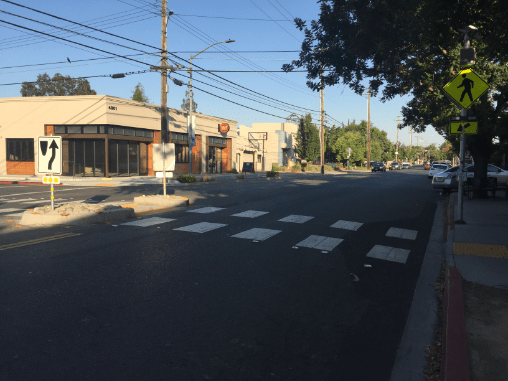 Medians and Pedestrian Crossing Islands in Urban and Suburban Areas: These medians provide a safe space for pedestrians to wait while part way across the intersection, and simplify the crossing by making so the walker only has to look at one traffic direction at a time. They are used both in mid-block and intersection settings. The photo is of a pedestrian island at Folsom and 48th in Sacramento. This is a location with frequent crossings, with popular businesses on the north and south side of Folsom. And with a popular bar on the north side, the importance of safe crossing is increased.
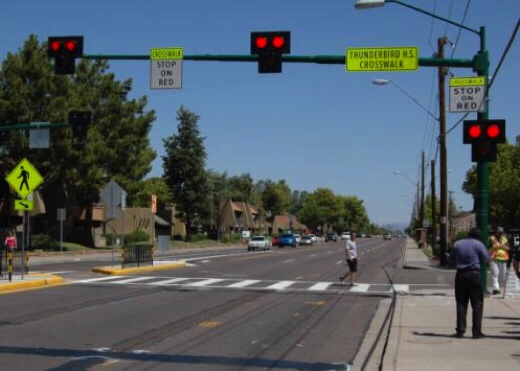 Pedestrian Hybrid Beacon: This is a specialized signal for mid-block pedestrian crossings that grabs the attention of drivers with a sequence of changing signal patterns that eventually goes to full stop. These are also known as HAWK signals (High intensity Activated crossWalK), invented in Arizona. I often hear complaints that these signals are confusing to drivers, but to me, that is exactly the point, it grabs their attention. Though I’ve seen these installed at intersections, this is a mis-application; they are designed for mid-block crossings. These signals are expensive, about 20% of the cost of a fully signalized intersection. The Rectangular Rapid Flashing Beacon (RRFB) is a much simpler and much less expensive alternative, but limited to lower traffic volume and lower speeds than the hybrid beacon.
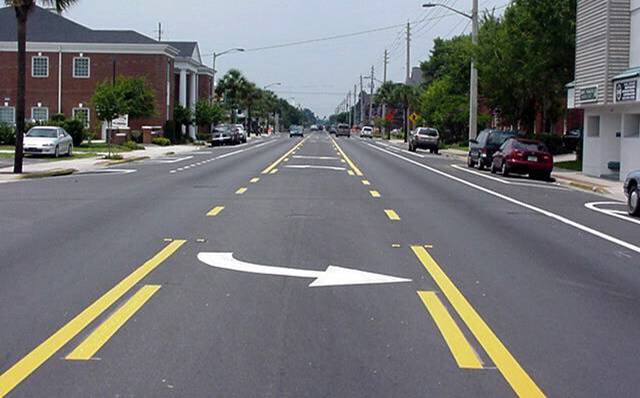 Road Diet: A road diet reallocates roadway width from regular motor vehicles lanes (called general purpose lanes) to more constructive use such as wider sidewalks, bike lanes or separated bikeways, transit lanes, and sometimes parking – where it is really needed and calms traffic). The simplest to implement is the conversion of parallel parking to diagonal parking on overly wide streets, such as has been done a number of places in Sacramento central city. More complicated reallocations are often called ‘Complete Streets,’ though complete streets are not well defined, and adding sidewalks and bike lanes to 45 mph posted (55 mph actual) arterials with infrequent safe crossings does not encourage anyone to walk or bike and may be a waste of money. But in urban areas where the capacity of multi-lane streets is not needed, or needed for only a very small part of the day, a road diet may create a safer and walkable environment.
For a full list of pedestrian safety countermeasures, see Countermeasures.
Zegeer and crosswalks
In 2005, the Federal Highway Administration (FHWA) published Safety Effects of Marked Versus Unmarked Crosswalks at Uncontrolled Locations. The authors were Charles V. Zegeer, J. Richard Stewart, Herman H. Huang, Peter A. Lagerwey, John Feaganes, and B.J. Campbell, but the research paper is usually referred to as ‘the Zegeer report.’
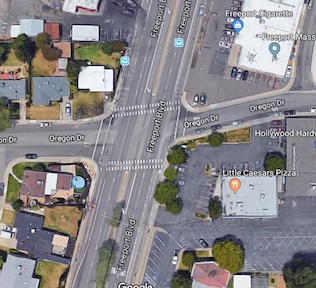 This is the research that Ryan Moore was referring to in the crosswalk removal meeting when he said that the city was following federal guidelines that required them to remove the crosswalk at Freeport and Oregon, though he did not call out Zegeer by name. Twenty-three crosswalks were removed in total, though we still don’t know where all of them are, and the city won’t provide that information.
As you would imagine, research reports contain a lot of text and figures and tables, but a key finding is that on multi-lane roads (more than one lane in a direction), with traffic volumes over 12K ADT, marked crosswalks had a somewhat higher crash rate than unmarked crosswalks. There is always an unmarked crosswalk at intersections unless there is specific signing to prohibiting crossing. It is this finding that traffic engineers have used to not install, or to remove, crosswalks on arterial roads all over the US. They don’t read beyond that.
The report says several things relevant to the crosswalk removal issue:
- “In most cases, marked crosswalks are best used in combination with other treatments (e.g., curb extensions, raised crossing islands, traffic signals, roadway narrowing, enhanced overhead lighting, traffic calming measures). Marked crosswalks should be one option in a progression of design treatments. If one treatment does not accomplish the task adequately, then move on to the next one. Failure of one particular treatment is not a license to give up and do nothing. In all cases, the final design must accomplish the goal of getting pedestrians across the road safely.”
- “Raised medians provided significantly lower pedestrian crash rates on multilane roads, compared to roads with no raised median.” (There is a raised median on both north and south sides of the intersection, and though they are narrower than would be required if built today, they do indeed provide pedestrian refuge.)
- “Regardless of whether marked crosswalks are used, there remains the fundamental obligation to get pedestrians safely across the street.”
- “Pedestrians have a right to cross roads safely, and planners and engineers have a professional responsibility to plan, design, and install safe and convenient crossing facilities. Pedestrians should be included as design users for all streets.”
Most importantly, Charles Zegeer, the lead author, said this about the key table in the report:
“This table should never be used to remove crosswalks. That will not solve the safety problem. Use this table to make crosswalks safe.” – Charlie Zegeer
I was on a webinar in which he said that he was horrified by the tendency of traffic engineers to use his research to justify crosswalk removal, and he strongly implied that this was professional malfeasance.
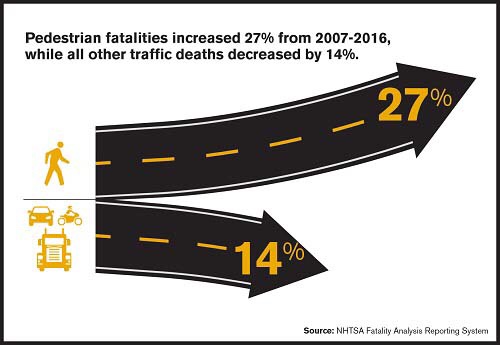 I believe that the city removed the crosswalk because they looked at the intersection and decided that removal was preferable to all other options. This is the ‘cars first’ attitude that contributes to the death of almost 6000 pedestrians a year. It preferences the convenience of people driving though a neighborhood over the safety of people in the neighborhood. This is not acceptable to me, and I doubt it is acceptable to the neighborhood around the removed crosswalk. The city needs to rethink its entire approach to pedestrian safety. Having a Vision Zero Action Plan will do no good if traffic engineers continue to make the wrong choices.
J & 13th needs a pedestrian scramble
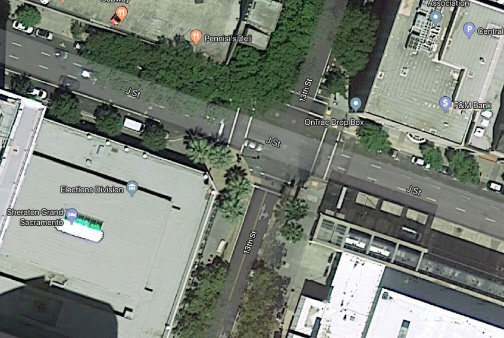 Following the post yesterday, Morse-Cottage pedestrian scramble, here is my first suggestion for a pedestrian scramble in Sacramento. J Street and 13th Street would be a great location for one. It has high pedestrian traffic, it has pedestrian attractors on three corners (convention center, Sheraton Grand Hotel, and a parking garage), and many people cross more than one direction. I am not sure that it is the highest volume intersection, but it is quite possible the highest visitor location where people are less likely to be paying attention or to understand our signal system
Most importantly, the pedestrian signalization here is seriously screwed up, and it needs to be changed. On the west leg, the pedestrian phase is short. On the east leg,there is a ‘leading vehicle interval’ that allows southbound left turning vehicles to start before the pedestrian walk comes on, so almost every cycle creates pedestrian-vehicle conflicts. All the crossings require button pushes, none are on automatic recall that is standard at intersections in urban areas with heavy pedestrian flow. And the whole intersection cycle is much too long, giving preference to drivers on J Street over walkers, right here in the heart of a place where so many people walk. The cycle also sometimes skips the west leg completely, making pedestrians wait through two cycles of J Street traffic, which is a long, long time.
In addition to the exclusive phase, diagonal crosswalks should be marked to make it clear how the intersection works.
Let’s make this the first of many pedestrian scrambles in the central city.
Morse-Cottage pedestrian scramble
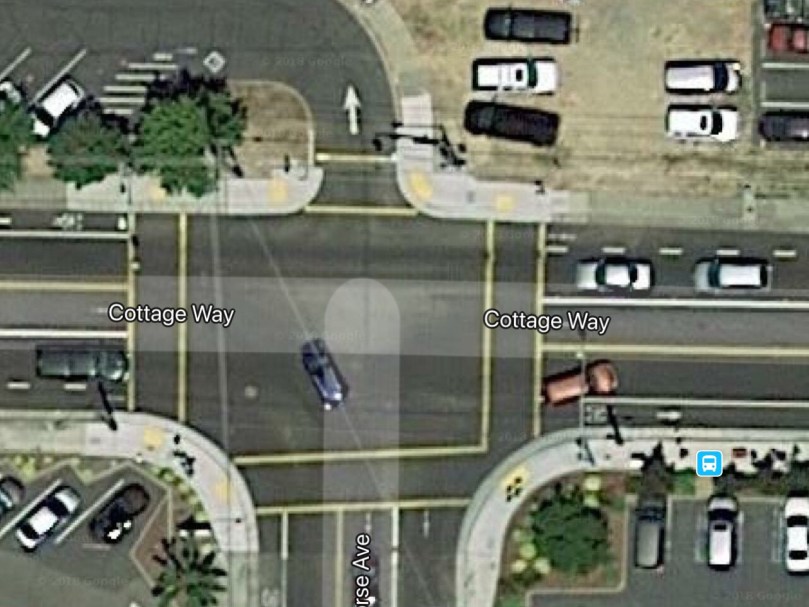 At the intersection of Morse Ave and Cottage Way in the Arden-Arcade community of Sacramento county, there is a pedestrian scramble. What this men’s is that the pedestrian signal is on, for walk, in all the directions at once. They are also called Barnes Dance, for Henry Barnes, the traffic engineer who popularized them, and exclusive pedestrian phases.
Sometimes these intersections have marked diagonal crosswalks, as a reminder that diagonal crossings are permitted, and sometimes they do not, but a pedestrian may cross diagonally whether the marked crosswalk is there or not.
I am most familiar with these from Reno (I lived in Carson City for some years), which has several along Virginia Street in downtown. I’ve seen them other places, but don’t recall exactly where right now. At every location where I’ve seen them, right turns are prohibited on red, by signing, so when pedestrians are crossing, no cars are moving at all, and there is no issue with drivers failing to yield to pedestrians using the crosswalk.
I think that every intersection that has heavy pedestrian traffic, particularly where many of the pedestrians are crossing one street and then the other, should have pedestrian scrambles. Yes, they slow traffic a bit, but they increase pedestrian safety and comfort, a great trade-off in my opinion. Many scrambled that existed in the past were removed by traffic engineers who wanted to prioritize vehicle flow over all other considerations, including safety, but it is time to bring them back, at least in select locations. See Governing Magazine, Cities Revive an Old Idea to Become More Pedestrian-Friendly, or search the Internet for pedestrian scramble for both recent and old installations.
The county had this to say about the intersection:
- The all-ways crossing, also known as a pedestrian scramble, at Cottage and Morse was in place/operation prior to the 2016 Cottage Way modification project. After doing some researched, we discovered it has been in place since the signal was installed in 1969.
- The pedestrian scramble operates 24 hours a day.
- The configuration of this intersection is unusual for the County. The scramble works for this location given the layout and right of way constraints that result in some of the corners only having one pedestrian push button to serve two directions.
- We currently do not have any plans to add diagonal crossings at this location.
- This is currently the only location in the County that has a pedestrian scramble.
 Getting Around Sacramento