Traffic Skills and Project Ride Smart

Jibe (formerly North Natomas TMA) and partners are offering two Traffic Skills 101 workshops, in December and January. Though the workshops are schedule to train new instructors for the Jibe Project Ride Smart program that teaches bicycling skills and safety in schools, they are open to others. Traffic Skills is a League of American Bicyclists course that qualifies people to go on to take the League Cycling Instructor Seminar.

The first workshop is Thursday, December 6, evening, and Saturday, December 8, daytime.

Please check the flier for more information.

JUMP news

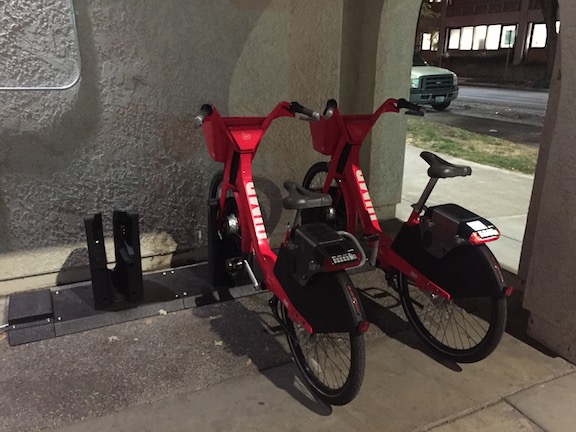
I learned from a JUMP field staff how to deal with U-bars that won’t insert. Just move the rear wheel a bit, and it will go in. The U-bar is hitting the spokes, so rotating the rear wheel removes the block. This happens particularly with the charging rack, since with the front wheel locked into the rack, the rear wheel doesn’t move as much.

JUMP just changed their return to hub policy. Users will get a 25 cent credit for returning a bike to any hub, on that trip, and a dollar credit for returning to any charging hub. The email (graphics below) doesn’t make it clear if this applies to any drop zone hub, or only the charging hubs, but my experience yesterday and today is that it is for any drop zone hub (the green icon with lightning bolt). The credit I got for drop zone hubs was $1.25, both credits together. This could change. It could also vary depending on your membership type. I hope that this will encourage people to return bikes to hubs at the end of their trip. I often see bikes parked less than a half block from hub. Will 25 cents make a difference? Probably not, but it is a start. How about 50 cents, JUMP? In some other cities, there is a charge of $2 for leaving a bike outside a hub, in addition to the trip charge. I hope that we don’t need to go there in Sacramento.

I now have a student membership in JUMP Sac since I’m a student at American River College. At $30 a year, it is a great deal for anyone who uses JUMP regularly. You get 60 free minutes a day. Almost makes it worth being a student! An oddity is that taking a bike to a drop zone hub for credit counts against my daily minutes, until the daily minutes are used up, then the ride time is no longer charged. So it seems I get partial credit while I still have minutes, and full credit after I don’t have minutes remaining. I’m not sure I understand this structure, and I’m not sure it is consistent.

I, and everyone else, had hoped that bike parking would improve over time as people got used to the system, but parking seems to be getting worse rather than better. I’m not talking about parking in the buffer zone or to the side on wide sidewalks, which while technically illegal is practical where there are no bike racks, but parking in the sidewalk. This morning there were six bikes parked on and blocking the sidewalk on S Street. I don’t know why users would do this, as there was a sidewalk buffer immediately adjacent with plenty of space for bike parking (though nothing to lock to). Get it together people! There is no excuse for this kind of parking. It is both rude and hazardous for people walking, particularly if they have mobility issues and can’t go around. I moved the bikes. Yes, they are heavy.

I have been finding a lot of dead GPS bikes, with no display and no lights on the GPS unit. I’m not sure if this is common, or I’m just adept at finding them. If you find a bike like this, that does not wake up when buttons are pressed, please report it to support@jumpbikes.com. Sometimes they have lost track of these bikes, and sometimes they know the last location before the unit went dead, but it doesn’t hurt to report it.

change the signal at J St and 13th St

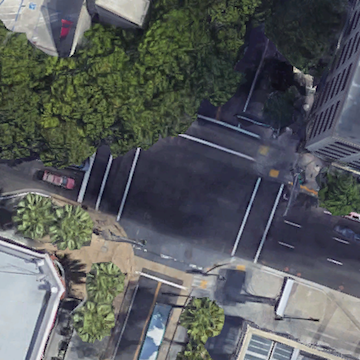
The signal at J Street and 13th Street in downtown Sacramento (shown at right) does not work well for pedestrians. The signal cycle is long, even compared to other signals on J Street, so the wait for pedestrians is quite long. I have seen the signal cycle skip both pedestrian crossings and vehicle crossings a number of times, which means that the wait is doubly long. Most walkers respond to this long wait by simply crossing the street against the pedestrian signal, and I don’t blame them at all.

A second issue is that the signal is set so that the east crosswalk walk mode occurs at the same time as the left turn from 13th Street southbound to J Street eastbound, meaning there is always a conflict between pedestrians and drivers at this point, and this conflict has been created by the signal setup. Many drivers cut directly behind or in front of people walking, as they know if they wait until the crosswalk is clear, as the law requires, they won’t make the signal.

This signal should be reconfigured so that it gives priority to pedestrians, without making them wait an unreasonable period of time, and does not create unnecessary conflict between turning drivers and people walking. The east crosswalk at a minimum needs a longer leading pedestrian interval (LPI).

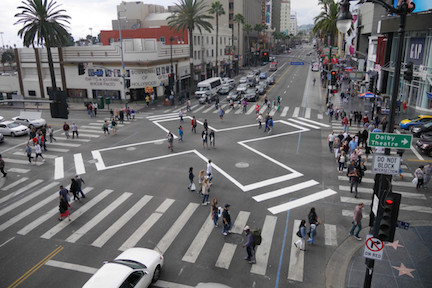
Even better would be to make this a pedestrian scramble intersection, with an all-direction crossing phase during which all vehicle turning movement are prohibited. The intersection can be marked with diagonal crosswalks, and additional diagonal pedestrian signal head added, however, simply changing the signal timing is sufficient as an initial step. This is a busy crosswalk intersection, with the convention center on one corner, the Sheraton Grand on another, and the parking garage for the Sheraton and others on the third corner. It is alway busy, and the people crossing here are commonly tourists, who are likely used to more advanced ‘world class’ cities where pedestrians are not second class citizens after car drivers.

Note: There are a number of busy pedestrian crossing intersection in the Sacramento central city that deserve an upgrade, but this is the one that most irritates me, whether walking or bicycling.

JUMP at SacATC

JUMP Bikes representative Alex Hagelin made a presentation at the September 19 meeting of the Sacramento Active Transportation Commission (SacATC). Below are my notes from the presentation, and you can view it online at http://sacramento.granicus.com/MediaPlayer.php?clip_id=4254.

JUMP Bike Share Update at SacATC 2018-09-26, agenda item 5

Alex Hagelin, Sacramento General Manger

  • Launched in May
  • 900 bikes by October
  • Metrics
    • 80% month to month growth
    • 350,000 miles
    • > 300,00 Lbs CO2 saved
    • 13,000,000 calories burned
    • Parking complaints about 0.3% of trips
    • (no stats on trips per bike)
  • Parking
    • > 600 bike racks within city, 300 racks pending review for placement
    • Gathered community input on locations 11,000 votes
  • Charging
    • 10 plus with SacRT light rail stations, additional locations at private businesses (due to electrical drop requirements)
  • Bike parking behavior change
    • 2-3 times more use of JUMP as compared to GoBike in San Francisco
    • Considering photo requirement that users would have to take a photo of their parking job
    • Education, carrots, sticks, response time
  • Community
    • Drafting equity plan, available soon
    • Boost membership, $5 per year for low income; Pay Near Me to allow cash addition to account
    • Participating in local events
  • Looking forward
    • Community outreach
    • Responsible and responsive vendor
    • Growth: new bikes, expanded service area
  • Questions/answers
    • Bike clubs complaining about rider skills
    • JUMP seeing people on bikes who are not regular riders
    • City talking to JUMP about what education will look like
    • Raised issues about where bikes are located, neighborhood equity
    • Asked about service area, north to American River, and south a ways, will need new hubs in these areas
    • Charging stations SacState, city college, SacRT, private property

http://sacramento.granicus.com/MediaPlayer.php?clip_id=4254

preserving access during construction

Sacramento central city is booming with construction, which I consider to be a wonderful thing. Mixed use buildings, single lot apartments and  homes, state office buildings. But the construction is having a serious impact on walkability, and often bikeability. (Note: this post is not about road construction or about temporary closures, which also need to be addressed, but not today.)

Two examples, both of state developments, but with principles applicable to private developments, will illustrate the issues. For the new California Natural Resources Agency building between O and P, and 8th and 7th, the sidewalk, parking and one travel lane on the south side (P St) were removed from service. These are not being used in any way for the project. Perhaps they will be eventually, but in the meanwhile, presumably for the entire life of the construction project, they are just sitting empty and unused. For the new O Street office building at O and 12th, the sidewalk and parking were removed from the east side of 12th between the N-O alley and the O-P alley. The section to the north, where the building is being constructed, needs closure, as the underground level is being dug and the sidewalk will be replaced. But on the section to the south, which is being used for storing construction materials, do not need to be closed. There is plenty of space on this former parking lot.

12th Street construction closure

For some of the private construction going on, of which there are many examples, some closures are no doubt necessary. But the closures seem to be occurring from the very first day of construction to the very last day of construction, even though it is needed for only part of the time.

Construction companies are doing this because they can, out of convenience or laziness. And the city is allowing them to. Each construction project requires a traffic control plan, and the permit specifies allowable areas and time frames.

When I questioned the closure on the southern section of 12th Street, Matt from Construction Services in Public Works argued that since parking was removed, it was only fair that the sidewalk access be removed. His thinking was that fairness required making everyone lose something, and that the loss of parking was equivalent to the loss of sidewalk access.

This of course is a ridiculous argument. Parking is in no way equivalent to access. And priority must be given on all roadways to the most vulnerable users, which are in order of importance, pedestrians, bicyclists, and motor vehicle drivers.

At the recent Sacramento Active Transportation Commission meeting, Jennifer said that she though there might be guidance on access restrictions, but wasn’t sure, and would look into it.

In the meanwhile, let me propose:

  1. For any roadway with more than one lane in a direction, space will be taken from a general purpose travel lane:
    • If a sidewalk or informal walking path is present, pedestrian access will be preserved by the creation of a temporary sidewalk protected by delineators or barriers.
    • If a bike lane or separated bikeway is present, access will be preserved by the creation of a temporary bike lane protected by delineators or barriers.
  2. For any roadway with a single lane in a direction, space will be taken by closing the general purpose lane in one direction, with appropriate detours for motor vehicles:
    • If a sidewalk or informal walking path is present, pedestrian access will be preserved by the creation of a temporary sidewalk protected by delineators or barriers.
    • If a bike lane or separated bikeway is present, access will be preserved by the creation of a temporary bike lane protected by delineators or barriers.

JUMP update

The credit for returning a low battery $ bike to a drop zone is now $1.00, up from 50 cents.

I notice a lot of scrapes on the bikes. It seems that there are a lot of minor crashes occurring. I have not heard of any major injuries, but there must be a lot of minor injuries going on, because there are minor injuries to the bikes. In addition to the scrapes on the basket, the brake lever, particular the right, is often turned under, which requires some impact to accomplish. The front fenders seem to get bent out of alignment as well.

I have heard directly from several people about crashes on the tracks, particularly along K Street. I initially discounted the rumors, as I assumed that it would be hard for these wide-tired bikes to have problems with tracks, but apparently I was wrong. I’m not sure if these are occurring at the rail crossover (between 9th and 10th), or all along K. K probably sees more bike share bikes than any other street with rails in Sacramento. There are many inexperienced bike riders on these bikes, who may not know that tracks should be crossed at a high angle, 90 degrees perpendicular if possible, but at least 45 degrees. Anything less risks capturing the wheel and taking you someplace you didn’t intend to go.

There seem to be new bikes out (nice and shiny, without scrapes), with 6000 series numbers, so I think that the overall total is now above 600, but I don’t have any specific numbers.

I’m seeing more and more bikes outside the system boundary in Sacramento, some miles outside. I’m not sure if JUMP has given up on charging the out-of-bounds fee, or these are people with money to pay it, but it kind of irritates me, as these bikes are often unavailable until picked up by JUMP field staff, meaning they are used much less than those that stay within the boundaries. I know that an expansion of the boundaries is planned, but I’d heard it will not occur until the system reaches its total of 900 bikes.

The transformation of the central city continues, at least during evenings. There are many fewer private vehicles, fewer ride hailing vehicles, and a continuous stream of JUMP bikes. When I park a bike, it is often gone within five minutes. These bikes are getting used!


new JUMP charging hub 8th & P

JUMP has added a new charging station at 8th St and P St, called ‘Capital Athletic Club Charging’. The charging hub is under the overhang to the right (south) of the entrance, NOT the traditional wave racks at the entrance. There are nine charging docks, three groups of three, at this location. This is the second charging hub in Sacramento, joining the one at Sac City College, near the light rail station entrance. This location was not a drop zone, so it represents an additional hub in a part of downtown that did not have a drop zone.

By the way, JUMP bikes had disappeared from the Transit app for about a week, but they are back. Apparently JUMP changed some things about how the data feed works, and it broke other apps that rely upon the JUMP feed.

Parking in the protected bike lane

People are again parking in the protected bike lane (correctly called a separated bikeway in California) on 10th Street in Sacramento, approaching K Street. This happened for about two weeks after the facility was installed, and then seemed to stop as people adjusted to a different street configuration, but now it is happening again. I was not sure whether this is illegal or not, but the city confirmed that it is illegal. The parking meters are for the parking spaces in the parking lane to the left of the bike lane, not for the curb. Confusingly, the red curb was painted over, probably in a misguided attempt to follow city design guidelines without thinking about the real world.

The bike lane here needs to be changed to prevent this from happening. The 10th Street bikeway is full of compromises made with parking. Mostly, it works, despite that, but in this particular place, it does not.

JUMP charging station at Sac City College

I thought I was through with JUMP posts for at least the day, but then I got together with Claire who clued me into the new charging hub that has been installed at Sac City College. The station is on the outside of the fence at the light rail station (which may be SacRT property rather than college property, I’m not sure). This charging hub has ten docks. So far as I know, this is the first charging hub in Sacramento, though someone else we were talking to thought maybe there were charging hubs in Davis. If you know, please comment.

I have not used this hub, so I don’t know if bringing a low battery $ icon bike to the hub earns more than the standard 50 cent credit. Let me know!

I will try to get around to the other drop zone hubs in Sacramento this week to see if any of the others are now charging hubs. Comment is you have visited any of the hubs in the region and know.

Please see my previous post on charging hubs in San Francisco for details about what they look like and how they work.

Yay!

JUMP users

I have heard many complaints from regular bicyclists and car drivers about JUMP bike riders. Since I spend a lot of my time paying attention to where the riders are and how they are riding, and I live in the central city where a large percentage of the usage is occurring (I live two blocks from the R Street corridor and three blocks from the 16th Street corridor), of course I have some perspective to offer.

Sidewalk riding: Is there a lot more sidewalk riding by JUMP riders? Well, I certainly see JUMP bikes on sidewalks, and it bothers me in part because JUMP bikes potentially go faster. However, I think the reason there are JUMPs on the sidewalk is because there a just more bike riders out. I don’t think JUMP riders are on sidewalks any more than any kind of bicycle. I fact, I’ve noticed a lot of JUMP riders in travel lanes on streets that don’t have bike lanes. Most bike riders avoid these roads, but because JUMP bikes are more able to keep up with traffic than the average bike rider, it seems like more are doing this. As SABA and many others have pointed out, most people riding on sidewalks are doing so because of their perception that the street is not a safe place to ride, and in many cases they are right. Probably a few are doing it out of habit, they learned to ride there and they continue to do so without thinking about whether and where that is appropriate, but again, the rate of sidewalk riding doesn’t seem any higher.

Parking: I hear complaints of bikes parked everywhere and blocking everything. Some of the comments are similar to those of people reacting to electric rental scooters in other cities, that civilization is ending and the sky is falling. But the more reasoned comments are worth considering. There are simply a lot more bikes needing to be parked than there were before. And there are not enough bike racks. The JUMP hubs are generally not in the most in-demand locations, but a block or two away, and so a lot of riders are parking exactly where they are going, and not at the hubs, sometimes on existing bike racks and frequently on sign poles and parking meters, and sometimes not locked to anything at all. On the whole, I see people parking JUMP bikes in appropriate locations. JUMP’s user agreement is that the bike be locked to something, and the City of Sacramento rule is that they must be locked to a bike rack (I’m not sure about West Sacramento and Davis). Very occasionally, I see a bike parked in such a way that it blocks pedestrians (both walkers and mobility devices). But this is rare.

I have been surprised by a recent trend, to lock a bike to nothing except itself (the lock mechanism locks the rear wheel, so it cannot be ridden, whether locked to anything or not). I’m seeing this even when there is something easy to lock to, right next to a bike rack or right next to a pole. Since the JUMP user agreement says the user is responsible for the bike unless it is locked to something. it surprises me that people would not lock to something when it is convenient or possible. I have not heard of any theft, but better safe than sorry. Yes, many types of bike racks are awkward to lock to, and pole and parking meters are not always easy to use.

If you do see a bike blocking pedestrian access, and you have some muscles, please move it! Yes, the bikes are heavy and not easy to move, but most people could move them a couple of feet to clear the sidewalk.

Riding skill: People who ride regularly are horrified by the skill of many of the JUMP riders. They have a point, there are a lot of unskilled riders, as many riders are people who don’t regularly ride bikes. They may not be handling it very well, particularly with the speed and acceleration. There are often riding in the wrong place on the road, which is in the travel lane if there is not a bike lane.

Traffic laws: I see JUMP riders not stopping at stop signs, and occasionally not at signals. But I don’t perceive that there is any difference between JUMP riders and other riders. And as always, I must point out that motor vehicle drivers run stop signs at a higher rate than bicyclists, though they also run red lights at a lower rate. Drivers have a perception that bicyclists always violate the law, and so they see what they expect to see, but they have a perception that drivers mostly follow the law (which is far, far from the truth), so they don’t see driver violations. Of course being on a bright red bike makes one more prominent.

Helmets: And last of all (added), people complain that JUMP users aren’t wearing helmets. I’ll keep this short, recognizing that even anything I say about helmets is likely to start a war with helmet trolls. There is no real evidence that helmets save lives. Yes, trauma nurse say so, but they only see the after-effects and know nothing about the causes. Yes, the ‘research’ of the helmet industry says so, but it has all been discredited. NHTSA (National Highway Traffic Safety Administration) has removed all reference to the ‘prevents 85% of head injuries’ statements because it turned out the research results that they cited were fabricated. I’ll accept the validity of helmets when pedestrians and motor vehicle drivers, who both have higher rates of head injuries, are also wearing them. If you are so concerned about the safety of bicyclist, then get cars off the road.